




- Biotechnology
- Biological Seed Treatment Market
Biological Seed Treatment Market Size, Share, and Growth Forecast 2026 - 2033
Biological Seed Treatment Market by Treatment Type (Biofungicides, Bioinsecticides, Biofertilizers, Bionematicides, Others), Crop Type (Cereals & Grains, Fruits & Vegetables, Oilseeds & Pulses, Others), by Application (Seed Coating, Seed Dressing, Seed Pelleting, Others), and Regional Analysis, 2026 - 2033

Biological Seed Treatment Market Share and Trends Analysis
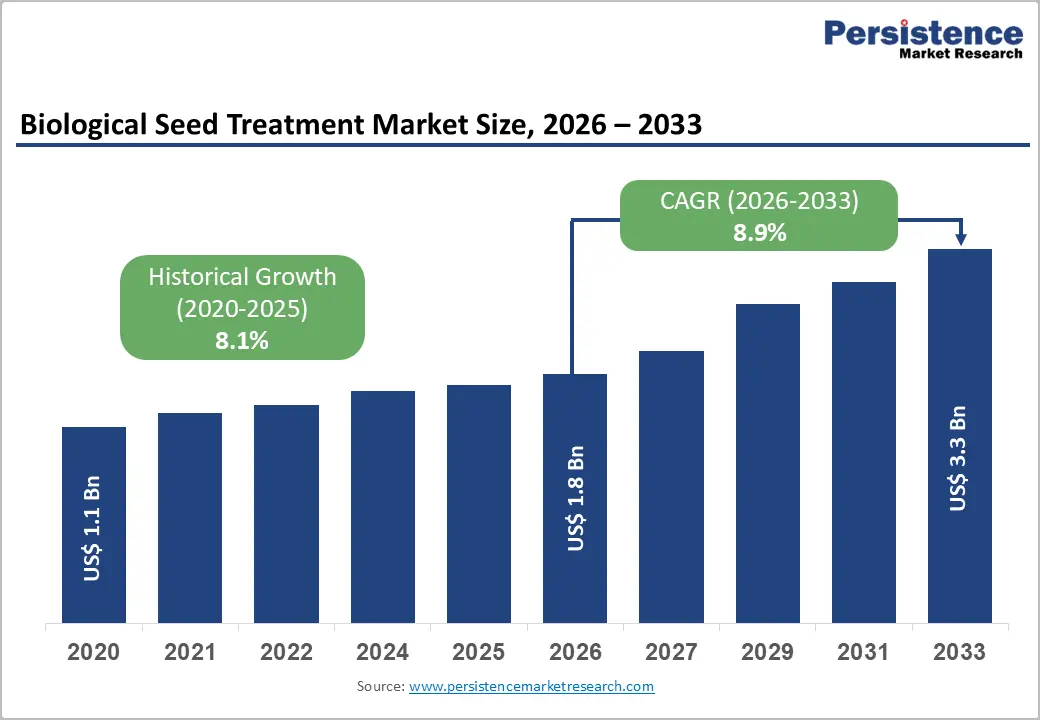
The global biological seed treatment market size is expected to be valued at US$ 1.8 billion in 2026 and projected to reach US$ 3.3 billion by 2033, growing at a CAGR of 8.9% between 2026 and 2033. It is growing steadily as agriculture shifts toward sustainable and environmentally safe farming practices. These treatments use natural microorganisms and biological agents to protect seeds from fungi, insects, nematodes, and soil-borne diseases while improving germination and crop vigor.
Rising concerns over chemical pesticide residues and stricter environmental regulations are increasing demand for bio-based alternatives. Farmers are adopting biological seed treatments to improve yield, soil health, and long-term farm productivity. Growth in organic farming, high-value crops, and microbial innovation, along with government support for eco-friendly agriculture, continues to drive global market expansion.
Key Industry Highlights:
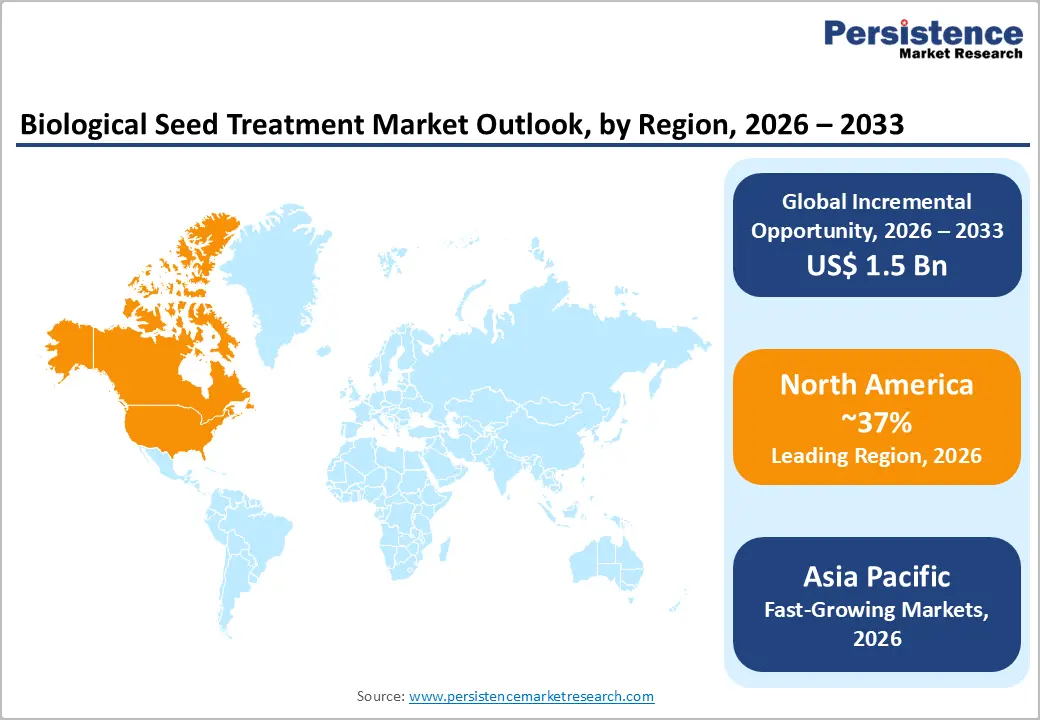
- Leading Region - North America commanded approximately 37% of the global biological seed treatment share in 2026, driven by 5.5 million+ certified organic acres per USDA NOP, active EPA biopesticide registration pathways, and strong commercial investment from Corteva, Valent BioSciences, and Certis USA.
- Fast-Growing Market - Asia Pacific is the fasts-growing market, propelled by India's PKVY scheme, China's Zero Growth Action Plan, and Japan's Midori Strategy targeting 25% organic coverage by 2050, collectively creating massive addressable demand for biological seed treatment products.
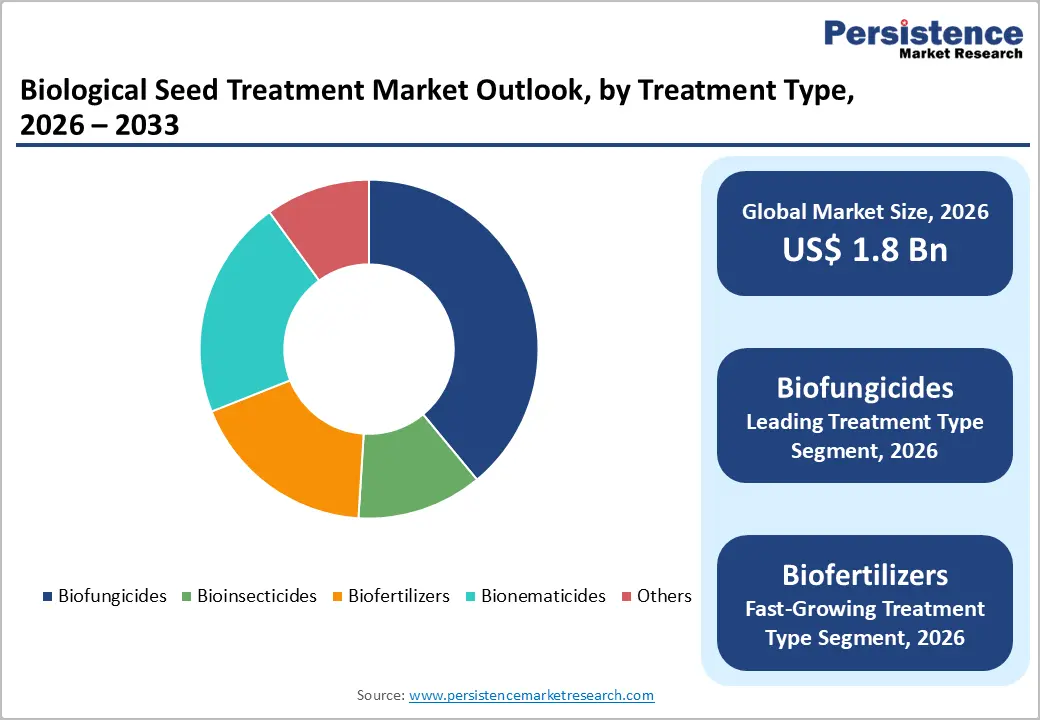
- Dominant Treatment Type - Biofungicides led with approximately 39% share in 2025, supported by proven Trichoderma and Bacillus subtilis efficacy data, EU neonicotinoid withdrawal regulatory tailwinds, and commercial presence across 40+ countries through products like BASF's Serenade®.
- Fast-Growing Treatment Type - Biofertilizers are the fastest-growing treatment type, driven by the EU Farm to Fork's 20% fertilizer reduction target by 2030, FAO data documenting 33% global soil degradation, and Novozymes/Novonesis' commercial expansion of nitrogen-fixing seed inoculants across North America and Europe.
- Key Opportunity - Asia Pacific Government Programs: India's PKVY organic farming scheme, China's MARA-registered biological product approvals, and ASEAN harmonized biopesticide registration are collectively unlocking a high-growth regional demand corridor worth US$ 1.5 billion in incremental opportunity.
Market Dynamics
Drivers - Tightening Chemical Pesticide Regulations: Accelerating Biological Seed Treatment Adoption
Increasingly stringent global regulatory restrictions on conventional chemical seed treatments are the most powerful structural driver of biological alternative adoption. In the European Union, the Sustainable Use of Pesticides Regulation (SUR) and the revision of Regulation (EC) No 1107/2009 on plant protection products have progressively withdrawn approval for several neonicotinoid and organophosphate seed treatments-including the suspension of clothianidin, imidacloprid, and thiamethoxam outdoor uses directly creating market gaps that biological alternatives fill.
The U.S. Environmental Protection Agency (EPA) has similarly increased scrutiny of synthetic fungicide active ingredients. According to the European Food Safety Authority (EFSA), over 70 active substances have been withdrawn from the EU market since 2000, creating sustained demand pull for registered biological seed treatment products from suppliers including BASF SE and Corteva Agriscience.
Expanding Organic Farming Area Generating Structural Biofungicide and Biofertilizer Demand
The rapid global expansion of certified organic farming, which mandates the use of biological rather than synthetic crop inputs, is creating a robust and sustained demand base for biological seed treatment products. According to the Research Institute of Organic Agriculture (FiBL) and IFOAM Organics International, global organic agricultural land reached approximately 76 million hectares in 2022, representing a 54% increase over the past decade.
In the United States, the USDA National Organic Program (NOP) certifies that organic farmland has surpassed 5.5 million acres, with certified organic operations exceeding 25,000 farms. Organic seed treatment requirements for biofungicide protection against damping-off pathogens and nitrogen-fixing biofertilizer inoculants are essentially mandated by certification standards, generating predictable and growing procurement volumes that underpin biological seed treatment market growth.
Restraints - Shorter Shelf Life and Stringent Cold-Chain Requirements Limiting Bioagent Viability
A fundamental technical constraint restraining broader biological seed treatment adoption is the inherently limited shelf life of living microbial agents, including Trichoderma, Bacillus subtilis, and Rhizobium species, compared to synthetic chemical treatments.
Biological seed treatments typically require refrigerated storage at 2-8°C and have shelf lives of 6-18 months versus several years for chemical equivalents. This cold-chain dependency creates significant logistical complexity and cost in emerging market distribution networks across sub-Saharan Africa and South Asia, restricting adoption in precisely the regions with the highest growth potential, and limiting the scalability of distribution infrastructure for biological seed treatment suppliers.
Variable Field Performance Under Diverse Agronomic and Environmental Conditions
Biological seed treatment products demonstrate inherently higher performance variability across diverse soil types, moisture regimes, and temperature conditions compared to synthetic alternatives with predictable biochemical modes of action. Published agronomic trials documented in the Journal of Applied Microbiology have shown that the efficacy of microbial seed treatments can vary by 30-50% across different soil pH and organic matter profiles. This performance unpredictability creates grower hesitancy, particularly among large commercial producers in North America and Brazil who require consistent, bankable yield protection, limiting biological seed treatment adoption beyond early-adopter organic and sustainability-committed farming segments.
Opportunities - Biofertilizers: Fastest-Growing Treatment Segment Propelled by Soil Health and Sustainability Mandates
Biofertilizer seed treatments represent the fastest-growing segment within the biological seed treatment market, driven by mounting evidence linking synthetic fertilizer reduction to soil microbiome restoration and long-term agricultural productivity. The FAO's Global Soil Partnership has documented that over 33% of global soils are degraded, with excessive nitrogen fertilizer use identified as a primary cause, creating regulatory and agronomic pressure to incorporate biological nitrogen fixation and phosphate solubilization technologies.
Products featuring Bradyrhizobium, Azospirillum, and Bacillus-based seed inoculants are gaining traction in major cereal and oilseed markets. The European Green Deal's Farm to Fork Strategy target of reducing fertilizer use by 20% by 2030 is directly incentivizing biofertilizer seed treatment adoption across EU member states, creating a multi-billion-dollar addressable market for companies, including Novozymes A/S and Verdesian Life Sciences.
Category-wise Analysis
Treatment Type Insights
The biofungicide segment dominated the biological seed treatment market, commanding approximately 39% of total market share in 2025. Biofungicides formulated from beneficial microorganisms, including Trichoderma harzianum, Bacillus subtilis, and Coniothyrium minitans, are the most commercially established category of biological seed treatments, offering proven protection against major seed- and soil-borne pathogens including Fusarium, Rhizoctonia, and Pythium species.
The withdrawal of multiple synthetic fungicide active substances across the EU and U.S. markets has directly elevated biofungicide adoption. Leading commercial biofungicide seed treatments, including BASF SE's Serenade® Opti and Bayer AG's Serenade ASO, are registered in over 40 countries globally, providing broad market access. The combination of regulatory tailwinds, established efficacy data, and growing grower familiarity reinforces biofungicide's continued market leadership through the forecast period.
Crop Type Insights
Cereals and grains constituted the leading crop type segment, representing approximately 43% of the biological seed treatment market demand in 2025. The sheer scale of global cereal cultivation with wheat, corn, rice, and barley collectively covering over 700 million hectares globally per FAO statistics, provides the largest addressable seed treatment application base of any crop category.
Biological seed treatments in cereals address critical agronomic needs, including protection against Fusarium head blight, smuts, and Rhizoctonia root rot while enhancing germination and early root development. The growing adoption of biological seed treatments in U.S. corn and soybean production, driven by precision agriculture and integrated pest management (IPM) principles promoted by the USDA Natural Resources Conservation Service (NRCS) has been a primary volume driver for the cereals and grains segment, reinforcing its market dominance.
Application Insights
Seed coating dominated the application segment of the biological seed treatment market, accounting for approximately 48% of total application demand in 2025. Seed coating, applying a thin, uniform layer of biological active ingredient and film-forming polymer directly to the seed surface, is the preferred application method for commercial-scale biological seed treatment owing to its precise active ingredient dosing, reduced dust-off during planting equipment handling, and compatibility with automated high-speed seed treatment and coating machinery used by major seed companies.
Precision Laboratories, LLC and Bayer AG's SeedGrowth® platforms have commercialized polymer film coating technologies specifically engineered for biological microorganism viability preservation during coating and storage. Seed coating also enables combination products co-applying biofungicides with biofertilizer inoculants in a single treatment pass, maximizing the agronomic benefit per seed and further driving adoption among large-scale commercial seed producers and on-farm treaters.
Regional Insights
North America Biological Seed Treatment Market Trends and Insights
North America led the global biological seed treatment market with approximately 37% market share in 2025, driven by a sophisticated agribusiness infrastructure, large-scale organic farming sector, rigorous EPA biopesticide registration pathways, and strong grower interest in integrated biological-chemical seed treatment programs across corn, soybean, and wheat production systems.
U.S. Biological Seed Treatment Market Size
The U.S. accounts for approximately 80% of North American biological seed treatment revenues, underpinned by over 5.5 million certified organic acres per USDA NOP, active EPA Biopesticides and Pollution Prevention Division registration support, and strong commercial interest from Corteva Agriscience, Valent BioSciences LLC, and Certis USA LLC in advancing biological seed treatment product portfolios for major row crops.
Europe Biological Seed Treatment Market Trends and Insights
Europe is the second-largest and most policy-driven market for biological seed treatments, shaped decisively by the EU Farm to Fork Strategy's 50% chemical pesticide reduction target by 2030, accelerating biofungicide and bionematicide registrations under Regulation (EC) No 1107/2009. Germany, France, and Spain are leading national adoption markets, with organic farmland exceeding 17 million hectares EU-wide per Eurostat 2023 data.
Germany Biological Seed Treatment Market Size
Germany leads European biological seed treatment adoption, supported by approximately 1.8 million hectares of certified organic farmland per Federal Office for Agriculture and Food (BLE) data. The German government's National Action Plan on Sustainable Use of Plant Protection Products (NAP) targets ongoing reduction of synthetic seed treatment dependence, directly channeling investment toward biofungicide and biofertilizer alternatives from companies including BASF SE.
UK Biological Seed Treatment Market Size
UK market dynamics contains the post-Brexit Health and Safety Executive (HSE) pesticide review processes, several of which have accelerated conventional seed treatment withdrawals and the Agriculture Act 2020's Environmental Land Management (ELM) schemes rewarding sustainable farming practices. UK organic acreage exceeding 500,000 hectares per Organic Research Centre data supports biological seed treatment adoption in cereals and vegetables.
France Biological Seed Treatment Market Size
France is among the most active European markets for biological seed treatment adoption, driven by the Ecophyto II+ Plan targeting a 50% reduction in pesticide use in 2025 and France's 3 million+ hectares of organic farmland per Agence Bio data. Italpollina S.p.A.'s biostimulant seed treatment products and Koppert Biological Systems' microbial inoculants have established strong commercial footholds.
Asia Pacific Biological Seed Treatment Market Trends and Insights
Asia Pacific is the fastest-growing regional market for biological seed treatments, propelled by government subsidy programs for biological crop inputs, large smallholder farming populations responsive to cost-effective biotreatment solutions, and rapidly expanding organic certification programs. China's Zero Growth Action Plan for chemical pesticides and fertilizers achieving its zero growth target in 2020 per MARA is actively redirecting farmer investment toward registered biological alternatives, creating significant demand volumes.
India Biological Seed Treatment Market Size
India is a high-priority growth market, with the government's PKVY scheme and the National Centre of Organic and Natural Farming (NCONF) promoting biofertilizer seed inoculant use across 5 million+ organic hectares. India's position as a major Trichoderma and Rhizobium biofertilizer producer with DAC&FW (Department of Agriculture and Farmers' Welfare)-registered biological products supports both domestic adoption and export growth.
Competitive Landscape
The global biological seed treatment market is moderately competitive, led by strong global agrochemical and biological solution providers focused on sustainable crop protection and seed enhancement. Companies compete through microbial innovation, advanced biofungicide and biofertilizer formulations, and expansion of crop-specific treatment portfolios. Strategic partnerships, product launches, and acquisitions are common approaches to strengthening market presence and geographic reach. Investment in R&D for microbial strains, shelf-life improvement, and regulatory approvals remains a key differentiator.
Key Developments:
- In July 2025, Corteva Agriscience enhanced its LumiGEN® corn seed treatment portfolio by introducing Lumidapt™ Valta LS, a naturally derived biological nutrition seed treatment designed to improve corn germination, root development, and stand uniformity.
- In May 2026, BASF successfully commissioned its new BioHub fermentation plant at Ludwigshafen, Germany, with a high double-digit million-euro investment to strengthen its biological crop protection portfolio.
Companies Covered in Biological Seed Treatment Market
- Bayer AG
- BASF SE
- Syngenta AG
- Corteva Agriscience
- Novozymes A/S
- Valent BioSciences LLC
- Koppert Biological Systems
- Verdesian Life Sciences
- Plant Health Care plc
- Precision Laboratories, LLC
- Italpollina S.p.A.
- UPL Limited
- Certis USA LLC
Frequently Asked Questions
The global biological seed treatment market is expected to reach US$ 1.8 billion in 2026.
The primary demand drivers for the Biological Seed Treatment market include rising demand for chemical-free and residue-free crops, increasing adoption of organic and sustainable farming practices, and growing consumer preference for healthier food products.
North America leads with approximately 37% of global market share in 2025, anchored by the U.S.'s 5.5 million+ certified organic acres per USDA NOP, active EPA biopesticide registration infrastructure, and commercial investment from Corteva Agriscience, Valent BioSciences, and Certis USA.
Growing preference for residue-free food and stricter regulations on chemical pesticides are creating strong opportunities for biofungicides, biofertilizers, and seed enhancement solutions.
Leading companies include Bayer AG, BASF SE (Serenade®), Corteva Agriscience (Lumisena™), Syngenta AG, Novozymes A/S (Novonesis) (Jumpstart® Ultra), Koppert Biological Systems, Valent BioSciences LLC, and UPL Limited.


