




- Plastics, Polymers & Resins
- Bio-based Resin Composites Market
Bio-based Resin Composites Market Size, Share, and Growth Forecast, 2026 – 2033
Bio-based Resin Composites Market by Product Type (Flax Bio-based Resin Composites, Coir Bio-based Resin Composites, Hemp Bio-based Resin Composites, Others), Application (Automotive, Aerospace, Others), and Regional Analysis for 2026 – 2033

Bio-based Resin Composites Market Size and Trends Analysis
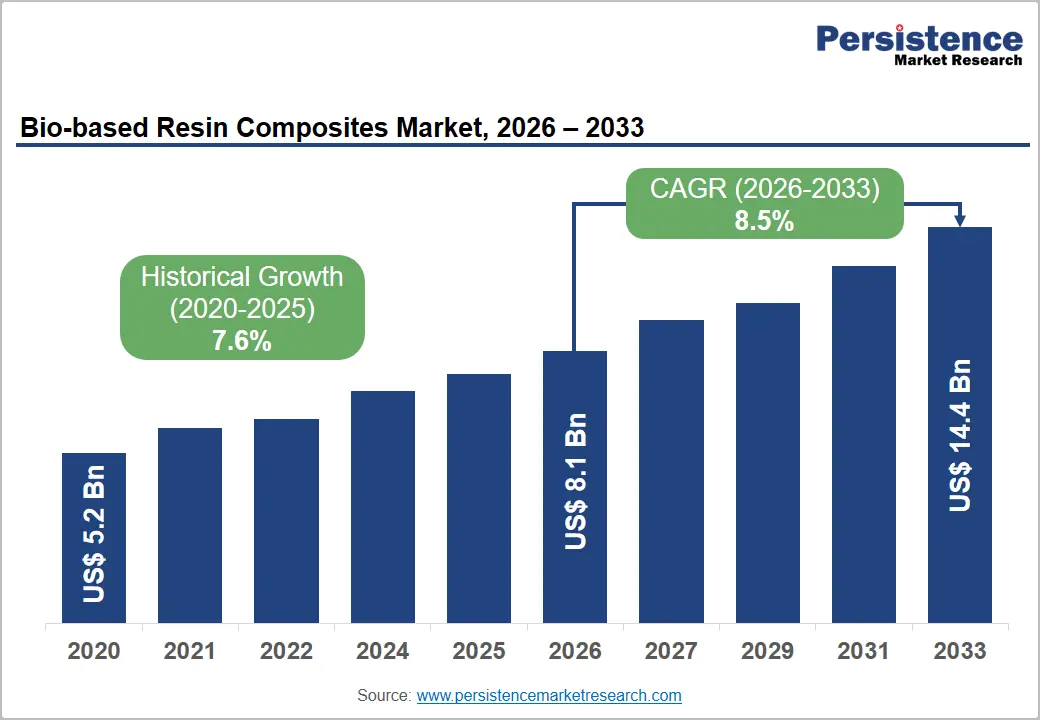
The global bio-based resin composites market size is likely to be valued at US$8.1 billion in 2026 and is expected to reach US$14.4 billion by 2033, growing at a CAGR of 8.5% during the forecast period from 2026 to 2033, driven by strong momentum as industries increasingly adopt sustainable materials to reduce environmental impact and meet carbon-reduction targets.
Natural fiber-reinforced composites based on flax, hemp, coir, and kenaf are gaining traction in automotive, construction, and consumer goods applications due to their lightweight properties and renewable sourcing. Ongoing advancements in bio-based composite technologies are improving performance, durability, and recyclability, accelerating their commercialization across industrial sectors.
Key Industry Highlights:
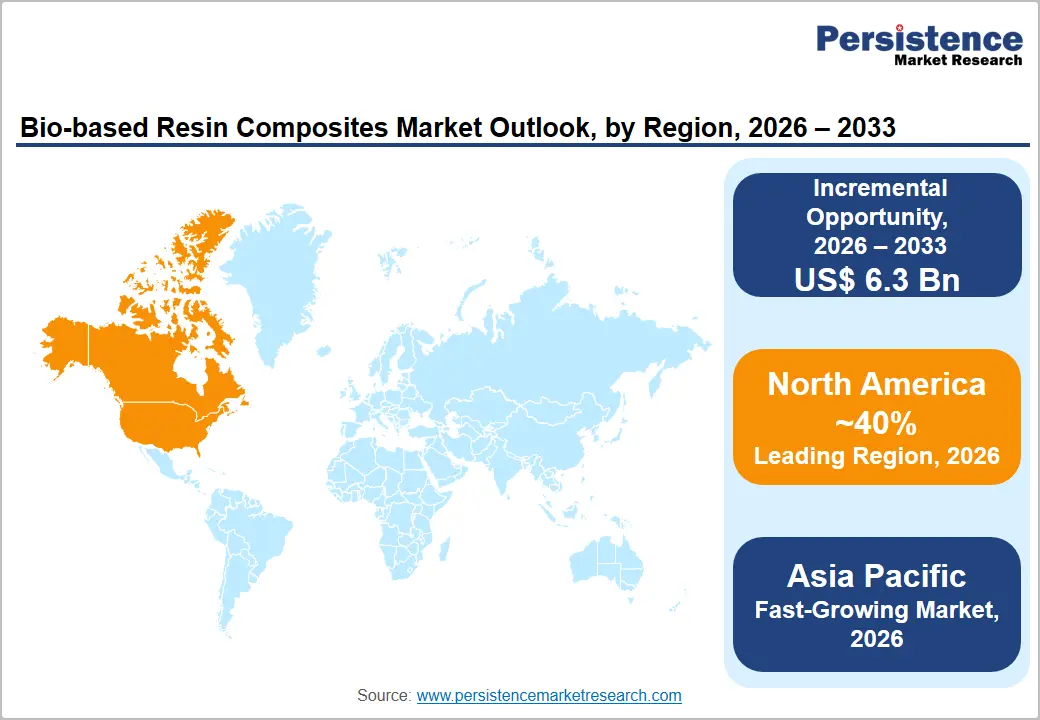
- Leading Region: North America is anticipated to be the leading region, accounting for a market share of 40% in 2026, driven by strong sustainability initiatives, advanced bio-composite innovation, and widespread adoption across automotive and construction sectors.
- Fastest-growing Region: Asia Pacific is likely to be the fastest-growing region, supported by expanding manufacturing capabilities and abundant natural fiber resources.
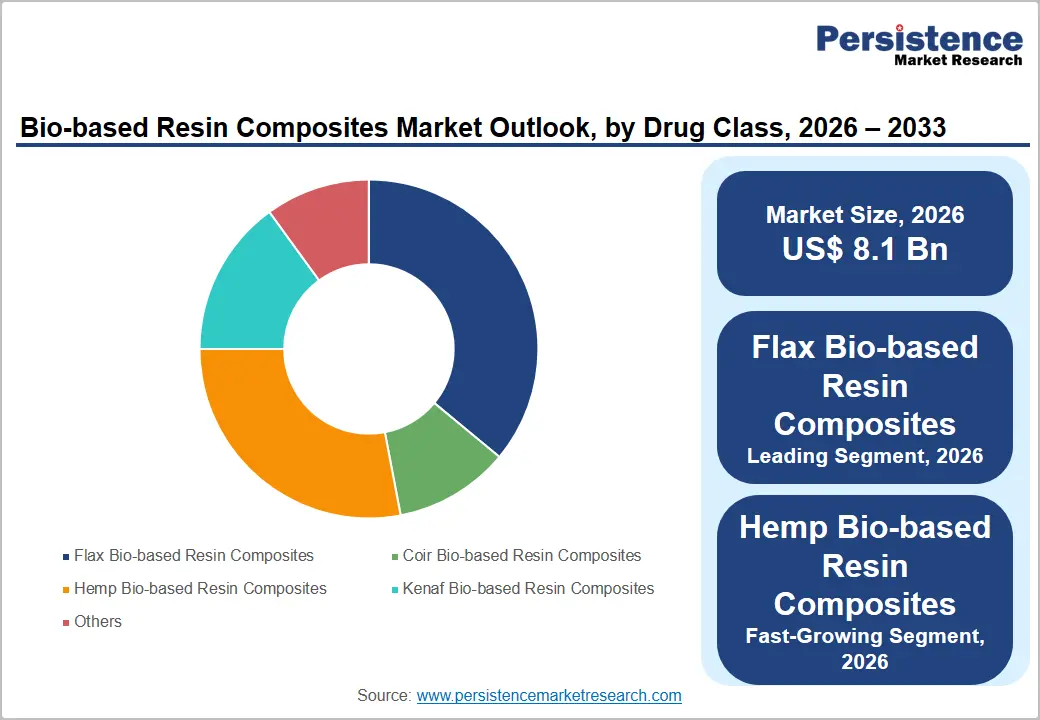
- Leading Product Type: Flax bio-based resin composites are projected to remain the leading product type in 2026, accounting for 34% of the total revenue, driven by their favorable mechanical properties and broad adoption across a wide range of industrial applications.
- Leading Application: The automotive segment is expected to dominate the market, accounting for approximately 42% of total revenue in 2026, driven by the growing adoption of bio-based composite materials by automotive manufacturers to reduce vehicle weight, enhance fuel efficiency, and advance sustainability goals, which is driving segment growth.
- Key Opportunity: The growing shift toward sustainable manufacturing and circular economy practices is creating significant opportunities for bio-based resin composites across automotive, construction, consumer goods, and industrial applications through the adoption of renewable, lightweight, and recyclable materials.
DRO Analysis
Driver - Technological Advancements in Material Performance Enhance Viability
Bio-based resin composites are benefiting from continuous technological advancements that improve their mechanical strength, durability, moisture resistance, and thermal stability. Innovations in resin chemistry and fiber treatment techniques have enabled natural fibers such as flax, hemp, coir, and kenaf to achieve performance levels closer to conventional synthetic composites.
Manufacturers are increasingly developing bio-based epoxy, polyester, and polyurethane resins that offer improved compatibility with natural fibers, resulting in enhanced structural integrity and longer product life. These advancements support broader adoption across automotive, construction, aerospace, and consumer goods sectors where lightweight, sustainable materials are increasingly required to meet environmental objectives.
Improved fiber-resin bonding increases load-bearing capacity and dimensional stability while reducing defects during production. Automotive manufacturers are integrating high-performance bio-composites into interior panels, trims, and structural components to reduce vehicle weight and improve fuel efficiency. Construction companies are utilizing advanced bio-based composite materials for durable and environmentally responsible building applications.
Restraint - Technical Performance Limitations and Material Variability Pose Structural Challenges
Natural fibers exhibit variability in strength, density, moisture content, and dimensional characteristics due to differences in cultivation conditions, harvesting methods, and geographic origin. Such inconsistencies can affect product quality and performance reliability, creating challenges for manufacturers seeking standardized materials. Moisture absorption remains another significant concern because natural fibers tend to attract water, potentially leading to swelling, degradation, and reduced structural integrity over time.
Manufacturers often require additional treatments and processing steps to address these challenges, increasing production complexity and costs. The lack of harmonized standards for bio-based composite materials also creates uncertainty regarding quality assurance and certification requirements. Industries such as aerospace and heavy-duty transportation demand strict performance consistency, making adoption more challenging when material variability persists.
Opportunity - Technological Convergence with Recycling and Hybrid Systems
Increasing emphasis on circular economy principles is encouraging manufacturers to develop composite solutions that combine renewable feedstocks with enhanced recyclability and resource efficiency. Hybrid composites that integrate natural fibers with recycled fibers, bio-based resins, or selected synthetic reinforcements offer improved performance while maintaining sustainability advantages. Such developments help industries meet environmental targets without compromising functionality.
Advancements in mechanical recycling, chemical recycling, and composite recovery technologies are creating new pathways for extending material life cycles. Manufacturers are investing in closed-loop production models that minimize waste generation while improving overall resource utilization.
Hybrid bio-composite systems are gaining attention in automotive, construction, and consumer goods applications because they deliver a balance between performance, durability, and environmental benefits. The growing availability of recycled raw materials and improvements in recycling infrastructure strengthen commercial prospects.
Category-wise Analysis
Product Type Insights
Flax bio-based resin composites are expected to account for 34% of the revenue share in 2026, due to an excellent balance of strength, stiffness, lightweight characteristics, and surface quality, making them suitable for a broad range of industrial applications. Flax fibers possess favorable mechanical properties that enable manufacturers to replace conventional synthetic reinforcements in selected automotive, construction, and consumer product applications while maintaining performance requirements. A notable example includes the use of flax fiber composites in automotive interior panels by European vehicle manufacturers.
Hemp bio-based resin composites are likely to represent the fastest-growing segment, supported by increasing cultivation, favorable sustainability characteristics, and expanding industrial acceptance. Hemp fibers offer high cellulose content, excellent strength-to-weight ratio, and strong environmental credentials, making them attractive for manufacturers focused on reducing carbon footprints and improving material circularity. The material’s versatility enables applications across automotive components, construction materials, packaging products, and consumer goods.
For example, the adoption of hemp-reinforced composite panels in sustainable construction applications.
Application Insights
The automotive segment is projected to lead the market, capturing around 42% of the revenue share in 2026. Automotive manufacturers increasingly utilize bio-based composite materials to reduce vehicle weight, improve fuel efficiency, and support sustainability objectives. Natural fiber-reinforced composites provide an attractive combination of lightweight performance, mechanical strength, and environmental benefits, making them suitable for interior and semi-structural vehicle components. For instance, BMW's use of natural fiber composite components to enhance vehicle sustainability.
The construction segment is likely to be the fastest-growing application due to increasing adoption of sustainable building materials and growing emphasis on environmentally responsible infrastructure development. Bio-based resin composites offer advantages such as lightweight performance, corrosion resistance, thermal insulation properties, and reduced environmental footprint, making them attractive for various construction applications. A notable example includes the integration of hemp fiber-reinforced bio-composite panels in green building projects.
Regional Insights
North America Bio-based Resin Composites Market Trends
North America is anticipated to be the leading region, accounting for a market share of 40% in 2026, supported by strong sustainability regulations, increasing adoption of lightweight materials, and growing investment in renewable manufacturing technologies. Automotive, construction, and consumer goods industries are actively incorporating natural fiber-reinforced composites to reduce carbon footprints and meet environmental targets. For instance, Huntsman Corp., which continues to expand its portfolio of sustainable resin technologies supporting bio-based composite applications.
U.S. Bio-based Resin Composites Market Trends
The U.S. is expected to dominate the regional market, accounting for approximately 78% of the market share in 2026, driven by strong automotive manufacturing and green building initiatives. Federal support for bio-based materials continues to encourage industrial adoption. Electric vehicle manufacturers increasingly seek lightweight composite solutions to improve efficiency. Universities and private companies are investing in natural fiber composite research. Infrastructure modernization programs are creating opportunities for sustainable construction materials.
Canada Bio-based Resin Composites Market Trends
Canada is likely to be a significant market for bio-based resin composites, holding approximately 22% of the market share in 2026. The country benefits from abundant biomass resources supporting bio-based feedstock availability. Green building standards are encouraging the use of environmentally friendly composite materials. Investments in sustainable housing projects continue to increase. Natural fiber utilization is expanding across industrial applications. Research institutions are developing advanced bio-composite technologies.
Europe Bio-based Resin Composites Market Trends
Europe is likely to be a significant market for bio-based resin composites in 2026, due to ambitious climate goals, circular economy policies, and widespread adoption of sustainable materials. The region has a strong natural fiber supply base, particularly for flax and hemp, which supports composite manufacturing across automotive, construction, and consumer goods industries. A notable example includes Arkema SA, which has expanded development of bio-based resin solutions to support sustainable composite applications across multiple industrial sectors.
U.K. Bio-based Resin Composites Market Trends
The U.K. is likely to be a significant market for bio-based resin composites, accounting for 15% of the Europe market share in 2026, supported by sustainability commitments and carbon reduction strategies. Green building initiatives are encouraging greater use of renewable materials. Research organizations are supporting innovation in natural fiber technologies. Demand for environmentally responsible consumer products continues to grow. Manufacturers are exploring bio-based alternatives for packaging and industrial applications.
Germany Bio-based Resin Composites Market Trends
Germany is anticipated to dominate the regional market, accounting for around 40% of the Europe market share in 2026, due to its strong automotive and engineering industries. Vehicle manufacturers continue integrating natural fiber composites into interior and structural applications. Sustainability targets are accelerating adoption of renewable materials. Industrial manufacturers are investing in bio-based alternatives to conventional plastics. Research institutions are advancing fiber treatment and composite technologies.
Asia Pacific Bio-based Resin Composites Market Trends
The Asia Pacific region is likely to be the fastest-growing region in bio-based resin composites in 2026, driven by its expanding industrialization, abundant natural fiber availability, and increasing government support for sustainable manufacturing. The region benefits from large-scale production capabilities and cost-effective access to feedstocks such as hemp, kenaf, coir, and other agricultural fibers. For example, UPM which has strengthened its presence in Asia through sustainable material solutions that support bio-based industrial applications and circular economy objectives.
China Bio-based Resin Composites Market Trends
China is projected to dominate the regional market, holding around a 30% share of the market in 2026, due to its large manufacturing base and strong government focus on sustainable development. Demand for lightweight materials is increasing across automotive and industrial sectors. Renewable material adoption is supported by environmental regulations. Investments in advanced composite production facilities continue to grow. Domestic manufacturers are expanding bio-based material portfolios.
India Bio-based Resin Composites Market Trends
India is expected to emerge as a significant market, accounting for approximately 20% share in 2026, due to abundant agricultural fiber resources and expanding industrial applications. The construction sector is increasingly utilizing environmentally friendly products. Automotive manufacturers are exploring natural fiber composites for lightweight components. Rising environmental awareness is supporting demand growth. Domestic production capabilities are steadily improving. Research organizations are developing cost-effective composite technologies.
Competitive Landscape
The global bio-based resin composites market exhibits a moderately fragmented structure, driven by increasing demand for sustainable materials, advancements in bio-based resin technologies, and expanding adoption of natural fiber composites across automotive, construction, aerospace, and consumer goods industries. The market is characterized by the presence of multinational chemical companies, specialized bio-material developers, and regional composite manufacturers focused on enhancing product performance and environmental sustainability.
With key leaders, including BASF SE, Arkema SA, Huntsman Corp., Braskem SA, DuPont de Nemours, UPM, Novamont SpA, and Ashland Global Holdings, competition remains active across both developed and emerging markets. These players compete through product innovation, development of high-performance bio-resins, expansion of natural fiber composite portfolios, strategic partnerships, and investments in sustainable manufacturing capabilities. Companies are focusing on improving fiber-resin compatibility, durability, recyclability, and lightweight performance to address increasing industry requirements.
Key Industry Developments:
- In April 2026, Microtex Composites launched the B1-151 bio-based epoxy resin system for high-performance composite applications, featuring renewable feedstock-derived content and high thermal resistance, enabling manufacturers in automotive, motorsport, and advanced industrial sectors to reduce environmental impact while maintaining performance and processing reliability.
- In April 2025, Huntsman Corp. announced the launch of its new bio-based I-BOND® PB BIO 1025 and I-BOND® OSB BIO 1025 resins for composite wood products, designed to increase renewable content and reduce the carbon footprint of particleboard and oriented strand board applications while maintaining high performance and durability.
- In September 2025, Exel Composites announced the commercial-scale adoption of INEOS’ ENVIREZ® bio-based resin system, marking a major step toward replacing conventional hydrocarbon-based resins in composite manufacturing and expanding sustainable, low-carbon bio-based composite solutions without compromising material performance.
Companies Covered in Bio-based Resin Composites Market
- Archer Daniels Midland Co.
- BASF SE
- Huntsman Corp.
- Novamont SpA
- Trinseo SA
- Braskem SA
- DuPont de Nemours
- Ligrove
- UPM
- Arkema SA
- Ashland Global Holdings
- FlexForm Technologies
- Fiberon LLC
Frequently Asked Questions
The global bio-based resin composites market is projected to reach US$8.1 billion in 2026.
Growing demand for sustainable, lightweight, and low-carbon materials across automotive, construction, aerospace, and consumer goods industries is driving the bio-based resin composites market.
The bio-based resin composites market is expected to grow at a CAGR of 8.5% from 2026 to 2033.
Expanding adoption of recyclable bio-composites and natural fiber-reinforced materials in electric vehicles, green buildings, and circular economy initiatives presents significant market opportunities.
Archer Daniels Midland Co., BASF SE, Huntsman Corp., Novamont SpA, Trinseo SA, and Braskem SA are the leading players.


