


- Executive Summary
- Global Automotive Human Machine Interface (HMI) Snapshot 2026 and 2033
- Market Opportunity Assessment, 2026-2033, US$ Bn
- Key Market Trends
- Industry Developments and Key Market Events
- Demand Side and Supply-Side Analysis
- PMR Analysis and Recommendations
- Market Overview
- Market Scope and Definitions
- Value Chain Analysis
- Macro-Economic Factors
- Global GDP Outlook
- Global Automotive Industry Overview
- Global Electrical Industry Overview
- Forecast Factors - Relevance and Impact
- COVID-19 Impact Assessment
- PESTLE Analysis
- Porter's Five Forces Analysis
- Geopolitical Tensions: Market Impact
- Regulatory and Technology Landscape
- Market Dynamics
- Drivers
- Restraints
- Opportunities
- Trends
- Price Trend Analysis, 2020 - 2033
- Region-wise Price Analysis
- Price by Segments
- Price Impact Factors
- Global Automotive Human Machine Interface (HMI) Outlook: Historical (2020 - 2025) and Forecast (2026 - 2033)
- Key Highlights
- Global Automotive Human Machine Interface (HMI) Outlook: Operation Type
- Introduction/Key Findings
- Historical Market Size (US$ Bn) and Volume (Units) Analysis by Operation Type, 2020-2025
- Current Market Size (US$ Bn) and Volume (Units) Forecast, by Operation Type, 2026-2033
- Voice Control
- Central Display
- Instrument Cluster
- HUD
- Others
- Market Attractiveness Analysis: Operation Type
- Global Automotive Human Machine Interface (HMI) Outlook: Application Type
- Introduction/Key Findings
- Historical Market Size (US$ Bn) and Volume (Units) Analysis by Application Type, 2020-2025
- Current Market Size (US$ Bn) and Volume (Units) Forecast, by Application Type, 2026-2033
- Infotainment
- Navigation
- Driver Assistance
- Climate Control
- Vehicle Diagnostics
- Connectivity Services
- Market Attractiveness Analysis: Application Type
- Global Automotive Human Machine Interface (HMI) Outlook: Vehicle Type
- Introduction/Key Findings
- Historical Market Size (US$ Bn) and Volume (Units) Analysis by Vehicle Type, 2020-2025
- Current Market Size (US$ Bn) and Volume (Units) Forecast, by Vehicle Type, 2026-2033
- Passenger Vehicles
- Commercial Vehicles
- Market Attractiveness Analysis: Vehicle Type
- Global Automotive Human Machine Interface (HMI) Outlook: Region
- Key Highlights
- Historical Market Size (US$ Bn) and Volume (Units) Analysis by Region, 2020-2025
- Current Market Size (US$ Bn) and Volume (Units) Forecast, by Region, 2026-2033
- North America
- Europe
- East Asia
- South Asia & Oceania
- Latin America
- Middle East & Africa
- Market Attractiveness Analysis: Region
- North America Automotive Human Machine Interface (HMI) Outlook: Historical (2020 - 2025) and Forecast (2026 - 2033)
- Key Highlights
- Pricing Analysis
- North America Market Size (US$ Bn) and Volume (Units) Forecast, by Country, 2026-2033
- U.S.
- Canada
- North America Market Size (US$ Bn) and Volume (Units) Forecast, by Operation Type, 2026-2033
- Voice Control
- Central Display
- Instrument Cluster
- HUD
- Others
- North America Market Size (US$ Bn) and Volume (Units) Forecast, by Application Type, 2026-2033
- Infotainment
- Navigation
- Driver Assistance
- Climate Control
- Vehicle Diagnostics
- Connectivity Services
- North America Market Size (US$ Bn) and Volume (Units) Forecast, by Vehicle Type, 2026-2033
- Passenger Vehicles
- Commercial Vehicles
- Europe Automotive Human Machine Interface (HMI) Outlook: Historical (2020 - 2025) and Forecast (2026 - 2033)
- Key Highlights
- Pricing Analysis
- Europe Market Size (US$ Bn) and Volume (Units) Forecast, by Country, 2026-2033
- Germany
- Italy
- France
- U.K.
- Spain
- Russia
- Rest of Europe
- Europe Market Size (US$ Bn) and Volume (Units) Forecast, by Operation Type, 2026-2033
- Voice Control
- Central Display
- Instrument Cluster
- HUD
- Others
- Europe Market Size (US$ Bn) and Volume (Units) Forecast, by Application Type, 2026-2033
- Infotainment
- Navigation
- Driver Assistance
- Climate Control
- Vehicle Diagnostics
- Connectivity Services
- Europe Market Size (US$ Bn) and Volume (Units) Forecast, by Vehicle Type, 2026-2033
- Passenger Vehicles
- Commercial Vehicles
- East Asia Automotive Human Machine Interface (HMI) Outlook: Historical (2020 - 2025) and Forecast (2026 - 2033)
- Key Highlights
- Pricing Analysis
- East Asia Market Size (US$ Bn) and Volume (Units) Forecast, by Country, 2026-2033
- China
- Japan
- South Korea
- East Asia Market Size (US$ Bn) and Volume (Units) Forecast, by Operation Type, 2026-2033
- Voice Control
- Central Display
- Instrument Cluster
- HUD
- Others
- East Asia Market Size (US$ Bn) and Volume (Units) Forecast, by Application Type, 2026-2033
- Infotainment
- Navigation
- Driver Assistance
- Climate Control
- Vehicle Diagnostics
- Connectivity Services
- East Asia Market Size (US$ Bn) and Volume (Units) Forecast, by Vehicle Type, 2026-2033
- Passenger Vehicles
- Commercial Vehicles
- South Asia & Oceania Automotive Human Machine Interface (HMI) Outlook: Historical (2020 - 2025) and Forecast (2026 - 2033)
- Key Highlights
- Pricing Analysis
- South Asia & Oceania Market Size (US$ Bn) and Volume (Units) Forecast, by Country, 2026-2033
- India
- Southeast Asia
- ANZ
- Rest of SAO
- South Asia & Oceania Market Size (US$ Bn) and Volume (Units) Forecast, by Operation Type, 2026-2033
- Voice Control
- Central Display
- Instrument Cluster
- HUD
- Others
- South Asia & Oceania Market Size (US$ Bn) and Volume (Units) Forecast, by Application Type, 2026-2033
- Infotainment
- Navigation
- Driver Assistance
- Climate Control
- Vehicle Diagnostics
- Connectivity Services
- South Asia & Oceania Market Size (US$ Bn) and Volume (Units) Forecast, by Vehicle Type, 2026-2033
- Passenger Vehicles
- Commercial Vehicles
- Latin America Automotive Human Machine Interface (HMI) Outlook: Historical (2020 - 2025) and Forecast (2026 - 2033)
- Key Highlights
- Pricing Analysis
- Latin America Market Size (US$ Bn) and Volume (Units) Forecast, by Country, 2026-2033
- Brazil
- Mexico
- Rest of LATAM
- Latin America Market Size (US$ Bn) and Volume (Units) Forecast, by Operation Type, 2026-2033
- Voice Control
- Central Display
- Instrument Cluster
- HUD
- Others
- Latin America Market Size (US$ Bn) and Volume (Units) Forecast, by Application Type, 2026-2033
- Infotainment
- Navigation
- Driver Assistance
- Climate Control
- Vehicle Diagnostics
- Connectivity Services
- Latin America Market Size (US$ Bn) and Volume (Units) Forecast, by Vehicle Type, 2026-2033
- Passenger Vehicles
- Commercial Vehicles
- Middle East & Africa Automotive Human Machine Interface (HMI) Outlook: Historical (2020 - 2025) and Forecast (2026 - 2033)
- Key Highlights
- Pricing Analysis
- Middle East & Africa Market Size (US$ Bn) and Volume (Units) Forecast, by Country, 2026-2033
- GCC Countries
- South Africa
- Northern Africa
- Rest of MEA
- Middle East & Africa Market Size (US$ Bn) and Volume (Units) Forecast, by Operation Type, 2026-2033
- Voice Control
- Central Display
- Instrument Cluster
- HUD
- Others
- Middle East & Africa Market Size (US$ Bn) and Volume (Units) Forecast, by Application Type, 2026-2033
- Infotainment
- Navigation
- Driver Assistance
- Climate Control
- Vehicle Diagnostics
- Connectivity Services
- Middle East & Africa Market Size (US$ Bn) and Volume (Units) Forecast, by Vehicle Type, 2026-2033
- Passenger Vehicles
- Commercial Vehicles
- Competition Landscape
- Market Share Analysis, 2025
- Market Structure
- Competition Intensity Mapping
- Competition Dashboard
- Company Profiles
- Bosch Inc.
- Company Overview
- Product Portfolio/Offerings
- Key Financials
- SWOT Analysis
- Company Strategy and Key Developments
- Denso Corporation
- Continental AG
- Alpine Electronics Inc.
- Panasonic Corporation
- Visteon Corporation
- Nuance Communications Inc.
- Clarion Co. Ltd.
- Harman
- Samsung Electronics Co. Ltd
- Bosch Inc.
- Appendix
- Research Methodology
- Research Assumptions
- Acronyms and Abbreviations


- Automotive
- Automotive Human Machine Interface (HMI) Market
Automotive Human Machine Interface (HMI) Market Size, Share, and Growth Forecast 2026 - 2033
Automotive Human Machine Interface (HMI) Market by Operation Type (Voice Control, Central Display, Instrument Cluster, HUD, Others), Application Type (Infotainment, Navigation, Driver Assistance, Climate Control, Vehicle Diagnostics, Connectivity Services), Vehicle Type (Passenger Vehicles, Commercial Vehicles), and Regional Analysis for 2026 - 2033
Automotive Human Machine Interface (HMI) Market Size and Trend Analysis
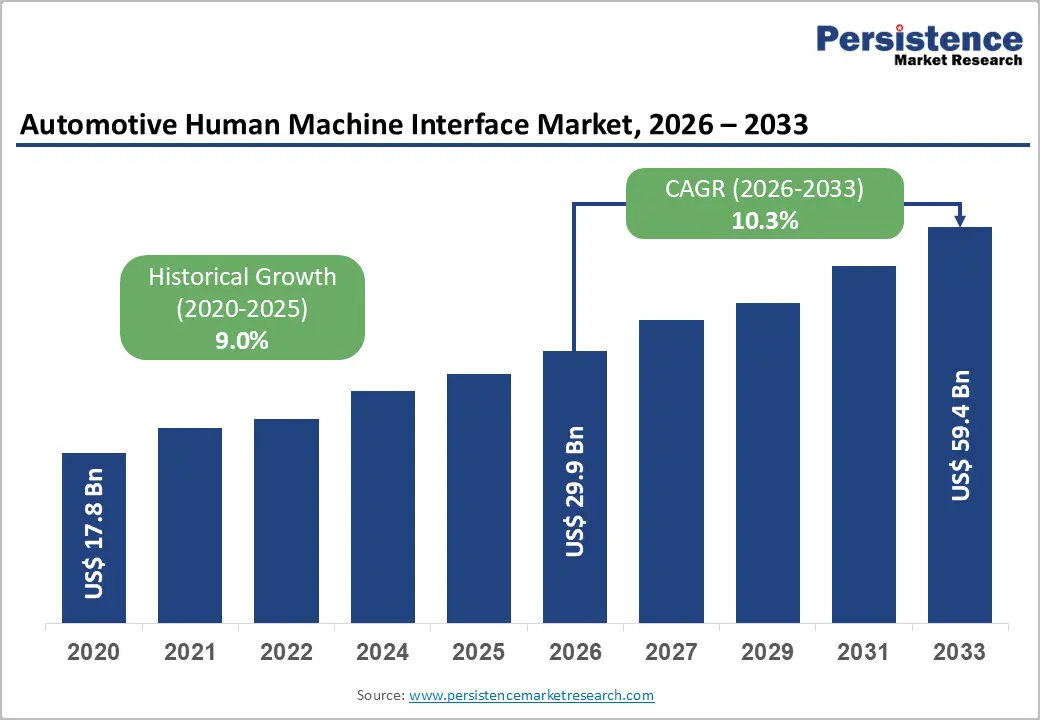
The global automotive human machine interface (HMI) market size is likely to bevalued at US$ 29.9 billion in 2026 and is projected to reach US$ 59.4 billion by 2033, growing at a CAGR of 10.3% between 2026 and 2033.
This robust expansion is primarily driven by the rapid proliferation of connected and electric vehicles, surging consumer demand for intuitive in-cabin digital experiences and increasing integration of advanced driver-assistance systems (ADAS). The automotive industry's global pivot toward software-defined vehicles has elevated HMI from a peripheral convenience to a central safety and user-experience pillar.
Key Market Highlights
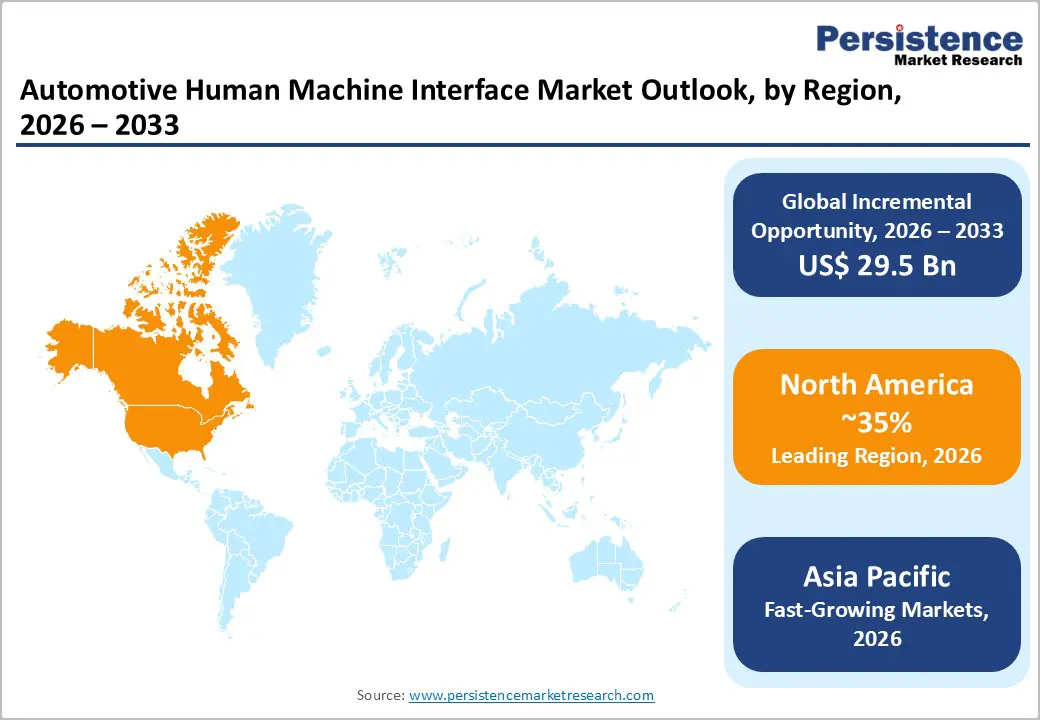
- Leading Region: North America leads the Automotive Human Machine Interface (HMI) Market driven by advanced connected vehicle regulations, a robust technology innovation ecosystem, and strong consumer adoption of AI-powered in-cabin digital experiences.
- Fastest Growing Region: Asia Pacific is the fastest-growing region, propelled by China's 9.4 million NEV units sold in 2023, rapid OEM cockpit digitalization, and India's record passenger vehicle sales exceeding 4.2 million units in FY2023-24.
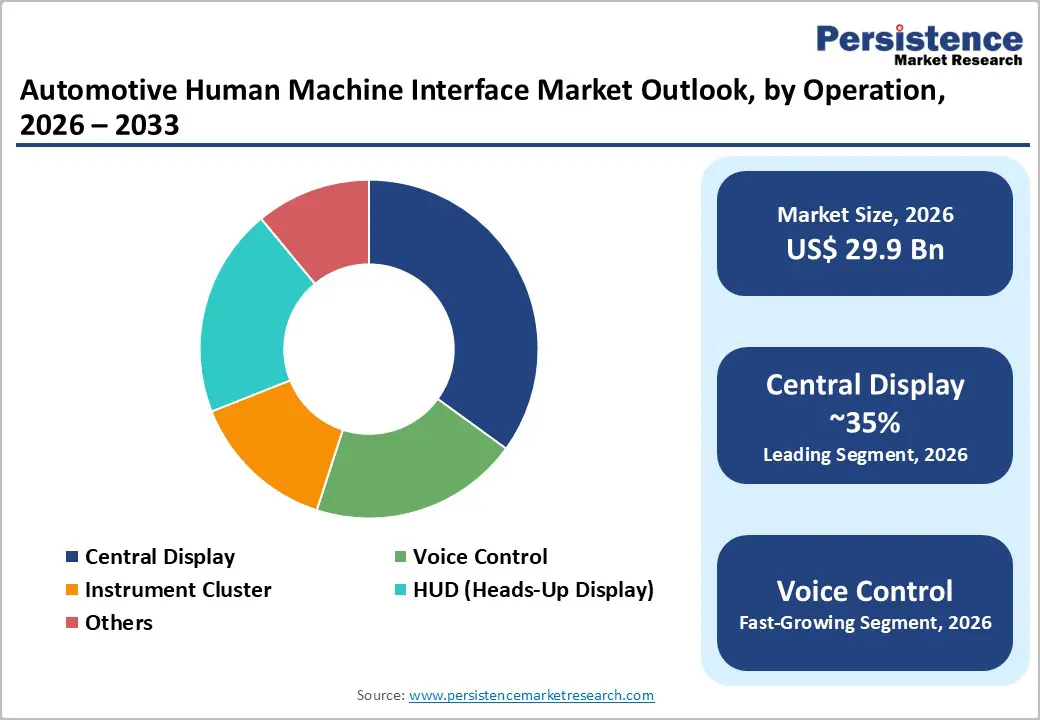
- Dominant Operation Segment: Central Display leads the Operation Type category with approximately 33% market share, driven by industry-wide consolidation of controls into large-format touchscreen interfaces across passenger and electric vehicles.
- Fastest Growing Operation Segment: Voice Control is the fastest-growing operation type, accelerated by AI and NLP integration, with in-vehicle voice assistant penetration among connected car users in North America surpassing 50% as of 2023.
- Key Opportunity: AR-HUD technology presents a high-value differentiation and safety-compliance opportunity, increasingly mandated as ADAS regulations deepen across the EU and North America through General Safety Regulation requirements.
| Key Insights | Details |
|---|---|
| Automotive Human Machine Interface (HMI) Market Size (2026E) | US$ 29.9 Bn |
| Market Value Forecast (2033F) | US$ 59.4 Bn |
| Projected Growth (CAGR 2026 to 2033) | 10.3% |
| Historical Market Growth (CAGR 2019 to 2025) | 9.0% |
Market Dynamics
Drivers - Accelerating Electric Vehicle Adoption and Software-Defined Vehicle Architecture
The global surge in electric vehicle (EV) adoption is fundamentally reshaping vehicle cockpit design, with automakers replacing traditional analog controls with expansive touchscreen interfaces, digital clusters, and integrated voice command systems. The IEA's Global EV Outlook 2024 confirmed that over 40 million EVs were on the road globally by end-2023, with annual sales reaching 14 million units that year a trend that continued accelerating into 2024 with more than 17 million units sold. EVs, by design, eliminate mechanical controls and shift entirely toward digital HMI ecosystems. The transition to software-defined vehicles (SDVs), where vehicle functionality is governed by updatable software layers, further amplifies this driver: companies such as Tesla, BMW, and Mercedes-Benz have committed to over-the-air (OTA) update capabilities, embedding HMI as the primary interface layer for vehicle operations. This architecture necessitates continuous HMI hardware and software investment from Tier-1 suppliers and OEMs alike.
Stringent Vehicle Safety Regulations Mandating Advanced Driver Assistance Systems (ADAS)
Regulatory mandates for enhanced vehicle safety are directly fueling HMI demand by requiring advanced driver assistance and alert systems that interface with drivers through visual, audio, and haptic channels. The European Union's General Safety Regulation (GSR 2022/2023), which came into effect for all new vehicle models from July 2022 and all new registrations from July 2024, mandates features including intelligent speed assistance, driver drowsiness monitoring, emergency stop signals, and lane-keeping assist all of which are communicated to the driver via the HMI layer. Similarly, the U.S. National Highway Traffic Safety Administration (NHTSA) has progressively strengthened requirements around distraction mitigation and alert systems in light-duty vehicles. According to the European Transport Safety Council (ETSC), the EU's GSR package is expected to save over 25,000 lives by 2038, underscoring the safety imperative behind mandated HMI integration across vehicle platforms.
Restraints - High Development and Integration Costs Constraining Mid-Segment Adoption
The development of sophisticated HMI systems encompassing large-format central displays, augmented reality heads-up displays (AR-HUDs), and AI-based voice recognition involves significant R&D, hardware procurement, and software integration expenses. According to online studies, the average cost of automotive-grade displays and associated computing platforms has risen considerably as feature complexity increases, making advanced HMI adoption primarily concentrated in premium vehicle segments. For mass-market and entry-level vehicles, particularly in emerging economies, this cost barrier limits the penetration of full-featured HMI systems. Automakers face difficult trade-offs between maintaining vehicle affordability and incorporating cutting-edge cockpit technologies, a challenge that constrains the pace of HMI democratization across the global vehicle fleet.
Driver Distraction Risks and Evolving Regulatory Scrutiny Around Touchscreen Interfaces
A growing body of research and regulatory attention is scrutinizing the potential for touchscreen-heavy HMI systems to increase driver distraction and accident risk. A study published in the IAM Road Smart journal found that using a touchscreen while driving led to significantly impaired reaction times worse than the legal alcohol and cannabis limits in the UK. The UK's Driver and Vehicle Licensing Agency (DVLA) and transport safety bodies across Europe have raised concerns about complex menu-driven systems replacing tactile, eyes-off controls. This creates a tension between the commercial push toward fully digital cockpits and the safety imperative for intuitive, low-distraction interfaces, potentially exposing automakers to regulatory corrective requirements that increase redesign costs and delay product timelines in the automotive human machine interface (HMI) Market.
Opportunities - Augmented Reality Heads-Up Display (AR-HUD) Technology as a High-Value Differentiation Platform
Augmented Reality Heads-Up Displays represent one of the most commercially significant emerging technologies within the Automotive Human Machine Interface (HMI) Market, enabling real-time navigation guidance, hazard alerts, and ADAS information to be overlaid directly onto the driver's field of view without requiring eyes-off-road interaction. This technology directly addresses the distraction risks associated with conventional touchscreen systems, positioning AR-HUD as both a safety solution and a premium feature differentiator. Continental AG has already deployed AR-HUD systems in production vehicles, while BMW launched its BMW iX with a standard AR navigation system. According to the Society of Automotive Engineers (SAE), AR-HUD systems are increasingly specified as standard or optional equipment in Level 2 and Level 3 autonomous vehicles.
AI-Powered Personalized Voice Control and Natural Language Processing Integration
The integration of artificial intelligence and natural language processing (NLP) into automotive voice control systems is creating a new category of highly personalized, contextually aware in-cabin assistants that go well beyond legacy command-and-response voice systems. This shift is being propelled by substantial investment from both technology companies and automotive Tier-1 suppliers. Amazon Alexa Auto, Google Assistant, and Nuance Communications' Dragon Drive platform are already embedded in production vehicles from multiple OEMs, enabling drivers to control navigation, climate, entertainment, and vehicle diagnostics through conversational interaction. The U.S. Consumer Technology Association (CTA) reported that in-vehicle voice assistant usage rose to over 50% among connected car users in North America by 2023.
Category-wise Analysis
Operation Type Insights
Among the operation type segments, Central Display holds the leading position in the Automotive Human Machine Interface (HMI) Market, accounting for approximately 33% of the total share. Central display systems comprising touchscreen infotainment panels, multi-function control units, and configurable center stacks have become the primary control surface in modern vehicle cockpits. Their dominance reflects the industry-wide consolidation of physical controls into large, high-resolution touchscreen units, a design philosophy pioneered by Tesla and subsequently adopted by virtually all major OEMs. According to the Society of Motor Manufacturers and Traders (SMMT), touchscreen-equipped vehicles accounted for over 85% of new car registrations in the UK in 2023. The increasing screen sizes with vehicles like the Mercedes-Benz EQS featuring a 56-inch Hyperscreen further solidify the central display's primacy as the dominant HMI modality across passenger and commercial vehicle platforms.
Application Type Insights
Infotainment is the leading application type segment in the Automotive Human Machine Interface (HMI) Market, commanding approximately 30% of total application-type revenue. Infotainment systems serve as the central hub for audio, video, connectivity, app integration, and communication services within the vehicle, making them the most frequently used application category by drivers and passengers alike. The global transition to connected vehicles has further expanded the infotainment segment's scope: Apple CarPlay and Android Auto now available in over 800 vehicle models globally, according to Apple Inc. have established smartphone mirroring as a baseline consumer expectation. J.D. Power's 2023 U.S. Tech Experience Index identified infotainment reliability as the top driver of overall vehicle technology satisfaction, reinforcing the commercial imperative for automakers to invest in best-in-class infotainment HMI architectures. The segment is further buoyed by the integration of over-the-air update capabilities, enabling continuous feature enrichment post-sale.
Vehicle Type Insights
Passenger Vehicles dominate the vehicle type segmentation in the Automotive Human Machine Interface (HMI) Market, representing approximately 72% of the total segment share. This dominance is supported by the sheer volume of passenger vehicle production globally, the International Organization of Motor Vehicle Manufacturers (OICA) reported global passenger car production of approximately 67.1 million units in 2023, coupled with strong consumer expectations for premium digital cockpit experiences in personal vehicles. Passenger vehicle buyers, particularly in the premium and mid-premium segments, have demonstrated a strong willingness to pay for advanced HMI features, including multi-zone digital clusters, AR-HUD, and AI voice assistants. The rapid electrification of the passenger vehicle segment also accelerates HMI adoption, as EV cockpit designs are inherently screen-centric and software-defined, requiring advanced HMI stacks as a core vehicle architecture component rather than an optional feature.
Regional Insights
North America Automotive Human Machine Interface (HMI) Market Trends
North America represents one of the most advanced and innovative-intensive regional markets for automotive HMI, underpinned by the region's leadership in software-defined vehicle development, artificial intelligence integration, and connected vehicle infrastructure. The United States is home to a dense ecosystem of HMI technology innovators, including Nuance Communications, Qualcomm, NVIDIA, and Google, all of which supply critical software and hardware components to automotive OEMs globally.
The region also benefits from high consumer technology adoption rates. According to J.D. Power, U.S. vehicle owners ranked in-vehicle technology as the second most important purchase consideration in 2023, behind only safety features. The growing penetration of Level 2 and Level 2+ ADAS systems, with the Insurance Institute for Highway Safety (IIHS) reporting over 90% of new vehicles sold in the U.S. in 2023 offering automatic emergency braking as standard, creates sustained downstream demand for the HMI systems that display and communicate ADAS status and interventions to drivers.
Europe Automotive Human Machine Interface (HMI) Market Trends
Europe is a leading regulatory and innovation hub for automotive HMI, driven by the European Union's ambitious vehicle safety regulations and its well-established automotive OEM ecosystem. The EU General Safety Regulation that mandated advanced safety systems from July 2024 has directly embedded HMI requirements into type-approval processes, ensuring that all newly registered vehicles integrate standardized alert and monitoring interfaces. Germany remains the region's epicenter of HMI innovation, with Bosch, Continental AG, and Siemens among the primary R&D contributors to HMI component development. France, the UK, and Spain are also notable contributors to HMI market activity in Europe. Renault's partnership with Google to integrate Android Automotive OS across its model range and Stellantis' STLA Brain software platform for connected vehicles exemplify the strategic direction of European OEMs toward cloud-connected, AI-enhanced HMI systems.
Asia Pacific Automotive Human Machine Interface (HMI) Market Trends
Asia Pacific is the fastest-growing regional market for automotive HMI, driven by China's dominance in both EV production and digital cockpit innovation, Japan's manufacturing excellence in automotive electronics, and India's rapidly expanding vehicle parc. China is the world's largest automotive market and the leading EV producer the China Association of Automobile Manufacturers (CAAM) reported that NEV sales in China reached 9.4 million units in 2023, up 37.9% year-on-year creating an enormous addressable demand base for sophisticated HMI systems.
Japan remains a global center of HMI component manufacturing and R&D, with Denso Corporation, Panasonic Corporation, and Alpine Electronics among the top-tier global suppliers of instrument clusters, display systems, and infotainment modules. India's automotive sector is undergoing rapid modernization: the Society of Indian Automobile Manufacturers (SIAM) reported passenger vehicle sales of over 4.2 million units in FY2023-24, a record high, while consumer demand for connected features in mid-range vehicles is accelerating HMI adoption beyond the premium segment.
Competitive Landscape
The global automotive human machine interface (HMI) Market is moderately consolidated, dominated by a small number of established Tier-1 automotive suppliers and electronics conglomerates that maintain deep OEM relationships, strong IP portfolios, and global manufacturing capabilities. Leading players, including Bosch, Continental AG, Harman International, and Visteon, differentiate through end-to-end integrated cockpit domain controller platforms that combine display hardware, software middleware, and connectivity services. Strategic focus areas include platform standardization for software-defined vehicles, partnerships with AI and cloud providers, and geographic expansion in China and India.
Key Market Developments
- In January 2025, Harman International unveiled its new Ready Care in-vehicle wellness platform at CES 2025, integrating biometric monitoring and AI-driven contextual alerts into its next-generation automotive HMI cockpit framework for passenger vehicles.
- In September 2024, Continental AG announced a strategic collaboration with Qualcomm Technologies to co-develop a unified cockpit platform leveraging the Snapdragon Digital Chassis, targeting next-generation HMI deployments across premium and mainstream OEM platforms from 2026.
Companies Covered in Automotive Human Machine Interface (HMI) Market
- Bosch Inc.
- Denso Corporation
- Continental AG
- Alpine Electronics Inc.
- Panasonic Corporation
- Visteon Corporation
- Nuance Communications Inc.
- Clarion Co. Ltd.
- Harman
- Samsung Electronics Co. Ltd
- Other Key Players
Frequently Asked Questions
The global Automotive Human Machine Interface (HMI) Market is valued at US$ 29.9 Bn in 2026 and is projected to reach US$ 59.4 Bn by 2033, expanding at a CAGR of 10.3% during the forecast period 2026 to 2033.
The primary demand driver is the accelerating global adoption of electric and connected vehicles, with the IEA reporting over 17 million EV units sold in 2024, combined with EU and U.S. regulatory mandates for advanced driver assistance and safety alert systems that require sophisticated HMI integration across all new vehicle platforms.
The Central Display segment leads the Operation Type category, holding approximately 33% of market share, owing to the widespread adoption of large-format touchscreens as the primary vehicle control interface by major OEMs globally, including in electric and software-defined vehicle platforms.
North America holds the leading regional position in the Automotive Human Machine Interface (HMI) Market, supported by the region's dense technology ecosystem, strong ADAS regulatory frameworks from the NHTSA, and high consumer willingness to adopt AI-powered, connected in-vehicle digital experiences.
Leading companies in the Automotive Human Machine Interface (HMI) Market include Bosch Inc., Continental AG, Harman International (a Samsung Electronics subsidiary), Visteon Corporation, Denso Corporation, Panasonic Corporation, Nuance Communications Inc., Alpine Electronics Inc., Clarion Co. Ltd., and Aptiv PLC, among others.


