




- Aerospace & Defense
- Aircraft Lighting Market
Aircraft Lighting Market Size, Share, and Growth Forecast, 2026 - 2033
Aircraft Lighting Market by Light Type (Exterior Lights, Interior Lights, Others), Aircraft Type (Commercial Aircraft, Narrow-body Aircraft, Others), Technology, Installation, and Regional Analysis for 2026 - 2033

Aircraft Lighting Market Size and Trends Analysis
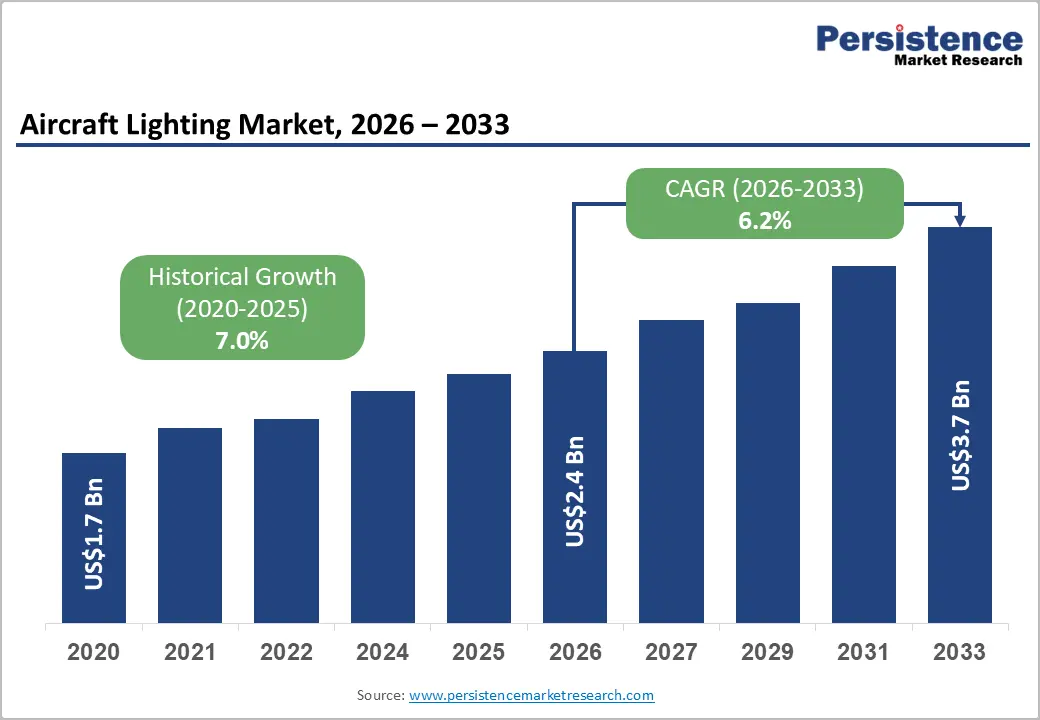
The global aircraft lighting market size is likely to be valued at US$2.4 billion in 2026 and is expected to reach US$3.7 billion by 2033, growing at a CAGR of 6.2% between 2026 and 2033, driven by sustained global fleet expansion, increasing retrofit activity across aging aircraft, and rising investments in cabin modernization programs.
Growth is further supported by steady air passenger traffic expansion, particularly in the Asia Pacific, and long-term aircraft procurement outlooks. Regulatory certification requirements and the rapid adoption of LED technologies continue to shape product development cycles, reinforcing a stable yet innovation-driven market trajectory.
Key Industry Highlights:
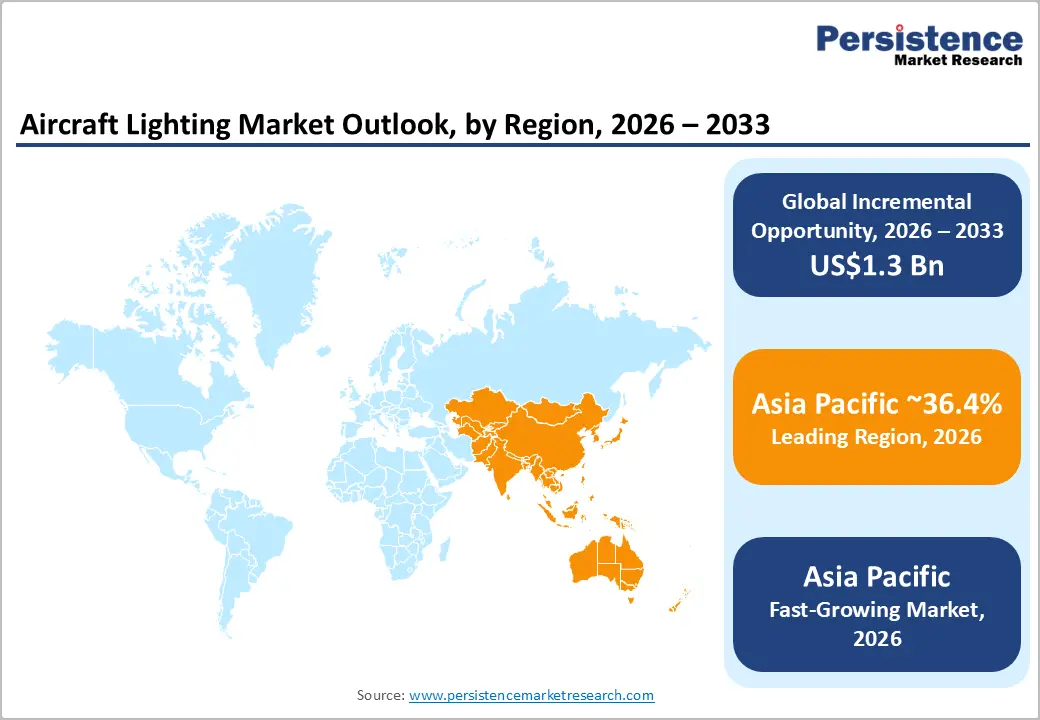
- Leading Region: Asia Pacific is projected to account for over 36.4% of market share, driven by rapid fleet expansion and increasing passenger traffic across China, India, and Southeast Asia.
- Fastest-growing Region: Asia Pacific is also the fastest-growing region, supported by strong narrow-body aircraft demand and expanding MRO infrastructure.
- Investment Plans: Industry investments are primarily focused on LED lighting upgrades, cabin modernization programs, and retrofit solutions, with airlines allocating capital to improve the passenger experience and operational efficiency across both new and existing fleets.
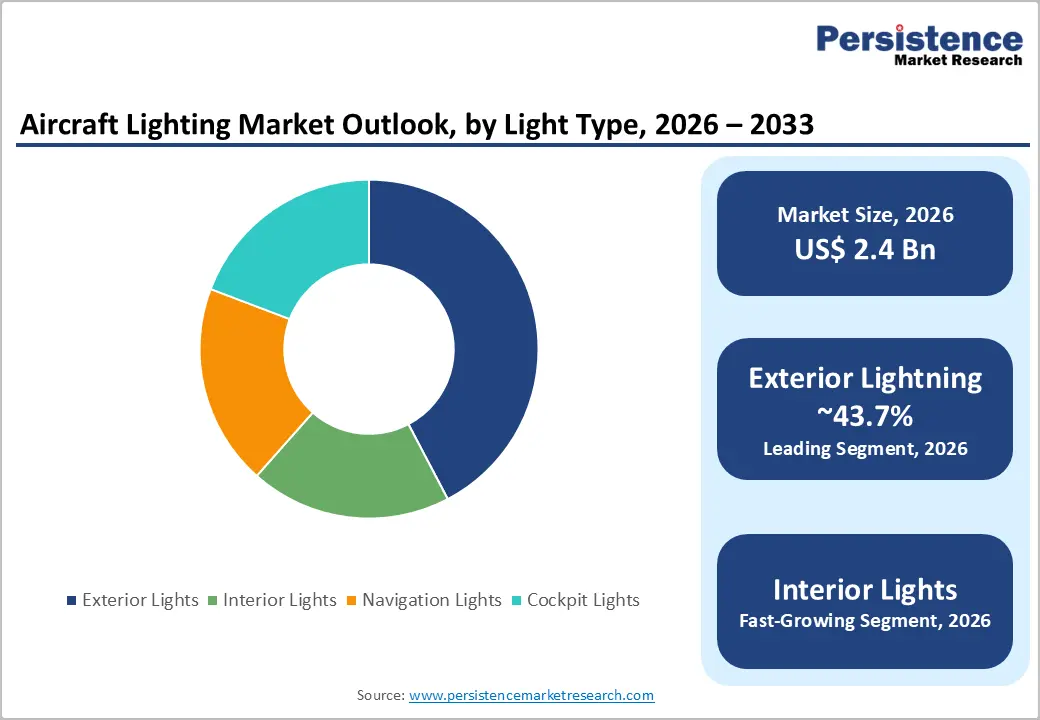
- Dominant Light Type: Exterior lighting remains the dominant segment, with an anticipated 43.7% market share, driven by its critical role in safety, compliance, and mandatory use across all aircraft types.
- Leading Aircraft Type: Commercial aircraft is estimated to lead, contributing over 56.1% of the market share, supported by a large fleet size, high utilization rates, and continuous cabin upgrade initiatives.
DRO Analysis
Driver - Fleet Expansion and Retrofit-Driven Replacement Demand
The installed global aircraft fleet remains the primary driver of demand for aircraft lighting systems. While new aircraft deliveries contribute to incremental growth, a significant portion of market value originates from retrofit and replacement cycles across existing fleets. Airlines are increasingly investing in cabin upgrades, regulatory compliance, and operational efficiency improvements, which directly stimulate demand for advanced lighting systems.
Retrofit programs, particularly in commercial and business aviation, allow operators to enhance aircraft appeal while extending service life. Lighting upgrades are frequently integrated into scheduled maintenance checks, creating a consistent revenue stream for suppliers. This dynamic ensures that demand is not solely dependent on new aircraft production cycles but is also supported by ongoing fleet modernization strategies. As airlines aim to standardize cabin configurations across fleets, lighting systems are becoming a critical component of harmonization initiatives.
LED Adoption Improving Operational Efficiency and Passenger Experience
The transition toward LED lighting technology represents a structural shift in the aircraft lighting market. LED systems offer significant advantages, including reduced weight, lower energy consumption, extended lifespan, and decreased maintenance requirements. These benefits translate directly into lower operating costs for airlines, making LED adoption economically compelling. At the same time, LEDs enable advanced cabin lighting features such as dynamic mood lighting, customizable color schemes, and improved illumination quality, enhancing passenger experience.
Airlines increasingly view lighting as a strategic tool for brand differentiation and customer satisfaction rather than a purely functional component. The ability to integrate lighting with cabin management systems further strengthens its value proposition. As a result, LED technology continues to penetrate both line-fit and retrofit segments, reinforcing its dominance across all aircraft categories.
Restraint - Certification Complexity and Integration Challenges
Aircraft lighting systems are subject to stringent regulatory standards and certification requirements, which significantly impact product development timelines and costs. Any modification or new installation must comply with detailed airworthiness regulations, including supplemental type certifications and design approvals. These requirements increase engineering complexity, particularly when adapting solutions for multiple aircraft platforms with varying configurations.
Integration challenges also arise due to differences in wiring systems, cabin layouts, and legacy infrastructure. For suppliers, this creates high upfront investment requirements before achieving commercial scale. Smaller companies may face barriers to entry, while larger players must balance innovation with compliance. These structural constraints slow the pace of product adoption and limit rapid technological transitions, particularly in retrofit markets where cost sensitivity is higher.
Opportunity - Rising Demand for Enhanced Cabin Experience and Brand Differentiation
Aircraft lighting is increasingly being leveraged as a key element of cabin design and passenger experience strategy. Airlines are investing in advanced lighting solutions to create differentiated onboard environments, particularly in premium and long-haul segments. Features such as circadian lighting, mood-based illumination, and integrated signage systems are gaining traction as carriers seek to improve passenger comfort and reduce travel fatigue.
Lighting is also being used to reinforce brand identity through customized color schemes and visual themes. This shift transforms lighting from a compliance-driven component into a value-added system, opening new revenue opportunities for suppliers. Companies that can offer integrated, customizable, and easy-to-install lighting solutions are well-positioned to capitalize on this trend.
Asia Pacific Aviation Growth and Expanding MRO Ecosystem
Rapid growth in air travel demand across the Asia Pacific presents a significant opportunity for aircraft lighting manufacturers. The region is experiencing strong fleet expansion, particularly in narrow-body aircraft, driven by increasing passenger traffic and rising middle-class populations. This growth is accompanied by the development of maintenance, repair, and overhaul (MRO) infrastructure, which supports ongoing retrofit and replacement demand.
Airlines in the region are also focusing on improving operational efficiency and passenger experience, further boosting demand for advanced lighting systems. Suppliers with localized production, service capabilities, and certification expertise can benefit from reduced turnaround times and stronger customer relationships. The convergence of fleet growth and expanding aftermarket services creates a robust long-term opportunity in the region.
Category-wise Analysis
Light Type Insights
Exterior lights are projected to dominate the market with an anticipated 43.7% share in 2026, due to their critical role in operational safety and regulatory compliance. These include navigation lights, anti-collision lights, landing lights, taxi lights, and recognition lights, all of which are mandatory across aircraft types. Their widespread application across commercial, military, and general aviation platforms ensures a broad and stable demand base.
For instance, Whelen Aerospace Technologies supplies LED anti-collision and position lights widely used across business jets and rotorcraft, while Oxley Group specializes in NVG-compatible exterior lighting for military aircraft. These systems are subject to regular inspection and replacement cycles, contributing to consistent aftermarket revenue. Standardization across aircraft platforms further supports scalability for manufacturers, making this segment highly resilient to market fluctuations.
Interior lighting is likely to be the fastest-growing segment, driven by increased emphasis on passenger experience and cabin aesthetics. Airlines are adopting advanced LED-based systems that enable customizable lighting environments, including mood lighting and dynamic color transitions. These systems enhance passenger comfort, particularly on long-haul flights, and support brand differentiation strategies.
For example, STG Aerospace offers liTeMood LED cabin lighting solutions designed for retrofit programs across Boeing and Airbus fleets, while Diehl Aviation integrates intelligent lighting systems into next-generation cabin designs. Interior lighting upgrades are often included in cabin refurbishment programs, which are becoming more frequent as airlines seek to remain competitive. The ability to integrate lighting with digital cabin management systems further enhances its appeal. This segment offers significant value creation potential, particularly in retrofit-heavy markets.
Aircraft Type Insights
Commercial aircraft lead with an anticipated share of over 56.1%, due to their large fleet size and high utilization rates. Frequent maintenance cycles, combined with ongoing cabin upgrades, drive consistent demand for both interior and exterior lighting systems. Airlines invest heavily in maintaining and enhancing passenger experience, making lighting a key component of cabin modernization initiatives.
For example, Collins Aerospace supplies integrated lighting systems for major commercial aircraft programs, while Safran Electrical & Power supports lighting and electrical integration across Airbus platforms. The segment also benefits from long-term aircraft procurement programs, ensuring sustained demand from OEM channels. Commercial aviation remains the primary revenue generator for lighting suppliers due to its scale and regulatory requirements.
Narrow-body aircraft are the fastest-growing segment, driven by increasing short- and medium-haul travel demand. These aircraft dominate global fleets and are central to airline expansion strategies, particularly in emerging markets. Their high utilization rates necessitate frequent maintenance and upgrades, creating strong demand for lighting systems.
For instance, Airbus A320 family and Boeing 737 series are widely deployed across global airline networks, leading to large-scale, repeat demand for standardized lighting solutions. Standardized configurations across large fleets enable efficient deployment of lighting systems, reducing installation complexity and costs. As airlines continue to expand regional connectivity and optimize fleet efficiency, narrow-body aircraft will remain a key growth driver for the market.
Regional Insights
North America Aircraft Lighting Market Trends
North America remains a significant market for aircraft lighting, driven by a large installed fleet, advanced aviation infrastructure, and the strong presence of leading manufacturers. The U.S. dominates the regional market, accounting for over 87.8% of the share.
The region benefits from a mature aviation ecosystem supported by well-established maintenance, repair, and overhaul (MRO) networks and a highly structured regulatory environment under the Federal Aviation Administration. Major players such as Collins Aerospace, Honeywell Aerospace Technologies, and Astronics Corporation continue to invest in advanced LED lighting systems and integrated cabin technologies, reinforcing the region’s leadership in innovation.
U. S. Aircraft Lighting Market Trends
Growth in the U.S. is largely driven by retrofit and modernization programs rather than new aircraft deliveries. Airlines such as Delta Air Lines and American Airlines have undertaken cabin refurbishment initiatives that include advanced LED mood lighting systems to enhance passenger experience and brand identity.
In business aviation, companies such as Gulfstream Aerospace integrate high-end cabin lighting solutions into new aircraft, driving demand for premium lighting systems. These developments support increased adoption of energy-efficient and software-controlled lighting, positioning North America as a leader in high-value, technology-driven segments.
Europe Aircraft Lighting Market Trends
Europe plays a critical role in the aircraft lighting market due to its strong aerospace manufacturing base and regulatory harmonization under the European Union Aviation Safety Agency. The region benefits from a centralized certification framework, which simplifies compliance across multiple countries. Key markets such as Germany, the U.K., France, and Spain contribute significantly to regional demand, supported by the presence of major OEMs and Tier-1 suppliers.
Germany Aircraft Lighting Market Trends
Germany is a hub for aircraft interiors and lighting innovation, led by companies such as Diehl Aviation. The company has developed intelligent LED cabin lighting systems integrated into aircraft interiors, supporting Airbus programs and retrofit solutions. This strengthens Europe’s position in high-end cabin lighting design and engineering.
France Aircraft Lighting Market Trends
France plays a key role through Safran Electrical & Power, which focuses on electrical and lighting integration across aircraft platforms. The company’s work on electrification and energy-efficient systems aligns with Europe’s broader sustainability goals, influencing lighting system design toward lower power consumption and reduced weight.
United Kingdom Aircraft Lighting Market Trends
The U.K. contributes through specialized lighting providers such as STG Aerospace, which has introduced advanced LED cabin lighting and photoluminescent emergency systems. Its retrofit-focused solutions are widely used across Airbus and Boeing fleets, supporting the growing demand for cabin upgrades in Europe and globally.
Across Europe, airlines are actively investing in cabin modernization, while sustainability initiatives are influencing product development. The focus on energy-efficient, lightweight lighting solutions continues to shape innovation. Although fleet growth is moderate compared to Asia Pacific, Europe remains a high-value, technologically advanced market.
Asia Pacific Aircraft Lighting Market Trends
Asia Pacific is projected to be the largest and fastest-growing region in the aircraft lighting market, holding over 36.4% share in 2026. The region’s growth is driven by rapid expansion in air travel demand, particularly in China, India, and Southeast Asia.
China Aircraft Lighting Market Trends
China is expected to account for approximately 30.7% of the regional market, reflecting its large and expanding aviation sector. China’s aviation growth is supported by aggressive fleet expansion and increasing domestic air travel demand. State-owned carriers such as China Southern Airlines and Air China are continuously adding narrow-body aircraft, driving demand for both OEM and aftermarket lighting systems. The development of indigenous aircraft programs such as COMAC’s C919 is also creating opportunities for local and international lighting suppliers to participate in new platform development.
India Aircraft Lighting Market Trends
India is one of the fastest-growing aviation markets globally, supported by rising passenger traffic and expanding airline fleets. Airlines such as IndiGo and Air India are undertaking large aircraft orders and fleet modernization programs. Air India’s recent wide-body aircraft upgrades include enhanced cabin lighting systems to improve the passenger experience. The rapid growth of MRO infrastructure in India further supports demand for retrofit lighting solutions.
Japan Aircraft Lighting Market Trends
Japan contributes through advanced aerospace manufacturing and technology integration. Companies like Mitsubishi Heavy Industries are involved in aircraft component manufacturing, including systems that support lighting integration. Japanese airlines also emphasize high-quality passenger experience, driving the adoption of advanced cabin lighting technologies.
The region’s growth is supported by increasing aircraft deliveries, expanding airline networks, and rising passenger volumes. Narrow-body aircraft dominate fleet expansion, creating strong demand for lighting systems in both OEM and aftermarket segments. The development of local MRO infrastructure further supports demand for retrofit and replacement. Asia Pacific offers significant opportunities due to its scale, rapid growth, and evolving aviation ecosystem, making it the most dynamic region in the aircraft lighting market.
Competitive Landscape
The global aircraft lighting market is characterized by a fragmented structure, with a mix of large aerospace corporations and specialized lighting manufacturers. Major players hold significant influence due to their extensive product portfolios and global reach, while smaller companies compete by focusing on niche segments and retrofit solutions. Competitive positioning is largely determined by certification capabilities, product reliability, and the ability to serve multiple aircraft platforms. The market does not exhibit high concentration, allowing room for innovation and new entrants with differentiated offerings.
Key market participants are prioritizing LED innovation, certification expertise, and global expansion. Companies are focusing on developing lightweight, energy-efficient solutions while expanding retrofit capabilities. Strategic emphasis is placed on reducing installation complexity, enhancing product reliability, and strengthening aftermarket service networks to capture recurring revenue opportunities.
Key Industry Developments:
- In October 2025, Collins Aerospace announced that its Venue™ smart monitor integrated with Airshow® HD would enter service on a Dassault Falcon 7X, offering a consolidated cabin solution that reduces power consumption and simplifies installation, supporting the broader trend of integrated, energy-efficient cabin systems, including lighting.
- In February 2025, Collins Aerospace launched the Powered by Collins Initiative™ 2025 at Aero India, expanding collaboration with startups and SMEs to accelerate development of next-generation aerospace technologies, including advanced materials and systems that influence future aircraft lighting innovation and integration.
Companies Covered in Aircraft Lighting Market
- Collins Aerospace
- Honeywell Aerospace Technologies
- Safran Electrical & Power
- Diehl Aviation
- Astronics Corporation
- STG Aerospace
- Whelen Aerospace Technologies
- Bruce Aerospace
- Heads Up Technologies
- Oxley Group
- PWI, Inc.
- Precise Flight, Inc.
- Aveo Engineering Group
- Luminator Aerospace
- Soderberg Manufacturing Company, Inc.
- AeroLEDs
Frequently Asked Questions
The aircraft lighting market is valued at US$2.4 billion in 2026.
The market is projected to reach US$3.7 billion by 2033.
Key trends include widespread adoption of LED lighting technology, increasing focus on passenger experience through cabin mood lighting, rising retrofit activities across aging fleets, and integration of lighting with digital cabin management systems.
The exterior lighting segment leads the market, holding an anticipated 43.7% share, due to its critical role in aircraft safety and regulatory compliance.
The market is expected to grow at a CAGR of 6.2% from 2026 to 2033.
Major players include Collins Aerospace, Honeywell Aerospace Technologies, Safran Electrical & Power, Diehl Aviation, and Astronics Corporation.


