




- Aerospace & Defense
- Aircraft Gearbox Market
Aircraft Gearbox Market Size, Share, and Growth Forecast 2026 - 2033
Aircraft Gearbox Market by Component (Gear, Housing, Bearing, Others), Platform (Commercial, Civil, Military), Gearbox Type (Accessory Gearboxes, Reduction Gearboxes, Actuation Gearboxes, Tail Rotor Gearboxes, Auxiliary Power Unit (APU) Gearboxes, Others), End-user (OEM, MRO, Others), and Regional Analysis for 2026 - 2033

Aircraft Gearbox Market Size and Trend Analysis
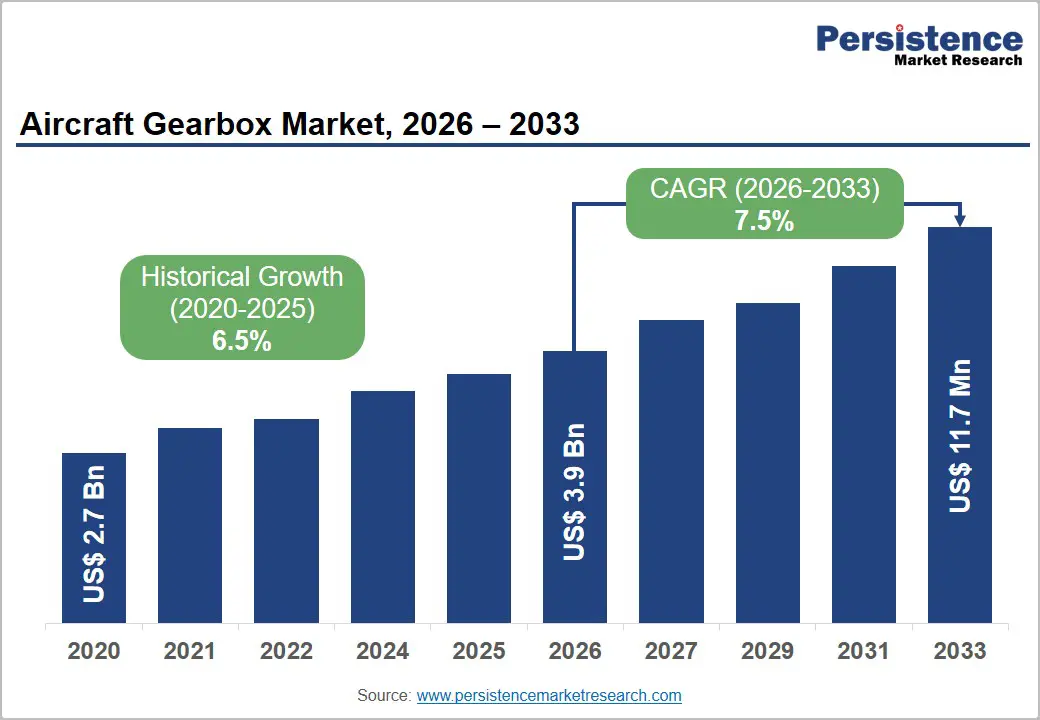
The global aircraft gearbox market is valued at US$ 3.9 Bn in 2026 and is projected to reach US$ 11.7 Bn by 2033, growing at a CAGR of 7.5% between 2026 and 2033. This robust growth is driven by recovering global commercial aviation activity, accelerating military modernization programs, and increasing demand for next-generation narrowbody and widebody aircraft deliveries requiring advanced gearbox systems. The International Air Transport Association (IATA) projects global air passenger traffic to reach pre-pandemic levels and exceed them through the early 2030s, underpinning a significant wave of new aircraft orders.
Key Industry Highlights:
- Leading Region: North America dominates the global aircraft gearbox market with approximately 38% revenue share in 2026, driven by the world's largest commercial and military aviation fleets and major OEM gearbox manufacturers including Parker Hannifin and Triumph Group.
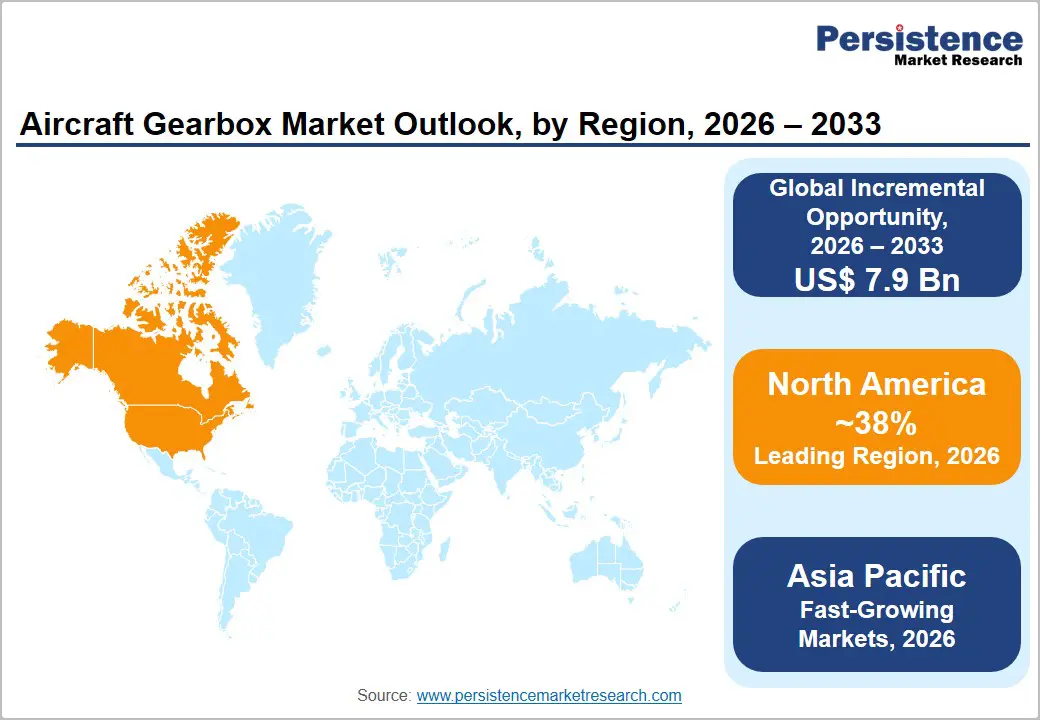
- Fast-Growing Market: Asia Pacific is the fast-growing region at an estimated CAGR of 9.2%, propelled by surging commercial fleet expansion in China and India, Défense modernization programs, and government-led initiatives to develop indigenous aerospace manufacturing capabilities.
- Dominant End-user: The OEM end-user segment leads with approximately 55% market share, anchored by record-high aircraft backlogs at Airbus and Boeing and exclusive long-term supply agreements between engine OEMs and certified gearbox manufacturers.
- Fast-Growing Segment: The MRO end-user segment is the fast-growing, as global commercial and military fleets age and gearbox overhaul cycles intensify, creating high-margin, long-cycle aftermarket service demand for OEM-affiliated MRO providers.
- Key Opportunity: The emerging Advanced Air Mobility (AAM) and eVTOL sector presents a transformative new demand frontier for compact, high-efficiency gearbox systems, with the FAA on track to certify initial eVTOL platforms by the mid-2020s across a potential US$ 500 billion market.
DRO Analysis
Drivers - Surging Commercial Aircraft Deliveries and Post-Pandemic Aviation Recovery
The global commercial aviation sector is experiencing a powerful recovery cycle, with aircraft original equipment manufacturers generating record backlogs that translate directly into sustained gearbox demand. Airbus reported a backlog of over 8,600 aircraft as of early 2025, while Boeing maintained a commercial backlog exceeding 5,600 aircraft.
Both narrowbody programs, the Airbus A320neo family and Boeing 737 MAX, rely on next-generation high-bypass turbofan engines incorporating advanced accessory gearboxes and reduction gearboxes. The International Air Transport Association (IATA) forecasts annual passenger numbers to exceed 4.7 billion by 2026, compelling airlines to accelerate fleet renewal and driving OEM gearbox procurement volumes to multi-year highs across the commercial aviation supply chain.
Escalating Global Défense Budgets and Military Aviation Modernization Programs
Sustained growth in global defined expenditure is a structural demand driver for aircraft gearbox manufacturers, particularly in the rotorcraft and military fixed-wing segments. According to the Stockholm International Peace Research Institute (SIPRI), global military spending reached a record US$ 2.44 trillion in 2023, with the United States, China, Russia, and India among the top spenders. Military helicopter programs, including the U.S.
Army's Future Long-Range Assault Aircraft (FLRAA) and Future Attack Reconnaissance Aircraft (FARA) initiatives require highly specialized tail rotor and main rotor gearboxes. NATO member states committed to Défense spending targets of 2% of GDP are procuring rotorcraft and advanced fighter aircraft at accelerated rates, reinforcing multi-year gearbox demand pipelines for both OEM production and MRO services.
Restraints - Stringent Airworthiness Certification Requirements and Extended Development Lead Times
Aircraft gearbox development and certification involve exhaustive testing protocols mandated by airworthiness authorities, including the U.S. Federal Aviation Administration (FAA), the European Union Aviation Safety Agency (EASA), and the Military Airworthiness Authority (MAA) for Défense applications.
Certification processes for new gearbox designs can require 3-7 years and investments exceeding US$ 50-100 million, creating high barriers to entry and limiting the pace of technology refreshment. These lead times constrain market responsiveness to rapidly evolving aircraft program requirements and create significant financial risk for smaller tier-2 and tier-3 gearbox component suppliers.
Supply Chain Complexity and Specialized Material Procurement Challenges
Aircraft gearboxes require high-strength, lightweight aerospace-grade alloys, including titanium, high-grade steel, and advanced aluminum alloys, as well as precision bearings and seals with extremely tight manufacturing tolerances. Supply chain disruptions experienced during 2021-2024 significantly impacted aerospace component lead times, with the Aerospace Industries Association (AIA) documenting widespread material and skilled-labour shortages across U.S. aerospace manufacturing.
Geopolitical factors, including U.S.-China trade tensions and potential U.S.-Iran conflict disruptions affecting rare earth and specialty metal supply chains, introduce further procurement risk, raising input costs and extending manufacturing lead times for precision gearbox components globally.
Opportunities - Advanced Air Mobility (AAM) and Urban Air Mobility (UAM) Platforms Creating New Gearbox Demand
The emerging Advanced Air Mobility (AAM) sector, encompassing electric vertical take-off and landing (eVTOL) aircraft and urban air taxis, are generating a new and rapidly growing demand segment for compact, high-efficiency gearbox and drivetrain solutions. The FAA has established an AAM Aviation Rulemaking Advisory Committee (ARAC) and projects certifying initial eVTOL platforms by the mid-2020s.
Companies including Joby Aviation, Lilium, and Archer Aviation are developing multi-rotor architectures that require precisely engineered speed-reduction and torque-splitting gearboxes. According to the NASA Advanced Air Mobility Mission, the U.S. AAM market alone could represent a US$ 500 billion economic opportunity by 2035, positioning gearbox innovators at the forefront of this transformative aviation segment.
MRO Market Expansion Driven by Aging Global Fleet and Increasing Flight Hours
The global aircraft Maintenance, Repair, and Overhaul (MRO) market represents a large and growing opportunity for aircraft gearbox manufacturers and service providers. As the world commercial fleet ages, with a significant portion of the ~26,000 active commercial aircraft globally now exceeding 15 years of service per IATA fleet data, gearbox overhaul cycles become more frequent and intensive.
The Aircraft Fleet Recycling Association (AFRA) notes increasing demand for serviceable used gearbox components as airlines balance cost management with airworthiness compliance. Défense MRO demand is additionally rising, with aging rotorcraft fleets in U.S. Army, U.S. Navy, and allied nation inventories requiring sustained gearbox overhaul and replacement services that provide long-term, high-margin revenue streams for OEM-affiliated MRO providers.
Category-wise Analysis
Component Insights
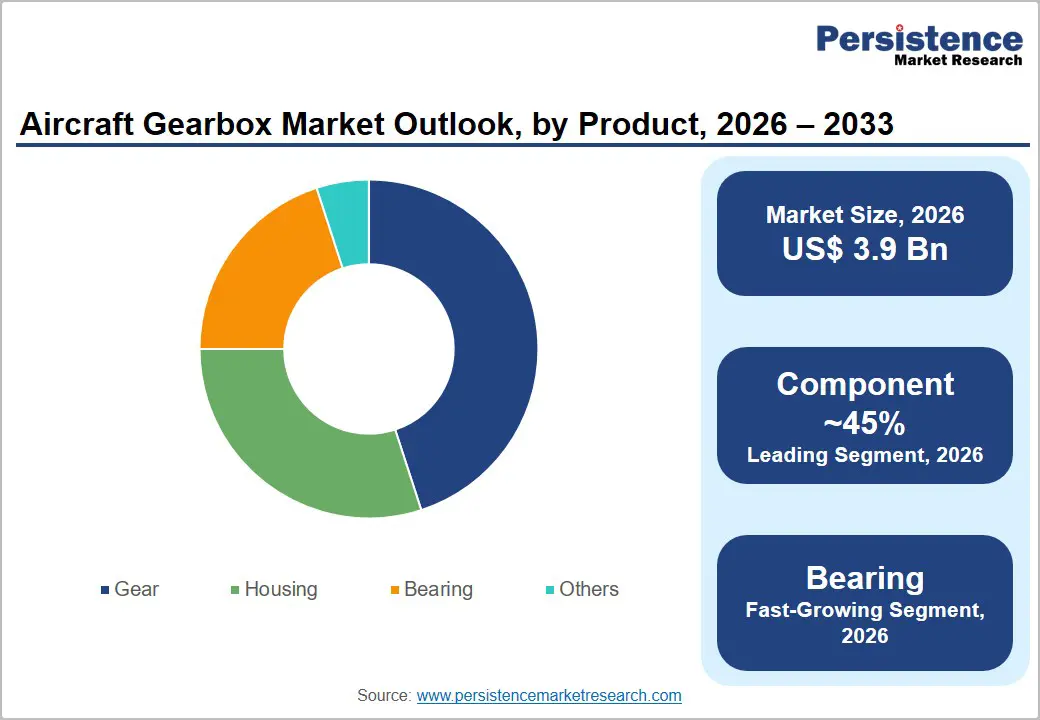
The Gear segment is the dominant component category in the aircraft gearbox market, accounting for approximately 45% of total component revenue. Gears are the core functional element of every gearbox assembly, transmitting torque, modifying rotational speed, and enabling power transfer between aircraft engine shafts and accessory systems.
Advances in gear tooth geometry including helical, bevel, and epicyclic designs used in turboprop reduction gearboxes and helicopter main gearboxes continue to drive R&D investment. Leading gear producers such as Safran Transmission Systems and Leonardo DRS invest heavily in advanced gear manufacturing and testing capabilities to maintain competitive differentiation.
Platform Insights
The commercial platform segment leads the aircraft gearbox market, holding approximately 48% of the total share in 2026. Commercial aviation's dominance reflects the enormous scale of the global commercial aircraft fleet, over 26,000 active commercial aircraft per IATA data, combined with the high gearbox content per aircraft in modern high-bypass turbofan engines.
Each commercial turbofan engine incorporates an accessory gearbox driving hydraulic pumps, generators, fuel pumps, and oil pumps, while turboprop-powered regional aircraft require precision reduction gearboxes as core powertrain components. Record Airbus and Boeing backlogs, combined with a growing global fleet requiring MRO services, ensure that the commercial platform segment will retain market leadership throughout the forecast period.
Gearbox Type Insights
The Accessory Gearbox (AGB) segment leads the gearbox type category, representing approximately 38% of the aircraft gearbox market. Accessory gearboxes are installed on virtually every commercial and military gas turbine engine, serving as the mechanical interface between the engine core and aircraft system accessories, including generators, hydraulic pumps, fuel control units, and oil pumps.
Every CFM LEAP, Pratt & Whitney GTF, and GE9X engine powering new generation narrowbody and widebody aircraft incorporates an advanced AGB. As narrowbody aircraft deliveries accelerate to serve post-pandemic travel demand, AGB volumes scale proportionally, cementing this segment's market leadership.
End-user Insights
The OEM (Original Equipment Manufacturer) end-user segment holds the leading position, accounting for approximately 55% of the aircraft gearbox market revenue. OEM demand is driven by new aircraft production volumes at Airbus, Boeing, Leonardo, Sikorsky (Lockheed Martin), and Bell (Textron), all of which require gearbox assemblies as critical powertrain and system components.
The extended OEM supply chain, including tier-1 engine manufacturers such as CFM International, Pratt & Whitney, and Rolls-Royce, further amplifies OEM gearbox volumes. While the MRO segment is growing rapidly as the global in-service fleet ages, OEM's structural advantage stems from long-term exclusive supply agreements and sole-source certification positions that are difficult for competitors to displace.
Regional Analysis
North America Aircraft Gearbox Market Trends & Analysis
North America is the world's leading aircraft gearbox market, commanding approximately 38% of global revenue in 2026. The United States is the primary driver, home to the world's largest commercial aviation fleet, the largest Défense aviation procurement budget, and major gearbox manufacturing capabilities concentrated in companies including Parker Hannifin, Eaton Aerospace, Triumph Group, and Moog Inc.
The U.S. Department of Défense (DoD) fiscal year 2025 budget request of over US$ 849 billion includes substantial rotorcraft and fixed-wing aircraft procurement, sustaining military gearbox demand. However, a rise in U.S. tariffs on imported steel, aluminum, and precision components from Europe and Asia are creating input cost headwinds for U.S.-based gearbox manufacturers reliant on global supply chains.
U.S. Aircraft Gearbox Market Size
The United States accounts for approximately 32% of the global aircraft gearbox market revenue in 2026. The country's position as the world's largest operator of both commercial and military aircraft, with over 7,000 commercial jets operated by U.S. carriers per FAA data and the world's largest military aviation fleet per SIPRI, creates unparalleled OEM and MRO demand.
Europe Aircraft Gearbox Market Trends, Drivers, & Insights
Europe is the second-largest aircraft gearbox market, with strong demand anchored in France, Germany, and the U.K., home to major gearbox manufacturers including Safran Transmission Systems (France), Liebherr Aerospace (Germany), and Rolls-Royce Holdings (U.K.). Airbus's Toulouse and Hamburg production facilities generate substantial gearbox procurement volumes for A320neo, A330neo, and A350 programs.
Europe's Défense aviation sector is experiencing renewed investment following NATO's collective commitment to 2% of GDP Défense spending, spurred by the Russia-Ukraine conflict and heightened continental security concerns.
Germany Aircraft Gearbox Market Size
Germany holds approximately 7% of global aircraft gearbox market revenue. The country's aerospace sector, anchored by Airbus Deutschland, MTU Aero Engines, and Liebherr Aerospace, drives substantial gearbox production and procurement activity. MTU Aero Engines is a key partner in the CFM LEAP and Pratt & Whitney GTF programs, contributing precision gearbox and transmission components that serve the global narrowbody aircraft market.
U.K. Aircraft Gearbox Market Size
The United Kingdom commands approximately 6% of global market revenue. Rolls-Royce Holdings is the U.K.'s anchor aerospace company, with gearbox and power gearbox systems integral to its UltraFan® engine program featuring the world's largest engine power gearbox, enabling a 25% fuel efficiency improvement over prior generations.
France Aircraft Gearbox Market Size
France accounts for approximately 8% of global aircraft gearbox revenue, reflecting the country's status as a global aerospace manufacturing powerhouse. Safran Transmission Systems, headquartered in Gonfreville-l'Orcher, is arguably the world's most specialized aircraft gearbox manufacturer, producing accessory gearboxes and transmission systems for virtually every major commercial and military jet engine program globally. France's support for Airbus programs and the FCAS next-generation fighter initiative positions it as a long-term strategic gearbox production hub within the European aerospace ecosystem.
Asia Pacific Aircraft Gearbox Market Drivers & Analysis
Asia Pacific is the fastest-growing aircraft gearbox market, expanding at an estimated CAGR of 9.2% through 2033, driven by surging commercial aviation demand, rapid Défense modernization, and expanding domestic aerospace manufacturing capabilities. The International Air Transport Association (IATA) identifies the Asia Pacific region as the largest contributor to new air passenger growth over the next two decades. China and India are simultaneously expanding their commercial aviation fleets and investing heavily in indigenous military aircraft programs.
China Aircraft Gearbox Market Size
China represents approximately 12% of the global aircraft gearbox market revenue in 2026 and is the fastest-growing country market. The Commercial Aircraft Corporation of China (COMAC) is scaling production of its C919 narrowbody aircraft, which requires domestic or jointly developed gearbox and engine accessory systems, while its C929 widebody program is in advanced development.
India Aircraft Gearbox Market Size
India accounts for a substantial revenue share and is among the fast-growing countries. The Ministry of Defence has approved numerous programs under the Aatmanirbhar Bharat (Self-Reliant India) initiative, including the Advanced Medium Combat Aircraft (AMCA), Light Utility Helicopter (LUH), and Indian Multi-Role Helicopter (IMRH), all requiring domestically sourced or co-developed gearbox systems.
Japan Aircraft Gearbox Market Size
Japan is likely to account for a leading share in 2026. Kawasaki Heavy Industries, Mitsubishi Heavy Industries (MHI), and IHI Corporation are the primary Japanese aerospace contributors, participating as risk-sharing partners on major programs including the Boeing 787 and 777X, as well as Japan's F-X next-generation fighter program developed under the Global Combat Air Programme (GCAP) with the U.K. and Italy.
Competitive Landscape
The global aircraft gearbox market is highly consolidated, with the top five players, including Safran Transmission Systems, Parker Hannifin, Rolls-Royce Holdings, Liebherr Aerospace, and Triumph Group, collectively holding over 55% of global revenue.
High barriers to entry driven by FAA/EASA certification requirements, long-term OEM exclusive supply agreements, and intensive capital requirements entrench incumbents. Key competitive differentiators include proprietary gear metallurgy and machining expertise, co-development partnerships with engine OEMs, and integrated MRO network capabilities.
Key Developments:
- In May 2025, XTI Aerospace, Inc. selected Triumph Geared Solutions, Formsprag Clutch, and Kamatics Corporation to design, develop, and manufacture the drivetrain system for its innovative TriFan 600 xVTOL aircraft.
- In July 2024, Triumph Group's Geared Solutions business secured a contract from GE Aerospace to supply the auxiliary gearbox for the F404 engine. The gearbox may support platforms like the Boeing T7-A Red Hawk.
Companies Covered in Aircraft Gearbox Market
- Safran Transmission Systems
- Parker Hannifin Corporation - Aerospace Systems Division
- Rolls-Royce Holdings plc
- Liebherr Aerospace
- Triumph Group, Inc.
- Eaton Aerospace (Eaton Corporation)
- Moog Inc.
- Raytheon Technologies - Collins Aerospace
- GE Aerospace (General Electric)
- Kawasaki Heavy Industries
- Mitsubishi Heavy Industries (MHI)
- Hindustan Aeronautics Limited (HAL)
- Leonardo S.p.A. (AgustaWestland)
- Bell Textron Inc.
- Sikorsky Aircraft (Lockheed Martin)
Frequently Asked Questions
The global Aircraft Gearbox market is valued at US$ 3.9 Bn in 2026 and is projected to reach US$ 11.7 Bn by 2033, reflecting a CAGR of 7.5% over the forecast period.
The primary growth drivers are surging commercial aircraft deliveries underpinned by record Airbus and Boeing backlogs exceeding 14,000 aircraft combined and the rise in global Défense budgets reaching a record US$ 2.44 trillion in 2023 per SIPRI driving military rotorcraft and fixed-wing aircraft procurement programs requiring specialized gearbox solutions.
Accessory Gearboxes (AGB) represent the leading Gearbox Type segment with approximately 38% market share.
North America leads the global aircraft gearbox market with approximately 38% of revenue in 2026, anchored by the world's largest commercial and military aviation fleets, major gearbox OEM manufacturing operations, and robust U.S. Department of Défense procurement budgets that sustain both OEM production and MRO aftermarket demand.
Leading companies in the global aircraft gearbox market include Safran Transmission Systems, Parker Hannifin Aerospace Systems, Rolls-Royce Holdings, Liebherr Aerospace, Triumph Group, Eaton Aerospace, Moog Inc., Collins Aerospace, GE Aerospace, and Kawasaki Heavy Industries.


