




- Advanced Materials
- Air Ionizer Market
Air Ionizer Market Size, Share, and Growth Forecast 2026 - 2033
Air Ionizer Market by Product Type (Portable Air Ionizers, Wall-Mounted Air Ionizers, In-Duct Air Ionizers, Whole House Air Ionizers), by Technology (Negative Ionization Technology, Electrostatic Technology, Plasma Technology, Ultraviolet Light Technology), by Features, by Application, End-user, and Regional Analysis, 2026 - 2033

Air Ionizer Market Size and Trend Analysis
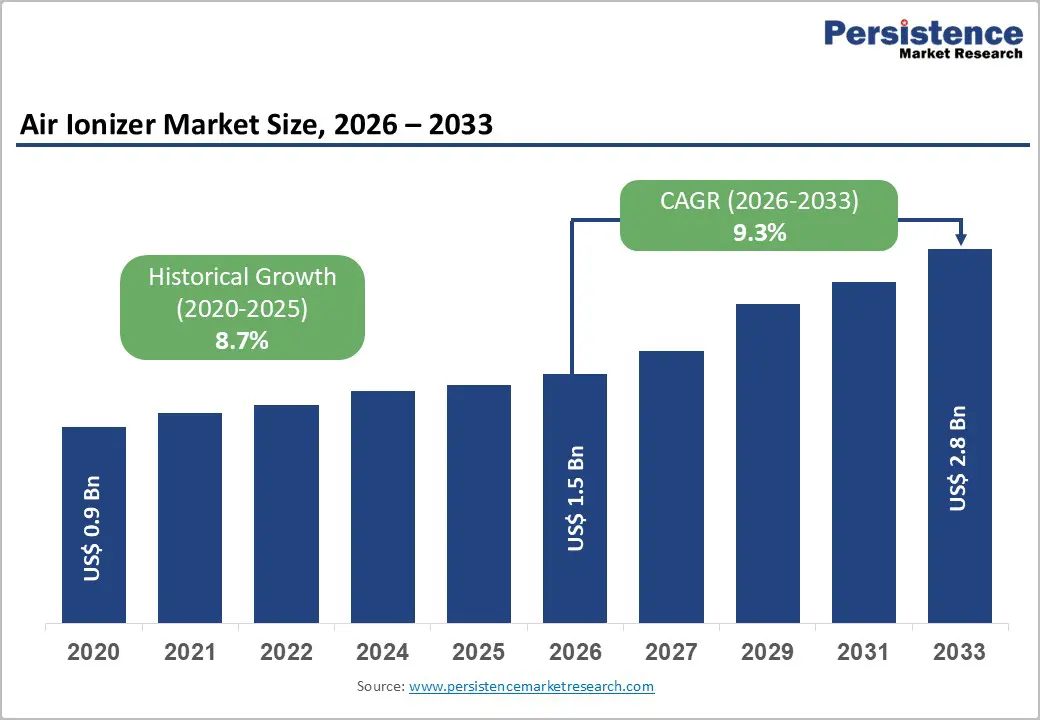
The global Air Ionizer market size is expected to reach US$ 1.5 billion in 2026 and is projected to reach US$ 2.8 billion by 2033, growing at a CAGR of 9.3% between 2026 and 2033.
Growing awareness of indoor air quality and rising health concerns are accelerating the adoption of air purification technologies. Increased exposure to pollutants, allergens, and airborne particles has heightened the need for cleaner indoor environments across residential and commercial spaces. According to the World Health Organization, air pollution causes around 7 million premature deaths annually, underscoring the demand for purification solutions. Regulatory guidance from the U.S. Environmental Protection Agency and advances in ionization technology further support market expansion.
Key Industry Highlights:
- Leading Region: North America leads the air ionizer market with 35% share, supported by strong indoor air quality initiatives from the U.S. Environmental Protection Agency.
- Fastest-Growing Region: Asia Pacific holds 31% share and is the fastest-growing region due to rapid urbanization and rising pollution concerns across China and India.
- Leading Product Category: Portable air ionizers dominate the market with a 45% share, thanks to their compact design and flexibility for personal and residential air purification.
- Leading Feature Category: Smart functionality leads with 40% share as consumers increasingly adopt IoT-enabled air purification systems.
- Key Market Opportunity: Healthcare sector adoption is a major opportunity, as hospitals deploy advanced air purification solutions aligned with Centers for Disease Control and Prevention guidelines.
| Key Insights | Details |
|---|---|
|
Air Ionizer Size (2026E) |
US$ 1.5 billion |
|
Market Value Forecast (2033F) |
US$ 2.8 billion |
|
Projected Growth CAGR(2026-2033) |
9.3% |
|
Historical Market Growth (2020-2025) |
8.7% |
Market Dynamics
Drivers - Growing Health Awareness and Urbanization Driving Demand for Air Ionizers
Rapid urbanization and increasing health awareness are significantly boosting demand for indoor air purification technologies. The United Nations projects that nearly 68% of the global population will live in urban areas by 2050, increasing exposure to indoor pollutants such as particulate matter and volatile organic compounds (VOCs). These conditions are contributing to respiratory issues and allergies in densely populated environments.
According to the American Lung Association, poor indoor air quality is linked to asthma and allergies, affecting nearly 300 million people worldwide. Air ionizers release negative ions that attach to airborne particles, causing them to cluster and settle, thereby reducing allergen levels. Research published in the Journal of Environmental Sciences highlights significant reductions in airborne particles, encouraging wider adoption across residential and office spaces.
Regulatory Standards Supporting Indoor Air Quality Improvements
Stringent indoor air quality regulations are another major driver supporting the expansion of the air ionizer market. Regulatory bodies such as the Occupational Safety and Health Administration in the United States and indoor air quality initiatives across the European Union have established limits on pollutants within commercial and industrial environments, pushing organizations to adopt efficient air purification technologies.
Air ionizers are particularly effective at capturing ultrafine and submicron particles that traditional filtration systems may miss. Testing and guidance from the U.S. Environmental Protection Agency indicate that newer ionizer models have reduced ozone emissions. These regulatory requirements are prompting offices, hospitals, and public facilities to invest in advanced purification systems, strengthening market demand.
Restraints - High Costs and Safety Concerns Limiting Consumer Adoption
High initial costs and lingering safety concerns are key barriers affecting the wider adoption of air ionizers. Advanced ionizers equipped with smart sensors, connectivity features, and automated air monitoring systems can cost significantly more than basic air purification devices, according to the U.S. Department of Energy. This price difference often discourages cost-sensitive consumers from adopting premium models.
Additionally, concerns regarding ozone emissions from earlier ionizer technologies continue to influence consumer perception. The California Air Resources Board has reported that older ionizer designs sometimes exceeded acceptable ozone emission limits. As a result, many consumers prefer alternative air purification technologies such as filtration-based systems, slowing the adoption rate of ionizers despite improvements in newer low-ozone models.
Low Awareness and Traditional Ventilation Practices in Developing Regions
Limited awareness about air ionizer technology in developing regions also restricts market expansion. According to the World Health Organization, nearly 90% of respiratory health issues in low-income areas are linked to poor air quality. However, adoption of advanced indoor air purification technologies remains relatively low due to limited consumer awareness and affordability challenges.
In many regions, traditional ventilation methods such as open windows and natural airflow remain the primary approach to improving indoor air quality. Studies from the National Institutes of Health indicate that ionization technologies can significantly reduce fine particulate matter (PM2.5), yet awareness of these benefits remains limited, slowing adoption of these technologies across emerging markets.
Opportunities - Integration with Smart Home Technologies Creating Growth Opportunities
The rapid expansion of smart home ecosystems presents strong opportunities for air ionizer manufacturers. Connected home devices are increasing rapidly worldwide, enabling appliances to be controlled through mobile applications and voice assistants. Air ionizers integrated with smart sensors and automated air quality monitoring can adjust purification levels in response to real-time indoor conditions, improving convenience and efficiency for households.
Integration with voice platforms such as Amazon Alexa and other smart home systems allows users to manage air quality remotely. This connectivity also enables data-driven features such as pollution alerts, automatic operation, and energy optimization. As smart home adoption continues to rise globally, manufacturers can position advanced ionizers as premium connected appliances within the growing ecosystem of intelligent home devices.
Rising Adoption in Healthcare and Industrial Environments
Increasing demand from the healthcare and industrial sectors is creating significant opportunities for the air ionizer market. Healthcare organizations are focusing on technologies that help control airborne pathogens and improve indoor hygiene standards. Research supported by the Centers for Disease Control and Prevention indicates that ionization technologies can significantly reduce airborne microbes in controlled environments.
Industrial facilities are also adopting advanced air purification systems to maintain strict air quality standards. Regulations such as ISO 14644 -1, the cleanroom guidelines, encourage the use of technologies capable of controlling fine particulate contamination. As pharmaceutical manufacturing, laboratories, and food processing plants require cleaner environments, plasma-based and advanced ionization solutions are gaining increasing attention.
Category-wise Analysis
Product Type Insights
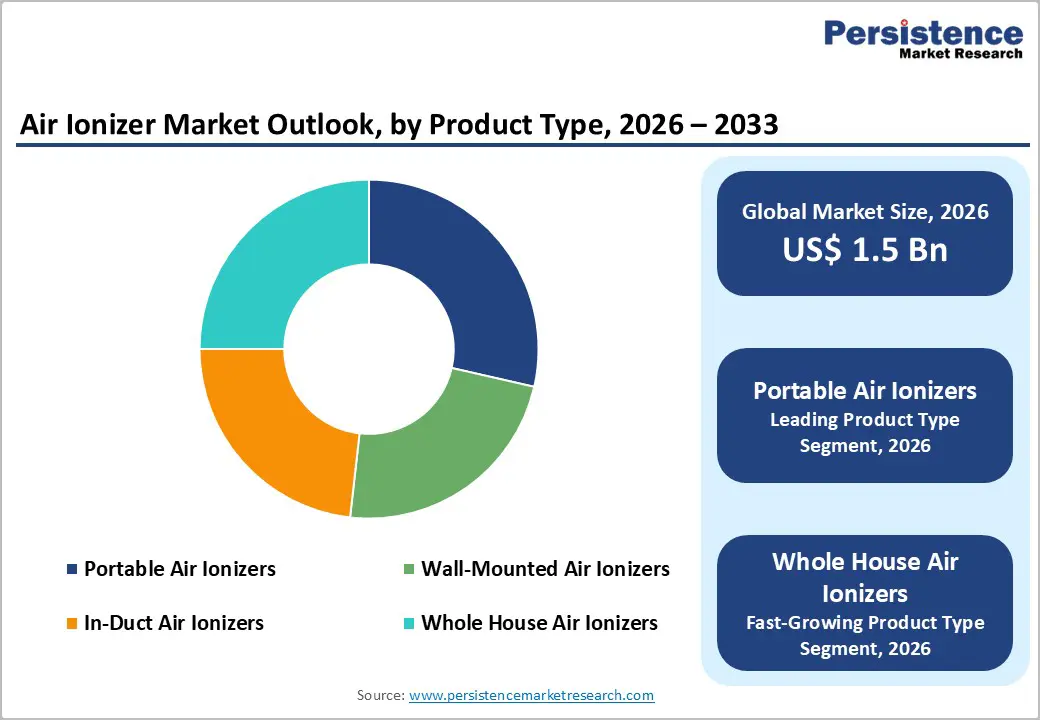
Portable air ionizers are dominant accounting for 45% share in 2025 due to their flexibility and ease of use across different indoor environments. Their compact design allows convenient placement in homes, offices, and personal spaces, making them a popular choice for individual air purification needs. Data from the U.S. Consumer Product Safety Commission indicates stronger consumer demand for portable models compared to fixed installations. Research published in the Journal of Aerosol Science also highlights their effectiveness in capturing airborne particles, further strengthening their adoption.
HVAC-integrated ionizers are emerging as the fastest-growing product type as buildings increasingly integrate purification technologies directly into ventilation systems. These systems provide whole-building air purification and are gaining attention in offices, hospitals, and commercial infrastructure. Growing demand for centralized indoor air quality management and advanced building automation systems is encouraging the adoption of integrated ionization solutions.
Technology Insights
Negative ionization technology holds the largest share of the air ionizer market, accounting for nearly 50% in 2025. This technology mimics the natural ionization process found in environments such as forests and waterfalls, where negatively charged ions help neutralize airborne contaminants. Studies conducted by NASA have shown that ionization can reduce bacteria and airborne particles while helping control odors. In addition, low-energy-consumption standards supported by Energy Star highlight the efficiency advantages of ion-based purification systems.
Plasma ionization technology is emerging as the fastest-growing segment due to its enhanced ability to neutralize microorganisms and volatile compounds. This technology is increasingly adopted in healthcare facilities, commercial buildings, and industrial environments where stricter air purification standards are required. Growing emphasis on infection control and advanced air treatment systems is accelerating their adoption across multiple sectors.
Features Insights
Smart functionality with IoT connectivity leads the air ionizer market, accounting for approximately 40% of the market share in 2025 as consumers increasingly adopt connected home devices. Integration with mobile applications, sensors, and automated air-quality monitoring enables users to track and control indoor air conditions in real time. According to insights referenced by Gartner, a growing proportion of smart home users prefer appliances connected to their digital ecosystems. UL testing also indicates improved operational efficiency through sensor-driven optimization.
Self-cleaning and low-maintenance ionizers are emerging as the fastest-growing feature segment as consumers prioritize convenience and long-term usability. These devices reduce the need for frequent cleaning or filter replacement, making them attractive for both residential and commercial environments. Increasing consumer preference for low-maintenance appliances and improved durability is supporting the expansion of this category.
Application Insights
Residential applications account for the largest share of the air ionizer market, at about 55% in 2025, as households increasingly prioritize healthier indoor environments. Growing concerns about allergens, pollution, and airborne pathogens are driving adoption of air purification solutions in homes. Surveys referenced by the European Environment Agency indicate that many households report improvements in indoor comfort after adopting air quality solutions. Studies in the Indoor Air Journal also highlight ionizers' ability to reduce particulate matter in enclosed living spaces.
Healthcare facilities are emerging as the fastest-growing application segment as hospitals and clinics strengthen infection control measures. Air ionization technologies are increasingly integrated into medical environments to help reduce airborne microbes and improve overall hygiene standards. Rising investment in healthcare infrastructure and stricter sanitation protocols are accelerating adoption within this segment.
End-user Insights
Households account for the largest share of the air ionizer market, holding approximately 48% in 2025 as consumers increasingly invest in personal air purification solutions. Rising awareness of indoor air quality and its health impacts has led more consumers to adopt ionizers for everyday use. Consumer Reports' product evaluations also emphasize their suitability for daily household use.
Commercial establishments are emerging as the fastest-growing end-user segment as businesses prioritize healthier environments for employees and visitors. Offices, retail stores, hospitality venues, and public buildings are increasingly installing advanced air purification systems to improve indoor air conditions. The growing emphasis on workplace wellness and building air quality standards is supporting rapid adoption in commercial spaces.
Regional Insights
North America Air Ionizer Market Trends and Insights
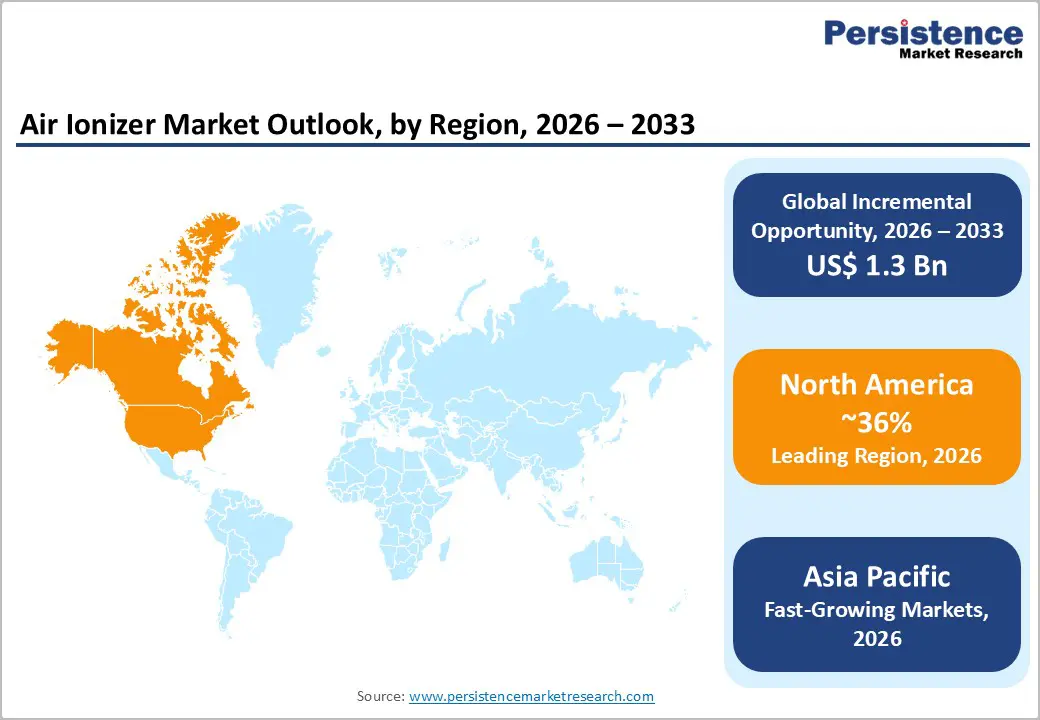
North America leads the global air ionizer market, accounting for about 35% share in 2025 due to strong awareness of indoor air quality and supportive regulatory frameworks. The United States plays a central role in regional demand as building standards increasingly emphasize healthier indoor environments. Programs from the U.S. Environmental Protection Agency and ventilation standards promoted by ASHRAE encourage the integration of advanced air purification technologies across residential and commercial infrastructure.
Technology development and regulatory oversight further strengthen the regional market. Certification requirements from the California Air Resources Board have accelerated the development of low-ozone ionizer technologies, particularly within innovation hubs such as California. Continuous research, rising smart home adoption, and consumer preference for advanced air purification solutions are supporting sustained demand across the region.
Europe Air Ionizer Market Trends and Insights
Europe represents a steadily expanding market for air ionizers, supported by strong environmental policies and rising focus on sustainable indoor environments. Countries such as Germany and the United Kingdom are actively promoting indoor air quality improvements through environmental regulations and public health initiatives. Regional policies linked to chemical safety and environmental sustainability, including frameworks from the European Chemicals Agency under the REACH regulation, are encouraging the use of cleaner air technologies.
The market in Europe is projected to grow at around a 9% CAGR during the forecast period as governments strengthen building efficiency and air quality standards. Initiatives such as the Energy Performance of Buildings Directive promote energy-efficient ventilation and purification systems. These policies, along with increasing awareness of urban pollution and indoor allergens, are supporting broader adoption of ionization-based air purification technologies across commercial and residential sectors.
Asia Pacific Air Ionizer Market Trends and Insights
Asia Pacific holds a significant position in the global air ionizer market with approximately 31% share in 2025 and continues to expand rapidly due to urbanization, industrialization, and rising air pollution concerns. Major economies such as China and India are key contributors as governments emphasize air quality improvements in urban centers. Policies led by the Ministry of Ecology and Environment of China are encouraging wider adoption of indoor air purification technologies.
The region also benefits from strong manufacturing capabilities and technological development. Japan remains a leader in advanced air purification technologies, while Southeast Asian economies are seeing increased demand driven by urban population growth and infrastructure expansion. Rising consumer awareness, increasing disposable income, and strong electronics manufacturing ecosystems are driving both domestic consumption and export growth across the Asia Pacific air ionizer market.
Competitive Landscape
The air ionizer market is moderately consolidated, with leading manufacturers maintaining strong positions through continuous product innovation, brand recognition, and global distribution networks. Companies are focusing on improving purification efficiency, reducing ozone emissions, and developing compact designs suited for residential and commercial environments. Investments in research and development are accelerating advancements in plasma ionization, sensor-based purification, and energy-efficient technologies.
Competition is also evolving through strategic partnerships, acquisitions, and expansion into smart home ecosystems. Manufacturers are integrating IoT connectivity, real-time air quality monitoring, and mobile app controls to enhance user experience. Additionally, emerging service-based models such as remote diagnostics, subscription-based air monitoring, and maintenance support are gradually reshaping competitive strategies across the industry.
Key Developments:
- In June 2025, Sharp Corporation launched a new IoT-integrated air ionizer series designed for smart home ecosystems, featuring advanced sensors and remote monitoring capabilities while complying with global ozone emission standards to improve indoor air quality and device safety.
- In March 2024, Honeywell International Inc. introduced plasma-based whole-house ionization units aimed at large residential and industrial environments, incorporating advanced purification technology and receiving certification from UL to ensure performance reliability and safety compliance.
- In November 2023, Dyson Ltd. unveiled a hybrid air purification system combining ionization and ultraviolet technology, designed to enhance indoor air purification efficiency while reducing allergens and microscopic airborne particles by up to 99.97% in controlled testing environments.
Companies Covered in Air Ionizer Market
- Sharp Corporation
- Honeywell International Inc.
- Dyson Ltd.
- Philips N.V.
- Panasonic Corporation
- Coway Co. Ltd.
- Blueair AB
- IQAir
- Alen Corporation
- Sylvane Inc.
Frequently Asked Questions
The global Air Ionizer market is expected to reach US$ 1.5 billion in 2026.
Rising health awareness and urbanization, with WHO noting 7 million air pollution deaths yearly, boost demand.
North America leads with 35% share in 2025, driven by EPA regulations.
IoT smart home integration, with 75 billion devices forecasted by 2025.
Leading companies include Sharp Corporation, Honeywell, and Dyson Ltd.


