




- Clothing, Footwear, & Accessories
- Agri Textiles Market
Agri Textiles Market Size, Trends, Share, and Growth Forecast 2026 - 2033
Agri Textiles Market by Product Type (Shade Nets, Mulch Mats, Anti-Hail Nets, Bird Protection Nets, Anti-Insect Nets, Fishing Nets, Others), Material (Nylon, Polyethylene (PE), Polypropylene (PP), Polyester, Natural Fibers, Others), Fabric (Woven, Knitted, Non-woven, Others), Application (Open-Field Agriculture, Horticulture & Floriculture, Aquaculture / Fisheries, Forestry, Other), and Regional Analysis from 2026 - 2033

Agri Textiles Market Size and Trend Analysis
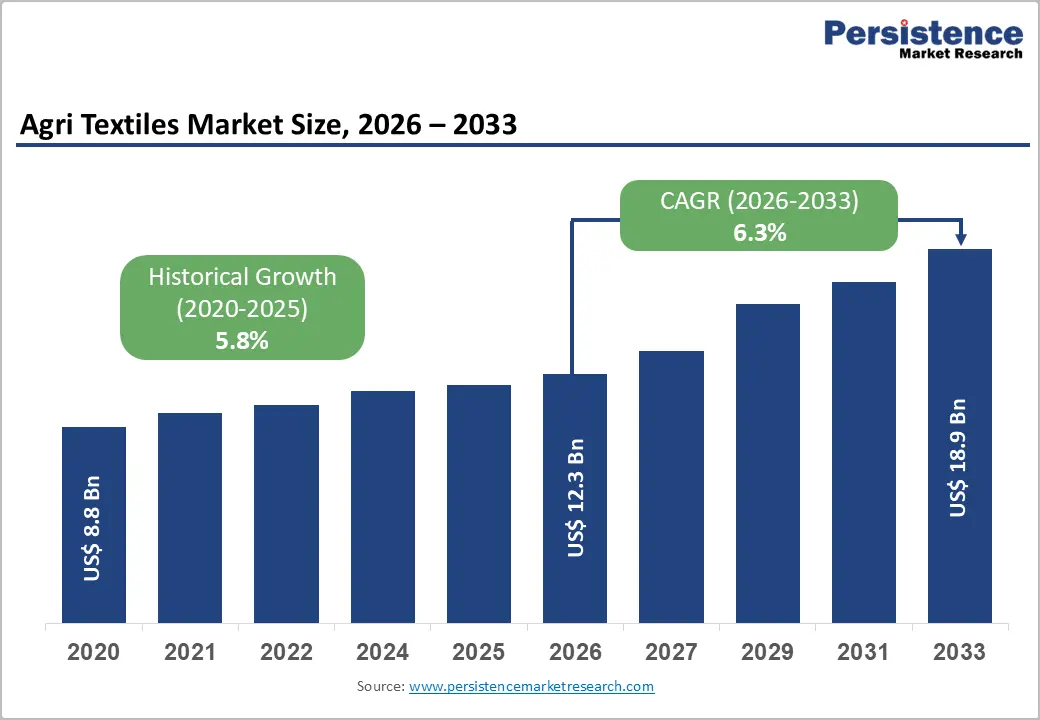
The global Agri Textiles Market size is expected to be valued at US$ 12.3 billion in 2026 and projected to reach US$ 18.9 billion by 2033, growing at a CAGR of 6.3% between 2026 and 2033.
The growth is supported by rising demand for sustainable, high-yield farming and wider adoption of protective textile solutions across agriculture and fisheries. Products such as shade nets, mulch mats, and anti-hail nets help reduce crop losses caused by weather and pests. With global crop losses estimated at 20–40%, farmers are increasingly adopting these solutions. Government initiatives like Pradhan Mantri Krishi Sinchayee Yojana further support market expansion
Key Industry Highlights:
- Leading Region: Asia Pacific leads the Agri Textiles Market with a 42% share in 2025, driven by large-scale agriculture and strong government support.
- Fastest Growing Region: Asia Pacific is also the fastest-growing region, projected to expand at a CAGR of 7.2% due to increasing farm modernization and aquaculture demand.
- Leading Product Category: Shade nets dominate the market with a 28% share in 2025, supported by widespread use in crop protection and microclimate control.
- Leading Material Category: Polyethylene (PE) leads with a 35% share in 2025, owing to its durability, UV resistance, and cost efficiency.
- Key Opportunity: Expansion of protected horticulture and aquaculture is creating strong growth opportunities for agri textiles driven by climate-resilient farming needs.
| Key Insights | Details |
|---|---|
|
Agri Textiles Size (2026E) |
US$ 12.3 billion |
|
Market Value Forecast (2033F) |
US$ 18.9 billion |
|
Projected Growth CAGR (2026-2033) |
6.3% |
|
Historical Market Growth (2020-2025) |
5.8% |
DRO Analysis
Driver - Growing Need for Climate-Resilient Crop Protection Textile Solutions
A major driver of the Agri Textiles Market is the rising need for effective crop protection amid climate variability and pest pressures. Protective solutions such as shade nets, anti-hail nets, and insect-proof fabrics help safeguard crops from extreme weather, excessive sunlight, and infestations, ensuring improved yield stability and product quality across agricultural systems.
According to the United Nations Environment Program, extreme weather events have increased significantly since 2000, intensifying crop risks globally. In India, Indian Council of Agricultural Research highlights that hail nets can reduce orchard damage by up to 70%. This growing risk environment is accelerating adoption, especially in high-value horticulture and export-oriented farming.
Expanding Government Incentives Supporting Sustainable Precision Agriculture Adoption
Government subsidies and policy support are accelerating agri-textile adoption by reducing cost barriers and promoting climate-smart agriculture. Many countries are encouraging protected cultivation systems, where textile-based solutions like mulch mats and greenhouse nets play a critical role in improving water efficiency, soil health, and crop productivity.
Programs such as the Common Agricultural Policy in Europe and initiatives by the United States Department of Agriculture provide financial assistance and technical support for sustainable farming technologies. Additionally, World Bank data indicates rising investments in protected agriculture infrastructure, particularly in the Asia Pacific, further driving demand for agri textiles across diverse farming applications.
Restraints - High Upfront Investment Barriers and Low Smallholder Awareness Levels
A key restraint in the Agri Textiles Market is the high initial cost of installing quality nets, mulch mats, and protective systems. For small and marginal farmers, these costs can be significantly higher than conventional inputs, limiting adoption despite long-term productivity benefits and improved crop protection outcomes.
According to International Fund for Agricultural Development, installation costs can be 20–30% higher per hectare, especially in regions with limited access to credit. Additionally, low awareness of product durability and return on investment leads to hesitation and suboptimal usage, particularly in developing economies dominated by smallholder farming systems.
Environmental Concerns and Limited Durability of Synthetic Agro Textiles
Environmental challenges related to synthetic materials are another major restraint affecting market growth. Most agri textiles are made from non-biodegradable polymers like polyethylene and polypropylene, contributing to plastic waste accumulation at the farm level when disposal and recycling systems are inadequate.
Assessments linked to Food and Agriculture Organization indicate that agricultural plastics form a notable share of farm waste in some regions, prompting stricter regulations. Additionally, exposure to UV radiation and harsh climatic conditions reduces product lifespan to around 2–3 years, increasing replacement costs and discouraging adoption among cost-sensitive farmers.
Opportunities - Growing Adoption of Protected Horticulture and High-Value Crop Cultivation
A major opportunity lies in expanding protected horticulture, where textile solutions enable better climate control, enhanced pest protection, and more efficient water use. Increasing demand for high-value crops such as fruits, vegetables, and flowers is encouraging farmers to adopt advanced cultivation techniques supported by agri textiles. According to the Food and Agriculture Organization, global horticultural output is expected to grow steadily, while initiatives such as India's National Horticulture Mission are promoting protected farming infrastructure. This is driving demand for innovative, lightweight, and UV-stabilized textile products suited for both small-scale and commercial greenhouse applications.
Rising Investments in Aquaculture Infrastructure and Fisheries Modernization
The modernization of aquaculture and fisheries presents a significant growth opportunity for agri textiles, particularly in nets and pond-lining solutions. Increasing global demand for sustainable protein sources is accelerating investments in efficient and controlled aquaculture systems supported by specialized textile materials.
Projections from the Food and Agriculture Organization indicate continued growth in aquaculture production, while policy frameworks like China 14th Five-Year Plan emphasize infrastructure upgrades. Additionally, regional efforts led by the ASEAN Secretariat are promoting advanced netting systems, including emerging smart textiles that enhance monitoring, productivity, and disease control.
Category wise Analysis
Product Type Insights
Shade nets dominated the product type segment and accounted for 28% of the global share in 2025. Their widespread adoption in open-field and greenhouse farming is driven by their ability to regulate light intensity, reduce heat stress, and protect crops from sunburn. Studies by the Indian Council of Agricultural Research highlight yield improvements of 25–30% in crops like tomatoes and flowers, reinforcing their strong market position.
Anti-insect nets are emerging as the fastest-growing product type due to growing concerns about pest resistance and reduced pesticide use. Farmers are shifting toward integrated pest management solutions, where insect-proof textiles play a crucial role in minimizing chemical dependency while maintaining crop quality, particularly in high-value horticulture and export-driven farming systems.
Material Insights
Polyethylene (PE) leads the material segment with an estimated 35% share in 2025, supported by its durability, UV resistance, and cost-effectiveness. It is widely used in manufacturing nets and mulch mats due to its lightweight nature and long functional lifespan. According to the Food and Agriculture Organization, UV-stabilized PE fabrics can last up to 4–5 years under varied climatic conditions, making them suitable for large-scale agricultural applications.
Biodegradable and natural fiber-based materials are gaining traction as the fastest-growing segment. Increasing environmental concerns and regulatory pressures on plastic usage are driving innovation in eco-friendly alternatives, encouraging farmers and producers to adopt sustainable materials that reduce long-term soil and environmental impact.
Fabric Insights
Woven fabrics hold the leading position in 2025, capturing around 32% of the market due to their superior tensile strength and durability. These textiles are extensively used in applications such as anti-hail nets and aquaculture systems where mechanical stability is essential. Standards referenced by the International Organization for Standardization indicate that woven structures can withstand significantly higher stress compared to other fabric types.
Non-woven fabrics are emerging as the fastest-growing segment, driven by their cost efficiency and versatility. They are increasingly used in mulch mats and crop covers, offering benefits such as moisture retention, weed suppression, and ease of installation, making them suitable for both smallholder and commercial farming applications.
Application Insights
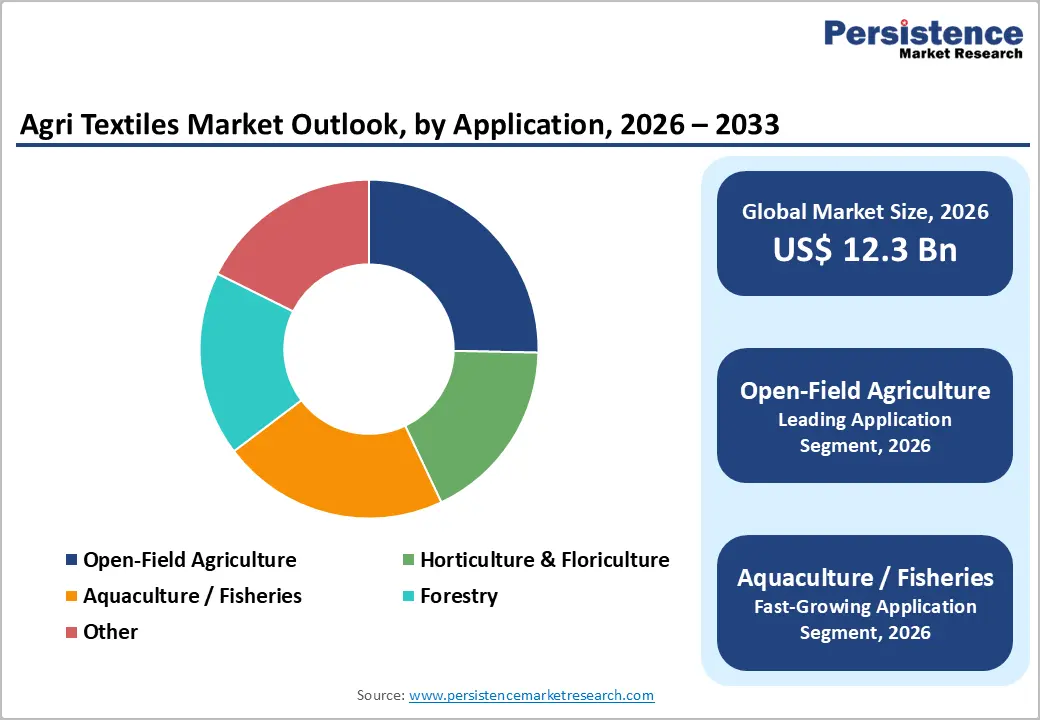
Open-field agriculture dominates the application segment, accounting for approximately 40% of the market in 2025 due to its extensive use in large-scale farming. Textile solutions like mulch mats and ground covers are widely adopted to improve soil health, reduce water evaporation, and control weeds. Insights from the World Resources Institute suggest that such systems can lower irrigation requirements by up to 30% in water-stressed regions.
Aquaculture and fisheries are the fastest-growing application segments, supported by rising global demand for seafood and sustainable protein sources. Advanced textile-based nets and liners are increasingly being used to enhance productivity, improve water management, and reduce disease risks, aligning with broader trends in modernized and technology-driven farming practices.
Regional Insights
North America Agri Textiles Market Trends and Insights
North America holds a significant share of the Agri Textiles Market, accounting for approximately 25% in 2025, with the United States leading regional demand. Adoption is strong in high-value horticulture and controlled environment agriculture, supported by programs from the United States Department of Agriculture. Around 15% of vegetable farms utilize protective nets and ground covers, particularly in states like California and Florida, reinforcing steady market penetration.
The region is witnessing rapid innovation driven by sustainability regulations and research initiatives. Guidelines from the Environmental Protection Agency promote recyclable and eco-friendly materials, encouraging manufacturers to develop advanced textile solutions. Collaborations with institutions such as the University of California further support yield improvements and reduced pesticide use, strengthening long-term adoption.
Europe Agri Textiles Market Trends and Insights
Europe represents a mature and regulation-driven market, supported by strong policy frameworks and growing adoption in horticulture and viticulture. Programs under the Common Agricultural Policy have accelerated the adoption of protective textiles, while countries such as Germany, Spain, and France are leading implementation across orchards and vineyards. Expansion of protected cultivation areas continues to drive steady regional demand.
The market is projected to grow at a CAGR of approximately 5.8% through the forecast period, driven by sustainability regulations and material innovation. Frameworks such as REACH are encouraging the adoption of recyclable and bio-based textiles. Government initiatives promoting climate-resilient agriculture further support demand for advanced agri-textile solutions across the region.
Asia Pacific Agri Textiles Market Trends and Insights
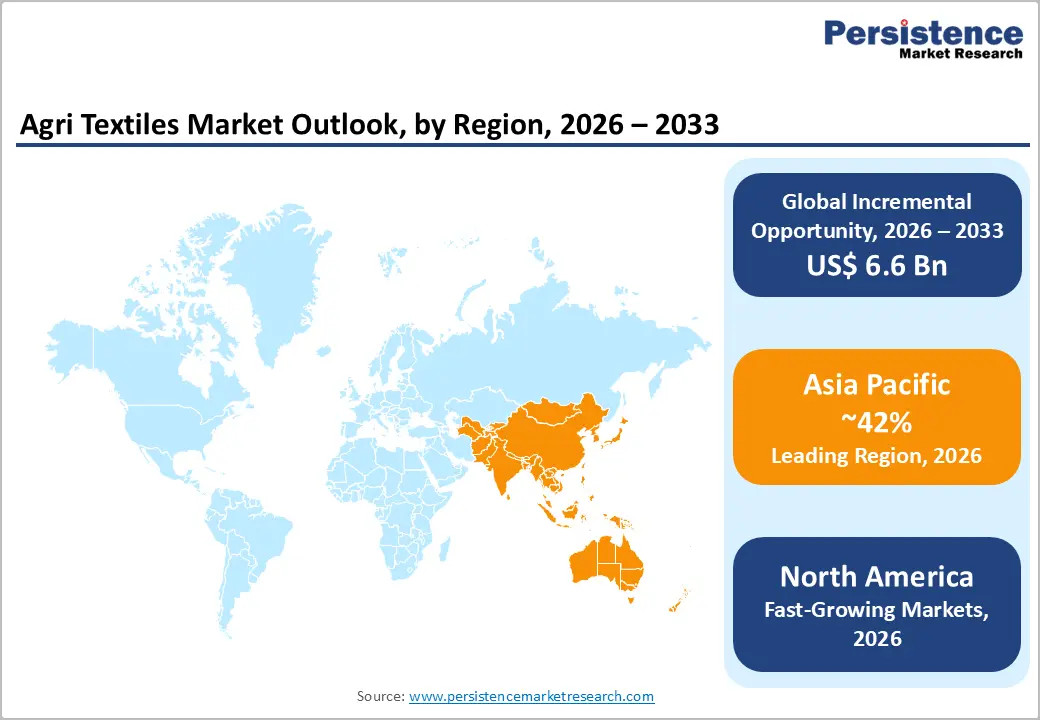
Asia Pacific dominates the global agri textiles market, with an estimated 42% share in 2025, driven by large-scale agricultural activity and expanding aquaculture. Countries like China and India are key contributors, with support from organizations such as the Indian Council of Agricultural Research promoting the adoption of shade nets and protective systems to enhance productivity and crop quality.
The region is also the fastest growing, supported by government-backed modernization programs and rising demand for efficient farming inputs. Initiatives led by the ASEAN Secretariat are accelerating adoption in aquaculture, while Japan and Southeast Asia focus on advanced textile technologies. Strong manufacturing capacity and policy support position the Asia Pacific as the primary growth engine.
Competitive Landscape
The global agri textiles market is moderately fragmented, comprising a mix of multinational corporations and numerous regional and local manufacturers. Market participants are increasingly focusing on expanding production capacities, particularly in high-growth regions, while diversifying product portfolios to include advanced textile solutions such as UV-stabilized, biodegradable, and performance-enhanced materials tailored for modern agricultural needs.
Competition is driven by continuous investment in research and development, enabling innovation in polymer technologies, coatings, and recyclable materials. Companies are also adopting service-oriented approaches, including flexible financing models and technical support, to improve accessibility for farmers. Integration of digital tools and precision agriculture solutions is further transforming the competitive landscape toward technology-driven offerings.
Key Developments:
- In March 2025, TenCate launched a new range of recyclable polyethylene (PE) shade nets designed to meet European Union green-product standards, emphasizing improved UV resistance and end-of-life recyclability.
- In July 2024, Freudenberg Performance Materials expanded its manufacturing facility in Asia to increase production capacity for non-woven agri-textile mats used in soil stabilization and erosion control.
- In November 2023, Asahi Kasei introduced a next-generation anti-insect net with reported 99% efficacy in limiting pest infiltration while maintaining high airflow, targeting high-value horticulture markets in Japan and Southeast Asia.
Companies Covered in Agri Textiles Market
- TenCate Geosynthetics
- Garware Technical Fibres Ltd.
- Beaulieu Technical Textiles
- SRF Limited
- B&V Agro Irrigation Co.
- Tama Plastic Industry
- Meyabond Industry & Trading Co., Ltd.
- Belton Industries, Inc.
- Neo Corp International Limited
- Hy-Tex (UK) Ltd.
- Diatex
- Zhongshan Hongjun Nonwovens Co., Ltd.
- CTM Agro Textiles Ltd.
- Rishi TechTex Ltd.
- Strata Geosystems Pvt. Ltd.
Frequently Asked Questions
The global Agri Textiles Market is projected to reach US$ 12.3 billion in 2026, driven by growing adoption of protective textile solutions.
Rising climate-induced crop losses, government support like Pradhan Mantri Krishi Sinchayee Yojana, and expansion of horticulture and aquaculture are key drivers.
Asia Pacific leads the market with a 42% share in 2025 due to strong agricultural activity and policy support.
Growth in protected horticulture and precision farming is a major opportunity driving demand for advanced agri textiles.
Key players include TenCate Geosynthetics, Freudenberg Performance Materials, Asahi Kasei, Low & Bonar, and Huesker.


