




- Clothing, Footwear, & Accessories
- U.S. Women’s Lingerie and Men’s Underwear Market
U.S. Women’s Lingerie and Men’s Underwear Market Size, Share, and Growth Forecast, 2026 - 2033
U.S. Women’s Lingerie and Men’s Underwear Market by Product Type (Women’s Lingerie, Men’s Underwear), Material Type (Nylon, Polyester, Spandex, Cotton, Others) , Age Group (Under 25, 26-35 Age Group, 36-45 Age Group, 46-55 Age Group, 56-65 Age Group, 65+ Age Group) , Size (Extra Small, Small, Medium, Large, Extra Large, Double XL, Triple XL) Distribution Channel (Offline, Online), and Regional Analysis for 2026 - 2033

U.S. Women’s Lingerie and Men’s Underwear Market Size and Trends Analysis
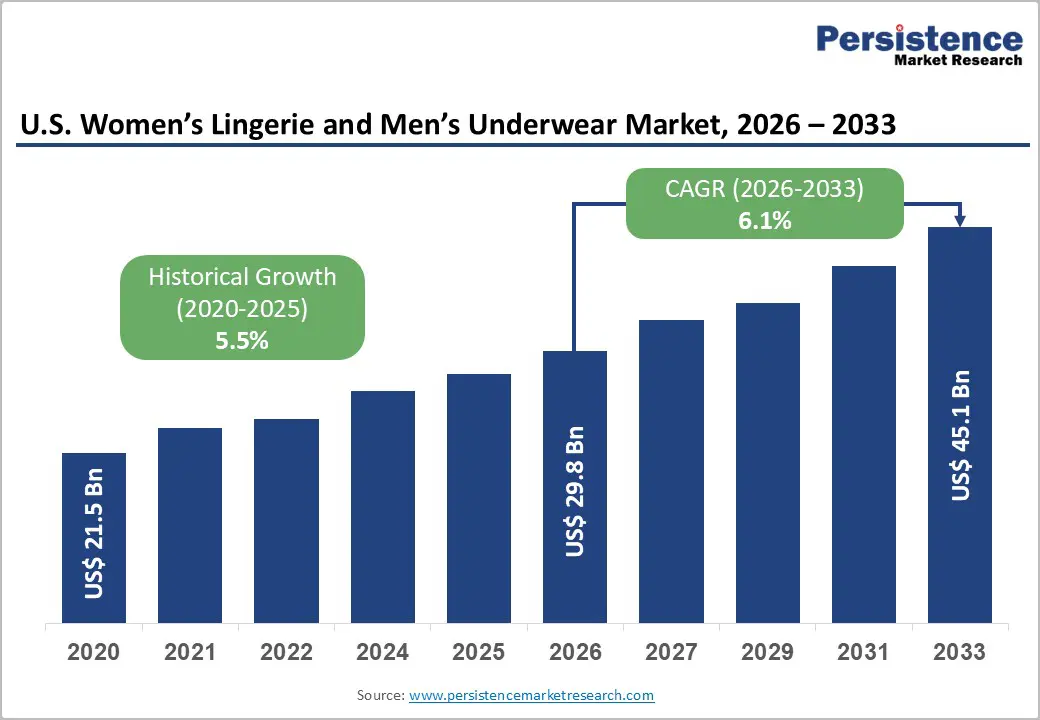
The U.S. Women's Lingerie and Men's Underwear Market size was valued at US$ 29.8 billion in 2026 and is projected to reach US$ 45.1 billion by 2033, growing at a CAGR of 6.1% between 2026 and 2033. This steady expansion is driven by evolving consumer preferences toward comfort-focused and inclusive product designs, accelerated e-commerce adoption enabling direct-to-consumer engagement, and demographic shifts supporting demand for gender-inclusive and sustainable intimate apparel.
The market's trajectory reflects fundamental shifts in consumer attitudes, with body positivity, functional innovation, and personalized fit now prioritized over traditional, aesthetic-centric lingerie and underwear categories. With retail partnerships expanding across digital and physical channels, brands are leveraging technological innovation in fabric development, size-inclusive offerings, and marketing strategies that emphasize authenticity to meet evolving consumer expectations.
Key Industry Highlights:
- Leading Distribution Channel: Offline retail channels hold the largest share at 58% in 2026, supported by in-person fitting services, tactile fabric evaluation, and immediate purchase gratification.
- Dominant Product Category: Women’s lingerie accounts for 69% of the market, driven by extensive product diversity, higher unit prices, and style-conscious consumer preferences.
- Fastest-Growing Segment: Men’s underwear represents the fastest-growing category, fueled by premium innovations, advanced fabric technologies, anatomical designs, and successful brand entries.
- Trend-Driven Demand: Growth is driven by digital-first strategies, personalized fit solutions, subscription models, and growing consumer comfort with online purchases of intimate apparel.
- Emerging Market Opportunities: Opportunities are expanding through eco-conscious materials, sustainable manufacturing, direct-to-consumer e-commerce, virtual try-on technologies, and brand-led digital expansion.
| Key Insights | Details |
|---|---|
| U.S. Women’s Lingerie and Men’s Underwear Market Size (2026E) | US$ 29.8 Bn |
| Market Value Forecast (2033F) | US$ 45.1 Bn |
| Projected Growth (CAGR 2026 to 2033) | 6.1% |
| Historical Market Growth (CAGR 2020 to 2025) | 5.5% |
Market Dynamics
Growth Drivers
E-commerce Infrastructure Expansion and Digital Retail Partnership Development
The strategic expansion of e-commerce platforms and digital retail partnerships creates substantial accessibility and market reach opportunities for intimate apparel brands within the U.S. Women's Lingerie and Men's Underwear Market, enabling direct-to-consumer engagement, personalized shopping experiences, and geographic expansion without physical retail investment. Victoria's Secret & Co. significantly expanded its digital presence on June 6, 2023, by launching over 4,000 bras, underwear, lingerie, and apparel products on Amazon, marking the first time its lingerie and apparel styles became available through a major retail partner in North America, offering fast Prime delivery and Try Before You Buy options.
This strategic shift responded to competitive pressure from Walmart, Target, and Amazon while addressing consumer preferences for convenient online shopping experiences with hassle-free returns. Knix achieved nine-figure U.S. revenue through e-commerce channels before expanding into wholesale partnerships with retailers such as Bloomingdale's in November 2025.
Digital platforms enable brands to offer comprehensive size ranges, personalized fit recommendations through virtual fitting technologies, and direct customer feedback mechanisms informing product development. The e-commerce expansion addresses consumer preferences for privacy in intimate apparel purchases, provides access to specialized products unavailable in traditional retail formats, and enables subscription models ensuring recurring revenue streams, positioning digital retail as a critical growth driver within the U.S. Women's Lingerie and Men's Underwear Market.
Sustainable Manufacturing and Eco-Conscious Material Innovation Adoption
The adoption of sustainable manufacturing practices and the development of eco-conscious materials in intimate apparel production address consumer environmental concerns while differentiating brands in the increasingly competitive U.S. Women's Lingerie and Men's Underwear Market. Fruit of the Loom launched its Fruitful Threads™ Men's Underwear Collection in April 2023, featuring sustainable LENZING™ ECOVERO™ fibers made from certified renewable wood resources, promoting eco-friendly manufacturing with up to 50% lower CO2 emissions and water footprint than conventional production methods.
The collection included boxer briefs and trunks with contour-darted pouches, gussets, and flat seams, available in six colors and sold in three-packs at $19.99 through Fruit.com, Walmart, and Amazon. Step One entered the U.S. men's underwear market in September 2023, introducing a size-inclusive, sustainable line featuring moisture-wicking bamboo viscose fabric, emphasizing ethical manufacturing with BSCI and SA8000-certified factories, compostable packaging, and sizes from S to 6XL.
These sustainability initiatives respond to consumer demand for environmentally responsible products, regulatory pressures on the textile industry's environmental impact, and opportunities for competitive differentiation in increasingly commoditized intimate apparel categories. Brands that implement sustainable practices benefit from premium pricing opportunities, enhanced brand loyalty among environmentally conscious consumers, and reduced regulatory risks, thereby establishing sustainability as a strategic priority in the U.S. Women's Lingerie and Men's Underwear Market.
Market Restraining Factors
Gender-Based Tariff Disparities and Regulatory Cost Implications
The U.S. tariff structure imposes significantly higher average duties on women's underwear compared to men's products, creating pricing disadvantages and competitive challenges for women's lingerie manufacturers and retailers. According to a CNN-covered analysis by the U.S. Government and Progressive Policy Institute released on February 5, 2025, U.S. tariff policy imposes average duties of 15.5 percent on women's underwear versus 11.5 percent on men's products, effectively increasing retail costs by roughly $1.10 per pair for women compared to $0.75 for men. These regulatory cost disparities disproportionately affect women's lingerie brands, reducing their price competitiveness relative to men's underwear and constraining margins.
The tariff differential complicates pricing strategies, particularly for brands offering both women's and men's product lines and creates potential consumer backlash regarding perceived gender-based pricing inequities, limiting market expansion opportunities and profitability within the women's lingerie segment.
Key Market Opportunities
Men's Underwear Category Innovation and Premium Segment Development
The men's underwear category presents substantial opportunities for innovation-driven growth in the U.S. Women's Lingerie and Men's Underwear Market through advanced fabric technologies, anatomical design features, and premium positioning that address unmet consumer needs for comfort, performance, and style. Multiple brands launched innovative men's underwear solutions between 2019 and 2025, introducing patented technologies and functional features, transforming traditionally commoditized product categories.
SAXX expanded into the U.S. premium men's underwear market in July 2019 through a strategic partnership with McCann Canada, leveraging patented BallPark Pouch™ technology, Three-D Fit™, and Flat-Out Seams, offering innovative boxers, boxer briefs, performance wear, and swimwear designed for comfort and support.
Step One entered the U.S. market in September 2023 with features including 3D elastic pouches, Ultra-Glyde Panels reducing friction, and moisture-wicking bamboo viscose fabric, addressing common issues like chafing and ride-up. PVH Corp. announced strategic men's underwear licensing agreement with Nike in May 2019, leveraging expertise through Calvin Klein and Tommy Hilfiger brands to expand Nike-branded men's intimates’ offerings.
Calvin Klein launched its Spring 2024 collection featuring refreshed classic designs with new logo treatments and innovative materials including intense power, micro stretch, and micro mesh, emphasizing stylish everyday comfort. These innovations demonstrate substantial opportunities for premium positioning, technology-driven differentiation, and performance-oriented product development capturing consumer willingness to pay premium prices for superior comfort, durability, and functionality within the U.S. Women's Lingerie and Men's Underwear Market.
Digital-First Brand Development and Direct-to-Consumer Business Models
The maturation of e-commerce infrastructure and consumer comfort with online purchases of intimate apparel enable digital-first brand development strategies that deliver superior unit economics, direct customer relationships, and agile product development cycles in the U.S. Women's Lingerie and Men's Underwear Market. Digital-native brands avoid substantial fixed costs associated with physical retail operations, enabling investment to be redirected toward product innovation, customer acquisition, and brand building while maintaining competitive pricing.
Victoria's Secret's Amazon expansion on June 6, 2023, launching over 4,000 products, marked the first time its lingerie and apparel became available through a major retail partner, demonstrating established brands' recognition of digital platform importance. Bonds made its U.S. debut in April 2025, bringing the iconic Australian underwear brand's "Made for Down Under" comfort to American consumers, featuring comprehensive ranges for men and women with sizes XS–XXL for women, S–3XL for men, and 32A–38DD for bras, supported by national marketing across digital, social, out-of-home, and television channels.
Digital platforms enable subscription models, personalized fit recommendations through data analytics, virtual try-on technologies, and direct customer feedback mechanisms informing product development, creating competitive advantages unavailable through traditional wholesale distribution. Brands leveraging direct-to-consumer models capture higher margins, build proprietary customer databases enabling targeted marketing, and maintain pricing control, avoiding wholesale margin structures, positioning digital-first strategies as critical opportunities within the U.S. Women's Lingerie and Men's Underwear Market.
Category-wise Analysis
Product Type Insights
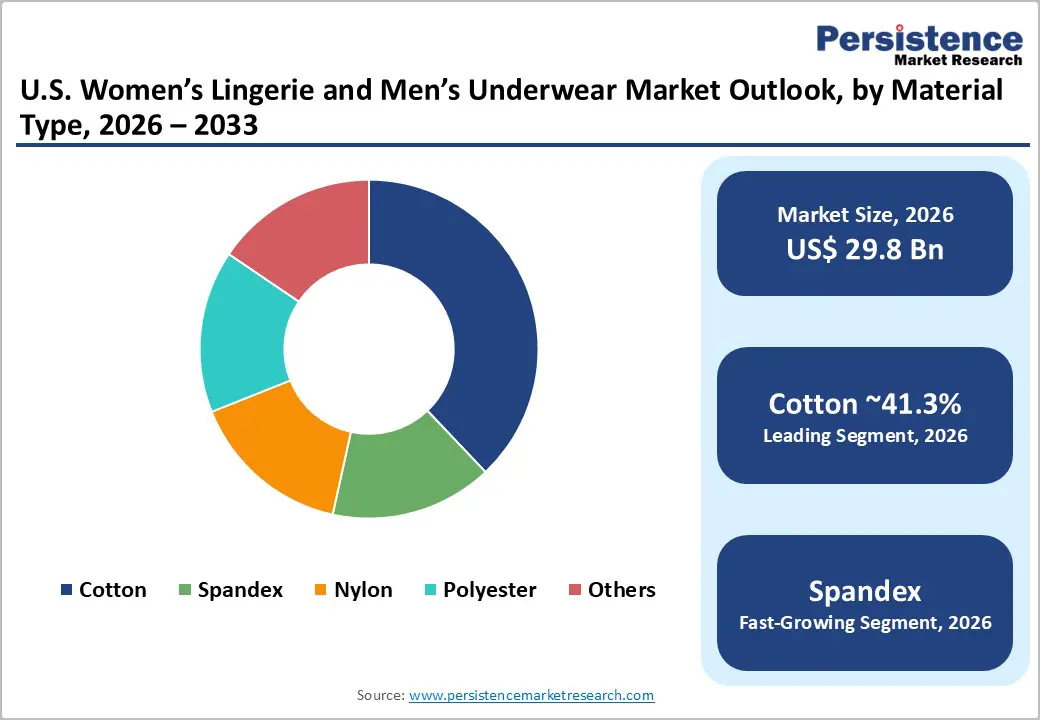
Women's Lingerie dominates the U.S. Women's Lingerie and Men's Underwear Market, accounting for 69% of the market in 2026. The segment's market leadership stems from higher average unit prices than men's underwear, greater purchase frequency driven by style preferences, and substantial product innovation that addresses diverse consumer requirements, ranging from everyday comfort to special occasions. The segment benefits from continuous innovation in comfort technologies, inclusive sizing initiatives and body-positive marketing strategies resonating with contemporary consumer values, maintaining women's lingerie as the dominant category despite evolving market dynamics.
Men's Underwear represents the fastest-growing segment within the U.S. Women's Lingerie and Men's Underwear Market, driven by premium product innovation, expanded retail distribution, increased consumer awareness of functional benefits, and successful category entries by established women's intimate apparel brands. The segment's accelerated growth reflects substantial product advancements beyond traditionally commoditized basic underwear toward technology-enhanced, performance-oriented, and style-conscious offerings that command premium prices.
Hanes launched its inclusive "Every Bod" men's underwear advertising campaign in December 2020, marking notable shifts toward body-positive marketing and diversity in the domestic men's underwear segment. MANSCAPED celebrated National Underwear Day in August 2020 by promoting best-selling men's boxers, emphasizing comfort, breathability, and performance-oriented features, including temperature control, anti-chafing protection, and no-roll waistbands.
Strategic licensing agreements, including PVH Corp.'s partnership with Nike in May 2019, expanded branded men's underwear offerings, leveraging expertise from Calvin Klein and Tommy Hilfiger brands. The men's underwear category benefits from reduced price sensitivity among consumers who recognize functional innovation value, expanded distribution through digital channels, and successful premium positioning strategies, thereby establishing the segment as the fastest-growing category through 2033.
Distribution Channel Insights
Offline distribution channels command 58% of the U.S. Women's Lingerie and Men's Underwear Market in 2026, reflecting persistent consumer preferences for in-person fitting, tactile fabric evaluation, and immediate purchase gratification when selecting intimate apparel. Physical retail encompasses department stores, specialty lingerie boutiques, mass merchandisers, and brand-operated stores providing personalized fitting services, comprehensive product assortments, and hands-on shopping experiences, particularly valued for complex products like bras requiring precise sizing.
Knix's expansion strategy in November 2025 included new U.S. retail and wholesale partnerships with retailers such as Bloomingdale's, demonstrating the successful integration of digital-native brands into traditional retail channels. Bonds' U.S. debut in April 2025 featured comprehensive marketing across digital, social, out-of-home, and television channels supporting physical retail distribution. Traditional retailers maintain advantages, including established customer traffic, shopping convenience integrated with broader apparel purchases, and reduced return rates through in-person fitting expertise.
Online distribution is the fastest-growing channel in the U.S. Women's Lingerie and Men's Underwear Market, driven by greater consumer comfort with digital intimate apparel purchases, improved virtual fitting technologies, convenient return policies, and exclusive product offerings unavailable through traditional retail channels. Digital platforms enable a comprehensive size range availability, personalized product recommendations, discreet purchasing experiences, and direct-to-consumer engagement supporting brand loyalty.
Competitive Landscape
The U.S. Women’s Lingerie and Men’s Underwear market is moderately consolidated, with a blend of mass-market giants and premium lifestyle brands competing across retail and digital channels. A few major players command significant shelf presence, including Victoria’s Secret & Co., Hanesbrands Inc., PVH Corp. (Calvin Klein), Jockey International, and Fruit of the Loom, creating an environment where scale, brand equity, and distribution power matter.
The market also features rising premium and direct-to-consumer labels such as Skims and ThirdLove, intensifying competition in fit-focused and comfort-driven subcategories. While dominant incumbents leverage large retail networks and legacy brand trust, new entrants increasingly differentiate through sizing inclusivity, seamless fabrics, and eco-friendly materials. The ongoing shift toward e-commerce, personalization, and athleisure-inspired innerwear is reshaping competitive dynamics.
Key Industry Developments
- Nov 13, 2025, Knix launched its first men’s underwear line in North America, expanding beyond women’s lingerie with moisture-blocking “Pristine Pouch” technology, supported by nine-figure U.S. revenues and new U.S. retail/wholesale partnerships (e.g., Bloomingdale’s), strengthening its position in the U.S. women’s lingerie & men’s underwear market.
- September 18, 2023, Step One entered the U.S. men’s underwear market, introducing a size-inclusive, sustainable line featuring 3D elastic pouches, Ultra-Glyde Panels, and moisture-wicking bamboo viscose fabric, emphasizing ethical manufacturing and inclusivity, marking a significant push for comfort, innovation, and sustainability in the U.S. men’s underwear segment.
Companies Covered in U.S. Women’s Lingerie and Men’s Underwear Market
- Marks & Spencer Group plc
- Victoria’s Secret & Co.
- Calvin Klein Inc. (PVH Corp.)
- Elle
- ThirdLove Inc.
- Adidas
- Knix Inc.
- Nike
- Wacoal America, Inc.
- FULLBEAUTY Brands
- Hanky Panky, Inc.
- Commando LLC
- Jockey International, Inc.
- Hanesbrands Inc.
- Saxx Underwear
- Skims Inc.
- Fruit of the Loom, Inc.
- Cass and Company, LLC
- PVH Corp. (Philips-Van Heusen Corporation)
- HUGO BOSS Fashions, Inc.
- Ralph Lauren Corporation
- Under Armour, Inc.
- American Eagle Outfitters, Inc. (AEO Inc.)
Frequently Asked Questions
The U.S. Women’s Lingerie and Men’s Underwear Market is projected to be valued at US$ 29.8 Bn in 2026.
The Women’s Lingerie segment is expected to account for approximately 69.0% of the U.S. Women’s Lingerie and Men’s Underwear Market by Product Type in 2026.
The market is expected to witness a CAGR of 6.1% from 2026 to 2033.
E-commerce expansion, digital retail partnerships, and sustainability-focused material innovation are the primary drivers of U.S. Women’s Lingerie and Men’s Underwear market growth.
The key market opportunities in the U.S. Women’s Lingerie and Men’s Underwear Market lie in premium and innovation-driven men’s underwear with advanced fabrics and functional designs, and in digital-first, direct-to-consumer strategies enabling personalized, agile, and high-margin brand growth.
Key players in the U.S. Women’s Lingerie and Men’s Underwear Market include Victoria’s Secret & Co., Hanesbrands Inc., PVH Corp. (Calvin Klein), Jockey International, and Fruit of the Loom.


