




- Specialty & Fine Chemicals
- Silica Gel Market
Silica Gel Market Size, Trends, Share, and Growth Forecast, 2025 - 2032
Silica Gel Market by Product Type (Precipitated Silica, Fumed Silica, Fused Silica, Silica Gel, and Colloidal Silica), Pore Size (Fine Pore (Type A), Medium Pore (Type B) and Wide Pore (Type C), by Application (Chromatography, Catalyst Support, Paints & Coatings, Plastic, Desiccants, and Personal Care Products) and Regional Analysis for 2025 - 2032

Silica Gel Market Size and Trends Analysis
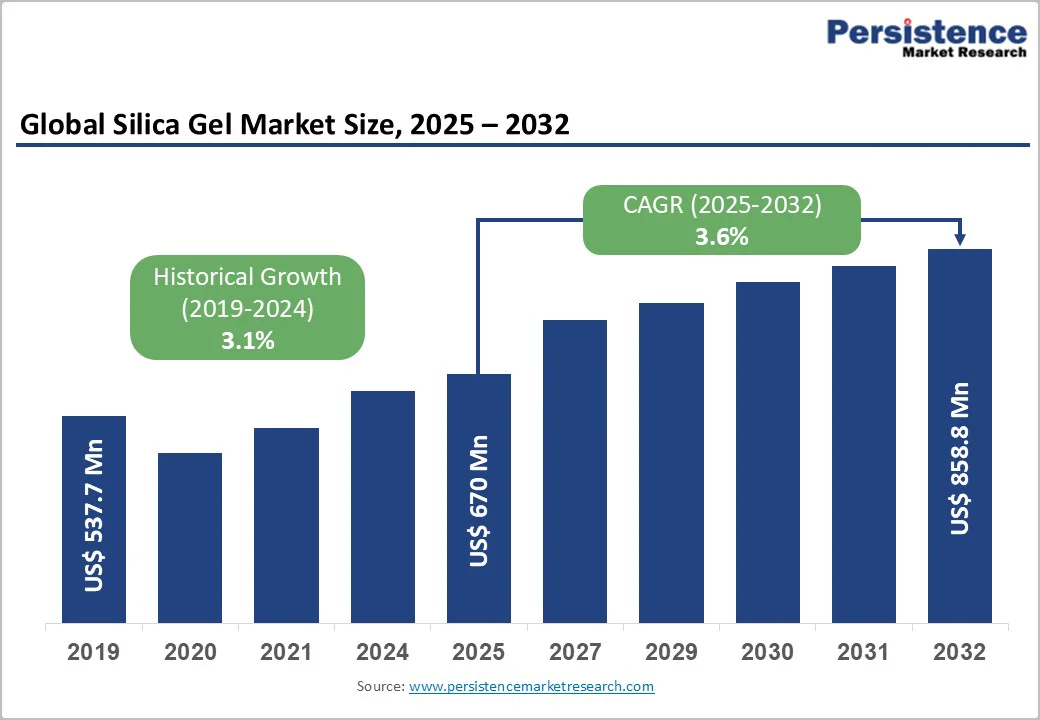
The global silica gel market size was valued at US$ 670.0 million in 2025 and is projected to reach US$ 858.1 million, growing at a CAGR of 3.6% between 2025 and 2032.
The expansion reflects accelerating demand for moisture control solutions across pharmaceutical, food, electronics, and industrial applications, driven by rising global trade complexity, increasing e-commerce adoption requiring protective packaging, and pharmaceutical industry growth, particularly in emerging markets.
Key Industry Highlights:
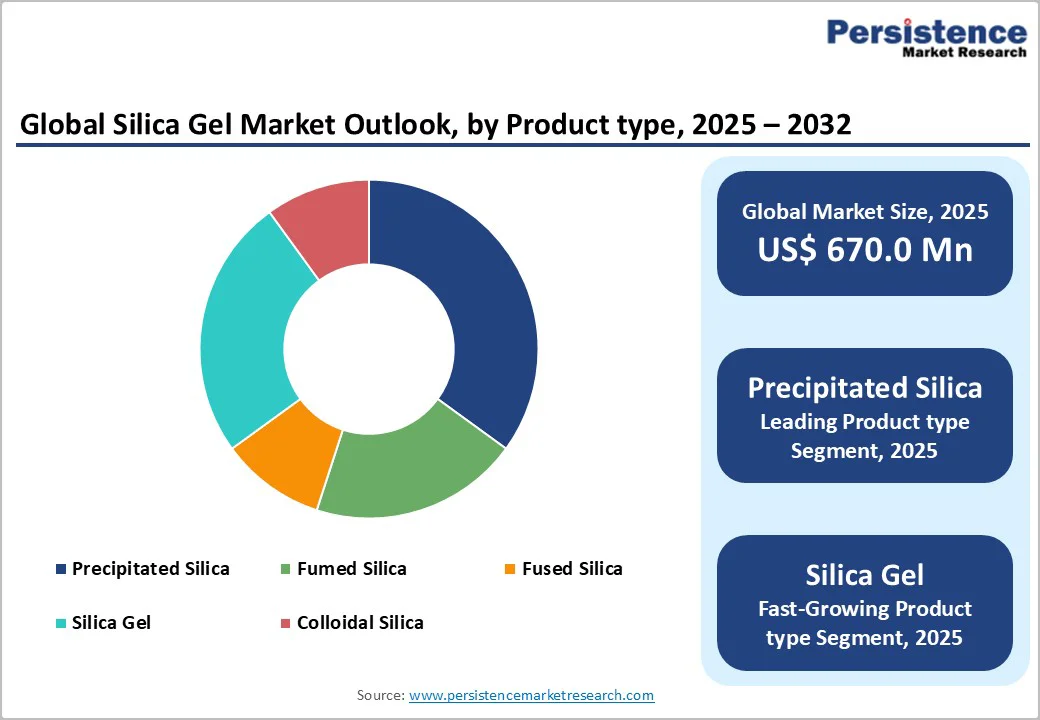
- Product Type Segmentation Leadership: Precipitated silica dominates with 34% market share, driven by extensive use in tire manufacturing, rubber reinforcement, and personal care formulations, while silica gel represents the fastest-growing segment (7-9% CAGR), supported by rising demand in chromatography, catalyst support, and advanced separation media applications commanding premium pricing.
- Pore Structure Dynamics: Wide pore (Type C) silica leads with 36.4% share through industrial gas drying and protein adsorption applications, whereas medium pore (Type B) variants achieve the fastest growth (5% CAGR) driven by liquid adsorbent usage and evolving moisture control requirements across electronics and pharmaceutical packaging.
- Application Market Trends: Desiccant applications dominate with 60% global volume share through critical roles in pharmaceuticals, food preservation, and electronics protection, while specialized uses such as chromatography and catalyst supports capture 15% of value share, benefiting from high-performance and precision requirements.
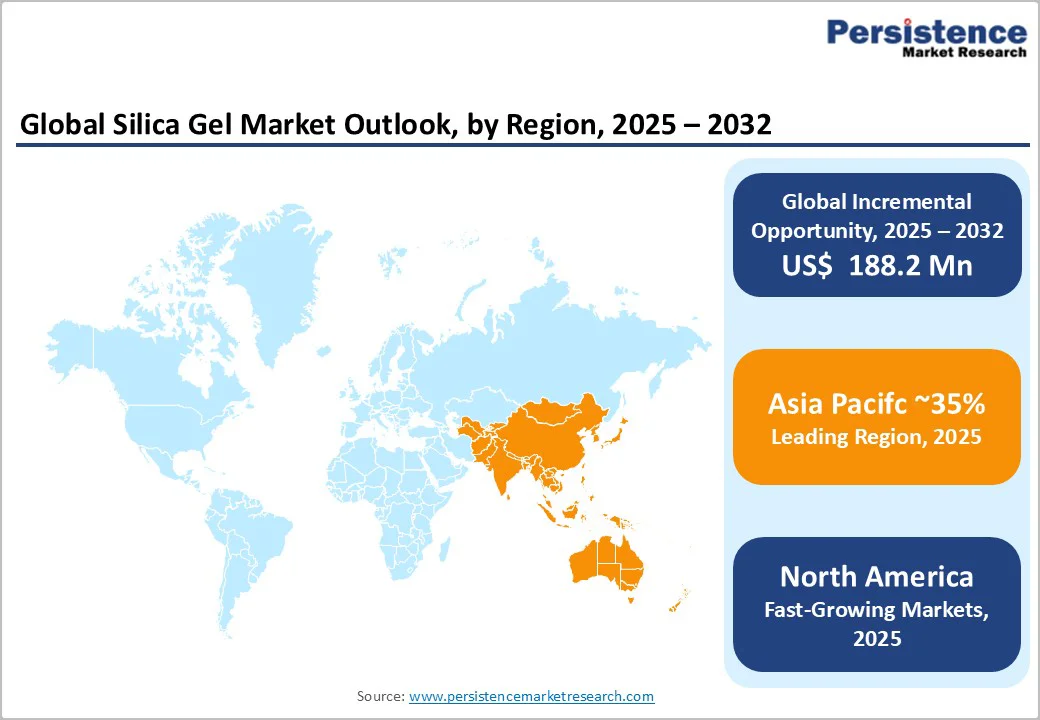
- Regional Growth Patterns: Asia Pacific leads with 35% global share, expanding at 8.5% CAGR, led by China (48% regional share) and India (6.0% CAGR) through robust pharmaceutical and industrial expansion. North America sustains growth at 5.2% CAGR via pharmaceutical innovation, while Europe progresses at 4.8% CAGR, emphasizing sustainability-driven silica adoption.
- Strategic Market Developments: Evonik dominates with its comprehensive AEROSIL portfolio, alongside strong competition from Cabot, Tokuyama, and W.R. Grace. The Evonik-Wynca joint venture in China (2026) strengthens regional production and supply capabilities, reinforcing Asia Pacific’s leadership and supporting long-term silica market expansion
| Key Insights | Details |
|---|---|
| Silica Gel Market Size (2025E) | US$ 670.0 Mn |
| Market Value Forecast (2032F) | US$ 858.1 Mn |
| Projected Growth (CAGR 2025 to 2032) | 3.6% |
| Historical Market Growth (CAGR 2019 to 2024) | 3.1% |
Market Dynamics
Drivers - Rising Global Trade and E-Commerce Growth Driving Protective Packaging Demand
Explosive growth in international logistics, cross-border e-commerce transactions, and supply chain complexity create unprecedented demand for reliable moisture protection throughout extended transit periods and varied environmental conditions.
E-commerce market expansion reaching $5.8 trillion globally with 25-30% annual growth in emerging markets amplifies exposure of packaged goods to temperature and humidity fluctuations during extended shipping cycles, creating sustained silica gel demand for protective packaging.
Logistics and shipping applications representing 3.2% of desiccant market penetration demonstrate growing industry recognition of silica gel's critical role in preventing moisture damage during international transport across diverse climates and transit timeframes.
Electronics shipments increasingly incorporate silica gel desiccants preventing condensation-induced corrosion on circuit boards and components during multi-month transit periods to remote markets, with semiconductor and electronics sectors consuming 15-20% of total silica gel supply.
Pharmaceutical Industry Expansion and Moisture-Sensitive Formulation Growth
Pharmaceutical industry growth at 6-8% CAGR with rising complexity of biologics, enzyme formulations, and moisture-sensitive drugs creates exponential demand for silica gel desiccants, ensuring medication stability, potency preservation, and regulatory compliance throughout multi-year shelf-life periods.
Pharmaceutical applications commanding 26.4% share of desiccant market reflect universal requirement for silica gel in packaging antibiotics, aspirin formulations, gelatin capsules, and specialized medications where even minor moisture exposure causes hydrolytic degradation, rendering products therapeutically ineffective.
Silica gel's high adsorption capacity (30% by weight), chemical inertness preventing pharmaceutical interactions, and ability to maintain 20% relative humidity in sealed containers directly address the pharmaceutical industry's stringent moisture control requirements.
The pharmaceutical market expansion in booming economies, particularly in India and China, combined with a 12+ billion population, drives silica gel demand as domestic manufacturers scale production to meet international quality standards and export requirements.
Restraint - Raw Material Price Volatility and Supply Chain Constraints
Silica gel manufacturing, dependent on sodium silicate(water glass) and sulfuric acid sourcing, faces commodity price fluctuations correlating with crude oil markets and industrial chemical pricing cycles, creating cost unpredictability, constraining profit margins.
Silica gel production scale challenges small to mid-sized manufacturers, lacking integrated raw material sourcing, limiting supply chain efficiency, with larger players controlling 40% market, commanding purchasing economies of scale unavailable to regional competitors.
US-China trade tariffs and import restrictions from traditional suppliers, including Thailand and Belgium, create regional supply disruptions affecting the pharmaceutical and food packaging sectors, with estimated 15-25% cost increases. Manufacturing capacity constraints in developing regions limit production scaling to match demand growth, with capacity utilization rates of 70-80% creating bottlenecks during peak demand seasons.
Health Hazards and Regulatory Compliance Challenges
Silica gel's crystalline silica dust exposure during manufacturing and handling creates workplace respiratory hazard concerns requiring comprehensive OSHA compliance, ventilation systems, and protective equipment, increasing operational costs 10-15% for compliant manufacturers.
Respirable crystalline silica classification as a carcinogenic material by IARC necessitates stringent manufacturing controls, worker protection programs, and medical monitoring, creating liability exposure and regulatory compliance burden, particularly for small-to-medium enterprises lacking resources for comprehensive occupational health infrastructure.
Indicator silica gel containing cobalt chloride health concerns, including potential allergenicity restrictions, drive transition toward safer cobalt-free formulations requiring product reformulation investments.
Regulatory fragmentation across regions including different classification standards for desiccant purity, contaminant limits, and food-contact safety specifications, creates compliance complexity requiring market-specific product variants, increasing inventory management complexity and production costs.
Opportunity - Emerging Market Infrastructure Development and Industrialization
Rapidly developing economies in the Asia Pacific, Latin America, and Africa are constructing modern manufacturing infrastructure, pharmaceutical production facilities, and food processing plants, creating substantial silica gel demand as industrial base expansion scales across developing regions.
India's pharmaceutical industry, representing 16% of global generic drug production with 60+ billion tablets manufactured annually, drives proportional silica gel demand for moisture protection throughout manufacturing, packaging, and distribution.
China's 6.5% CAGR silica gel demand growth through expansion of automotive electronics, pharmaceutical manufacturing, and food production, supporting domestic consumption alongside export markets, positions the region as a critical demand hub.
Developing nation infrastructure, including cold chains for pharmaceutical distribution, food export capabilities, and electronics manufacturing expansion, creates silica gel opportunities as quality standards and international compliance requirements drive adoption of moisture protection technologies.
Advanced Applications and Specialized Material Innovation
Emerging applications, including catalyst support in chemical reactions, chromatography separation media, and specialized adsorption processes, create high-value market opportunities commanding significant price premiums, justifying manufacturer R&D investments.
Silica gel as a heterogeneous catalyst support in pharmaceutical synthesis, fine chemistry, and photocatalysis applications, achieves 40% reaction efficiency improvements, enabling cost-effective processes previously requiring expensive homogeneous catalysts.
Chromatography silica gel market expansion through laboratory automation, pharmaceutical testing, and environmental analysis drives demand for specialized high-purity formulations with precisely controlled pore distributions.
Investment casting binder applications utilizing colloidal silica and silica gel for aerospace and automotive components create high-value opportunities supporting advanced manufacturing sectors. Smart desiccant innovations incorporating indicator technology providing visual humidity level feedback expand adoption in high-value applications, including precision electronics, aerospace components, and medical devices.
Category-wise Analysis
Product Type Insights
Precipitated silica dominates with a 34% share, driven by extensive use in tire manufacturing, personal care, and food processing applications, where high absorption capacity and cost efficiency deliver strong value. In automotive tires, precipitated silica enhances grip and durability while enabling 15% weight reduction and improved fuel efficiency, aligning with global sustainability goals.
Personal care products such as toothpaste and cosmetics leverage their mild abrasiveness and whitening properties, with oral care alone accounting for 15% of total consumption.
Silica gel is the fastest-growing segment (7% CAGR), expanding from desiccants into chromatography, catalyst support, and advanced separations. Renewable, rice-husk-based silica gels, achieving comparable performance and lower environmental impact, drive sustainable adoption and premium market growth.
Pore Size Type Insights
Wide pore Type C silica gel dominates with 36.4% share due to superior performance in industrial gas drying, organic acid removal, and high-molecular-weight protein processing. Its large pore structure supports the adsorption of complex biomolecules, making it vital in fermentation and biopharmaceutical operations.
Industrial gas purification systems benefit from Type C’s high adsorption capacity and efficiency under elevated humidity, while its rapid moisture-release properties enhance performance in electronics and industrial equipment packaging.
Medium pore Type B silica gel is the fastest-growing segment (7% CAGR), driven by demand for liquid adsorption, humidity regulation, and adaptive moisture control. Its equilibrium moisture behavior benefits food, pharmaceutical, and fragrance applications requiring stable performance across variable humidity and temperature conditions.
Application Insights
Desiccant applications dominate the silica gel market with 60% volume share, serving as the foundation of industry demand through widespread use in pharmaceutical packaging, food preservation, and electronics protection.
Pharmaceutical desiccants maintaining humidity stability over multi-year shelf lives account for over 26% of market share, while electronics packaging applications preventing corrosion and moisture damage grow at 10% annually. Food packaging desiccants supporting freshness and shelf-life extension further strengthen demand, particularly with e-commerce expansion.
Chromatography and separation media represent high-value specialized applications, contributing 10-15% of market value despite a limited 2-3% volume share. Ultra-pure silica gels with tightly controlled pore structures support LC-MS and HPLC applications, enabling precise molecular separations and justifying premium pricing in pharmaceutical and analytical research sectors.
Regional Market Insights
North America Silica Gel Market Trends
North America generates approximately US$195 million market value in 2025 growing at 5.2% CAGR through 2032, supported by pharmaceutical industry leadership, advanced manufacturing infrastructure, and regulatory emphasis on product quality preservation.
The United States dominates the regional market with a 70% share through the pharmaceutical industry, representing 40% of the global market value, establishing North America as a critical silica gel consumption hub.
The pharmaceutical sector, representing 26.4% of desiccant applications, consumes 30% of the regional silica gel supply, reflecting industry emphasis on moisture protection throughout extended shelf-life periods. Electronics manufacturing and semiconductor industries, consuming 15% of silica gel supply, drive demand for specialized high-purity formulations, preventing condensation damage.
Advanced manufacturing, including aerospace and automotive components utilizing silica gel catalyst support applications create specialized opportunities with premium pricing. Regulatory environment through FDA and USP standards mandating desiccant purity and performance specifications supports market specialization and quality differentiation, enabling premium positioning.
Europe Silica Gel Market Trends
Europe represents approximately US$145 million market in 2025 growing at 4.8% CAGR through 2032, characterized by stringent environmental regulations, strong pharmaceutical manufacturing base, and emphasis on sustainable silica gel formulations. Germany leads the European market with 30-35% regional share through pharmaceutical manufacturing leadership, chemical industry expertise, and advanced manufacturing capabilities.
The United Kingdom and France contribute steady growth through pharmaceutical industry presence and an emerging focus on sustainable desiccant solutions. Regulatory harmonization through the European Chemicals Agency (ECHA) requirements mandating occupational health compliance and sustainability standards creates consistent market conditions across member states.
Biodegradable and eco-friendly silica gel formulations achieving 20% price premiums align with EU sustainability directives and corporate ESG commitments, driving differentiated product development. Investment in sustainable production technologies, including renewable feedstock integration, positions European manufacturers as sustainability leaders supporting premium positioning in environmentally conscious markets.
Asia Pacific Silica Gel Market Trends
Asia Pacific represents the fastest-growing region at approximately 8.5% CAGR through 2032, with estimated market value reaching US$380 million by 2032 comprising 40% global market share through manufacturing dominance, pharmaceutical industry expansion, and rapid industrialization. China dominates the regional market with 48% of Asia-Pacific consumption driven by extensive pharmaceutical manufacturing, electronics industry leadership, and export-oriented supply chains.
China's 6.5% silica gel demand CAGR sustained through tier 1 and tier 2 city urbanization, automotive electronics expansion, and pharmaceutical export growth, creating continuous demand acceleration. India emerges as a high-growth market at 6.0% CAGR through pharmaceutical industry expansion as "pharmacy of the world" producing 50%+ of generic drugs globally, creating proportional silica gel demand for moisture protection.
India's silica gel market value expansion projected toward $85-100 million by 2032 supporting 40-50% regional growth opportunity as pharmaceutical production scales. Southeast Asian nations including Vietnam, Thailand, Indonesia demonstrating 12% annual pharma growth drive proportional silica gel demand expansion through regional manufacturing capacity.
Manufacturing advantages including lower production costs, established chemical supply chains, and cost-competitive positioning enable regional suppliers to capture emerging market share while serving developing nation requirements at accessible price points.
Competitive Landscape
The silica gel market exhibits moderate fragmentation with leading global players commanding approximately 30% combined market share, while regional specialists and emerging manufacturers capture growing segments through specialized applications and geographic coverage.
Evonik Industries emerges as market leader through comprehensive AEROSIL silica portfolio including specialty formulations, commissioning new Easy-to-Disperse fumed silica plant in 2026 supporting continued capacity expansion. Cabot Corporation maintains strong competitive positioning through a diversified silica product portfolio and technical innovation leadership.
Key Industry Developments:
- In January 2024, BASF, a provider of silica gel, partnered with Stena Recycling, a recycling company, to develop a new recycling process for lithium-ion batteries used in electric vehicles
- In December 2023, AGC Inc., a Japanese company known for its production of glass, chemicals, and high-tech materials, announced that it aims to enhance its biopharmaceutical CDMO) capacity at the AGC Yokohama Technical Center.
- In September 2023, Merck, a prominent science company, became the first organisation to provide comprehensive services covering all essential phases of mRNA development, production, and commercialisation, including products and testing
Companies Covered in Silica Gel Market
- W.R. Grace & Co.
- Thermo Fischer Scientific
- Merck KGaA
- Clariant AG
- BASF SE
- AGC Chemicals Americas, Inc.
- OSAKA SODA CO., LTD.
- SiliCycle Inc
- Multisorb Technologies
- Hengye, Inc.
- Dessicare, Inc.
- Others Key Players
Frequently Asked Questions
The Silica Gel market is estimated to be valued at US$ 670.0 Mn in 2025.
The key demand driver for the Silica Gel market is the growing need for effective moisture control and preservation across industrial and consumer applications. Rising demand from the pharmaceutical, food & beverage, and electronics industries.
In 2025, the Asia Pacific dominated with an exceeding 35% revenue share in the global Silica Gel market.
Among the Product Type, Precipitated Silica holds the highest preference, capturing beyond 34% of the market revenue share in 2025, surpassing other Product type.
The key players in Silica Gel are W.R. Grace & Co., Thermo Fischer Scientific, Merck KGaA, Clariant AG, and BASF SE.


