




- Home Appliances
- Refrigerated Glass Door Market
Refrigerated Glass Door Market Size, Share, and Growth Forecast, 2026 - 2033
Refrigerated Glass Door Market by Door Type (Hinged Doors, and Sliding Doors), by Application (Beverage Refrigerators, Refrigerated Vending Machines, Freezers & Refrigerators, and Glass Door Merchandizers) and Regional Analysis for 2026 - 2033

Refrigerated Glass Door Market Size and Trends Analysis
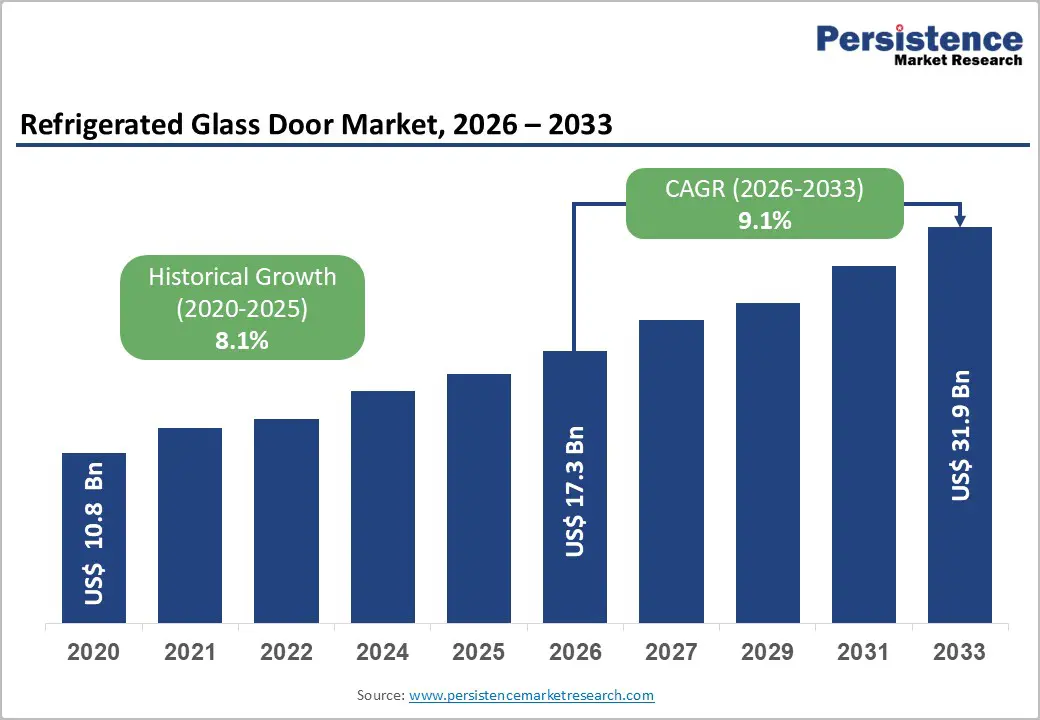
The global refrigerated glass door market size was valued at US$ 10.8 Billion in 2020 and is projected to reach US$ 17.3 Billion by 2026, expanding further to US$ 31.9 Billion by 2033, growing at a CAGR of 9.1% between 2026 and 2033.
This robust expansion is driven by accelerating demand for energy-efficient refrigeration solutions in retail and commercial sectors, growing consumer preference for transparent product visibility in beverage and frozen food merchandising, and substantial investments in modernization of food service infrastructure across emerging markets. The market's sustained growth trajectory reflects structural shifts in global food retail operations, coupled with regulatory emphasis on reducing refrigerant emissions and improving energy efficiency standards across developed and developing economies.
Key Industry Highlights:
- Door Type Analysis: Hinged doors dominate with 75%+ revenue share; sliding doors grow fastest at 9.5% CAGR - reflecting evolving retail preferences toward space optimization and operational efficiency
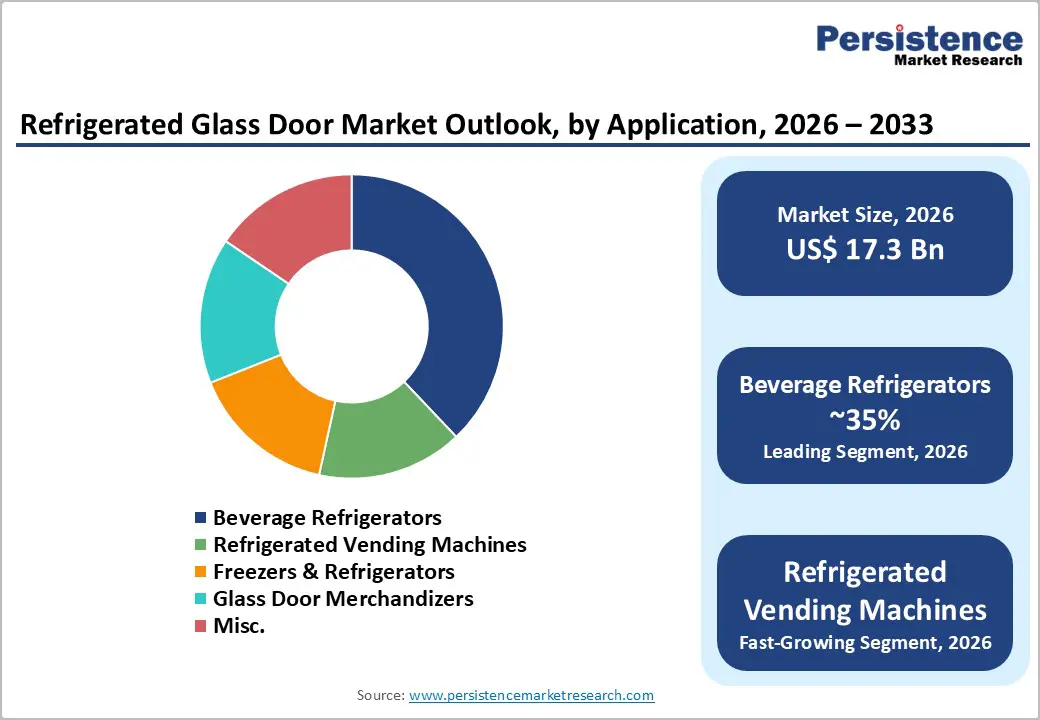
- Application Analysis: Beverage refrigerators lead applications at 35%+ market share; refrigerated vending machines accelerate at 9.7% CAGR - highlighting retail channel shifts toward modern formats and unmanned retail expansion
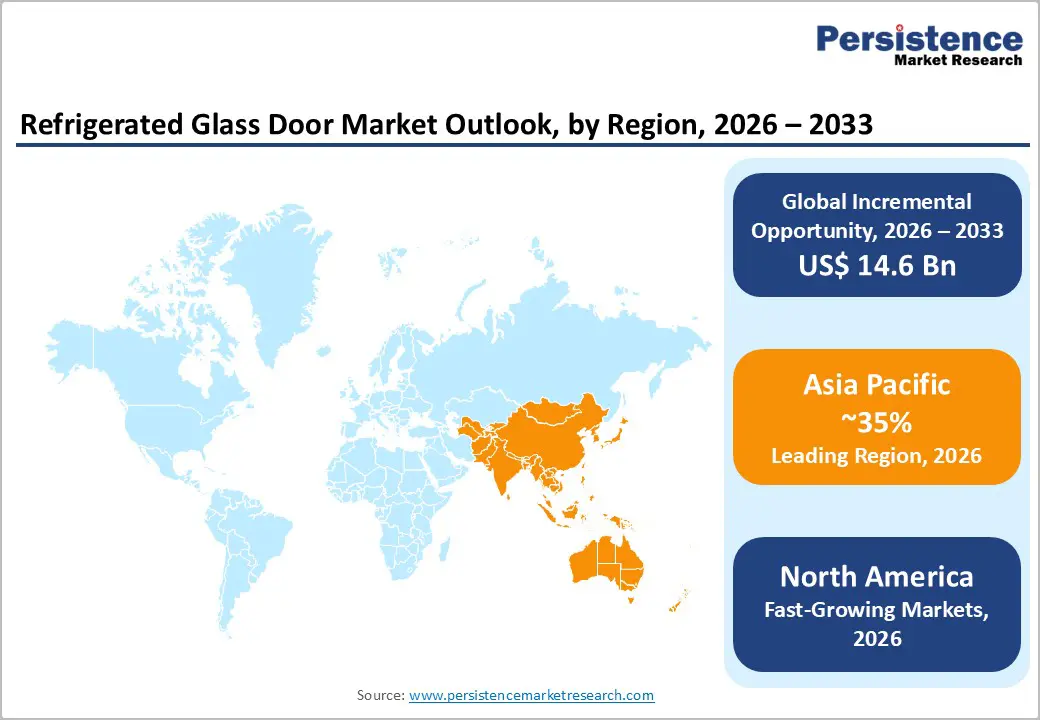
- Regional Analysis: Asia-Pacific commands 35%+ global market share, fastest-growing at 12.5% CAGR; North America grows 9.5% CAGR as developed region leader - indicating emerging market dominance with sustained developed market momentum
- Competitive Analysis: Strategic developments including smart platform launches, major M&A consolidation (Beverage-Air acquisition), and geographic expansion investments exceeding US$ 500M+ (2024-2025) - demonstrating sustained competitive intensity and technology-driven differentiation
| Global Market Attributes | Key Insights |
|---|---|
| Refrigerated Glass Door Market Size (2026E) | US$ 17.3 Bn |
| Market Value Forecast (2033F) | US$ 31.9 Bn |
| Projected Growth (CAGR 2026 to 2033) | 9.1% |
| Historical Market Growth (CAGR 2020 to 2025) | 8.1% |
Key Growth Drivers
Rising Demand for Energy-Efficient Refrigeration Solutions
The global refrigeration sector faces increasing pressure to adopt energy-efficient technologies in response to climate change concerns and escalating operational costs. According to the International Institute of Refrigeration (IIR), commercial refrigeration accounts for approximately 15% of global electricity consumption, representing a critical efficiency opportunity. Energy-efficient glass door refrigerators reduce electricity consumption by 20-30% compared to conventional opaque-door models, directly lowering total cost of ownership for retail and food service operators. Government initiatives such as the EU's F-Gas Regulation (EC 517/2014) and the Kigali Amendment to the Montreal Protocol mandate progressive reduction of high global warming potential refrigerants, creating market incentives for technologically advanced glass door solutions. The U.S. Department of Energy's appliance efficiency standards and similar regulations in Japan, South Korea, and Australia collectively influence procurement decisions across the beverage retail and grocery sectors, propelling market growth at a compound annual rate of 8.1% historically and an accelerated 9.1% through 2033.
Market Restraining Factors
Regulatory Compliance Complexity and Supply Chain Disruptions
Divergent refrigerant regulations across jurisdictions create compliance complexity and increase manufacturing costs. The transition from HFC refrigerants to HFO and hydrofluoroolefin-based alternatives requires equipment retrofitting and supply chain reconfiguration, imposing transition costs on manufacturers and end-users. Supply chain disruptions experienced during 2020-2023, including semiconductor shortages affecting smart control systems and container capacity constraints, extended lead times from 8-12 weeks to 16-20 weeks, constraining market growth. The variability of electrical standards, safety certifications (CE, UL, CSA, BIS), and import regulations across regions increases market entry barriers and operational complexity for global manufacturers, limiting competitive flexibility and market responsiveness.
Refrigerated Glass Door Market Trends and Opportunities
Integration of Smart Monitoring and Data Analytics
The convergence of IoT, artificial intelligence, and cloud computing creates substantial opportunities for next-generation refrigerated display solutions incorporating predictive maintenance, remote diagnostics, and real-time inventory management. Connected glass door systems can provide retailers with consumption pattern analytics, temperature anomaly detection, and automated replenishment signals, enhancing operational efficiency and reducing food waste. Market research indicates that smart refrigeration solutions command 25-35% price premiums, expanding average selling prices and profit margins. The global connected refrigeration market, estimated at US$ 2.1 billion in 2023, is projected to expand to 11.8% CAGR through 2030, creating significant opportunities for technology integration by incumbents and technology-enabled entrants.
Refrigerated Glass Door Market Insights and Trends
Door Type Insights
Hinged Doors Dominate While Sliding Designs Accelerate Growth in Refrigerated Glass Markets
Hinged door refrigerators continue to dominate the refrigerated glass door market, accounting for more than 75% of total revenue share. This leadership is driven by long-standing market acceptance, proven durability, and extensive deployment across conventional retail formats such as convenience stores, supermarkets, and foodservice outlets. Hinged door systems provide superior accessibility, straightforward product loading, and smoother customer interaction in high-traffic environments, supporting their premium positioning. Their strong penetration in North America and Europe, along with steady adoption across expanding Asian retail infrastructure, ensures sustained revenue generation even as newer configurations emerge.
In contrast, sliding door refrigerators represent the fastest-growing segment, registering a CAGR of 9.5%, slightly above the overall market growth rate of 9.1%. This momentum reflects shifting retailer priorities toward space optimization, particularly in urban stores where floor space is costly. Sliding doors reduce aisle clearance requirements, minimize cold air loss, and improve merchandising efficiency. Advances such as soft-close mechanisms and low-noise operation have resolved earlier performance concerns, boosting retailer confidence. Growth is especially strong in Asia-Pacific and North America, where operational efficiency and space utilization increasingly justify the transition from hinged to sliding door systems.
Application Insights
Beverage Refrigerators Lead Market While Refrigerated Vending Machines Drive Accelerated Growth Globally
Beverage refrigerators represent the leading application segment, accounting for over 35% of total market revenue and maintaining a dominant position across global markets. This leadership is supported by steady demand from convenience stores, supermarkets, quick-service restaurants, and hospitality establishments that require dependable cold storage combined with high product visibility. Transparent glass-door beverage refrigerators enhance brand visibility and stimulate impulse purchases, making them a preferred solution for beverage retailers. In developed markets, the segment benefits from its maturity and replacement demand, while emerging regions provide significant expansion opportunities. Intense competition among beverage brands and retailers further encourages continuous investment in premium point-of-sale refrigeration equipment that improves consumer engagement and overall shopping experience, ensuring long-term revenue stability.
In contrast, refrigerated vending machines are the fastest-growing application segment, registering a robust CAGR of 9.7%, well above the overall market growth rate. This rapid expansion is driven by the global rise of unmanned and contactless retail formats in offices, educational institutions, urban centers, and transportation hubs. Post-pandemic shifts toward minimal human interaction have accelerated adoption of intelligent vending systems equipped with cashless payments, real-time inventory tracking, and dynamic pricing. Growth is particularly strong in Asia-Pacific and North America, where high labor costs and limited retail space favor automated retail solutions. By 2033, refrigerated vending machines are projected to capture 38-42% of total market value, reflecting sustained momentum and ongoing share gains.
Regional Insights and Trends
Asia-Pacific Refrigerated Glass Door Market Leads Global Growth Through Urbanization Retail Expansion
Asia-Pacific represents the largest and most dynamic regional market for refrigerated glass doors, accounting for more than 35% of global revenue. The regional market is valued at around US$ 4.2 billion in 2026 and is forecast to reach nearly US$ 10.8 billion by 2033, registering a robust 12.5% CAGR that significantly outpaces global growth. This momentum is supported by rapid urbanization, rising middle-class consumption, modernization of retail infrastructure, and increasing food safety awareness across emerging economies.
China dominates regional revenues with an estimated 35-40% share, driven by supermarket expansion, QSR growth, and dense convenience store networks. India is the fastest-growing market, expanding at 14-16% annually as urban populations rise and disposable incomes increase. Japan and South Korea contribute stable, high-value demand focused on premium and energy-efficient systems, while Southeast Asia shows strong emerging potential.
Growth is further reinforced by government-led cold chain investments and stricter energy-efficiency regulations. Competitive intensity is high, with multinational players such as Carrier, Hussmann, and Electrolux competing alongside regional manufacturers including Snowhill Group, Berjaya Group, and Guangdong Aucma. Strong foreign investment in food retail modernization continues to underpin long-term market confidence.
North America Refrigerated Glass Door Market Driven by Regulation, Innovation, Retail Modernization
North America accounts for roughly 25-28% of the global refrigerated glass door market, valued at about US$ 4.3 billion in 2026 and projected to reach US$ 7.2 billion by 2033, registering a strong 9.5% CAGR. Despite its mature market status, the region is the fastest-growing developed market, supported by aging retail infrastructure upgrades, accelerated regulations, and rapid adoption of advanced refrigeration technologies. The United States dominates regional revenue with a 70-75% share, while Canada contributes around 15-20% and Mexico 5-10%. The U.S. benefits from sophisticated retail operations and capital availability, whereas Mexico is emerging as a high-growth market driven by retail modernization and beverage sector expansion.
Growth is primarily driven by regulatory pressure from the U.S. Environmental Protection Agency and the U.S. Department of Energy, which mandate low-GWP refrigerants and higher-efficiency standards. In parallel, major retailers such as Kroger, Walmart, and Target invest heavily in store renovations, while convenience chains including 7-Eleven and Circle K modernize refrigeration systems. Rising labor costs further encourage adoption of efficient, low-maintenance equipment.
The competitive landscape is led by established manufacturers such as Carrier Transicold, Hussmann, Beverage Air, and Turbo Air, with innovation increasingly focused on smart, connected glass door solutions.
Refrigerated Glass Door Market Competitive Landscape
The refrigerated glass door market is moderately consolidated, with the top 10 manufacturers commanding approximately 55-65% of global market value. This structure reflects significant barriers to entry including capital intensity, regulatory compliance complexity, established distribution networks, and technology requirements. Market leadership is distributed among multinational corporations with global presence, regional manufacturers with geographic specialization, and emerging Chinese competitors gaining market share through cost leadership and manufacturing scale. The competitive environment is characterized by moderate differentiation around energy efficiency, smart technology integration, customization capabilities, and aftermarket service quality. Market concentration is highest in developed regions (North America, Europe) and relatively fragmented in emerging markets where local manufacturers compete effectively on price and customization.
Key Industry Developments
- In May 2025, Whirlpool expanded its premium refrigeration portfolio with the launch of the Lapis Grande glass door refrigerator range. Designed to elevate kitchen aesthetics, the new lineup emphasizes luxury finishes and refined styling, positioning the product as a statement appliance for modern Indian homes. The launch reflects Whirlpool’s continued focus on blending advanced refrigeration performance with upscale visual appeal.
- On 10 November 2024, Haier Appliances India introduced its Vogue series of glass door refrigerators, offering multiple design variants tailored to Indian kitchen décor and living spaces. The range focuses on enhancing ambience while delivering contemporary features, reinforcing Haier’s strategy of combining functional innovation with lifestyle-oriented design.
- On 18 July 2024, Whirlpool of India, a subsidiary of Whirlpool Corporation, launched the Ice Magic Pro Glass Door refrigerator range. The new single-door lineup highlights superior craftsmanship and modern aesthetics, aligning with the company’s belief that stylish, contemporary appliances are essential for evolving Indian households.
Companies Covered in Refrigerated Glass Door Market
- Carrier Transicold
- Electrolux Professional
- Hussmann
- Beverage-Air
- Turbo Air
- Danfoss
- Liebherr
- AUCMA
- Haier Commercial
- Snowhill Group
- Berjaya Group
- Eaton
- Guangdong Aucma
- Other Market Players
Frequently Asked Questions
The Refrigerated Glass Door market is estimated to be valued at US$ 17.3 Bn in 2026.
Retailers, supermarkets, convenience stores, and food & beverage outlets increasingly prefer refrigerated glass door systems because they allow clear visibility of products, which directly influences impulse purchasing and improves sales per square foots
In 2026, the Asia Pacific region will dominate the market with an exceeding 35% revenue share in the global Refrigerated Glass Door market.
Among applications, beverage refrigerators have the highest preference, capturing beyond 35% of the market revenue share in 2026, surpassing other applications.
Hussmann, Beverage-Air, Turbo Air, Danfoss, Liebherr, AUCMA, and Haier Commercial. There are a few leading players in the Refrigerated Glass Door market.


