Report Background

Potato Snacks Market Size, Share, and Growth Forecast for 2025 - 2032

Potato Snacks Market Size, Share and Growth Forecast By Product Type (Chips & Shoestrings, Canned Potato, Frozen, Dehydrated), Application (Prepared Meals, Ready to Cook Products, Snacks), End Use (Retail, Food Service), and Regional Analysis for 2025-2032

ID: PMRREP31517
Calendar

March 2025

306 Pages

Author : Amol Patil

Potato Snacks Consumption Analysis (2019-2024) Vs. Market Estimations (2025-2032)

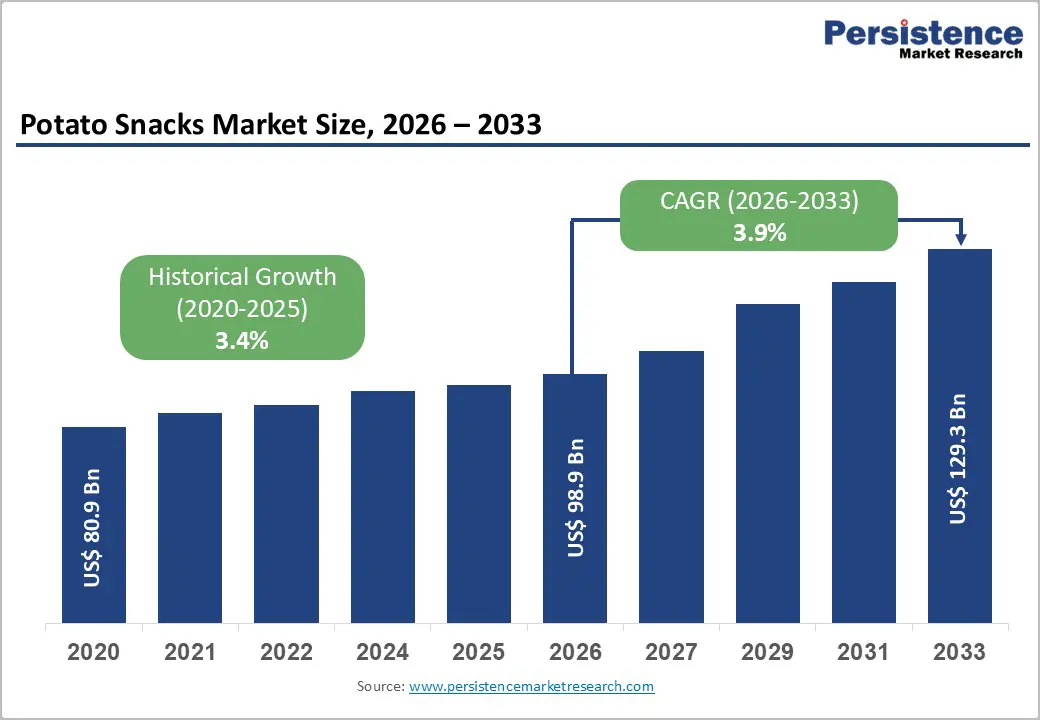
The global potato snacks market has witnessed significant growth in the historical period registering a CAGR of 3.5% in the historical period and was valued at US$ 94.8 Bn in 2024. The market is expected to grow steadily with increasing applications of potato snacks.

The major market driver for potato snacks is increasing snacking habit of the consumers along with various flavors of potato-based snacks. The potato snacks also serve as a time saving convenience food product which are also available in the form of munchies, nibbles, and others which makes it an excellent alternative option related to other snacks items for consumers.

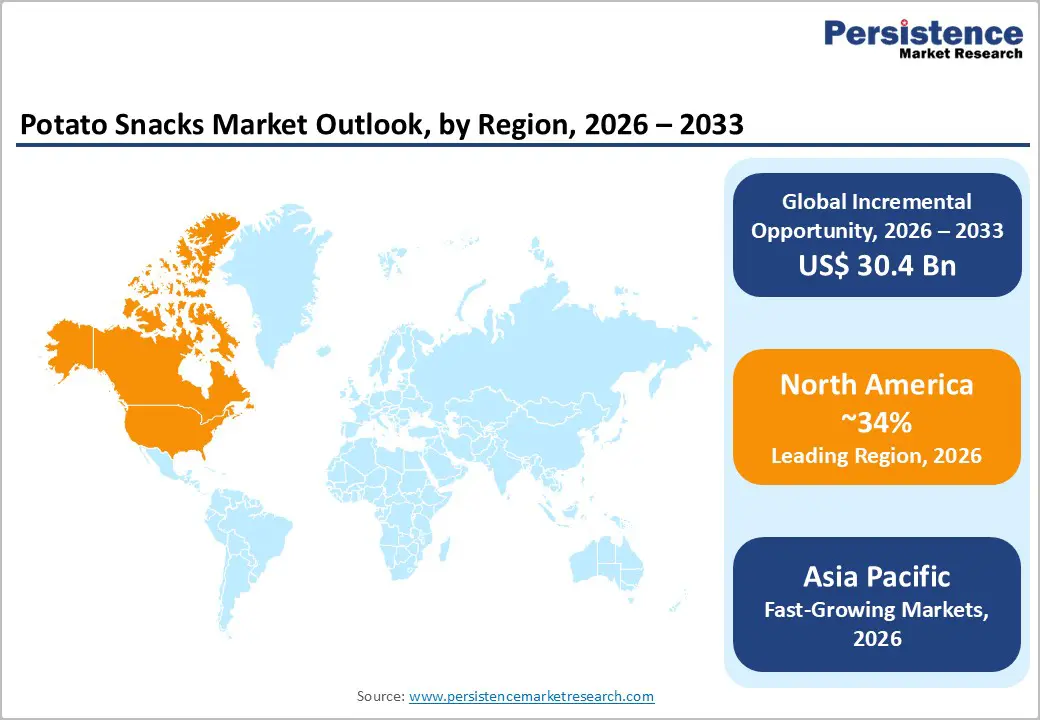
The major demanding regions of potato snacks is North America followed by East Asia. In both the regions demand is expected to grow owing to the fact that these regions have dominance over the snacks industry. US holds a market share of more than 97.7%, and Canada more than 2.3% in the North American market. China is the major market for potato snacks in the East Asian region. The global market for potato snacks is estimated to reach an approximate valuation of US$ 126.5 Bn in the forecast period.

Country-wise insights

Why Does the U.K. Account for the Largest Share in the Potato Snacks Business in the European Region?

The market for potato snacks is witnessing steady growth in the United Kingdom with a value CAGR 3.1%. Demand for potato snacks in the European region is growing at a significant rate, which provides a favourable market growth opportunity for potato-based snack suppliers.

Which Country Holds the Largest Share of Potato Snack Sales in the East Asia Market?

China holds a major share in the East Asian market for potato snacks. This is due to the growing health and nutritional benefits of potato snacks. Moreover, increasing demand for convenient foods and on-the-go snacking with high nutrition in the foodservice sector will have a positive impact on potato snack demand, with market growth in China pegged at a high 7.8% CAGR.

Category-wise insights

Why are Frozen Potato Snacks Most Demanded in the Global Market?

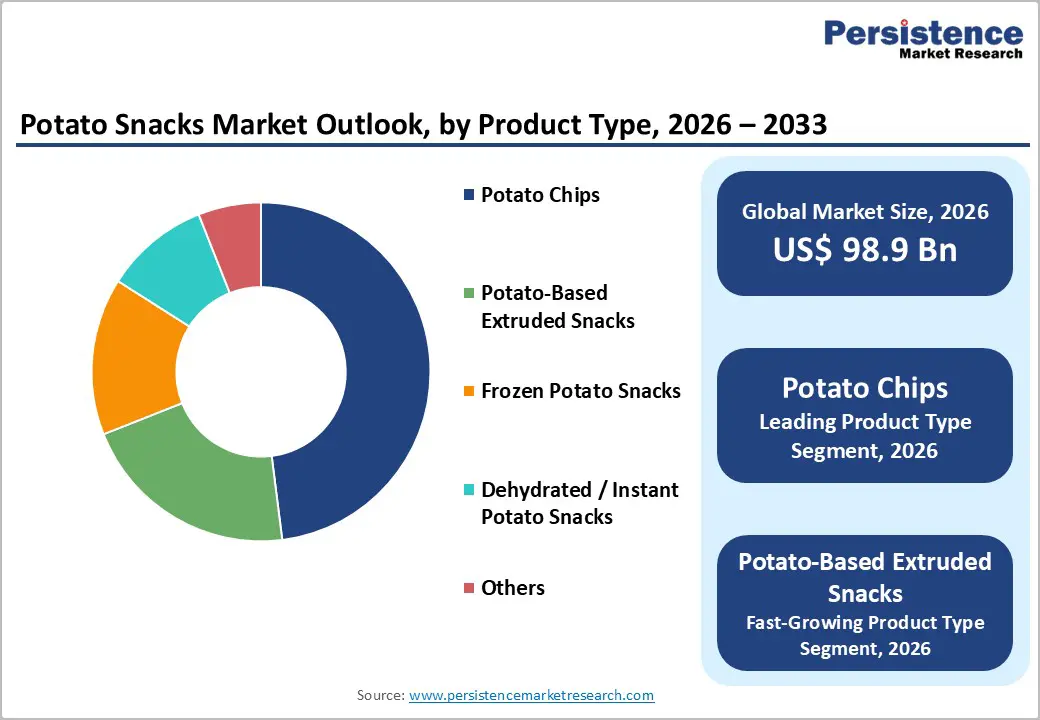
Based on product type, frozen potato-based snacks are mostly demanded and consumed in the potato snacks category. Market value share of frozen potato-based snacks is 45.3%. Demand is increasing for frozen potato snacks in the retail sector owing to their high popularity among consumers and the convenience offered. They also offer numerous health benefits to consumers.

Which Distribution Channel is Offering New Opportunity for Potato Snacks Vendors?

Demand is increasing for potato snacks in the retail sector due to easy availability of the product. Market value of potato snacks in the retail category is expected to reach US$ 67.3 Bn by the end of the forecast period.

Competitive Dashboard

Key potato snack producers are inclined toward innovation, research & development, and expansion to obtain potato snacks with fine-quality. Manufacturers are striving and investing heavily to enhance their operations and innovation capabilities.

  • In January 2019, Kraft Heinz completed the acquisition of primal kitchen, one of the top companies manufacturing healthy snacks and different food products. The acquisition will help the company in strengthening its position in the U.S. food & beverages market.
  • In Dec 2018, Emsland Group announced its strategic partnership with Poland-based IMPAG Group. This partnership enables the reorganization of the sales structure of Emsland Group in Poland.
  • In May 2019, the company has acquired the 70% of stake of Serya, a Brazilian food company which is specialized in pre-formed potato specialty market. The investment will thrive the company’s potato business in Brazil as well as provide the opportunity to expand its presence in South America.
  • In June 2019, Lamb Weston Holdings has completed the expansion of new potato processing line in Hermiston, Oregon. The company had invested US$ 250 million in 2017 for the expansion. The new processing line will increase the production capacity of frozen French fries.

Potato Snacks Industry Research by Category

By Product Type:

  • Chips & Shoestrings
  • Canned Potato
  • Frozen
  • Dehydrated
  • Others

By Application:

  • Prepared Meals
  • Ready to Cook Products
  • Snacks

By End Use:

  • Retail
    • Modern Trade
    • Departmental Store
    • Specialty Stores
    • Online Retailers
    • Other Retail Channel
  • Food Service
    • Quick Service
    • Full Service
    • Catering
    • Hotels & Club

By Region:

  • North America
  • Latin America
  • Europe
  • South Asia & Pacific
  • East Asia
  • Middle East & Africa

Companies Covered in Potato Snacks Market

  • McCain Foods Limited
  • Lamb Weston Holdings, Inc.
  • The Kraft Heinz Company
  • Aviko B.V.
  • AGRANA Beteiligungs-AG
  • Farm Frites International B.V.
  • Emsland Group
  • LENG-D'OR
  • Idahoan Foods, LLC
  • J.R. Simplot Company
  • PepsiCo
  • Limagrain Ingredients
  • Intersnack Group GmbH & Co. Kg
  • The Little Potato Company Ltd.
  • J.R. Short Milling Company
Frequently Asked Questions

The global market for potato snacks has a value of US$ 98.1 Bn in 2023.

The global market for potato snacks has a value CAGR of 3.5% from 2019-2024.

The global market for potato snacks has a value of US$ 126.5 Bn in 2032.

The global market for potato snacks has a value CAGR of 3.7% from 2025-2032.

McCain Foods Limited, J.R. Simplot Company, Aviko B.V., Lamb Weston Holdings, Inc., and PepsiCo are the top 5 potato snack manufacturers accounting for around hold 30%-40% market share.

Potato Snacks Industry Report Scope
Attribute Details

Forecast period

2025-2032

Historical data available for

2019-2024

Market Analysis Units Value: US$ Bn/Mn, Volume: As applicable

Key regions covered

  • North America
  • Latin America
  • Europe
  • South Asia & Pacific
  • East Asia
  • Middle East & Africa

Key countries covered

  • U.S.
  • Canada
  • Germany
  • U.K.
  • France
  • Italy
  • Spain
  • Russia
  • China
  • Japan
  • South Korea
  • India
  • Thailand
  • Malaysia
  • Indonesia
  • Australia
  • New Zealand
  • GCC countries
  • Turkey
  • Northern Africa
  • South Africa

Key market segments covered

  • Product Type
  • Application
  • End Use
  • Region

Key companies profiled

  • McCain Foods Limited
  • Lamb Weston Holdings, Inc.
  • The Kraft Heinz Company
  • Aviko B.V.
  • AGRANA Beteiligungs-AG
  • Farm Frites International B.V.
  • Emsland Group
  • LENG-D'OR
  • Idahoan Foods, LLC
  • J.R. Simplot Company
  • PepsiCo
  • Limagrain Ingredients
  • Intersnack Group GmbH & Co. Kg
  • The Little Potato Company Ltd.
  • J.R. Short Milling Company
Report Highlights
  • Market Forecast and Trends
  • Competitive Intelligence & Share Analysis
  • Growth Factors and Challenges
  • Strategic Growth Initiatives
  • Pricing Analysis & Technology Roadmap
  • Future Opportunities and Revenue Pockets
  • Industry Market Analysis Tools

Customization & pricing

Available upon request

Related Reports

1. Executive Summary

    1.1. Global Market Outlook

    1.2. Demand Side Trends

    1.3. Supply Side Trends

    1.4. Technology Roadmap

    1.5. Analysis and Recommendations

2. Market Overview

    2.1. Market Coverage / Taxonomy

    2.2. Market Definition / Scope / Limitations

3. Key Market Trends

    3.1. Key Trends Impacting the Market

        3.1.1. Rising Consumption of Convenience Food.

        3.1.2. Growing Demand for Gluten-free Products.

        3.1.3. Increasing Awareness for use of Clean Label Ingredients.

        3.1.4. Others

    3.2. Product Innovation / Development Trends

4. Key Success Factors

    4.1. Product USPs / Features

    4.2. Strategic Promotional Strategies

5. Production and Trade Analysis of Potato by Country - HS Code 070190 (Fresh or Chilled Potatoes (excluding seeds))

    5.1. Global Production Estimates of Potato

    5.2. Top Exporting Countries for Potato (Value and Volume)

    5.3. Top Importing Countries for Potato (Value and Volume)

6. Global Potato Snack Market Demand Analysis 2019-2032

    6.1. Historical Market Volume (Metric Tons) Analysis, 2019-2023

    6.2. Current and Future Market Volume (Metric Tons) Projections, 2024-2032

    6.3. Y-o-Y Growth Trend Analysis

7. Global Potato Snack Market - Pricing Analysis

    7.1. Regional Pricing Analysis

    7.2. Pricing Break-up

        7.2.1. Manufacturer Level Pricing (Key players)

        7.2.2. Gross Margin Analysis

    7.3. Global Average Pricing Analysis Benchmark

8. Global Potato Snack Market Demand (in Value or Size in US$ Mn) Analysis 2019-2032

    8.1. Historical Market Value (US$ Mn) Analysis, 2019-2023

    8.2. Current and Future Market Value (US$ Mn) Projections, 2024-2032

        8.2.1. Y-o-Y Growth Trend Analysis

        8.2.2. Absolute $ Opportunity Analysis

9. Market Background

    9.1. Global Snacks Market, 2022

    9.2. Macro-Economic Factors

        9.2.1. Global GDP Growth Outlook

        9.2.2. Global GDP and Infrastructure Investment

        9.2.3. International Trade

        9.2.4. Global Industry Outlook

    9.3. Global Food & Beverage Industry Outlook

    9.4. Global Pharmaceutical Industry Outlook

    9.5. Global Animal Feed Industry Outlook

    9.6. Potato Production Process

    9.7. Potato Snacks Supply Chain

    9.8. Key Regulations

    9.9. Forecast Factors - Relevance & Impact

        9.9.1. Top Companies Historical Growth

        9.9.2. GDP Growth forecast

        9.9.3. Manufacturing Industry forecast

        9.9.4. Global Urbanization Growth Outlook

        9.9.5. Business Climate

    9.10. Value Chain

        9.10.1. Raw Material Suppliers

        9.10.2. Product Manufacturers

        9.10.3. End Users

    9.11. Market Dynamics

        9.11.1. Drivers

        9.11.2. Restraints

        9.11.3. Opportunity Analysis

10. Global Potato Snack Market Analysis 2019-2032, by Product Type

    10.1. Introduction / Key Findings

    10.2. Historical Market Size (US$ Mn) and Volume (Metric Tons) Analysis By Product Type, 2019-2023

    10.3. Current and Future Market Size (US$ Mn) and Volume (Metric Tons) Analysis and Forecast By Product Type, 2024-2032

        10.3.1. Chips & Shoestrings

        10.3.2. Canned Potatoes

        10.3.3. Frozen

        10.3.4. Dehydrated

        10.3.5. Others

    10.4. Market Attractiveness Analysis By Product Type

11. Global Potato Snack Market Analysis 2019-2032, By Application

    11.1. Introduction / Key Findings

    11.2. Historical Market Size (US$ Mn) and Volume (Metric Tons) Analysis By Application, 2019-2023

    11.3. Current and Future Market Size (US$ Mn) and Volume (Metric Tons) Analysis and Forecast By Application, 2024-2032

        11.3.1. Prepared Meals

        11.3.2. Ready to Cook Products

        11.3.3. Snacks

    11.4. Market Attractiveness Analysis By Application

12. Global Potato Snack Market Analysis 2019-2032, by End Use

    12.1. Introduction / Key Findings

    12.2. Historical Market Size (US$ Mn) and Volume (Metric Tons) Analysis By End Use, 2019-2023

    12.3. Current and Future Market Size (US$ Mn) and Volume (Metric Tons) Analysis and Forecast By End Use, 2024-2032

        12.3.1. Retail

            12.3.1.1. Modern Trade

            12.3.1.2. Departmental Store

            12.3.1.3. Specialty Stores

            12.3.1.4. Online Retailers

            12.3.1.5. Other Retail Channel

        12.3.2. Foodservice

            12.3.2.1. Quick Service

            12.3.2.2. Full Service

            12.3.2.3. Catering

            12.3.2.4. Hotels & Club

    12.4. Market Attractiveness Analysis By End Use

13. Global Potato Snack Market Analysis 2019-2032, by Region

    13.1. Introduction

    13.2. Historical Market Size (US$ Mn) and Volume (Metric Tons) Analysis By Region, 2019-2023

    13.3. Current Market Size (US$ Mn) and Volume (Metric Tons) Analysis and Forecast By Region, 2024-2032

        13.3.1. North America

        13.3.2. Latin America

        13.3.3. Europe

        13.3.4. East Asia

        13.3.5. South Asia and Pacific

        13.3.6. Middle East and Africa (MEA)

    13.4. Market Attractiveness Analysis By Region

14. North America Potato Snack Market Analysis 2019-2032

    14.1. Introduction

    14.2. Pricing Analysis

    14.3. Historical Market Size (US$ Mn) and Volume (Metric Tons) Trend Analysis By Market Taxonomy, 2019-2023

    14.4. Market Size (US$ Mn) and Volume (Metric Tons) Forecast By Market Taxonomy, 2024-2032

        14.4.1. By Country

            14.4.1.1. U.S.

            14.4.1.2. Canada

        14.4.2. By Product Type

        14.4.3. By Application

        14.4.4. By End Use

    14.5. Market Attractiveness Analysis

        14.5.1. By Country

        14.5.2. By Product Type

        14.5.3. By Application

        14.5.4. By End Use

    14.6. Market Trends

    14.7. Key Market Participants - Intensity Mapping

    14.8. Drivers and Restraints - Impact Analysis

15. Latin America Potato Snack Market Analysis 2019-2032

    15.1. Introduction

    15.2. Pricing Analysis

    15.3. Historical Market Size (US$ Mn) and Volume (Metric Tons) Trend Analysis By Market Taxonomy, 2019-2023

    15.4. Market Size (US$ Mn) and Volume (Metric Tons) Forecast By Market Taxonomy, 2024-2032

        15.4.1. By Country

            15.4.1.1. Brazil

            15.4.1.2. Mexico

            15.4.1.3. Chile

            15.4.1.4. Argentina

            15.4.1.5. Columbia

            15.4.1.6. Rest of Latin America

        15.4.2. By Product Type

        15.4.3. By Application

        15.4.4. By End Use

    15.5. Market Attractiveness Analysis

        15.5.1. By Country

        15.5.2. By Product Type

        15.5.3. By Application

        15.5.4. By End Use

    15.6. Market Trends

    15.7. Key Market Participants - Intensity Mapping

    15.8. Drivers and Restraints - Impact Analysis

16. Europe Potato Snack Market Analysis 2019-2032

    16.1. Introduction

    16.2. Pricing Analysis

    16.3. Historical Market Size (US$ Mn) and Volume (Metric Tons) Trend Analysis By Market Taxonomy, 2019-2023

    16.4. Market Size (US$ Mn) and Volume (Metric Tons) Forecast By Market Taxonomy, 2024-2032

        16.4.1. By Country

            16.4.1.1. Germany

            16.4.1.2. Italy

            16.4.1.3. France

            16.4.1.4. U.K.

            16.4.1.5. Spain

            16.4.1.6. BENELUX

            16.4.1.7. Russia

            16.4.1.8. Rest of Europe

        16.4.2. By Product Type

        16.4.3. By Application

        16.4.4. By End Use

    16.5. Market Attractiveness Analysis

        16.5.1. By Country

        16.5.2. By Product Type

        16.5.3. By Application

        16.5.4. By End Use

    16.6. Market Trends

    16.7. Key Market Participants - Intensity Mapping

    16.8. Drivers and Restraints - Impact Analysis

17. South Asia and Pacific Potato Snack Market Analysis 2019-2032

    17.1. Introduction

    17.2. Pricing Analysis

    17.3. Historical Market Size (US$ Mn) and Volume (Metric Tons) Trend Analysis By Market Taxonomy, 2019-2023

    17.4. Market Size (US$ Mn) and Volume (Metric Tons) Forecast By Market Taxonomy, 2024-2032

        17.4.1. By Country

            17.4.1.1. India

            17.4.1.2. ASEAN

            17.4.1.3. Oceania (Australia & New Zealand)

            17.4.1.4. Rest of South Asia & Pacific

        17.4.2. By Product Type

        17.4.3. By Application

        17.4.4. By End Use

    17.5. Market Attractiveness Analysis

        17.5.1. By Country

        17.5.2. By Product Type

        17.5.3. By Application

        17.5.4. By End Use

    17.6. Market Trends

    17.7. Key Market Participants - Intensity Mapping

    17.8. Drivers and Restraints - Impact Analysis

18. East Asia Potato Snack Market Analysis 2019-2032

    18.1. Introduction

    18.2. Pricing Analysis

    18.3. Historical Market Size (US$ Mn) and Volume (Metric Tons) Trend Analysis By Market Taxonomy, 2019-2023

    18.4. Market Size (US$ Mn) and Volume (Metric Tons) Forecast By Market Taxonomy, 2024-2032

        18.4.1. By Country

            18.4.1.1. China

            18.4.1.2. Japan

            18.4.1.3. South Korea

        18.4.2. By Product Type

        18.4.3. By Application

        18.4.4. By End Use

    18.5. Market Attractiveness Analysis

        18.5.1. By Country

        18.5.2. By Product Type

        18.5.3. By Application

        18.5.4. By End Use

    18.6. Market Trends

    18.7. Key Market Participants - Intensity Mapping

    18.8. Drivers and Restraints - Impact Analysis

19. Middle East and Africa Potato Snack Market Analysis 2019-2032

    19.1. Introduction

    19.2. Pricing Analysis

    19.3. Historical Market Size (US$ Mn) and Volume (Metric Tons) Trend Analysis By Market Taxonomy, 2019-2023

    19.4. Market Size (US$ Mn) and Volume (Metric Tons) Forecast By Market Taxonomy, 2024-2032

        19.4.1. By Country

            19.4.1.1. GCC Countries

            19.4.1.2. Turkey

            19.4.1.3. Northern Africa

            19.4.1.4. South Africa

            19.4.1.5. Rest of Middle East and Africa

        19.4.2. By Product Type

        19.4.3. By Application

        19.4.4. By End Use

    19.5. Market Attractiveness Analysis

        19.5.1. By Country

        19.5.2. By Product Type

        19.5.3. By Application

        19.5.4. By End Use

    19.6. Market Trends

    19.7. Key Market Participants - Intensity Mapping

    19.8. Drivers and Restraints - Impact Analysis

20. Country Wise Potato Snack Market Analysis 2024

    20.1. Introduction

        20.1.1. Market Value Proportion Analysis, By Key Countries

        20.1.2. Global Vs. Country Growth Comparison

    20.2. U.S. Potato Snack Market Analysis

        20.2.1. By Product Type

        20.2.2. By Application

        20.2.3. By End Use

    20.3. Canada Potato Snack Market Analysis

        20.3.1. By Product Type

        20.3.2. By Application

        20.3.3. By End Use

    20.4. Brazil Potato Snack Market Analysis

        20.4.1. By Product Type

        20.4.2. By Application

        20.4.3. By End Use

    20.5. Mexico Potato Snack Market Analysis

        20.5.1. By Product Type

        20.5.2. By Application

        20.5.3. By End Use

    20.6. Chile Potato Snack Market Analysis

        20.6.1. By Product Type

        20.6.2. By Application

        20.6.3. By End Use

    20.7. Argentina Potato Snack Market Analysis

        20.7.1. By Product Type

        20.7.2. By Application

        20.7.3. By End Use

    20.8. Columbia Potato Snack Market Analysis

        20.8.1. By Product Type

        20.8.2. By Application

        20.8.3. By End Use

    20.9. Germany Potato Snack Market Analysis

        20.9.1. By Product Type

        20.9.2. By Application

        20.9.3. By End Use

    20.10. Italy Potato Snack Market Analysis

        20.10.1. By Product Type

        20.10.2. By Application

        20.10.3. By End Use

    20.11. France Potato Snack Market Analysis

        20.11.1. By Product Type

        20.11.2. By Application

        20.11.3. By End Use

    20.12. U.K. Potato Snack Market Analysis

        20.12.1. By Product Type

        20.12.2. By Application

        20.12.3. By End Use

    20.13. Spain Potato Snack Market Analysis

        20.13.1. By Product Type

        20.13.2. By Application

        20.13.3. By End Use

    20.14. Russia Potato Snack Market Analysis

        20.14.1. By Product Type

        20.14.2. By Application

        20.14.3. By End Use

    20.15. China Potato Snack Market Analysis

        20.15.1. By Product Type

        20.15.2. By Application

        20.15.3. By End Use

    20.16. Japan Potato Snack Market Analysis

        20.16.1. By Product Type

        20.16.2. By Application

        20.16.3. By End Use

    20.17. S. Korea Potato Snack Market Analysis

        20.17.1. By Product Type

        20.17.2. By Application

        20.17.3. By End Use

    20.18. India Potato Snack Market Analysis

        20.18.1. By Product Type

        20.18.2. By Application

        20.18.3. By End Use

    20.19. Oceania (Australia and New Zealand) Potato Snack Market Analysis

        20.19.1. By Product Type

        20.19.2. By Application

        20.19.3. By End Use

    20.20. Turkey Potato Snack Market Analysis

        20.20.1. By Product Type

        20.20.2. By Application

        20.20.3. By End Use

    20.21. South Africa Potato Snack Market Analysis

        20.21.1. By Product Type

        20.21.2. By Application

        20.21.3. By End Use

21. Market Structure Analysis

    21.1. Market Analysis by Tier of Companies (Potato Snack)

    21.2. Market Share Analysis of Top Players

    21.3. Market Presence Analysis

22. Competition Analysis

    22.1. Competition Dashboard

    22.2. Competition Benchmarking

    22.3. Competition Deep Dive

        22.3.1. McCain Foods Limited

            22.3.1.1. Overview

            22.3.1.2. Product Portfolio

            22.3.1.3. Profitability by Market Segments (Product/Channel/Region)

            22.3.1.4. Sales Footprint

            22.3.1.5. Strategy Overview

        22.3.2. Lamb Weston Holdings, Inc.

            22.3.2.1. Overview

            22.3.2.2. Product Portfolio

            22.3.2.3. Profitability by Market Segments (Product/Channel/Region)

            22.3.2.4. Sales Footprint

            22.3.2.5. Strategy Overview

        22.3.3. The Kraft Heinz Company

            22.3.3.1. Overview

            22.3.3.2. Product Portfolio

            22.3.3.3. Profitability by Market Segments (Product/Channel/Region)

            22.3.3.4. Sales Footprint

            22.3.3.5. Strategy Overview

        22.3.4. Aviko B.V.

            22.3.4.1. Overview

            22.3.4.2. Product Portfolio

            22.3.4.3. Profitability by Market Segments (Product/Channel/Region)

            22.3.4.4. Sales Footprint

            22.3.4.5. Strategy Overview

        22.3.5. AGRANA Beteiligungs-AG

            22.3.5.1. Overview

            22.3.5.2. Product Portfolio

            22.3.5.3. Profitability by Market Segments (Product/Channel/Region)

            22.3.5.4. Sales Footprint

            22.3.5.5. Strategy Overview

        22.3.6. Farm Frites International B.V.

            22.3.6.1. Overview

            22.3.6.2. Product Portfolio

            22.3.6.3. Profitability by Market Segments (Product/Channel/Region)

            22.3.6.4. Sales Footprint

            22.3.6.5. Strategy Overview

        22.3.7. Emsland Group

            22.3.7.1. Overview

            22.3.7.2. Product Portfolio

            22.3.7.3. Profitability by Market Segments (Product/Channel/Region)

            22.3.7.4. Sales Footprint

            22.3.7.5. Strategy Overview

        22.3.8. LENG-D'OR

            22.3.8.1. Overview

            22.3.8.2. Product Portfolio

            22.3.8.3. Profitability by Market Segments (Product/Channel/Region)

            22.3.8.4. Sales Footprint

            22.3.8.5. Strategy Overview

        22.3.9. Idahoan Foods, LLC

            22.3.9.1. Overview

            22.3.9.2. Product Portfolio

            22.3.9.3. Profitability by Market Segments (Product/Channel/Region)

            22.3.9.4. Sales Footprint

            22.3.9.5. Strategy Overview

        22.3.10. J.R. Simplot Company

            22.3.10.1. Overview

            22.3.10.2. Product Portfolio

            22.3.10.3. Profitability by Market Segments (Product/Channel/Region)

            22.3.10.4. Sales Footprint

            22.3.10.5. Strategy Overview

        22.3.11. PepsiCo

            22.3.11.1. Overview

            22.3.11.2. Product Portfolio

            22.3.11.3. Profitability by Market Segments (Product/Channel/Region)

            22.3.11.4. Sales Footprint

            22.3.11.5. Strategy Overview

        22.3.12. Limagrain Ingredients

            22.3.12.1. Overview

            22.3.12.2. Product Portfolio

            22.3.12.3. Profitability by Market Segments (Product/Channel/Region)

            22.3.12.4. Sales Footprint

            22.3.12.5. Strategy Overview

        22.3.13. Intersnack Group GmbH & Co. Kg

            22.3.13.1. Overview

            22.3.13.2. Product Portfolio

            22.3.13.3. Profitability by Market Segments (Product/Channel/Region)

            22.3.13.4. Sales Footprint

            22.3.13.5. Strategy Overview

        22.3.14. The Little Potato Company Ltd.

            22.3.14.1. Overview

            22.3.14.2. Product Portfolio

            22.3.14.3. Profitability by Market Segments (Product/Channel/Region)

            22.3.14.4. Sales Footprint

            22.3.14.5. Strategy Overview

        22.3.15. J.R. Short Milling Company

            22.3.15.1. Overview

            22.3.15.2. Product Portfolio

            22.3.15.3. Profitability by Market Segments (Product/Channel/Region)

            22.3.15.4. Sales Footprint

            22.3.15.5. Strategy Overview

23. Assumptions and Acronyms Used

24. Research Methodology

Research Methodology Framework for Market Research Excellence

At Persistence Market Research, we implement a comprehensive, validated, and multi-dimensional approachto market analysis that delivers actionable insights across complex market landscapes. Our methodology combines the analytical rigor of leading consulting firms with innovative research techniques, ensuring robust market assessments that guide strategic decision-making with confidence.

Core Research Philosophy

Our methodology is built on four foundational pillars:

Research Philosophy Image

At Persistence Market Research, our methodology is designed to transcend conventional market studies by combining analytical rigor, multi-source validation, and future-focused insights.

We integrate advanced research frameworks, robust data collection strategies, cutting-edge analytics, and innovative technologies to deliver a 360-degree view of complex markets.

We integrate advanced research frameworks, robust data collection strategies, cutting-edge analytics, and innovative technologies to deliver a 360-degree view of complex markets.

Each stage spanning from strategic scoping and hypothesis-building to competitive intelligence, quality validation, and actionable recommendations is engineered to provide clients with unmatched clarity, precision, and confidence in decision-making.

By embedding innovation and technology at the core, our approach ensures that insights are not only comprehensive but also predictive, empowering businesses to seize opportunities, mitigate risks, and achieve sustainable growth

Research Philosophy Image

Capturing Key Information and Events

During this phase, key research objectives focus on essential information and data points for assessing the market, including:

Research Philosophy Image

TAM-SAM-SOM Framework Implementation

We employ both top-down and bottom-up approaches to ensure accurate market sizing.

Top-Down Market SizingBottom-Up Market Sizing
Universe Definition: Total global/regional market identificationUnit Economics: Average transaction values, purchase frequencies, customer lifecycle
Segmentation Filters: Geographic, demographic, and behavioral constraintsCustomer Segmentation: Detailed buyer persona development and sizing
Market Share Analysis: Competitive landscape assessment and share allocationPenetration Analysis: Market penetration rates by segment and geography
Growth Rate Application: Historical trends and forward-looking growth assumptionsScaling Methodology: Extrapolation techniques with confidence intervals

Validation & Cross-Verification

  • Triangulation: Comparing top-down and bottom-up results for consistency
  • Sensitivity Analysis: Testing key assumptions and parameter variations
  • Peer Benchmarking: Comparison with analogous markets and industry benchmarks
  • Expert Review: External validation through industry specialist consultation

Research Philosophy Image

Forecasting & Projection Modeling

Our proprietary forecasting models incorporate multiple variables and scenarios.

Forecasting Components

  • Historical Trend Analysis: 10-year historical growth patterns and cyclical variations
  • Driver-Based Modeling: Economic indicators, demographic shifts, technology adoption
  • Scenario Planning: Base case, optimistic, and conservative projections
  • Monte Carlo Simulations: Probability-weighted outcomes and risk assessments

Model Validation

  • Back-Testing: Historical accuracy assessment over 3–5-year periods
  • Cross-Validation: Multiple modeling approaches for result comparison
  • External Benchmarking: Comparison with established market forecasts
  • Continuous Calibration: Quarterly model updates based on new data

Comprehensive Data Collection Strategy

Our secondary research phase establishes a robust knowledge base utilizing diverse, credible sources.

Secondary Data Sourcess

  • Industry Publications & Reports
  • Government & Regulatory Data
  • Financial Intelligence (filings & reports)
  • Academic Research & Digital Intelligence

Quality Assurance Protocol

  • Source credibility assessment and publication date validation
  • Data consistency checks across multiple sources
  • Bias identification and neutralization techniques
  • Information gap tracking for primary research prioritization

Research Philosophy Image

Primary Research Excellence

Our primary research methodology employs best-in-class techniques to capture unique market insights.

Quantitative Research Methods

  • Large-Scale Surveys: Statistically representative samples with 95% confidence intervals
  • Survey Methodology: Multi-channel deployment (online, telephone, in-person)
  • Question Architecture and Response Optimization

Qualitative Research Methods

  • Executive Interviews
  • Focus Groups
  • Expert Consultations

Quality Assurance & Validation Framework

Multi-Stage Validation Process

  • Source Verification and Consistency Testing
  • Outlier Detection and Bias Assessment
  • Peer Review Process and External Validation
  • Sensitivity Analysis and Confidence Intervals

Research Philosophy Image

Methodology Validation & Credibility

Our research methodology has been extensively validated through:

  • Academic Partnerships: Collaborations with top-tier business schools and research institutions
  • Client Success Stories: Documented case studies demonstrating research impact and ROI
  • Continuous Benchmarking: Performance comparison with leading global research firms

This comprehensive methodology framework positions Persistence Market Research at the forefront of market intelligence, combining the analytical sophistication of top-tier consulting firms with innovative research techniques. Our approach ensures that every market assessment delivers precise, actionable, and strategically valuable insights that drive business success in competitive market environments.

Ready to unlock your market potential? Contact our research experts to discuss how our validated methodology can transform your strategic decision-making with data-driven market intelligence.

Copyright © 2026 Persistence Market Research. All Rights Reserved

Connect With Us -