




- Healthcare IT
- Physician Scheduling Systems Market
Physician Scheduling Systems Market Size, Share, Growth, and Regional Forecast, 2025 to 2032
Physician Scheduling Systems Market by Component (Scheduling Software Suites, Services), Scheduling System (Automated Systems, Cloud-Based Software, On-Premise Software), End-user and Regional Analysis from 2025 to 2032

Physician Scheduling Systems Market Share & Trends Analysis
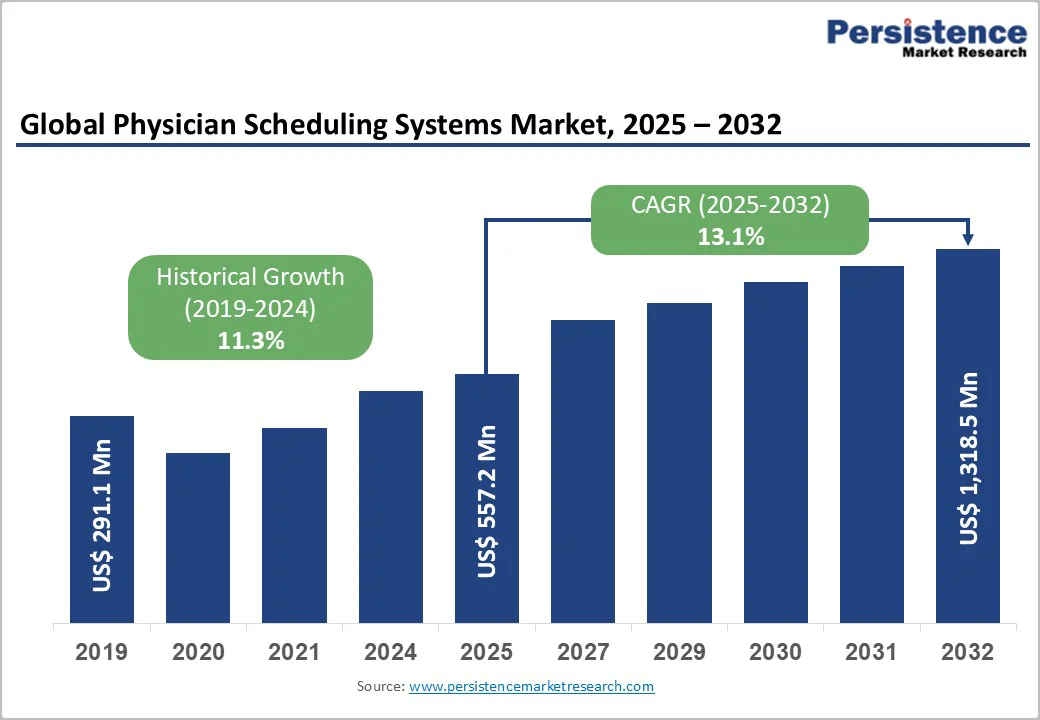
The global physician scheduling systems market size is valued at US$ 557.2 million in 2025 and is projected to reach US$ 1,318.5 million, growing at a CAGR of 13.1% between 2025 and 2032.
Healthcare providers are increasingly adopting bundled software solutions that unify scheduling, billing, electronic health records (EHR), and patient management into a single integrated platform. This shift reflects a growing preference for streamlined operations and reduced administrative complexity.
Key Industry Highlights
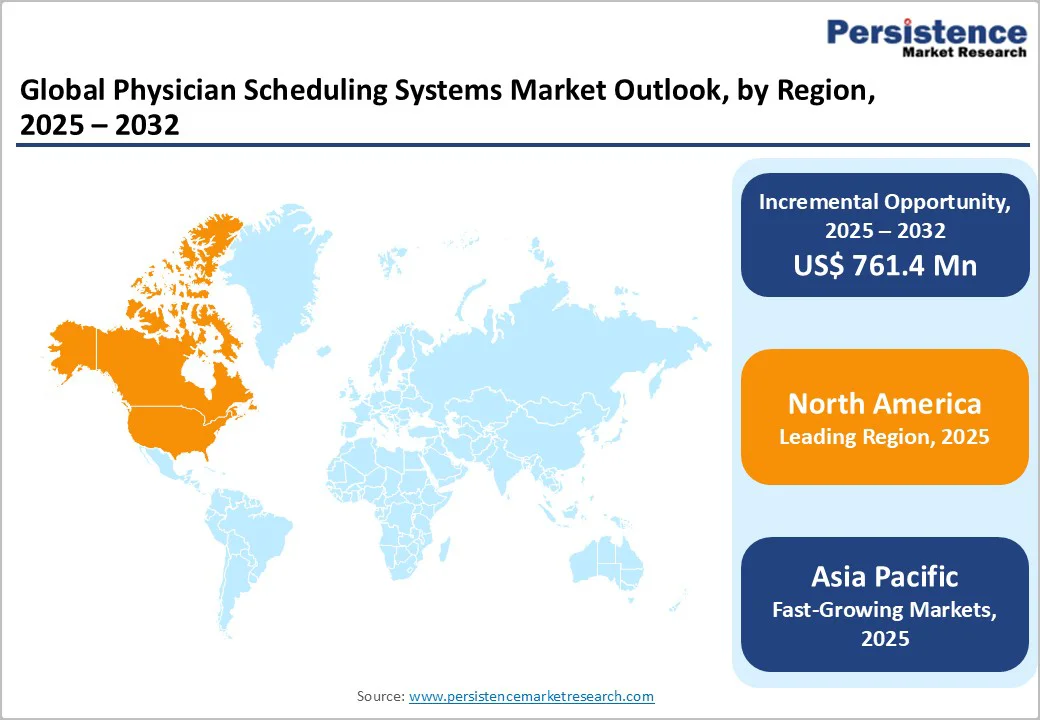
- Leading Region: North America dominates the global market with 36.7%, driven by advanced healthcare IT adoption, physician burnout reduction initiatives, and strong EHR integration.
- Fastest-Growing Region: Asia Pacific market is expected to grow rapidly with a CAGR of 16.1% in forecast period, fueled by telehealth expansion, cloud adoption, and rising private healthcare digitization investments.
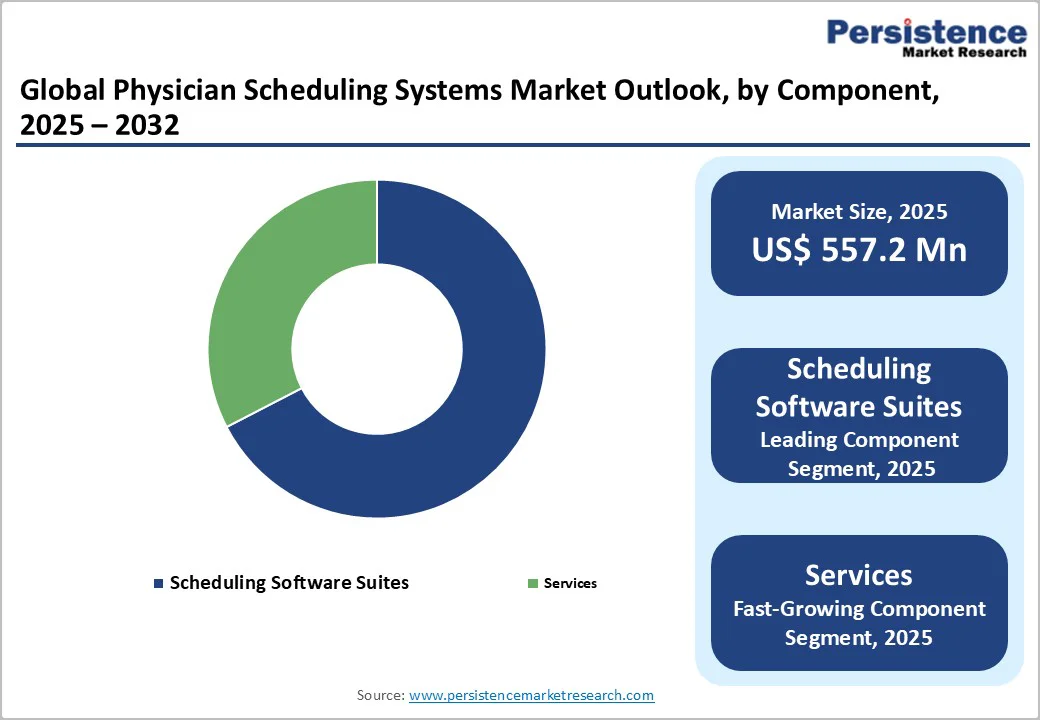
- Leading Component: Scheduling software suites lead with 67.4% share, supported by demand for integrated, feature-rich platforms enhancing workflow automation and patient engagement.
- Leading Scheduling System: Cloud-based software to remain dominant, driven by scalability, lower IT costs, and real-time coordination across multi-site healthcare networks.
- Growing adoption of AI-driven scheduling tools enhances predictive staffing, reduces manual errors, and improves workforce optimization.
- Public healthcare reforms and digital health funding initiatives drive adoption of scheduling and workforce management software.
- Strategic mergers and acquisitions are driving vendor consolidation, expanding market presence, and enhancing technological capabilities across the physician scheduling systems landscape.
- Deeper integration with EHR and electronic medical record (EMR) systems is streamlining data flow, improving documentation accuracy, and enhancing overall clinical efficiency across healthcare facilities.
| Key Insights | Details |
|---|---|
| Global Physician Scheduling Systems Market Size (2025E) | US$ 557.2 Million |
| Market Value Forecast (2032F) | US$ 1,318.5 Million |
| Projected Growth (CAGR 2025 to 2032) | 13.1% |
| Historical Market Growth (CAGR 2019 to 2024) | 11.3% |
Market Dynamics
Driver - Integration with Leading Practice Management (PM) and Electronic Health Record (EHR) Systems
Integration with leading practice management (PM) and EHR systems is a significant driver in the growth of the global physician scheduling system market. As healthcare organizations increasingly rely on technology to streamline operations, integrating scheduling systems with established PM and EHR platforms is crucial for achieving operational efficiency.
These integrations allow for seamless data sharing between scheduling, patient records, and administrative functions, reducing errors, improving workflow, and minimizing the need for duplicating data entry.
By integrating scheduling systems with PM and EHR solutions, healthcare providers are able to access real-time patient information, including medical histories, appointment history, and insurance details, when scheduling appointments.
This integration reduces the risk of scheduling conflicts, enables more accurate patient management, and improves decision-making by providing a holistic view of each patient’s care needs. It also simplifies appointment booking by eliminating the need for manual updates across different systems.
Furthermore, these integrated systems enhance patient experience by offering features including personalized appointment reminders, patient-specific scheduling preferences, and automated follow-ups, which contribute to better patient satisfaction and adherence to care plans. As healthcare organizations seek to adopt more connected, interoperable solutions to comply with regulatory standards and improve efficiency, the integration of scheduling systems with PM and EHR tools remains a driving force in the market’s growth.
Restraints - Lack of Digital Literacy as an Obstacle to Physician Scheduling Technology Adoption
Lack of digital literacy poses a significant challenge to the growth of the global physician scheduling system market. Many healthcare professionals, particularly in smaller or rural practices, may not be fully comfortable with advanced digital tools, limiting the adoption of technology solutions.
A significant portion of the medical workforce may not have the necessary training to effectively utilize sophisticated scheduling software, resulting in resistance to change and slow adoption rates.
Physician scheduling systems, especially those incorporating artificial intelligence (AI), cloud-based infrastructure, or integrated EHR functionalities, appear complex to users unfamiliar with modern technology. The inability to navigate these systems is likely to cause inefficiencies, errors in scheduling, and frustration among both healthcare providers and patients.
Furthermore, a lack of digital literacy also leads to reluctance from administrators and staff in fully embracing these technologies, often opting for traditional, manual scheduling methods. This challenge hinders healthcare organizations from fully realizing the benefits of automated scheduling, such as improved operational efficiency, reduced administrative burden, and enhanced patient satisfaction.
For the market to grow, it’s essential to address this barrier by providing adequate training, user-friendly interfaces, and technical support. Overcoming this challenge is expected to enable wider adoption and integration of physician scheduling systems, ultimately driving market expansion.
Opportunity - Rising Adoption of Telehealth Solutions & Integration with Telemedicine Platforms
The growing shift toward virtual care delivery is creating strong demand for physician scheduling systems integrated with telehealth and telemedicine platforms. As patients increasingly seek convenient, flexible, and remote consultation options, providers require scheduling tools that support real-time availability, virtual waiting rooms, and embedded video consultations.
These integrated solutions streamline the end-to-end process - from booking to follow-up - while reducing administrative overhead and enhancing patient accessibility. By enabling coordinated virtual workflows and efficient resource utilization, telehealth-integrated scheduling systems are becoming essential for hospitals, clinics, and independent practitioners aiming to expand digital care services and improve overall patient engagement and satisfaction.
Category-wise Analysis
By Component: Scheduling Software Suites Leads Driven by Adoption of Integrated, Feature-Rich Healthcare Platforms
Scheduling software suites are projected to hold a dominant 67.4% share of the global physician scheduling systems market in 2025, underscoring their central role in healthcare workflow optimization.
The increasing preference for self-service appointment booking is driving strong adoption of mobile scheduling applications, enabling patients to manage appointments at their convenience. This shift reflects growing digital literacy and demand for real-time, accessible healthcare management tools.
Additionally, the availability of specialized healthcare scheduling platforms-integrated with advanced features such as automated reminders, patient communication, and synchronization with EHR systems-has further accelerated market growth. Hospitals and clinics are increasingly leveraging these intelligent scheduling solutions to streamline operations, minimize administrative burden, and enhance overall patient experience.
By Scheduling System: Cloud-based software Dominate Market Enabled by Scalability, Real-Time Access, and Seamless Coordination
Cloud-based software is projected to remain the leading segment in the global physician scheduling systems market in 2025, accounting for approximately 47.8% of the global share. Its dominance is driven by the growing need for flexibility, scalability, and real-time accessibility across healthcare facilities.
Cloud-based scheduling platforms enable seamless coordination among multi-site hospitals, telehealth providers, and remote healthcare teams, reducing administrative complexity and improving workforce utilization. Moreover, they facilitate integration with EHRs, telemedicine modules, and communication tools, ensuring unified operations and better decision-making.
The pay-as-you-go pricing model and reduced IT maintenance costs make cloud deployment especially attractive for mid-sized hospitals and outpatient centers. As cybersecurity frameworks strengthen and data protection regulations evolve, adoption continues to accelerate, positioning cloud-based scheduling as a critical enabler of digital transformation and operational efficiency in modern healthcare systems.
By End-user: High Patient Loads and Need for Workflow Efficiency Make Hospitals a Dominant Sector
Hospitals are expected to remain the dominant application segment in 2025, accounting for around 42.1% of the global physician scheduling systems market. The widespread adoption of online scheduling software has transformed how hospitals manage patient appointments, enabling seamless booking through dedicated hospital websites or integrated portals.
These systems not only simplify appointment management but also allow patients to share relevant medical information in advance, improving consultation efficiency and care quality. By automating scheduling and reducing administrative workload, hospitals are enhancing patient experience, optimizing resource utilization, and maintaining smoother clinical workflows across departments.
Regional Insights
North America Physician Scheduling Systems Market Analysis
By 2025, North America is projected to account for around 36.7% of the global physician scheduling systems market, underscoring its strong digital transformation in healthcare delivery and workforce management. A key driver is the region’s growing demand for remote and virtual care scheduling, supported by increasing telehealth adoption and cloud-based interoperability.
A major catalyst is the region’s high level of physician burnout and workload stress. According to the American Medical Association (2025), 43.2% of U.S. physicians reported at least one symptom of burnout, primarily due to ineffective EHR systems, documentation overload, and staff shortages.
Physicians cited lack of control over schedules and excessive administrative tasks as key contributors, intensifying the need for intelligent scheduling platforms that balance workloads and reduce after-hours tasks.
Integration with leading EHR/EMR systems has also become pivotal. Modern scheduling tools now synchronize seamlessly with electronic health records, offering unified patient views, automated reminders, and appointment management-all of which enhance care coordination and operational efficiency.
Furthermore, regulatory emphasis on patient safety and staffing compliance, exemplified by CMS’s (Centers for Medicare & Medicaid Services) 2024 Minimum Staffing Standards Rule, compels healthcare facilities to maintain accurate staffing records and compliance visibility-driving demand for automated scheduling solutions.
Innovation partnerships, such as Fraser Health’s AI-powered scheduling initiative with Deloitte Canada (September 2024) and Hearst’s acquisition of QGenda LLC (August 2024) to optimize workforce capacity, further reflect the region’s momentum toward predictive, data-driven scheduling systems.
Europe Physician Scheduling Systems Market Trends
Europe represents a critical growth region, projected to capture around 25.3% of global share by 2025. A major driver is the rising focus on workforce optimization in public healthcare systems.
In July 2025, the European Junior Doctors’ (EJD) Association adopted a new Policy on Workforce-Led Optimization of Healthcare Systems, welcomed by World Health Organization (WHO)/Europe as a pivotal step toward aligning healthcare workforce supply with evolving population needs.
With the region’s ageing population and projected shortages of up to 30% more doctors and 33% more nurses by 2071, this initiative underscores the importance of data-driven workforce governance models.
Furthermore, in March 2025, Fraunhofer IKS and ATOSS Software jointly developed an AI-driven shift planning agent leveraging Graph Neural Networks and Reinforcement Learning to automate hospital rostering. Such innovations, alongside the EU’s broader digital transformation agenda, are positioning Europe as a frontrunner in intelligent, secure, and efficient physician scheduling solutions.
Asia Pacific Physician Scheduling Systems Market Trends
The Asia Pacific market is experiencing rapid growth, with a CAGR of 16.1% projected over the forecast period. The Asia Pacific region is witnessing rapid adoption of cloud-based and mobile physician scheduling tools, driven by expanding telehealth infrastructure and digital transformation in healthcare delivery.
While deterrents such as limited awareness, legacy investments, and concerns around cloud security persist, the benefits are becoming increasingly evident across areas such as remote monitoring, telemedicine, and data analytics.
In September 2023, Apollo Hospitals expanded its partnership with Google Cloud to strengthen the Apollo 24|7 platform-built entirely on Google Cloud-to improve nationwide healthcare access in India, where 60% of hospitals and 80% of doctors remain concentrated in urban areas.
Advanced markets such as Japan, South Korea, and Singapore have demonstrated the success of cloud-based health ecosystems through nationwide EHR databases, elderly monitoring, and telemedicine-enabled “health cities.”
Further, a 2022 - 2024 study across 26 institutions in central Taiwan revealed that integrating scheduling with telehealth and hospital management systems reduced non-emergent referrals from 30% to 10%, while 83% of stroke teleconsultations achieved treatment within the golden hour.
Such outcomes highlight how digital scheduling solutions not only optimize clinical workflows but also enhance patient access, safety, and satisfaction across the Asia Pacific healthcare landscape.
Market Competitive Landscape
The competitive landscape is marked by rapid innovation and consolidation, with leading vendors launching AI-driven, cloud-based scheduling platforms, securing top industry recognitions, and pursuing strategic acquisitions to enhance workforce optimization and healthcare efficiency.
Key Industry Developments:
- In February, 2025, symplr® unveiled the symplr Operations Platform (SOP), a scalable, cloud-based solution built on Amazon Web Services (AWS). This integrated platform helps healthcare CIOs consolidate various systems, standardizing processes for easier maintenance and measurement.
- In February 2025, PerfectServe®, a leading provider of cloud-based clinical collaboration and scheduling solutions, received dual recognition in the 2025 Best in KLAS report, with Lightning Bolt ranked #1 in Physician Scheduling.
- In September 2024, Fraser Health collaborated with Deloitte Canada to create AI-powered scheduling tools aimed at predicting healthcare demand. With support from a $1.5 million Scale AI grant, the project will develop models to forecast patient volumes and optimize staffing, using advanced analytics for efficient scheduling.
- In August 2024, Hearst company announced to acquire QGenda, LLC firm from investment firms Francisco Partners and ICONIQ Growth, to advance workforce scheduling, optimize capacity and improve access to care.
Companies Covered in Physician Scheduling Systems Market
- QGenda, LLC
- TigerConnect
- symplr
- AdvancedMD, Inc.
- ByteBloc Software
- Phreesia
- MetricAid
- PerfectServe, Inc.
- Kimedics, LLC
- Amion
- OSP
- TIMIFY
- Petal Solutions Inc.
- SimplyBook.me Ltd.
- MDsyncNET
- Claricode, Inc.
- Vertikal Technologies SRL
- 2K Digital Limited
- PracticeSuite Inc.
- Mesh AI
- Appointy
- Kronos SaaShr, Inc., a UKG Company
- Zedmed
Frequently Asked Questions
The global physician scheduling systems market is valued at US$ 557.2 Million in 2025.
Rising digital transformation in healthcare, increasing physician workload, and growing adoption of cloud-based and AI-integrated scheduling systems drive market growth.
The global market is poised to witness a CAGR of 13.1% between 2025 and 2032.
Integration with telehealth platforms, AI-powered workforce optimization, and expanding adoption in emerging healthcare markets present major growth opportunities.
Major players in the global are QGenda, LLC, TigerConnect, symplr, AdvancedMD, Inc., ByteBloc Software, and others.


