Pharmaceutical Excipients for Taste Masking Market Size, Trends, Share, Growth, and Regional Forecast, 2026 to 2033

Pharmaceutical Excipients for Taste Masking Market by Excipient (Natural, Artificial, Nutritive, non nutritive, Polyols), Technique (Hot Melt Extrusion, Microencapsulation, Coating, Organoleptic Methods), Usage, End-user, Regional Analysis, from 2026 to 2033

ID: PMRREP14743
Calendar

December 2025

200 Pages

Author : Abhijeet Surwase

Key Industry Highlights:

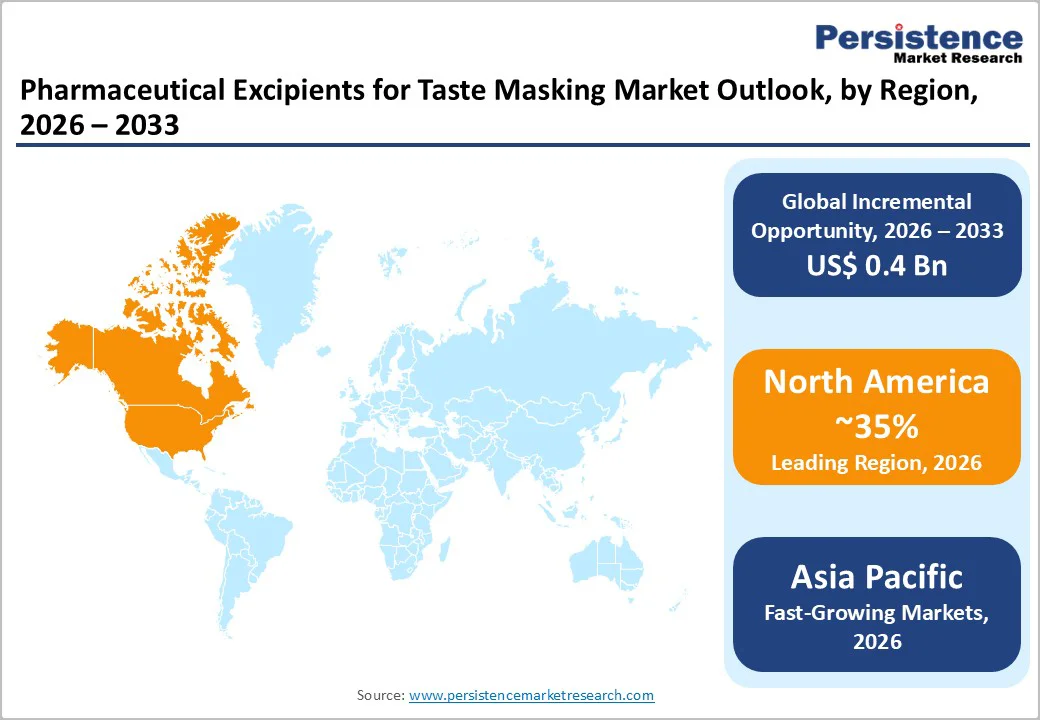
  • Leading Region: North America holds the largest market share in 2025 for pharmaceutical excipients for taste masking, supported by a large base of oral therapies, a strong regulatory framework, and the presence of major excipients.
  • Fastest Growing Region: Asia Pacific emerges fastest in growth, due to rapid expansion of pharmaceutical manufacturing in China, India, Japan, and ASEAN, increasing generic penetration, and rising demand for taste-optimized oral medicines across diverse patient populations.
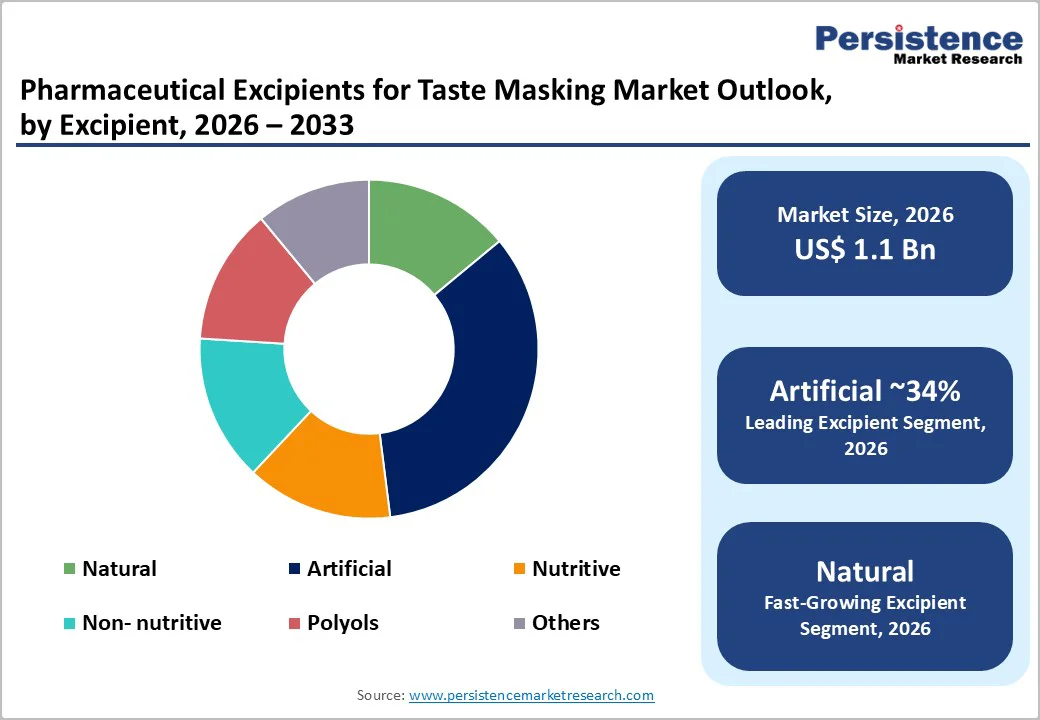
  • Dominant Segment: Artificial excipients are the leading segment in 2025, driven by their strong taste-masking efficiency, cost-effectiveness, and wide use across high-dose and highly soluble oral formulations.
  • Fastest Growing Segment: Natural excipients are the fastest-growing segment in 2025, supported by rising demand for clean-label ingredients and increasing preference for safer, plant-based taste-masking solutions in oral formulations.
Key Insights Details
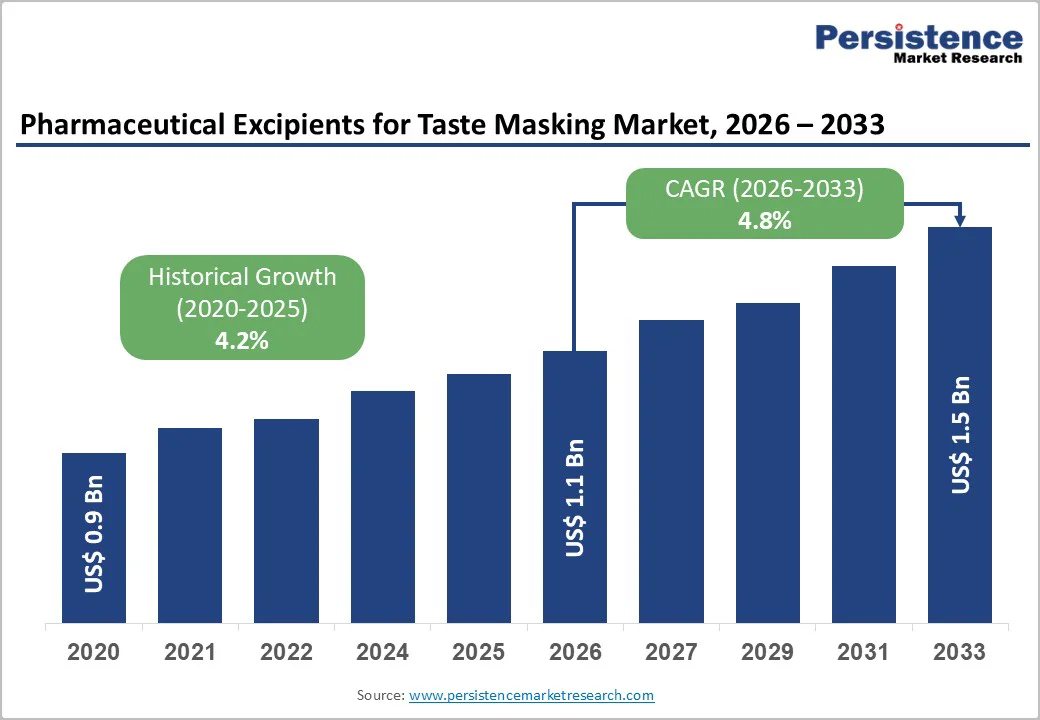
Pharmaceutical Excipients for Taste Masking Market Size (2026E) US$ 1.1 Bn
Market Value Forecast (2033F) US$ 1.5 Bn
Projected Growth (CAGR 2026 to 2033) 4.8%
Historical Market Growth (CAGR 2020 to 2024) 4.2%

pharmaceutical-excipients-for-taste-masking-market-2026–2033

Market Dynamics

Driver - Increasing Demand for Medicines

Any substance's flavour can be distinguished by its taste and odour. Any substance with a bitter taste finds it challenging to gain widespread acceptance. Thus, in order for patients such as elderly people and children, to take typical bitter medications orally, taste masking chemicals are now required.

Pharmaceutical excipients for taste masking play a crucial part in the final dosage of oral medications, unless the substances have no taste or have a bad taste. Pharmaceutical excipients for flavour masking help give many final medicine formulations a pleasing taste, potentially removing nausea brought on by drug taste.

The usage of various excipients for sweetening, ranging from synthetic to natural, has offered producers the viability they need to compete in the pharmaceutical excipients for flavour masking market in terms of price, availability, and accessibility. Chronic and lifestyle diseases are becoming more common everywhere in the world. For society's health, the prevalence of chronic diseases is a significant burden.

Diabetes, cardiovascular conditions, cancer, obesity, osteoporosis, and pulmonary conditions are examples of major chronic diseases. Lifestyle choices such as smoking, not exercising, and eating unhealthy foods all contribute to an increase in medicine demand, which eventually leads to a market expansion for pharmaceutical excipients that conceal flavour.

Restraints - Increasing Regulatory Stringency for Drug and Excipient Approval

The procedures for approving generic drugs are essentially the same everywhere, with minor variations in undeveloped countries. This is due to the fact that the world is not obliged to complete a bioequivalence (BE) research in order to receive generic medicine approval. Medical professionals assert that governments must guarantee the uniform quality of all generic medications. Only then can physicians be content and confident in writing generic medicine prescriptions.

Physicians' (and even patients') lack of trust in generic drugs has been largely attributed to weak regulatory standards governing the number of generic drugs and the number of permitted contaminants. Controlling the manufacturing and distribution of excipients is now a priority for authorities and medication manufacturers because combining excipients has resulted in adverse patient outcomes.

The development of new excipients and delivery technologies has also increased the importance of greater control over the supply and quality of pharmaceutical excipients in the context of in vivo activity.

Excipient suppliers must satisfy the pharmaceutical industry's quality standards due to the excipients' crucial role in pharmaceutical dosage forms, and the pharmaceutical industry must work to ensure the product's safety. The supply chain's use or storage integrity. Therefore, it is anticipated that the expansion of the worldwide market will be constrained by the increasing regulatory requirements for the licensing of pharmaceuticals and excipients.

Opportunity - Expansion of CDMO and Outsourcing Models in Oral Formulations

The growth of Contract Development and Manufacturing Organizations (CDMOs) and outsourcing models is creating new opportunities in the pharmaceutical taste-masking market.

Many pharmaceutical and nutraceutical companies now prefer to outsource the development and production of oral medicines to CDMOs that specialize in complex oral delivery systems. These CDMOs often invest in advanced taste-masking technologies such as hot melt extrusion, film coating, and microencapsulation. This creates a steady demand for high-performance taste-masking excipients.

As CDMOs aim to provide complete solutions from studying the active drug to designing patient-friendly doses, suppliers of excipients such as polyols, non-nutritive sweeteners, and co-processed materials have a chance to expand their business.

Their ingredients can be integrated into the proprietary platforms that CDMOs use for multiple clients and products. This trend not only increases the demand for innovative and high-quality excipients but also allows excipient suppliers to collaborate closely with CDMOs on new oral formulations. Overall, the expansion of outsourcing and CDMO models is a key opportunity for excipient manufacturers to grow and reach a wider range of pharmaceutical projects.

Category-wise Analysis

By Excipient Insights

The artificial excipient segment is expected to lead the pharmaceutical excipients for taste masking market, capturing approximately 34% of the market share in 2025. This growth is largely driven by the extensive use of synthetic sweeteners, flavoring agents, and specialized polymers, which effectively mask the bitterness of drugs even at low concentrations.

Artificial sweeteners and flavor modulators deliver strong sweetness while contributing minimal calories, making them suitable for both adult and pediatric formulations where controlling sugar intake is important. Additionally, synthetic film-forming polymers and coating systems play a critical role in managing drug release and taste perception, particularly for high-dose bitter active pharmaceutical ingredients (APIs) in tablets and granules.

An effective oral dosage form must address bitterness reduction, and significant advances have been made in developing taste-masking compositions in recent years. Synthetic excipients also support tablet manufacturing by binding ingredients, reducing die-wall friction, maintaining pH balance, and ensuring proper disintegration in the stomach. These functionalities have significantly contributed to the expansion and adoption of artificial excipients in pharmaceutical formulations.

By Usage Insights

Solid dosage forms are expected to account for approximately 74% of the Pharmaceutical Excipients for Taste Masking market in 2025, highlighting the widespread use of tablets, capsules, and granules in global prescriptions. This segment is particularly significant in chewable tablets, orally disintegrating tablets (ODTs), and sprinkle formulations, where the direct interaction of the dosage form with taste buds requires advanced masking techniques.

Innovations in co-processed excipients and orally disintegrating platforms developed by companies such as SPI Pharma and Adare Pharma Solutions have strengthened the dominance of solid dosage forms, particularly in chronic therapies where patient compliance is critical.

Many active pharmaceutical ingredients (APIs) exhibit poor solubility and slow dissolution in aqueous environments, such as the fluids of the digestive tract, which can limit oral bioavailability. Excipients play a vital role in overcoming these challenges by contributing to the stability, drug release, taste, and texture of the final formulation. Their inclusion ensures that the medication is both effective and palatable, making excipients indispensable in solid dosage forms.
pharmaceutical-excipients-for-taste-masking-market-outlook-by-excipient-2026–2033

Region-wise Insights

North America Pharmaceutical Excipients for Taste Masking Market Trends

North America, led by the U.S., is projected to account for about 37% of the global Pharmaceutical Excipients for Taste Masking market in 2025. The region benefits from a large portfolio of oral prescription and over-the-counter products, creating strong demand for excipients that improve taste and patient compliance.

Innovation in excipient and formulation development is a key driver, with companies focusing on advanced platforms for orally disintegrating tablets (ODTs), chewables, and pediatric suspensions, especially for chronic and acute therapies.

Regulatory oversight by the U.S. FDA ensures high-quality standards, promoting the use of well-characterized excipients and discouraging untested flavors or sweeteners. Leading industry players, including SPI Pharma, DuPont de Nemours, and Dow Pharma Solutions, help accelerate the adoption of novel taste-masking excipients in both branded and generic drugs.

High acceptance of patient-centric dosage forms and the use of technologies like microencapsulation and coating further enhance market growth. Additionally, the increasing role of North American CDMOs in oral drug delivery supports consistent demand for high-performance taste-masking solutions across the region.

Europe Pharmaceutical Excipients for Taste Masking Market Trends

Europe represents a mature but steadily expanding market for pharmaceutical taste-masking excipients. Key contributors include Germany, the U.K., France, and Spain, where oral solid dosage forms remain central to pharmaceutical therapy.

Regulatory guidance from the European Medicines Agency (EMA) and national authorities emphasizes both benefit-risk balance and patient acceptability, encouraging manufacturers to improve palatability, particularly in pediatric medicines under EU pediatric regulations. This has driven the use of taste-masking excipients such as maltodextrins, polyols, and cyclodextrins, alongside optimized film-coating systems that meet regional regulatory expectations.

Harmonization through European Pharmacopoeia monographs allows cross-border commercialization of excipient systems, supporting consistent product portfolios from suppliers like Roquette Frères and Gattefossé. Strong R&D capabilities and collaborations between universities, research institutes, and industry have further advanced innovation in taste-masking technologies.

Examples include hot melt extrusion techniques applied to pediatric suspensions and oral granules. These developments enable manufacturers to create patient-friendly formulations while complying with strict quality standards. As a result, Europe serves as an important hub for both the development and adoption of sophisticated taste-masking excipients across diverse therapeutic areas.

Asia and Pacific Pharmaceutical Excipients for Taste Masking Market Trends

Asia Pacific is emerging as one of the fastest-growing regions in the Pharmaceutical Excipients for Taste Masking market, driven by expanding pharmaceutical manufacturing in China, India, Japan, and ASEAN countries.

Increased healthcare access and rising penetration of generic medicines are fueling demand for patient-friendly oral formulations. Cost advantages and government incentives for local drug production in China and India have encouraged large-scale investments in oral solid and liquid dosage facilities, increasing the need for effective taste-masking excipients.

Companies in the region are adopting advanced technologies such as microencapsulation and coating to align products with regional taste preferences and improve patient compliance. Japan’s strong regulatory framework and high-quality standards support the use of high-purity excipients and innovative formulations. Meanwhile, ASEAN markets are witnessing growth in over-the-counter and pediatric medicines that rely heavily on taste and sweetness optimization.

Global excipient suppliers, including Roquette Frères and Asahi Kasei Corporation, have strengthened their regional presence through manufacturing facilities, technical support centers, and partnerships. These factors position Asia Pacific as a key growth driver for the taste-masking excipient market over the forecast period.
pharmaceutical-excipients-for-taste-masking-market-outlook-by-region-2026–2033

Competitive Landscape

The pharmaceutical excipients for taste masking market is moderately fragmented, with a mix of global excipient majors and specialized technology providers offering differentiated solutions for oral dosage forms.

Leading companies such as SPI Pharma, Inc., Roquette Frères, Gattefose, Asahi Kasei Corporation, DuPont de Nemours, Inc., and Dow Pharma Solutions compete on functional performance, regulatory support, and formulation expertise rather than on commodity pricing alone.

Key strategies include development of proprietary taste-masking platforms (e.g., Actimask®, Microcaps®), investment in technical service centers, collaboration with CDMOs, and expansion of pediatric-focused excipient offerings, enabling suppliers to embed their materials into customers’ long-term product pipelines.

Key Industry Developments:

  • March 2024: Adare Pharma Solutions expanded its Microcaps® taste-masking technology offering for oral solid and liquid dosage forms, positioning it as a platform to enhance stability, bioavailability, and patient acceptability.
  • In March 2022, CD Formulation launched customized excipient solutions aimed at improving bioavailability, addressing the long-standing challenge of insufficient drug absorption in pharmaceutical production.

Companies Covered in Pharmaceutical Excipients for Taste Masking Market

  • SPI Pharma, Inc.
  • Adare Pharmaceutical Inc.
  • GPT Pharmaceuticals Pvt. Ltd
  • Roquette Frères
  • Rochem International, Inc.
  • Gattefose
  • Asahi Kasei Corporation
  • DuPont de Nemours, Inc
  • Dow Pharma Solutions
  • Others
Frequently Asked Questions

The global pharmaceutical excipients for taste masking market is projected to be valued at US$ 1.1 Bn in 2026.

The increasing focus on patient adherence, particularly in the pediatric and geriatric population are the key factor driving demand for pharmaceutical excipients for taste masking products.

The global pharmaceutical excipients for taste masking market market is poised to witness a CAGR of 4.8% between 2026 and 2033.

A key opportunity is embedding taste-masking excipients into CDMO platform technologies to accelerate development of patient-friendly oral formulations.

Prominent players include SPI Pharma, Inc., Adare Pharmaceutical Inc., Roquette Frères, Gattefose, Asahi Kasei Corporation, DuPont de Nemours, Inc., Dow Pharma Solutions, BASF SE, Evonik Industries AG, Colorcon Inc., Ashland Inc., among others.

Global Pharmaceutical Excipients for Taste Masking Market Report Scope
Report Attribute Details
Historical Data/Actuals 2020 - 2025
Forecast Period 2026 - 2033
Market Analysis Value: US$ Bn and Volume (if Available)
Geographical Coverage
  • North America
  • Europe
  • East Asia
  • South Asia and Oceania
  • Middle East and Africa
  • Latin America
Segmental Coverage
  • By Excipient
  • By Technique
  • By Usage
  • By End-user
  • By Region
Competitive Analysis
  • SPI Pharma, Inc.
  • Adare Pharmaceutical Inc.
  • GPT Pharmaceuticals Pvt. Ltd
  • Roquette Frères
  • Rochem International, Inc.
  • Gattefose
  • Asahi Kasei Corporation
  • DuPont de Nemours, Inc
  • Dow Pharma Solutions
  • Others
Report Highlights
  • Market Forecast and Trends
  • Competitive Intelligence & Share Analysis
  • Growth Factors and Challenges
  • Strategic Growth Initiatives
  • Future Opportunities and Revenue Pockets
  • Market Analysis Tools
Market Segmentation

By Excipient

  • Natural
  • Artificial
  • Nutritive
  • Non-nutritive
  • Polyols
  • Others

By Technique

  • Hot Melt Extrusion
  • Microencapsulation
  • Coating
  • Organoleptic Methods
  • Others

By Usage

  • Solid Dosage Forms
    • Tablets
    • Granules
    • Capsules
  • Liquid Dosage Forms

By End-user

  • Pharmaceuticals
  • Nutraceuticals
  • Contract Manufacturing Organizations

By Region

  • North America
  • Europe
  • East Asia
  • South Asia and Oceania
  • Latin America
  • Middle East and Africa

Related Reports

  1. Executive Summary
    1. Global Pharmaceutical Excipients for Taste Masking Market Snapshot, 2026 and 2033
    2. Market Opportunity Assessment, 2026 - 2033, US$ Bn
    3. Key Market Trends
    4. Future Market Projections
    5. Premium Market Insights
    6. Industry Developments and Key Market Events
    7. PMR Analysis and Recommendations
  2. Market Overview
    1. Market Scope and Definition
    2. Market Dynamics
      1. Drivers
      2. Restraints
      3. Opportunity
      4. Challenges
      5. Key Trends
    3. COVID-19 Impact Analysis
    4. Forecast Factors - Relevance and Impact
  3. Value Added Insights
    1. Value Chain Analysis
    2. Excipient Adoption / Usage Analysis
    3. Key Market Players
    4. Key Promotional Strategies, By Key Players
    5. Regulatory Landscape
    6. PESTLE Analysis
    7. Porter’s Five Force Analysis
  4. Global Pharmaceutical Excipients for Taste Masking Market Outlook
    1. Key Highlights
      1. Market Size (US$ Bn) and Y-o-Y Growth
      2. Absolute $ Opportunity
    2. Market Size (US$ Bn) Analysis and Forecast
      1. Historical Market Size (US$ Mn) Analysis, 2020-2024
      2. Market Size (US$ Bn) Analysis and Forecast, 2025-2033
    3. Global Pharmaceutical Excipients for Taste Masking Market Outlook: Excipient
      1. Historical Market Size (US$ Mn) Analysis, By Excipient, 2020-2024
      2. Market Size (US$ Mn) Analysis and Forecast, By Excipient, 2025-2033
        1. Natural
        2. Artificial
        3. Nutritive
        4. Non- nutritive
        5. Polyols
        6. Others
      3. Market Attractiveness Analysis: Excipient
    4. Global Pharmaceutical Excipients for Taste Masking Market Outlook: Technique
      1. Historical Market Size (US$ Bn) Analysis, By Technique, 2020-2024
      2. Market Size (US$ Bn) Analysis and Forecast, By Technique, 2025-2033
        1. Hot Melt Extrusion
        2. Microencapsulation
        3. Coating
        4. Organoleptic Methods
        5. Others
      3. Market Attractiveness Analysis: Technique
    5. Global Pharmaceutical Excipients for Taste Masking Market Outlook: Usage
      1. Historical Market Size (US$ Bn) Analysis, By Usage, 2020-2024
      2. Market Size (US$ Bn) Analysis and Forecast, By Usage, 2025-2033
        1. Solid Dosage Forms
          1. Tablets
          2. Granules
          3. Capsules
        2. Liquid Dosage Forms
      3. Market Attractiveness Analysis: Usage
    6. Global Pharmaceutical Excipients for Taste Masking Market Outlook: End User
      1. Historical Market Size (US$ Bn) Analysis, By End User, 2020-2024
      2. Market Size (US$ Bn) Analysis and Forecast, By End User, 2025-2033
        1. Pharmaceuticals
        2. Nutraceuticals
        3. Contract Manufacturing Organizations
      3. Market Attractiveness Analysis: End User
  5. Global Pharmaceutical Excipients for Taste Masking Market Outlook: Region
    1. Historical Market Size (US$ Bn) Analysis, By Region, 2020-2024
    2. Market Size (US$ Bn) Analysis and Forecast, By Region, 2025-2033
      1. North America
      2. Latin America
      3. Europe
      4. East Asia
      5. South Asia and Oceania
      6. Middle East & Africa
    3. Market Attractiveness Analysis: Region
  6. North America Pharmaceutical Excipients for Taste Masking Market Outlook
    1. Historical Market Size (US$ Bn) Analysis, By Market, 2020-2024
      1. By Country
      2. By Excipient
      3. By Technique
      4. By Usage
      5. By End User
    2. Market Size (US$ Bn) Analysis and Forecast by Country, 2025-2033
      1. U.S.
      2. Canada
    3. Market Size (US$ Mn) Analysis and Forecast, By Excipient, 2025-2033
      1. Natural
      2. Artificial
      3. Nutritive
      4. Non- nutritive
      5. Polyols
      6. Others
    4. Market Size (US$ Bn) Analysis and Forecast, By Technique, 2025-2033
      1. Hot Melt Extrusion
      2. Microencapsulation
      3. Coating
      4. Organoleptic Methods
      5. Others
    5. Market Size (US$ Bn) Analysis and Forecast, By Usage, 2025-2033
      1. Solid Dosage Forms
        1. Tablets
        2. Granules
        3. Capsules
      2. Liquid Dosage Forms
    6. Market Size (US$ Bn) Analysis and Forecast, By End User, 2025-2033
      1. Pharmaceuticals
      2. Nutraceuticals
      3. Contract Manufacturing Organizations
    7. Market Attractiveness Analysis
  7. Europe Pharmaceutical Excipients for Taste Masking Market Outlook
    1. Historical Market Size (US$ Bn) Analysis, By Market, 2020-2024
      1. By Country
      2. By Excipient
      3. By Technique
      4. By Usage
      5. By End User
    2. Market Size (US$ Bn) Analysis and Forecast by Country, 2025-2033
      1. Germany
      2. France
      3. U.K.
      4. Italy
      5. Spain
      6. Russia
      7. Rest of Europe
    3. Market Size (US$ Mn) Analysis and Forecast, By Excipient, 2025-2033
      1. Natural
      2. Artificial
      3. Nutritive
      4. Non- nutritive
      5. Polyols
      6. Others
    4. Market Size (US$ Bn) Analysis and Forecast, By Technique, 2025-2033
      1. Hot Melt Extrusion
      2. Microencapsulation
      3. Coating
      4. Organoleptic Methods
      5. Others
    5. Market Size (US$ Bn) Analysis and Forecast, By Usage, 2025-2033
      1. Solid Dosage Forms
        1. Tablets
        2. Granules
        3. Capsules
      2. Liquid Dosage Forms
    6. Market Size (US$ Bn) Analysis and Forecast, By End User, 2025-2033
      1. Pharmaceuticals
      2. Nutraceuticals
      3. Contract Manufacturing Organizations
    7. Market Attractiveness Analysis
  8. East Asia Pharmaceutical Excipients for Taste Masking Market Outlook
    1. Historical Market Size (US$ Bn) Analysis, By Market, 2020-2024
      1. By Country
      2. By Excipient
      3. By Technique
      4. By Usage
      5. By End User
    2. Market Size (US$ Bn) Analysis and Forecast by Country, 2025-2033
      1. China
      2. Japan
      3. South Korea
    3. Market Size (US$ Mn) Analysis and Forecast, By Excipient, 2025-2033
      1. Natural
      2. Artificial
      3. Nutritive
      4. Non- nutritive
      5. Polyols
      6. Others
    4. Market Size (US$ Bn) Analysis and Forecast, By Technique, 2025-2033
      1. Hot Melt Extrusion
      2. Microencapsulation
      3. Coating
      4. Organoleptic Methods
      5. Others
    5. Market Size (US$ Bn) Analysis and Forecast, By Usage, 2025-2033
      1. Solid Dosage Forms
        1. Tablets
        2. Granules
        3. Capsules
      2. Liquid Dosage Forms
    6. Market Size (US$ Bn) Analysis and Forecast, By End User, 2025-2033
      1. Pharmaceuticals
      2. Nutraceuticals
      3. Contract Manufacturing Organizations
    7. Market Attractiveness Analysis
  9. South Asia & Oceania Pharmaceutical Excipients for Taste Masking Market Outlook
    1. Historical Market Size (US$ Bn) Analysis, By Market, 2020-2024
      1. By Country
      2. By Excipient
      3. By Technique
      4. By Usage
      5. By End User
    2. Market Size (US$ Bn) Analysis and Forecast by Country, 2025-2033
      1. India
      2. Indonesia
      3. Thailand
      4. Singapore
      5. ANZ
      6. Rest of South Asia & Oceania
    3. Market Size (US$ Mn) Analysis and Forecast, By Excipient, 2025-2033
      1. Natural
      2. Artificial
      3. Nutritive
      4. Non- nutritive
      5. Polyols
      6. Others
    4. Market Size (US$ Bn) Analysis and Forecast, By Technique, 2025-2033
      1. Hot Melt Extrusion
      2. Microencapsulation
      3. Coating
      4. Organoleptic Methods
      5. Others
    5. Market Size (US$ Bn) Analysis and Forecast, By Usage, 2025-2033
      1. Solid Dosage Forms
        1. Tablets
        2. Granules
        3. Capsules
      2. Liquid Dosage Forms
    6. Market Size (US$ Bn) Analysis and Forecast, By End User, 2025-2033
      1. Pharmaceuticals
      2. Nutraceuticals
      3. Contract Manufacturing Organizations
    7. Market Attractiveness Analysis
  10. Latin America Pharmaceutical Excipients for Taste Masking Market Outlook
    1. Historical Market Size (US$ Bn) Analysis, By Market, 2020-2024
      1. By Country
      2. By Excipient
      3. By Technique
      4. By Usage
      5. By End User
    2. Market Size (US$ Bn) Analysis and Forecast by Country, 2025-2033
      1. Brazil
      2. Mexico
      3. Rest of Latin America
    3. Market Size (US$ Mn) Analysis and Forecast, By Excipient, 2025-2033
      1. Natural
      2. Artificial
      3. Nutritive
      4. Non- nutritive
      5. Polyols
      6. Others
    4. Market Size (US$ Bn) Analysis and Forecast, By Technique, 2025-2033
      1. Hot Melt Extrusion
      2. Microencapsulation
      3. Coating
      4. Organoleptic Methods
      5. Others
    5. Market Size (US$ Bn) Analysis and Forecast, By Usage, 2025-2033
      1. Solid Dosage Forms
        1. Tablets
        2. Granules
        3. Capsules
      2. Liquid Dosage Forms
    6. Market Size (US$ Bn) Analysis and Forecast, By End User, 2025-2033
      1. Pharmaceuticals
      2. Nutraceuticals
      3. Contract Manufacturing Organizations
    7. Market Attractiveness Analysis
  11. Middle East & Africa Pharmaceutical Excipients for Taste Masking Market Outlook
    1. Historical Market Size (US$ Bn) Analysis, By Market, 2020-2024
      1. By Country
      2. By Excipient
      3. By Technique
      4. By Usage
      5. By End User
    2. Market Size (US$ Bn) Analysis and Forecast by Country, 2025-2033
      1. GCC Countries
      2. Egypt
      3. South Africa
      4. Northern Africa
      5. Rest of Middle East & Africa
    3. Market Size (US$ Mn) Analysis and Forecast, By Excipient, 2025-2033
      1. Natural
      2. Artificial
      3. Nutritive
      4. Non- nutritive
      5. Polyols
      6. Others
    4. Market Size (US$ Bn) Analysis and Forecast, By Technique, 2025-2033
      1. Hot Melt Extrusion
      2. Microencapsulation
      3. Coating
      4. Organoleptic Methods
      5. Others
    5. Market Size (US$ Bn) Analysis and Forecast, By Usage, 2025-2033
      1. Solid Dosage Forms
        1. Tablets
        2. Granules
        3. Capsules
      2. Liquid Dosage Forms
    6. Market Size (US$ Bn) Analysis and Forecast, By End User, 2025-2033
      1. Pharmaceuticals
      2. Nutraceuticals
      3. Contract Manufacturing Organizations
    7. Market Attractiveness Analysis
  12. Competition Landscape
    1. Market Share Analysis, 2025
    2. Market Structure
      1. Competition Intensity Mapping by Market
      2. Competition Dashboard
    3. Company Profiles (Details - Overview, Financials, Strategy, Recent Developments)
      1. Roquette Frères
        1. Overview
        2. Segments and Distribution Channels
        3. Key Financials
        4. Market Developments
        5. Market Strategy
      2. Rochem International, Inc.
      3. Gattefose
      4. Asahi Kasei Corporation
      5. DuPont de Nemours, Inc
      6. Dow Pharma Solutions
      7. SPI Pharma, Inc
      8. GPT Pharmaceuticals Pvt. Ltd
      9. Adare Pharmaceuticals Inc.
      10. Others
  13. Appendix
    1. Research Methodology
    2. Research Assumptions
    3. Acronyms and Abbreviations

Research Methodology Framework for Market Research Excellence

At Persistence Market Research, we implement a comprehensive, validated, and multi-dimensional approachto market analysis that delivers actionable insights across complex market landscapes. Our methodology combines the analytical rigor of leading consulting firms with innovative research techniques, ensuring robust market assessments that guide strategic decision-making with confidence.

Core Research Philosophy

Our methodology is built on four foundational pillars:

Research Philosophy Image

At Persistence Market Research, our methodology is designed to transcend conventional market studies by combining analytical rigor, multi-source validation, and future-focused insights.

We integrate advanced research frameworks, robust data collection strategies, cutting-edge analytics, and innovative technologies to deliver a 360-degree view of complex markets.

We integrate advanced research frameworks, robust data collection strategies, cutting-edge analytics, and innovative technologies to deliver a 360-degree view of complex markets.

Each stage spanning from strategic scoping and hypothesis-building to competitive intelligence, quality validation, and actionable recommendations is engineered to provide clients with unmatched clarity, precision, and confidence in decision-making.

By embedding innovation and technology at the core, our approach ensures that insights are not only comprehensive but also predictive, empowering businesses to seize opportunities, mitigate risks, and achieve sustainable growth

Research Philosophy Image

Capturing Key Information and Events

During this phase, key research objectives focus on essential information and data points for assessing the market, including:

Research Philosophy Image

TAM-SAM-SOM Framework Implementation

We employ both top-down and bottom-up approaches to ensure accurate market sizing.

Top-Down Market SizingBottom-Up Market Sizing
Universe Definition: Total global/regional market identificationUnit Economics: Average transaction values, purchase frequencies, customer lifecycle
Segmentation Filters: Geographic, demographic, and behavioral constraintsCustomer Segmentation: Detailed buyer persona development and sizing
Market Share Analysis: Competitive landscape assessment and share allocationPenetration Analysis: Market penetration rates by segment and geography
Growth Rate Application: Historical trends and forward-looking growth assumptionsScaling Methodology: Extrapolation techniques with confidence intervals

Validation & Cross-Verification

  • Triangulation: Comparing top-down and bottom-up results for consistency
  • Sensitivity Analysis: Testing key assumptions and parameter variations
  • Peer Benchmarking: Comparison with analogous markets and industry benchmarks
  • Expert Review: External validation through industry specialist consultation

Research Philosophy Image

Forecasting & Projection Modeling

Our proprietary forecasting models incorporate multiple variables and scenarios.

Forecasting Components

  • Historical Trend Analysis: 10-year historical growth patterns and cyclical variations
  • Driver-Based Modeling: Economic indicators, demographic shifts, technology adoption
  • Scenario Planning: Base case, optimistic, and conservative projections
  • Monte Carlo Simulations: Probability-weighted outcomes and risk assessments

Model Validation

  • Back-Testing: Historical accuracy assessment over 3–5-year periods
  • Cross-Validation: Multiple modeling approaches for result comparison
  • External Benchmarking: Comparison with established market forecasts
  • Continuous Calibration: Quarterly model updates based on new data

Comprehensive Data Collection Strategy

Our secondary research phase establishes a robust knowledge base utilizing diverse, credible sources.

Secondary Data Sourcess

  • Industry Publications & Reports
  • Government & Regulatory Data
  • Financial Intelligence (filings & reports)
  • Academic Research & Digital Intelligence

Quality Assurance Protocol

  • Source credibility assessment and publication date validation
  • Data consistency checks across multiple sources
  • Bias identification and neutralization techniques
  • Information gap tracking for primary research prioritization

Research Philosophy Image

Primary Research Excellence

Our primary research methodology employs best-in-class techniques to capture unique market insights.

Quantitative Research Methods

  • Large-Scale Surveys: Statistically representative samples with 95% confidence intervals
  • Survey Methodology: Multi-channel deployment (online, telephone, in-person)
  • Question Architecture and Response Optimization

Qualitative Research Methods

  • Executive Interviews
  • Focus Groups
  • Expert Consultations

Quality Assurance & Validation Framework

Multi-Stage Validation Process

  • Source Verification and Consistency Testing
  • Outlier Detection and Bias Assessment
  • Peer Review Process and External Validation
  • Sensitivity Analysis and Confidence Intervals

Research Philosophy Image

Methodology Validation & Credibility

Our research methodology has been extensively validated through:

  • Academic Partnerships: Collaborations with top-tier business schools and research institutions
  • Client Success Stories: Documented case studies demonstrating research impact and ROI
  • Continuous Benchmarking: Performance comparison with leading global research firms

This comprehensive methodology framework positions Persistence Market Research at the forefront of market intelligence, combining the analytical sophistication of top-tier consulting firms with innovative research techniques. Our approach ensures that every market assessment delivers precise, actionable, and strategically valuable insights that drive business success in competitive market environments.

Ready to unlock your market potential? Contact our research experts to discuss how our validated methodology can transform your strategic decision-making with data-driven market intelligence.

Copyright © 2026 Persistence Market Research. All Rights Reserved

Connect With Us -
Pharmaceutical Excipients for Taste MaskingIndustry