Pecan Nuts Market Size, Share, and Growth Forecast 2026 - 2033

Pecan Nuts Market by Product Type (In-shell, Shelled), by Form (Raw/Whole, Processed), End-user, Distribution Channel, and Regional Analysis, 2026 - 2033

ID: PMRREP12652
Calendar

March 2026

202 Pages

Author : Amol Patil

Pecan Nuts Market Size and Trend Analysis

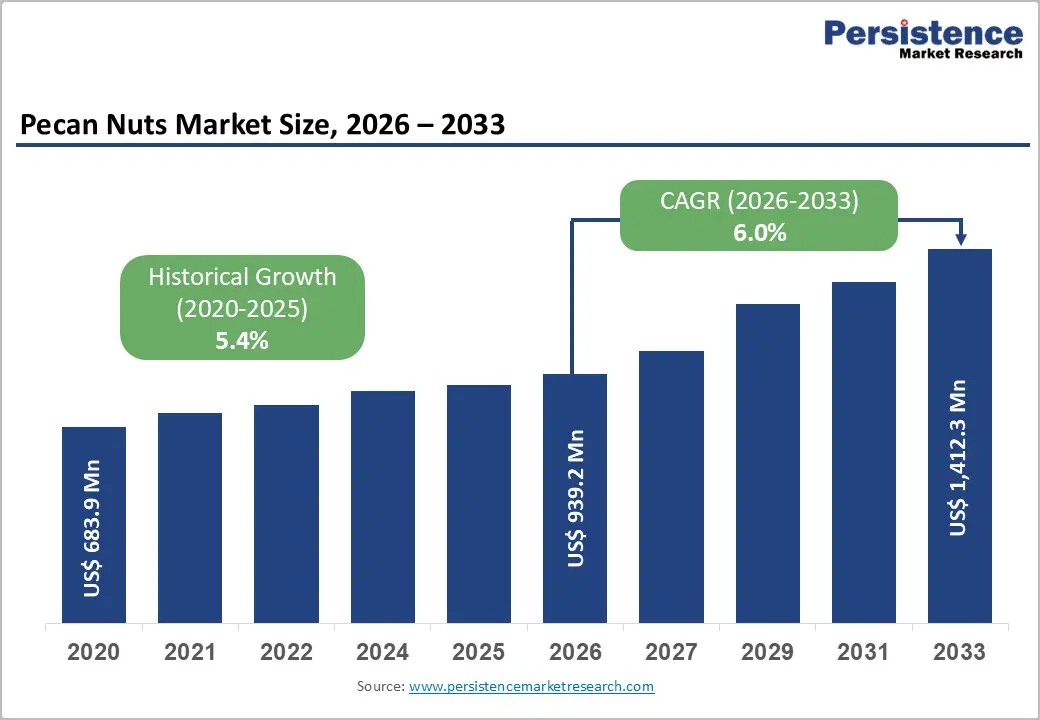
The global pecan nuts market size is expected to be valued at US$ 939.2 million in 2026 and projected to reach US$ 1,412.3 million by 2033, growing at a CAGR of 6.0% between 2026 and 2033.

Potential growth in the global pecan industry is expected to be driven by innovations such as chocolate-coated, spiced, or honey-roasted pecans. Growing pecan consumption in the Asia Pacific and Europe offers lucrative opportunities for exporters. Rising awareness of pecans' health benefits, such as their richness in antioxidants, healthy fats, and essential nutrients, is set to drive demand. Pecan products marketed as non-GMO, gluten-free, and high-protein snacks will gain traction, especially among health-conscious consumers.

Key Industry Highlights:

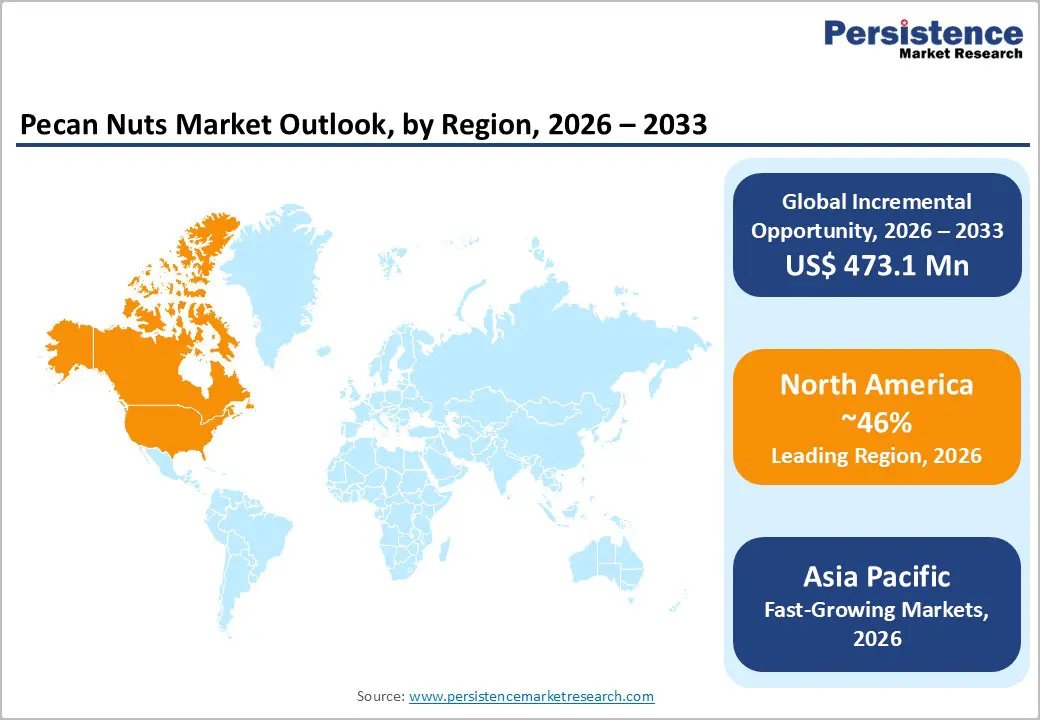
  • North America dominates with 46% share in 2025, driven by U.S. production leadership, efficient export channels, and strong domestic consumption.
  • Asia Pacific is the fastest growing, fuelled by urbanization, rising incomes, and premium pecan demand in China and India.
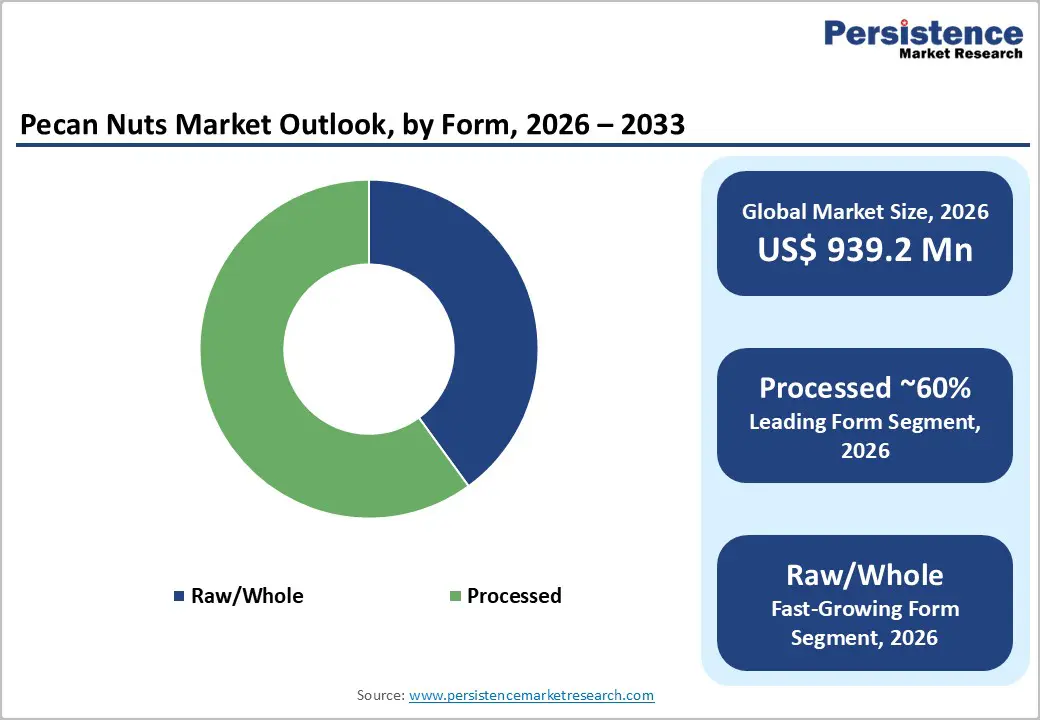
  • Processed pecans lead with 60% share in 2025, preferred for convenience, usage in snacks, bakery items, and ready-to-eat food products.
  • Raw/Whole pecan nuts are the fastest-growing, boosted by natural snacking trends, health-conscious consumers, and increasing inclusion in recipes.
  • Asia Pacific plant-based foods present a key opportunity, leveraging pecans’ health benefits, functional nutrition, and rising demand for vegan and protein-rich snacks.
Key Insights Details

Pecan Nuts Market Size (2026E)

US$ 939.2 million

Market Value Forecast (2033F)

US$ 1,412.3 million

Projected Growth CAGR (2026-2033)

6.0%

Historical Market Growth (2020-2025)

5.4%

pecan-nuts-market-size-2026-2033

Market Dynamics

Driver - Innovations in Packaging to Bolster Demand Worldwide

There is a growing shift toward recyclable, biodegradable, and compostable packaging materials, as sustainability becomes a prominent focus for companies and consumers. Companies are adopting eco-friendly packaging solutions to appeal to environmentally conscious consumers. The industry is witnessing an increasing consumer preference for packaging that minimizes environmental impact. For instance, around 38% of consumers are willing to pay a premium for products that use sustainable packaging.

Recyclable materials such as paper, cardboard, and biodegradable plastics are becoming common in the pecan nuts market. Plant-based packaging, including mushroom packaging or seaweed-based films, is gaining popularity in the food industry as a biodegradable alternative to plastic.

Pecan producers can differentiate their brands by adopting these materials and prominently displaying their sustainability efforts on packaging. This aligns with growing consumer demand for products with reduced environmental footprints.

Modern consumers prefer minimalistic and transparent packaging that enables them to see the product inside. This trend is driven by the desire for simplicity, freshness, and the perception of higher quality. As consumers increasingly seek on-the-go snack options, portion-controlled and resealable packaging has become a major trend. Small and single-serve packs are especially popular with busy consumers.

Sustainable Farming Practices and Transparency to Attract Consumers

Water conservation is a key focus for the pecan nuts industry due to the high-water requirements for growing pecans. Innovations in water-efficient irrigation systems, such as drip irrigation and moisture sensors, are being adopted to reduce water waste and improve water management. Pecan farming in regions like U.S. Southwest has started to adopt drip irrigation systems to decrease water consumption and increase efficiency.

Drip irrigation systems deliver water directly to the plant's roots, reducing water usage by 30% to 50% compared to traditional flood irrigation methods. Moisture sensors and weather-based irrigation controllers are being integrated to optimize irrigation schedules and further minimize water waste. With rising consumer demand for organic products, more pecan farmers are adopting organic farming practices, including the elimination of synthetic pesticides, fertilizers, and herbicides.

Organic certification not only meets consumer demand for cleaner, chemical-free products but also enhances soil health and biodiversity. A survey revealed that 38% of consumers are more likely to purchase products from companies that are transparent about their ethical sourcing and labor practices.

Restraint - Supply Chain and Labor Issues May Hinder Demand

The pecan harvesting season generally peaks in the fall and early winter, requiring large numbers of seasonal workers to ensure timely collection and processing of the nuts. A shortage of available workers during this critical period can result in delays in harvesting, leading to a loss of crop quality. Overripe or under-ripe nuts can affect the marketability and pricing of pecans.

A significant portion of agricultural labor in the U.S., particularly in pecan-producing states like Georgia, Texas, and New Mexico, is performed by migrant workers. Immigration policies and restrictions on migrant labor have made it difficult to fill seasonal positions in orchards and processing plants. For instance, according to the American Farm Bureau Federation, 50% to 70% of U.S. farm laborers are foreign-born, and restrictions on this workforce can create key labor gaps during peak seasons. These gaps lead to the need for higher wages, which, in turn, drive up production costs.

Opportunity - Brands to Leverage E-commerce Channels to Gain Profit

The food and beverage e-commerce market is witnessing skyrocketing growth as consumer preferences shift toward the convenience of online shopping. Consumers are increasingly seeking direct-to-consumer (D2C) options, which offer a wider selection, better prices, and the convenience of home delivery. Consumers are increasingly willing to buy premium and niche products, such as organic or non-GMO pecans, through e-commerce channels, as they trust online retailers for product variety, pricing, and convenience. For instance, in the U.S., 50% of consumers now purchase groceries online, and this number continues to rise, with a growing proportion choosing online shopping for their snack and nut needs. A study found that 36% of millennials prefer buying snacks and nuts, including premium and organic pecans, from online grocery platforms because of their convenience and the ease of comparing prices.

Subscription boxes for nuts, including pecans, are appealing to consumers who want to try different varieties or enjoy regular deliveries of their favorite products. A survey revealed that 60% of millennials are more likely to sign up for a subscription service that provides healthy and natural snacks like pecans, making it an attractive option for younger generations.

Category-wise Analysis

Product Type Insights

The shelled segment is anticipated to hold a share of 72% in 2026. Shelled pecans are ready to use, making these more appealing to consumers and industries compared to in-shell pecans, which require additional effort to crack and clean. This convenience caters to busy consumers and food manufacturers who prioritize time-saving solutions.

In 2024, the U.S. exported 21.5 thousand metric tons of shelled pecans, compared to 32.2 thousand metric tons of in-shell pecans. The significant difference reflects higher demand for shelled pecans in both domestic and international markets. Shelled pecans are often marketed as a healthy, ready-to-eat snack, appealing to consumers focused on convenience and nutrition.

Their versatility in plant-based diets and recipes further enhances their popularity. Retailers and online platforms predominantly sell shelled pecans in consumer-friendly packaging. The rise of e-commerce has further boosted the demand for pre-packaged, shelled pecans.

Distribution Channel Insights

Business-to-business is projected to hold a share of 62.8% in 2026. In 2025, the B2B segment accounted for nearly 68% of the global pecan market revenue, significantly surpassing the Business-to-Consumer (B2C) segment. Businesses purchase pecans in bulk to decrease procurement costs and ensure a steady supply, especially during peak production seasons.

International food and beverage companies source pecans in large quantities, driving the B2B segment's dominance in exports. For example, in 2022, the U.S. exported 37.6 thousand metric tons of pecans, with the majority being purchased by industrial clients. The B2B segment ensures year-round demand due to production schedules in food manufacturing and other industries, unlike the B2C segment, which can be influenced by seasonal trends.

Processed pecans dominate the B2B market as they are more convenient for industrial applications. Businesses prefer shelled, roasted, or chopped pecans for direct incorporation into products. Processed pecans accounted for nearly 60% of the total market revenue in 2024, much of which is attributed to B2B transactions.
pecan-nuts-market-outlook-by-form-2026-2033

Regional Insights

North America Pecan Market Trends and Insights

The pecan nuts market in North America is predicted to hold a share of 46% in 2026. The U.S. pecan market remains a cornerstone of the global industry, supported by favorable growing conditions across southern states like Georgia, Texas, and New Mexico. With rising consumer interest in heart-healthy snacks and plant-based ingredients, domestic demand continues to expand. Exports to key markets such as China and Mexico also drive revenue growth, reinforcing the country's leadership in both production and trade. The U.S. is the largest producer of pecans globally, accounting for 80% of the world’s supply. This dominance in production ensures a steady supply and market control in the region. In 2024, the U.S. exported approximately 53.7 thousand metric tons of pecans, valued at over $381 million, to countries such as Mexico, China, and Canada.

Pecans are widely consumed in North America, driven by their use in traditional dishes like pecan pie as well as their incorporation in snacks, baked goods, and health foods. For instance, according to statistics provided by the National Pecan Shellers Association, per capita pecan consumption in the U.S. was approximately 0.5 pounds in 2023.

As consumers increasingly prioritize healthful eating, demand for nutrient-dense nuts like pecans has surged. Growing adoption of plant-based diets has further boosted the market as a source of protein and healthy fats. North America boasts a well-developed infrastructure for pecan production, processing, and distribution. The U.S. pecan industry has successfully expanded its global reach. For instance, exports to China have grown significantly, despite trade challenges in recent years.

Asia Pacific Pecan Market Trends and Insights

Asia Pacific is emerging as the fastest-growing region in the pecan market, projected to maintain a strong CAGR through 2032. Key countries driving this growth include China, India, Japan, and ASEAN nations, where rapid urbanization and increasing disposable incomes are boosting demand for premium nuts. In China, pecans are widely imported for gifting and wellness purposes, although some sourcing is shifting to South Africa. Rising health awareness and a preference for nutritious snacks have encouraged cafés, restaurants, and retail chains to include pecans in their offerings, further supporting market expansion.

The region’s growth is also fueled by manufacturing advantages and expanding e-commerce platforms, which improve availability and convenience for consumers. Australia plays a significant role as a regional supplier, ensuring consistent quality and supply. In India, the increasing adoption of Western snacking habits presents strong potential for market development. With these dynamics, Asia Pacific is poised to capture a larger share of the global pecan market, driven by evolving consumer preferences, premiumization trends, and cross-border trade opportunities.
pecan-nuts-market-outlook-by-region-2026-2033

Competitive Landscape

Companies in the pecan nuts market are developing unique pecan-based products such as pecan oil, pecan butter, flavored pecans, and pecan snacks. They are catering to health-conscious consumers by offering organic and non-GMO pecans.

Businesses are highlighting the origin, sustainability practices, and family-owned traditions to build emotional connections with consumers. They are progressively using platforms like Instagram and TikTok to promote recipes and uses for pecans. Brands are also partnering with chefs, influencers, and food bloggers to increase visibility. They are implementing water conservation, integrated pest management, and other sustainable farming practices. Organizations are ensuring traceability to attract ethically conscious buyers. They are expanding in markets with rising demand for the nut.

Key Developments:

  • In January 2025, Kodiak’s chief brand officer, Zac Efron, introduced the new Apple Brown Sugar Pecan Oatmeal.
  • In January 2025, Paris Baguette made a new winter menu addition featuring butter pecan delights and savory sourdough creations.
  • In September 2024, Starbucks added a new Pecan Crunch Oatmilk Latte to its 2024 fall menu.

Companies Covered in Pecan Nuts Market

  • Royalty Pecan Farms
  • The Kraft Heinz Company
  • Diamond Foods, Inc.
  • John B. Sanfilippo & Son, Inc.
  • Farmers Investment Co.
  • Sahale Snacks, Inc.
  • Lamar Pecan Company
  • Golden Peanut and Tree Nut
  • New Aces Pecan Company LLC
  • Atwell Pecan Co.
  • Pecan Argentina S.A.
  • Ellis Bros. Pecans, Inc.
  • Merritt Pecan, Inc.
  • Navarro Pecan Company Inc.
  • Others
Frequently Asked Questions

The global pecan nuts market is expected to reach US$ 939.2 million in 2026.

Rising health awareness boosts demand, with pecans favored for antioxidants and healthy fats in snacks and plant-based foods.

North America leads with 46% share in 2025.

A key opportunity in the pecan market lies in Asia-Pacific plant-based foods, leveraging health benefits and rising demand for nutritious snacks.

Prominent players in the market include Royalty Pecan Farms, The Kraft Heinz Company, and Diamond Foods, Inc.

Global Pecan Nuts Market Report Scope
Report Attribute Details

Historical Data/Actuals

2020 - 2025

Forecast Period

2026 - 2033

Market Analysis Units

Value: US$ Mn

Geographical Coverage

  • North America
  • Europe
  • East Asia
  • South Asia & Oceania
  • Latin America
  • Middle East & Africa

Segmental Coverage

  • Product Type
  • Form
  • End Use
  • Distribution Channel
  • Region

Competitive Analysis

  • Royalty Pecan Farms
  • The Kraft Heinz Company
  • Diamond Foods, Inc.
  • John B. Sanfilippo & Son, Inc.
  • Farmers Investment Co.
  • Sahale Snacks, Inc.
  • Lamar Pecan Company
  • Golden Peanut and Tree Nut
  • New Aces Pecan Company LLC
  • Atwell Pecan Co.
  • Pecan Argentina S.A.
  • Ellis Bros. Pecans, Inc.
  • Merritt Pecan, Inc.
  • Navarro Pecan Company Inc.
  • Others

Report Highlights

  • Market Forecast and Trends
  • Competitive Intelligence and Share Analysis
  • Growth Factors and Challenges
  • Strategic Growth Initiatives
  • Pricing Analysis
  • Future Opportunities and Revenue Pockets
  • Market Analysis Tools
Market Segmentation

By Product Type

  • In-shell
  • Shelled

By Form

  • Raw/Whole
  • Processed

By End Use

  • Food Industry
    • Bakery and Confectionery
    • Snacks and Meals
    • Dairy and Desserts
    • Beverages
  • Dietary Supplements
  • Cosmetics and Personal Care
  • Retail/Households

By Distribution Channel

  • Business to Business
  • Business to Consumer
    • Hypermarkets/Supermarkets
    • Convenience Stores
    • Specialty Retail
    • Online Retail

By Region

  • North America
  • Europe
  • Asia Pacific
  • Latin America
  • Middle East & Africa

Related Reports

  1. Executive Summary
    1. Global Pecan Nuts Market Snapshot 2026 and 2033
    2. Market Opportunity Assessment, 2026-2033, US$ Mn
    3. Key Market Trends
    4. Industry Developments and Key Market Events
    5. Demand Side and Supply-Side Analysis
    6. PMR Analysis and Recommendations
  2. Market Overview
    1. Market Scope and Definitions
    2. Market Dynamics
      1. Driver
      2. Restraint
      3. Opportunities
      4. Trends
    3. Macro-Economic Factors
      1. Global Sectorial Outlook
      2. Global GDP Growth Outlook
    4. Forecast Factors – Relevance and Impact
    5. COVID-19 Impact Assessment
  3. Value Added Insights
    1. Value Chain analysis
    2. Key Market Players
    3. Product Adoption Analysis
    4. Key Promotional Strategies by key players
    5. PESTLE Analysis
    6. Porter's Five Forces Analysis
    7. Regulatory and Technology Landscape
  4. Global Pecan Nuts Market Outlook: Historical (2020 – 2025) and Forecast (2026 – 2033)
    1. Key Highlights
    2. Global Pecan Nuts Market Outlook: Product Type
      1. Introduction/Key Findings
      2. Historical Market Size (US$ Mn) Analysis by Product Type, 2020-2025
      3. Current Market Size (US$ Mn) Forecast, by Product Type, 2026-2033
        1. In-shell
        2. Shelled
      4. Market Attractiveness Analysis: Product Type
    3. Global Pecan Nuts Market Outlook: Form
      1. Introduction/Key Findings
      2. Historical Market Size (US$ Mn) Analysis by Form, 2020-2025
      3. Current Market Size (US$ Mn) Forecast, by Form, 2026-2033
        1. Raw/Whole
        2. Processed
      4. Market Attractiveness Analysis: Form
    4. Global Pecan Nuts Market Outlook: End Use
      1. Introduction/Key Findings
      2. Historical Market Size (US$ Mn) Analysis by End Use, 2020-2025
      3. Current Market Size (US$ Mn) Forecast, by End Use, 2026-2033
        1. Food Industry
          1. Bakery and Confectionery
          2. Snacks and Meals
          3. Dairy and Desserts
          4. Beverages
        2. Dietary Supplements
        3. Cosmetics and Personal Care
        4. Retail/Households
      4. Market Attractiveness Analysis: End Use
    5. Global Pecan Nuts Market Outlook: Distribution Channel
      1. Introduction/Key Findings
      2. Historical Market Size (US$ Mn) Analysis by Distribution Channel, 2020-2025
      3. Current Market Size (US$ Mn) Forecast, by Distribution Channel, 2026-2033
        1. Business to Business
        2. Business to Consumer
          1. Hypermarkets/Supermarkets
          2. Convenience Stores
          3. Specialty Retail
          4. Online Retail
      4. Market Attractiveness Analysis: Distribution Channel
  5. Global Pecan Nuts Market Outlook: Region
    1. Key Highlights
    2. Historical Market Size (US$ Mn) Analysis by Region, 2020-2025
    3. Current Market Size (US$ Mn) Forecast by Region, 2026-2033
      1. North America
      2. Europe
      3. East Asia
      4. South Asia & Oceania
      5. Latin America
      6. Middle East & Africa
    4. Market Attractiveness Analysis: Region
  6. North America Pecan Nuts Market Outlook: Historical (2020 – 2025) and Forecast (2026 – 2033)
    1. Key Highlights
    2. North America Market Size (US$ Mn) Forecast, by Country, 2026-2033
      1. U.S.
      2. Canada
    3. North America Market Size (US$ Mn) Forecast, by Product Type, 2026-2033
      1. In-shell
      2. Shelled
    4. North America Market Size (US$ Mn) Forecast, by Form, 2026-2033
      1. Raw/Whole
      2. Processed
    5. North America Market Size (US$ Mn) Forecast, by End Use, 2026-2033
      1. Food Industry
        1. Bakery and Confectionery
        2. Snacks and Meals
        3. Dairy and Desserts
        4. Beverages
      2. Dietary Supplements
      3. Cosmetics and Personal Care
      4. Retail/Households
    6. North America Market Size (US$ Mn) Forecast, by Distribution Channel, 2026-2033
      1. Business to Business
      2. Business to Consumer
        1. Hypermarkets/Supermarkets
        2. Convenience Stores
        3. Specialty Retail
        4. Online Retail
  7. Europe Pecan Nuts Market Outlook: Historical (2020 – 2025) and Forecast (2026 – 2033)
    1. Key Highlights
    2. Europe Market Size (US$ Mn) Forecast, by Country, 2026-2033
      1. Germany
      2. Italy
      3. France
      4. U.K.
      5. Spain
      6. Russia
      7. Rest of Europe
    3. Europe Market Size (US$ Mn) Forecast, by Product Type, 2026-2033
      1. In-shell
      2. Shelled
    4. Europe Market Size (US$ Mn) Forecast, by Form, 2026-2033
      1. Raw/Whole
      2. Processed
    5. Europe Market Size (US$ Mn) Forecast, by End Use, 2026-2033
      1. Food Industry
        1. Bakery and Confectionery
        2. Snacks and Meals
        3. Dairy and Desserts
        4. Beverages
      2. Dietary Supplements
      3. Cosmetics and Personal Care
      4. Retail/Households
    6. Europe Market Size (US$ Mn) Forecast, by Distribution Channel, 2026-2033
      1. Business to Business
      2. Business to Consumer
        1. Hypermarkets/Supermarkets
        2. Convenience Stores
        3. Specialty Retail
        4. Online Retail
  8. East Asia Pecan Nuts Market Outlook: Historical (2020 – 2025) and Forecast (2026 – 2033)
    1. Key Highlights
    2. East Asia Market Size (US$ Mn) Forecast, by Country, 2026-2033
      1. China
      2. Japan
      3. South Korea
    3. East Asia Market Size (US$ Mn) Forecast, by Product Type, 2026-2033
      1. In-shell
      2. Shelled
    4. East Asia Market Size (US$ Mn) Forecast, by Form, 2026-2033
      1. Raw/Whole
      2. Processed
    5. East Asia Market Size (US$ Mn) Forecast, by End Use, 2026-2033
      1. Food Industry
        1. Bakery and Confectionery
        2. Snacks and Meals
        3. Dairy and Desserts
        4. Beverages
      2. Dietary Supplements
      3. Cosmetics and Personal Care
      4. Retail/Households
    6. East Asia Market Size (US$ Mn) Forecast, by Distribution Channel, 2026-2033
      1. Business to Business
      2. Business to Consumer
        1. Hypermarkets/Supermarkets
        2. Convenience Stores
        3. Specialty Retail
        4. Online Retail
  9. South Asia & Oceania Pecan Nuts Market Outlook: Historical (2020 – 2025) and Forecast (2026 – 2033)
    1. Key Highlights
    2. South Asia & Oceania Market Size (US$ Mn) Forecast, by Country, 2026-2033
      1. India
      2. Southeast Asia
      3. ANZ
      4. Rest of SAO
    3. South Asia & Oceania Market Size (US$ Mn) Forecast, by Product Type, 2026-2033
      1. In-shell
      2. Shelled
    4. South Asia & Oceania Market Size (US$ Mn) Forecast, by Form, 2026-2033
      1. Raw/Whole
      2. Processed
    5. South Asia & Oceania Market Size (US$ Mn) Forecast, by End Use, 2026-2033
      1. Food Industry
        1. Bakery and Confectionery
        2. Snacks and Meals
        3. Dairy and Desserts
        4. Beverages
      2. Dietary Supplements
      3. Cosmetics and Personal Care
      4. Retail/Households
    6. South Asia & Oceania Market Size (US$ Mn) Forecast, by Distribution Channel, 2026-2033
      1. Business to Business
      2. Business to Consumer
        1. Hypermarkets/Supermarkets
        2. Convenience Stores
        3. Specialty Retail
        4. Online Retail
  10. Latin America Pecan Nuts Market Outlook: Historical (2020 – 2025) and Forecast (2026 – 2033)
    1. Key Highlights
    2. Latin America Market Size (US$ Mn) Forecast, by Country, 2026-2033
      1. Brazil
      2. Mexico
      3. Rest of LATAM
    3. Latin America Market Size (US$ Mn) Forecast, by Product Type, 2026-2033
      1. In-shell
      2. Shelled
    4. Latin America Market Size (US$ Mn) Forecast, by Form, 2026-2033
      1. Raw/Whole
      2. Processed
    5. Latin America Market Size (US$ Mn) Forecast, by End Use, 2026-2033
      1. Food Industry
        1. Bakery and Confectionery
        2. Snacks and Meals
        3. Dairy and Desserts
        4. Beverages
      2. Dietary Supplements
      3. Cosmetics and Personal Care
      4. Retail/Households
    6. Latin America Market Size (US$ Mn) Forecast, by Distribution Channel, 2026-2033
      1. Business to Business
      2. Business to Consumer
        1. Hypermarkets/Supermarkets
        2. Convenience Stores
        3. Specialty Retail
        4. Online Retail
  11. Middle East & Africa Pecan Nuts Market Outlook: Historical (2020 – 2025) and Forecast (2026 – 2033)
    1. Key Highlights
    2. Middle East & Africa Market Size (US$ Mn) Forecast, by Country, 2026-2033
      1. GCC Countries
      2. South Africa
      3. Northern Africa
      4. Rest of MEA
    3. Middle East & Africa Market Size (US$ Mn) Forecast, by Product Type, 2026-2033
      1. In-shell
      2. Shelled
    4. Middle East & Africa Market Size (US$ Mn) Forecast, by Form, 2026-2033
      1. Raw/Whole
      2. Processed
    5. Middle East & Africa Market Size (US$ Mn) Forecast, by End Use, 2026-2033
      1. Food Industry
        1. Bakery and Confectionery
        2. Snacks and Meals
        3. Dairy and Desserts
        4. Beverages
      2. Dietary Supplements
      3. Cosmetics and Personal Care
      4. Retail/Households
    6. Middle East & Africa Market Size (US$ Mn) Forecast, by Distribution Channel, 2026-2033
      1. Business-to-Business
      2. Business to Consumer
        1. Hypermarkets/Supermarkets
        2. Convenience Stores
        3. Specialty Retail
        4. Online Retail
  12. Competition Landscape
    1. Market Share Analysis, 2025
    2. Market Structure
      1. Competition Intensity Mapping
      2. Competition Dashboard
    3. Company Profiles
      1. Royalty Pecan Farms
        1. Company Overview
        2. Product Portfolio/Offerings
        3. Key Financials
        4. SWOT Analysis
        5. Company Strategy and Key Developments
      2. The Kraft Heinz Company
      3. Diamond Foods, Inc.
      4. John B. Sanfilippo & Son, Inc.
      5. Farmers Investment Co.
      6. Sahale Snacks, Inc.
      7. Lamar Pecan Company
      8. Golden Peanut and Tree Nut
      9. New Aces Pecan Company LLC
      10. Atwell Pecan Co.
      11. Pecan Argentina S.A.
      12. Ellis Bros. Pecans, Inc.
      13. Merritt Pecan, Inc.
      14. Navarro Pecan Company Inc.
      15. Others
  13. Appendix
    1. Research Methodology
    2. Research Assumptions
    3. Acronyms and Abbreviations

Research Methodology Framework for Market Research Excellence

At Persistence Market Research, we implement a comprehensive, validated, and multi-dimensional approachto market analysis that delivers actionable insights across complex market landscapes. Our methodology combines the analytical rigor of leading consulting firms with innovative research techniques, ensuring robust market assessments that guide strategic decision-making with confidence.

Core Research Philosophy

Our methodology is built on four foundational pillars:

Research Philosophy Image

At Persistence Market Research, our methodology is designed to transcend conventional market studies by combining analytical rigor, multi-source validation, and future-focused insights.

We integrate advanced research frameworks, robust data collection strategies, cutting-edge analytics, and innovative technologies to deliver a 360-degree view of complex markets.

We integrate advanced research frameworks, robust data collection strategies, cutting-edge analytics, and innovative technologies to deliver a 360-degree view of complex markets.

Each stage spanning from strategic scoping and hypothesis-building to competitive intelligence, quality validation, and actionable recommendations is engineered to provide clients with unmatched clarity, precision, and confidence in decision-making.

By embedding innovation and technology at the core, our approach ensures that insights are not only comprehensive but also predictive, empowering businesses to seize opportunities, mitigate risks, and achieve sustainable growth

Research Philosophy Image

Capturing Key Information and Events

During this phase, key research objectives focus on essential information and data points for assessing the market, including:

Research Philosophy Image

TAM-SAM-SOM Framework Implementation

We employ both top-down and bottom-up approaches to ensure accurate market sizing.

Top-Down Market SizingBottom-Up Market Sizing
Universe Definition: Total global/regional market identificationUnit Economics: Average transaction values, purchase frequencies, customer lifecycle
Segmentation Filters: Geographic, demographic, and behavioral constraintsCustomer Segmentation: Detailed buyer persona development and sizing
Market Share Analysis: Competitive landscape assessment and share allocationPenetration Analysis: Market penetration rates by segment and geography
Growth Rate Application: Historical trends and forward-looking growth assumptionsScaling Methodology: Extrapolation techniques with confidence intervals

Validation & Cross-Verification

  • Triangulation: Comparing top-down and bottom-up results for consistency
  • Sensitivity Analysis: Testing key assumptions and parameter variations
  • Peer Benchmarking: Comparison with analogous markets and industry benchmarks
  • Expert Review: External validation through industry specialist consultation

Research Philosophy Image

Forecasting & Projection Modeling

Our proprietary forecasting models incorporate multiple variables and scenarios.

Forecasting Components

  • Historical Trend Analysis: 10-year historical growth patterns and cyclical variations
  • Driver-Based Modeling: Economic indicators, demographic shifts, technology adoption
  • Scenario Planning: Base case, optimistic, and conservative projections
  • Monte Carlo Simulations: Probability-weighted outcomes and risk assessments

Model Validation

  • Back-Testing: Historical accuracy assessment over 3–5-year periods
  • Cross-Validation: Multiple modeling approaches for result comparison
  • External Benchmarking: Comparison with established market forecasts
  • Continuous Calibration: Quarterly model updates based on new data

Comprehensive Data Collection Strategy

Our secondary research phase establishes a robust knowledge base utilizing diverse, credible sources.

Secondary Data Sourcess

  • Industry Publications & Reports
  • Government & Regulatory Data
  • Financial Intelligence (filings & reports)
  • Academic Research & Digital Intelligence

Quality Assurance Protocol

  • Source credibility assessment and publication date validation
  • Data consistency checks across multiple sources
  • Bias identification and neutralization techniques
  • Information gap tracking for primary research prioritization

Research Philosophy Image

Primary Research Excellence

Our primary research methodology employs best-in-class techniques to capture unique market insights.

Quantitative Research Methods

  • Large-Scale Surveys: Statistically representative samples with 95% confidence intervals
  • Survey Methodology: Multi-channel deployment (online, telephone, in-person)
  • Question Architecture and Response Optimization

Qualitative Research Methods

  • Executive Interviews
  • Focus Groups
  • Expert Consultations

Quality Assurance & Validation Framework

Multi-Stage Validation Process

  • Source Verification and Consistency Testing
  • Outlier Detection and Bias Assessment
  • Peer Review Process and External Validation
  • Sensitivity Analysis and Confidence Intervals

Research Philosophy Image

Methodology Validation & Credibility

Our research methodology has been extensively validated through:

  • Academic Partnerships: Collaborations with top-tier business schools and research institutions
  • Client Success Stories: Documented case studies demonstrating research impact and ROI
  • Continuous Benchmarking: Performance comparison with leading global research firms

This comprehensive methodology framework positions Persistence Market Research at the forefront of market intelligence, combining the analytical sophistication of top-tier consulting firms with innovative research techniques. Our approach ensures that every market assessment delivers precise, actionable, and strategically valuable insights that drive business success in competitive market environments.

Ready to unlock your market potential? Contact our research experts to discuss how our validated methodology can transform your strategic decision-making with data-driven market intelligence.

Copyright © 2026 Persistence Market Research. All Rights Reserved

Connect With Us -