Male Hypogonadism Market Size, Trends, Share, Growth, and Regional Forecast, 2025 to 2032

Male Hypogonadism Market by Product (Injectables, Topical Gels, Transdermal Patches, Others), Therapy Type (Testosterone Replacement Therapy, Gonadotropin Replacement Therapy), Indication (Klinefelter's Syndrome, Pituitary Adenomas, Kallmann Syndrome, Others), and Regional Analysis from 2025 to 2032

ID: PMRREP22303
Calendar

November 2025

199 Pages

Author : Abhijeet Surwase

Key Industry Highlights

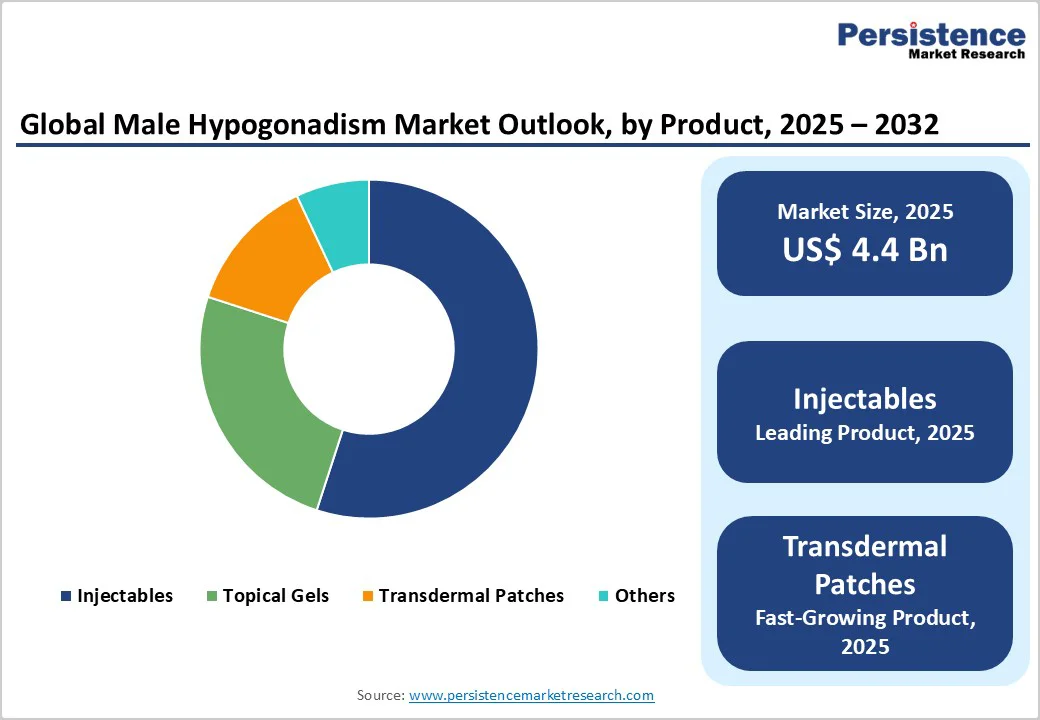
  • Dominant Product: Injectables, capturing nearly 54.4% market share, driven by their long-acting formulations, higher patient compliance, and cost-effectiveness compared to topical and transdermal products. Injectable testosterone remains the preferred choice among physicians for treating both primary and secondary hypogonadism.
  • Dominant Therapy Type: Testosterone Replacement Therapy (TRT), holding around 79.7% share, dominates the male hypogonadism market due to its proven efficacy in restoring testosterone levels, improving libido and energy, and wide availability across multiple delivery forms, including gels, injectables, and patches.
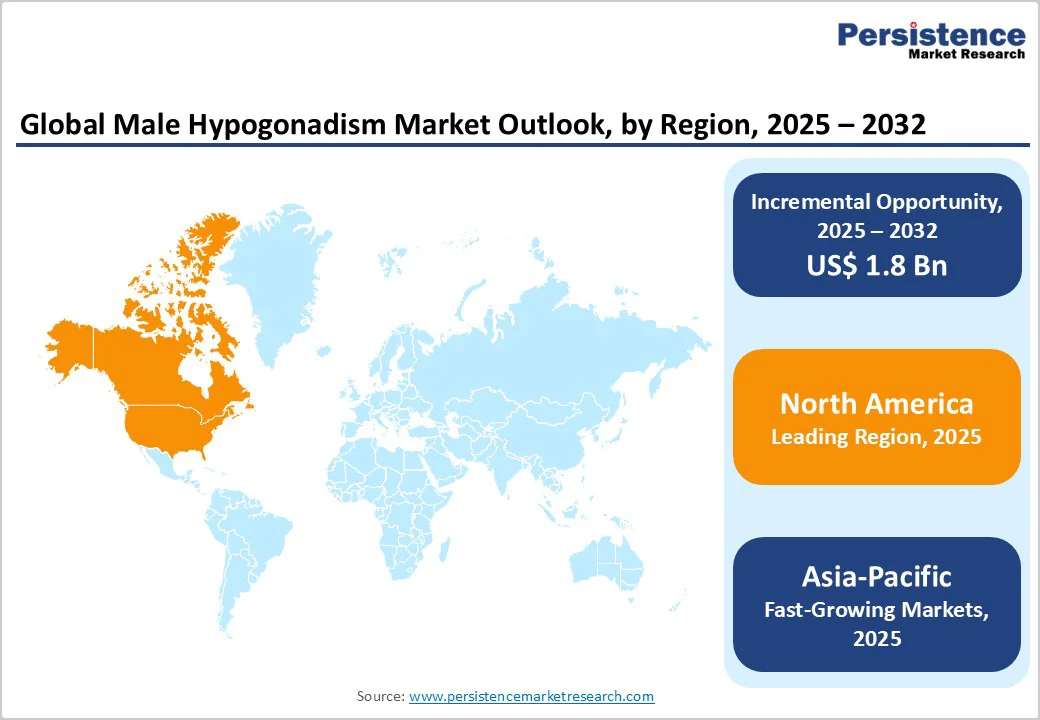
  • Dominant Region: North America, accounting for approximately 41.2% of global revenue, leads the market owing to advanced healthcare infrastructure, strong diagnostic capabilities, supportive reimbursement frameworks, and rising awareness of age-related testosterone decline among men.
  • Investment Plans: Asia Pacific, witnessing rapid growth with expanding healthcare access, increasing diagnosis rates, and pharmaceutical investments focused on introducing novel testosterone formulations and digital monitoring tools for long-term therapy management.
  • Growth Indicator: Rising prevalence of testosterone deficiency among aging men, increasing awareness of hormonal health, availability of advanced drug delivery systems, and favorable insurance coverage for testosterone replacement therapies.
  • Market Opportunity: Development of next-generation oral testosterone formulations, AI-driven hormone monitoring platforms, partnerships between pharmaceutical firms and telehealth providers, and entry into untapped emerging markets with growing male health awareness.
Key Insights Details
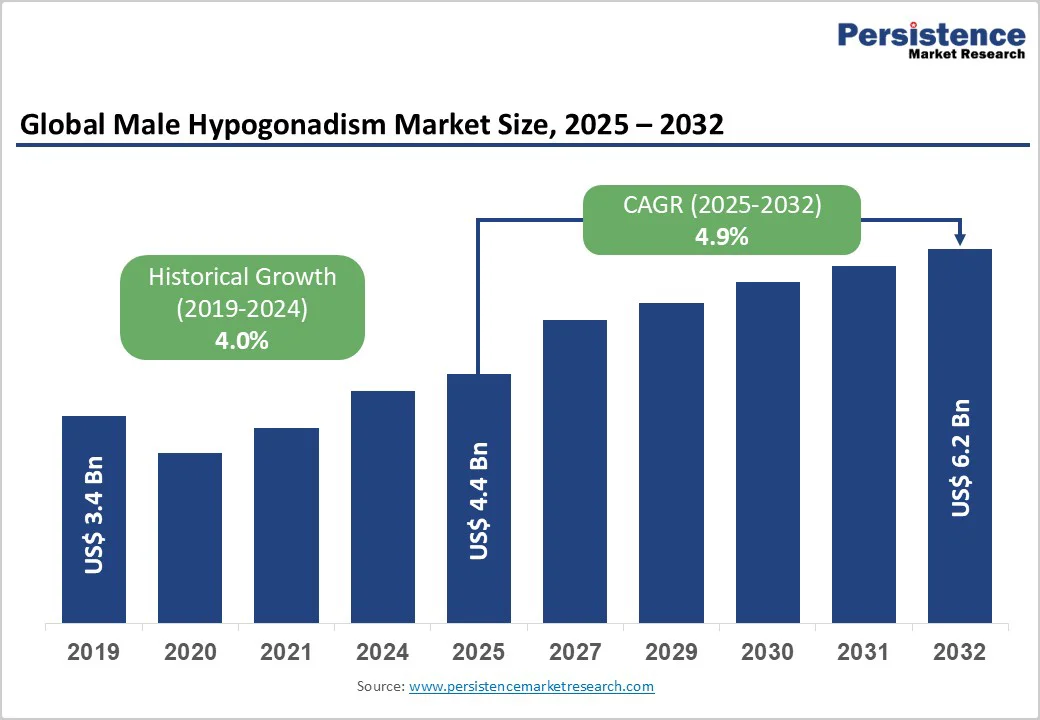
Global Male Hypogonadism Market Size (2025E) US$ 4.4 Bn
Market Value Forecast (2032F) US$ 6.2 Bn
Projected Growth (CAGR 2025 to 2032) 4.9%
Historical Market Growth (CAGR 2019 to 2024) 4.0%

global-male-hypogonadism-market-size-2025-2032

Market Dynamics

Driver - Growing Awareness of Men’s Health and Hormonal Disorders

Growing awareness of men’s health and hormonal disorders is a meaningful driver for the male hypogonadism market. According to data from the Endocrine Society, approximately 35% of men over the age of 45 and between 30-50% of men with obesity or type 2 diabetes are estimated to have hypogonadism. In the U.S., the nationally-representative NHANES III study projected that nearly 6.0-8.4 million men aged 40+ may have low total testosterone levels.

Despite these prevalence figures, a UK community survey found that 55% of men were unfamiliar with symptoms of testosterone deficiency, and only about 5% had been formally diagnosed, though approximately 26-31% reported characteristic symptoms such as low libido or erectile issues.

This gap between prevalence and awareness underscores the growing market opportunity for better screening, diagnostic tools, and therapy adoption driven by increasing recognition of men’s hormonal health issues.

Restraints - Safety Concerns and Side Effects of Testosterone Therapy

Safety concerns around testosterone therapy pose a significant restraint for the male hypogonadism market. The Food and Drug Administration (FDA) and other regulatory bodies have repeatedly issued warnings: in 2014, the FDA communicated a possible increased risk of heart attack, stroke, and death with testosterone products, especially when used off-label for age-related low testosterone.

Real-world data from the FDA’s Adverse Event Reporting System found 3,057 cases of major adverse cardiovascular events (MACE) among testosterone users from 2004 to 2022, with a reporting odds ratio for myocardial infarction (MI) as high as 9.46 (95 % CI: 3.08) in some analyses.

While a large randomized trial (the TRAVERSE trial) later indicated no increased composite cardiovascular risk (7.0% vs 7.3% placebo) in men aged 45-80, clinicians are still cautioned over elevated blood-pressure signals and possible thromboembolic events. These safety uncertainties reduce physician willingness to prescribe, increase monitoring burdens, and slow uptake, impacting the overall market growth.

Opportunity - Emergence of Oral Testosterone Formulations

The emergence of oral testosterone formulations represents a significant opportunity in the male hypogonadism market. For example, the JATENZO (testosterone undecanoate) was approved by the U.S. Food & Drug Administration in March 2019, with 87% of hypogonadal men in a Phase III study achieving normal testosterone levels.

In August 2022, another oral product, KYZATREX, gained FDA approval, providing a further option for adult males with testosterone deficiency. Oral delivery addresses limitations of injectables (e.g., injections, clinic visits) and topical gels (e.g., skin transfer risks) and may improve patient adherence.

Moreover, academic literature notes that male hypogonadism affects 10-30% of the male population and remains under-treated. Given these factors, the arrival of oral formulations is poised to expand the treatment-eligible population, improve convenience, and penetrate markets where injectable or topical access is limited.

Category-wise Analysis

By Product Insights

The reagents & consumables dominate with a 54.4% share in 2025, because they deliver reliable, long-acting testosterone levels and are supported by long-standing clinical use. According to the review in StatPearls, injectable TRT “is the most prescribed formulation in the USA healthcare market.” The U.S. Food & Drug Administration (FDA) also noted that men aged 40-74 comprise over 80% of TRT users, and that injectables account for the majority of annual prescriptions.

As injectables are generic, widely available, cost-effective and allow dosing intervals (often every 1-3 weeks) they pose fewer administration hurdles compared to daily gels or patches. This convenience and cost-structure drive their strong market share and explain why they remain the dominant product type.

By Therapy Type Insights

The dominance of Testosterone Replacement Therapy (TRT) in the male hypogonadism market is grounded in both regulatory approval and recorded usage patterns. According to the U.S. Food & Drug Administration (FDA), testosterone products are only approved for men who have low testosterone levels caused by specific medical conditions (such as testicular failure or hypothalamic/pituitary disorders).

Between 2003 and 2013 in the United States, the rate of TRT use in men aged 18-45 increased from 29.2 to 118.1 per 10,000 person-years a four-fold rise. That steep growth reflects how TRT has become the primary therapeutic route once hypogonadism is diagnosed. Because TRT addresses the hormone deficiency directly and is the only approved broad-therapy category, it logically commands the largest share in the market.
global-male-hypogonadism-market-outlook-by-product-2025-2032

Regional Insights

North America Male Hypogonadism Market Trends

North America dominates the global market with a 41.2% share in 2025, because it combines high prevalence, robust healthcare infrastructure, and strong treatment uptake. A U.S. study found that among men ≥45 years, the prevalence of testosterone levels <300 ng/dL was 38.7% in clinical practice settings.

Between 2018 and 2022, testosterone therapy prescriptions in the U.S. rose by 120% among those aged ≤24, and by 86% among those 25-34, demonstrating swift uptake. Advanced diagnostics, awareness of men’s hormone health, and reimbursement frameworks further support the region’s leadership. For example, reports indicate North America holds about 40% of the global market share for hypogonadism treatments.

Europe Male Hypogonadism Market Trends

Europe represents a key region in the male hypogonadism market for several reasons. First, age-related testosterone decline is evidenced by the European Male Ageing Study (EMAS), which reported a prevalence of symptomatic hypogonadism of 2.1% in men aged 40-79 years (ranging from 0.6% in men 50-59 to 5.1% in men 70-79).

Second, physician awareness is relatively strong: in a survey of endocrinologists and urologists across France, Germany, Italy, and Spain, 86.5% recognized testosterone deficiency syndrome as a clinical entity, estimating prevalence at 10-15% of the male population.

Third, the region has well-developed healthcare systems, enabling diagnosis, treatment, and monitoring essential for market uptake. Thus, while prevalence is modest, Europe’s aging population, combined with established endocrine infrastructure and growing physician awareness, makes it an important growth region for hypogonadism therapies.

Asia Pacific Male Hypogonadism Market Trends

Asia Pacific is the fastest-growing region in the male hypogonadism market due to several converging factors. Epidemiological data from a large Chinese study of 5,980 men aged 40-79 found that late-onset hypogonadism prevalence rose from 0.9% in the 40-49 age group to 24% in men aged 75-79.

In Taiwan, 24.1% of men over 40 had androgen deficiency (TT < 300 ng/dL), and 12.0% had symptomatic androgen deficiency. At the same time, lifestyle changes-such as rising obesity rates in Asia (China’s male overweight/obesity rate grew from ~28.9% in 2002 to 45.3% in 2010) increase risk for hypogonadism, thereby expanding the addressable patient pool.

Healthcare infrastructure in many APAC countries is improving, raising diagnosis and treatment access. Together, greater disease burden + better access = rapid regional growth.
global-male-hypogonadism-market-outlook-by-region-2025-2032

Competitive Landscape

Leading companies in the male hypogonadism market are focusing on product innovation, regulatory approvals, and strategic collaborations to enhance treatment options.

Key players are investing in advanced testosterone formulations, including oral and long-acting injectables, while expanding their global presence through mergers and acquisitions. These strategies aim to improve patient compliance, ensure safety, and meet the growing demand for effective testosterone replacement and hormonal balance therapies worldwide.

Key Industry Developments:

  • In September 2025, Marius Pharmaceuticals and Hims & Hers™ announced a collaboration to expand access to KYZATREX® (testosterone undecanoate) CIII capsules, the first FDA-approved oral testosterone therapy available through the Hims & Hers platform. The partnership aimed to make prescription testosterone replacement more accessible to men with clinically diagnosed hypogonadism via telehealth services. This initiative marked a major milestone in broadening digital access to regulated hormonal therapies for men’s health management in the U.S.
  • In September 2025, Hims & Hers launched personalized treatment plans for low testosterone, expanding its telehealth offerings in men’s health. The new plans provided clinically guided, at-home solutions for men experiencing symptoms of testosterone deficiency, including fatigue, low libido, and mood changes. By offering virtual consultations and ongoing medical support, Hims & Hers aimed to make hormone health management more accessible and discreet, reinforcing its leadership in direct-to-consumer healthcare services.
  • In October 2024, SK Chemicals secured exclusive marketing rights for the male hypogonadism drug Nebido in Korea, strengthening its presence in the men’s health segment. The agreement allowed SK Chemicals to distribute and promote Nebido, a long-acting injectable testosterone therapy designed to treat testosterone deficiency.

Companies Covered in Male Hypogonadism Market

  • AbbVie
  • Eli Lilly
  • Pfizer
  • Endo International
  • Teva Pharmaceutical Industries
  • Grünenthal
  • Merck KGaA
  • Ferring Pharmaceuticals
  • Viatris (Mylan)
  • Abbott Laboratories
  • ANI Pharmaceuticals
  • Sun Pharmaceutical Industries
  • Lupin
  • Zydus Lifesciences
  • Marius Pharmaceuticals
  • Hims & Hers
  • Others
Frequently Asked Questions

The global male hypogonadism market is projected to be valued at US$ 4.4 bn in 2025.

Rising prevalence of testosterone deficiency, aging male population, lifestyle disorders, growing awareness of men’s health, and advancements in testosterone replacement therapies drive the global Male Hypogonadism Market.

The global male hypogonadism market is poised to witness a CAGR of 4.9% between 2025 and 2032.

Emergence of oral testosterone formulations, digital hormone monitoring, personalized therapies, and expanding diagnosis in Asia Pacific present major growth opportunities.

AbbVie, Eli Lilly, Pfizer, Endo International, Teva Pharmaceutical Industries, Grünenthal, Merck KGaA.

Male Hypogonadism Market Report Scope
Report Attribute Details
Historical Data/Actuals 2019 - 2024
Forecast Period 2025 - 2032
Market Analysis Value: US$ Bn
Geographical Coverage
  • North America
  • Europe
  • East Asia
  • South Asia & Oceania
  • Latin America
  • Middle East and Africa
Segmental Coverage
  • Product
  • Therapy Type
  • Indication
  • Region
Competitive Analysis
  • AbbVie
  • Eli Lilly
  • Pfizer
  • Endo International
  • Teva Pharmaceutical Industries
  • Grünenthal
  • Merck KGaA
  • Ferring Pharmaceuticals
  • Viatris (Mylan)
  • Abbott Laboratories
  • ANI Pharmaceuticals
  • Sun Pharmaceutical Industries
  • Lupin
  • Zydus Lifesciences
  • Marius Pharmaceuticals
  • Hims & Hers
  • Others
Report Highlights
  • Market Forecast and Trends
  • Competitive Intelligence & Share Analysis
  • Growth Factors and Challenges
  • Strategic Growth Initiatives
  • Pricing Analysis
  • Future Opportunities and Revenue Pockets
  • Industry Market Analysis Tools
Market Segmentation

By Product

  • Injectables
  • Topical Gels
  • Transdermal Patches
  • Others

By Therapy Type

  • Testosterone Replacement Therapy
  • Gonadotropin Replacement Therapy

By Indication

  • Klinefelter's Syndrome
  • Pituitary Adenomas
  • Kallmann Syndrome
  • Others

By Region

  • North America
  • Europe
  • East Asia
  • South Asia & Oceania
  • Latin America
  • Middle East and Africa

Related Reports

  1. Executive Summary
    1. Global Male Hypogonadism Market Snapshot, 2025 and 2032
    2. Market Opportunity Assessment, 2025 - 2032, US$ Mn
    3. Key Market Trends
    4. Future Market Projections
    5. Premium Market Insights
    6. Industry Developments and Key Market Events
    7. PMR Analysis and Recommendations
  2. Market Overview
    1. Market Scope and Definition
    2. Market Dynamics
      1. Drivers
      2. Restraints
      3. Opportunity
      4. Challenges
      5. Key Trends
    3. Macro-Economic Factors
      1. Global Sectorial Outlook
      2. Global GDP Growth Outlook
    4. COVID-19 Impact Analysis
    5. Forecast Factors - Relevance and Impact
  3. Value Added Insights
    1. Regulatory Landscape
    2. Product Adoption Analysis
    3. Value Chain Analysis
    4. Key Deals and Mergers
    5. PESTLE Analysis
    6. Porter’s Five Force Analysis
  4. Global Male Hypogonadism Market Outlook:
    1. Key Highlights
      1. Market Size (US$ Mn) and Y-o-Y Growth
      2. Absolute $ Opportunity
    2. Market Size (US$ Mn) Analysis and Forecast
      1. Historical Market Size (US$ Mn) Analysis, 2019-2024
      2. Market Size (US$ Mn) Analysis and Forecast, 2025-2032
    3. Global Male Hypogonadism Market Outlook: Product
      1. Introduction / Key Findings
      2. Historical Market Size (US$ Mn) Analysis, By Product, 2019 - 2024
      3. Market Size (US$ Mn) Analysis and Forecast, By Product, 2025 - 2032
        1. Injectables
        2. Topical Gels
        3. Transdermal Patches
        4. Others
      4. Market Attractiveness Analysis: Product
    4. Global Male Hypogonadism Market Outlook: Therapy Type
      1. Introduction / Key Findings
      2. Historical Market Size (US$ Mn) Analysis, By Therapy Type, 2019 - 2024
      3. Market Size (US$ Mn) Analysis and Forecast, By Therapy Type, 2025 - 2032
        1. Testosterone Replacement Therapy
        2. Gonadotropin Replacement Therapy
      4. Market Attractiveness Analysis: Therapy Type
    5. Global Male Hypogonadism Market Outlook: Indication
      1. Introduction / Key Findings
      2. Historical Market Size (US$ Mn) Analysis, By Indication, 2019 - 2024
      3. Market Size (US$ Mn) Analysis and Forecast, By Indication, 2025 - 2032
        1. Klinefelter's Syndrome
        2. Pituitary Adenomas
        3. Kallmann Syndrome
        4. Others
      4. Market Attractiveness Analysis: Indication
  5. Global Male Hypogonadism Market Outlook: Region
    1. Key Highlights
    2. Historical Market Size (US$ Mn) Analysis, By Region, 2019 - 2024
    3. Market Size (US$ Mn) Analysis and Forecast, By Region, 2025 - 2032
      1. North America
      2. Europe
      3. East Asia
      4. South Asia and Oceania
      5. Latin America
      6. Middle East & Africa
    4. Market Attractiveness Analysis: Region
  6. North America Male Hypogonadism Market Outlook:
    1. Key Highlights
    2. Historical Market Size (US$ Mn) Analysis, By Market, 2019 - 2024
      1. By Country
      2. By Product
      3. By Therapy Type
      4. By Indication
    3. Market Size (US$ Mn) Analysis and Forecast, By Country, 2025 - 2032
      1. U.S.
      2. Canada
    4. Market Size (US$ Mn) Analysis and Forecast, By Product, 2025 - 2032
      1. Injectables
      2. Topical Gels
      3. Transdermal Patches
      4. Others
    5. Market Size (US$ Mn) Analysis and Forecast, By Therapy Type, 2025 - 2032
      1. Testosterone Replacement Therapy
      2. Gonadotropin Replacement Therapy
    6. Market Size (US$ Mn) Analysis and Forecast, By Indication, 2025 - 2032
      1. Klinefelter's Syndrome
      2. Pituitary Adenomas
      3. Kallmann Syndrome
      4. Others
    7. Market Attractiveness Analysis
  7. Europe Male Hypogonadism Market Outlook:
    1. Key Highlights
    2. Historical Market Size (US$ Mn) Analysis, By Market, 2019 - 2024
      1. By Country
      2. By Product
      3. By Therapy Type
      4. By Indication
    3. Market Size (US$ Mn) Analysis and Forecast, By Country, 2025 - 2032
      1. Germany
      2. France
      3. U.K.
      4. Italy
      5. Spain
      6. Russia
      7. Rest of Europe
    4. Market Size (US$ Mn) Analysis and Forecast, By Product, 2025 - 2032
      1. Injectables
      2. Topical Gels
      3. Transdermal Patches
      4. Others
    5. Market Size (US$ Mn) Analysis and Forecast, By Therapy Type, 2025 - 2032
      1. Testosterone Replacement Therapy
      2. Gonadotropin Replacement Therapy
    6. Market Size (US$ Mn) Analysis and Forecast, By Indication, 2025 - 2032
      1. Klinefelter's Syndrome
      2. Pituitary Adenomas
      3. Kallmann Syndrome
      4. Others
    7. Market Attractiveness Analysis
  8. East Asia Male Hypogonadism Market Outlook:
    1. Key Highlights
    2. Historical Market Size (US$ Mn) Analysis, By Market, 2019 - 2024
      1. By Country
      2. By Product
      3. By Therapy Type
      4. By Indication
    3. Market Size (US$ Mn) Analysis and Forecast, By Country, 2025 - 2032
      1. China
      2. Japan
      3. South Korea
    4. Market Size (US$ Mn) Analysis and Forecast, By Product, 2025 - 2032
      1. Injectables
      2. Topical Gels
      3. Transdermal Patches
      4. Others
    5. Market Size (US$ Mn) Analysis and Forecast, By Therapy Type, 2025 - 2032
      1. Testosterone Replacement Therapy
      2. Gonadotropin Replacement Therapy
    6. Market Size (US$ Mn) Analysis and Forecast, By Indication, 2025 - 2032
      1. Klinefelter's Syndrome
      2. Pituitary Adenomas
      3. Kallmann Syndrome
      4. Others
    7. Market Attractiveness Analysis
  9. South Asia & Oceania Male Hypogonadism Market Outlook:
    1. Key Highlights
    2. Historical Market Size (US$ Mn) Analysis, By Market, 2019 - 2024
      1. By Country
      2. By Product
      3. By Therapy Type
      4. By Indication
    3. Market Size (US$ Mn) Analysis and Forecast, By Country, 2025 - 2032
      1. India
      2. Southeast Asia
      3. ANZ
      4. Rest of South Asia & Oceania
    4. Market Size (US$ Mn) Analysis and Forecast, By Product, 2025 - 2032
      1. Injectables
      2. Topical Gels
      3. Transdermal Patches
      4. Others
    5. Market Size (US$ Mn) Analysis and Forecast, By Therapy Type, 2025 - 2032
      1. Testosterone Replacement Therapy
      2. Gonadotropin Replacement Therapy
    6. Market Size (US$ Mn) Analysis and Forecast, By Indication, 2025 - 2032
      1. Klinefelter's Syndrome
      2. Pituitary Adenomas
      3. Kallmann Syndrome
      4. Others
    7. Market Attractiveness Analysis
  10. Latin America Male Hypogonadism Market Outlook:
    1. Key Highlights
    2. Historical Market Size (US$ Mn) Analysis, By Market, 2019 - 2024
      1. By Country
      2. By Product
      3. By Therapy Type
      4. By Indication
    3. Market Size (US$ Mn) Analysis and Forecast, By Country, 2025 - 2032
      1. Brazil
      2. Mexico
      3. Rest of Latin America
    4. Market Size (US$ Mn) Analysis and Forecast, By Product, 2025 - 2032
      1. Injectables
      2. Topical Gels
      3. Transdermal Patches
      4. Others
    5. Market Size (US$ Mn) Analysis and Forecast, By Therapy Type, 2025 - 2032
      1. Testosterone Replacement Therapy
      2. Gonadotropin Replacement Therapy
    6. Market Size (US$ Mn) Analysis and Forecast, By Indication, 2025 - 2032
      1. Klinefelter's Syndrome
      2. Pituitary Adenomas
      3. Kallmann Syndrome
      4. Others
    7. Market Attractiveness Analysis
  11. Middle East & Africa Male Hypogonadism Market Outlook:
    1. Key Highlights
    2. Historical Market Size (US$ Mn) Analysis, By Market, 2019 - 2024
      1. By Country
      2. By Product
      3. By Therapy Type
      4. By Indication
    3. Market Size (US$ Mn) Analysis and Forecast, By Country, 2025 - 2032
      1. GCC Countries
      2. Egypt
      3. South Africa
      4. Northern Africa
      5. Rest of Middle East & Africa
    4. Market Size (US$ Mn) Analysis and Forecast, By Product, 2025 - 2032
      1. Injectables
      2. Topical Gels
      3. Transdermal Patches
      4. Others
    5. Market Size (US$ Mn) Analysis and Forecast, By Therapy Type, 2025 - 2032
      1. Testosterone Replacement Therapy
      2. Gonadotropin Replacement Therapy
    6. Market Size (US$ Mn) Analysis and Forecast, By Indication, 2025 - 2032
      1. Klinefelter's Syndrome
      2. Pituitary Adenomas
      3. Kallmann Syndrome
      4. Others
    7. Market Attractiveness Analysis
  12. Competition Landscape
    1. Market Share Analysis, 2024
    2. Market Structure
      1. Competition Intensity Mapping By Market
      2. Competition Dashboard
    3. Company Profiles (Details - Overview, Financials, Strategy, Recent Developments)
      1. AbbVie
        1. Overview
        2. Segments and Products
        3. Key Financials
        4. Market Developments
        5. Market Strategy
      2. Eli Lilly
      3. Pfizer
      4. Endo International
      5. Teva Pharmaceutical Industries
      6. Grünenthal
      7. Merck KGaA
      8. Ferring Pharmaceuticals
      9. Viatris (Mylan)
      10. Abbott Laboratories
      11. ANI Pharmaceuticals
      12. Sun Pharmaceutical Industries
      13. Lupin
      14. Zydus Lifesciences
      15. Marius Pharmaceuticals
      16. Hims & Hers
      17. Others
  13. Appendix
    1. Research Methodology
    2. Research Assumptions
    3. Acronyms and Abbreviations

Research Methodology Framework for Market Research Excellence

At Persistence Market Research, we implement a comprehensive, validated, and multi-dimensional approachto market analysis that delivers actionable insights across complex market landscapes. Our methodology combines the analytical rigor of leading consulting firms with innovative research techniques, ensuring robust market assessments that guide strategic decision-making with confidence.

Core Research Philosophy

Our methodology is built on four foundational pillars:

Research Philosophy Image

At Persistence Market Research, our methodology is designed to transcend conventional market studies by combining analytical rigor, multi-source validation, and future-focused insights.

We integrate advanced research frameworks, robust data collection strategies, cutting-edge analytics, and innovative technologies to deliver a 360-degree view of complex markets.

We integrate advanced research frameworks, robust data collection strategies, cutting-edge analytics, and innovative technologies to deliver a 360-degree view of complex markets.

Each stage spanning from strategic scoping and hypothesis-building to competitive intelligence, quality validation, and actionable recommendations is engineered to provide clients with unmatched clarity, precision, and confidence in decision-making.

By embedding innovation and technology at the core, our approach ensures that insights are not only comprehensive but also predictive, empowering businesses to seize opportunities, mitigate risks, and achieve sustainable growth

Research Philosophy Image

Capturing Key Information and Events

During this phase, key research objectives focus on essential information and data points for assessing the market, including:

Research Philosophy Image

TAM-SAM-SOM Framework Implementation

We employ both top-down and bottom-up approaches to ensure accurate market sizing.

Top-Down Market SizingBottom-Up Market Sizing
Universe Definition: Total global/regional market identificationUnit Economics: Average transaction values, purchase frequencies, customer lifecycle
Segmentation Filters: Geographic, demographic, and behavioral constraintsCustomer Segmentation: Detailed buyer persona development and sizing
Market Share Analysis: Competitive landscape assessment and share allocationPenetration Analysis: Market penetration rates by segment and geography
Growth Rate Application: Historical trends and forward-looking growth assumptionsScaling Methodology: Extrapolation techniques with confidence intervals

Validation & Cross-Verification

  • Triangulation: Comparing top-down and bottom-up results for consistency
  • Sensitivity Analysis: Testing key assumptions and parameter variations
  • Peer Benchmarking: Comparison with analogous markets and industry benchmarks
  • Expert Review: External validation through industry specialist consultation

Research Philosophy Image

Forecasting & Projection Modeling

Our proprietary forecasting models incorporate multiple variables and scenarios.

Forecasting Components

  • Historical Trend Analysis: 10-year historical growth patterns and cyclical variations
  • Driver-Based Modeling: Economic indicators, demographic shifts, technology adoption
  • Scenario Planning: Base case, optimistic, and conservative projections
  • Monte Carlo Simulations: Probability-weighted outcomes and risk assessments

Model Validation

  • Back-Testing: Historical accuracy assessment over 3–5-year periods
  • Cross-Validation: Multiple modeling approaches for result comparison
  • External Benchmarking: Comparison with established market forecasts
  • Continuous Calibration: Quarterly model updates based on new data

Comprehensive Data Collection Strategy

Our secondary research phase establishes a robust knowledge base utilizing diverse, credible sources.

Secondary Data Sourcess

  • Industry Publications & Reports
  • Government & Regulatory Data
  • Financial Intelligence (filings & reports)
  • Academic Research & Digital Intelligence

Quality Assurance Protocol

  • Source credibility assessment and publication date validation
  • Data consistency checks across multiple sources
  • Bias identification and neutralization techniques
  • Information gap tracking for primary research prioritization

Research Philosophy Image

Primary Research Excellence

Our primary research methodology employs best-in-class techniques to capture unique market insights.

Quantitative Research Methods

  • Large-Scale Surveys: Statistically representative samples with 95% confidence intervals
  • Survey Methodology: Multi-channel deployment (online, telephone, in-person)
  • Question Architecture and Response Optimization

Qualitative Research Methods

  • Executive Interviews
  • Focus Groups
  • Expert Consultations

Quality Assurance & Validation Framework

Multi-Stage Validation Process

  • Source Verification and Consistency Testing
  • Outlier Detection and Bias Assessment
  • Peer Review Process and External Validation
  • Sensitivity Analysis and Confidence Intervals

Research Philosophy Image

Methodology Validation & Credibility

Our research methodology has been extensively validated through:

  • Academic Partnerships: Collaborations with top-tier business schools and research institutions
  • Client Success Stories: Documented case studies demonstrating research impact and ROI
  • Continuous Benchmarking: Performance comparison with leading global research firms

This comprehensive methodology framework positions Persistence Market Research at the forefront of market intelligence, combining the analytical sophistication of top-tier consulting firms with innovative research techniques. Our approach ensures that every market assessment delivers precise, actionable, and strategically valuable insights that drive business success in competitive market environments.

Ready to unlock your market potential? Contact our research experts to discuss how our validated methodology can transform your strategic decision-making with data-driven market intelligence.

Copyright © 2026 Persistence Market Research. All Rights Reserved

Connect With Us -
Male Hypogonadism Market Size, Share & Analysis, 2032