




- Biotechnology
- In Vitro Protein Expression Market
In Vitro Protein Expression Market Size, Share, Trends, Growth, and Regional Forecast, 2026 to 2033
In Vitro Protein Expression Market by Product Type (E. coli System, Rabbit Reticulocytes System, Wheat Germ System, Insect Cells System, Mammalian System), Expression Mode (Continuous Flow Expression, Batch Expression), Application, End-user, and Regional Analysis from 2026 to 2033

In Vitro Protein Expression Market Share and Trends Analysis
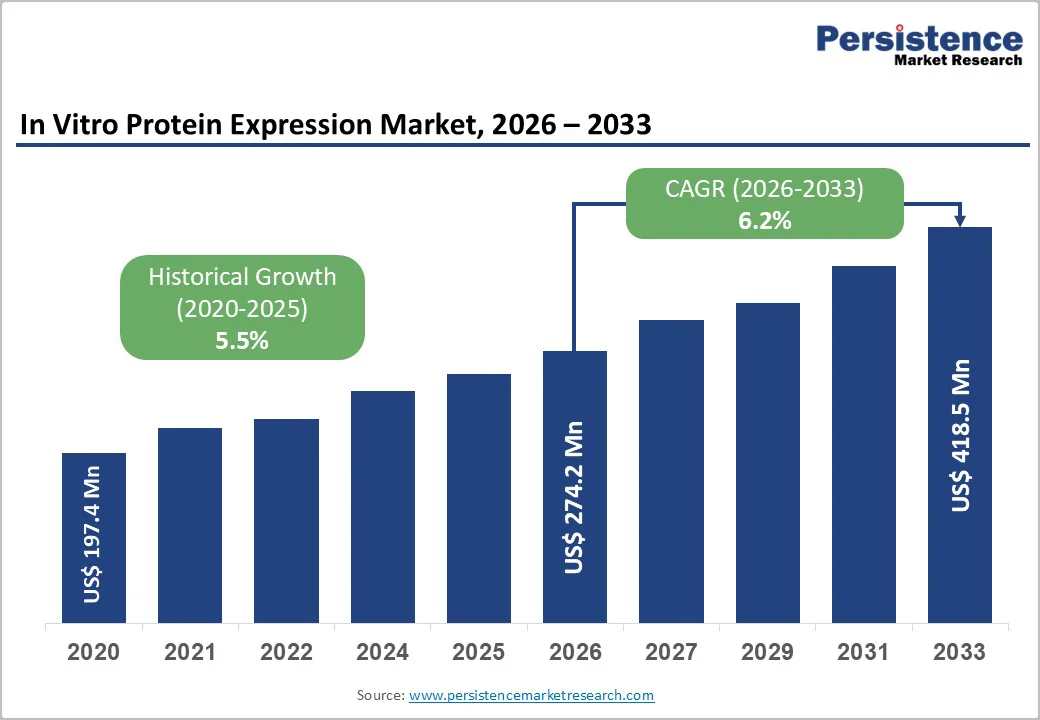
The global in vitro protein expression market size is estimated to grow from US$274.2 million in 2026 to US$418.5 million by 2033. The market is projected to record a CAGR of 6.2% from 2026 to 2033.
The global market is rapidly expanding as clinical researchers seek faster, cell-free systems to accelerate protein synthesis, structural biology, and functional screening. The demand is growing for biopharma rapid antibody prototyping, enzyme engineering, and difficult-to-express proteins that traditional cell-based platforms cannot handle.
Innovations in recombinant kits, linear DNA templates, and high-throughput automation are improving yield, purity, and scalability. Growing use in personalized medicine, synthetic biology, and vaccine development further boosts adoption. Academic labs, CROs, and biotech startups increasingly rely on cell-free expression to shorten R&D timelines and enhance experimental flexibility across diverse biological applications.
Key Industry Highlights
- Biopharma companies increasingly use cell-free expression for rapid antibody prototyping, toxic protein characterization, and screening applications.
- Synthetic biology companies leverage in vitro expression to build, test, and refine genetic circuits, enzymes, and metabolic pathways.
- In vitro expression supports rapid antigen screening, protein characterization, and preclinical validation of biologics.
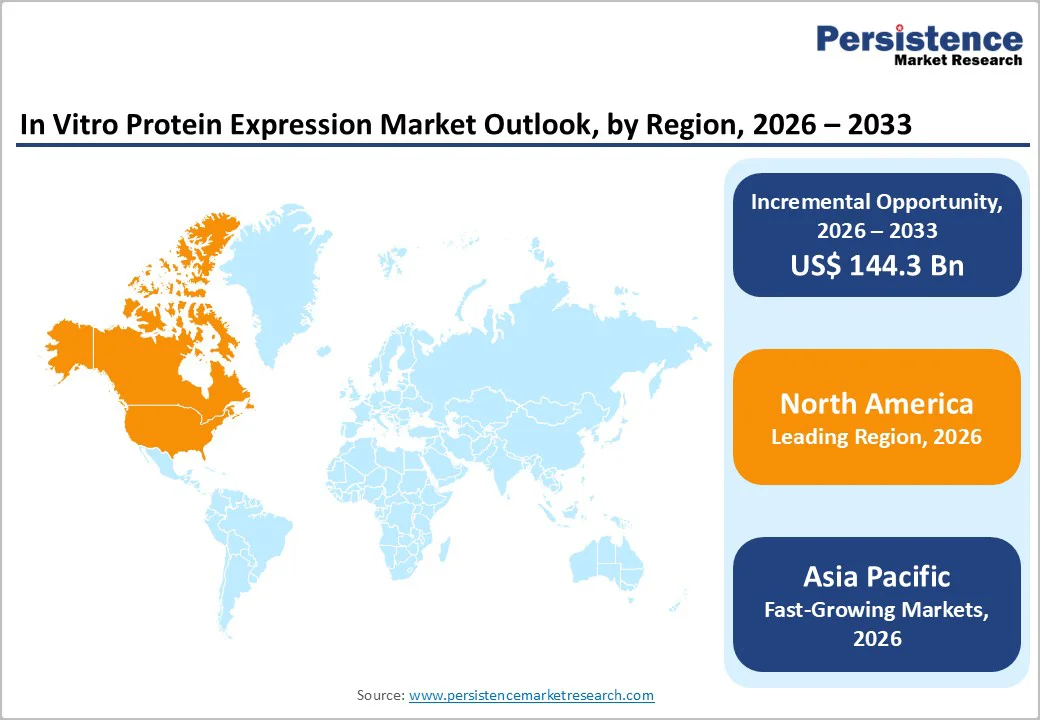
- Leading Region: North America leads the In Vitro Protein Expression Market due to strong biopharmaceutical R&D, high adoption of advanced cell-free systems, significant funding for synthetic biology, and the presence of major biotech players and CROs
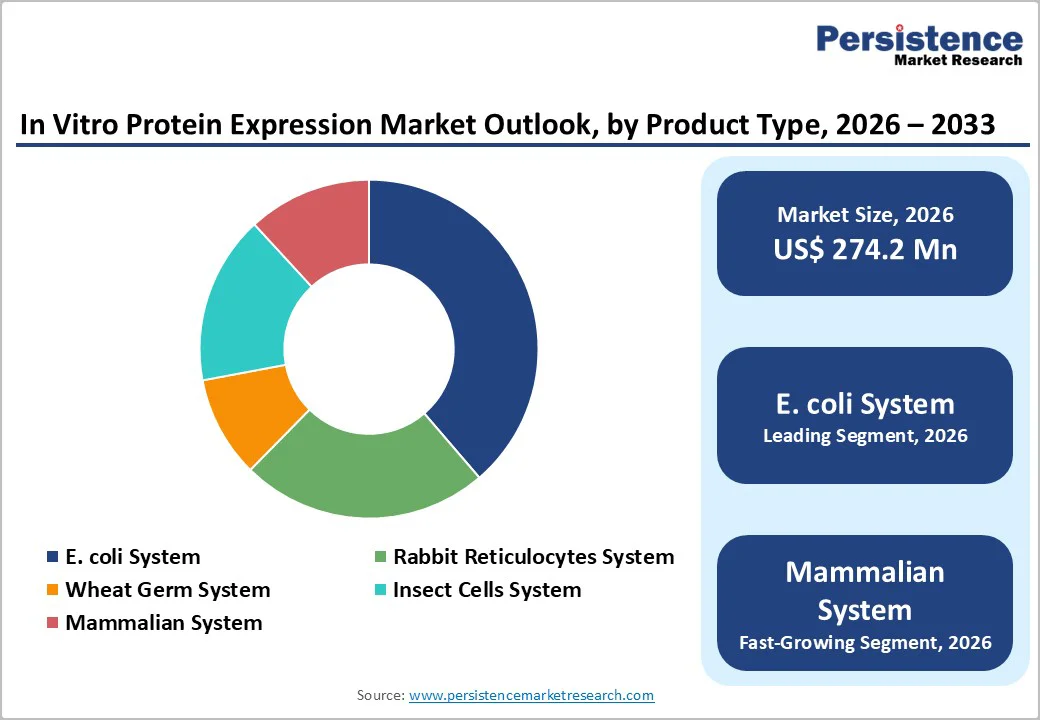
- Leading Product Type: E. coli cell-free systems lead due to low cost, fast reaction cycles, high protein yield, easy lysate preparation, and widespread use in biopharma, synthetic biology, and academic R&D workflows.
| Key Insights | Details |
|---|---|
| In Vitro Protein Expression Market Size (2026E) | US$274.2 Mn |
| Market Value Forecast (2033F) | US$418.5 Mn |
| Projected Growth (CAGR 2026 to 2033) | 6.2% |
| Historical Market Growth (CAGR 2020 to 2025) | 5.5% |
Market Dynamics
Driver - Increased Need for Hard-to-Express and Toxic Protein Synthesis
The rising need to produce hard-to-express, unstable, or toxic proteins is a major driver for the In Vitro Protein Expression Market. Traditional cell-based systems often fail when proteins interfere with cellular metabolism, are rapidly degraded, or trigger cytotoxic effects, limiting yield and quality.
In vitro cell-free platforms overcome these challenges by eliminating living cells, offering complete control over reaction conditions, including redox balance, temperature, cofactors, and folding environments. This enables efficient synthesis of membrane proteins, ion channels, viral proteins, and enzymes that are difficult or impossible to express in bacterial or mammalian hosts.
As drug discovery, enzyme engineering, and structural biology research increasingly rely on these complex proteins, demand for robust cell-free expression systems continues to surge.
Restraints - Limited Protein Yield for Complex Proteins
One significant restraint in the in vitro protein expression market is the limited protein yield for complex proteins. While cell-free systems are highly efficient for small and simple proteins, large proteins, multi-domain proteins, or those requiring post-translational modifications often exhibit lower expression levels.
This limitation arises because in vitro systems may lack the full complement of cellular machinery needed for proper folding, disulfide bond formation, glycosylation, or other modifications. As a result, researchers may experience reduced functional activity or solubility, which can affect downstream applications such as structural analysis, drug screening, or therapeutic development.
Overcoming this challenge requires optimized lysates and tailored reaction conditions, which increase complexity and cost.
Opportunity - Synthetic Biology & Genetic Circuit Testing
Synthetic biology & genetic circuit testing in the in vitro protein expression Market represents a high-growth opportunity as researchers increasingly rely on cell-free systems for rapid prototyping. Traditional cell-based methods are often time-consuming and limited by host cell viability, making it difficult to test novel genetic circuits or complex metabolic pathways.
In vitro platforms enable precise control of reaction conditions, enabling rapid iteration, optimization, and functional validation of enzymes, biosensors, and synthetic pathways. This accelerates innovation in bio-manufacturing, environmental sensing, and therapeutic development. The flexibility, scalability, and reproducibility of these systems make them indispensable for advancing synthetic biology research efficiently.
Category-wise Analysis
By Product Type, E. coli System Segment is leading in the Market
The E. coli system accounts for the highest share in the In Vitro Protein Expression Market due to its cost-effectiveness, simplicity, and high efficiency. E. coli lysates are easy to prepare, support rapid protein synthesis, and deliver high yields, making them ideal for both academic research and industrial applications.
The system is compatible with a wide range of DNA templates and is well-suited for producing soluble proteins, enzymes, and other biologics. Additionally, E. coli-based cell-free expression platforms require minimal infrastructure and shorter reaction times compared to mammalian or insect systems, reducing operational costs.
Its extensive use in biopharma, synthetic biology, and proteomics research further strengthens its market dominance, establishing it as the preferred choice globally.
By Application, Enzyme Engineering Segment Leads the Market
Enzyme engineering holds the highest share in the in vitro protein expression market due to the increasing demand for tailored enzymes across pharmaceuticals, industrial biotechnology, and synthetic biology. Cell-free systems allow rapid synthesis, screening, and optimization of enzyme variants that are difficult or toxic to express in living cells.
Researchers can quickly test functional activity, stability, and modifications without lengthy cell-culture processes. This accelerates R&D timelines, reduces costs, and supports high-throughput experimentation. The ability to produce modified, site-specific, or multi-domain enzymes efficiently further strengthens its adoption, making enzyme engineering the leading application segment in both academic and industrial protein expression workflows globally.
Regional Insights
North America In Vitro Protein Expression Market Trends
North America leads the In Vitro Protein Expression Market, driven by strong biopharmaceutical R&D, advanced synthetic biology initiatives, and substantial government and private funding. The U.S., in particular, dominates adoption, with major biotech hubs like Boston, San Francisco, and San Diego driving innovation in antibody prototyping, enzyme engineering, and cell-free vaccine research.
Academic institutions and CROs extensively use E. coli-based and mammalian systems for high-throughput protein synthesis. Advances in automation, microfluidics, and ready-to-use kits further accelerate market growth. Growing demand for personalized medicine, structural biology, and rapid therapeutic development positions the region as a global leader in innovation and revenue.
Asia Pacific In Vitro Protein Expression Market Trends
Asia Pacific is experiencing a rapid surge, fueled by growing biopharmaceutical R&D, government-backed biotechnology initiatives, and expanding academic research. Countries such as China, Japan, and India are investing heavily in synthetic biology, protein engineering, and vaccine development. The increasing adoption of E. coli and mammalian cell-free systems, combined with the rising presence of CROs, accelerates protein production and screening capabilities.
Affordable labor, expanding biotech infrastructure, and collaborations with global firms enhance market growth. High demand for personalized medicine, enzyme engineering, and high-throughput protein synthesis positions the Asia Pacific as the fastest-growing regional market with significant long-term potential.
Competitive Landscape
The in vitro protein expression market is highly competitive, characterized by rapid innovation and technological advancement. Companies focus on developing high-throughput, automated, and scalable cell-free platforms to meet growing demand for rapid protein synthesis.
Strategic partnerships, regional expansions, and customized solutions for biopharma, academic, and CRO sectors intensify competition. Differentiation relies on product quality, workflow efficiency, and specialized reagents for hard-to-express proteins.
Continuous R&D in enzyme optimization, lysate formulations, and integration with synthetic biology applications drives market dynamics. As demand grows globally, firms compete to offer flexible, cost-effective, and reproducible protein expression solutions, fostering an innovation-driven landscape.
Key Industry Developments:
- In October 2023, Taysha Gene Therapies showcased promising preclinical in vitro data on TSHA-102 for Rett Syndrome at the European Society of Gene & Cell Therapy Congress, highlighting its potential to regulate MECP2 expression via miRARE.
Companies Covered in In Vitro Protein Expression Market
- Thermo Fisher Scientific, Inc.
- Takara Bio Company
- New England Biolabs
- Promega Corporation
- Jena Bioscience GmbH
- GeneCopoeia, Inc.
- Biotechrabbit GmbH
- Cube Biotech GmbH
- CellFree Sciences Co., Ltd.
- Bioneer Corporation
- Others
Frequently Asked Questions
The global in vitro protein expression market is projected to be valued at US$274.2 Mn in 2026.
Cell-free systems enable the production of toxic, unstable, or membrane proteins that are challenging in cell-based platforms.
The global in vitro protein expression market is poised to witness a CAGR of 6.2% between 2026 and 2033.
Rapid therapeutic protein screening for drug discovery and biopharma pipelines.
Thermo Fisher Scientific, Inc., Takara Bio Company, New England Biolabs, Promega Corporation, and others.


