Dimethyl Oxalate Market Size, Share, and Growth Forecast 2026 - 2033

Dimethyl Oxalate Market by Grade (Industrial Grade, Pharmaceutical Grade, and High-Purity Grade), Application (Pharmaceutical Intermediates, Agrochemical Intermediates, Solvents, Plasticizers, Metal Processing, Textile Processing, and Specialty Chemicals), Distribution Channel (Direct Sales, and Indirect Sale), End-user, and by Regional Analysis, 2026 - 2033

ID: PMRREP33141
Calendar

January 2026

220 Pages

Author : Satender Singh

Dimethyl Oxalate Market Size and Trend Analysis

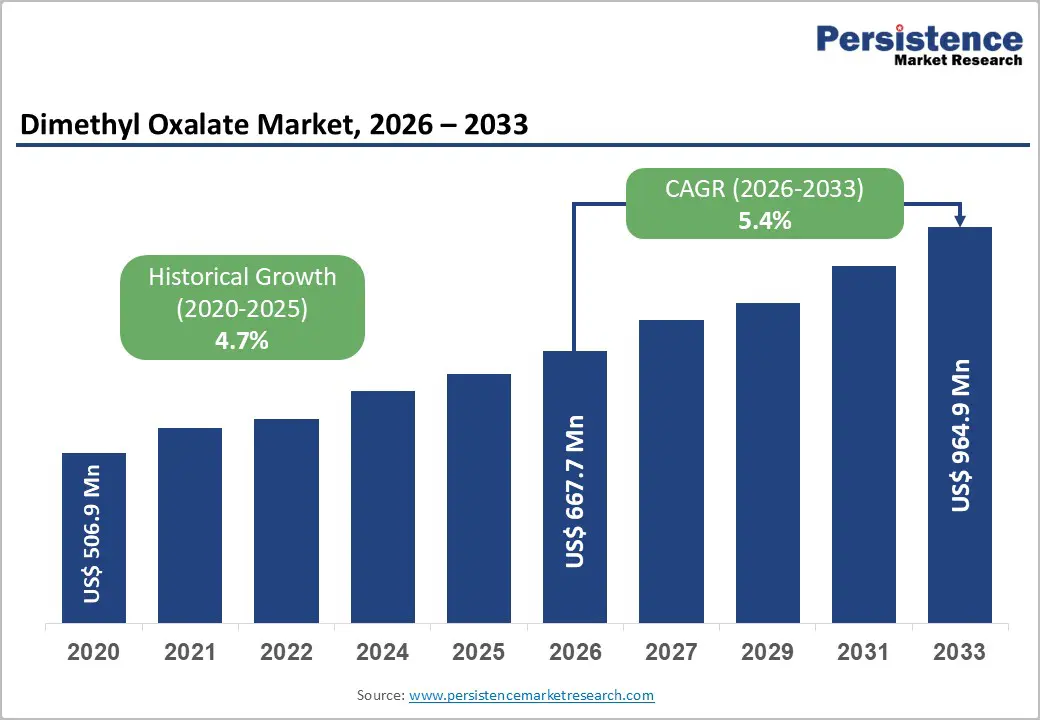
The global dimethyl oxalate market size is likely to be valued at US$ 667.7 million in 2026 and is expected to reach US$ 964.9 million by 2033, growing at a CAGR of 5.4% during the forecast period from 2026 to 2033. This expansion is primarily fueled by the increasing demand for pharmaceutical and agrochemical intermediates, as well as the rising need for specialized solvents and plasticizers in various industries.

Key Industry Highlights:

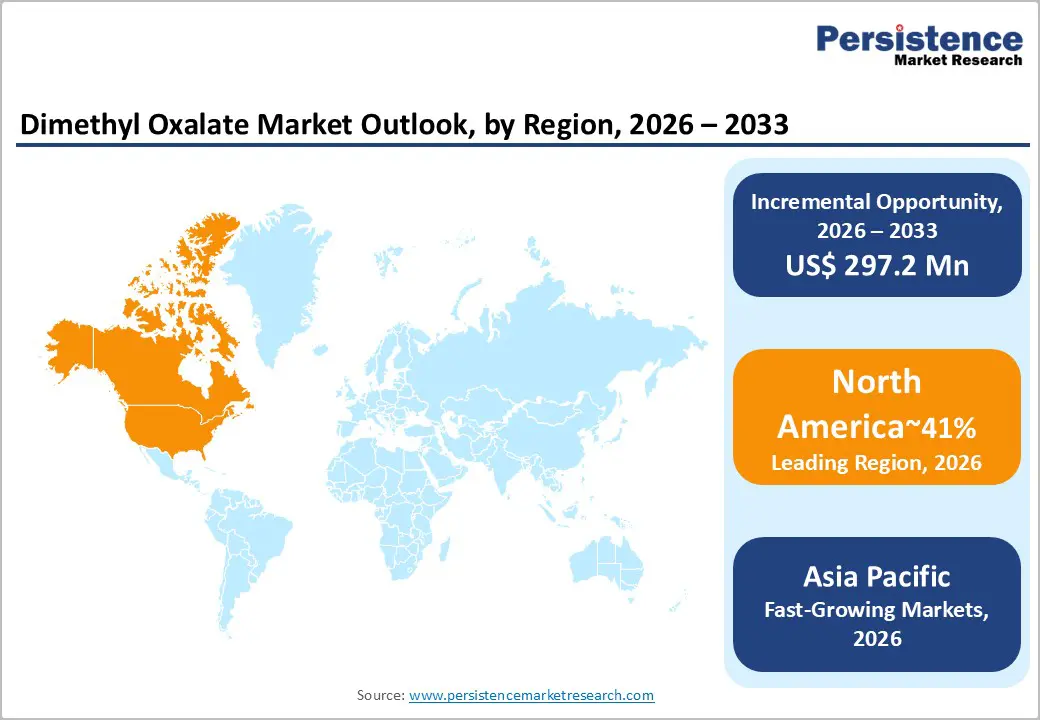
  • Leading region: North America leads the Dimethyl Oxalate market, holding 37% share, supported by robust chemical and pharmaceutical industries, advanced research infrastructure, and a strong regulatory framework.
  • Fastest growing region: Asia Pacific is the fastest-growing region for the Dimethyl Oxalate market with a rising CAGR of 6.8%, driven by rapid industrialization, government-led innovation programs, and expanding pharmaceutical manufacturing.
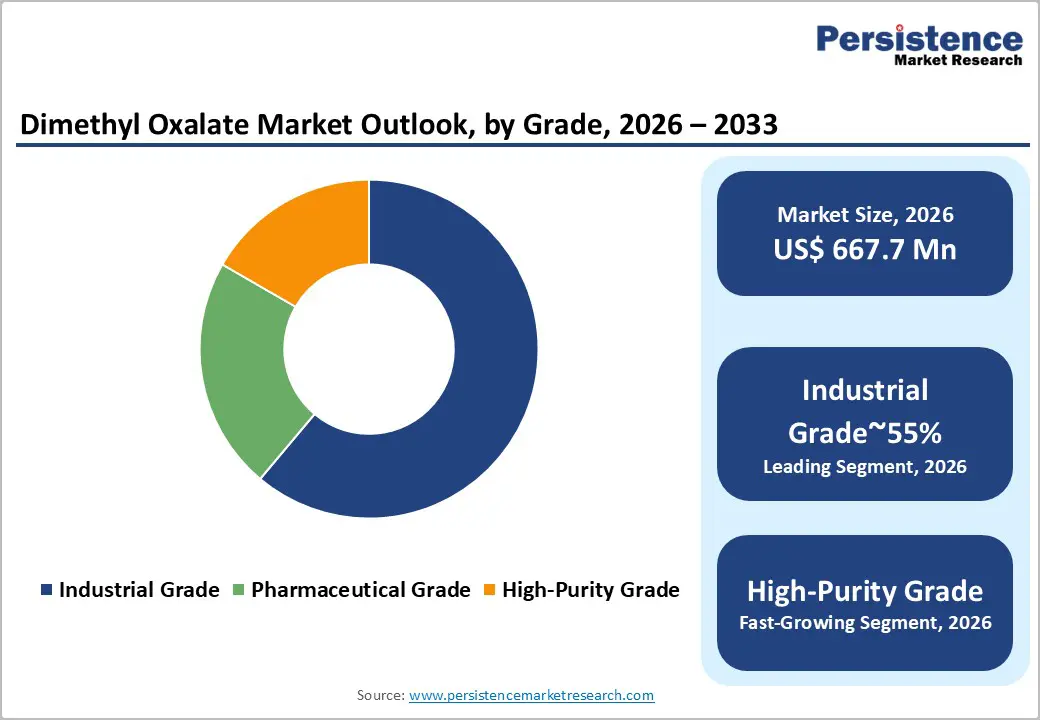
  • Dominant segment: Industrial Grade is the dominant segment in the dimethyl oxalate market, capturing about 55% market share due to widespread industrial use.
  • Fastest growing segment: Pharmaceutical Intermediates is the fastest growing segment in the market, with rising demand for advanced drugs and therapies.
  • Key market opportunity: Expansion of novel applications in pharmaceuticals and specialty chemicals, especially in emerging economies.
Key Insights Details

Dimethyl Oxalate Market Size (2026E)

US$ 667.7 Million

Dimethyl Oxalate Market Value Forecast (2033F)

US$ 964.9 Million

Projected Growth CAGR(2026-2033)

5.4%

Historical Market Growth (2020-2025)

4.7%

dimethyl-oxalate-market-2026–2033

Market Dynamics

Drivers - Expanding pharmaceutical and agrochemical manufacturing is driving strong demand for dimethyl oxalate as a critical chemical intermediate

The global pharmaceutical and agrochemical industries have become the primary consumers of dimethyl oxalate, significantly driving market growth. Pharmaceutical manufacturers are increasing production of antiretroviral drugs, steroids, and barbiturates, which has boosted demand for dimethyl oxalate as a critical intermediate. In parallel, the agrochemical sector relies heavily on dimethyl oxalate for synthesizing pesticides, herbicides, and fungicides that enhance crop yields and protect agricultural output. This dual-sector dependence is creating steady and long-term demand growth.

In 2025, Merck’s announced the positive Phase 3 trial results for its investigational HIV treatment DOR/ISL. The U.S. FDA’s acceptance of the NDA, with a target action date of April 28, 2026, highlights the accelerating pace of advanced drug development. Islatravir’s complex synthesis requires specialized intermediates such as dimethyl oxalate, reinforcing its importance. Merck’s collaboration with Gilead on injectable formulations further strengthens demand for pharmaceutical-grade intermediates, directly supporting dimethyl oxalate market expansion.

Growing adoption of green chemistry and sustainable manufacturing processes is accelerating dimethyl oxalate market growth globally

Growing emphasis on green chemistry is strongly supporting the dimethyl oxalate market, as regulators and industries shift toward cleaner and more sustainable production methods. Dimethyl oxalate is increasingly researched for use in environmentally friendly industrial processes, including bio-based chemical production and direct oxidation fuel cells. Governments and multinational corporations are investing heavily in R&D to develop low-emission alternatives, positioning dimethyl oxalate as a preferred option due to its comparatively low toxicity and reduced environmental impact.

This transition is clearly reflected in UBE Corporation’s February 2025 groundbreaking ceremony for its DMC and EMC manufacturing plant in Louisiana. The facility will use UBE’s proprietary gas-phase nitrite process, which delivers lower energy consumption, fewer by-products, and superior quality. With planned production of 100,000 tons of DMC and 40,000 tons of EMC annually starting November 2026, the project demonstrates how dimethyl oxalate–derived products are enabling sustainable growth in battery, energy storage, and electric vehicle applications.

Restraints - Strict safety regulations and compliance requirements increase operational costs and limit rapid expansion of the dimethyl oxalate market

Dimethyl oxalate is classified as a corrosive chemical and requires strict handling and safety protocols, which creates regulatory challenges for manufacturers. Compliance with guidelines set by authorities such as the U.S. EPA and the European Chemicals Agency increases production complexity and costs. Regulatory approval processes can delay product launches and slow market entry, particularly for new or smaller producers. Manufacturers must invest in specialized storage, transportation, and disposal systems to meet safety standards, adding operational burdens.

These requirements can be especially challenging for small and medium enterprises with limited capital resources. Additionally, evolving environmental and occupational safety regulations require continuous monitoring and compliance upgrades. While these measures are essential for worker and environmental protection, they can restrict supply expansion and discourage new entrants. As a result, stringent regulatory frameworks remain a key restraint on the overall growth of the dimethyl oxalate market.

Low market awareness and availability of alternative chemicals continue to restrict broader adoption of dimethyl oxalate

Despite its valuable chemical properties, dimethyl oxalate remains a niche product with relatively low awareness among end-users. Many industries continue to rely on traditional solvents and intermediates that are well-established, cost-effective, and integrated into existing manufacturing processes. This preference limits the adoption of dimethyl oxalate, particularly in price-sensitive markets. Additionally, the availability of substitute chemicals with similar functional performance further restricts market penetration.

End-users may be reluctant to shift to dimethyl oxalate due to perceived switching costs, limited technical familiarity, or insufficient supplier outreach. In emerging economies, lack of technical knowledge and training further constrains adoption. These factors collectively slow demand growth and prevent dimethyl oxalate from achieving wider commercial use. Overcoming this restraint will require targeted awareness initiatives, technical support, and cost-competitive offerings from manufacturers.

Opportunity - Rising innovation in advanced pharmaceuticals and specialty chemicals is creating new growth opportunities for dimethyl oxalate

The pharmaceutical industry is increasingly exploring new applications for dimethyl oxalate in advanced drug development, including integrase inhibitors and next-generation therapies. Its flexibility as both a solvent and intermediate enables innovation in high-value API synthesis and specialty chemical manufacturing. Research into its use in direct oxidation fuel cells and other emerging technologies further expands its commercial potential.

In 2025, Thermo Fisher Scientific’s October 2025 partnership with OpenAI, which integrates AI capabilities into its Accelerator Drug Development platform. This collaboration enhances drug development efficiency across small molecules, biologics, and cell and gene therapies. With over 700 completed pharmaceutical programs across 14 therapeutic areas, Thermo Fisher supports rapid innovation for biotech firms requiring specialized intermediates. As AI-driven drug development accelerates clinical timelines, demand for high-purity chemical building blocks like dimethyl oxalate is expected to rise, opening new revenue opportunities for manufacturers.

Rapid industrialization and pharmaceutical expansion in emerging economies are generating significant demand for dimethyl oxalate

Emerging economies such as India, China, and Brazil are experiencing rapid industrialization, creating strong demand for pharmaceutical and agrochemical intermediates. Government incentives, increased healthcare spending, and expanding agricultural output are supporting this growth. HefeiTNJ Chemical Industry Co. Ltd.’s 2025 expansion of pharmaceutical-grade production highlights this trend, particularly its focus on India’s fast-growing API market. The commissioning of advanced purification and crystallization facilities reflects rising quality standards among emerging-market manufacturers.

India’s pharmaceutical intermediate demand is projected to grow at a 6% CAGR through 2035, driven by backward integration strategies and expanding generic drug production.  Asia-Pacific’s pharmaceutical chemicals market is expected to exceed USD 120 billion by 2027, further strengthening demand for locally sourced intermediates. HefeiTNJ’s expansion across Central Asia, the Middle East, and South America demonstrates how emerging economies are becoming key growth engines for the global dimethyl oxalate market.

Category-wise Analysis

Grade Insights

The Industrial Grade segment dominates the dimethyl oxalate market, accounting for approximately 55% of total demand. This leadership is driven by its extensive use in bulk chemical manufacturing, plastics, and agrochemical applications. Industrial-grade dimethyl oxalate offers a cost-effective solution for large-scale production, making it the preferred choice for manufacturers focused on volume and efficiency. Its suitability for multiple industrial processes further strengthens its market position.

At the same time, demand for pharmaceutical and high-purity grades is steadily increasing. Stricter quality standards in pharmaceutical manufacturing, laboratory research, and specialty chemical production are pushing manufacturers to invest in advanced purification technologies. As regulatory requirements continue to tighten, the premium segment is expected to grow faster, although industrial grade will remain the volume leader due to its widespread industrial use.

Application Insights

Pharmaceutical intermediates represent the largest application segment, accounting for approximately 45% of the dimethyl oxalate market. This dominance is driven by rising production of antiretroviral drugs, steroids, oncology treatments, and other advanced pharmaceuticals. Increasing R&D investments and global demand for HIV and cancer therapies continue to support growth. Dimethyl oxalate plays a critical role in synthesizing complex APIs, making it essential for pharmaceutical manufacturing.

The agrochemical intermediates segment is also expanding rapidly, supported by the growing need for pesticides and herbicides to improve agricultural productivity. As global food demand rises, agrochemical manufacturers are increasing output, further boosting dimethyl oxalate consumption. Together, these application segments form the backbone of market demand and are expected to sustain long-term growth.

Industry Insights

The pharmaceutical industry is the largest end-user of dimethyl oxalate, accounting for approximately 40% of total consumption. Demand is driven by the need for high-quality APIs and specialty intermediates used in drug synthesis. Continuous expansion of pharmaceutical manufacturing capacity, especially in emerging markets, supports this trend. The agrochemical industry is another major consumer, particularly in regions with intensive agricultural activity.

Dimethyl oxalate is widely used in producing crop protection chemicals that enhance yields and reduce losses. Additional demand comes from textiles, metal fabrication, and other industrial sectors, where dimethyl oxalate is used as a solvent and processing aid. Although these segments represent a smaller share, they contribute to overall market stability and diversification.

Distribution Channel Insights

Direct sales dominate the dimethyl oxalate market, accounting for approximately 60% of total distribution. Large manufacturers and industrial buyers prefer direct supplier relationships to ensure consistent quality, reliable supply, and customized solutions. Direct sales also enable long-term contracts and better price negotiation for bulk purchases. This channel is particularly important for pharmaceutical and agrochemical companies that require strict quality compliance.

Indirect sales channels, including distributors and agents, play a key role for small and medium enterprises and laboratory buyers. These customers value flexibility, smaller order volumes, and quicker access to products. While indirect sales account for a smaller share, they help expand market reach and improve accessibility, especially in regional and emerging markets.
dimethyl-oxalate-market-outlook-by-grade-2026-2033

Regional Insights

North America Dimethyl Oxalate Trends

North America leads the dimethyl oxalate market, supported by strong pharmaceutical and chemical industries, advanced R&D infrastructure, and a robust regulatory environment. The United States remains the largest contributor, driven by investments in sustainable chemistry and specialty chemical manufacturing.

In November 2026, the plant will produce DMC and EMC using a low-emission, high-efficiency gas-phase nitrite process. This investment establishes a domestic supply chain for battery and semiconductor chemicals while reducing import dependence. The project also reflects North America’s focus on sustainability, innovation, and skilled job creation. Collaboration between chemical manufacturers and pharmaceutical companies continues to drive product innovation and market growth across the region.

Europe Dimethyl Oxalate Trends

Europe holds a significant share of the global dimethyl oxalate market, led by Germany, the U.K., and France. The region’s stringent environmental and quality regulations encourage adoption of sustainable and high-purity chemicals. Continuous R&D investments and the presence of global pharmaceutical leaders strengthen demand. Merck KGaA’s €300 million Advanced Research Center in Darmstadt highlights Europe’s commitment to pharmaceutical innovation.

Scheduled to begin operations in early 2027, the facility will focus on mRNA, antibodies, and biotechnological manufacturing solutions. These advanced research activities require specialized chemical intermediates, including dimethyl oxalate. Europe’s harmonized regulatory framework also facilitates cross-border trade, supporting market stability and long-term growth.

Asia Pacific Dimethyl Oxalate Market Trends

Asia Pacific is the fastest-growing region in the dimethyl oxalate market, driven by rapid industrialization, government support, and expanding pharmaceutical manufacturing. China leads as the largest producer and exporter, supported by large-scale capacity expansions and rising R&D investment. India is emerging as a key market due to growth in pharmaceuticals and agriculture. Sinopec’s US$40.9 billion purchasing agreements at CIIE 2025 reflect the region’s expanding chemical supply chain.

Rising production of ethylene, synthetic resins, and polymers further supports intermediate demand. HefeiTNJ Chemical’s expansion across Asia, the Middle East, and South America demonstrates strong regional integration. Competitive manufacturing costs, skilled labor, and supportive policies position Asia as a global hub for dimethyl oxalate production.
dimethyl-oxalate-market-outlook-by-region-2026–2033

Competitive Landscape

The global dimethyl oxalate market is moderately consolidated, with leading players controlling nearly one-third of global revenue. Companies such as UBE Corporation, Merck KGaA, Connect Chemical GmbH, Nanjing Chegyi Chemical, and HefeiTNJ Chemical Industry are strengthening their positions through strategic partnerships, R&D investments, and geographic expansion. Product quality, technological innovation, and regulatory compliance remain key competitive differentiators. Many players are also adopting sustainable manufacturing practices to meet evolving customer and regulatory expectations. Emerging business models focus on customized solutions for pharmaceutical and agrochemical clients, as well as environmentally friendly production methods. This competitive environment supports innovation while maintaining steady market growth.

Key Market Developments

  • In February 2025: UBE Corporation, a global leader in specialty chemicals with over 120 years of manufacturing experience, held a groundbreaking ceremony, for a transformative $500 million facility in Louisiana, United States.

Companies Covered in Dimethyl Oxalate Market

  • UBE Corporation
  • Merck KGaA
  • Connect Chemical GmbH
  • Nanjing Chegyi Chemical Co. Ltd.
  • HefeiTNJ Chemical Industry Co. Ltd.
  • Mudanjiang Fengda Chemical Corporation
  • Zhonglan Industry Co. Ltd.
  • Ningbo Jiasi Chemical Co. Ltd.
  • Changzhou Yetai Fine Chemicals Research Institute Co. Ltd.
  • Otto Chemie Pvt. Ltd
  • Richman Chemical Inc
  • Oakwood Products Inc.
  • Spectrum Chemical
  • Thermo Fisher Scientific Inc.
  • Sinopec Group
  • Shanghai Rich Chemicals Co. Ltd.
Frequently Asked Questions

The global Dimethyl Oxalate market is valued at US$ 667.7 Million in 2026 and is expected to reach US$ 964.9 Million by 2033.

Key drivers include rising demand from pharmaceutical and agrochemical industries, technological advancements, and global shifts toward sustainable chemical production.

The Industrial Grade segment holds the largest market share, accounting for approximately 55% of total demand.

Asia Pacific is the largest market, driven by rapid industrialization and strong manufacturing bases in China and India.

Expansion of novel applications in pharmaceuticals, specialty chemicals, and emerging economies offers significant growth potential.

Key players include UBE Corporation, Merck KGaA, Connect Chemical GmbH, Nanjing Chegyi Chemical Co. Ltd., HefeiTNJ Chemical Industry Co. Ltd., and others.

Global Dimethyl Oxalate Report Scope
Report Attribute Details

Historical Data/Actuals

2020 - 2025

Forecast Period

2026 - 2033

Market Analysis Units

Value: US$ Mn, Volume: Tons

Geographical Coverage

  • North America
  • Europe
  • East Asia
  • South Asia and Oceania
  • Latin America
  • Middle East and Africa

Segmental Coverage

  • Grade
  • Application
  • End-Use
  • Distribution Channel

Competitive Analysis

  • UBE Corporation
  • Merck KGaA
  • Connect Chemical GmbH
  • Nanjing Chegyi Chemical Co. Ltd.
  • HefeiTNJ Chemical Industry Co. Ltd.
  • Mudanjiang Fengda Chemical Corporation
  • Zhonglan Industry Co. Ltd.
  • Ningbo Jiasi Chemical Co. Ltd.
  • Changzhou Yetai Fine Chemicals Research Institute Co. Ltd.
  • Otto Chemie Pvt. Ltd
  • Richman Chemical Inc
  • Oakwood Products Inc.
  • Spectrum Chemical
  • Thermo Fisher Scientific Inc.
  • Sinopec Group
  • Shanghai Rich Chemicals Co. Ltd.

Report Highlights

  • Market Forecast and Trends
  • Competitive Intelligence & Share Analysis
  • Growth Factors and Challenges
  • Strategic Growth Initiatives
  • Pricing Analysis, & Future Opportunities and Revenue Pockets
  • Market Analysis Tools
Market Segmentation

By Grade

  • Industrial Grade
  • Pharmaceutical Grade
  • High-Purity Grade

By Application

  • Pharmaceutical Intermediates
  • Agrochemical Intermediates
  • Solvents
  • Plasticizers
  • Metal Processing
  • Textile Processing
  • Specialty Chemicals

By Industry

  • Chemical Manufacturing
  • Pharmaceutical Industry
  • Agrochemical Industry
  • Textile Industry
  • Automotive & Metal Fabrication
  • Research & Laboratories

By Distribution Channel

  • Direct Sales
  • Indirect Sale

By Regions

  • North America
  • Europe
  • East Asia
  • South Asia & Oceania
  • Latin America
  • Middle East & Africa

Related Reports

  1. Executive Summary
    1. Global Dimethyl Oxalate Market Snapshot 2026 and 2033
    2. Market Opportunity Assessment, 2026-2033, US$ Mn
    3. Key Market Trends
    4. Industry Developments and Key Market Events
    5. Demand Side and Supply Side Analysis
    6. PMR Analysis and Recommendations
  2. Market Overview
    1. Market Scope and Definitions
    2. Value Chain Analysis
    3. Macro-Economic Factors
      1. Global GDP Outlook
      2. Global Chemical Industry Overview
      3. Global Automotive Industry Overview
      4. Global Pharmaceutical Industry Overview
      5. Global Agrochemical Industry Overview
    4. Forecast Factors – Relevance and Impact
    5. COVID-19 Impact Assessment
    6. PESTLE Analysis
    7. Porter's Five Forces Analysis
    8. Geopolitical Tensions: Market Impact
    9. Regulatory and Technology Landscape
  3. Market Dynamics
    1. Drivers
    2. Restraints
    3. Opportunities
    4. Trends
  4. Price Trend Analysis, 2020 – 2033
    1. Region-wise Price Analysis
    2. Price by Segments
    3. Price Impact Factors
  5. Global Dimethyl Oxalate Market Outlook: Historical (2020 – 2025) and Forecast (2026 – 2033)
    1. Key Highlights
    2. Global Dimethyl Oxalate Market Outlook: By Grade
      1. Introduction/Key Findings
      2. Historical Market Size (US$ Mn) and Volume (Tons) Analysis by By Grade, 2020-2025
      3. Current Market Size (US$ Mn) and Volume (Tons) Forecast, by By Grade, 2026-2033
        1. Industrial Grade
        2. Pharmaceutical Grade
        3. High-Purity Grade
      4. Market Attractiveness Analysis: By Grade
    3. Global Dimethyl Oxalate Market Outlook: By Distribution Channel
      1. Introduction/Key Findings
      2. Historical Market Size (US$ Mn) and Volume (Tons) Analysis by By Distribution Channel, 2020-2025
      3. Current Market Size (US$ Mn) and Volume (Tons) Forecast, by By Distribution Channel, 2026-2033
        1. Direct Sales
        2. Indirect Sale
      4. Market Attractiveness Analysis: By Distribution Channel
    4. Global Dimethyl Oxalate Market Outlook: By Application
      1. Introduction/Key Findings
      2. Historical Market Size (US$ Mn) and Volume (Tons) Analysis by By Application, 2020-2025
      3. Current Market Size (US$ Mn) and Volume (Tons) Forecast, by By Application, 2026-2033
        1. Pharmaceutical Intermediates
        2. Agrochemical Intermediates
        3. Solvents
        4. Plasticizers
        5. Metal Processing
        6. Textile Processing
        7. Specialty Chemicals
      4. Market Attractiveness Analysis: By Application
    5. Global Dimethyl Oxalate Market Outlook: By End-Use Industry
      1. Introduction/Key Findings
      2. Historical Market Size (US$ Mn) and Volume (Tons) Analysis by By End-Use Industry, 2020-2025
      3. Current Market Size (US$ Mn) and Volume (Tons) Forecast, by By End-Use Industry, 2026-2033
        1. Chemical Manufacturing
        2. Pharmaceutical Industry
        3. Agrochemical Industry
        4. Textile Industry
        5. Automotive & Metal Fabrication
        6. Research & Laboratories
      4. Market Attractiveness Analysis: By End-Use Industry
  6. Global Dimethyl Oxalate Market Outlook: Region
    1. Key Highlights
    2. Historical Market Size (US$ Mn) and Volume (Tons) Analysis by Region, 2020-2025
    3. Current Market Size (US$ Mn) and Volume (Tons) Forecast, by Region, 2026-2033
      1. North America
      2. Europe
      3. East Asia
      4. South Asia & Oceania
      5. Latin America
      6. Middle East & Africa
    4. Market Attractiveness Analysis: Region
  7. North America Dimethyl Oxalate Market Outlook: Historical (2020 – 2025) and Forecast (2026 – 2033)
    1. Key Highlights
    2. Pricing Analysis
    3. North America Market Size (US$ Mn) and Volume (Tons) Forecast, by Country, 2026-2033
      1. U.S.
      2. Canada
    4. North America Market Size (US$ Mn) and Volume (Tons) Forecast, by By Grade, 2026-2033
      1. Industrial Grade
      2. Pharmaceutical Grade
      3. High-Purity Grade
    5. North America Market Size (US$ Mn) and Volume (Tons) Forecast, by By Distribution Channel, 2026-2033
      1. Direct Sales
      2. Indirect Sale
    6. North America Market Size (US$ Mn) and Volume (Tons) Forecast, by By Application, 2026-2033
      1. Pharmaceutical Intermediates
      2. Agrochemical Intermediates
      3. Solvents
      4. Plasticizers
      5. Metal Processing
      6. Textile Processing
      7. Specialty Chemicals
    7. North America Market Size (US$ Mn) and Volume (Tons) Forecast, by By End-Use Industry, 2026-2033
      1. Chemical Manufacturing
      2. Pharmaceutical Industry
      3. Agrochemical Industry
      4. Textile Industry
      5. Automotive & Metal Fabrication
      6. Research & Laboratories
  8. Europe Dimethyl Oxalate Market Outlook: Historical (2020 – 2025) and Forecast (2026 – 2033)
    1. Key Highlights
    2. Pricing Analysis
    3. Europe Market Size (US$ Mn) and Volume (Tons) Forecast, by Country, 2026-2033
      1. Germany
      2. Italy
      3. France
      4. U.K.
      5. Spain
      6. Russia
      7. Rest of Europe
    4. Europe Market Size (US$ Mn) and Volume (Tons) Forecast, by By Grade, 2026-2033
      1. Industrial Grade
      2. Pharmaceutical Grade
      3. High-Purity Grade
    5. Europe Market Size (US$ Mn) and Volume (Tons) Forecast, by By Distribution Channel, 2026-2033
      1. Direct Sales
      2. Indirect Sale
    6. Europe Market Size (US$ Mn) and Volume (Tons) Forecast, by By Application, 2026-2033
      1. Pharmaceutical Intermediates
      2. Agrochemical Intermediates
      3. Solvents
      4. Plasticizers
      5. Metal Processing
      6. Textile Processing
      7. Specialty Chemicals
    7. Europe Market Size (US$ Mn) and Volume (Tons) Forecast, by By End-Use Industry, 2026-2033
      1. Chemical Manufacturing
      2. Pharmaceutical Industry
      3. Agrochemical Industry
      4. Textile Industry
      5. Automotive & Metal Fabrication
      6. Research & Laboratories
  9. East Asia Dimethyl Oxalate Market Outlook: Historical (2020 – 2025) and Forecast (2026 – 2033)
    1. Key Highlights
    2. Pricing Analysis
    3. East Asia Market Size (US$ Mn) and Volume (Tons) Forecast, by Country, 2026-2033
      1. China
      2. Japan
      3. South Korea
    4. East Asia Market Size (US$ Mn) and Volume (Tons) Forecast, by By Grade, 2026-2033
      1. Industrial Grade
      2. Pharmaceutical Grade
      3. High-Purity Grade
    5. East Asia Market Size (US$ Mn) and Volume (Tons) Forecast, by By Distribution Channel, 2026-2033
      1. Direct Sales
      2. Indirect Sale
    6. East Asia Market Size (US$ Mn) and Volume (Tons) Forecast, by By Application, 2026-2033
      1. Pharmaceutical Intermediates
      2. Agrochemical Intermediates
      3. Solvents
      4. Plasticizers
      5. Metal Processing
      6. Textile Processing
      7. Specialty Chemicals
    7. East Asia Market Size (US$ Mn) and Volume (Tons) Forecast, by By End-Use Industry, 2026-2033
      1. Chemical Manufacturing
      2. Pharmaceutical Industry
      3. Agrochemical Industry
      4. Textile Industry
      5. Automotive & Metal Fabrication
      6. Research & Laboratories
  10. South Asia & Oceania Dimethyl Oxalate Market Outlook: Historical (2020 – 2025) and Forecast (2026 – 2033)
    1. Key Highlights
    2. Pricing Analysis
    3. South Asia & Oceania Market Size (US$ Mn) and Volume (Tons) Forecast, by Country, 2026-2033
      1. India
      2. Southeast Asia
      3. ANZ
      4. Rest of SAO
    4. South Asia & Oceania Market Size (US$ Mn) and Volume (Tons) Forecast, by By Grade, 2026-2033
      1. Industrial Grade
      2. Pharmaceutical Grade
      3. High-Purity Grade
    5. South Asia & Oceania Market Size (US$ Mn) and Volume (Tons) Forecast, by By Distribution Channel, 2026-2033
      1. Direct Sales
      2. Indirect Sale
    6. South Asia & Oceania Market Size (US$ Mn) and Volume (Tons) Forecast, by By Application, 2026-2033
      1. Pharmaceutical Intermediates
      2. Agrochemical Intermediates
      3. Solvents
      4. Plasticizers
      5. Metal Processing
      6. Textile Processing
      7. Specialty Chemicals
    7. South Asia & Oceania Market Size (US$ Mn) and Volume (Tons) Forecast, by By End-Use Industry, 2026-2033
      1. Chemical Manufacturing
      2. Pharmaceutical Industry
      3. Agrochemical Industry
      4. Textile Industry
      5. Automotive & Metal Fabrication
      6. Research & Laboratories
  11. Latin America Dimethyl Oxalate Market Outlook: Historical (2020 – 2025) and Forecast (2026 – 2033)
    1. Key Highlights
    2. Pricing Analysis
    3. Latin America Market Size (US$ Mn) and Volume (Tons) Forecast, by Country, 2026-2033
      1. Brazil
      2. Mexico
      3. Rest of LATAM
    4. Latin America Market Size (US$ Mn) and Volume (Tons) Forecast, by By Grade, 2026-2033
      1. Industrial Grade
      2. Pharmaceutical Grade
      3. High-Purity Grade
    5. Latin America Market Size (US$ Mn) and Volume (Tons) Forecast, by By Distribution Channel, 2026-2033
      1. Direct Sales
      2. Indirect Sale
    6. Latin America Market Size (US$ Mn) and Volume (Tons) Forecast, by By Application, 2026-2033
      1. Pharmaceutical Intermediates
      2. Agrochemical Intermediates
      3. Solvents
      4. Plasticizers
      5. Metal Processing
      6. Textile Processing
      7. Specialty Chemicals
    7. Latin America Market Size (US$ Mn) and Volume (Tons) Forecast, by By End-Use Industry, 2026-2033
      1. Chemical Manufacturing
      2. Pharmaceutical Industry
      3. Agrochemical Industry
      4. Textile Industry
      5. Automotive & Metal Fabrication
      6. Research & Laboratories
  12. Middle East & Africa Dimethyl Oxalate Market Outlook: Historical (2020 – 2025) and Forecast (2026 – 2033)
    1. Key Highlights
    2. Pricing Analysis
    3. Middle East & Africa Market Size (US$ Mn) and Volume (Tons) Forecast, by Country, 2026-2033
      1. GCC Countries
      2. South Africa
      3. Northern Africa
      4. Rest of MEA
    4. Middle East & Africa Market Size (US$ Mn) and Volume (Tons) Forecast, by By Grade, 2026-2033
      1. Industrial Grade
      2. Pharmaceutical Grade
      3. High-Purity Grade
    5. Middle East & Africa Market Size (US$ Mn) and Volume (Tons) Forecast, by By Distribution Channel, 2026-2033
      1. Direct Sales
      2. Indirect Sale
    6. Middle East & Africa Market Size (US$ Mn) and Volume (Tons) Forecast, by By Application, 2026-2033
      1. Pharmaceutical Intermediates
      2. Agrochemical Intermediates
      3. Solvents
      4. Plasticizers
      5. Metal Processing
      6. Textile Processing
      7. Specialty Chemicals
    7. Middle East & Africa Market Size (US$ Mn) and Volume (Tons) Forecast, by By End-Use Industry, 2026-2033
      1. Chemical Manufacturing
      2. Pharmaceutical Industry
      3. Agrochemical Industry
      4. Textile Industry
      5. Automotive & Metal Fabrication
      6. Research & Laboratories
  13. Competition Landscape
    1. Market Share Analysis, 2025
    2. Market Structure
      1. Competition Intensity Mapping
      2. Competition Dashboard
    3. Company Profiles
      1. UBE Corporation
        1. Company Overview
        2. Product Portfolio/Offerings
        3. Key Financials
        4. SWOT Analysis
        5. Company Strategy and Key Developments
      2. Merck KGaA
      3. Connect Chemical GmbH
      4. Nanjing Chegyi Chemical Co. Ltd.
      5. HefeiTNJ Chemical Industry Co. Ltd.
      6. Mudanjiang Fengda Chemical Corporation
      7. Zhonglan Industry Co. Ltd.
      8. Ningbo Jiasi Chemical Co. Ltd.
      9. Changzhou Yetai Fine Chemicals Research Institute Co. Ltd.
      10. Otto Chemie Pvt. Ltd
      11. Richman Chemical Inc
      12. Oakwood Products Inc.
      13. Spectrum Chemical
      14. Thermo Fisher Scientific Inc. 
  14. Appendix
    1. Research Methodology
    2. Research Assumptions
    3. Acronyms and Abbreviations

Research Methodology Framework for Market Research Excellence

At Persistence Market Research, we implement a comprehensive, validated, and multi-dimensional approachto market analysis that delivers actionable insights across complex market landscapes. Our methodology combines the analytical rigor of leading consulting firms with innovative research techniques, ensuring robust market assessments that guide strategic decision-making with confidence.

Core Research Philosophy

Our methodology is built on four foundational pillars:

Research Philosophy Image

At Persistence Market Research, our methodology is designed to transcend conventional market studies by combining analytical rigor, multi-source validation, and future-focused insights.

We integrate advanced research frameworks, robust data collection strategies, cutting-edge analytics, and innovative technologies to deliver a 360-degree view of complex markets.

We integrate advanced research frameworks, robust data collection strategies, cutting-edge analytics, and innovative technologies to deliver a 360-degree view of complex markets.

Each stage spanning from strategic scoping and hypothesis-building to competitive intelligence, quality validation, and actionable recommendations is engineered to provide clients with unmatched clarity, precision, and confidence in decision-making.

By embedding innovation and technology at the core, our approach ensures that insights are not only comprehensive but also predictive, empowering businesses to seize opportunities, mitigate risks, and achieve sustainable growth

Research Philosophy Image

Capturing Key Information and Events

During this phase, key research objectives focus on essential information and data points for assessing the market, including:

Research Philosophy Image

TAM-SAM-SOM Framework Implementation

We employ both top-down and bottom-up approaches to ensure accurate market sizing.

Top-Down Market SizingBottom-Up Market Sizing
Universe Definition: Total global/regional market identificationUnit Economics: Average transaction values, purchase frequencies, customer lifecycle
Segmentation Filters: Geographic, demographic, and behavioral constraintsCustomer Segmentation: Detailed buyer persona development and sizing
Market Share Analysis: Competitive landscape assessment and share allocationPenetration Analysis: Market penetration rates by segment and geography
Growth Rate Application: Historical trends and forward-looking growth assumptionsScaling Methodology: Extrapolation techniques with confidence intervals

Validation & Cross-Verification

  • Triangulation: Comparing top-down and bottom-up results for consistency
  • Sensitivity Analysis: Testing key assumptions and parameter variations
  • Peer Benchmarking: Comparison with analogous markets and industry benchmarks
  • Expert Review: External validation through industry specialist consultation

Research Philosophy Image

Forecasting & Projection Modeling

Our proprietary forecasting models incorporate multiple variables and scenarios.

Forecasting Components

  • Historical Trend Analysis: 10-year historical growth patterns and cyclical variations
  • Driver-Based Modeling: Economic indicators, demographic shifts, technology adoption
  • Scenario Planning: Base case, optimistic, and conservative projections
  • Monte Carlo Simulations: Probability-weighted outcomes and risk assessments

Model Validation

  • Back-Testing: Historical accuracy assessment over 3–5-year periods
  • Cross-Validation: Multiple modeling approaches for result comparison
  • External Benchmarking: Comparison with established market forecasts
  • Continuous Calibration: Quarterly model updates based on new data

Comprehensive Data Collection Strategy

Our secondary research phase establishes a robust knowledge base utilizing diverse, credible sources.

Secondary Data Sourcess

  • Industry Publications & Reports
  • Government & Regulatory Data
  • Financial Intelligence (filings & reports)
  • Academic Research & Digital Intelligence

Quality Assurance Protocol

  • Source credibility assessment and publication date validation
  • Data consistency checks across multiple sources
  • Bias identification and neutralization techniques
  • Information gap tracking for primary research prioritization

Research Philosophy Image

Primary Research Excellence

Our primary research methodology employs best-in-class techniques to capture unique market insights.

Quantitative Research Methods

  • Large-Scale Surveys: Statistically representative samples with 95% confidence intervals
  • Survey Methodology: Multi-channel deployment (online, telephone, in-person)
  • Question Architecture and Response Optimization

Qualitative Research Methods

  • Executive Interviews
  • Focus Groups
  • Expert Consultations

Quality Assurance & Validation Framework

Multi-Stage Validation Process

  • Source Verification and Consistency Testing
  • Outlier Detection and Bias Assessment
  • Peer Review Process and External Validation
  • Sensitivity Analysis and Confidence Intervals

Research Philosophy Image

Methodology Validation & Credibility

Our research methodology has been extensively validated through:

  • Academic Partnerships: Collaborations with top-tier business schools and research institutions
  • Client Success Stories: Documented case studies demonstrating research impact and ROI
  • Continuous Benchmarking: Performance comparison with leading global research firms

This comprehensive methodology framework positions Persistence Market Research at the forefront of market intelligence, combining the analytical sophistication of top-tier consulting firms with innovative research techniques. Our approach ensures that every market assessment delivers precise, actionable, and strategically valuable insights that drive business success in competitive market environments.

Ready to unlock your market potential? Contact our research experts to discuss how our validated methodology can transform your strategic decision-making with data-driven market intelligence.

Copyright © 2026 Persistence Market Research. All Rights Reserved

Connect With Us -