• Home
  • Home
  • Healthcare IT
  • Home
  • Computerized Physician Order Entry (CPOE) Systems Market

Computerized Physician Order Entry (CPOE) Systems Market Size, Share, Growth, and Regional Forecast, 2025 to 2032

Computerized Physician Order Entry (CPOE) Systems Market by Component (Software, Hardware, Services), Delivery Mode (Web/Cloud-based, On-Premises), Modality (Integrated Platforms, Stand-alone Platforms), End-user, and Regional Analysis from 2025 to 2032

ID: PMRREP2813
Calendar

December 2025

197 Pages

Author : Abhijeet Surwase

Computerized Physician Order Entry (CPOE) Systems Market Share and Trends Analysis

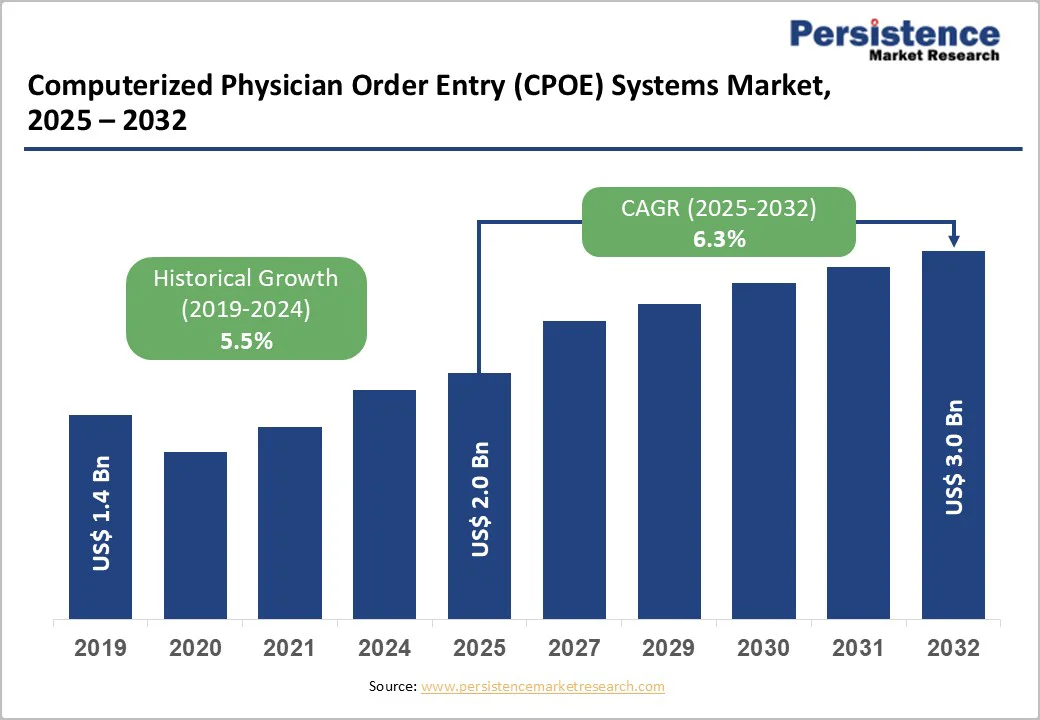
The global computerized physician order entry (CPOE) systems market size is valued at US$ 2.0 billion in 2025 and is projected to reach US$ 3.0 billion by 2032, growing at a CAGR of 6.3% between 2025 and 2032.

A computerized physician order entry (CPOE) system is a healthcare information platform that enables clinicians to electronically capture, manage, and transmit medication orders and treatment instructions, replacing traditional paper-based workflows.

These systems are frequently integrated with comprehensive Electronic Health Records (EHRs), allowing physicians, nurses, and pharmacists to access real-time patient information, streamline care coordination, and support more accurate, data-driven clinical decision-making.

Key Industry Highlights

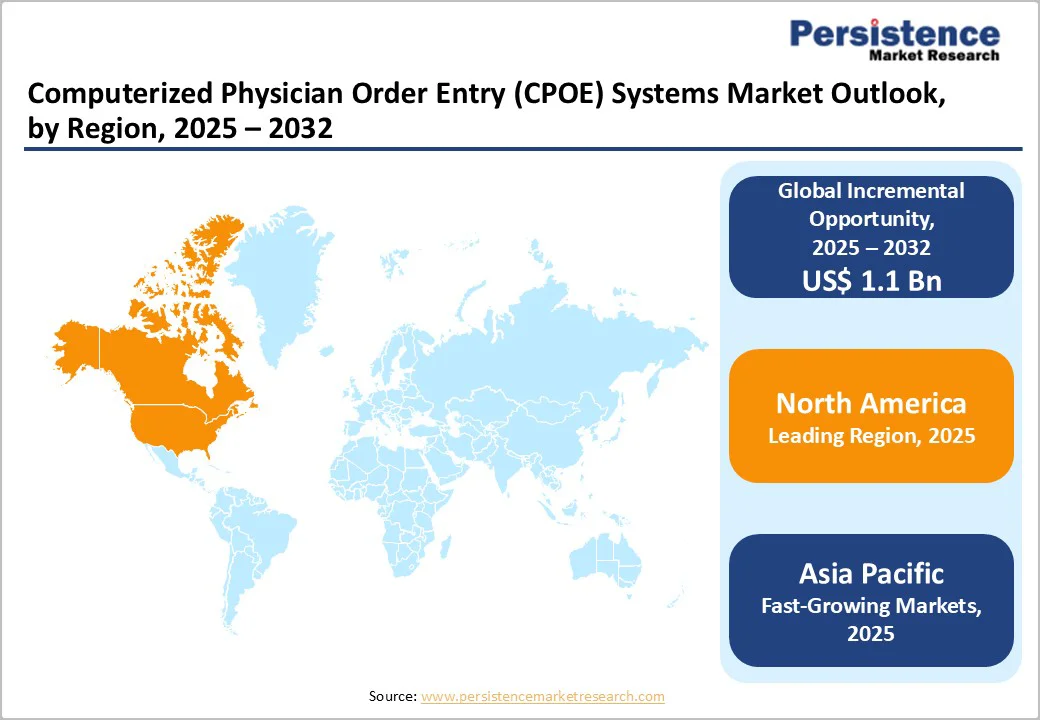
  • Leading Region: North America dominates the global market, accounting for 42.7%, driven by mature digital-health infrastructure, strong EHR-CPOE integration, and sustained federal incentives that accelerate system modernization.
  • Fastest-Growing Region: The Asia Pacific market is expected to grow rapidly with a CAGR of 7.8% in the forecast period, fueled by large patient volumes, national digital-health programs, and accelerated hospital IT upgrades.
  • Leading Component: Software lead with 54.8% share, supported by increasing demand for advanced analytics, seamless interoperability, and continuous updates enabling safer, faster clinical decision-making.
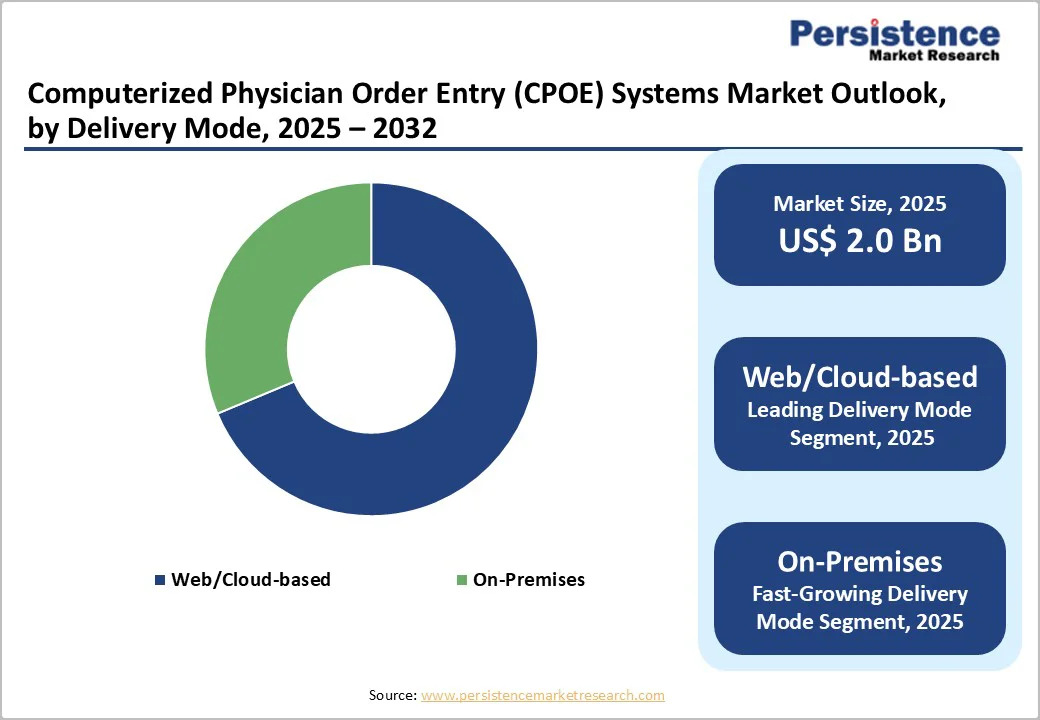
  • Leading Delivery Mode: Web/Cloud-based to remain dominant, driven by scalable deployment, lower upfront costs, and real-time accessibility across distributed clinical teams and multi-site networks.
  • Leading Modality: Integrated platforms lead with 71.1% share due to unified workflows, real-time data exchange, and the ability to connect CPOE with EHRs, CDSS, labs, and pharmacy systems.
  • Leading End-user: Hospitals & clinics lead with 48.4% share, owing to high patient throughput, strong regulatory pressure for electronic prescribing, and the need for coordinated, error-free medication management.
  • Expansion Across Ambulatory Care Settings: Outpatient centers are accelerating CPOE adoption to streamline routine prescribing, support chronic disease management, and ensure consistent documentation across multi-specialty practices.
  • Rising Cloud Security Enhancements: Advancements in healthcare cloud encryption and compliance frameworks are strengthening trust in cloud-based CPOE deployments.
Key Insights Details
Computerized Physician Order Entry (CPOE) Systems Market Size (2025E) US$2.0 Billion
Market Value Forecast (2032F) US$3.0 Billion
Projected Growth (CAGR 2025 to 2032) 6.3%
Historical Market Growth (CAGR 2019 to 2024) 5.5%

computerized-physician-order-entry-cpoe-systems-market-2025-2032

Market Dynamics

Driver - Integrated Care Demand, Error Reduction Needs, and Expanding Digital-Health Infrastructure

By 2025, the global computerized physician order entry (CPOE) systems market will be propelled by the accelerating need for integrated healthcare workflows and the rising urgency to reduce medication errors across hospitals and clinics.

The growing volume of patient data and expanding burden of chronic diseases demand automated, standardized, and interoperable platforms capable of supporting EHRs and Clinical Decision Support Systems (CDSS).

Governments worldwide have intensified digital-health policies encouraging structured electronic prescribing, secure information exchange, and real-time clinical documentation. This shift has strengthened the role of CPOE platforms as essential components of coordinated care delivery. Their ability to support drug-dosage checks, interaction alerts, and continuous patient-care pathways has significantly improved clinical safety and operational efficiency.

Additionally, increasing adoption of wireless, mobile, and cloud-based interfaces enables physicians to enter, access, and verify orders through secure devices, enhancing workflow speed and data accuracy. Growing healthcare IT investments, combined with rising awareness of patient-centric digital care, further reinforce the market’s momentum. Overall, the global push toward safer, interoperable, and data-driven healthcare is expected to sustain strong CPOE expansion through the forecast period.

Restraints - CPOE Adoption Limited by High Costs, Interoperability Gaps, Workforce Shortages, and Persistent User-Related Challenges

Despite strong momentum, several structural constraints continue to impede the global computerized physician order entry (CPOE) systems market. One of the most persistent challenges is the shortage of trained healthcare IT professionals capable of managing system deployment, customization, and troubleshooting.

High installation and integration costs, combined with lengthy implementation timelines, remain significant barriers for small and mid-sized healthcare facilities, particularly in developing regions. Interoperability limitations between CPOE systems, EHRs, CDSS platforms, and laboratory information systems (LIS) frequently disrupt workflow continuity and hinder seamless data exchange.

Moreover, low awareness and limited physician engagement reduce system utilization, especially where digital literacy remains uneven. Operational risks also arise from user-related errors, such as incorrect data entry, complex interfaces, and alert fatigue, in which repeated notifications lead clinicians to ignore critical warnings.

As new users adapt to digital workflows, temporary spikes in documentation errors is likely to occur. In rare cases, system-level gaps may fail to flag harmful drug interactions, posing safety concerns. Together, these restraints highlight the need for better training, simplified interfaces, and stronger interoperability standards. Addressing these challenges is essential for maximizing the long-term value of CPOE adoption worldwide.

Opportunity - AI, Cloud Expansion, Interoperability Policies, and Mobile-First Care Models

The global computerized physician order entry (CPOE) systems market is positioned for significant opportunity as healthcare transitions toward intelligent, interoperable, and value-based digital ecosystems. The rapid advancement of artificial intelligence (AI) and machine learning (ML) offers an avenue to enhance clinical decision support, enabling predictive alerts, automated dose recommendations, and personalized treatment insights.

Expanding adoption of cloud-based and Software-as-a-Service (SaaS) deployment models presents strong growth prospects by reducing infrastructure costs and improving scalability for both large networks and smaller care settings. Increasing investments in national digital-health infrastructures, particularly in emerging economies, are creating opportunities for vendor partnerships, system upgrades, and integrated prescribing workflows.

The rising emphasis on remote care, telemedicine, and mobile-first clinical workflows further opens the door to CPOE platforms optimized for smartphones and secure tablets. Moreover, global policy alignment toward interoperability and patient-centric data exchange strengthens demand for platforms that seamlessly integrate with EHRs, CDSS, imaging archives, and laboratory systems.

As healthcare providers seek error-free prescribing, operational efficiency, and unified digital records, CPOE systems have significant room to expand into new markets, new care models, and next-generation clinical environments.

Category-wise Analysis

By Component Insights

Software is expected to account for 54.8% of the global computerized physician order entry (CPOE) systems market by 2025, driven by growing demand for interoperable, analytics-enabled platforms that seamlessly integrate with EHRs and CDSS.

Increasing focus on medication safety, workflow automation, and real-time alerts continues to position software as the core enabler of efficient digital ordering. Continuous updates, configurable modules, and faster scalability further strengthen market preference for software over hardware-based components.

By Delivery Mode Insights

Web/Cloud-based solutions are projected to dominate the computerized physician order entry (CPOE) systems market in 2025, with a 68.7% share, supported by flexible deployment models, reduced infrastructure costs, and easier multi-site integration.

Their ability to offer real-time order entry, secure remote access, and continuous system upgrades drives widespread adoption. Growing acceptance of cloud security frameworks and rising hospital demand for mobile-friendly, always-available clinical systems further reinforce the shift toward cloud-driven CPOE platforms.

By Modality Insights

Integrated platforms are projected to capture 71.1% of the global CPOE systems market in 2025, driven by their ability to unify prescribing workflows across departments, reduce duplication, and support coherent clinical data flow.

These platforms enhance safety through consolidated alerts, coordinated medication management, and streamlined links with EHRs, laboratories, and pharmacy systems. As hospitals prioritize end-to-end digital ecosystems, integrated CPOE solutions remain the preferred modality for efficiency and patient-centric care.

By End-user Insights

Hospitals and clinics are projected to dominate the CPOE systems market in 2025 with 48.4% share, reflecting their need for standardized order management, reduced medication errors, and compliance with electronic prescribing mandates.

High patient throughput, complex treatment pathways, and multidisciplinary coordination make CPOE essential for ensuring timely decisions and accurate documentation. Growing investments in digital infrastructure and rising emphasis on safety-driven care models further strengthen adoption within these high-acuity care environments.
computerized-physician-order-entry-cpoe-systems-market-outlook-by-delivery-mode-2025-2032

Regional Insights

North America Computerized Physician Order Entry (CPOE) Systems Market Trends

By 2025, North America is expected to account for nearly 42.7% of the global computerized physician order entry (CPOE) systems market, supported by a mature digital health ecosystem and long-standing regulatory focus.

The region continues to benefit from strong EHR integration mandates, which require hospitals to embed CPOE capabilities into core clinical workflows to reduce prescribing errors and improve real-time data capture. Rapid cloud migration across major health systems has further strengthened adoption by enabling scalable, secure, and cost-efficient deployment models.

In parallel, federal incentives introduced through ongoing digital health modernization programs in the United States have accelerated investment in advanced CPOE platforms, particularly those incorporating analytics and decision-support functions. Growing emphasis on interoperability, medication safety, and coordinated care models also reinforces the overall demand trajectory.

Collectively, these factors position North America as a consistently strong and innovation-driven market. The region is expected to maintain leadership as hospitals continue to prioritize automation, compliance, and integrated digital infrastructure.

Europe Computerized Physician Order Entry (CPOE) Systems Market Trends

By 2025, Europe is projected to hold nearly 26.1% of the global computerized physician order entry (CPOE) systems market, supported by a regulatory environment that places patient safety and structured prescribing at its core.

Strict national and regional frameworks, including European Union (EU) directives that standardize clinical documentation and reduce medication-related risks, have led hospitals to expand CPOE penetration systematically.

Governments and healthcare authorities across Western and Central Europe have also increased funding for clinical information technology (IT) upgrades, prioritizing platforms that integrate seamlessly with EHRs and enable traceable, audit-ready prescribing workflows.

Interoperability remains a major driver, with EU-wide initiatives such as cross-border data exchange programs pushing hospitals toward more unified and compliant digital infrastructures. Additionally, the region’s shift toward value-based care and the rising pressure to reduce medical errors have accelerated the transition from legacy ordering systems to fully digitized CPOE environments.

As regulatory alignment deepens and hospitals continue modernizing their digital architecture, Europe is positioned to see steady and sustained CPOE uptake.

Asia Pacific Computerized Physician Order Entry (CPOE) Systems Market Trends

Asia Pacific is expanding rapidly in the computerized physician order entry (CPOE) systems market, projected to grow at a CAGR of 7.8% over the forecast period. This momentum is driven primarily by accelerated hospital digitalization initiatives, especially in China, India, Japan, and South Korea, where healthcare providers are upgrading core clinical systems to support standardized electronic prescribing.

Government-led health information technology (IT) programs-including national digital health missions, e-hospital initiatives, and incentives for electronic medical record adoption-have significantly boosted CPOE procurement.

The region’s large and diverse patient volumes further encourage hospitals to adopt scalable ordering platforms that reduce manual workload, minimize medication errors, and improve turnaround times in high-pressure clinical settings.

Increasing private hospital investments, rising awareness about patient safety, and the need for integrated data flows also contribute to the region’s strong growth trajectory. As digital maturity improves and infrastructure gaps narrow, the Asia Pacific is expected to transition into one of the most dynamic CPOE markets globally.
computerized-physician-order-entry-cpoe-systems-market-outlook-by-region-2025-2032

Competitive Landscape

The competitive landscape is shaped by expanding digital-health adoption, rapid cloud migration, advancing AI-driven clinical tools, strong interoperability demands, and increasing investments in integrated platforms that enhance efficiency, reduce errors, and support large-scale healthcare modernization.

Companies Covered in Computerized Physician Order Entry (CPOE) Systems Market

  • GE Healthcare
  • Siemens Healthineers AG
  • Epic Systems Corporation
  • Athenahealth, Inc.
  • Lifepoint Informatics
  • VersaSuite
  • Bizmatics, Inc
  • Oracle
  • Cerner Corporation
  • Veradigm LLC
  • Optum, Inc.
  • eClinicalWorks
  • NXGN Management, LLC
  • CareCloud, Inc.
  • First Databank, Inc.
Frequently Asked Questions

The global computerized physician order entry (CPOE) systems market is valued at US$ 2.0 Billion in 2025.

Growing demand for error-free prescribing, integrated EHR workflows, and automated clinical decision support is accelerating global CPOE system adoption.

The global computerized physician order entry (CPOE) systems market is poised to witness a CAGR of 6.3% between 2025 and 2032.

AI-enabled decision intelligence, cloud-based deployments, and expansion into emerging hospital networks create strong growth opportunities for next-generation CPOE platforms.

Major players in the global computerized physician order entry (CPOE) systems market are GE Healthcare, Siemens Healthineers AG, Epic Systems Corporation, Athenahealth, Inc., and others.

Global Computerized Physician Order Entry (CPOE) Systems Market Report Scope
Report Attribute Details
Historical Data/Actuals 2019 - 2024
Forecast Period 2025 - 2032
Market Analysis Value: US$ Mn
Geographical Coverage
  • North America
  • Europe
  • East Asia
  • South Asia & Oceania
  • Latin America
  • Middle East and Africa
Segmental Coverage
  • Component
  • Delivery Mode
  • Modality
  • End-user
  • Region
Competitive Analysis
  • GE Healthcare
  • Siemens Healthineers AG
  • Epic Systems Corporation
  • Athenahealth, Inc.
  • Lifepoint Informatics
  • VersaSuite
  • Bizmatics, Inc
  • Oracle
  • Cerner Corporation
  • Veradigm LLC
  • Optum, Inc.
  • eClinicalWorks
  • NXGN Management, LLC
  • CareCloud, Inc.
  • First Databank, Inc.
Report Highlights
  • Market Forecast and Trends
  • Competitive Intelligence & Share Analysis
  • Growth Factors and Challenges
  • Strategic Growth Initiatives
  • Pricing Analysis
  • Future Opportunities and Revenue Pockets
  • Market Analysis Tools
Market Segmentation

By Component

  • Software
  • Hardware
  • Services

By Delivery Mode

  • Web/Cloud-based
  • On-Premises

By Modality

  • Integrated Platforms
  • Stand-alone Platforms

By End-user

  • Hospitals & Clinics
  • Ambulatory Surgical Centers
  • Home Health Agencies
  • Others

By Region

  • North America
  • Europe
  • East Asia
  • South Asia & Oceania
  • Latin America
  • Middle East and Africa

Related Reports

  1. Executive Summary
    1. Global Computerized Physician Order Entry (CPOE) Systems Market Snapshot, 2025 and 2032
    2. Market Opportunity Assessment, 2025 - 2032, US$ Mn
    3. Key Market Trends
    4. Future Market Projections
    5. Premium Market Insights
    6. Industry Developments and Key Market Events
    7. PMR Analysis and Recommendations
  2. Market Overview
    1. Market Scope and Definition
    2. Market Dynamics
      1. Drivers
      2. Restraints
      3. Opportunity
      4. Key Trends
    3. Macro-Economic Factors
      1. Global Sectorial Outlook
      2. Global GDP Growth Outlook
    4. COVID-19 Impact Analysis
    5. Forecast Factors - Relevance and Impact
  3. Value Added Insights
    1. Product Adoption Analysis
    2. Regulatory Landscape
    3. Value Chain Analysis
    4. Key Deals and Mergers
    5. PESTLE Analysis
    6. Porter’s Five Force Analysis
  4. Global Computerized Physician Order Entry (CPOE) Systems Market Outlook:
    1. Key Highlights
      1. Market Size (US$ Mn) and Y-o-Y Growth
      2. Absolute $ Opportunity
    2. Market Size (US$ Mn) Analysis and Forecast
      1. Historical Market Size (US$ Mn) Analysis, 2019-2024
      2. Market Size (US$ Mn) Analysis and Forecast, 2025-2032
    3. Global Computerized Physician Order Entry (CPOE) Systems Market Outlook: Component
      1. Introduction / Key Findings
      2. Historical Market Size (US$ Mn) Analysis, By Component, 2019-2024
      3. Market Size (US$ Mn) Analysis and Forecast, By Component, 2025-2032
        1. Software
        2. Hardware
        3. Services
      4. Market Attractiveness Analysis: Component
    4. Global Computerized Physician Order Entry (CPOE) Systems Market Outlook: Delivery Mode
      1. Introduction / Key Findings
      2. Historical Market Size (US$ Mn) Analysis, By Delivery Mode, 2019-2024
      3. Market Size (US$ Mn) Analysis and Forecast, By Delivery Mode, 2025-2032
        1. Web/Cloud-based
        2. On-Premises
      4. Market Attractiveness Analysis: Delivery Mode
    5. Global Computerized Physician Order Entry (CPOE) Systems Market Outlook: Modality
      1. Introduction / Key Findings
      2. Historical Market Size (US$ Mn) Analysis, By Modality, 2019-2024
      3. Market Size (US$ Mn) Analysis and Forecast, By Modality, 2025-2032
        1. Integrated Platforms
        2. Stand-alone Platforms
      4. Market Attractiveness Analysis: Modality
    6. Global Computerized Physician Order Entry (CPOE) Systems Market Outlook: End User
      1. Introduction / Key Findings
      2. Historical Market Size (US$ Mn) Analysis, By End User, 2019-2024
      3. Market Size (US$ Mn) Analysis and Forecast, By End User, 2025-2032
        1. Hospitals & Clinics
        2. Ambulatory Surgical Centers
        3. Home Health Agencies
        4. Others
      4. Market Attractiveness Analysis: End User
  5. Global Computerized Physician Order Entry (CPOE) Systems Market Outlook: Region
    1. Key Highlights
    2. Historical Market Size (US$ Mn) Analysis, By Region, 2019-2024
    3. Market Size (US$ Mn) Analysis and Forecast, By Region, 2025-2032
      1. North America
      2. Europe
      3. East Asia
      4. South Asia and Oceania
      5. Latin America
      6. Middle East & Africa
    4. Market Attractiveness Analysis: Region
  6. North America Computerized Physician Order Entry (CPOE) Systems Market Outlook:
    1. Key Highlights
    2. Historical Market Size (US$ Mn) Analysis, By Market, 2019-2024
      1. By Country
      2. By Component
      3. By Delivery Mode
      4. By Modality
      5. By End User
    3. Market Size (US$ Mn) Analysis and Forecast, By Country, 2025-2032
      1. U.S.
      2. Canada
    4. Market Size (US$ Mn) Analysis and Forecast, By Component, 2025-2032
      1. Software
      2. Hardware
      3. Services
    5. Market Size (US$ Mn) Analysis and Forecast, By Delivery Mode, 2025-2032
      1. Web/Cloud-based
      2. On-Premises
    6. Market Size (US$ Mn) Analysis and Forecast, By Modality, 2025-2032
      1. Integrated Platforms
      2. Stand-alone Platforms
    7. Market Size (US$ Mn) Analysis and Forecast, By End User, 2025-2032
      1. Hospitals & Clinics
      2. Ambulatory Surgical Centers
      3. Home Health Agencies
      4. Others
    8. Market Attractiveness Analysis
  7. Europe Computerized Physician Order Entry (CPOE) Systems Market Outlook:
    1. Key Highlights
    2. Historical Market Size (US$ Mn) Analysis, By Market, 2019-2024
      1. By Country
      2. By Component
      3. By Delivery Mode
      4. By Modality
      5. By End User
    3. Market Size (US$ Mn) Analysis and Forecast, By Country, 2025-2032
      1. Germany
      2. France
      3. U.K.
      4. Italy
      5. Spain
      6. Russia
      7. Türkiye
      8. Rest of Europe
    4. Market Size (US$ Mn) Analysis and Forecast, By Component, 2025-2032
      1. Software
      2. Hardware
      3. Services
    5. Market Size (US$ Mn) Analysis and Forecast, By Delivery Mode, 2025-2032
      1. Web/Cloud-based
      2. On-Premises
    6. Market Size (US$ Mn) Analysis and Forecast, By Modality, 2025-2032
      1. Integrated Platforms
      2. Stand-alone Platforms
    7. Market Size (US$ Mn) Analysis and Forecast, By End User, 2025-2032
      1. Hospitals & Clinics
      2. Ambulatory Surgical Centers
      3. Home Health Agencies
      4. Others
    8. Market Attractiveness Analysis
  8. East Asia Computerized Physician Order Entry (CPOE) Systems Market Outlook:
    1. Key Highlights
    2. Historical Market Size (US$ Mn) Analysis, By Market, 2019-2024
      1. By Country
      2. By Component
      3. By Delivery Mode
      4. By Modality
      5. By End User
    3. Market Size (US$ Mn) Analysis and Forecast, By Country, 2025-2032
      1. China
      2. Japan
      3. South Korea
    4. Market Size (US$ Mn) Analysis and Forecast, By Component, 2025-2032
      1. Software
      2. Hardware
      3. Services
    5. Market Size (US$ Mn) Analysis and Forecast, By Delivery Mode, 2025-2032
      1. Web/Cloud-based
      2. On-Premises
    6. Market Size (US$ Mn) Analysis and Forecast, By Modality, 2025-2032
      1. Integrated Platforms
      2. Stand-alone Platforms
    7. Market Size (US$ Mn) Analysis and Forecast, By End User, 2025-2032
      1. Hospitals & Clinics
      2. Ambulatory Surgical Centers
      3. Home Health Agencies
      4. Others
    8. Market Attractiveness Analysis
  9. South Asia & Oceania Computerized Physician Order Entry (CPOE) Systems Market Outlook:
    1. Key Highlights
    2. Historical Market Size (US$ Mn) Analysis, By Market, 2019-2024
      1. By Country
      2. By Component
      3. By Delivery Mode
      4. By Modality
      5. By End User
    3. Market Size (US$ Mn) Analysis and Forecast, By Country, 2025-2032
      1. India
      2. Southeast Asia
      3. ANZ
      4. Rest of South Asia & Oceania
    4. Market Size (US$ Mn) Analysis and Forecast, By Component, 2025-2032
      1. Software
      2. Hardware
      3. Services
    5. Market Size (US$ Mn) Analysis and Forecast, By Delivery Mode, 2025-2032
      1. Web/Cloud-based
      2. On-Premises
    6. Market Size (US$ Mn) Analysis and Forecast, By Modality, 2025-2032
      1. Integrated Platforms
      2. Stand-alone Platforms
    7. Market Size (US$ Mn) Analysis and Forecast, By End User, 2025-2032
      1. Hospitals & Clinics
      2. Ambulatory Surgical Centers
      3. Home Health Agencies
      4. Others
    8. Market Attractiveness Analysis
  10. Latin America Computerized Physician Order Entry (CPOE) Systems Market Outlook:
    1. Key Highlights
    2. Historical Market Size (US$ Mn) Analysis, By Market, 2019-2024
      1. By Country
      2. By Component
      3. By Delivery Mode
      4. By Modality
      5. By End User
    3. Market Size (US$ Mn) Analysis and Forecast, By Country, 2025-2032
      1. Brazil
      2. Mexico
      3. Rest of Latin America
    4. Market Size (US$ Mn) Analysis and Forecast, By Component, 2025-2032
      1. Software
      2. Hardware
      3. Services
    5. Market Size (US$ Mn) Analysis and Forecast, By Delivery Mode, 2025-2032
      1. Web/Cloud-based
      2. On-Premises
    6. Market Size (US$ Mn) Analysis and Forecast, By Modality, 2025-2032
      1. Integrated Platforms
      2. Stand-alone Platforms
    7. Market Size (US$ Mn) Analysis and Forecast, By End User, 2025-2032
      1. Hospitals & Clinics
      2. Ambulatory Surgical Centers
      3. Home Health Agencies
      4. Others
    8. Market Attractiveness Analysis
  11. Middle East & Africa Computerized Physician Order Entry (CPOE) Systems Market Outlook:
    1. Key Highlights
    2. Historical Market Size (US$ Mn) Analysis, By Market, 2019-2024
      1. By Country
      2. By Component
      3. By Delivery Mode
      4. By Modality
      5. By End User
    3. Market Size (US$ Mn) Analysis and Forecast, By Country, 2025-2032
      1. GCC Countries
      2. Egypt
      3. South Africa
      4. Northern Africa
      5. Rest of Middle East & Africa
    4. Market Size (US$ Mn) Analysis and Forecast, By Component, 2025-2032
      1. Software
      2. Hardware
      3. Services
    5. Market Size (US$ Mn) Analysis and Forecast, By Delivery Mode, 2025-2032
      1. Web/Cloud-based
      2. On-Premises
    6. Market Size (US$ Mn) Analysis and Forecast, By Modality, 2025-2032
      1. Integrated Platforms
      2. Stand-alone Platforms
    7. Market Size (US$ Mn) Analysis and Forecast, By End User, 2025-2032
      1. Hospitals & Clinics
      2. Ambulatory Surgical Centers
      3. Home Health Agencies
      4. Others
    8. Market Attractiveness Analysis
  12. Competition Landscape
    1. Market Share Analysis, 2024
    2. Market Structure
      1. Competition Intensity Mapping By Market
      2. Competition Dashboard
    3. Company Profiles (Details - Overview, Financials, Strategy, Recent Developments)
      1. GE Healthcare
        1. Overview
        2. Segments and Product
        3. Key Financials
        4. Market Developments
        5. Market Strategy
      2. Siemens Healthineers AG
      3. Epic Systems Corporation
      4. Athenahealth, Inc.
      5. Lifepoint Informatics
      6. VersaSuite
      7. Bizmatics, Inc
      8. Oracle
      9. Cerner Corporation
      10. Veradigm LLC
      11. Optum, Inc.
      12. eClinicalWorks
      13. NXGN Management, LLC
      14. CareCloud, Inc.
      15. First Databank, Inc.
  13. Appendix
    1. Research Methodology
    2. Research Assumptions
    3. Acronyms and Abbreviations

Research Methodology Framework for Market Research Excellence

At Persistence Market Research, we implement a comprehensive, validated, and multi-dimensional approachto market analysis that delivers actionable insights across complex market landscapes. Our methodology combines the analytical rigor of leading consulting firms with innovative research techniques, ensuring robust market assessments that guide strategic decision-making with confidence.

Core Research Philosophy

Our methodology is built on four foundational pillars:

Research Philosophy Image

At Persistence Market Research, our methodology is designed to transcend conventional market studies by combining analytical rigor, multi-source validation, and future-focused insights.

We integrate advanced research frameworks, robust data collection strategies, cutting-edge analytics, and innovative technologies to deliver a 360-degree view of complex markets.

We integrate advanced research frameworks, robust data collection strategies, cutting-edge analytics, and innovative technologies to deliver a 360-degree view of complex markets.

Each stage spanning from strategic scoping and hypothesis-building to competitive intelligence, quality validation, and actionable recommendations is engineered to provide clients with unmatched clarity, precision, and confidence in decision-making.

By embedding innovation and technology at the core, our approach ensures that insights are not only comprehensive but also predictive, empowering businesses to seize opportunities, mitigate risks, and achieve sustainable growth

Research Philosophy Image

Capturing Key Information and Events

During this phase, key research objectives focus on essential information and data points for assessing the market, including:

Research Philosophy Image

TAM-SAM-SOM Framework Implementation

We employ both top-down and bottom-up approaches to ensure accurate market sizing.

Top-Down Market SizingBottom-Up Market Sizing
Universe Definition: Total global/regional market identificationUnit Economics: Average transaction values, purchase frequencies, customer lifecycle
Segmentation Filters: Geographic, demographic, and behavioral constraintsCustomer Segmentation: Detailed buyer persona development and sizing
Market Share Analysis: Competitive landscape assessment and share allocationPenetration Analysis: Market penetration rates by segment and geography
Growth Rate Application: Historical trends and forward-looking growth assumptionsScaling Methodology: Extrapolation techniques with confidence intervals

Validation & Cross-Verification

  • Triangulation: Comparing top-down and bottom-up results for consistency
  • Sensitivity Analysis: Testing key assumptions and parameter variations
  • Peer Benchmarking: Comparison with analogous markets and industry benchmarks
  • Expert Review: External validation through industry specialist consultation

Research Philosophy Image

Forecasting & Projection Modeling

Our proprietary forecasting models incorporate multiple variables and scenarios.

Forecasting Components

  • Historical Trend Analysis: 10-year historical growth patterns and cyclical variations
  • Driver-Based Modeling: Economic indicators, demographic shifts, technology adoption
  • Scenario Planning: Base case, optimistic, and conservative projections
  • Monte Carlo Simulations: Probability-weighted outcomes and risk assessments

Model Validation

  • Back-Testing: Historical accuracy assessment over 3–5-year periods
  • Cross-Validation: Multiple modeling approaches for result comparison
  • External Benchmarking: Comparison with established market forecasts
  • Continuous Calibration: Quarterly model updates based on new data

Comprehensive Data Collection Strategy

Our secondary research phase establishes a robust knowledge base utilizing diverse, credible sources.

Secondary Data Sourcess

  • Industry Publications & Reports
  • Government & Regulatory Data
  • Financial Intelligence (filings & reports)
  • Academic Research & Digital Intelligence

Quality Assurance Protocol

  • Source credibility assessment and publication date validation
  • Data consistency checks across multiple sources
  • Bias identification and neutralization techniques
  • Information gap tracking for primary research prioritization

Research Philosophy Image

Primary Research Excellence

Our primary research methodology employs best-in-class techniques to capture unique market insights.

Quantitative Research Methods

  • Large-Scale Surveys: Statistically representative samples with 95% confidence intervals
  • Survey Methodology: Multi-channel deployment (online, telephone, in-person)
  • Question Architecture and Response Optimization

Qualitative Research Methods

  • Executive Interviews
  • Focus Groups
  • Expert Consultations

Quality Assurance & Validation Framework

Multi-Stage Validation Process

  • Source Verification and Consistency Testing
  • Outlier Detection and Bias Assessment
  • Peer Review Process and External Validation
  • Sensitivity Analysis and Confidence Intervals

Research Philosophy Image

Methodology Validation & Credibility

Our research methodology has been extensively validated through:

  • Academic Partnerships: Collaborations with top-tier business schools and research institutions
  • Client Success Stories: Documented case studies demonstrating research impact and ROI
  • Continuous Benchmarking: Performance comparison with leading global research firms

This comprehensive methodology framework positions Persistence Market Research at the forefront of market intelligence, combining the analytical sophistication of top-tier consulting firms with innovative research techniques. Our approach ensures that every market assessment delivers precise, actionable, and strategically valuable insights that drive business success in competitive market environments.

Ready to unlock your market potential? Contact our research experts to discuss how our validated methodology can transform your strategic decision-making with data-driven market intelligence.

Copyright © 2026 Persistence Market Research. All Rights Reserved

Connect With Us -