




- Food Ingredients & Additives
- Cassava Starch Market
Cassava Starch Market Size, Share, Growth, and Regional Forecast, 2026 - 2033
Cassava Starch Market is segmented by Product Type (Native, Modified), by Nature (Organic, Conventional), End-user (Food and Beverage, Pharmaceutical, Cosmetics and Personal Care, Paper, Textile and Adhesives, Animal Feed, Others), and Regional Analysis, 2026 - 2033

Cassava Starch Market Share and Trends Analysis
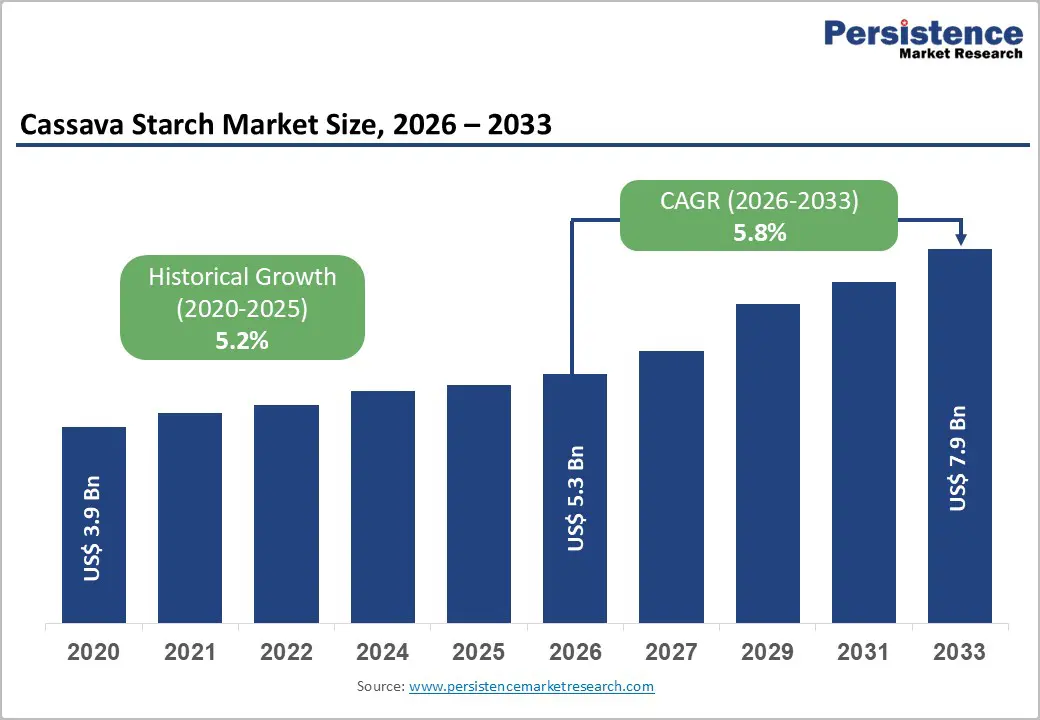
The global Cassava Starch market size is expected to be valued at US$ 5.3 billion in 2026 and projected to reach US$ 7.9 billion by 2033, growing at a CAGR of 5.8% between 2026 and 2033.
The market expansion is primarily driven by the escalating demand for gluten-free and clean-label ingredients across the global food processing industry. As a versatile carbohydrate source with superior thickening and stabilizing properties, cassava starch has become an indispensable raw material in both food and industrial sectors. The market's upward trajectory is further supported by the rising utilization of starch derivatives in sustainable packaging and the transition toward plant-based additives in pharmaceuticals, ensuring robust demand in both developed and emerging economies.
Key Industry Highlights:
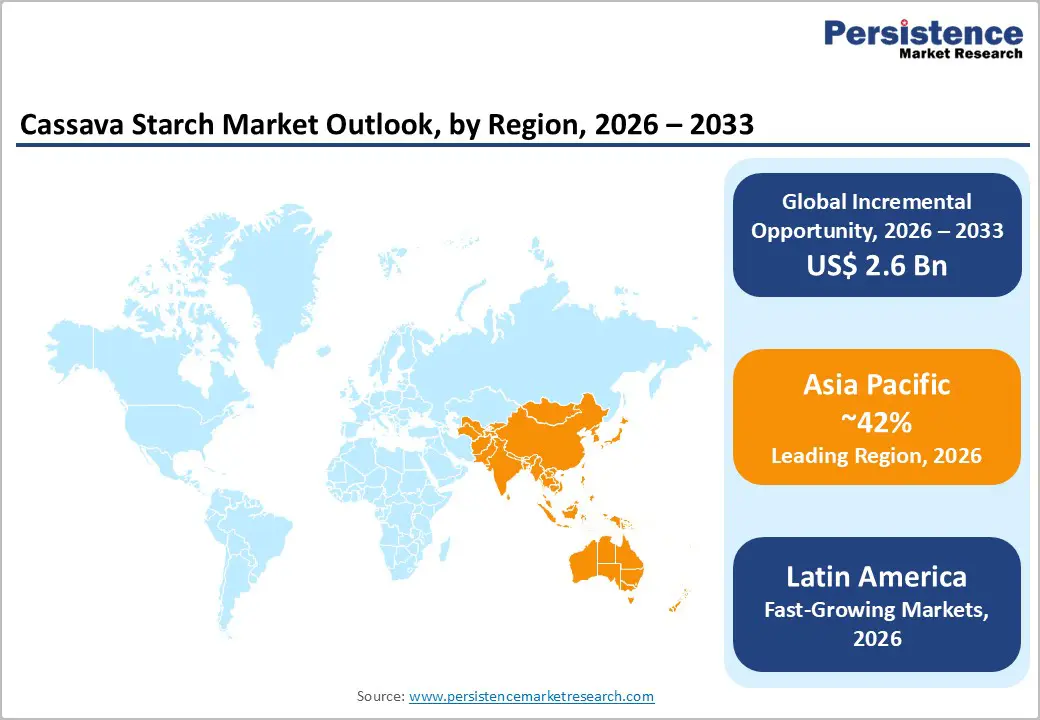
- Leading Region: Asia Pacific, holding 42% share, driven by large-scale production in Thailand, Vietnam, and Indonesia, strong export infrastructure, and rising industrial demand from food, textile, and paper sectors.
- Fastest-Growing Region: Latin America, fueled by expanding processing capabilities, government support for bio-based industries, rising domestic consumption, and increasing focus on organic and export-oriented production.
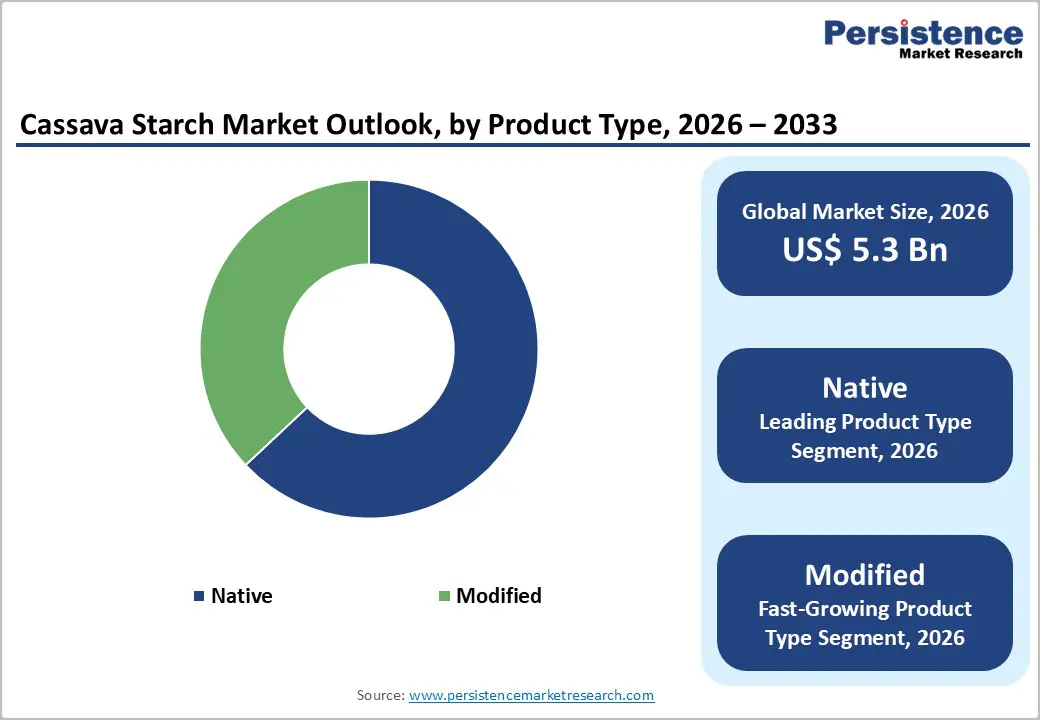
- Dominant Product Type Segment: Native Cassava Starch, accounting for 63% share, supported by its natural composition, clean-label appeal, and wide applicability across food, textile, and industrial applications.
- Leading End Use Segment: Food and Beverage, holding 43% market share, driven by growing demand for processed, convenience, gluten-free, and functional food products.
- Market Drivers: Increasing use of cassava starch in the textile industry for warp sizing, printing, and finishing, supported by global textile sector expansion and demand for efficient starch solutions.
- Opportunities: Rising demand for processed and convenience foods, with cassava starch gaining traction as a clean-label, gluten-free, and functional ingredient in ready-to-eat and health-focused formulations.
- Key Developments: In November 2025, Laos exported 1,000 tons of cassava starch to China via the China–Laos Railway. In November 2025, Dei Biopharma announced a $50 million cassava starch plant to strengthen regional production capacity.
| Key Insights | Details |
|---|---|
|
Global Cassava Starch Market Size (2026E) |
US$ 5.3 Bn |
|
Market Value Forecast (2033F) |
US$ 7.9 Bn |
|
Projected Growth (CAGR 2026 to 2033) |
5.8% |
|
Historical Market Growth (CAGR 2020 to 2025) |
5.2% |
Market Dynamics
Driver - Growing Use of Cassava starch in the Textile Industry
Starches are used for different operations in the textile industry like warp sizing, cloth finishing, and printing. Cassava starch is one of the prominent ingredients utilized for the warp sizing application. The textile industry is witnessing significant growth, owing to its offering of customized solutions across the world. Textile applications including warp sizing and cloth finishing, are required to further provide viable textile solutions to consumers.
Textile manufacturers are also considering the use of an effective starch solution such as cassava starch, in varied textile operations. Furthermore, cassava starch is also utilized for cloth printing and placing a certain design on the smooth surface of fabric. Since the textile industry is continuously achieving growth in the global market, and demanding a viable starch solution, the demand for cassava starch is also estimated to increase.
Restraints - Volatility in Raw Material Supply and Climatic Disruptions
A significant barrier to the steady growth is the unpredictability of cassava root supply. Cassava cultivation is predominantly carried out by smallholder farmers in tropical regions, making the supply chain highly susceptible to erratic weather patterns and pest infestations, such as cassava mosaic disease. As per multiple government reports, extreme droughts or excessive rainfall in major producing nations like Thailand and Nigeria often lead to sudden harvest shortfalls. This supply instability causes significant price fluctuations for the raw tubers, which directly impacts the profit margins of starch refiners. Such volatility complicates long-term contract pricing for industrial end-users, potentially forcing them to seek more stable, though perhaps less functional, starch alternatives like corn or potato starch.
Opportunity - Expansion into Processed and Convenience Foods
Modern lifestyles have resulted in an increasing preference for quick, ready-to-eat, and easy-to-prepare food options. Cassava starch, known for its versatility and neutral flavor profile, plays a vital role in this segment by serving as a thickener, stabilizer, and texture enhancer in several food products. Its high amylopectin content gives processed foods a desirable texture and shelf stability, meeting the quality expectations of consumers and manufacturers alike.
The global trend toward gluten-free and allergen-free diets has boosted the use of cassava starch as a substitute for wheat-based products. With the clean-label movement gaining momentum, cassava starch’s identity as a minimally processed, plant-based ingredient aligns well with the demand for transparency and natural food products.
Cassava starch has found applications in creating healthy food formulations, such as low-fat or low-calorie products. Its resistant starch component, which supports gut health and aids in weight management, further amplifies its appeal in health-conscious markets.
Category-wise Analysis
Product Type Insights
The native cassava starch segment emerges as a leading type in the global cassava starch market with a share of 63% in 2025 owing to its natural, unmodified properties and broad applicability across various industries. Growth in the industry is driven by its versatility and increasing demand for clean-label ingredients.
Rising consumer preference for natural, minimally processed foods is one of the primary factors contributing to the growth of native cassava starch. As demand for gluten-free, allergen-free, and clean-label products increases, native starch aligns with this trend owing to its simple composition and lack of additives. Its neutral flavor and excellent binding properties make it an ideal choice for manufacturers looking to enhance the texture and shelf life of their products without adding artificial ingredients.
Native cassava starch is gaining traction in industrial applications, such as in the production of paper, textiles, and bio-based materials. The growing emphasis on sustainability has pushed companies to seek renewable and eco-friendly materials, and native cassava starch, being a naturally occurring substance, aligns well with these goals.
End-user Insights
The food and beverage sector stands out as the leading application in the cassava starch market with a market share of 43% in 2025 due to increasing demand for processed, convenient, and health-conscious food products. There is increasing interest in functional foods that offer additional health benefits.
Cassava starch contains resistant starch a form of fibre known for its digestive health benefits, which has made it popular in low-carb and weight management foods. The shift towards healthy eating patterns, including the consumption of plant-based and organic foods, is expected to boost cassava starch’s role in food formulations. Its role is especially crucial in applications like beverages, snacks, and sauces.
The rise in processed and convenience foods, further bolsters the use of cassava starch. Its ability to improve the texture, viscosity, and shelf stability of packaged food products make it a key ingredient in ready-to-eat meals, soups, and sauces.
Region-wise Insights
Asia Pacific Cassava Starch Market Trends and Insights
Asia Pacific currently holds the leading market share of 42% in 2025, deeply rooted in the massive production capacities of Thailand, Vietnam, and Indonesia. Thailand remains the global benchmark for starch quality and export volume, supported by a highly sophisticated processing infrastructure and the Thai Tapioca Starch Association. The region benefits from significant manufacturing advantages, including a favorable tropical climate for year-round harvesting and established trade corridors to China and Japan.
The innovation ecosystem in this region is focused on high-efficiency extraction and the expansion of the Modified starch sector. In China, the rapid growth of the textile and paper industries has created a massive requirement for industrial-grade starch. Furthermore, the rising popularity of bubble tea globally has boosted the regional demand for cassava pearls, a high-value derivative. The presence of specialized firms like Asia Fructose Co., Ltd. and Sanstar Bio-Polymers Ltd. ensures that the region remains the primary engine for global market supply, while also serving as a major consumption hub for the processed food industry.
Latin America Cassava Starch Market Trends and Insights
Latin America is identified as the fastest growing region for the cassava starch market through 2033. The market leadership in Brazil is underpinned by a long history of cassava cultivation and a rising domestic demand for starch-based snacks and traditional staples like pão de queijo. The region is witnessing a transition from traditional manual processing to large-scale automated refineries, significantly improving yields and quality standards.
The growth dynamics in the region are supported by favorable trade agreements and an increasing focus on the Organic segment for the export market. Government initiatives in Colombia and Paraguay are promoting cassava as a sustainable alternative to corn, providing incentives for the production of bio-adhesives and bio-plastics. The regional innovation ecosystem is also exploring the use of cassava starch in animal nutrition to reduce reliance on imported grains. As Latin America improves its processing efficiencies and logistical links to the North American market, it is poised to become a formidable competitor to the traditional Asian supply hubs.
Competitive Landscape
The cassava starch market demonstrates a moderately consolidated structure, dominated by a mix of global conglomerates and strong regional processors. Leading players are expanding their portfolios by introducing value-added offerings such as modified starch, resistant starch, and bio-based derivatives to address evolving industrial needs. Companies are increasingly focusing on developing customized starch solutions with specific functional properties, including controlled viscosity and application-specific performance across food, pharmaceutical, and industrial sectors. At the same time, manufacturers are optimizing production processes to improve efficiency and reduce operational costs, while strengthening supply chains to secure stable raw material sourcing. Sustainability is becoming a strategic priority, with companies adopting environmentally responsible practices such as recycling cassava by-products into animal feed or utilizing waste for biogas generation, enhancing both cost efficiency and environmental performance.
Key Developments:
- In November 2025, a milestone shipment saw 1,000 tons of cassava starch exported from Laos to China via the China–Laos Railway, marking the first full train consignment from Vientiane South Station.
- In November 2025, Dei Biopharma unveiled a $50 million cassava starch plant, signaling rising investment in local value addition and strengthening Africa’s position in the global starch supply chain.
- In June 2025, SMS Corporation Co., Ltd. participated in the Global Cassava Sustainability Forum 2025, where Poonphol Group delivered a keynote on future opportunities and trends in the cassava starch industry.
Companies Covered in Cassava Starch Market
- Tate & Lyle
- Ingredion
- Cargill, Incorporated
- AGRANA Beteiligungs-AG
- Sanstar Bio-Polymers Ltd.
- Vaighai Agro Products Ltd.
- Ekta International
- Asia Fructose Co., Ltd.
- Cassava Inc.
- StarCo
- Others
Frequently Asked Questions
The global Cassava Starch market is projected to be valued at US$ 5.3 Bn in 2026.
Growing Use of Cassava starch in the Textile Industry is a major factor driving the global Cassava Starch market.
The Global Cassava Starch market is poised to witness a CAGR of 5.8% between 2026 and 2033.
Expansion into processed and convenience foods is a significant opportunity in the Cassava Starch market.
Major players in the Global Cassava Starch market include Tate & Lyle, Ingredion, Cargill, Incorporated, AGRANA Beteiligungs-AG, and others.


