




- Medical Devices
- Biochemistry Analyzer Market
Biochemistry Analyzer Market Size, Share, and Growth Forecast, 2025 - 2032
Biochemistry Analyzer Market By Product Type (Semi-automated Biochemistry Analyzer, Others), Modality (Benchtop Biochemistry Analyzer, Others), Application (Clinical Diagnostics, Others), End-user (Hospitals, Others), and Regional Analysis from 2025 to 2032

Biochemistry Analyzer Market Size and Trends Analysis
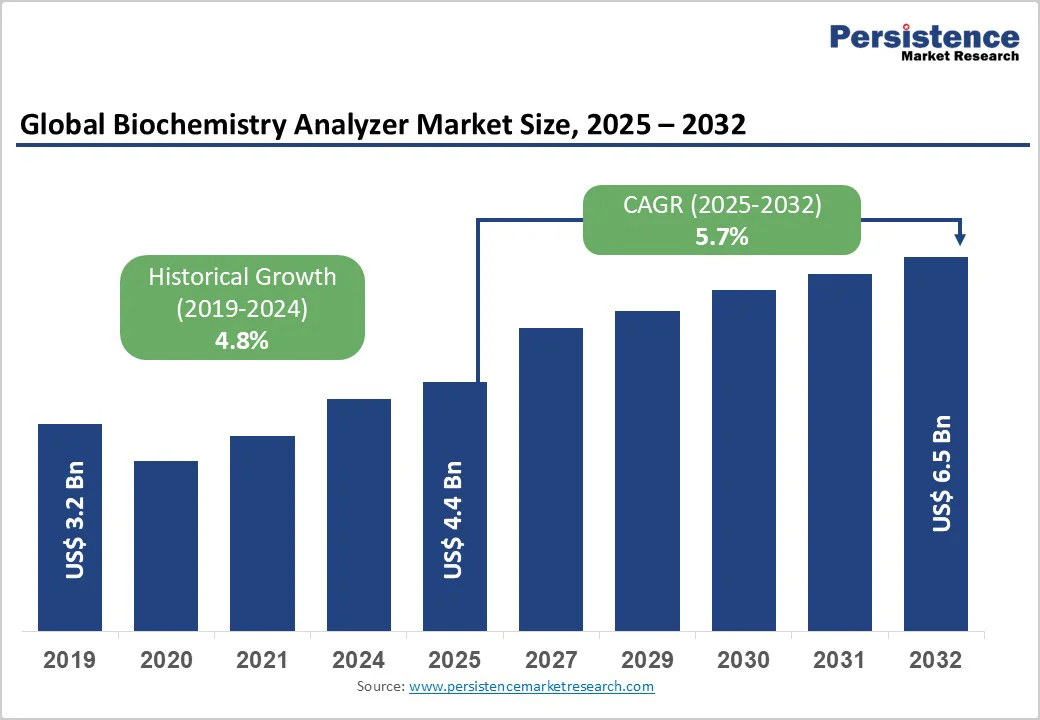
The global biochemistry analyzer market size is likely to be valued at US$4.4 Billion in 2025 and is expected to reach US$6.5 Billion by 2032, growing at a CAGR of 5.7% during the forecast period from 2025 to 2032, driven by the increasing demand for fast, accurate, and reliable diagnostic solutions to improve patient outcomes.
The rising prevalence of chronic diseases, metabolic disorders, and cancer is fueling demand for advanced analyzers with high-throughput and multi-parameter testing. Expansion of hospitals and diagnostic centers, coupled with innovations such as automated workflows, AI analytics, and integrated LIS, is enhancing lab efficiency. Growing awareness of early disease detection and preventive care further drives market growth.
Key Industry Highlights
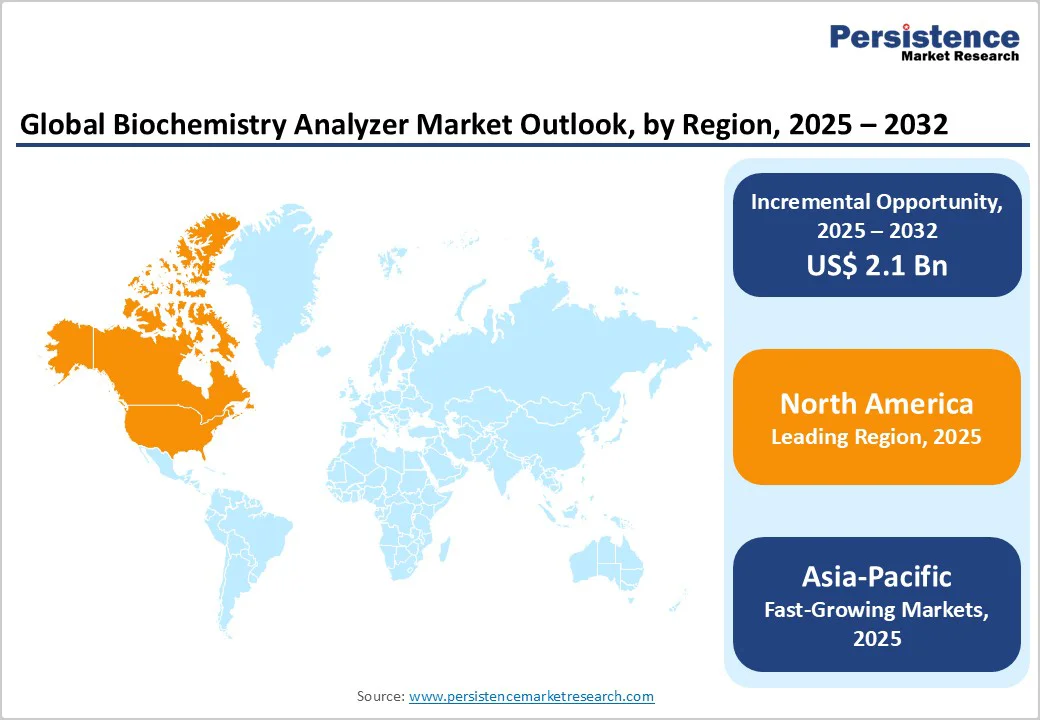
- Leading Region: North America dominates the market in 2025, with a revenue share of 38.8%, driven by the strong presence of key diagnostic manufacturers, advanced healthcare infrastructure, and growing adoption of automated laboratory systems.
- Fastest-Growing Region: Asia Pacific is expanding rapidly due to increasing healthcare expenditure, growing diagnostic testing demand, rising prevalence of chronic diseases, and government initiatives to strengthen laboratory infrastructure.
- Leading Modality Segment: The benchtop biochemistry analyzer segment leads the modality segment, driven by its high throughput capacity, accuracy, and suitability for medium to large laboratories requiring consistent sample processing.
- Fastest-Growing Modality Segment: Portable biochemistry analyzers are the fastest-growing segment, propelled by the increasing need for point-of-care testing, improved accessibility in rural settings, and the demand for rapid and reliable diagnostics in emergency care.
- Market Drivers: Rising incidence of metabolic and chronic diseases, growing demand for automated testing, and integration of artificial intelligence (AI) for efficient workflow and real-time data analysis are fueling market growth.
- Market Opportunity: Expanding adoption of point-of-care testing devices, integration with digital health platforms, and untapped potential in emerging economies offer significant opportunities for biochemistry analyzer manufacturers.
| Key Insights | Details |
|---|---|
| Biochemistry Analyzer Market Size (2025E) | US$4.4 Bn |
| Market Value Forecast (2032F) | US$6.5 Bn |
| Projected Growth (CAGR 2025 to 2032) | 5.7% |
| Historical Market Growth (CAGR 2019 to 2024) | 4.8% |
Market Factors - Growth, Barriers, and Opportunity Analysis
Shift Toward Fully Automated, High-Throughput Laboratories Enhancing Efficiency and Rising Chronic Disease Prevalence
The global shift toward laboratory automation is significantly propelling the adoption of advanced biochemistry analyzers. Fully automated, high-throughput systems enable rapid, accurate, and large-scale testing while minimizing human error and labor costs.
This is driven by the growing volume of diagnostic tests in hospitals and reference laboratories, necessitating faster turnaround times and improved efficiency. Automation supports integrated workflows by connecting chemistry, immunoassay, and hematology analyzers through centralized systems, enhancing productivity and data management.
The increasing global burden of chronic diseases such as diabetes, cardiovascular disorders, and kidney diseases is a major driver for the market. These conditions require continuous biochemical monitoring of parameters such as glucose, cholesterol, creatinine, and electrolytes for early diagnosis and treatment management.
For instance, in 2024, the International Diabetes Federation (IDF) reported that around 589 million adults aged 20-79 years were living with diabetes worldwide, a number projected to surge to 853 million by 2050. This escalating disease burden is significantly increasing the demand for routine glucose, lipid, and renal function tests, thereby driving the adoption of automated biochemistry analyzers in hospitals and diagnostic laboratories globally.
High Capital Cost of Advanced Analyzer Limiting Adoption and Regulatory and Reimbursement Variability across Countries
The high initial investment required for purchasing an advanced biochemistry analyzer acts as a major restraint for small and mid-sized diagnostic laboratories. Fully automated and high-throughput analyzers integrate multiple testing modules, robotics, and advanced software systems, which significantly increase procurement costs. Smaller laboratories, particularly in developing economies, struggle to upgrade to these systems due to limited capital budgets and lower patient volumes, which reduce the cost recovery potential.
The additional expenses associated with installation, regular maintenance, calibration, and consumables further increase operational costs. These financial barriers hinder the adoption of advanced analyzers in cost-sensitive healthcare environments, thereby slowing the overall market penetration in low-resource settings.
The market faces challenges due to differing regulatory frameworks and reimbursement policies across countries. Approval timelines, quality standards, and certification requirements vary significantly between regions, making market entry and expansion complex for manufacturers.
AI-Enabled Workflow Optimization and Integration with Laboratory Automation and LIS
The integration of artificial intelligence (AI) and automation in biochemistry analyzers presents a significant market opportunity. AI-enabled systems can optimize laboratory workflows by prioritizing samples, flagging abnormal results, and reducing human errors, leading to faster and more accurate diagnostics.
Predictive maintenance powered by AI monitors equipment performance in real time, anticipating faults and scheduling timely service, which minimizes downtime and extends analyzer lifespan. This not only improves operational efficiency but also reduces maintenance costs, making advanced analyzers more attractive to hospitals and diagnostic laboratories seeking reliable, high-throughput solutions.
For instance, in July 2024, Beckman Coulter Diagnostics launched the DxC 500i clinical analyzer, offering an integrated clinical chemistry and immunoassay solution. Its use of common reagents and consumables across a scalable portfolio enables commutable patient results, supports standardized workflows, and provides strategic benefits in patient care, inventory management, and the overall laboratory efficiency.
Category-wise Analysis
Product Insights
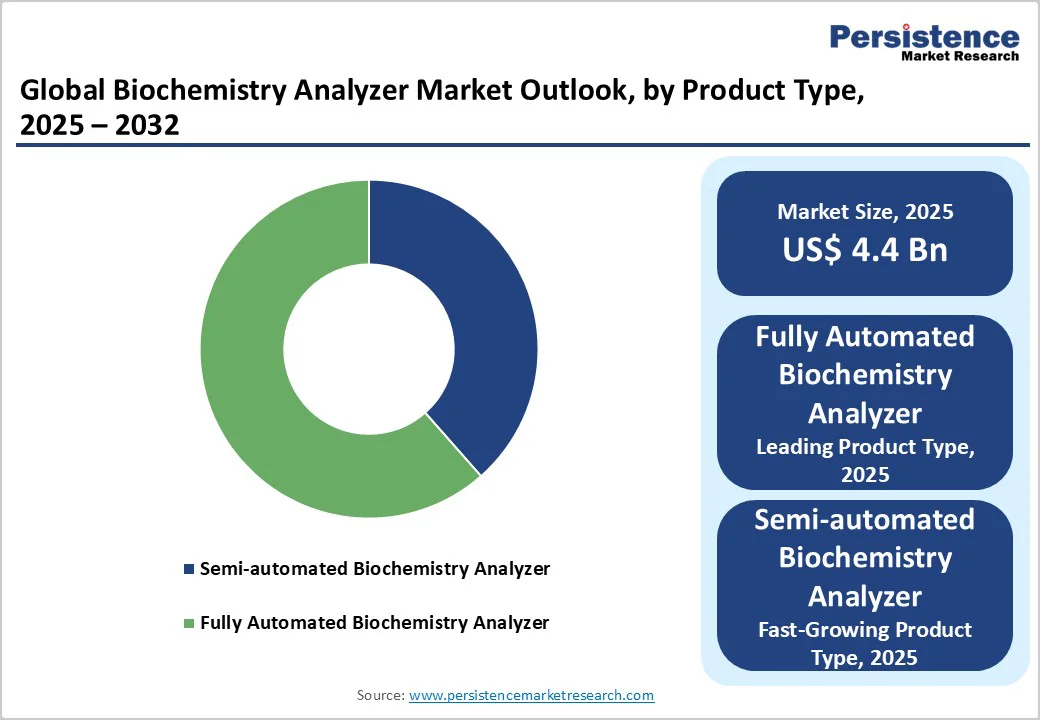
The fully automated biochemistry analyzer segment dominates the market in 2025, accounting for the revenue share of 61.5%. The strong performance of this segment is primarily driven by the growing demand for rapid, accurate, and high-throughput testing in hospitals, reference laboratories, and research centers, where efficiency and precision are critical. Fully automated systems minimize manual intervention, reduce human error, and improve reproducibility, making them essential for large-scale biochemical testing.
Furthermore, the integration of these analyzers with laboratory information systems (LIS) and automated sample handling workflows enhances operational efficiency, enables real-time data management, and supports consolidated diagnostic reporting. The increasing prevalence of chronic diseases, metabolic disorders, and cancer, which require frequent and complex biochemical testing, is also fueling adoption.
Modality Insights
The benchtop biochemistry analyzer segment dominates the market in 2025, with a revenue share of 56.7%, driven by its compact design, ease of use, and versatility, which make it highly suitable for small to mid-sized laboratories, specialty clinics, and point-of-care settings. These analyzers provide rapid, accurate testing with minimal sample volumes, enabling efficient monitoring of key biochemical parameters such as glucose, liver and kidney function, electrolytes, and lipid profiles.
Benchtop analyzers often feature automated sample handling and integrated quality control, allowing seamless data management and improved workflow efficiency. Their relatively lower cost, smaller footprint, and user-friendly interface make them attractive for facilities with limited space or budget constraints, while still delivering high-throughput capabilities.
Application Insights
The clinical diagnostics segment dominates the market in 2025, accounting for a revenue share of 61.1%. This dominance is primarily driven by the growing need for accurate, rapid, and high-throughput testing in hospitals, diagnostic laboratories, and outpatient care centers.
The increasing prevalence of chronic diseases such as diabetes, cardiovascular disorders, liver and kidney dysfunctions, and cancer has amplified the demand for routine biochemical testing, which forms the backbone of clinical diagnostics.
Biochemistry analyzers in clinical diagnostics are essential for early disease detection, monitoring treatment efficacy, and guiding therapeutic decisions, ensuring better patient outcomes. The growing focus on personalized medicine, preventive healthcare, and centralized laboratory networks is driving the need for sophisticated clinical diagnostic analyzers capable of multi-parameter testing.
Region-wise Insights
North America Biochemistry Analyzer Market Trends
North America leads globally with a revenue share of 38.8% in 2025, led by the U.S., due to the high prevalence of chronic diseases such as diabetes, cardiovascular disorders, and kidney diseases, which necessitate frequent biochemical testing. The region also benefits from advanced healthcare infrastructure, including state-of-the-art hospitals, diagnostic centers, and centralized laboratories that support high-throughput testing.
The rapid adoption of automated laboratory systems and integration with laboratory information systems (LIS) further enhances operational efficiency, reduces turnaround times, and ensures accurate results.
Strong reimbursement policies and favorable government regulations in the U.S. incentivize the adoption of advanced analyzers, making routine biochemical testing more accessible. Growing investments in research and diagnostics innovation continue to propel the demand for modern, automated biochemistry analyzers, thereby driving market growth in the North America region.
Europe Biochemistry Analyzer Market Trends
The Europe biochemistry analyzer market is expected to grow steadily, driven by the increasing prevalence of lifestyle-related and chronic diseases, such as diabetes, cardiovascular disorders, and obesity, which require regular biochemical monitoring.
Growth is further supported by the widespread adoption of automated and high-throughput laboratory systems, integration with laboratory information systems (LIS), and strong investments in healthcare infrastructure across Western Europe.
Government initiatives and favorable reimbursement frameworks in countries such as Germany, France, and the U.K. also encourage the use of advanced diagnostic technologies. Rising demand for personalized medicine, rapid diagnostics, and centralized laboratory networks is boosting market growth in the region.
Asia and Pacific Biochemistry Analyzer Market Trends
The Asia Pacific biochemistry analyzer market is projected to grow at the fastest CAGR from 2025 to 2032, fueled by the rapidly expanding healthcare infrastructure, increasing prevalence of chronic and lifestyle-related diseases, and rising awareness of early disease detection. For instance, according to the Press Information Bureau, in 2022, approximately 20 million new cancer cases were reported globally, with 9.7 million deaths attributed to the disease.
Cancer continues to be a significant public health challenge in India, where incidence rates are projected to rise sharply. Currently, about 100 people per 1 lakh population are diagnosed with cancer in the country. The Indian Council of Medical Research (ICMR) estimates that over 14 lakh new cancer cases occurred in India in 2023, highlighting the growing need for early detection and advanced diagnostic solutions.
This rising disease burden is driving demand for advanced biochemistry analyzers, enabling rapid, accurate, and high-throughput testing for cancer-related biomarkers, liver and kidney function, and metabolic profiles.
Growth is further supported by government initiatives to improve diagnostic accessibility, rising investments in modern laboratories, and the adoption of automated and high-throughput testing systems. Emerging economies such as India, China, and Southeast Asian countries are witnessing a surge in hospital and diagnostic center expansions, increasing demand for efficient and reliable biochemistry analyzers.
Competitive Landscape
The global biochemistry analyzer market is highly competitive, with major players such as F. Hoffmann-La Roche Ltd, Siemens Healthcare Private Limited, Beckman Coulter, Inc., Abbott, and Shenzhen Mindray Bio-Medical Electronics Co., Ltd. leading the industry through strong product portfolios, extensive distribution networks, and continuous technological innovations. These companies focus on high-throughput systems, automated workflows,
AI-enabled analytics and integrated Laboratory Information System (LIS) solutions to improve diagnostic accuracy, efficiency, and laboratory productivity. Strategic initiatives such as mergers & acquisitions, regional expansions, and collaborations with hospitals and research institutions further strengthen their market position and drive overall market growth.
Key Industry Developments:
- In July 2025, Diatron launched its new flagship clinical chemistry analyzer, the P780. The P780 is designed for mid to high-throughput laboratories, offering continuous photometric testing, an independent ISE (ion-selective electrode) arm, and a dual concentric reagent tray with cooled calibrator/control positions.
- In March 2025, YHLO launched the iBC 2000 Fully Automated Biochemistry Analyzer at the CACLP event in Hangzhou. The system delivers up to 3,200 tests/hour (T/H) per unit and 9,200 T/H when connected, offering high-throughput and precision testing.
- In April 2024, Mindray launched two stand-alone analyzers, CL-2600i and BS-1000M, along with two integrated systems, M680 and M980. These compact, high-performance solutions reflect Mindray’s commitment to advancing chemiluminescence immunoassay and clinical chemistry technologies, enabling laboratories to enhance productivity and optimize workflow efficiency.
Companies Covered in Biochemistry Analyzer Market
- F. Hoffmann-La Roche Ltd.
- Siemens Healthcare Private Limited
- Beckman Coulter, Inc.
- Abbott
- Mindray Medical India Pvt. Ltd.
- Hologic, Inc.
- Randox Laboratories Ltd.
- Awareness Technology, Inc.
- Transasia Bio-Medicals
- Nova Biomedical
- Kanad Vidyut
- Agappe Diagnostics Ltd.
- Microlab Instruments Private Limited
- Raj Biosis Pvt. Ltd.
- Zellen Biotech LLP
- Shenzhen YHLO Biotech Co., Ltd.
- Diatron
Frequently Asked Questions
The biochemistry analyzer market is projected to be valued at US$4.4 Billion in 2025.
Rising prevalence of chronic diseases, such as diabetes and cardiovascular disorders, and the growing adoption of automated, high-throughput laboratory systems for faster, accurate, and efficient diagnostics are driving the market growth.
The biochemistry analyzer market is poised to witness a CAGR of 5.7% between 2025 and 2032.
Government support and initiatives, along with rising investments and enhanced production capabilities, are creating significant growth opportunities in the market.
F. Hoffmann-La Roche Ltd, Siemens Healthcare Private Limited, Beckman Coulter, Inc., Abbott, Shenzhen Mindray Bio-Medical Electronics Co., Ltd. are some of the key players in the biochemistry analyzer market.


