




- Automotive Components & Materials
- Automotive Drive Shaft Market
Automotive Drive Shaft Market Size, Share, and Growth Forecast 2026 - 2033
Automotive Drive Shaft Market by Product Type (Hollow Drive Shafts, Solid Drive Shafts), Position (Front, Rear), Vehicle Type (Passenger Cars, Light Commercial Vehicles (LCVs), Heavy Commercial Vehicles (HCVs)), and Regional Analysis for 2026-2033

Automotive Drive Shaft Market Size and Trends Analysis
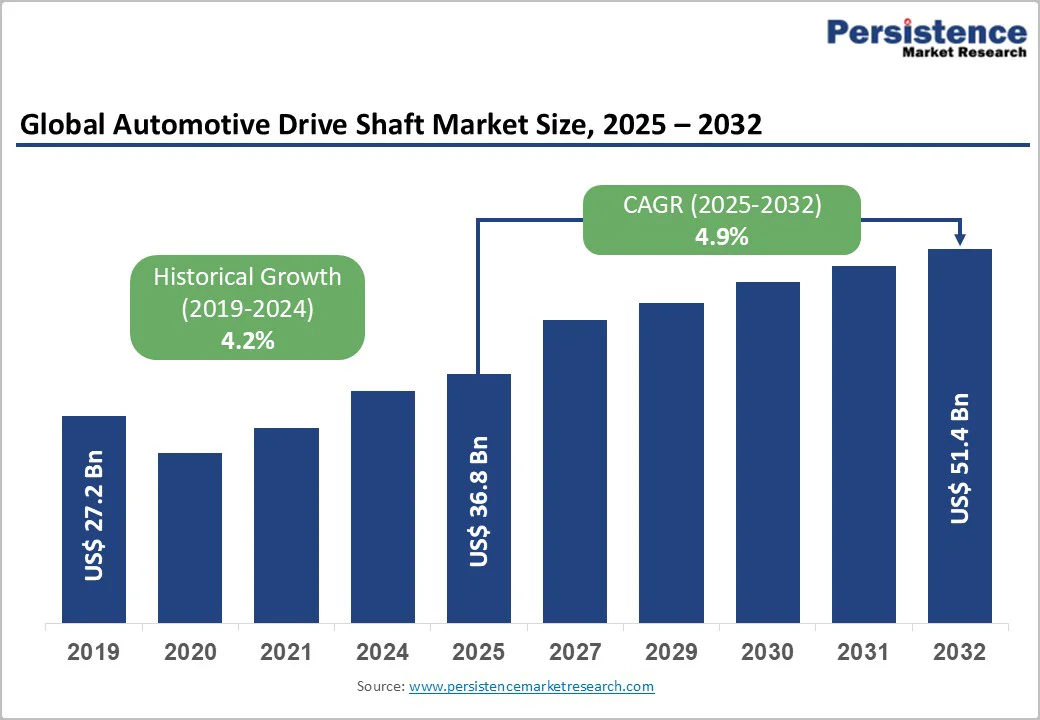
The global automotive drive shaft market is expected to be valued at US$ 38.7 billion in 2026 and is projected to reach US$ 54.8 billion, growing at a CAGR of 5.1% between 2026 and 2033. Rising global vehicle production continues to drive demand for drive shaft systems worldwide. Growing all-wheel-drive adoption across SUVs and crossovers further supports market growth. The International Organization of Motor Vehicle Manufacturers, known as OICA, reported global vehicle output surpassing 93 million units in a recent year. This figure spans passenger cars, light commercial vehicles, and heavy commercial vehicles across major manufacturing regions. Growing electric vehicle output is also creating demand for dedicated half-shafts and axle components, particularly in dual-motor and all-wheel-drive configurations, adding a new layer of component demand beyond conventional combustion platforms.
Key Industry Highlights
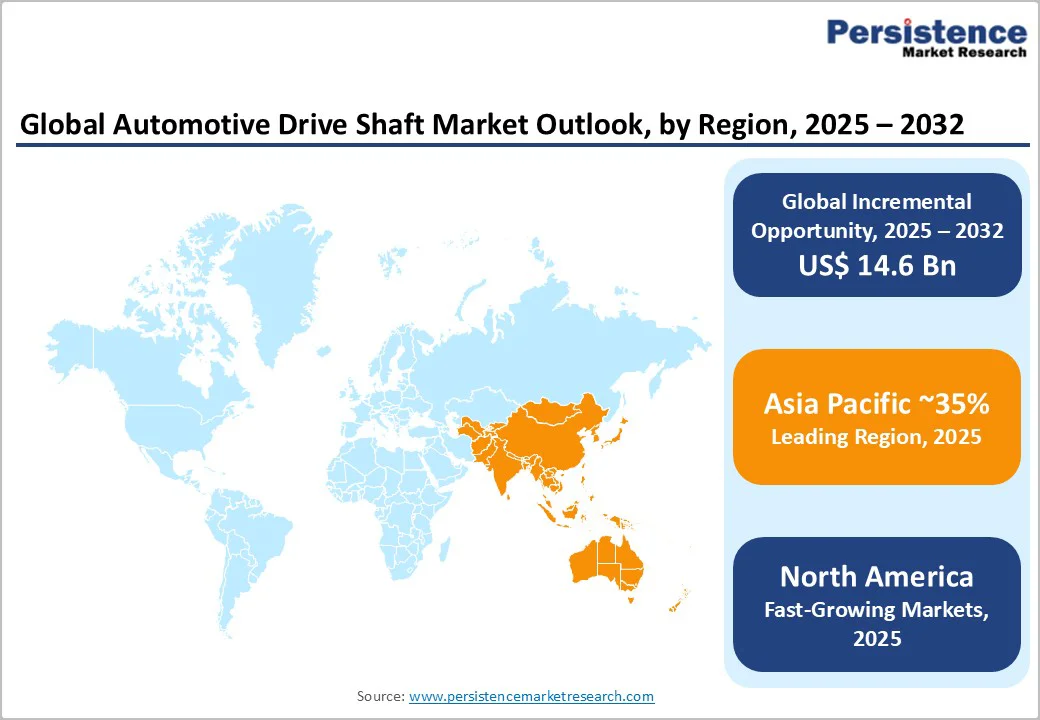
- Leading Region: Asia Pacific is likely to lead the automotive drive shaft market with an estimated 35% revenue share in 2026, supported by high vehicle production volumes across China, India, and Japan, along with rising demand for SUVs, crossovers, and light commercial vehicles.
- Fastest-growing Region: North America represents the fastest-growing regional market through 2033, driven by strong pickup truck and SUV demand, increasing all-wheel-drive adoption, and expanding electric and hybrid vehicle production.
- Leading Segment: Solid drive shafts are the leading product type segment, holding an estimated 62% share in 2026, supported by lower production costs, high torque-handling capability, and broad adoption across passenger and commercial vehicles.
- Fastest-growing Segment: Hollow drive shafts are the fastest-growing product type segment, projected to expand at an estimated 5.8% CAGR through 2033, driven by increasing vehicle lightweighting requirements, fuel-efficiency targets, and the need to improve electric vehicle energy efficiency and driving range.
- Key Market Opportunity: Rising dual-motor electric and hybrid all-wheel-drive adoption represents a key market opportunity, driven by the growing availability of AWD configurations that require dedicated half-shafts and related axle components for both front and rear drive units across SUV and crossover platforms.
Market Dynamics
Drivers - Rising Global Vehicle Production Sustaining Component Demand
Global vehicle output remains a major driver of demand for drive shaft systems across passenger and commercial vehicle segments. The International Organization of Motor Vehicle Manufacturers, known as OICA, reports global vehicle production surpassing 93 million units in a recent year. Passenger cars and light commercial vehicles account for a substantial portion of this volume. China, the U.S., Japan, and India rank among the largest vehicle-producing nations.
Vehicles using rear-wheel-drive or all-wheel-drive architectures generally require propeller shafts or related driveline components to transfer power between the powertrain and driven axles. Front-wheel-drive vehicles, by contrast, typically use shorter axle shafts rather than a conventional longitudinal propeller shaft. This links drive shaft and axle component demand closely with vehicle production volumes and drivetrain mix across major manufacturing hubs. Growing vehicle ownership across emerging economies adds further support as rising incomes increase demand for personal and commercial vehicles.
Growing SUV and All-Wheel-Drive Adoption Increasing Driveline Content Per Vehicle
Rising consumer preference for sport utility vehicles and crossovers is increasing average driveline content per vehicle. The International Energy Agency reports that SUVs accounted for more than 45% of global car sales in a recent year. This represents a significant increase from a decade earlier, when SUVs accounted for a substantially smaller share of new vehicle sales. Many SUVs and crossovers are offered with all-wheel-drive or four-wheel-drive configurations.
These configurations require additional driveline components compared with conventional two-wheel-drive layouts, including propeller shafts and axle shafts depending on the vehicle architecture. This shift toward multi-axle drive configurations can increase average component content and value per vehicle. Suppliers therefore benefit from the continued shift toward larger vehicles and higher drivetrain complexity, even during periods of moderate overall vehicle production growth.
Restraints - Simplified Electric Vehicle Driveline Architecture Reducing Propeller Shaft Demand
Many electric vehicles use single-motor, direct-drive architectures positioned directly at the front or rear axle. This configuration eliminates the long propeller shaft commonly used to transmit power from a front-mounted combustion engine to a rear driven axle. It also reduces the number and complexity of conventional driveline components required in single-motor configurations.
The International Energy Agency's Global EV Outlook reports electric vehicle sales surpassing 14 million units in a recent year. A substantial share of these vehicles uses simplified single-motor layouts, particularly across compact and mid-size segments where cost efficiency is a major consideration. Electric vehicle adoption continues to expand globally as emissions regulations tighten across major markets. This transition creates pressure on suppliers focused heavily on conventional propeller shaft systems, although growing demand for dual-motor and all-wheel-drive EVs provides an offsetting opportunity for half-shaft and axle-component suppliers.
Raw Material Price Volatility Pressuring Manufacturing Margins
Drive shaft manufacturing depends heavily on steel and, increasingly, aluminum for shafts and related components. Prices for these materials have experienced significant volatility in recent years. Energy costs, trade policy changes, supply disruptions, and fluctuations in raw material availability contribute to this instability.
Aluminum, increasingly used in lightweight shaft designs, carries additional exposure to energy-intensive smelting costs and global supply conditions. This is particularly relevant for manufacturers operating in regions dependent on imported raw materials. Material price volatility complicates long-term cost planning for component manufacturers operating under fixed- or negotiated-price supply contracts with automakers. Smaller suppliers with limited purchasing scale and hedging capabilities face greater margin pressure.
Opportunities - Rising Dual-Motor Electric and Hybrid All-Wheel-Drive Adoption
Growing consumer and regulatory demand for all-wheel-drive electric and hybrid vehicles is creating a distinct growth opportunity for drive shaft and axle-component suppliers. Unlike many single-motor electric vehicles, dual-motor architectures independently drive the front and rear axles. This configuration requires dedicated half-shafts and related axle components at both ends of the vehicle, increasing component content per vehicle.
The International Energy Agency's Global EV Outlook documents continued growth in global electric vehicle sales. An increasing number of new models now offer dual-motor, all-wheel-drive variants across SUV and crossover segments. Automakers frequently position dual-motor trims as premium configurations, supporting broader adoption across model lineups in North America, Europe, and China. This trend creates additional demand for high-strength, lightweight half-shafts and related driveline components.
Lightweight Composite and Aluminum Shaft Technology Adoption
More automakers are adopting lightweight composite and aluminum drive shaft technologies to meet tightening fuel-efficiency and emissions requirements. The European Union's CO2 emission performance standards for cars and vans continue to encourage vehicle lightweighting and drivetrain efficiency improvements. These requirements are influencing vehicle development across major production markets as manufacturers seek to reduce vehicle weight while maintaining performance and durability.
Carbon-fiber-reinforced polymer shafts can weigh substantially less than comparable steel components while providing high strength and torque-handling capability. Lower shaft weight supports vehicle efficiency and, in electric vehicles, can contribute to improved energy efficiency and driving range. Suppliers investing in composite manufacturing and advanced aluminum forging technologies are positioned to benefit from this shift toward lightweight driveline components.
Category-wise Analysis
Product Type Insights
Solid drive shafts represent the leading segment, holding an estimated 62% share of the automotive drive shaft market in 2026. Their straightforward manufacturing process and lower per-unit production cost support wide adoption across passenger cars and commercial vehicles. Solid shafts also provide high torque-handling capability without the additional engineering considerations associated with hollow designs, helping maintain competitive production costs. Lightweighting trends favor hollow designs in premium and electric vehicle segments, particularly where automakers pursue aggressive fuel-efficiency and weight-reduction targets. Solid-shaft designs remain a widely used option, supported by decades of manufacturing experience, established production processes, and reliable supply chains.
Hollow drive shafts are the fastest-growing product type segment, driven by increasing demand for vehicle lightweighting, improved fuel efficiency, and higher energy efficiency in electric and hybrid vehicles. Their lower weight compared with equivalent solid designs can reduce rotating mass and support overall vehicle efficiency. Adoption is particularly increasing across premium vehicles, performance applications, SUVs, and electric vehicle platforms, where manufacturers place greater emphasis on weight reduction without compromising torque-handling performance.
Position Insights
The front segment is projected to hold around 54% share of the market in 2026. Front-wheel-drive architecture remains widely used across global passenger car production, particularly in mass-market segments across Asia Pacific and Europe. Compact and mid-size vehicles account for a substantial share of unit sales in these regions. Front-wheel-drive vehicles typically use a pair of front axle half-shafts to transfer power from the transaxle to the driven wheels, supporting sustained demand for front-position shaft components across new-vehicle production. A large production base of front-wheel-drive passenger cars across China, India, and Europe further supports segmental growth.
Vehicle Type Insights
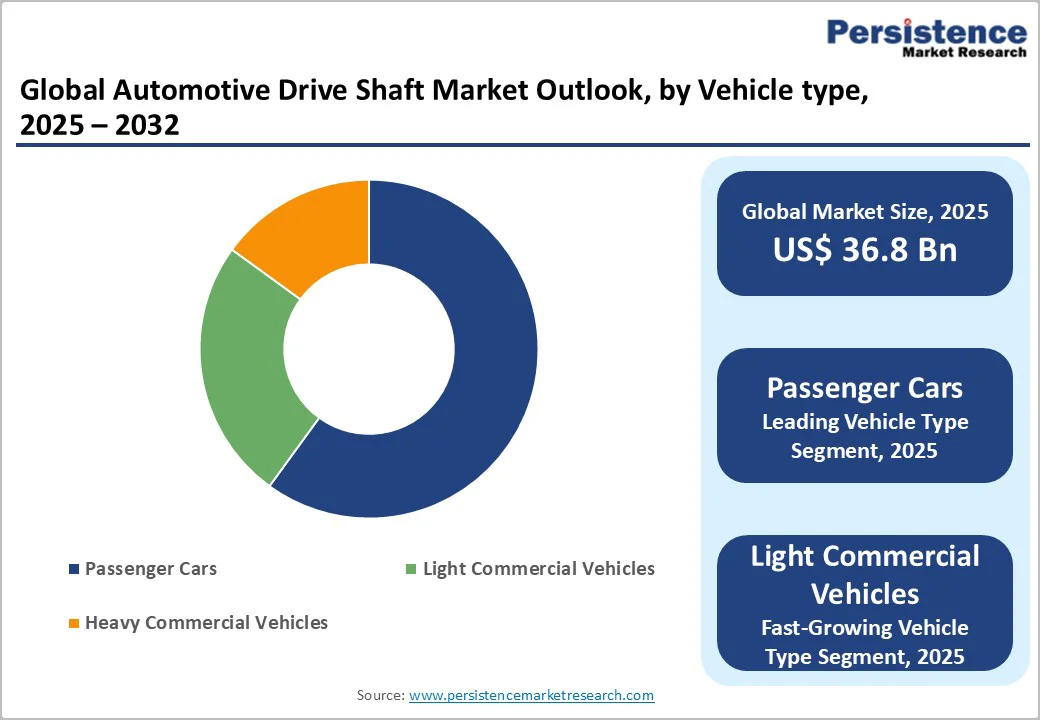
Passenger cars are the leading vehicle type segment, holding an estimated 58% share of the market in 2026. This reflects their position as the largest vehicle category by global production volume. The International Organization of Motor Vehicle Manufacturers tracks consistently high passenger vehicle production across major manufacturing economies. Rising personal vehicle ownership across Asia Pacific, particularly in India and Southeast Asia, adds further support to this segment's scale. Steady replacement demand across mature markets in North America and Europe, where the vehicle fleet continues to age, also supports passenger car component demand. Together, these factors sustain a broad, high-volume base for passenger car drive shaft and axle component demand across major automotive markets.
Regional Analysis
North America Automotive Drive Shaft Market Trends and Insights
North America is the fastest-growing market, supported by strong demand for pickup trucks and SUVs equipped with all-wheel-drive and four-wheel-drive systems. Continued vehicle production across the U.S. and Mexico sustains demand for drive shaft and axle components throughout the region's automotive manufacturing base. Growing electric vehicle output adds a new source of demand for specialized half-shafts and driveline components, particularly in dual-motor and all-wheel-drive configurations.
Expanding availability of dual-motor models from established automakers and newer entrants further supports market growth. Mexico's growing role as a regional vehicle assembly hub, supported by integrated North American supply chains and cross-border trade, adds further manufacturing capacity and component demand.
U.S. Automotive Drive Shaft Market Size
The U.S. automotive drive shaft market is estimated at US$ 7.9 billion in 2026. Strong domestic pickup truck and SUV production supports this substantial market. Rising electric vehicle production also supports demand for specialized axle and driveline components, particularly in multi-motor and all-wheel-drive configurations. Growing investment in domestic battery and electric drivetrain manufacturing adds further momentum. Federal clean-vehicle policies and incentives support continued investment in vehicle electrification, while the country's large and established light-truck and full-size SUV production base sustains demand for conventional and advanced driveline components.
Europe Automotive Drive Shaft Market Trends and Insights
Europe is expected to hold a substantial share of the global market in 2026, reflecting steady passenger vehicle production alongside tightening emissions requirements under the European Union's CO2 performance standards for cars and vans. Manufacturers across Germany, the U.K., and France continue investing in lightweight shaft technologies to improve vehicle efficiency and meet increasingly stringent emissions targets. This supports demand for lightweight driveline components across the region's mature automotive production base.
The European Union's transition toward zero-emission vehicles is also reshaping driveline design priorities. Growing electric and hybrid vehicle production across major manufacturing clusters is creating additional demand for specialized axle shafts, half-shafts, and other electrified driveline components beyond conventional replacement demand.
Germany Automotive Drive Shaft Market Size
Germany’s automotive drive shaft market is projected to be valued at US$ 2.6 billion in 2026, reflecting its position as one of Europe's largest vehicle manufacturing bases. The German Association of the Automotive Industry, known as VDA, reports sustained domestic production across premium and mass-market segments. This supports demand for both hollow and solid shaft components across the country's extensive automotive supplier network.
Germany's strong premium vehicle production base, which includes several globally recognized automakers, supports demand for precision-engineered and lightweight driveline components for high-performance and all-wheel-drive applications. Growing domestic electric and hybrid vehicle production adds further demand for specialized axle and driveline components.
U.K. Automotive Drive Shaft Market Size
The U.K.’s market is anticipated to be valued at US$ 1.5 billion in 2026, supported by domestic vehicle assembly and growing production of electrified SUVs and crossovers. The Society of Motor Manufacturers and Traders reports continued investment in electric vehicle production capacity across the country's major assembly plants. This supports demand for lightweight axle and driveline components, including parts used in dual-motor configurations.
Domestic automakers and international manufacturers operating in the U.K. are also expanding electrified SUV and crossover lineups. Government support for zero-emission vehicle production and battery manufacturing further supports investment across the country's automotive supply chain.
France Automotive Drive Shaft Market Size
France’s market is estimated at US$ 1.3 billion in 2026, driven by domestic passenger vehicle production and growing electric vehicle output across major assembly plants. Increasing electrified vehicle production supports demand for lightweight shaft and axle components across the country's automotive manufacturing base. Domestic automakers are expanding compact and mid-size electric vehicle lineups for both domestic and export markets. Continued investment in battery manufacturing and electric drivetrain production is also supporting the development of France's electrified automotive supply chain.
Asia Pacific Automotive Drive Shaft Market Trends and Insights
Asia Pacific is expected to maintain its leadership in the global automotive drive shaft market while holding around 35% share in 2026, supported by high vehicle production volumes across China, India, and Japan. The China Association of Automobile Manufacturers reports the world's largest annual vehicle production base by volume, spanning domestic and export-oriented production. China's rapid electric vehicle production growth is reshaping regional driveline demand, with both single-motor and dual-motor platforms creating demand for different combinations of axle and driveline components. Substantial investment in battery, electric motor, and drivetrain manufacturing is further changing component requirements. Rapid industrialization and expanding vehicle production across the wider Asia Pacific region add further support.
India Automotive Drive Shaft Market Size
India’s market is projected to be valued at US$ 2.7 billion in 2026, driven by rising domestic vehicle production tracked by the Society of Indian Automobile Manufacturers. Growing demand for compact SUVs and light commercial vehicles adds further support, while expanding road and highway infrastructure supports vehicle ownership and commercial transportation activity. India's Ministry of Road Transport and Highways continues to report growth in vehicle registrations. Rising incomes and expanding highway infrastructure across major states are supporting vehicle demand, while increasing domestic production capacity for passenger vehicles and light commercial vehicles further strengthens the market for driveline components.
Japan Automotive Drive Shaft Market Size
Japan’s automotive drive shaft market is expected to be valued at US$ 2.0 billion in 2026, owing to its mature but technically advanced vehicle manufacturing base. The Japan Automobile Manufacturers Association tracks domestic vehicle production alongside continued hybrid and electric vehicle development. This supports demand for precision-engineered drive shaft, axle, and other driveline components across the country's manufacturing facilities. Many of these plants supply both domestic and export markets across Asia, North America, and Europe.
Japan's long-standing strength in hybrid vehicle technology continues to support demand for specialized driveline components, particularly for complex hybrid powertrain architectures. Decades of manufacturing expertise and established automotive supplier networks further reinforce this position.
Southeast Asia Automotive Drive Shaft Market Size
Southeast Asia’s automotive drive shaft market is anticipate to be valued at US$ 1.6 billion in 2026, supported by growing vehicle assembly across Thailand, Indonesia, and Vietnam. Rising ASEAN-linked automotive investment and expanding regional export production are strengthening the area's manufacturing base. Increasing vehicle ownership among consumers transitioning from two-wheelers to passenger cars is also supporting demand, particularly in emerging markets such as Vietnam and the Philippines.
Thailand's established position as a major regional vehicle assembly and export hub continues to attract investment and support established supplier networks. Indonesia's expanding electric vehicle manufacturing ambitions add another source of demand for advanced axle and driveline components.
Competitive Landscape
The global automotive drive shaft market remains moderately consolidated. Established suppliers such as American Axle & Manufacturing, Dana Incorporated, GKN Automotive, and NTN Corporation hold a large, combined share. This spans major vehicle platforms worldwide. Numerous regional manufacturers also compete for aftermarket and lower-tier contracts. Growing capability in electric vehicle half-shaft design suited to higher torque loads matters too.
Automakers now demand parts engineered specifically for electric drivetrain needs, rather than parts adapted from combustion-vehicle designs. Leading suppliers continue investing in dedicated electric vehicle driveline production lines. Strategic automaker partnerships and expanded manufacturing footprints across fast-growing markets in Asia Pacific and North America add further momentum.
Key Industry Developments
- In January 2025, Dana Incorporated expanded its electric drive shaft and axle production capacity to meet rising demand from electric vehicle manufacturers.
- In June 2024, GKN Automotive launched a new lightweight side shaft technology designed to improve efficiency in electric vehicle drivetrains.
Global Automotive Drive Shaft Market - Key Insights & Details
| Key Insights | Details |
|---|---|
|
Historical Market Value (2020) |
US$ 29.7 billion |
|
Current Market Value (2026) |
US$ 38.7 billion |
|
Projected Market Value (2033) |
US$ 54.8 billion |
|
CAGR (2026-2033) |
5.1% |
|
Leading Region |
Asia Pacific, 35% share |
|
Dominant Category-1 |
Solid Drive Shafts |
|
Top-ranking Category-2 |
Front Position Drive Shafts |
|
Incremental Opportunity |
US$ 16.1 billion |
Companies Covered in Automotive Drive Shaft Market
- American Axle & Manufacturing
- Dana Incorporated
- GKN Automotive
- NTN Corporation
- JTEKT Corporation
- IFA Group
- Hyundai WIA Corporation
- Neapco Holdings
- ILJIN Global
- Hitachi Astemo
Frequently Asked Questions
The global automotive drive shaft market is expected to be valued at US$ 38.7 billion in 2026.
Rising global vehicle production drives the demand for drive shafts. Growing SUV and all-wheel-drive adoption further boosts demand, as these vehicles require more shaft content per unit than standard passenger cars.
Asia Pacific is likely to lead the global market with around 35% share in 2026, supported by increasing vehicle production across China, India, and Japan.
Rising dual-motor electric and hybrid all-wheel-drive adoption marks a major opportunity. These vehicles need dedicated front and rear half-shafts, unlike simpler single-motor electric vehicle designs.
Leading firms include American Axle & Manufacturing, Dana Incorporated, GKN Automotive, NTN Corporation, and JTEKT Corporation, along with other established regional manufacturers.


