




- Medical Devices
- Wound and Tissue Management Market
Wound and Tissue Management Market Size, Share, and Growth Forecast, 2026 - 2033
Wound and Tissue Management Market by Product Type (Wound Closure Devices, Static and Dynamic Compression Therapy, Others), Application (Acute Wounds, Chronic Wounds, Surgical Wounds), and Regional Analysis for 2026 - 2033

Wound and Tissue Management Market Size and Trends Analysis
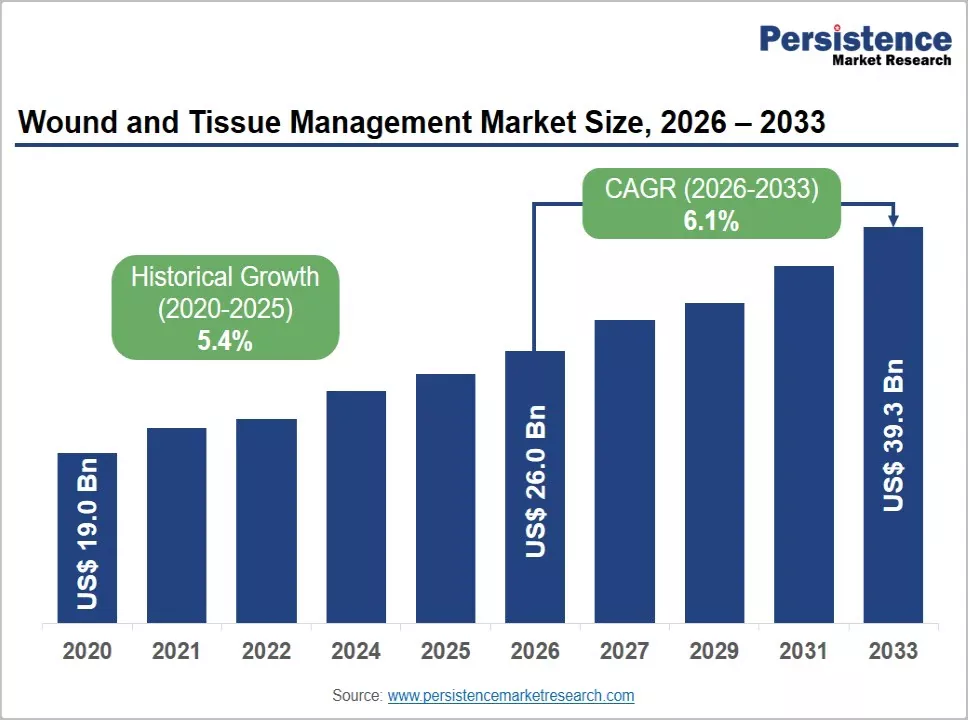
The global wound and tissue management market size is likely to be valued at US$ 26.0 billion in 2026 and is expected to reach US$ 39.3 billion by 2033, growing at a CAGR of 6.1% during the forecast period from 2026 to 2033, as healthcare providers prioritize effective wound healing, infection prevention, and improved patient outcomes.
Rising diabetes prevalence, population aging, increasing surgical procedures, and the growing burden of chronic wounds are supporting demand for advanced dressings, wound closure devices, tissue sealants, and negative pressure wound therapy. In 2025, the World Health Organization issued updated guidance on surgical site infection prevention, reinforcing the importance of evidence-based practices to reduce postoperative complications.
Key Industry Highlights:
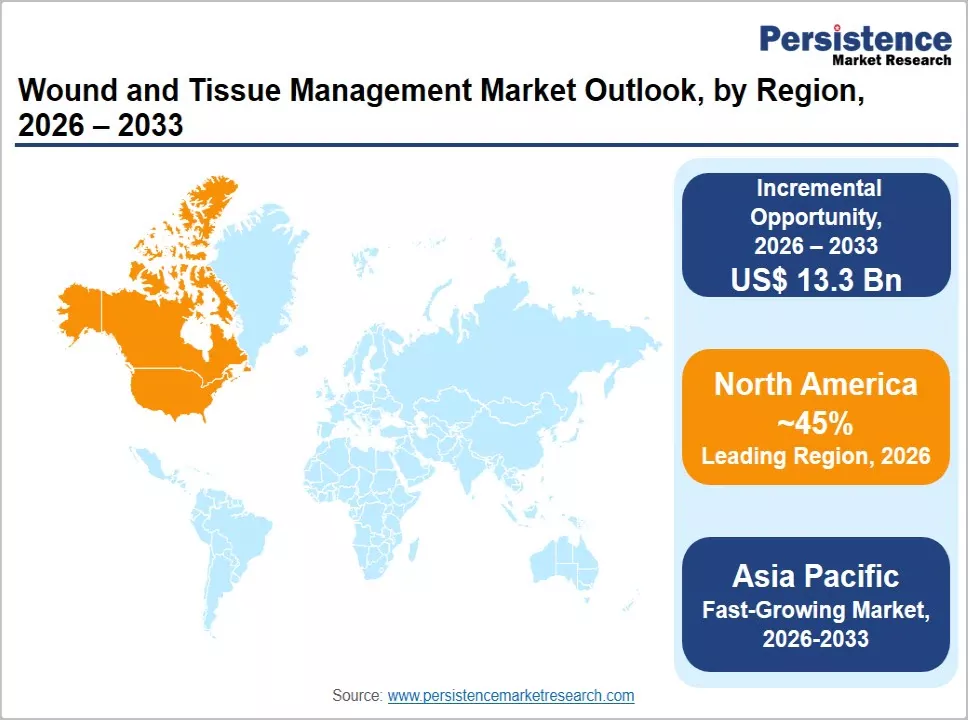
- Leading Region: North America is anticipated to lead the global market, accounting for 45% share in 2026, driven by advanced healthcare infrastructure, high adoption of advanced wound care therapies, and a strong presence of established manufacturers.
- Fastest-growing Region: Asia Pacific is likely to be the fastest-growing market, supported by rising chronic wound cases, expanding healthcare access, and increasing demand for advanced wound management solutions.
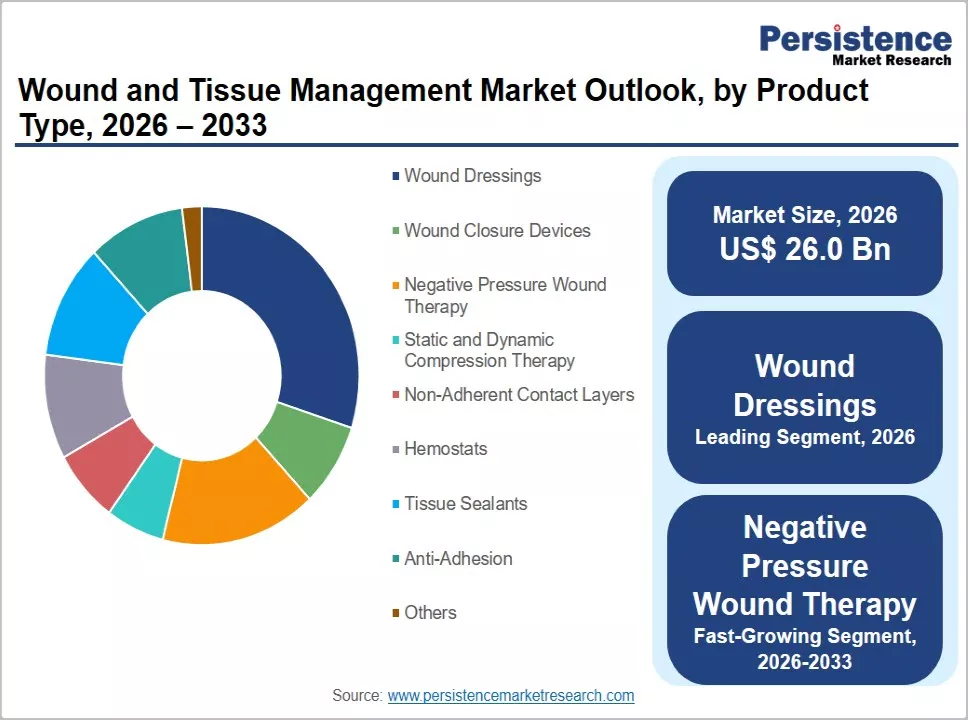
- Leading Product Type: Wound dressings represent the leading product type segment, accounting for 40% of the market share in 2026, owing to their recurring use across acute and chronic wounds and increasing demand for advanced dressing materials.
- Leading Application: Acute wounds are anticipated to be the leading application, accounting for around 40% of the revenue share in 2026, supported by high treatment volumes across emergency care, trauma management, and routine wound care.
- Key Opportunity: The key market opportunity lies in developing advanced wound care solutions that integrate regenerative therapies, smart dressings, and portable negative pressure wound therapy to improve healing outcomes and expand access to chronic, acute, and surgical wound management across hospitals and home healthcare settings.
Market Dynamics
Driver - Increasing Surgical Procedure Volumes and Trauma Incidence
Surgical interventions require reliable wound closure devices, hemostats, tissue sealants, and dressings to support healing and minimize complications. Road traffic accidents, workplace injuries, burns, and sports-related trauma further increase the need for effective wound treatment. As healthcare providers perform more complex procedures, demand for products that control bleeding, protect injured tissues, and facilitate wound closure continues to expand.
These clinical requirements support adoption across acute and surgical wound management applications. The growing emphasis on postoperative recovery and infection prevention further strengthens this market driver. Healthcare facilities increasingly prioritize wound management protocols that reduce surgical site complications and support timely healing.
Advanced dressings, negative pressure wound therapy, and specialized closure technologies are being incorporated into treatment pathways for selected patients with complex wounds. Rising surgical activity also creates recurring demand for consumable products used during procedures and follow-up care. The expansion of outpatient surgery increases the need for convenient wound care solutions that support recovery beyond hospitals.
Restraint - Workforce and Training Gaps in Specialized Wound Care
Complex wounds, including diabetic foot ulcers, venous leg ulcers, and pressure injuries, often require detailed assessment, appropriate product selection, and continuous monitoring. However, healthcare facilities often lack sufficient wound care specialists, particularly in rural communities and resource-constrained settings. Inadequate familiarity with advanced dressings, compression therapy, and negative pressure wound therapy can lead to inconsistent treatment practices. These limitations can delay technology adoption, reduce treatment efficiency, and restrict access to specialized wound management services, particularly among patients requiring prolonged or multidisciplinary care.
Training gaps also create implementation challenges for manufacturers introducing innovative wound management technologies. Healthcare professionals require practical education to select suitable dressings, apply compression systems correctly, manage negative pressure devices, and recognize complications. Without adequate training, facilities face inconsistent product utilization, avoidable treatment errors, and increased resource requirements.
Opportunity - Convergence of Biologics, Smart Materials, and Regenerative Approaches
The convergence of biologics, smart materials, and regenerative technologies creates opportunities for differentiated wound and tissue management solutions. Advanced biomaterials, antimicrobial dressings, bioactive matrices, and tissue-engineered products are being developed to support healing in complex wounds. These approaches help maintain favorable wound conditions, manage exudate, and support tissue regeneration when appropriately designed for specific clinical needs.
Manufacturers can differentiate their portfolios by combining established dressing technologies with bioactive components and materials that respond to changes in the wound environment. Demand from patients with chronic ulcers, difficult-to-heal surgical wounds, and extensive tissue injuries creates potential applications for these innovations. Smart wound dressings and regenerative technologies also offer opportunities to improve monitoring and personalize treatment.
Sensor-enabled products provide information about wound conditions, while advanced materials help clinicians assess healing progress and identify potential complications. Combining digital monitoring with specialized dressings and biologic therapies supports more informed treatment decisions and reduces unnecessary dressing changes in suitable settings. Clinical validation, regulatory approval, manufacturing scalability, and reimbursement remain important considerations.
Category-wise Analysis
Product Type Insights
Wound dressings represent the leading product type segment, accounting for 40% of the market share in 2026, owing to their extensive use in acute, chronic, and surgical wound care. Their ability to protect injured tissues, absorb wound exudate, maintain moisture balance, and support infection prevention sustains demand across hospitals, clinics, and home healthcare settings. Product innovation in foam, hydrocolloid, alginate, silicone, and antimicrobial dressings strengthens adoption. For example, Smith+Nephew offers advanced wound dressings, including its ALLEVYN range of foam dressings.
Negative pressure wound therapy is likely to represent the fastest-growing segment, supported by increasing adoption of advanced wound management technologies and portable treatment systems. The therapy applies controlled negative pressure to selected wounds, helping manage exudate and supporting the healing process. Its applications include complex wounds, diabetic foot ulcers, and selected surgical incisions. Growing interest in outpatient treatment and home-based care is encouraging demand for compact, user-friendly systems. For instance, Solventum offers the V.A.C. Therapy System portfolio for negative pressure wound management.
Application Insights
Acute wounds are projected to lead the market, capturing around 40% of the revenue share in 2026, supported by their high treatment volumes across emergency departments, trauma centers, and surgical facilities. These wounds commonly result from accidents, burns, cuts, and medical procedures, requiring timely cleaning, closure, protection, and healing support. Wound dressings, closure devices, hemostats, and tissue sealants are widely used to manage these injuries. Demand is reinforced by the need to control bleeding, reduce contamination risks, and protect damaged tissue during recovery.
Chronic wounds are likely to be the fastest-growing application due to increasing diabetes prevalence, population aging, and the growing burden of diabetic foot ulcers, venous leg ulcers, and pressure injuries. These wounds often require prolonged treatment, repeated dressing changes, ongoing monitoring, and multidisciplinary care. Healthcare providers increasingly use advanced dressings, compression therapy, and negative pressure wound therapy, where clinically appropriate, to support healing.
Regional Analysis
North America Wound and Tissue Management Market Trends
North America is anticipated to lead the global market by holding the largest share of 45% in 2026, supported by advanced healthcare infrastructure, established reimbursement systems, rising chronic wound prevalence, and strong adoption of advanced wound care technologies. Hospitals and specialized wound centers increasingly use antimicrobial dressings, compression therapy, wound closure devices, and negative pressure wound therapy to improve patient outcomes. Demand is also supported by an aging population and the burden of diabetes-related ulcers.
U.S. Wound and Tissue Management Market Trends
The U.S. is expected to dominate the North American market, accounting for around 80% of the regional market revenue in 2026, driven by its advanced hospital network, established wound care clinics, and adoption of specialized treatment technologies. Hospitals increasingly emphasize infection prevention, wound monitoring, and effective recovery protocols. Demand is supported by diabetes-related ulcers, pressure injuries, trauma, and surgical wounds. Advanced dressings and negative pressure wound therapy remain important treatment options.
Canada Wound and Tissue Management Market Trends
Canada is likely to remain a significant market for wound and tissue management, accounting for 20% of the regional market share in 2026. The Canadian market benefits from public healthcare infrastructure, chronic disease management programs, and increasing attention to diabetic foot complications. Diabetes-related circulation problems and nerve damage increase the risk of foot ulcers and delayed healing. Healthcare providers require suitable dressings, compression products, and specialized wound management solutions.
Europe Wound and Tissue Management Market Trends
Europe is projected to hold a significant share of the global market in 2026, driven by strong infection prevention practices and demand for advanced dressing technologies. Aging populations and the growing burden of diabetes-related ulcers and pressure injuries are encouraging healthcare providers to adopt specialized treatment products. Regulatory requirements and clinical evidence influence product selection across the region. Manufacturers are investing in foam dressings, antimicrobial materials, compression therapy, and solutions designed for community-based care.
U.K. Wound and Tissue Management Market Trends
The U.K. is anticipated to hold a 15% share of the European market in 2026. Demand is supported by the National Health Service, community nursing, and a growing emphasis on managing chronic wounds outside hospitals. NHS England describes specialist tissue viability services as providing assessment, treatment, education, and prevention for complex and chronic wounds. These services cover conditions such as pressure ulcers, leg ulcers, and diabetic foot ulcers.
Germany Wound and Tissue Management Market Trends
Germany is anticipated to lead the European market, accounting for around 37% of Europe's market share in 2026, supported by its established hospital network, medical technology industry, and structured healthcare reimbursement system. Chronic wounds associated with diabetes, vascular disease, and aging create continuing demand for specialized treatment. Hospitals and outpatient providers use wound dressings, compression therapy, and tissue management products according to clinical requirements.
Asia Pacific Wound and Tissue Management Market Trends
Asia Pacific is likely to be the fastest-growing market during the forecast period. Its large patient population, expanding hospital infrastructure, rising chronic disease prevalence, and improving access to specialized healthcare are supporting market growth. Growing surgical activity and increasing awareness of infection prevention are further strengthening demand for wound dressings, closure devices, compression therapy, and negative pressure wound therapy.
China Wound and Tissue Management Market Trends
China is projected to lead the Asia Pacific market, holding around 30% of the regional market share in 2026, supported by its extensive healthcare system, aging population, and substantial burden of diabetes-related complications. Hospital modernization and expanding access to medical technologies are supporting demand for advanced dressings and specialized wound treatment products. Domestic manufacturers are positioned to compete through localized production and cost-effective product portfolios.
India Wound and Tissue Management Market Trends
India is expected to emerge as a significant market, driven by its large patient population, increasing diabetes burden, expanding hospital capacity, and rising awareness of advanced wound care. Public and private hospitals require wound dressings, closure devices, hemostats, and infection management products for surgical and traumatic injuries. Demand is also supported by the growth of specialty hospitals and outpatient services
Competitive Landscape
The global wound and tissue management market exhibits a moderately fragmented structure, driven by the presence of established medical technology companies, specialized wound care manufacturers, and providers of advanced healing solutions. Competition is shaped by demand for advanced dressings, wound closure devices, compression therapy, tissue sealants, and negative pressure wound therapy.
With key leaders including Smith+Nephew, Mölnlycke Health Care, Solventum, ConvaTec, Coloplast A/S, B. Braun, and HARTMANN Group, the market features both multinational innovators and specialized regional suppliers. These players compete through product innovation, clinical evidence, portfolio expansion, strategic acquisitions, and broader distribution networks.
Key Industry Developments:
- In May 2026, Smith+Nephew announced the launch of ALLEVYN COMPLETE CARE Foam Dressing and RENASYS EDGE Negative Pressure Wound Therapy System at the EWMA 2026 conference, introducing innovations designed to improve chronic wound management, support pressure injury prevention, simplify treatment, and enable patient self-care.
- In August 2026, BioLab Holdings announced a strategic partnership with mimiX AWC to add FastSkin® Patch autologous wound care technology to its tissue restoration portfolio.
Companies Covered in Wound and Tissue Management Market
- Smith & Nephew
- Molnlycke Health Care
- 3M Health Care
- ConvaTec
- Coloplast A/S
- BSN Medical
- Hartmann Group
- B.Braun
- Acelity
- Laboratories Urgo
- Medline Industries Inc.
- Hollister
- Medtronic
- Lohmann& Rauscher
Frequently Asked Questions
The wound and tissue management market is projected to be valued US$ 26.0 billion in 2026.
Rising chronic disease prevalence, increasing surgical procedures, an aging population, and growing adoption of advanced wound care technologies drive market growth.
The wound and tissue management market is expected to grow at a CAGR of 6.1% from 2026 to 2033.
Innovation in regenerative wound care, smart dressings, biologic therapies, and portable negative pressure wound therapy systems creates significant market opportunities.
Smith & Nephew, Mölnlycke Health Care, 3M Health Care, and ConvaTec are the leading players.


