




- Industrial Goods & Service
- Workplace Safety Systems Market
Workplace Safety Systems Market Size, Share, and Growth Forecast 2026 – 2033
Workplace Safety Systems Market by Product Type (Personal Protective Equipment, Workplace Safety Services), Technology (IoT-enabled, Wearable), End-user (Energy and Utilities, Construction and Engineering), and Regional Analysis, 2026 – 2033

Workplace Safety Systems Market Size and Trends Analysis
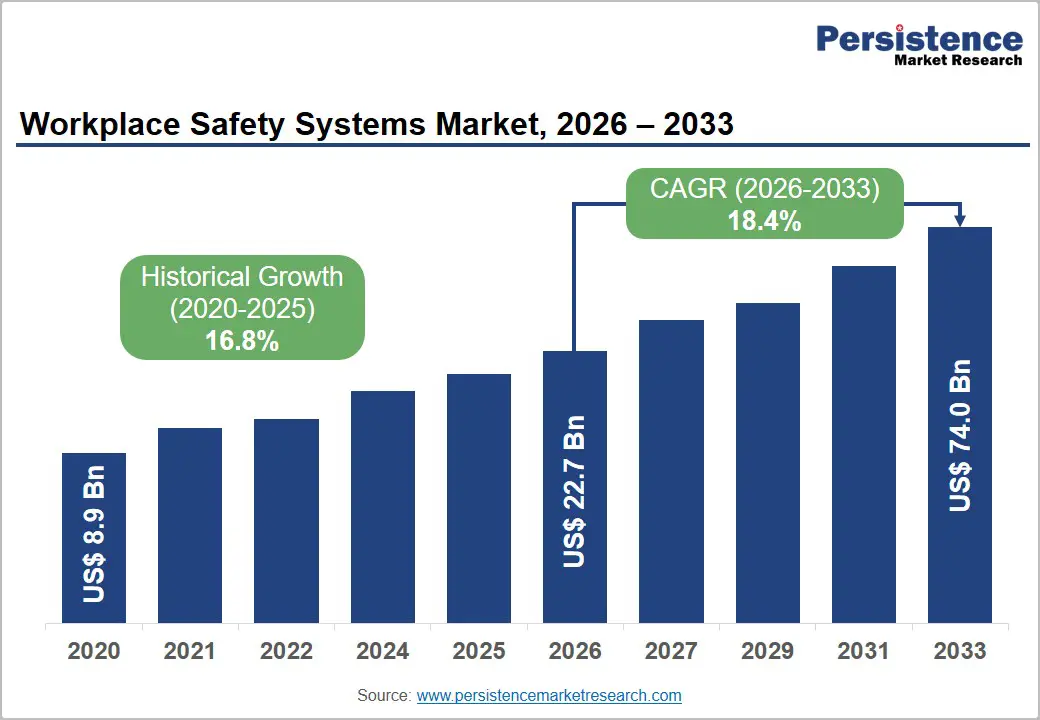
The global workplace safety systems market size is likely to be valued at US$22.7 billion in 2026 and is estimated to reach US$74.0 billion by 2033, growing at a CAGR of 18.4% during the forecast period from 2026 to 2033, driven by stringent occupational safety regulations, rising adoption of smart connected safety solutions, and increasing industrial automation across high-risk sectors. Surging investments in AI- and IoT-enabled worker monitoring systems are also helping organizations identify hazards in real time.
Key Industry Highlights:
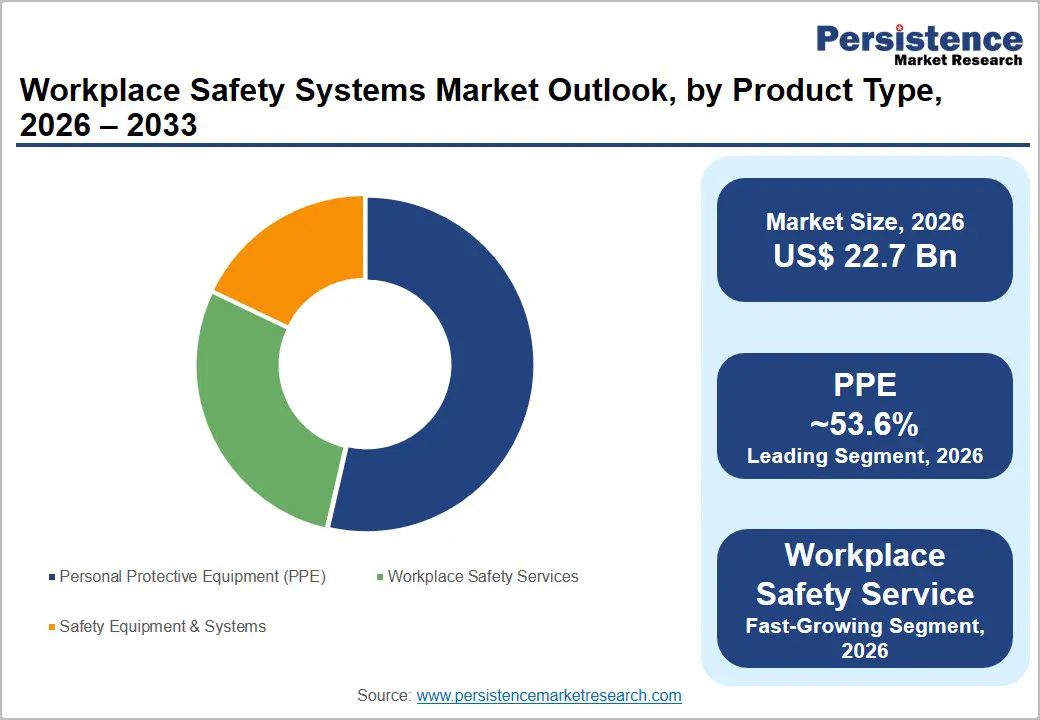
- Leading Product Type: Personal protective equipment, approximately 53.6% share in 2026, as it provides immediate protection against workplace hazards.
- Dominant Technology: IoT-enabled, nearly 34.7% share in 2026, as it enables real-time monitoring of workers, equipment, and hazardous conditions.
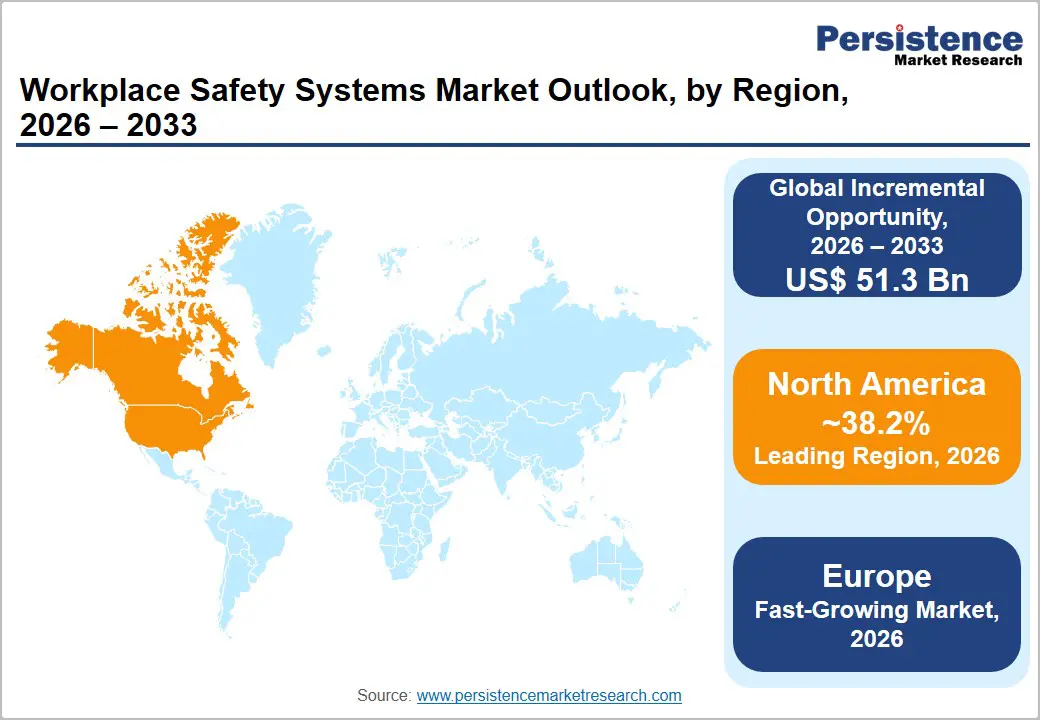
- Leading Region: North America, with about 38.2% share in 2026, backed by strict workplace safety regulations and high adoption of connected safety technologies.
- Fast-growing Region: Europe, spurred by increasing investments in digital workplace safety solutions to comply with evolving occupational safety regulations.
- Recent Acquisition: In July 2025, Honeywell acquired the Li-ion Tamer business from Nexceris. Li-ion Tamer specializes in early off-gas detection technology that identifies thermal runaway events in lithium-ion batteries before fires occur. Honeywell stated that the acquisition strengthens its fire and life safety portfolio for battery energy storage systems, data centers, and industrial facilities where lithium-ion battery risks are increasing.
DRO Analysis
Driver - New Regulatory Requirements and High Penalties
Occupational safety regulations are becoming more prescriptive, and the cost of non-compliance is rising. According to a January 2025 announcement from the U.S. Occupational Safety and Health Administration (OSHA), the maximum penalty for serious and other-than-serious violations increased from US$16,131 to US$16,550 per violation, while the maximum penalty for willful or repeated violations rose from US$161,323 to US$165,514 per violation. These adjustments were made annually under the Federal Civil Penalties Inflation Adjustment Act.
Beyond penalties, OSHA is extending the scope of what safety compliance requires. In May 2024, OSHA published a final rule updating the Hazard Communication Standard to better protect workers and first responders, with full compliance required through 2026. A proposed rule announced August 30, 2024 would additionally require employers in high-heat environments to provide water, shade, rest breaks, and documented illness prevention plans. Each new rule creates a compliance gap that employers must close. It is hence fueling investment in workplace safety systems, training platforms, and monitoring tools.
Boom of High-Risk Industries in Developing Economies
Industrialization in emerging economies is concentrating large numbers of workers in high-risk sectors, including construction, mining, and manufacturing, where safety infrastructure frequently lags behind the pace of growth. According to a 2024 World Risk Poll report developed in consultation with the International Labor Organization (ILO) and published by Lloyd's Register Foundation, approximately one in five workers globally (18%) report being harmed by their work. This figure has remained stubbornly consistent since the poll began in 2019, with mining and quarrying recording the highest harm rate at 21%.
The intensity of the underlying crisis is stark. A peer-reviewed epidemiology study published in PMC confirmed that 92% of all Work-Related Injuries (WRIs) occur in low- and middle-income countries, despite widespread underreporting. As construction and extraction activity expands across South and Southeast Asia, Sub-Saharan Africa, and Latin America, the demand for basic-to-intermediate workplace safety systems will likely rise in proportion. These are anticipated to include Personal Protective Equipment (PPE), gas detection, fall arrest, and site monitoring tools.
Restraint- Continuous Worker Monitoring May Generate Privacy Disputes
As safety wearables and computer vision tools collect biometric, location, and behavioral data from workers throughout their shifts, they are triggering significant legal and ethical pushback. A report published by the U.S. Government Accountability Office (GAO) in September 2024 found that while some trade associations noted that wearable biometric data collection can improve workplace safety and employee well-being, unions, workers, and advocacy organizations commented that such surveillance violates workers' privacy. Around 63 stakeholders specifically flagged the potential for discrimination or bias based on race, gender, or disability.
The ILO has formalized this as a governance concern. In March 2024, the ILO Governing Body decided to convene a tripartite meeting of experts on the protection of workers' personal data in the digital era. It showed the recognized need for updated and comprehensive standards for workers' data protection that establish a fair balance between workers' fundamental rights and employers' interests. Until internationally harmonized frameworks for workplace data collection are established, the absence of clear rules is anticipated to continue to restrict how deeply safety monitoring systems can be deployed.
Opportunity - Computer Vision Models to Detect Hazards That Human Supervisors Miss
Artificial Intelligence (AI)-supported computer vision systems can monitor construction sites continuously. These help in scanning every camera frame for PPE violations, unauthorized zone entry, and fall risk postures without fatigue or attention lapses. A peer-reviewed study published in Computers (MDPI) in January 2026 developed a deep learning-based PPE detection system using the YOLO11 object detection model, achieving a mean Average Precision at 50% Intersection over Union (mAP50) of 96.9% and an inference time of 7.3 milliseconds.
These are sufficient for real-time deployment, and a significant advance over previous approaches that required 170 milliseconds per frame. Another real-world analysis confirmed the practical impact of deployment. Sites implementing AI-based PPE monitoring achieved compliance rates exceeding 95%, compared to 70 to 80% with traditional human-based oversight. In February 2024, workplace safety AI company Intenseye raised US$64 million to extend its computer vision platform, which monitors camera feeds in real time for safety non-compliance events across industrial facilities.
Launch of Safety Digital Twins to Eliminate Pre-Construction Risk
Safety digital twins create a virtual replica of a construction site or facility before physical work begins. Hazard scenarios such as crane swing radii, scaffolding collapse loads, and worker congestion in confined spaces can be simulated and resolved in the model rather than on the actual site. A peer-reviewed study published in Buildings (MDPI) in March 2025 confirmed that Building Information Modeling (BIM) has emerged as a transformative technology creating new opportunities for improving safety standards and reduce accidents throughout the entire project lifecycle.
A further study published in Scientific Reports (Nature) in September 2025 on multi-dimensional digital twin simulation in intelligent construction confirmed that digital twin models integrating BIM and IoT enable real-time safety analysis and risk visualization. It has specific applications in large underground space construction and prefabricated building hoisting, both historically high-fatality work phases. As BIM adoption becomes mandated on public infrastructure projects in the EU and U.K., safety digital twins are transitioning from optional capability to a procurement requirement.
Category-wise Analysis
Product Type Insights
Personal Protective Equipment (PPE) is predicted to lead with a share of approximately 53.6% in 2026, as it provides the first level of protection against physical, chemical, biological, electrical, and respiratory hazards. Unlike complex safety systems that require infrastructure upgrades, PPE can be deployed immediately across almost every industry, including manufacturing, construction, healthcare, mining, oil & gas, and logistics. Governments also make PPE mandatory for several hazardous jobs, ensuring continuous demand.
Workplace safety services are estimated to be the fastest-growing segment over the forecast period, as companies now require continuous support rather than one-time safety assessments. Organizations increasingly outsource activities such as safety audits, compliance management, employee training, risk assessments, emergency planning, industrial hygiene monitoring, and environmental health services. Frequent updates to occupational safety regulations also encourage businesses to work with specialized service providers that can ensure compliance and reduce legal risks.
Technology Insights
The IoT-enabled segment is anticipated to dominate with a share of nearly 34.7% in 2026, as it allows organizations to monitor workers, equipment, and hazardous environments continuously. Connected sensors collect real-time information on gas leaks, temperature, vibration, worker location, fatigue, and equipment performance. This enables companies to identify risks before accidents occur, reducing downtime while improving emergency response. Unlike traditional safety systems that react after an incident, IoT supports predictive safety management through continuous data collection.
The Virtual Reality (VR) segment is expected to remain in the second position in 2026, as it provides immersive safety training without exposing employees to real workplace hazards. Workers can practice responding to fires, chemical leaks, confined spaces, electrical failures, or heavy machinery accidents in a controlled virtual environment. This improves learning outcomes, increases confidence, and reduces training-related risks. VR also enables organizations to standardize training across multiple facilities while lowering travel and operational costs.
Regional Insights
North America Workplace Safety Systems Market Trends
North America is predicted to dominate in 2026 with a share of approximately 38.2%, as it has some of the world's most stringent occupational safety regulations and a high adoption of digital safety technologies. Organizations across manufacturing, oil & gas, healthcare, mining, and logistics continuously invest in connected worker solutions, AI-based safety monitoring, and industrial automation to comply with regulations and reduce workplace risks. OSHA continues to strengthen workplace inspections and enforcement while promoting initiatives such as Safe + Sound. These encourage employers to implement comprehensive safety management systems.
U.S. Workplace Safety Systems Market Trends
A share of nearly 71.2% is expected to be held by the U.S. in 2026, supported by increasing investments in smart factories, industrial automation, and connected worker technologies. Companies are deploying IoT sensors, AI-enabled video analytics, wearable devices, and predictive safety platforms to reduce accidents and improve operational efficiency. The expansion of battery manufacturing, semiconductor production, data centers, and clean energy projects is also creating new demand for advanced workplace safety systems.
Europe Workplace Safety Systems Market Trends
Europe will likely be the fastest-growing region over the forecast period, with a share of nearly 31.4% in 2026, as industries are investing heavily in digital workplace safety while complying with strict worker protection and sustainability regulations. Manufacturers are integrating AI, IoT robotics, and predictive maintenance into production facilities to improve both productivity and worker safety. The region's focus on Industry 4.0 is fostering the deployment of connected safety systems across automotive, chemicals, pharmaceuticals, and heavy manufacturing. The European Agency for Safety and Health at Work (EU-OSHA) continues to promote digital technologies that improve occupational safety and health.
Germany Workplace Safety Systems Market Trends
Germany will likely register a substantial share of approximately 42.4% in 2026, as it has one of Europe's largest manufacturing sectors and is a global leader in Industry 4.0 adoption. Automotive, machinery, chemicals, and industrial equipment manufacturers are now using smart sensors, collaborative robots, AI-supported monitoring, and digital twins to improve workplace safety. Government-backed digital transformation programs continue to encourage companies to modernize industrial facilities while protecting workers.
U.K. Workplace Safety Systems Market Trends
A share of around 19.2% is predicted to be held by the U.K. in 2026, as organizations strengthen compliance with occupational health and safety regulations while increasing investments in digital safety management. Construction, transportation, healthcare, utilities, and manufacturing companies are adopting cloud-based safety platforms, wearable devices, and remote worker monitoring solutions. The Health and Safety Executive (HSE) continues to promote superior risk management practices through updated guidance and inspections.
Asia Pacific Workplace Safety Systems Market Trends
Asia Pacific is anticipated to witness steady growth in 2026 with a share of nearly 18.7%, owing to ongoing industrialization, expanding manufacturing capacity, and strict workplace safety norms. Countries across the region are upgrading factories with industrial automation, connected equipment, and AI-enabled monitoring technologies to improve worker protection. The expansion of electronics, automotive, logistics, construction, and renewable energy industries is further supporting adoption. Governments are also increasing workplace safety inspections.
China Workplace Safety Systems Market Trends
China will likely lead in Asia Pacific in 2026 with a share of around 33.8%, backed by continuous industrial modernization and enforcement of workplace safety regulations. Large-scale investments in smart manufacturing, electric vehicle production, renewable energy, and industrial automation are increasing demand for connected workplace safety systems. The government has continued implementing national workplace safety action plans that encourage digital monitoring and improved risk management in industrial facilities.
Singapore Workplace Safety Systems Market Trends
In 2026, Singapore is projected to account for a share of approximately 26.4%, as the country continues to prioritize workplace safety through strict regulations and advanced digital technologies. The Ministry of Manpower (MOM) regularly updates the Workplace Safety and Health (WSH) 2028 strategy, which focuses on reducing workplace injuries through technology adoption, superior safety culture, and data-driven risk management. Industries such as construction, marine, logistics, pharmaceuticals, and semiconductor manufacturing are increasingly adopting smart wearables, AI-supported surveillance, and digital permit-to-work systems.
Competitive Landscape
The global workplace safety systems market is moderately fragmented with the presence of diversified industrial technology companies, PPE manufacturers, industrial automation firms, and specialized software providers competing across different product categories. Established players such as Honeywell, 3M, ABB, Siemens, Rockwell Automation, MSA Safety, Hexagon, and DuPont hold strong positions. Together, they account for only about one-third of the global market, leaving significant room for regional manufacturers and niche technology providers.
Competition is driven more by technological differentiation and industry specialization than by market concentration. Leading companies are combining connected wearables, AI-assisted video analytics, gas detection, predictive maintenance, cloud-based EHS (Environment, Health, and Safety) software, and industrial IoT platforms into unified solutions. This allows vendors to generate recurring software revenue while improving customer retention. Strategic acquisitions and portfolio optimization have also become a defining competitive strategy.
Key Industry Developments:
- In May 2026, MSA Safety announced a definitive agreement to acquire Autronica Fire and Security for approximately US$555 million. The acquisition expands MSA Safety's portfolio of fire detection, gas detection, and alarm systems for critical infrastructure, energy, marine, and industrial facilities. The transaction would strengthen its integrated fire and gas safety solutions while expanding its presence in the fixed detection market.
- In June 2025, Honeywell completed the acquisition of Sundyne for US$2.16 billion. Honeywell noted that integrating Sundyne's critical pumps and gas compressor technologies with its Honeywell Forge platform would improve industrial process monitoring, automation, and operational safety across refining, petrochemical, LNG, and renewable fuel facilities.
- In May 2025, MSA Safety acquired M&C TechGroup in a transaction valued at approximately US$200 million. The acquisition adds gas analysis, gas sampling, and process safety technologies to MSA's detection portfolio. The companies noted that combining their technologies would improve workplace safety by providing more comprehensive gas monitoring and process control solutions across industrial environments.
Companies Covered in Workplace Safety Systems Market
- 3M
- ABB
- ANSELL LTD
- Cintas Corporation
- Drägerwerk AG & Co. KGaA
- DuPont
- Ecolab
- Hexagon AB
- Honeywell International Inc.
- KCWW
- Lindström
- MSA
- Vector Solutions
- VIKING
- Wolters Kluwer N.V.
- Others
Frequently Asked Questions
The global workplace safety systems market is projected to be valued at US$22.7 billion in 2026.
The workplace safety systems market is expected to reach US$74.0 billion by 2033.
Key market trends include the adoption of IoT-powered connected safety systems and immersive VR-based employee training.
PPE is expected to be the leading product type with a share of nearly 53.6% in 2026, owing to its essential role in reducing workplace injuries.
The workplace safety systems market is expected to grow at a CAGR of 18.4% from 2026 to 2033.
3M, ABB, and ANSELL LTD are a few key market players.


