




- Pharmaceuticals
- Viscosupplementation Market
Viscosupplementation Market Size, Share, Trends, Growth, and Regional Forecast, 2026 - 2033
Viscosupplementation Market by Product (Single Injection Viscosupplementation, Three Injection Viscosupplementation, Five Injection Viscosupplementation), Application (Knee Osteoarthritis, Shoulder Osteoarthritis, Hip Osteoarthritis, Others), Distribution Channel, and Regional Analysis from 2026 - 2033

Viscosupplementation Market Share and Trends Analysis
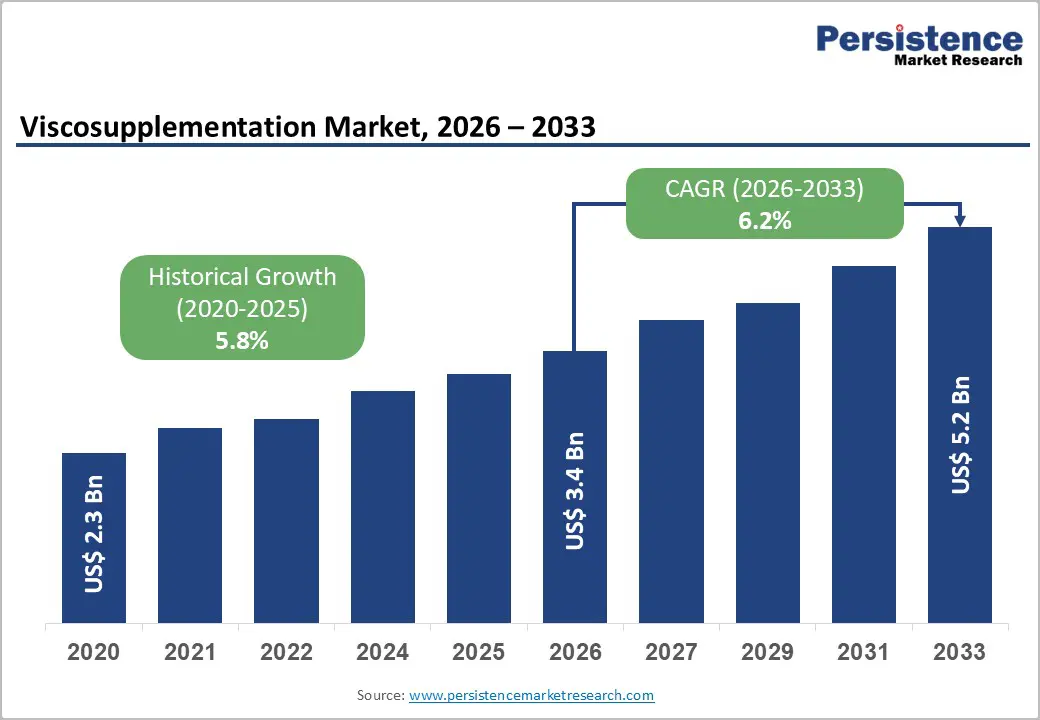
The global viscosupplementation market size is likely to be valued at US$3.4 billion in 2026 to US$5.2 billion by 2033 growing at a CAGR of 6.2% during the forecast period from 2026 to 2033.
The viscosupplementation market focuses on injectable hyaluronic acid–based therapies used to restore lubrication and shock absorption in osteoarthritic joints, particularly the knee. The market growth is driven by rising osteoarthritis prevalence, aging populations, and increasing preference for minimally invasive pain management options that delay or reduce the need for joint replacement surgery. Advancements in cross-linked and single-injection formulations have improved patient compliance and clinical outcomes. Expanding awareness among orthopedic specialists, growing outpatient procedure volumes, and wider adoption in sports medicine further support demand, while ongoing research into hip and shoulder applications continues to broaden the market’s therapeutic scope.
Key Industry Highlights:
- Rising osteoarthritis prevalence globally, especially knee OA among aging and obese populations, is the primary driver, increasing demand for non-surgical pain relief and joint function improvement therapies.
- Preference for minimally invasive treatments is accelerating adoption, as viscosupplementation offers pain relief with fewer complications, shorter recovery time, and potential delay of joint replacement surgeries.
- Technological advancements in cross-linked and high–molecular-weight hyaluronic acid formulations have enhanced durability, reduced injection frequency, and improved patient compliance and clinical outcomes.
- Single-injection and extended-release products are gaining traction because they reduce hospital visits, improve patient convenience, and lower the overall procedural burden on healthcare providers.
- Knee osteoarthritis remains the dominant application segment, while indications for hip, shoulder, and ankle are gradually expanding with supportive clinical evidence and regulatory approvals.
- Hospitals and orthopedic clinics dominate end-user adoption due to higher patient volume, greater specialist availability, and advanced imaging-guided injection capabilities that support accurate treatment delivery.
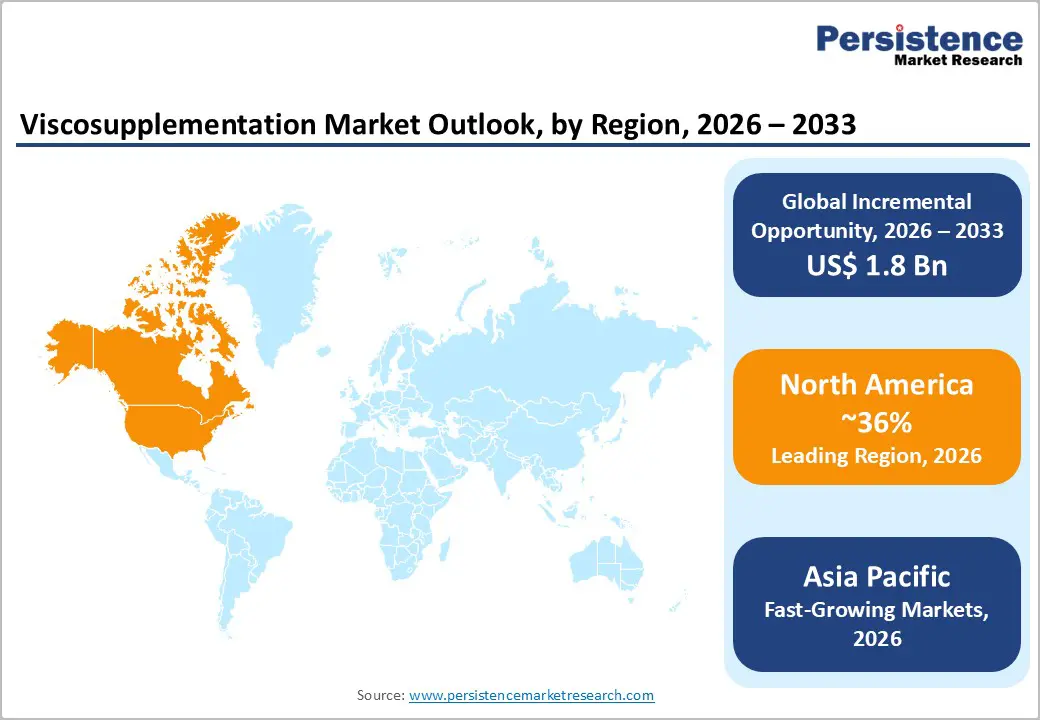
- North America leads the market owing to high disease awareness, favorable reimbursement policies, and strong presence of major manufacturers with well-established distribution networks.
| Key Insights | Details |
|---|---|
|
Viscosupplementation Market Size (2026E) |
US$3.4 Bn |
|
Market Value Forecast (2033F) |
US$5.2 Bn |
|
Projected Growth (CAGR 2026 to 2033) |
6.2% |
|
Historical Market Growth (CAGR 2020 to 2025) |
5.8% |
Market Dynamics
Driver - Rising Preference for Joint-preserving Therapies
Orthopedic treatment paradigms for osteoarthritis are undergoing a fundamental shift, with a growing preference for joint-preserving therapies over early surgical intervention. Surgeons are increasingly cautious about recommending total knee replacement for younger and physically active patients due to implant lifespan limitations, higher revision risks, and long-term functional concerns. Knee replacement implants typically last 15–20 years, making early surgery less desirable for patients in their 40s, 50s, or early 60s who maintain active lifestyles. As a result, clinicians are prioritizing therapies that can preserve native joint structure while effectively managing pain and improving mobility.
Viscosupplementation has emerged as a strategic tool within this conservative care framework. By restoring the viscoelastic properties of synovial fluid, hyaluronic acid injections help reduce friction, improve joint lubrication, and enhance shock absorption without permanently altering joint anatomy. This allows patients to remain active, maintain work productivity, and delay irreversible surgical decisions. For surgeons, viscosupplementation offers a repeatable, low-risk intervention that aligns with shared decision-making models and patient expectations for minimally invasive care.
Additionally, younger osteoarthritis patients often exhibit localized cartilage wear rather than end-stage degeneration, making them ideal candidates for joint-preserving approaches. Surgeons increasingly combine viscosupplementation with weight management, physiotherapy, and activity modification to extend the functional lifespan of the knee joint. This evolving clinical mindset, focused on preserving natural joint biomechanics rather than replacing them, continues to drive sustained demand for viscosupplementation across orthopedic practices.
Restraints - Safety Concerns Linked to Avian-derived Formulations
Safety concerns surrounding avian-derived viscosupplementation formulations represent a distinct yet persistent restraint for the market, particularly in patient populations with known sensitivities and in regions with strict safety perceptions. These products are typically sourced from rooster combs and may contain trace residual avian proteins despite purification processes. For patients with documented allergies to eggs, poultry, or feathers, this raises apprehension about potential hypersensitivity reactions, including localized inflammation, joint effusion, or post-injection flare responses. Even when adverse events are rare, the perceived risk often outweighs clinical benefit in physician–patient discussions.
From a clinical standpoint, orthopedic specialists increasingly favor formulations with predictable safety profiles to minimize medicolegal exposure. Any history of an allergic reaction, however minor, can lead clinicians to avoid avian-derived products altogether, opting instead for fermentation-based alternatives. This cautious approach is further reinforced by patient awareness, as access to online medical information has heightened scrutiny of biologic sourcing and manufacturing transparency.
Geographically, regulatory bodies and healthcare providers in regions such as Europe and parts of Asia apply more conservative standards to animal-derived injectables, driven by ethical considerations, infection control concerns, and perceptions of patient safety. Hospitals and procurement committees may also restrict avian-based products in formularies to reduce variability in risk across large patient volumes. Collectively, these factors limit adoption, constrain market penetration for avian-derived viscosupplements, and accelerate the shift toward non-animal, bio-fermented hyaluronic acid alternatives.
Opportunity - Smart Injection Systems and Image-Guided Delivery Innovations
Smart injection systems and image-guided delivery innovations are emerging as a high-impact opportunity in the viscosupplementation market, addressing one of the key limitations of conventional intra-articular injections, variable placement accuracy. Ultrasound-guided viscosupplementation significantly improves needle positioning within the synovial space, particularly in anatomically complex joints such as the hip, shoulder, and obese knee joints, where landmark-based injections often fail. Improved accuracy directly translates into better therapeutic outcomes, longer-lasting pain relief, and reduced need for repeat injections, strengthening physician confidence in the efficacy of viscosupplementation.
Precision-delivery technologies, including pre-calibrated injection systems, pressure-controlled syringes, and depth-limiting needles, further enhance consistency across procedures and reduce product wastage. These systems are especially valuable in outpatient orthopedic and ambulatory settings, where efficiency and reproducibility are critical. The integration of smart features—such as real-time visualization, ergonomic device design, and standardized injection protocols—also lowers the learning curve for clinicians, expanding adoption beyond highly specialized orthopedic centers.
From a commercial perspective, image-guided delivery enables manufacturers to differentiate products beyond formulation alone, supporting premium pricing and bundled solutions combining viscosupplements with delivery devices. As patient expectations shift toward minimally invasive, outcome-driven therapies, smart injection systems reinforce viscosupplementation’s role as a reliable, non-surgical intervention while aligning with broader trends in precision medicine and technology-enabled orthopedic care.
Category-wise Analysis
By Product, the Single-injection Viscosupplementation Segment is leading in the Market
Single-injection viscosupplementation accounts for the highest market share because it aligns better with modern clinical workflows, patient expectations, and healthcare economics than multi-injection regimens. From a patient perspective, a single injection significantly reduces treatment burden by minimizing hospital visits, needle anxiety, and time off work, which directly improves acceptance and adherence—especially among elderly and working-age osteoarthritis patients. Clinically, advances in high-molecular-weight and cross-linked hyaluronic acid formulations have enabled single-dose products to deliver sustained pain relief comparable to, or better than, three- or five-injection courses, strengthening physician confidence in their effectiveness.
From a healthcare system standpoint, single-injection therapies improve operational efficiency by reducing chair time, simplifying procedural scheduling, and decreasing cumulative injection-related risks, such as infection or post-injection flare. These benefits are particularly attractive in outpatient orthopedic clinics and ambulatory surgical centers, where throughput and standardization are critical. Commercially, single-injection products command premium pricing due to their convenience and differentiated clinical value, contributing disproportionately higher revenue per treatment cycle. Together, superior patient convenience, comparable clinical outcomes, workflow efficiency, and stronger revenue realization make single-injection viscosupplementation the dominant choice in current market adoption.
By Application, Knee Osteoarthritis Segment Leads the Market
Knee osteoarthritis accounts for the highest share of the viscosupplementation market because it combines the largest patient pool with the strongest clinical and commercial fit for hyaluronic acid injections. The knee is the most commonly affected joint due to its constant load-bearing role, making it highly vulnerable to cartilage degeneration from aging, obesity, sedentary lifestyles, and sports-related injuries. This creates a sustained and recurring demand for non-surgical pain management options, particularly in patients who are not immediate candidates for joint replacement.
Clinically, the knee joint offers easier anatomical access than the hip or shoulder, enabling greater injection accuracy even without advanced imaging. This has helped viscosupplementation become a routine, well-established treatment pathway for knee OA, supported by extensive clinical evidence, physician familiarity, and standardized treatment protocols. In contrast, hip and shoulder injections often require ultrasound or fluoroscopic guidance, limiting widespread adoption.
From a market perspective, knee OA patients typically undergo repeat treatment cycles over several years, driving higher cumulative product volumes. Additionally, reimbursement coverage and patient willingness to pay are more favorable for knee indications, as outcomes such as pain relief and mobility improvement are more predictable and measurable. Together, high disease prevalence, procedural simplicity, strong evidence base, and repeat utilization make knee osteoarthritis the dominant application for viscosupplementation globally.
Region-wise Insights
North America Viscosupplementation Market Trends
North America leads the global viscosupplementation market, driven by a combination of high osteoarthritis prevalence, advanced healthcare infrastructure, and strong insurance coverage. The United States, in particular, dominates the region due to its large aging population and rising demand for non-surgical joint therapies. Patients increasingly prefer minimally invasive treatments like hyaluronic acid injections to manage pain and delay knee replacement surgeries, boosting adoption rates.
Clinicians are supported by extensive clinical evidence and familiarity with these procedures, making single-injection and long-acting formulations particularly popular. The presence of major market players investing in R&D, along with the integration of technologies such as ultrasound-guided injections, further enhances treatment precision and patient outcomes.
Favorable reimbursement policies through Medicare and private insurers make viscosupplementation more accessible, while outpatient orthopedic clinics and ambulatory centers drive procedural efficiency. Additionally, growing awareness about joint health, combined with lifestyle and sports-related joint issues among active adults, sustains a steady demand pipeline. Overall, North America’s leadership stems from a unique alignment of clinical confidence, patient preference, technological adoption, and financial support, establishing it as both the largest market and a trendsetter influencing global viscosupplementation strategies.
Asia Pacific Viscosupplementation Market Trends
The Asia Pacific viscosupplementation market is witnessing rapid growth, driven by increasing osteoarthritis prevalence, urbanization, and lifestyle-related joint stress. Aging populations in countries such as China, Japan, South Korea, and India are fueling demand for non-surgical joint therapies like hyaluronic acid injections. Rising disposable incomes and expanding healthcare access, particularly in urban centers, are enabling more patients to afford advanced treatment options. Both local manufacturers and global players are introducing single-injection and long-acting formulations designed for regional needs, enhancing convenience and patient compliance.
Technological advancements, including ultrasound-guided injections and precision delivery systems, are improving procedural accuracy and boosting physician confidence. Government initiatives aimed at promoting joint health and orthopedic care are also supporting market expansion. Furthermore, increasing awareness about non-invasive treatments among younger, active populations, including athletes and working adults, is broadening the patient base. The combined effect of demographic shifts, economic growth, improved healthcare infrastructure, and technological adoption positions Asia Pacific as the fastest-growing viscosupplementation market, offering substantial opportunities for product innovation and regional expansion.
Competitive Landscape
The global viscosupplementation market is highly competitive, characterized by continuous innovation in product formulations and delivery technologies. Key players focus on developing single-injection and long-acting hyaluronic acid products to enhance patient convenience and adherence. Strategic initiatives such as partnerships, mergers, and regional expansions are intensifying market rivalry, while R&D investments drive next-generation formulations with improved efficacy and safety profiles. Technological advancements, including ultrasound-guided and precision delivery systems, are further differentiating offerings.
Key Industry Developments:
- In February 2024, IBSA UK, part of the Swiss IBSA Group, introduced its advanced SINOVIAL range in the UK for managing osteoarthritis. The product utilizes a proprietary NAHYCO technology, blending high and low molecular weight hyaluronic acid to provide enhanced joint lubrication and improved therapeutic performance.
- In January 2024, Zimmer-Biomet introduced VISCO-3, a three-injection high molecular weight hyaluronate therapy for moderate knee osteoarthritis in select international markets. Clinical trials demonstrated a 52% reduction in pain at 12 weeks, sustained relief for up to six months, and a favorable safety profile.
Companies Covered in Viscosupplementation Market
- Sanofi S.A.
- Zimmer Biomet Holdings Inc.
- Bioventus LLC
- Anika Therapeutics Inc.
- Fidia Pharma USA Inc.
- Ferring B.V.
- Seikagaku Corporation
- OrthogenRx Inc. (Channel-Markers Medical)
- Medical Device Business Services, Inc. (J&J)
- AVNS
- Searchlight Pharma Inc.
- Aptissen GmbH
- Teva Pharmaceutical Industries Ltd.
- TRB Chemedica International SA
- IBSA Institut Biochimique SA
- Others
Frequently Asked Questions
The global viscosupplementation market is projected to be valued at US$3.4 Bn in 2026.
Development of single-injection, long-acting, and cross-linked hyaluronic acid formulations enhances convenience, efficacy, and patient adherence.
The global market is poised to witness a CAGR of 6.2% between 2026 and 2033.
Growing demand for convenient, high-efficacy products that reduce clinic visits.
Sanofi S.A., Zimmer Biomet Holdings Inc., Bioventus LLC, Anika Therapeutics Inc., and others.


