




- Hardware & Software IT Services
- Virtual Desktop Infrastructure Market
Virtual Desktop Infrastructure Market Size, Share, and Growth Forecast, 2026 - 2033
Virtual Desktop Infrastructure Market by Offering (Solution, Services), Deployment (Cloud-based, On-premises), Industry (BFSI, Healthcare, IT & Telecom, Government & Public Sector, Education, Manufacturing, Retail, Others), and Regional Analysis for 2026 - 2033

Virtual Desktop Infrastructure Market Size and Trends
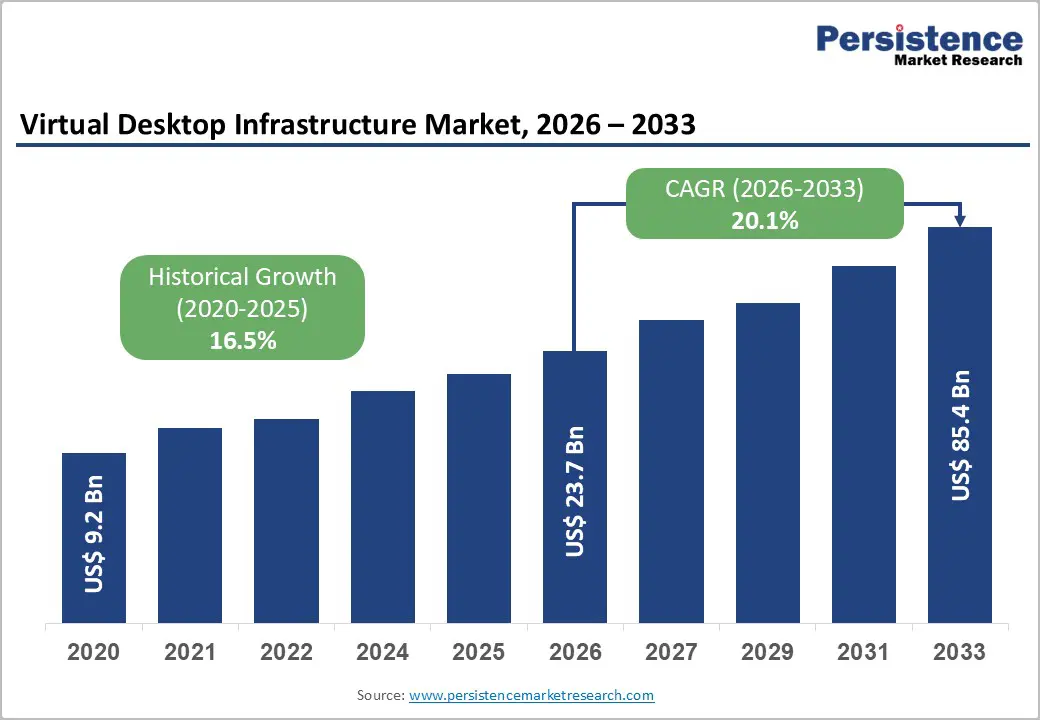
The global virtual desktop infrastructure market size is projected to rise from US$23.7 Bn in 2026 to US$85.4 Bn by 2033. It is anticipated to witness a CAGR of 20.1% during the forecast period from 2026 to 2033.
The market is experiencing exceptional growth driven by the widespread adoption of remote and hybrid work models, escalating demand for secure centralized desktop management, growing digital transformation initiatives across enterprises, and accelerating cloud migration strategies that emphasize scalability and cost efficiency in distributed computing environments.
Key Industry Highlights:
- Leading Offering: Solutions dominate with over 70% market share in 2026, valued at more than US$ 16.6 Bn, driven by the need for centralized IT management, secure remote access, and scalable virtual desktops. Services are the fastest-growing segment, supported by consulting, deployment, managed services, and ongoing performance and compliance optimization.
- Leading Deployment: On-premises holds over 45% market share in 2026, valued at more than US$ 10.7 Bn, preferred for data security, regulatory compliance, and low-latency performance for mission-critical workloads. Cloud-based VDI is the fastest-growing deployment, with a CAGR of 27.1%, driven by scalability, remote work enablement, cost optimization, and simplified IT management.
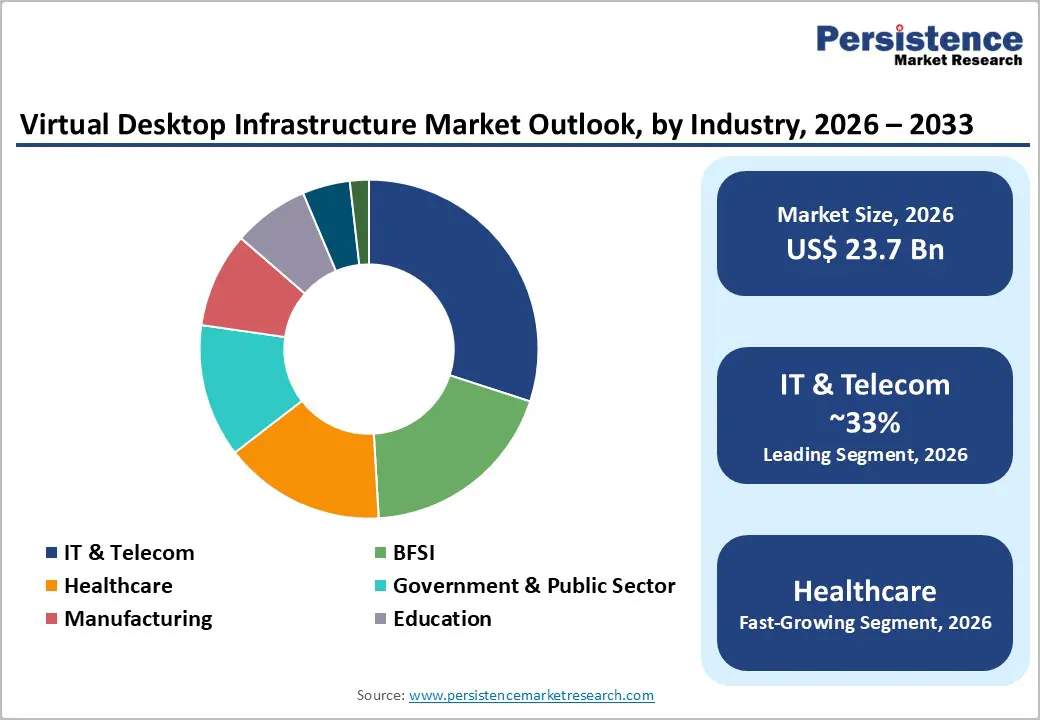
- Leading Industry: IT & Telecom commands the largest share at over 33% in 2026, valued at more than US$ 7.8 Bn, due to distributed workforces, 24/7 operations, and high security requirements. Healthcare is the fastest-growing industry, fueled by telehealth adoption, EHR deployment, and secure, anytime access to patient data across hospitals and remote care settings.
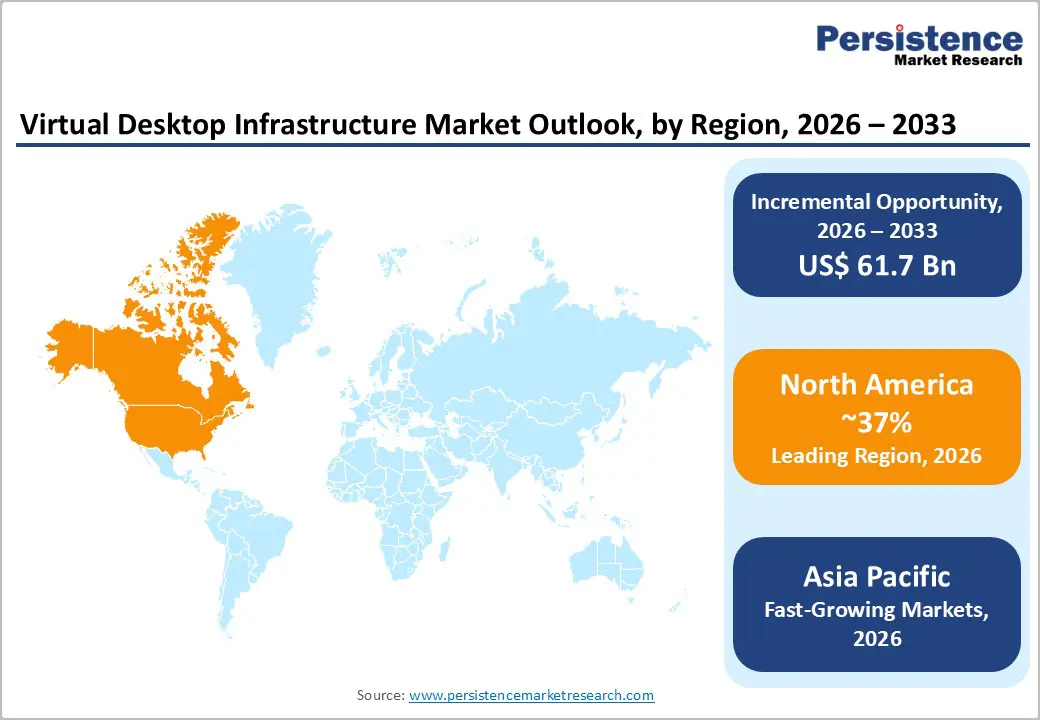
- Leading Region: North America leads with over 37% market share in 2026, valued at approximately US$ 8.8 Bn, supported by early adoption of digital technologies, mature cloud infrastructure, and hybrid work models. Asia Pacific is the fastest-growing region with a CAGR of 26.3%, driven by urbanization, expanding cloud infrastructure, digital government initiatives, and adoption of DaaS solutions. Europe holds over 24% of the market share, supported by GDPR compliance, smart office integration, and sustainable VDI implementations.
| Global Market Attribute | Key Insights |
|---|---|
| Virtual Desktop Infrastructure Market Size (2026E) | US$23.7 Bn |
| Market Value Forecast (2033F) | US$85.4 Bn |
| Projected Growth (CAGR 2026 to 2033) | 20.1% |
| Historical Market Growth (CAGR 2020 to 2025) | 16.5% |
Market Dynamics
Driver
Cost Efficiency and Simplified IT Management in VDI
Centralizing desktops in the data center or cloud helps organizations reduce expenses on physical hardware, maintenance, and energy consumption. IT teams manage updates, patches, and security policies centrally, eliminating the need for individual endpoint management. VDI lowers total cost of ownership by extending device lifecycles and minimizing downtime. Automated provisioning and simplified monitoring enhance operational efficiency and free IT staff for strategic tasks. Distributed and remote workforces benefit from consistent performance, secure access, and easier device management. These factors make VDI an attractive solution for enterprises seeking scalable, efficient, and streamlined IT operations.
BYOD, Workforce Mobility, and Scalability Needs
Organizations are increasingly supporting remote and hybrid work models, requiring secure access to corporate applications and data across diverse devices. VDI enables employees to work seamlessly from laptops, tablets, or smartphones without compromising security or performance. Scalability and flexibility are key, allowing IT teams to quickly provision virtual desktops as workforce size fluctuates or project needs change. This reduces infrastructure costs, streamlines management, and ensures consistent user experiences. VDI facilitates centralized control, making it easier to enforce compliance and security policies across a dispersed workforce. The ability to scale resources on demand supports business continuity and rapid response to evolving operational needs.
Restraint
High Implementation Costs and Technical Complexity
High initial implementation costs and technical complexity are major barriers, particularly affecting small and medium-sized enterprises with limited IT budgets. Organizations face substantial capital expenditures for hardware, software licensing, network upgrades, and professional services required for deployment and ongoing management. Integrating VDI into heterogeneous IT environments with legacy systems, diverse operating systems, and specialized applications often demands custom configurations, increasing complexity. Managing multi-cloud and hybrid-cloud VDI architectures, while ensuring compatibility across devices, adds operational challenges. These factors collectively extend implementation timelines, raise the total cost of ownership, and limit adoption among resource-constrained organizations.
Data Security and Regulatory Compliance Challenges
Regulations like GDPR in Europe and the DPDP Act in India impose strict obligations, including encrypted data transmission, secure storage, privacy-by-design, and comprehensive audit capabilities. Organizations must also ensure that printed documents with sensitive information are secured and access is restricted to authorized personnel. Compliance mandates such as GDPR’s 72-hour breach notification and data protection impact assessments add operational complexity. These requirements increase management overhead, operational costs, and the need for robust security mechanisms, limiting faster VDI adoption in regulated industries.
Opportunity
Integration of Artificial Intelligence and Advanced Automation Technologies Enabling Intelligent VDI Optimization
AI-powered VDI solutions optimize resource allocation in real time, predict infrastructure bottlenecks, and scale virtual desktops automatically to meet dynamic workloads. Intelligent authentication systems enhance security through behavioral analytics and adaptive access controls. GPU-enabled VDI supports graphics-intensive applications, including 3D design, video editing, and emerging AR/VR use cases. Integration with IoT, edge computing, and 5G enables real-time access for distributed teams across sectors such as healthcare, manufacturing, and professional services. The convergence of AI, automation, immersive technologies, and advanced networking is driving strong growth and creating differentiated opportunities for solution providers.
Integration with Workspace-as-a-Service (WaaS) & DaaS
Integration with Workspace-as-a-Service (WaaS) and Desktop-as-a-Service (DaaS) is creating significant opportunities by enabling organizations to deploy virtual desktops more quickly and cost-effectively. WaaS and DaaS integration enhances flexibility, offering employees secure access to desktops and applications from anywhere on any device. This also reduces IT management burdens, as updates, patches, and security policies are centrally managed in the cloud. It allows organizations to adopt a subscription-based model, converting high upfront costs into predictable operational expenses. They support business continuity and disaster recovery, ensuring seamless access during disruptions.
Category-wise Analysis
Offering Analysis
Solution dominates the global market, capturing more than 70% market share in 2026 with a value exceeding US$ 16.6 Bn, as organizations are prioritizing end-to-end software and platform capabilities that support secure, scalable, and centrally managed virtual desktops. VDI solutions address key business needs such as remote and hybrid work enablement, centralized IT management, strong data security, and reduced hardware dependency, making them more widely adopted than isolated tools or services. The shift to cloud-integrated solutions that streamline deployment and support diverse device access further boosts the demand for comprehensive VDI solutions.
Services demonstrate significant growth as organizations need expert support to design, deploy, and manage increasingly complex VDI environments. Enterprises require consulting and implementation services to ensure secure integration with existing IT infrastructure and cloud platforms. Ongoing managed services are in demand to handle performance optimization, updates, monitoring, and compliance. Limited in-house VDI expertise and the need for cost-efficient operations are pushing organizations to rely more on specialized service providers.
Deployment Analysis
On-premises hold over 45% of the market share in 2026, with a value exceeding US$ 10.7 Bn, as enterprises prioritize data security, privacy, and regulatory compliance, which are easier to control within their own infrastructure. Large organizations need low-latency performance and high reliability for mission-critical workloads, which on-prem VDI delivers more consistently. It also supports deep customization and legacy application compatibility that cloud VDI may not fully offer. Enterprises with existing data center investments prefer on-prem VDI to maximize asset utilization and maintain predictable long-term costs.
Cloud-based is expected to grow at the highest rate, with a CAGR of 27.1% as enterprises increasingly need scalable, on-demand desktop access without heavy upfront infrastructure investment. Organizations prioritize remote and hybrid work enablement, which cloud VDI supports with anytime, anywhere access. There is also a strong need for lower IT management complexity, faster deployment, and automatic updates. Growing demand for cost optimization, business continuity, and built-in security is pushing enterprises toward cloud-hosted VDI solutions.
Industry Analysis
IT & Telecom command the largest market share at over 33% in 2026, with a value exceeding US$ 7.8 Bn, driven by the strong need for secure, scalable, and always-available digital work environments. These organizations manage highly distributed workforces, 24/7 operations, and sensitive customer data, making centralized desktop control and security critical. VDI enables rapid user provisioning, remote access, and standardized environments for developers, network engineers, and support teams. Frequent technological upgrades and cloud adoption in IT & Telecom drive continuous demand for flexible, high-performance virtual desktop solutions.
Healthcare is expected to grow significantly due to the urgent need for secure, anytime access to patient data across hospitals, clinics, and remote care settings. VDI enables centralized data control to meet strict regulatory and privacy requirements while reducing the risk of data breaches. The rapid adoption of telehealth, electronic health records (EHRs), and mobile clinical workflows increases demand for consistent, device-agnostic desktop access. Healthcare providers need scalable IT environments to support staff shortages, shift-based work, and disaster recovery without compromising performance or compliance.
Regional Insights
North America Virtual Desktop Infrastructure Market Trends
North America accounts for over 37% of the Virtual Desktop Infrastructure market share in 2026, reaching approximately US$ 8.8 Bn, driven by early adoption of advanced digital technologies and a highly mature cloud ecosystem. The United States plays a central role due to the widespread implementation of hybrid and remote work models across enterprises. Strong presence of major VDI and cloud service vendors supports continuous innovation and large-scale deployments. Regulatory frameworks emphasizing data security, compliance, and identity protection further accelerate adoption. Key industries such as finance, healthcare, and government are increasingly deploying VDI to enable secure remote access and centralized IT management. Large enterprises in the region are also adopting complex hybrid and multi-cloud VDI architectures to enhance scalability, resilience, and workforce flexibility.
Asia Pacific Virtual Desktop Infrastructure Market Trends
Asia Pacific is expected to grow at the highest rate with a CAGR of 26.3%, due to rapid urbanization, expanding cloud infrastructure, and digital government initiatives across developing economies. China leads the region with strong manufacturing capabilities, widespread adoption of smart offices, and government digitalization efforts that support VDI expansion. India is also seeing significant growth, fueled by expanding digital infrastructure, small and medium businesses adopting cost-effective DaaS solutions, and the increasing shift toward remote work. Enterprises across the region are adopting VDI to enable centralized management, improve security, and support distributed workforces.
Europe Virtual Desktop Infrastructure Market Trends
Europe is expected to hold more than 24% share by 2026, driven by stringent data protection regulations, including GDPR, which emphasize privacy, secure data handling, and breach notification protocols. This creates strong demand for VDI solutions with robust encryption, access controls, and audit capabilities. Germany is a key adopter, supported by digital transformation initiatives and smart office integration, while the UK is seeing growth driven by remote work adoption and virtual collaboration tools. The region also focuses on sustainable, energy-efficient VDI implementations, with leading providers like Citrix and VMware developing eco-friendly solutions to meet corporate and regulatory sustainability goals.
Competitive Landscape
The virtual desktop infrastructure market exhibits a moderately consolidated competitive structure with technology leaders, established virtualization vendors, and emerging cloud-native specialists controlling substantial market share through differentiated solutions and extensive customer relationships. Vendors are leveraging substantial R&D investments, cloud infrastructure capabilities, and long-standing enterprise partnerships to sustain and strengthen their market positions.
Key Industry Developments
- In November 2025, Nutanix announced its Nutanix Cloud Platform will support Microsoft Azure Virtual Desktop in hybrid environments, enabling organizations to run Azure Virtual Desktop on-premises using the Nutanix AHV hypervisor. The move enhances flexibility for distributed workforces while improving control, performance, security, and cost efficiency for IT teams.
- In December 2025, The Horizon 8 2512 release enhances end-user experience while giving IT teams greater flexibility in deployment and management. Key updates include deeper Workspace ONE UEM integration, expanded hybrid cloud support, improved protocol performance, and stronger management and security capabilities, making Horizon easier to scale and operate.
Companies Covered in Virtual Desktop Infrastructure Market
- Microsoft Corporation
- VMware, Inc.
- Citrix Systems, Inc.
- Google LLC
- Amazon Web Services, Inc.
- Nutanix, Inc.
- HPE
- Oracle Corporation
- IBM
- Fujitsu Limited
- Cisco Systems, Inc.
- V2 Cloud Solutions Inc.
- Ericom Software, Inc.
- Others
Frequently Asked Questions
The global market is projected to be valued at US$23.7 Bn in 2026.
The need for secure remote access, centralized IT management, and seamless workforce mobility, especially as organizations adopt hybrid and remote work models are key driver of the market.
The market is expected to witness a CAGR of 20.1% from 2026 to 2033.
Artificial intelligence integration and advanced automation in VDI platforms represent the highest potential opportunity, enabling intelligent resource optimization, predictive maintenance, GPU-enabled immersive workloads, and edge computing integration are creating strong market expansion potential.
Microsoft Corporation, VMware, Inc., Citrix Systems, Inc., Google LLC, Amazon Web Services, Inc., Nutanix, Inc. are among the leading key players.


