




- Medical Devices
- Vessel Sealing Devices Market
Vessel Sealing Devices Market Size, Share, and Growth Forecast 2026 - 2033
Vessel Sealing Devices Market by Product Type (Generators, Instruments, Accessories), Application (General Surgery, Laparoscopic Surgery), by End-user (Hospitals and Specialty Clinics, Ambulatory Surgical Centers), and Regional Analysis, 2026 - 2033

Vessel Sealing Devices Market Size and Trends Analysis
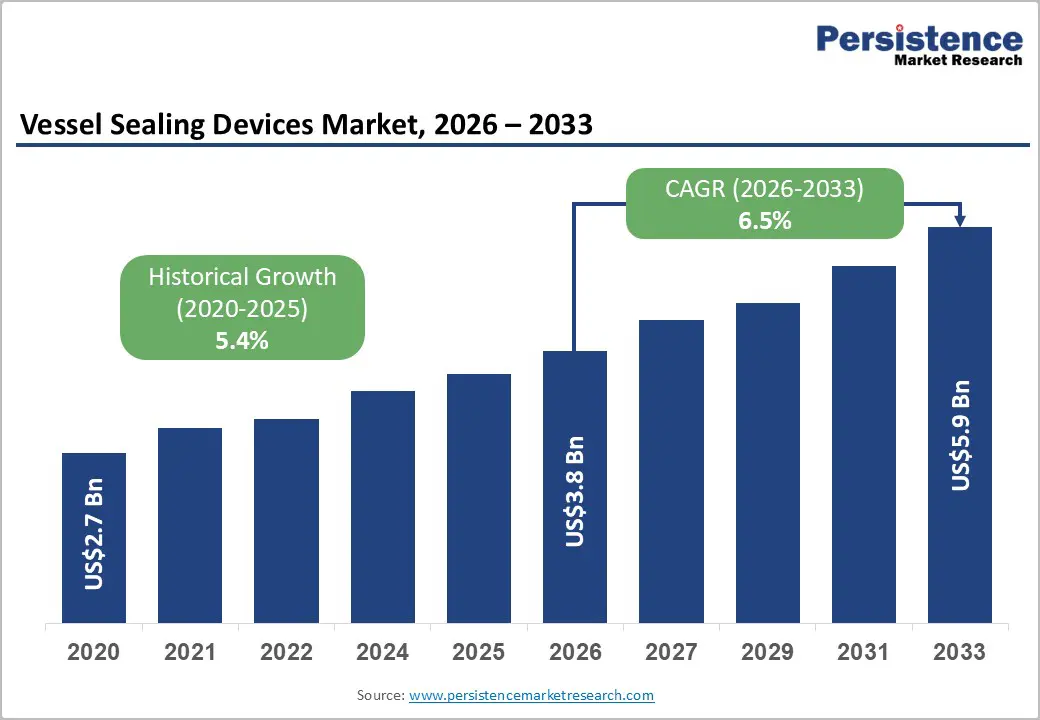
The global vessel sealing devices market size is likely to be valued at US$3.8 billion in 2026 and is expected to reach US$5.9 billion by 2033, growing at a CAGR of 6.5% during the forecast period from 2026 to 2033, driven by rising adoption of minimally invasive and laparoscopic surgeries, increasing global surgical volumes associated with chronic diseases such as cancer and gastrointestinal disorders, and surging demand for advanced energy-based surgical devices that reduce blood loss and operating time.
Key Industry Highlights:
- New Product: In October 2025, Olympus Corporation launched THUNDERBEAT II, its next-generation hybrid energy device for soft tissue management, at an event in Tokyo and Hamburg. It delivers speedy hemostatic dissection and secure vessel sealing, featuring a refined probe design.
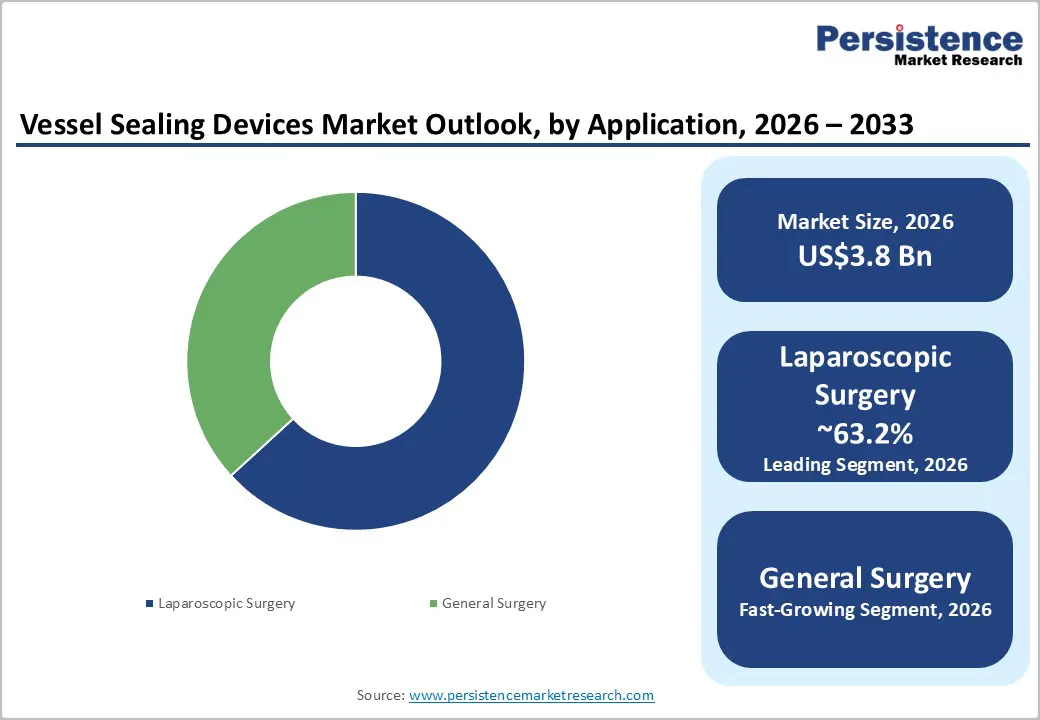
- Leading Application: Laparoscopic surgery, approximately 63.2% share in 2026, as it requires precise vessel sealing in confined spaces, which improves bleeding control and reduces procedure time.
- Dominant End-user: Hospitals and specialty clinics, nearly 56.7% in 2026, as these handle complex surgeries and invest in integrated energy platforms that ensure consistent sealing performance and surgical efficiency.
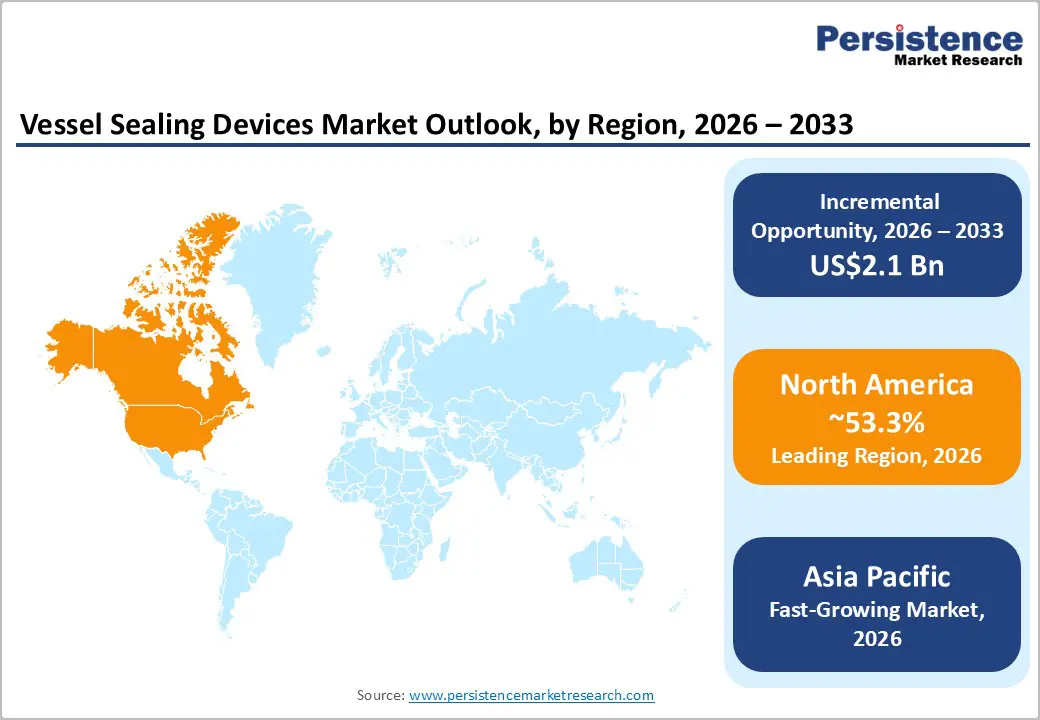
- Leading Region: North America, with about 53.3% share in 2026, backed by early adoption of advanced surgical technologies and the integration of vessel sealing systems with robotic as well as minimally invasive procedures.
- Fast-growing Region: Asia Pacific, spurred by expanding hospital infrastructure and rising adoption of minimally invasive surgeries supported by government healthcare investments.
DRO Analysis
Driver - Shifting Preference toward Minimally Invasive Procedures
The steady shift from open surgeries to minimally invasive techniques has become one of the key demand drivers for vessel sealing devices. Laparoscopic and robotic-assisted procedures work through narrow ports and confined anatomical spaces, where standard sutures and clips are simply impractical. Vessel sealing instruments, with their slim and wristed designs, fill that gap directly.
An estimated 5.5 million minimally invasive procedures are performed annually using robotic systems, and hospitals and surgery centers are now adopting these technologies. Regulatory approvals are accelerating this integration. In July 2025, Intuitive Surgical received FDA clearance for its Vessel Sealer Curved instrument. It is a fully wristed, advanced bipolar electrosurgical instrument designed for use with da Vinci systems. It is also the first of Intuitive's energy instruments to receive FDA clearance for the transection of lymphatic vessels.
Urgent Need to Lower Risks of Post-Operative Hemorrhaging
Vessel sealing devices deliver a fundamentally different and more reliable mechanism than traditional sutures or clips. Rather than physically tying off a vessel, these instruments use a controlled combination of radiofrequency energy and compression to work at a tissue level. These devices fuse vessel walls using a combination of electrical current and mechanical pressure, causing collagen and elastin in the targeted tissue to denature and mechanical pressure to form a coagulum.
It creates a permanent, fused seal and not a mechanical closure that can loosen or slip. Research published in Surgical Endoscopy further confirmed that the relative ratio of collagen and elastin in vessel walls determines the degree of vessel distensibility and plays an equally important role in defining seal strength. The result is more predictable hemostasis and a lower risk of post-operative bleeding compared to conventional ligation.
Restraint - Risk of Unintended Heat Damage to Surrounding Tissue
Despite their precision advantages, vessel sealing devices carry a well-documented clinical limitation, i.e., lateral thermal spread. When energy is delivered to seal a target vessel, heat can radiate outward and damage nearby nerves, ureters, or bowel, structures that were never meant to be affected. A 2022 study published in Diagnostics (MDPI) measured this effect in an ex vivo model. For the instruments studied, the mean extent of the critical zone exceeding 50°C was measured at approximately 2.3 mm above and nearly 1.7 mm below vessel branches, with necrosis zones measuring around 400 to 640 µm.
A follow-up study published in Surgery in Practice and Science in December 2023 further investigated whether leaving perivascular tissue in place could act as a natural insulating barrier against this lateral heat propagation. This indicated that the issue remains an active area of surgical research. A December 2024 study in the International Journal of Hyperthermia found that ceramic coating on electrosurgical electrodes significantly improved cutting performance and reduced lateral thermal damage by 86.15% at 35 W and 65% at 50 W. However, widespread clinical adoption of such improvements takes time, and the risk remains a genuine concern in procedures near delicate structures.
Opportunity - Smart Radiofrequency Platforms with Tissue-Sensing Intelligence
Modern advanced bipolar platforms have moved beyond simple energy delivery. They now read and respond to tissue in real time. Applied Medical's Voyant Intelligent Energy System, for example, continuously collects information about the nature of the tissue within its jaws, quickly measures tissue as the energy is applied, and adjusts to provide the optimal amount of energy throughout the seal cycle to create a permanent, fused seal. It results in superior hemostasis, speedy seal times, minimal lateral thermal spread, and less tissue adherence. This adaptive approach is a direct answer to the thermal spread problem discussed above.
Ultrasonic and Hybrid Energy Systems for Complex Procedures
Ultrasonic shears represent a distinct and growing segment, using high-frequency mechanical vibration rather than electrical current to seal and cut simultaneously. This eliminates the risk of current passing to the patient. Ethicon's HARMONIC 700 Shears are indicated for soft tissue incisions where bleeding control and minimal thermal injury are desired. This includes general, gynecologic, urologic, and thoracic procedures, with coagulation capability for vessels up to 7 mm in diameter using its Advanced Hemostasis mode. Hybrid devices push this further by combining both modalities.
Category-wise Analysis
Application Insights
The laparoscopic surgery segment is predicted to lead with a share of approximately 63.2% in 2026, as it reduces blood loss, which directly increases the requirement for precise vessel sealing. These procedures rely on controlled energy delivery in confined spaces. Vessel sealing devices help avoid clips and sutures, improving speed and consistency. According to the World Health Organization (WHO), minimally invasive surgeries reduce hospital stay by up to 50% in various procedures. This has pushed hospitals to standardize laparoscopic approaches for gallbladder, colorectal, and bariatric surgeries. A 2023 study in Surgical Endoscopy also showed that advanced bipolar sealing reduced operative time in laparoscopic hysterectomy by around 20%, strengthening its routine use.
The general surgery segment is estimated to be the fastest-growing in the forecast period, backed by the rising volume of high-frequency procedures such as hernia repair, appendectomy, and colorectal surgeries. These procedures increasingly rely on energy-based sealing instead of traditional ligation. The Centers for Disease Control and Prevention (CDC) reported that gastrointestinal disorders account for millions of surgeries annually in the U.S. alone. Surgeons are shifting to vessel sealing devices as these help reduce intraoperative bleeding and shorten closure time. A 2024 clinical review in JAMA Surgery showcased that energy devices lowered complication rates in colorectal resections, which is bolstering adoption.
End-user Insights
Hospitals and specialty clinics are anticipated to dominate with a share of nearly 56.7% in 2026, as they handle complex and high-risk surgeries where reliable vessel sealing is important. These settings invest in integrated surgical systems rather than standalone tools. Large hospitals often standardize specific platforms across departments. For example, the National Health Service (NHS) has centralized procurement frameworks that favor bundled surgical technologies. Specialty clinics, especially in oncology and gynecology, also prefer advanced sealing tools to improve surgical precision and patient outcomes.
The Ambulatory Surgical Center (ASC) segment is expected to remain in the second position in 2026, as ASCs focus on same-day surgeries, where speed and low complication rates are essential. Vessel sealing devices reduce operating time and minimize post-surgical bleeding, which supports early discharge. The Centers for Medicare & Medicaid Services has expanded reimbursement coverage for outpatient procedures, including laparoscopic surgeries. This policy shift has increased procedure volumes in ASCs. In 2024, CMS added more minimally invasive procedures to its ASC payable list, thereby boosting demand for compact and efficient sealing devices.
Regional Insights
North America Vessel Sealing Devices Market Trends
In 2026, North America will dominate with a share of around 53.3%, backed by early adoption of novel surgical technologies and superior clinical evidence backing energy devices. Hospitals in the region rapidly integrate new Food and Drug Administration (FDA)-approved tools into practice. The U.S. FDA cleared multiple next-generation vessel sealing systems in recent years, accelerating innovation cycles. Robotic surgery penetration is also high. Hospitals performing robotic-assisted procedures depend heavily on integrated sealing systems, which strengthens market leadership.
U.S. Vessel Sealing Devices Market Trends
The U.S. is expected to maintain steady growth due to rising surgical volumes and ongoing adoption of robotic platforms. According to the American College of Surgeons, minimally invasive procedures now account for a large share of abdominal surgeries. The expansion of outpatient surgery programs is also pushing demand. In 2025, several hospital systems broadened robotic surgery units, increasing the use of unique vessel sealing tools integrated into these systems.
Asia Pacific Vessel Sealing Devices Market Trends
Asia Pacific is predicted to be the fastest-growing market in the forecast period, spurred by rising healthcare access and ongoing expansion of surgical infrastructure. Governments are investing heavily in hospital upgrades and medical technology. For instance, the World Bank has supported multiple healthcare modernization projects across Southeast Asia. There is also a shift toward minimally invasive surgery in urban hospitals. This transition is increasing demand for vessel sealing devices, especially in tertiary care centers.
China Vessel Sealing Devices Market Trends
China’s growth is pushed by large-scale hospital expansion and domestic medical device development. The government’s healthcare reform policies are compelling hospitals to adopt unique surgical tools. The National Health Commission of the People's Republic of China has emphasized improving surgical quality and safety standards. Local manufacturers are also entering the vessel sealing field, increasing affordability and adoption in secondary hospitals.
India Vessel Sealing Devices Market Trends
India is witnessing decent growth, fueled by rising surgical demand and government-backed healthcare expansion. Programs such as Ayushman Bharat have increased access to surgical procedures for millions of patients. This has led to high volumes of laparoscopic and general surgeries in both public and private hospitals. Private hospital chains are also investing in advanced surgical equipment to attract medical tourism patients, which is boosting adoption of vessel sealing technologies.
Europe Vessel Sealing Devices Market Trends
Europe is growing steadily due to structured healthcare systems and strong clinical guidelines. Countries follow evidence-based adoption of surgical technologies. The European Commission has supported digital and surgical innovation through funding programs. Hospitals are also gradually replacing traditional ligation techniques with energy-based sealing, especially in laparoscopic procedures.
Germany Vessel Sealing Devices Market Trends
Germany shows stable growth due to its advanced hospital infrastructure and high surgical volumes. The country has one of the highest numbers of surgical procedures per capita in Europe. According to the Federal Statistical Office of Germany, millions of inpatient surgeries are performed annually. Hospitals are early adopters of precision surgical tools, which supports continued demand for vessel sealing devices.
U.K. Vessel Sealing Devices Market Trends
The U.K. is growing speedily due to efforts to reduce surgical backlogs after the pandemic. The National Health Service (NHS) has increased funding for elective surgeries and modern surgical tools. There is a strong push toward minimally invasive and outpatient procedures to improve efficiency. In 2024, NHS initiatives focused on expanding surgical hubs, which are equipped with novel energy devices, including vessel sealing systems.
Competitive Landscape
The global vessel sealing devices market is moderately consolidated, with a handful of multinational surgical device companies controlling a large share. Companies such as Medtronic, Johnson & Johnson, Olympus Corporation, and Intuitive Surgical dominate the competitive environment. Mid-sized firms and niche innovators compete through specialized technologies and robotic compatibility. Competition is heavily centered on energy efficiency, thermal spread reduction, sealing consistency, and robotic-assisted surgery integration rather than price alone.
Medtronic continues to hold a strong position in the advanced bipolar segment with its LigaSure portfolio, which has remained widely adopted in laparoscopic and general surgeries. In February 2025, the company reportedly received FDA clearance for the next-generation LigaSure XP device designed for tight anatomical spaces, strengthening its focus on precision surgery. Robotic surgery is becoming one of the key competitive battlegrounds in the industry.
Key Industry Developments:
- In July 2025, Medtronic also submitted the Hugo RAS system to the U.S. FDA for a urologic indication, paving the way for the LigaSure RAS vessel-sealing instrument to potentially enter the U.S. robotic surgery market. Hugo first gained CE mark in Europe in 2021 and was, at the time of the LigaSure CE mark announcement, in use in more than 30 countries, with expansions into hernia and gynecology planned following the urology FDA submission.
- In July 2025, Intuitive Surgical received FDA clearance for its Vessel Sealer Curved, an advanced energy instrument for use with its multiport da Vinci surgical systems. Vessel Sealer Curved is a fully wristed, advanced bipolar electrosurgical instrument designed to seal, cut, grasp, and dissect tissue.
- In July 2025, Medtronic received CE Mark for the LigaSure RAS vessel-sealing technology, expanding the capabilities of its Hugo Robotic-Assisted Surgery (RAS) system for gynecologic, general, and urologic procedures in Europe. Described as the first-ever robotic-driven LigaSure instrument, Medtronic positioned this milestone as the beginning of a new era for a vessel-sealing technology that has been used in more than 35 million procedures across 65+ countries over the last two decades.
Companies Covered in Vessel Sealing Devices Market
- Medtronic
- Olympus Corporation
- B. Braun Melsungen AG
- Medical Devices Business Services, Inc. (Johnson & Johnson)
- Erbe Elektromedizin GmbH
- Bowa Medical
- OmniGuide Holdings, Inc.
- Intuitive Surgical
- Bolder Surgical, LLC
- KLS Martin Group
- Others
Frequently Asked Questions
The global vessel sealing devices market is projected to be valued at US$3.8 billion in 2026.
The market is expected to reach US$5.9 billion by 2033.
Key market trends include rising integration with robotic surgery platforms and shift toward disposable sealing instruments.
Laparoscopic surgery is expected to be the leading application with a share of nearly 63.2% in 2026, as surgeons prefer energy-based sealing over sutures to achieve speedy recovery.
The market is expected to grow at a CAGR of 6.5% from 2026 to 2033.
Medtronic, Olympus Corporation, B. Braun Melsungen AG, and Medical Devices Business Services, Inc. (Johnson & Johnson) are a few key market players.


