




- Food Ingredients & Additives
- Vegetable Purees Ingredients Market
Vegetable Purees Ingredients Market Size, Share, and Growth Forecast, 2026 – 2033
Vegetable Purees Ingredients Market by Source Type (Fruits, Root Vegetables, Leafy Greens, Leguminous Vegetables, Tubers), Form Type (Concentrated, Liquid, Powdered, Frozen) Application (Food and Beverages, Others), and Regional Analysis for 2026 – 2033

Vegetable Purees Ingredients Market Size and Trends Analysis
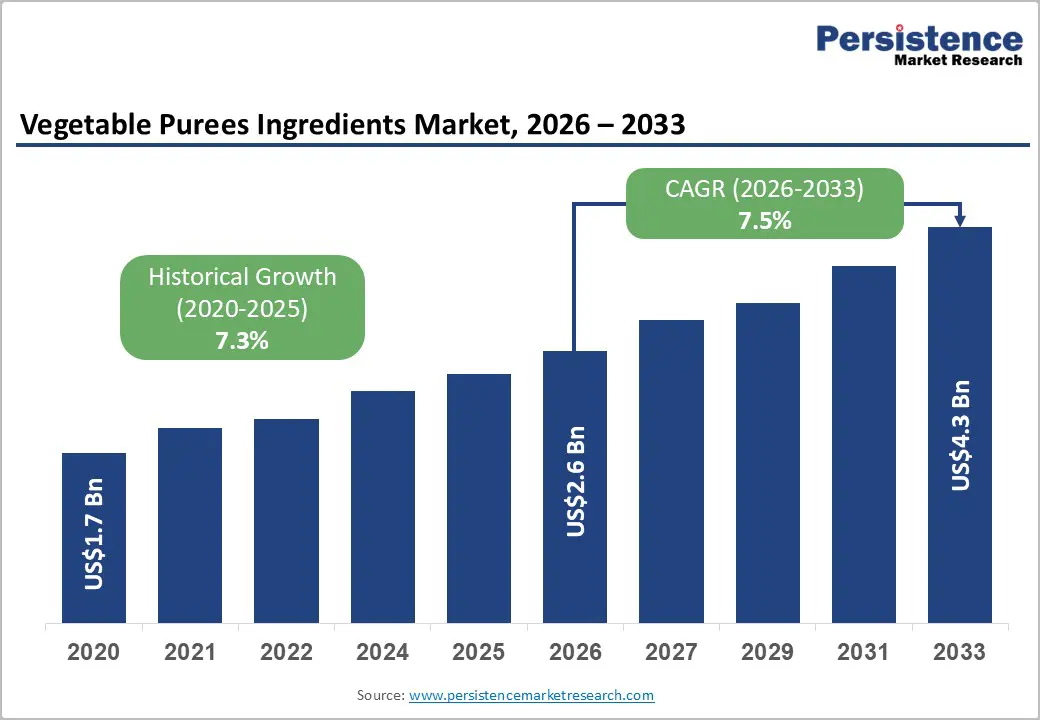
The global vegetable purees ingredients market size is likely to be valued at US$2.6 billion in 2026 and is expected to reach US$4.3 billion by 2033, growing at a CAGR of 7.5% during the forecast period from 2026 to 2033, driven by the need for versatile, nutrient-retaining ingredients that support industrial food formulation while adhering to clean-label, natural, and safety standards.
Growth is closely linked to rising consumer preference for plant-based, minimally processed, and convenient foods, as well as increasing interest in functional and fortified products that offer nutritional benefits. Technological advancements in processing, including high-pressure processing (HPP), cold-pressing, and aseptic packaging, enable manufacturers to retain natural flavors, colors, and bioactive compounds, enhancing product quality and shelf life. Regulatory frameworks emphasizing food safety, particularly for infant and pediatric nutrition, contribute to steady adoption. Increasing innovation in product types, including purees from root vegetables, leafy greens, legumes, and tubers, catering to evolving applications in beverages, snacks, sauces, and culinary ingredients.
Key Industry Highlights:
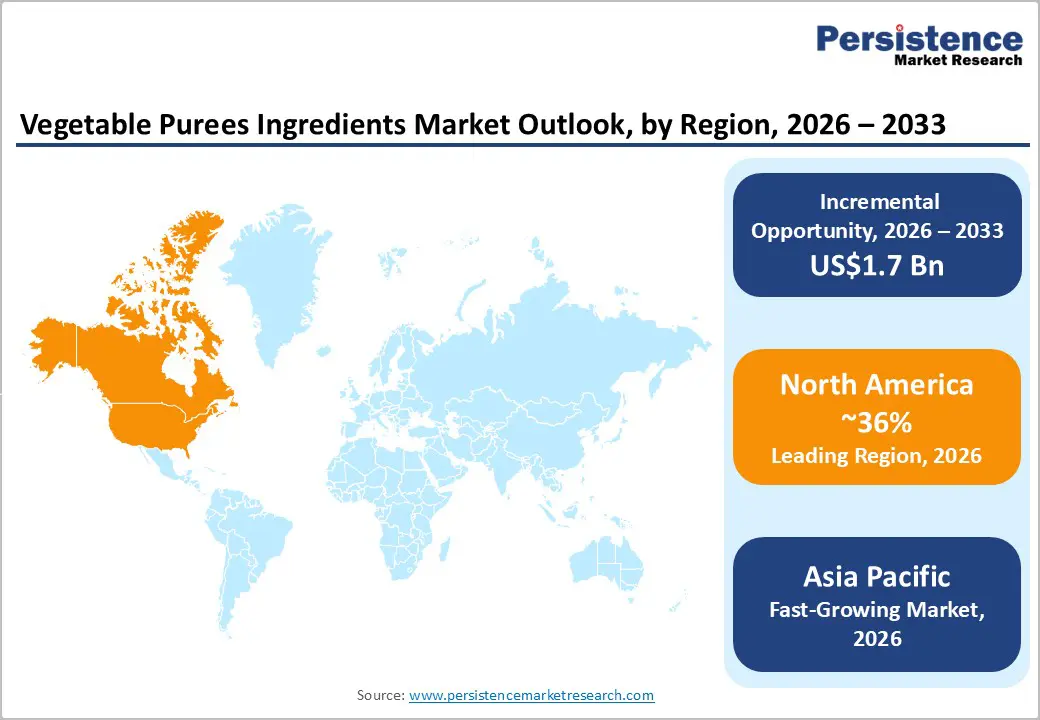
- Leading Region: North America is anticipated to be the leading region, accounting for a market share of 36% in 2026, driven by strong demand for infant nutrition, plant-based foods, advanced processing infrastructure, and regulatory emphasis on safety and traceability.
- Fastest-growing Region: Asia Pacific is likely to be the fastest-growing region in the vegetable purees ingredients in 2026, supported by rapid growth in convenience foods, abundant raw materials, and expanding processing capacity.
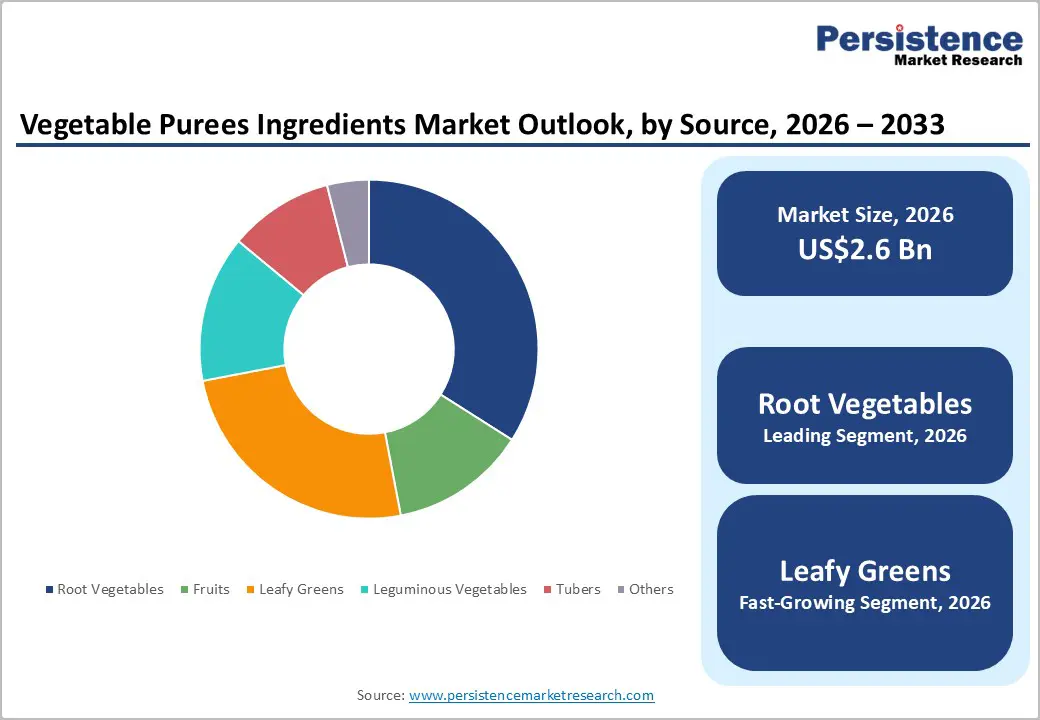
- Leading Source Type: Root vegetables are projected to represent the leading source type in 2026, accounting for 36% of the revenue share, driven by high-volume applications in tomato, carrot, and beet purees.
- Leading Form Type: The concentrated segment is anticipated to be the leading form type, accounting for over 40% of the revenue share in 2026, supported by ease of incorporation in sauces, beverages, and industrial food formulations.
| Key Insights | Details |
|---|---|
| Vegetable Purees Ingredients Market Size (2026E) | US$2.6 Bn |
| Market Value Forecast (2033F) | US$4.3 Bn |
| Projected Growth (CAGR 2026 to 2033) | 7.5% |
| Historical Market Growth (CAGR 2020 to 2025) | 7.3% |
DRO Analysis
Driver Analysis- Rising Demand for Convenience Foods and Infant Nutrition
The growing urban population and busier lifestyles are fueling demand for convenient, ready-to-use food ingredients, including vegetable purees. Manufacturers increasingly rely on purees for baby foods, soups, sauces, and ready-to-eat meals, as they offer consistent quality, nutrition retention, and ease of incorporation. Industrial-scale vegetable purees allow producers to maintain uniform flavor, color, and texture, meeting the expectations of modern consumers. This demand extends across retail and foodservice channels, with packaged baby foods particularly benefiting from nutrient-rich purees.
Vegetable purees also support fortified and functional products, enabling manufacturers to meet growing parental demand for nutritious infant foods. The segment’s appeal lies in retaining natural vitamins, minerals, and bioactive compounds while minimizing processing steps. As more households shift toward ready-to-eat and on-the-go solutions, the reliance on high-quality vegetable purees increases. Regulatory emphasis on infant food safety, including traceability and contaminant control, reinforces market trust. Manufacturers are leveraging these trends to innovate new formulations, expand product portfolios, and address both urban and emerging-market consumer segments.
Growth of Plant-Based and Flexitarian Diets
Increasing health awareness and environmental concerns are driving consumers toward plant-based and flexitarian diets. Vegetable purees serve as essential ingredients for plant-forward formulations, providing natural color, flavor, and texture while enhancing nutritional profiles. Their incorporation into soups, sauces, snacks, and beverages supports clean-label claims, reducing reliance on artificial additives. Rising adoption of vegetarian and flexitarian lifestyles encourages food manufacturers to reformulate products, replace animal-derived components, and create innovative, plant-based alternatives using root vegetables, leafy greens, and legumes.
The trend also aligns with sustainability initiatives and corporate ESG goals, making plant-based products more attractive in retail and foodservice channels. Vegetable purees allow manufacturers to cater to flexitarians seeking balanced diets without compromising convenience. Their versatility supports the development of functional foods, ready meals, and bakery items, meeting nutritional and taste expectations simultaneously. Emerging markets with growing middle-class populations are adopting plant-forward diets, expanding opportunities for purees in traditional and modern recipes, and establishing long-term growth prospects for this ingredient category.
Restraint Analysis - Consumer Perception Favoring Fresh Over Processed
Despite technological advances in nutrient retention, many consumers perceive processed vegetable ingredients as inferior to fresh produce in taste and health benefits. This preference can limit the adoption of purees in home cooking and premium retail segments. Fresh vegetables are often associated with higher vitamin content, better texture, and minimal chemical exposure, making some consumers hesitant to accept processed alternatives. Marketing efforts emphasizing natural and minimally processed claims attempt to bridge this perception gap but are met with varying success depending on consumer education and cultural habits.
The freshness bias affects product positioning in premium foodservice and baby food segments, where parents and chefs may prefer freshly prepared ingredients. While industrial-scale purees provide convenience and consistency, consumer skepticism about processing methods, additives, and shelf-life interventions can slow market penetration. Overcoming these perceptions requires transparent labeling, certifications, and demonstrations of retained nutritional value. Manufacturers also invest in sensory optimization to mimic fresh produce taste and appearance, gradually addressing consumer concerns while maintaining the operational advantages of processed vegetable purees.
Regulatory Hurdles On Contaminants and Nitrates
Strict regulations on contaminants, pesticide residues, and nitrate levels present challenges for large-scale vegetable puree production. Food safety authorities impose stringent testing and reporting requirements to ensure suitability for infant foods, beverages, and ready-to-eat meals. Compliance with these regulations increases production costs and limits sourcing flexibility, particularly in regions where agricultural practices are inconsistent or where raw material monitoring is inadequate. Manufacturers must implement robust quality assurance systems, including traceability, testing protocols, and third-party certifications, to meet regulatory expectations.
Exceeding permissible nitrate or contaminant levels can lead to recalls, reputational damage, and restricted market access, especially in baby food and export segments. Regulatory compliance also drives investment in advanced processing technologies, such as HPP or UV treatment, to reduce microbial risk and maintain safety standards. While essential for public health, these regulatory hurdles require constant monitoring of raw materials, strict adherence to food safety protocols, and strategic supply chain management, adding operational complexity for producers of vegetable purees in both domestic and international markets.
Opportunity Analysis - Organic and Plant-Based Convergence
The growing consumer preference for organic and plant-based foods offers significant opportunities for vegetable puree producers. Combining organic certification with plant-forward formulations allows manufacturers to create premium products that appeal to health-conscious and environmentally aware consumers. Organic purees support clean-label claims and sustainable sourcing, enhancing brand reputation while commanding higher retail pricing. This convergence also enables innovation in product lines, from baby foods to sauces and beverages, targeting niche segments seeking chemical-free, minimally processed ingredients.
The organic plant-based trend aligns with sustainability initiatives, allowing manufacturers to market products emphasizing reduced pesticide use, responsible water management, and carbon footprint reduction. Retailers and foodservice operators increasingly demand organic purees for value-added products, creating opportunities for long-term contracts and stable supply agreements. Investments in traceable organic sourcing, certification, and processing infrastructure can differentiate manufacturers in a competitive landscape, tapping into the premium segment while addressing growing consumer awareness of health, wellness, and environmental responsibility.
Functional Food Innovations
Vegetable purees offer versatility for functional food development, enabling the fortification of products with vitamins, minerals, fibers, and bioactive compounds. Manufacturers can leverage phytonutrient-rich purees from leafy greens, root vegetables, and legumes to create health-focused soups, snacks, beverages, and infant nutrition items. Functional claims, such as immune support, digestive health, and antioxidant benefits, resonate with increasingly health-conscious consumers seeking added value beyond basic nutrition. This trend opens new product lines and premium positioning opportunities in retail and foodservice markets.
Advances in processing technologies, such as HPP and spray-drying, preserve bioactive compounds while maintaining taste and color, supporting functional innovation. Collaboration with nutritionists, research institutions, and food technologists enables the creation of targeted formulations addressing specific health concerns. Functional vegetable purees can be incorporated into plant-based diets and ready-to-eat meals, providing convenience without compromising nutritional integrity. As consumers prioritize preventive health and wellness, functional food innovations using vegetable purees represent a significant growth avenue for ingredient manufacturers.
Category-wise Analysis
Source Type Insights
Root vegetables are expected to lead the vegetable purees ingredients market, accounting for approximately 36% of revenue in 2026, driven by their extensive use in sauces, soups, and infant nutrition products. Tomato purees, in particular, exemplify this dominance, being a staple ingredient across industrial food processing due to their consistent flavor, color, and texture. Large-scale food manufacturers prefer root vegetable purees for their versatility in both concentrated and liquid forms, allowing seamless integration into ready-to-eat meals, beverages, and sauces. For example, carrot puree is widely incorporated into baby food formulations due to its beta-carotene content, blending ease, and mild taste.
Leafy greens are likely to represent the fastest-growing segment, supported by rising consumer interest in health-focused, plant-based, and flexitarian products. Spinach puree illustrates this trend, increasingly used in smoothies, functional beverages, plant-based meals, and nutritional blends due to its rich phytonutrient content. For example, spinach puree is increasingly incorporated into plant-based pasta and beverage products, demonstrating both versatility and alignment with contemporary dietary preferences, positioning leafy greens as the fastest-growing source type in the vegetable puree market.
Form Type Insights
Concentrated form is projected to lead the market, capturing around 40% of the revenue share in 2026, supported by its convenience, ease of incorporation, and suitability in large-scale food production. These forms allow manufacturers to blend vegetable purees efficiently into sauces, soups, beverages, and ready-to-eat meals without compromising flavor or color. For example, concentrated tomato puree is widely used in industrial pasta sauces, providing a consistent taste profile and long shelf life, making it essential for food brands. The concentrated format also supports high-value applications such as infant nutrition, where nutrient density and purity are critical.
Powdered forms are likely to be the fastest-growing form type, driven by long shelf life, reduced logistics burden, and suitability for dry mixes and bakery applications. For example, powdered carrot puree is increasingly used in nutritional powders, ready-to-mix soups, and snack formulations, offering convenience for both manufacturers and consumers. Technological improvements in spray-drying and instant freezing (IQF) preserve nutrients, color, and flavor, making powdered forms suitable for premium products and functional applications. Sustainability trends also encourage powdered usage, as reduced spoilage and lighter transport weight lower environmental impact.
Regional Insights
North America Vegetable Purees Ingredients Market Trends
North America is anticipated to be the leading region, accounting for a market share of 36% in 2026, driven by rapid urbanization, rising disposable incomes, and expanding food processing industries in China, India, and ASEAN countries. Demand for convenience foods, ready meals, and healthier product options encourages manufacturers to incorporate vegetable purees into sauces, snacks, beverages, and infant food formulations. Regional consumers increasingly seek plant-based, functional, and nutrient-rich food ingredients, prompting local and multinational companies to innovate in concentrated, liquid, and powdered vegetable purees.
Regulatory alignment with international safety norms ensures products are suitable for both domestic use and export markets. For example, SVZ Industrial Vegetable and Fruit Ingredients, which supplies single-strength vegetable purees and concentrates across Asia Pacific. SVZ’s product range supports manufacturers seeking natural, clean-label vegetable ingredients suitable for diverse applications across beverages, sauces, ready meals, and snacks.
Europe Vegetable Purees Ingredients Market Trends
Europe is likely to be a significant market for vegetable puree ingredients in 2026, due to strong consumer demand for natural, additive-free, and functional foods. Countries including Germany, France, and the U.K. emphasize clean-label and organic product attributes, encouraging food manufacturers to use vegetable purees from root vegetables, leafy greens, and tubers in sauces, ready meals, and infant nutrition. Stringent European food safety regulations and organic certification standards drive quality assurance and traceability throughout the supply chain.
Technological advancements such as high-pressure processing (HPP) and aseptic packaging are increasingly adopted to preserve nutritional profiles and extend shelf life without artificial preservatives. For example, Dohler GmbH, which supplies natural and functional vegetable purees to European food and beverage manufacturers. Dohler focuses on nutrient-rich purees from carrots, spinach, and tomatoes for infant foods, beverages, and plant-based meals.
Asia Pacific Vegetable Purees Ingredients Market Trends
The Asia Pacific region is likely to be the fastest-growing region in 2026, driven by urbanization, rising disposable incomes, and increasing demand for convenience foods, ready-to-eat meals, and infant nutrition. Countries such as China, India, and ASEAN nations are expanding production capacity, leveraging abundant raw materials and lower labor costs. Government incentives for food processing and modern infrastructure enable manufacturers to adopt high-pressure processing and spray-drying, which preserve nutrients, color, and flavor.
Consumer trends for plant-based, functional, and nutrient-rich products drive adoption in beverages, sauces, snacks, and baby foods. For example, Kagome Co. Ltd., which supplies tomato and carrot purees across the Asia Pacific region. Kagome focuses on nutrient retention, clean-label processing, and sustainable sourcing, catering to both domestic food manufacturers and exporters. Their innovation in concentrated, liquid, and powdered forms supports the fast-growing demand for high-quality, functional vegetable purees across multiple applications.
Competitive Landscape
The global vegetable purees ingredients market exhibits a moderately fragmented structure, driven by the coexistence of large multinational food manufacturers and specialized puree suppliers competing across geographic regions and application segments. Major players vary from well-established food conglomerates to niche ingredient producers who focus heavily on vegetable puree solutions for sauces, baby foods, beverages, and emerging plant-based formulations. These companies operate across diverse markets while investing in product innovation, clean-label formulations, and sustainable sourcing practices to address shifting consumer preferences toward wholesome, convenient, and nutrient-rich ingredients.
With key leaders including SVZ Industrial Vegetable and Fruit Ingredients, Dohler GmbH, Kagome Co., Ltd., Nestlé S.A., and The Hain Celestial Group Inc., competition is characterized by continuous product portfolio expansion, processing technology upgrades, and sustainability initiatives. These players compete through differentiation in product quality, adoption of advanced preservation technologies, and strategic partnerships to enhance market reach. Emphasis on organics, fortified and mixed-vegetable purees, and tailored solutions for foodservice and industrial clients helps brands gain share.
Key Industry Developments:
- In March 2026, Once Upon a Farm unveiled a range of new organic products targeted at infant and children’s nutrition, expanding beyond traditional vegetable-based purees to meet evolving market demand for nutrient-dense, clean-label foods. The Berkeley, California-based company introduced refrigerated, cold-pressure-protected pouches featuring organic legume blends such as black bean and chickpea alongside protein-fortified smoothies with probiotics and soft snack bars made with whole grains, fruits, and vegetables.
- In September 2025, SVZ International B.V. announced the strategic expansion of its fruit and vegetable ingredient portfolio by fully integrating tropical fruit specialist SVZ International B.V.’s subsidiary Netra Agro into its core operations, reinforcing its position as a comprehensive supplier of vegetable and fruit ingredients worldwide. The integration brings Netra Agro’s nearly three decades of expertise in sourcing and supplying high-quality tropical fruit ingredients such as mango, banana, and pineapple in formats including purees, IQF pieces, and concentrates directly into SVZ’s main portfolio.
Companies Covered in Vegetable Purees Ingredients Market
- The Hain Celestial Group Inc.
- Kiril Mischeff Ltd.
- SVZ International B.V.,
- Dohler Gmbh
- Encore Fruit Marketing Inc.
- Kagome Co. Ltd.
- Incorporated Ingredient
- Ariza BV
- Nestlé S.A.
- F&S Produce Co., Inc.
- Grunewald International
- Dennick FruitSource LLC
- Les Vergers Boiron
- Baby Gourmet Foods
- Beech-Nut
Frequently Asked Questions
The global vegetable purees ingredients market is projected to reach US$2.6 billion in 2026.
The vegetable purees ingredients market is driven by rising demand for convenient, nutrient‑rich, and clean‑label foods across infant nutrition, ready-to-eat meals, and plant-based products.
The vegetable purees ingredients market is expected to grow at a CAGR of 7.5% from 2026 to 2033.
Key market opportunities lie in the growing demand for organic, plant-based, and functional vegetable purees for health-focused and clean-label food products.
The Hain Celestial Group Inc., Kiril Mischeff Ltd., SVZ International B.V., and Dohler GmbH are the leading players.


