




- Aerospace & Defense
- Underwater Towed Array Sonar Systems Market
Underwater Towed Array Sonar Systems Market Size, Share, and Growth Forecast 2026 - 2033
Underwater Towed Array Sonar Systems Market by Component (Hydrophone Array, Towing Cable), Application (Defense, Commercial), Platform (Surface Vessels, Submarines), End-User (Naval Forces, Maritime Security Agencies), and Regional Analysis, 2026 - 2033

Underwater Towed Array Sonar Systems Market Size and Trend Analysis
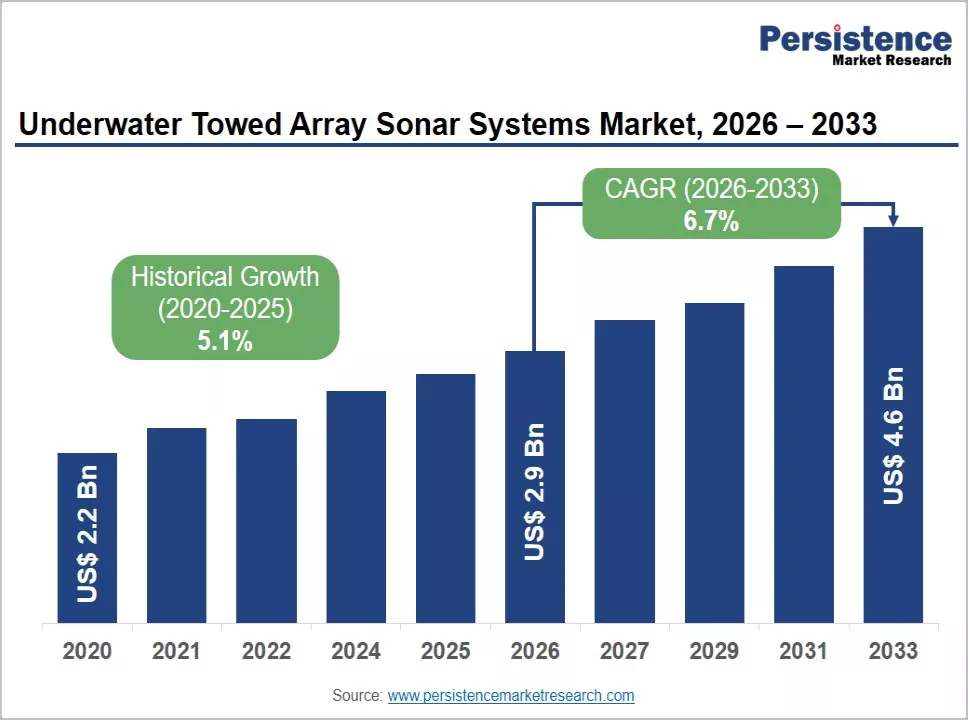
The global underwater towed array sonar systems market size is likely to be valued at US$ 2.9 billion in 2026, and is estimated to reach US$ 4.6 billion by 2033, growing at a CAGR of 6.7% during the forecast period 2026 - 2033.
Growth is underpinned by escalating anti-submarine warfare requirements, naval fleet modernization programs, and rising investments in undersea domain awareness across developed and emerging economies.
The market has been experiencing steady growth, reflecting long procurement cycles and program timing variations. However, the forecast period anticipates stronger acceleration as navies replace legacy arrays, adopt modular and containerized systems for a wider set of platforms, and integrate advanced signal processing and artificial intelligence to detect quieter submarines.
Key Industry Highlights
- Dominant Components: Hydrophone arrays are set to command around 38% of the revenue share in 2026, while signal processing units are likely to grow the fastest at 7.8% CAGR through 2033, as navies adopt advanced detection algorithms.
- Leading Applications: Defense is expected to lead with 83% in 2026, while scientific research is likely to be the fastest-growing at about 7.2% CAGR during 2026 - 2033, reflecting expanding ocean monitoring and marine mammal detection programs.
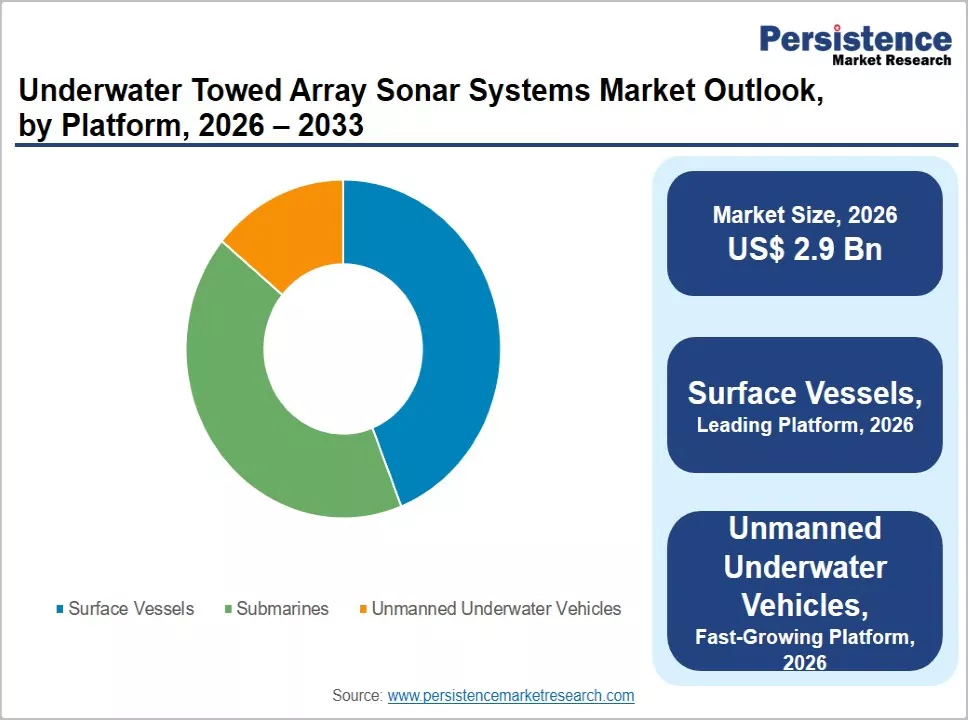
- Dominant Platform: Surface vessels are anticipated to lead with an estimated 47% share in 2026, while unmanned underwater vehicles are slated to represent the fastest-growing platform segment at 11.5% CAGR from 2026 to 2033.
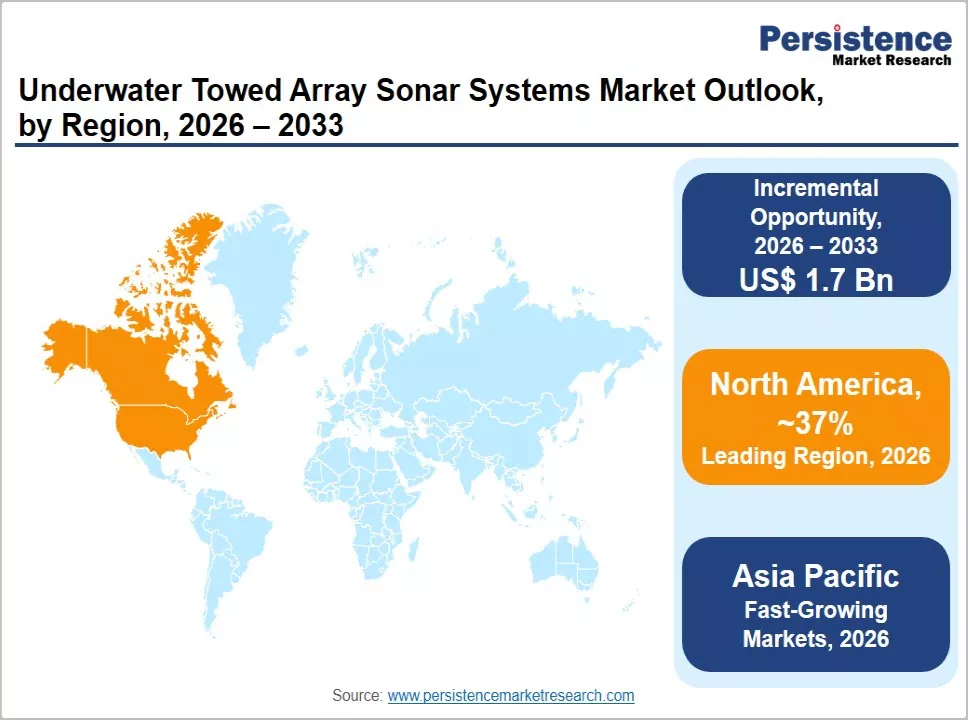
- Regional Leadership: North America is poised to dominate with an estimated 37% share in 2026, while Asia Pacific is projected to register the fastest growth at 8.3% CAGR through 2033, led by China, India, and Australia.
- Competitive Environment: Competitive dynamics include multi-year production contracts, modular system launches for smaller platforms, and expansion of export programs in Europe and Asia Pacific.
DRO Analysis
Drivers: Anti-Submarine Warfare Priorities and Fleet Modernization as Primary Growth Catalysts
Anti-submarine warfare modernization is the leading force driving the underwater towed array sonar systems market growth, as navies respond to the proliferation of quieter, more capable submarines and the growing strategic importance of undersea infrastructure. Towed arrays extend detection range by placing hydrophones away from the noise of the host vessel, making them essential for submarines, frigates, destroyers, and patrol vessels.
The U.S. Navy is sustaining production of thin-line and fat-line arrays, with L3Harris receiving contracts in January 2026 for TB-29C and TB-34A systems, and further agreements in April 2026 to support production through 2029. Allied navies in Europe, the Asia Pacific, and North America are also specifying towed array sonar for new surface combatants.
Digital Signal Processing and Multi-Static Operations
Advances in digital beamforming, machine learning classification, and fiber-optic hydrophone technology are improving detection range and reducing false alarms. Integration with multistatic networks and unmanned platforms allows navies to cover larger areas with fewer crewed assets, strengthening procurement momentum.
Restraints: High System Costs, Long Procurement Cycles, and Export Controls
Towed array sonar systems involve high development, testing, and integration costs, and procurement of sovereign defense capabilities proceeds through lengthy approval processes. Budget reprioritization, delays in shipbuilding programs, and the high price of advanced arrays limit adoption among smaller navies. Export controls and technology transfer restrictions further constrain international sales and require suppliers to navigate complex licensing and gvernment-to-government arrangements.
Technical Complexity and Skilled Workforce Gaps
Towed arrays require precise handling systems, reliable tow cables, and specialized operators, and failures at sea can be costly to repair. Integrating sonar with host vessel combat systems and maintaining array performance across varying ocean conditions demand skilled engineers and operators, which are in limited supply. These factors can delay installation and increase lifecycle costs.
Opportunities: Containerized Systems, Unmanned Platforms, and Naval Expansion in Asia Pacific
Modular and containerized arrays are making towed array sonar accessible for a wider range of platforms. In July 2026, OPTICS11 secured a Dutch Ministry of Defence contract for a containerized towed array system, which is designed to be deployed on existing crewed and uncrewed maritime platforms rather than only dedicated anti-submarine vessels. Compact arrays for unmanned underwater vehicles and unmanned surface vessels are likely to expand the addressable market and reduce costs for navies and maritime security agencies.
Regional Naval Buildups and Dual-Use Applications
Naval expansion in the Indo-Pacific, along with new offshore patrol vessel and submarine programs, is creating sustained demand for sonar suites. The Philippine Navy, for example, has planned modular towed array sonar for several of its new offshore patrol vessels. Commercial surveys, marine mammal monitoring, and scientific research are also emerging as complementary applications for lower-cost array systems.
Category-wise Insights
Component Analysis
Why Do Hydrophone Arrays Lead the Underwater Towed Array Sonar Systems Market?
Hydrophone arrays are the leading component segment, expected to hold about 38% of the underwater towed array sonar systems market revenue share in 2026. They form the core sensing element, consisting of numerous acoustic sensors arranged along a flexible line to capture low-frequency signals. Performance depends on sensitivity, noise reduction, and durability, and arrays require periodic replacement and upgrading. Programs such as thin-line and fat-line arrays for submarines and frigates provide steady production volumes and recurring spares demand.
Signal processing units are likely to grow the fastest through 2033. These units perform beamforming, filtering, target classification, and tracking, and are increasingly software-defined, allowing capability upgrades without replacing hardware. Navies are investing in artificial intelligence-enabled detection to manage large data volumes and identify quiet targets, while open architectures enable integration with combat management systems and multistatic networks.
Application Analysis
Which Application Dominates Underwater Towed Array Sonar Systems?
Defense dominates the application segment, projected to capture about 83% of the revenue share in 2026. Naval forces and maritime security agencies use towed arrays for submarine detection, tracking, and surveillance, and consider them critical to protecting sea lines of communication and carrier groups. Defense procurement is characterized by multi-year contracts, high performance requirements, and strong support from national security budgets, which provides revenue stability.
Scientific research represents the fastest-growing application segment, anticipated to achieve about 7.2% CAGR during the 2026 - 2033 period. Research vessels use towed arrays for seabed profiling, marine mammal monitoring, and acoustic oceanography, while environmental regulations increase demand for passive acoustic monitoring near offshore construction. Commercial uses in offshore energy and seismic surveys are smaller but expanding as compact, lower-cost arrays become available.
Platform Analysis
Why Do Surface Vessels Lead Towed Array Sonar Deployment?
Surface vessels are poised to lead with an estimated 47% share in 2026, reflecting the large number of frigates, destroyers, corvettes, and offshore patrol vessels equipped with towed array sonar. New shipbuilding programs commonly specify variable-depth or towed sonar to support anti-submarine missions. Thales Canada, for instance, won a contract in June 2026 to supply S2087 towed array systems for the Royal Canadian Navy’s future River-class destroyers, illustrating continuing demand from new surface combatants.
Unmanned underwater vehicles are the fastest-growing platform in towed array sonar, expected to showcase an approximate 11.5% CAGR through 2033. Compact arrays on autonomous vehicles offer persistent, lower-risk surveillance and can operate alongside crewed ships to extend coverage. Navies are testing and procuring unmanned systems for anti-submarine warfare and mine countermeasures, while submarines maintain a large installed base requiring replacement and upgrades of arrays.
Regional Insights
North America Underwater Towed Array Sonar Systems Market Trends and Insights
North America is anticipated to account for an estimated 37% of the global underwater towed array sonar systems market in 2026. The region’s market is likely to benefit from the largest naval budget globally, active submarine programs, and sustained investment in undersea surveillance. Long-term production agreements and support contracts are providing demand visibility for domestic suppliers. Competition among established defense primes and specialized sonar manufacturers is expected to remain concentrated, while new entrants focus on modular and unmanned solutions through 2033.
U.S. Underwater Towed Array Sonar Systems Market Size
The U.S. is estimated to account for approximately 85% of the North America underwater towed array sonar systems market in 2026. Market growth is likely to be supported by TB-29C and TB-34A production programs for attack submarines, towed array support contracts, and surveillance ship operations, including a large multi-year contract for operating towed-array surveillance vessels awarded in April 2026. Industrial base sustainment is a priority for the Navy, and contracts extending production through 2029 are expected to preserve domestic capabilities.
Canada Underwater Towed Array Sonar Systems Market Size
Canada is projected to represent approximately 8% of the North America underwater towed array sonar systems market in 2026. Market expansion is expected to be driven by fleet renewal under the national shipbuilding strategy, including the River-class destroyer program, and increased attention to Arctic and coastal surveillance. Procurement of towed array sonar for future destroyers and potential submarine acquisition plans are likely to support demand for advanced sonar systems and related integration services through 2033.
Europe Underwater Towed Array Sonar Systems Market Trends and Insights
Europe is estimated to account for approximately 17% of the global underwater towed array sonar systems market in 2026. The region’s market is expected to benefit from rising defense budgets, concern over Baltic and North Atlantic undersea security, and frigate and submarine renewal programs. European manufacturers, including Thales, Atlas Elektronik, Kongsberg, and Leonardo, offer a broad portfolio of towed array and variable-depth sonar systems. Cooperation on joint procurement and growing interest in containerized sonar for flexible platforms are expected to shape competition through 2033.
U.K. Underwater Towed Array Sonar Systems Market Size
The U.K. is anticipated to account for approximately 24% of the Europe underwater towed array sonar systems market in 2026. Demand is expected to be supported by Royal Navy frigate programs, submarine fleet modernization, and the AUKUS partnership’s focus on undersea capabilities. Domestic sonar specialists and export-oriented manufacturers are likely to benefit from continued investment in anti-submarine warfare and seabed protection. Emphasis on autonomous systems and persistent monitoring is projected to support market expansion through 2033.
Why Is Asia Pacific Expected to Be the Fastest-Growing Region in the Underwater Towed Array Sonar Systems Market?
Asia Pacific is projected to account for approximately 26% of the global underwater towed array sonar systems market in 2026, with the region anticipated to register the fastest growth at an estimated CAGR of 8.3% through 2033. Market expansion is likely to be driven by naval buildups, territorial maritime tensions, and submarine fleet expansion. China, India, Japan, South Korea, and Australia are expected to remain the primary demand centers, while Southeast Asian navies are increasingly acquiring modular towed array systems for offshore patrol vessels and frigates.
China Underwater Towed Array Sonar Systems Market Size
China is estimated to represent approximately 30% of the Asia Pacific underwater towed array sonar systems market in 2026. The country’s market is expected to benefit from rapid expansion of its submarine and surface combatant fleets and extensive investment in domestic anti-submarine technologies. Indigenous development of hydrophone arrays and signal processing capabilities is likely to reduce reliance on imports. Continued naval modernization and deployment of unmanned undersea systems are projected to sustain China’s regional market leadership through 2033.
India Underwater Towed Array Sonar Systems Market Size
India is projected to account for approximately 19% of the Asia Pacific underwater towed array sonar systems market in 2026. The market is expected to witness strong expansion, supported by anti-submarine corvette and frigate programs, submarine construction, and growing emphasis on indigenous defense manufacturing. Government initiatives to localize naval electronics and sonar are likely to encourage partnerships between domestic firms and international suppliers. Increasing Indian Ocean surveillance requirements are also expected to support procurement of towed array sonar systems.
Competitive Landscape
The global underwater towed array sonar systems market structure is moderately consolidated, with the top suppliers, including L3Harris, Thales, RTX, and Lockheed Martin, controlling a significant share of the revenue. These established players leverage long-standing naval relationships, extensive sonar intellectual property, and integration expertise with combat systems. They are also known to invest heavily in digital signal processing, fiber-optic sensing, and artificial intelligence to maintain technological leadership.
Regional and niche competitors such as Atlas Elektronik, Kongsberg Maritime, Leonardo, Saab, Ultra Maritime, and OPTICS11 are focusing on specialized segments and geographic strongholds. Barriers such as security clearances, government certification, and system integration requirements limit new entrants, but modular, containerized, and unmanned solutions are creating openings for agile technology firms. Market consolidation is expected to increase gradually as larger defense groups acquire sonar specialists and collaborate through international partnerships.
Key Market Developments
- In July 2026, OPTICS11 secured a contract from the Dutch Ministry of Defence for a containerized towed array system designed for use on existing crewed and uncrewed maritime platforms.
- In June 2026, Thales Canada won a contract from Lockheed Martin Canada to supply S2087 towed array sonar systems for the Royal Canadian Navy’s future River-class destroyers.
- In January 2026, L3Harris received U.S. Navy contracts for TB-34A fat-line towed arrays valued at US$ 22.9 million and for TB-29C thin-line towed arrays to support production for submarines.
Companies Covered in Underwater Towed Array Sonar Systems Market
- L3Harris Technologies, Inc.
- Thales Group
- RTX Corporation
- Lockheed Martin Corporation
- Leonardo S.p.A.
- Atlas Elektronik GmbH
- Kongsberg Maritime AS
- Saab AB
- Ultra Maritime
- OPTICS11
- Teledyne Technologies Incorporated
Frequently Asked Questions
The global underwater towed array sonar systems market is valued at US$ 2.9 billion in 2026 and is projected to reach US$ 4.6 billion by 2033, expanding at a CAGR of 6.7% during 2026 - 2033.
Escalating anti-submarine warfare requirements, naval fleet modernization programs, and rising investments in undersea domain awareness are driving the market.
Hydrophone arrays lead components with about 38% share, defense leads applications with about 83%, and surface vessels lead platforms with an estimated 47% in 2026.
North America dominates with an estimated 37% share in 2026, supported by the largest naval budget globally and active submarine programs, while Asia Pacific is projected to grow fastest at 8.3% CAGR through 2033.
Containerized and modular systems, unmanned platform integration, and naval expansion in Asia Pacific are key market opportunities.
The market is moderately consolidated, with L3Harris, Thales, RTX, and Lockheed Martin controlling a significant share of the revenue.


