




- Aerospace & Defense
- Search and Rescue (SAR) Equipment Market
Search and Rescue (SAR) Equipment Market Size, Share, and Growth Forecast 2026–2033
Search and Rescue (SAR) Equipment Market by Equipment Type (Rescue Equipment, Search Equipment, Communication Equipment, Technical Equipment), Platform (Airborne, Marine, Ground-Based), Application (Combat SAR, Urban SAR), and Regional Analysis, 2026–2033

Search and Rescue (SAR) Equipment Market Size and Trend Analysis
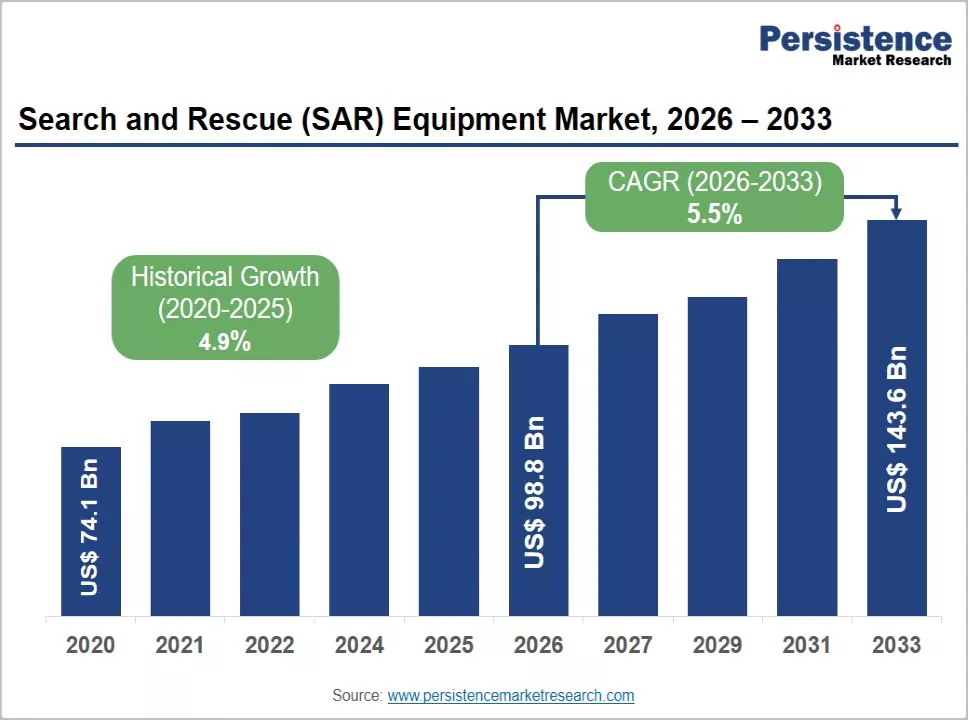
The global search and rescue (SAR) equipment market size is likely to be valued at US$ 98.80 billion in 2026 and is projected to reach US$ 143.60 billion by 2033, growing at a CAGR of 5.5% during the forecast period between 2026 and 2033.
A rising frequency of weather-related disasters, growing maritime and backcountry traffic, and renewed defense investment in personnel recovery are reshaping procurement priorities across the search and rescue equipment industry, compelling agencies and armed forces to modernize helicopters, sensors, hoists, and communications.
This trajectory reflects sustained demand from coast guards, civil protection bodies, and military rescue units, alongside a shift toward unmanned platforms, thermal imaging, and satellite-linked situational awareness. The World Meteorological Organization has documented a roughly fivefold increase in recorded weather, climate, and water-related disasters between 1970 and 2019, a structural trend that rewards suppliers with certified, interoperable, mission-ready systems.
Key Industry Highlights
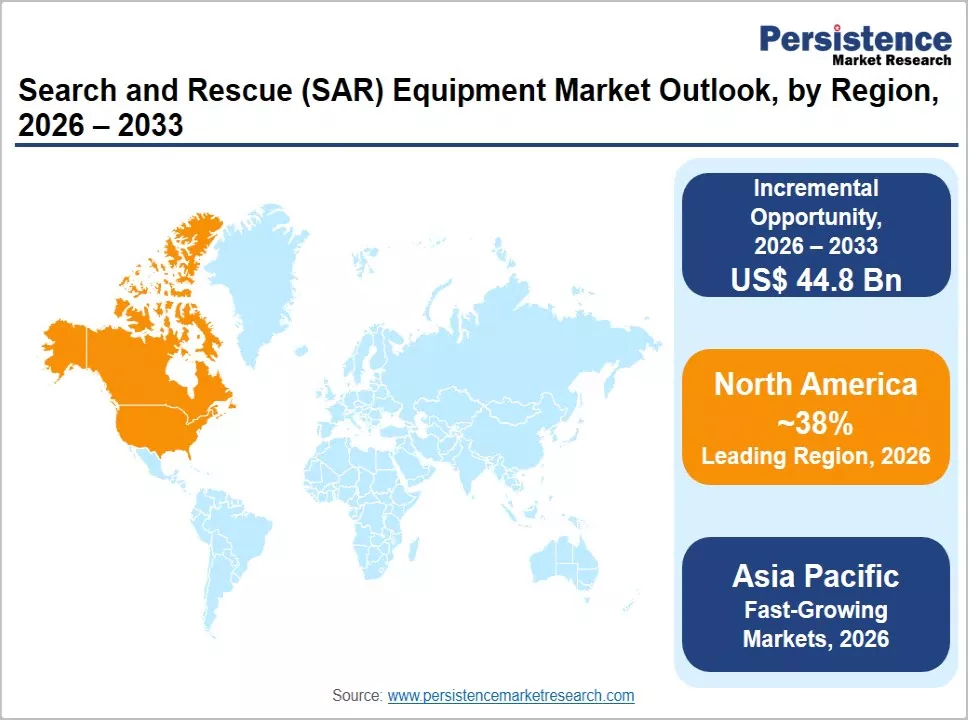
- Dominant Region: North America is forecast to dominate the regional market, hold about 38% market share in 2026. Large defense budgets, extensive coast guard and civil search and rescue (SAR) networks, and ongoing helicopter fleet recapitalization are collectively sustaining demand for advanced rescue and search systems, a position the region will retain through 2033.
- Fastest-growing Region: Growing at a CAGR of 6.9%, Asia Pacific is outpacing every other region in the SAR equipment industry. Expanding maritime patrol mandates, rising natural disaster exposure, and national investments in coast guard and civil defense capability across Japan, India, China, and Southeast Asia are jointly accelerating equipment procurement.
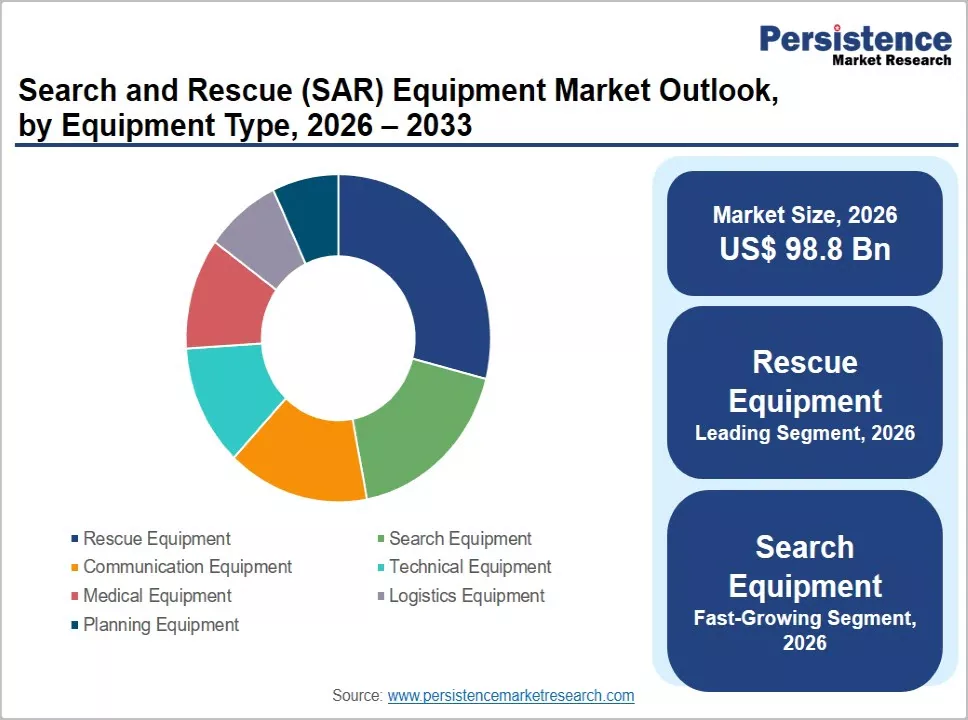
- Dominant Equipment Type: Rescue equipment holds 29% of market share in 2026, fueled by recurring replacement cycles for hoists, litters, rescue boats, rope systems, and extraction tools. Its leadership is structurally stable, as these items are consumable, safety-critical, and subject to mandatory inspection and recertification.
- Fastest-growing Equipment Type: Search equipment is gaining share rapidly as thermal imaging, electro-optical and infrared payloads, radar, and drone-borne sensors shorten the time required to locate survivors across large areas. Thales’ July 2026 introduction of a new-generation Search & Landing Light for helicopters signals continued investment in airborne detection capability.
- Leading Platform and Application: Airborne platforms account for around 46% of market share in 2026, while Combat SAR leads applications at about 58%. Ground-based platforms and Urban SAR are expected to expand fastest as robotics and drones enter collapsed-structure operations.
DRO Analysis
Driver- Escalating Disaster Frequency and Defense Personnel Recovery Investment
Climate-related floods, wildfires, storms, and earthquakes are increasing the operational tempo of civil rescue organizations, while geopolitical tension is lifting military spending on combat search and rescue. NATO members’ 2025 commitment to raise defense-related spending toward 5% of gross domestic product is broadening the funding pool for rotary-wing, communications, and medical capability.
The U.S. Coast Guard awarded MetOcean a five-year, US$ 10 million contract in April 2026 for iSLDMB search and rescue buoys that improve real-time ocean surface tracking, while Leonardo selected Onboard Systems’ Pegasus rescue hoist for its AW139 platform in February 2026. These programs demonstrate sustained procurement across both maritime and airborne rescue.
Restraint- Long Procurement Cycles, Certification Burden, and Budget Dependence
SAR equipment is largely purchased by governments through multi-year tenders, which lengthens sales cycles and exposes suppliers to budget reprioritization. Rescue hoists, avionics, and life-support systems must secure airworthiness and safety certifications from authorities such as the European Union Aviation Safety Agency (EASA) and the Federal Aviation Administration (FAA), a process that is costly and slow for smaller manufacturers. Export controls on military-grade sensors and communications equipment add another layer of friction, limiting access to growing markets and fragmenting the supplier landscape.
Opportunity- Unmanned Systems, AI-Assisted Detection, and Satellite-Linked Rescue Communications
Unmanned aerial systems are moving from experimental use to contracted capability in SAR. The UKSAR2G program led by Bristow Helicopters is a ten-year contract that adds fixed-wing and unmanned aerial systems services to the U.K.’s helicopter coverage, with a Schiebel Camcopter S-100 contributing to the unmanned layer. Satellite communication devices, including Garmin’s inReach range, and COSPAS-SARSAT beacon networks are extending the reach of distress alerting to backcountry and offshore users, creating a recurring service-linked revenue layer. Suppliers that integrate AI-assisted detection, mission planning, and resilient communications into modular kits are best placed to capture the premium pricing that interoperable systems command.
Category-wise Analysis
Equipment Type Insights
Why Does Rescue Equipment Dominate the SAR Equipment Market?
Rescue equipment is projected to account for nearly 29% of market share in 2026, driven by its mission-critical role and recurring replacement demand. Helicopter hoists, winches, rescue baskets, swift-water craft, rope systems, and hydraulic extrication tools are subject to strict inspection intervals, which generates consistent aftermarket revenue. Onboard Systems, whose rescue hoists the company says hold more EASA and FAA certifications than any other provider, was selected by Leonardo in 2026 for its Pegasus hoist, illustrating how OEM endorsements reinforce category leadership. Specialist suppliers such as CMC Rescue Inc., Weber Rescue Systems, and Cascade Rescue Company maintain strong positions in technical rescue and extrication.
Search equipment is likely to be the fastest-growing equipment type, propelled by electro-optical and infrared sensors, airborne radar, and drone-borne thermal cameras that allow small teams to cover large terrain at night. Communication equipment is also expanding, as satellite messengers, mesh radios, and resilient networks reduce the dead zones that complicate coordination in mountains, oceans, and collapsed urban environments.
Platform Insights
What Keeps Airborne Platforms at the Centre of SAR Operations?
Airborne is estimated to lead the platform segment, capture nearly 46% of market share in 2026, driven by the speed, reach, and hoist capability of helicopters in mountain, maritime, and disaster scenarios. Canada’s mid-life upgrade of its AW101 Cormorant fleet, a contract valued at about CAD 1 billion awarded to Leonardo, and the Swiss air rescue organization Rega’s H145 fleet equipped with Garmin avionics demonstrate sustained investment in rotary-wing capability. Fixed-wing SAR aircraft, such as Canada’s C295-based fleet, extend patrol range and search coverage.
Ground-based platforms are likely to be the fastest-growing segment, catalyzed by robotic crawlers, tracked vehicles, and rescue-specific trucks supplied for urban and disaster response. Marine platforms remain a stable segment anchored by coast guard cutters and rescue boats, and buoys such as MetOcean’s iSLDMB support drift modelling and survivor location.
Application Insights
Combat SAR is estimated to lead the application segment, account for about 58% of market share in 2026, driven by defense modernization programs, including recapitalization of rescue helicopter fleets such as the U.S. Air Force’s HH-60W Jolly Green II, and the need for secure communications, survival equipment, and personnel locator systems in contested environments. Suppliers including RTX Corporation, General Dynamics Corporation, Elbit Systems Ltd, Textron Systems, and Leonardo address this segment through integrated mission systems and sensors.
Urban SAR is likely to be the fastest-growing application, following the lessons of major earthquakes such as the 2023 Türkiye–Syria disaster, in which international rescue teams, coordinated under the International Search and Rescue Advisory Group (INSARAG) framework, relied on acoustic detection, listening devices, shoring, and heavy rescue tools. Governments are expanding national urban search and rescue teams, driving demand for standardized equipment caches and training.
Regional Insights
North America SAR Equipment Market Trends and Insights
North America is forecast to dominate the regional market, capture nearly 38% of market share in 2026, propelled by the scale of U.S. defense spending, extensive coast guard and civil SAR networks, and strong domestic suppliers across avionics, sensors, and rescue tools. Ongoing fleet recapitalization, maritime domain awareness investments, and wildfire and hurricane response needs are sustaining demand for hoists, thermal imagers, and communications. Through 2033, growth will be driven by unmanned systems integration and modernization of coastal search technology.
U.S. SAR Equipment Market Size
The U.S. is projected to hold about 86% of the North America regional market in 2026. The Department of Defense, the U.S. Coast Guard, and the Federal Emergency Management Agency’s urban search and rescue task forces collectively sustain procurement across all equipment categories. Multi-year contracts, such as the Coast Guard’s 2026 buoy award, provide visibility for suppliers through 2033.
Canada SAR Equipment Market Size
Canada is likely to command about 14% of the North America regional market in 2026. The country’s vast coastlines, Arctic territory, and sparsely populated backcountry demand long-range aircraft and helicopters. The Cormorant mid-life upgrade and the fixed-wing search and rescue program illustrate Canada’s long-term commitment to airborne rescue capability.
Europe SAR Equipment Market Trends and Insights
Europe is estimated to account for around 17% of market share in 2026, with a mature civil protection framework, strong helicopter manufacturing base, and increasing defense budgets reinforcing demand. The EU Civil Protection Mechanism and the rescEU reserve are funding pre-positioned rescue capacity for wildfires and floods, while NATO’s eastern flank states are modernizing combat search and rescue. Leonardo, Thales, and Airbus-linked suppliers anchor the regional industrial base.
U.K. SAR Equipment Market Size
The U.K. is projected to account for nearly 23% of the Europe regional market in 2026. The UKSAR2G program, delivered by Bristow Helicopters for the Maritime and Coastguard Agency, brings integrated rotary-wing, fixed-wing, and unmanned services under one ten-year contract, sustaining demand for mission equipment, maintenance, and training systems.
Germany SAR Equipment Market Size
Germany is expected to command nearly 19% of the Europe regional market in 2026. The country’s civil protection agencies, volunteer rescue organizations, and armed forces maintain large demand for hydraulic rescue tools, technical rescue equipment, and rescue helicopters. German specialists such as Weber Rescue Systems are well positioned to supply the domestic base and export markets.
Which Region Will Drive the Fastest SAR Equipment Growth Through 2033?
Asia Pacific is likely to be the fastest-growing region during the forecast period between 2026 and 2033, expanding at a CAGR of 6.9% and accounting for the equivalent of US$ 23.71 Billion in 2026. Typhoons, earthquakes, and floods across the region, combined with heavy maritime traffic and territorial security concerns, are driving investment in coast guard vessels, rescue helicopters, and urban rescue teams. Rising regional defense budgets add further momentum to combat SAR capability.
China SAR Equipment Market Size
China is anticipated to hold around 29% of the Asia Pacific regional market in 2026. Expanding maritime rescue services, civil aviation emergency response fleets, and a national emergency management system sustain broad procurement. Domestic manufacturers supply a growing share of equipment, though foreign helicopter platforms and avionics remain relevant in specialised segments.
Japan SAR Equipment Market Size
Japan is forecast to account for nearly 18% of the Asia Pacific regional market in 2026. Exposure to earthquakes, tsunamis, and typhoons, together with the Japan Coast Guard’s extensive maritime remit, sustains demand for rescue helicopters, communications, and disaster response systems. Investments in drone-based search and AI-assisted disaster mapping are expected to broaden demand through 2033.
Competitive Landscape
The global SAR equipment market is moderately fragmented, with a tier of defense and aerospace groups including Leonardo, Thales Group, RTX Corporation, General Dynamics Corporation, Honeywell International Inc., Elbit Systems Ltd, Textron Systems, and Cubic Corporation competing on integrated mission systems, sensors, avionics, and communications.
Below this tier, specialists such as Garmin Ltd., CMC Rescue Inc., Cascade Rescue Company, Weber Rescue Systems, Airborne Systems North America Inc., Aeromarine Srt, Angloco Ltd., and SAR Products Ltd. compete on application-specific expertise in technical rescue, parachutes, vehicles, and personal locator devices. Competitive differentiation increasingly turns on interoperability, certification track record, and the ability to bundle hardware with training and lifecycle support.
Key Industry Developments
- In April 2024, Fluid Marine announced the launch of its new Search and Rescue (SAR) boat series, comprising the SAR 26 and SAR 23 rigid inflatable boats (RIBs), designed to support marine emergency response operations. The company showcased the boats at the Fire Department Instructors Conference (FDIC) 2024, held at the Indiana Convention Center from April 15–20. Both models featured forward-positioned command and piloting consoles to increase aft deck space for victim recovery, equipment handling, and onboard medical treatment.
Companies Covered in Search and Rescue (SAR) Equipment Market
- Aeromarine Srt
- Cubic Corporation
- Elbit Systems Ltd
- Garmin Ltd.
- Honeywell International Inc.
- RTX Corporation
- Airborne Systems North America Inc.
- CMC Rescue Inc.
- Cascade Rescue Company
- Angloco Ltd.
- Weber Rescue Systems
- SAR Products Ltd.
- General Dynamics Corporation
- Leonardo
- Textron Systems
- Thales Group
Frequently Asked Questions
The global search and rescue (SAR) equipment market is valued at US$ 98.80 billion in 2026.
The rising frequency of weather-related disasters and growing defense investment in personnel recovery.
Rescue equipment holds the largest share of the SAR equipment market at 29% in 2026. Its dominance reflects recurring replacement cycles for hoists, litters, rescue boats, and extrication tools, which are safety-critical and subject to mandatory inspection and recertification.
North America dominates the market with a 38% share in 2026. Two structural factors underpin this leadership: large U.S. defense and coast guard budgets, and an extensive civil SAR network supported by strong domestic avionics, sensor, and rescue tool suppliers.
The most significant opportunities lie in unmanned aerial systems, AI-assisted search sensors, and satellite-linked rescue communications. Suppliers that integrate these into modular, interoperable kits and offer lifecycle services are best positioned to capture premium contracts through 2033.
The market is moderately fragmented, with Leonardo, Thales Group, RTX Corporation, General Dynamics Corporation, Honeywell International Inc., and Elbit Systems Ltd as dominant players.


