




- Aerospace & Defense
- Underwater Expendables Market
Underwater Expendables Market Size, Share, and Growth Forecast 2026 - 2033
Underwater Expendables Market by Product Type (Lighting, Batteries, Cables, Connectors), Application (Military & Defense, Commercial Diving, Underwater Research), End-User (Government, Commercial, Research Institutions), and Regional Analysis, 2026 - 2033

Underwater Expendables Market Size and Trend Analysis
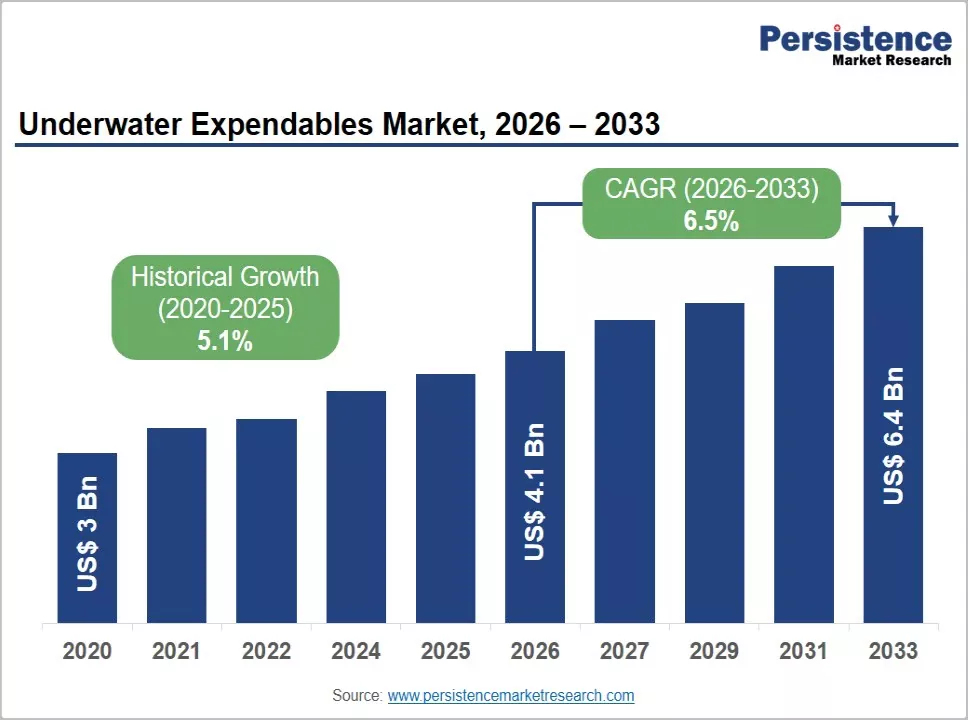
The global underwater expendables market size is likely to be valued at US$ 4.1 billion in 2026, and is estimated to reach US$ 6.4 billion by 2033, growing at a CAGR of 6.5% during the forecast period 2026 - 2033.
Growth is underpinned by increasing naval and defense investments in underwater capabilities, rising subsea activity in offshore energy, and expanding deployment of remotely operated and autonomous underwater vehicles.
The market has been experiencing steady growth, reflecting project timing variability and supply chain constraints during the historical period. However, the forecast period anticipates faster expansion as the installed base of subsea equipment grows and operators prioritize replacement of connectors, cables, batteries, and lighting that wear out under extreme pressure and corrosion.
Key Industry Highlights
- Dominant Product Types: Connectors are set to command around 30% of the revenue share in 2026, while batteries are likely to grow the fastest at 8.1% CAGR through 2033, as lithium-ion packs power larger vehicles and longer missions.
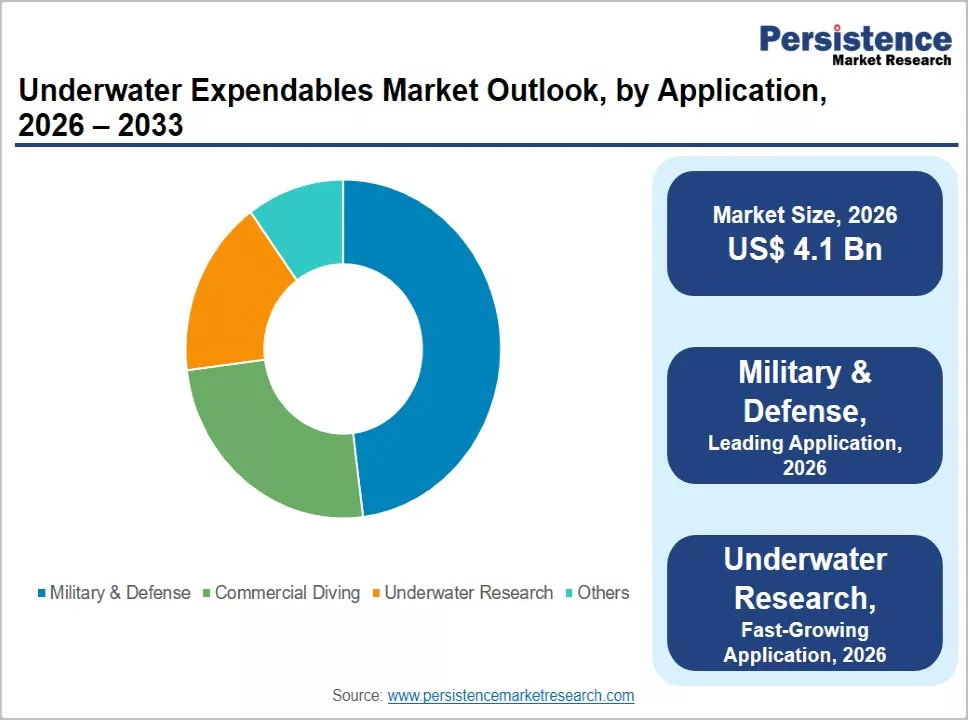
- Leading Applications: Military and defense is expected to lead with 44% in 2026, while underwater research is likely to be the fastest-growing at about 7.4% CAGR during 2026 - 2033, reflecting expanding ocean observation and seabed mapping programs.
- Dominant End-User: Government is anticipated to lead with an estimated 49% share in 2026, while research institutions are slated to represent the fastest-growing end-user segment at 7.6% CAGR from 2026 to 2033.
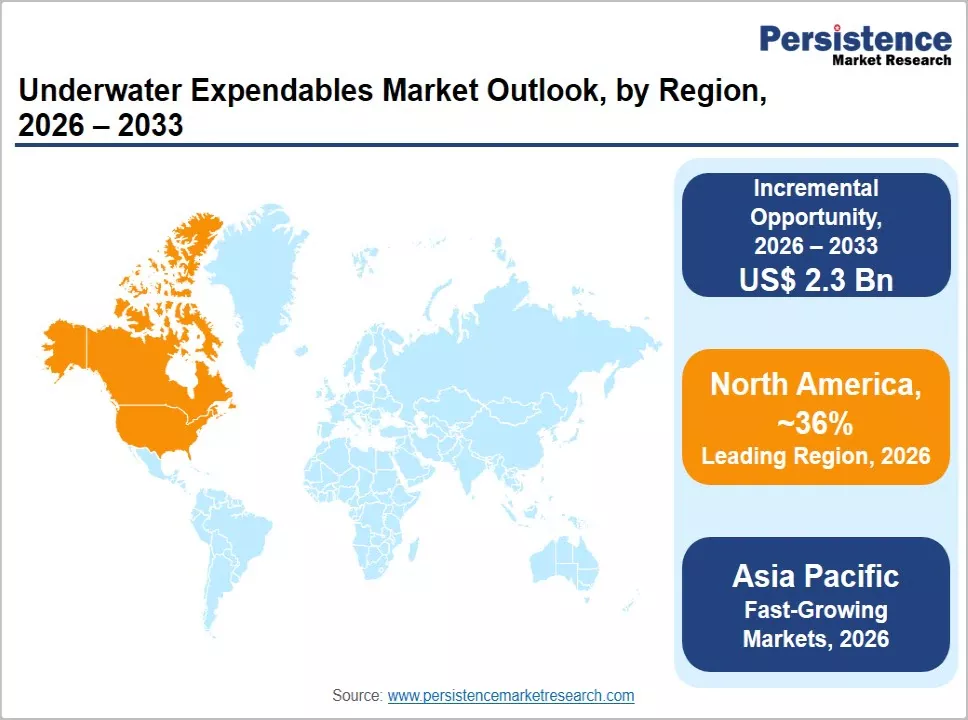
- Regional Leadership: North America is poised to dominate with an estimated 36% share in 2026, while Asia Pacific is projected to register the fastest growth at 8% CAGR through 2033, led by China, Japan, and Southeast Asian nations.
- Competitive Environment: Competitive dynamics include higher-current connector launches, integrated subsea power partnerships, and expansion of regional supply for defense and offshore energy customers.
DRO Analysis
Drivers: Underwater Vehicle Proliferation and Defense Investment as Primary Growth Catalysts
The rapid proliferation of remotely operated vehicles, autonomous underwater vehicles, and subsea tooling is the leading force driving the underwater expendables market growth, as each vehicle depends on connectors, cables, lighting, and batteries that require periodic replacement. Navies are expanding undersea surveillance, mine countermeasures, and seabed protection programs, increasing procurement of reliable consumable components.
Offshore energy operators are also extending the life of aging subsea infrastructure and developing wind, tidal, and carbon storage projects, which require inspection and intervention. Vehicle designers are integrating larger thrusters, higher-capacity batteries, and power-hungry payloads, which raises demand for high-current connectors and cable assemblies rated for deeper depths.
Electrification and Longer Missions
Longer endurance missions and persistent subsea operations place greater stress on batteries, cables, and underwater connectors, shortening replacement cycles. This usage pattern converts equipment growth into recurring aftermarket demand, supporting stable revenue across the forecast period.
Restraints: Harsh Operating Conditions, Qualification Costs, and Cyclical Offshore Spending
Underwater components must withstand high pressure, salinity, temperature extremes, and mechanical stress, and meeting certification standards requires extensive testing and engineering. Qualification costs and long approval cycles slow the entry of new suppliers and increase prices for end-users. Demand from offshore oil and gas is also cyclical, since project delays or reduced capital spending can postpone replacement purchases and exploration-related activity, creating revenue variability for suppliers.
Supply Chain and Safety Constraints
Specialized materials, such as titanium, elastomers, and marine-grade cabling, and the limited number of qualified manufacturers create supply risk. Safety regulations around lithium-ion batteries in subsea pressure housings add design and testing burdens, while export controls on defense-related components complicate cross-border sales and inventory planning.
Opportunities: High-Current Interfaces, Integrated Power Systems, and Defense Modernization
Suppliers are developing higher-current and hybrid electro-optical connectors that combine power and data in fewer penetrations, helping vehicle manufacturers simplify designs. HYSF SUBSEA expanded its high-current underwater connector range to 150A and 180A options in September 2026, targeting thrusters, battery systems, and offshore equipment. Integrated subsea power architectures that combine batteries, communications, and control are also creating new opportunities for system-level suppliers, particularly for ageing infrastructure and field-life extensions.
Defense Modernization and Offshore Renewables
Naval modernization programs, unmanned undersea vehicle adoption, and seabed infrastructure protection are expected to create a durable pipeline of demand for qualified consumables. Offshore wind installation and cable laying vessels also require large volumes of marine and subsea lighting, supporting recurring orders for lighting, cabling, and connection hardware.
Category-wise Insights
Product Type Analysis
Why Do Connectors Lead the Underwater Expendables Market?
Connectors are the leading product type segment, expected to hold about 30% of the underwater expendables market revenue share in 2026. They are critical interfaces for power, data, and fiber-optic links between vehicles, sensors, and tooling, and are subject to repeated mating, pressure cycling, and seawater exposure. Wet-mate, dry-mate, and hybrid connector designs with depth ratings to thousands of meters command premium pricing. Their replacement cycles and qualification requirements keep demand steady and favor established suppliers.
Batteries are likely to grow the fastest through 2033. Rechargeable lithium-ion packs, designed for pressure-tolerant or oil-filled housings, are powering larger autonomous vehicles, sensors, and subsea tools for longer deployments. Supply partnerships, such as the collaboration between Verlume and SubCtech announced in September 2026 to deliver integrated subsea power systems, reflect increasing focus on combining energy storage with power management and communications.
Application Analysis
Which Application Dominates Underwater Expendables?
Military and defense dominates the application segment, projected to capture about 44% of the revenue share in 2026. Navies depend on a wide range of consumable components for submarines, unmanned vehicles, sonar systems, and diver support equipment. Procurement is driven by readiness requirements, qualified supplier lists, and multi-year framework contracts, which provide stable demand. Increasing emphasis on undersea domain awareness and critical infrastructure protection is expected to sustain spending.
Underwater research represents the fastest-growing application segment, anticipated to achieve about 7.4% CAGR during the 2026 - 2033 period. Oceanographic institutions, climate scientists, and environmental monitoring programs are deploying more autonomous vehicles, seabed observatories, and deep-sea sensors. These platforms require reliable lighting, cables, connectors, and batteries, and increasing funding for ocean observation, carbon storage monitoring, and seabed mapping is expanding the replacement and spares market.
End-User Analysis
Why Does Government Lead Underwater Expendables Demand?
Government is poised to lead with an estimated 49% share in 2026, reflecting the central role of navies, coast guards, and public agencies in undersea operations. Government customers prioritize reliability, certification, and long-term supply assurance, and often procure through framework agreements that favor established suppliers. Defense budgets that emphasize undersea warfare and seabed security are likely to maintain this segment’s lead, supported by steady spares and sustainment requirements.
Research institutions are the fastest-growing end-user segment in underwater expendables, expected to register an approximate 7.6% CAGR through 2033. Universities and marine science organizations are expanding fleets of smaller vehicles and instruments, creating recurring demand for modular, cost-effective components. Commercial operators in offshore energy, aquaculture, and diving services remain steady contributors, favoring suppliers that provide custom assemblies and rapid delivery.
Regional Insights
North America Underwater Expendables Market Trends and Insights
North America is anticipated to account for an estimated 36% of the global underwater expendables market in 2026. The region’s market is likely to benefit from substantial naval spending, an established subsea services industry, and strong participation in ocean research. Demand is supported by submarine and unmanned underwater vehicle programs, offshore oil and gas activity in the Gulf of Mexico, and emerging offshore wind development. Established suppliers of connectors, batteries, and lighting, alongside specialized small manufacturers, are expected to compete actively through 2033.
U.S. Underwater Expendables Market Size
The U.S. is estimated to account for approximately 83% of the North America underwater expendables market in 2026. Market growth is likely to be supported by defense modernization, submarine construction and sustainment, and expanding adoption of autonomous underwater vehicles by naval and research agencies. Offshore energy operators and cable installation contractors are also anticipated to sustain demand for subsea connectors, cables, and lighting. Qualification requirements and domestic sourcing preferences are expected to favor established suppliers with documented performance records.
Canada Underwater Expendables Market Size
Canada is projected to represent approximately 9% of the North America underwater expendables market in 2026. Market expansion is expected to be driven by ocean research, offshore energy activity off the Atlantic coast, and naval and coast guard programs. The country’s expertise in marine technology and its growing cluster of underwater vehicle developers are likely to create demand for batteries, connectors, and cables. Arctic monitoring and seabed mapping initiatives are anticipated to support additional procurement through 2033.
Europe Underwater Expendables Market Trends and Insights
Europe is estimated to account for approximately 18% of the global underwater expendables market in 2026. The region’s market is expected to benefit from a mature offshore energy sector in the North Sea, rapid offshore wind construction, and active naval modernization programs. Strong clusters of subsea technology suppliers in Norway, the U.K., Denmark, and Germany support innovation in connectors, power systems, and lighting. Concerns over seabed infrastructure security are likely to encourage additional investment in monitoring and intervention equipment through 2033.
U.K. Underwater Expendables Market Size
The U.K. is anticipated to account for approximately 27% of the Europe underwater expendables market in 2026. Demand is expected to be supported by North Sea oil and gas life extension, offshore wind expansion, and defense programs emphasizing undersea capabilities. Aberdeen’s subsea cluster and the country’s underwater vehicle manufacturers are likely to sustain demand for connectors, cables, and battery systems. Investment in decommissioning and cable installation projects is projected to support market expansion through 2033.
Why Is Asia Pacific Expected to Be the Fastest-Growing Region in the Underwater Expendables Market?
Asia Pacific is projected to account for approximately 24% of the global underwater expendables market in 2026, with the region anticipated to register the fastest growth at an estimated CAGR of 8% through 2033. Market expansion is likely to be driven by naval buildups, offshore energy and wind development, and expanding marine research. China, Japan, South Korea, and Australia are expected to remain the primary demand centers, while Southeast Asian countries are increasing subsea inspection and maritime security investments.
China Underwater Expendables Market Size
China is estimated to represent approximately 36% of the Asia Pacific underwater expendables market in 2026. The country’s market is expected to benefit from naval expansion, deep-sea exploration programs, and a growing domestic subsea equipment industry. Domestic connector and cable manufacturers, such as HYSF SUBSEA, are expanding product ranges for remotely operated vehicles and autonomous underwater vehicles. Government support for marine science and offshore energy development is likely to sustain China’s regional leadership through 2033.
Japan Underwater Expendables Market Size
Japan is projected to account for approximately 21% of the Asia Pacific underwater expendables market in 2026. The market is expected to witness steady expansion, supported by maritime defense modernization, deep-sea research, and offshore wind projects. Japanese precision manufacturers and research institutions are likely to demand high-reliability batteries, lighting, and connectors for deep-diving vehicles. Growing attention to seabed resources and undersea infrastructure resilience is anticipated to encourage additional procurement.
Competitive Landscape
The global underwater expendables market structure is moderately fragmented, with leading suppliers, including TE Connectivity, Teledyne Technologies, MacArtney, and Amphenol, holding a considerable share of the connector and cable segments. These established players leverage deep-water qualification experience, global distribution, and long-standing relationships with defense and offshore customers. They are also known to invest in higher-current, hybrid electro-optical, and pressure-tolerant product designs to maintain technological leadership.
Specialist and regional competitors such as BIRNS, Deep Sea Power & Light, Blue Robotics, SubCtech, and Glamox are focusing on specific products, including lighting and battery systems, and on niche geographic markets. Barriers such as qualification requirements, depth-rating validation, and customer approval cycles limit new entrants, while lower-cost manufacturers in Asia are broadening the supply base. Partnerships between connector, battery, and power system suppliers are expected to increase as integrated subsea architectures gain traction.
Key Market Developments
- In September 2026, HYSF SUBSEA expanded its high-current underwater connector range with 150A and 180A options and hybrid electro-optical connectors for thrusters, battery systems, and remotely operated and autonomous vehicles.
- In September 2026, Verlume and SubCtech signed a memorandum of understanding to jointly develop and deliver integrated subsea power systems for offshore energy and defense applications, combining battery technology with power, communications, and control.
- In February 2026, Glamox secured a contract to supply 2,930 marine lights for the first of two next-generation Subsea Rock Installation Vessels being built for Van Oord.
Companies Covered in Underwater Expendables Market
- TE Connectivity Ltd.
- Teledyne Technologies Incorporated
- MacArtney Underwater Technology
- Amphenol Corporation
- BIRNS, Inc.
- Deep Sea Power & Light
- Blue Robotics Inc.
- SubCtech GmbH
- Glamox ASA
- Kongsberg Maritime AS
Frequently Asked Questions
The global underwater expendables market is valued at US$ 4.1 billion in 2026 and is projected to reach US$ 6.4 billion by 2033, expanding at a CAGR of 6.5% during 2026 - 2033.
Increasing naval and defense investments, rising subsea activity in offshore energy, and expanding deployment of remotely operated and autonomous underwater vehicles are driving the market.
Connectors lead product types with about 30% share, military and defense leads applications with about 44%, and government leads end-users with an estimated 49% in 2026.
North America dominates with an estimated 36% share in 2026, supported by substantial naval spending and an established subsea services industry, while Asia Pacific is projected to grow fastest at 8% CAGR through 2033.
High-current and hybrid connector development, integrated subsea power systems, and defense modernization are key market opportunities.
The market is moderately fragmented, with TE Connectivity, Teledyne Technologies, MacArtney, and Amphenol holding a considerable share of the connector and cable segments.


