




- Beauty & Personal Care
- PC Lenses Market
PC Lenses Market Size, Share, and Growth Forecast 2026 - 2033
PC Lenses Market by Product Type (Single Vision Lenses, Others), Coating Type (Anti-Reflective Coating, Others), Application (Prescription Eyewear, Others), Distribution Channel (Optical Retail Stores, Others), and Regional Analysis, 2026 - 2033

PC Lenses Market Size and Trend Analysis
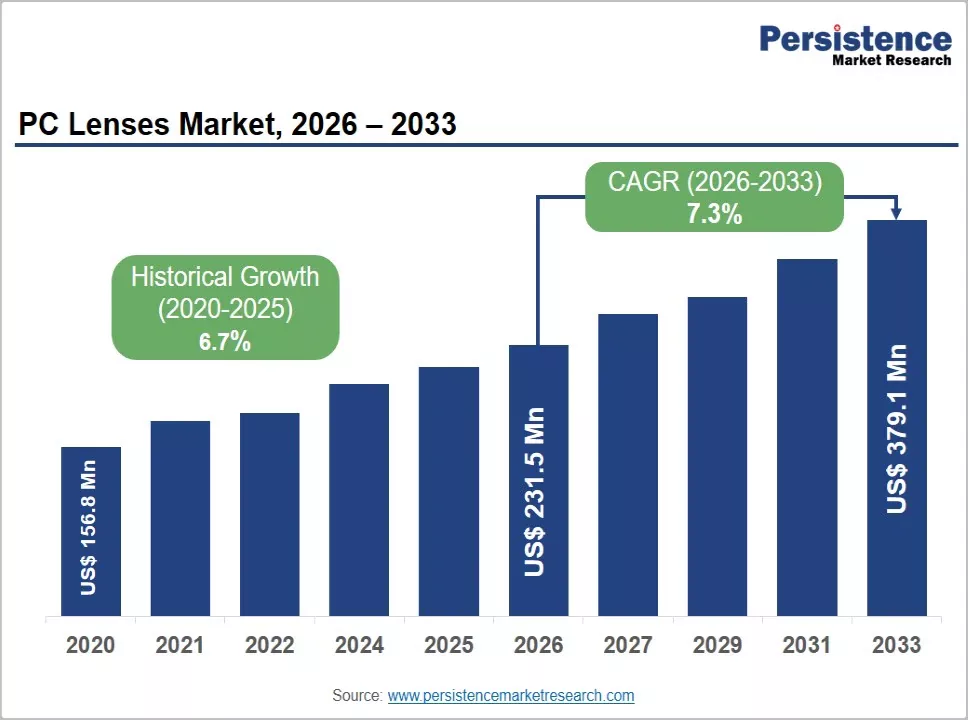
The global PC lenses market size is likely to be valued at US$ 231.50 million in 2026 and is projected to reach US$ 379.10 million by 2033, growing at a CAGR of 7.3% during forecast period between 2026 and 2033.
The World Health Organization (WHO) estimates that more than 2.2 billion people globally experience a near or distance vision impairment, with inadequate correction remaining the leading cause a population-scale demand signal that underpins prescriber adoption of polycarbonate lenses across both high-income and emerging markets. Their superior refractive index, inherent UV 400 protection, and compliance with ANSI Z87.1 impact-resistance standards make them the material of choice for optical laboratories, sports brands, and safety eyewear manufacturers alike.
Key Industry Highlights
- Leading Region: North America command the leading regional position, holding 32% of the PC lenses market in 2026, propelled by employer vision benefit infrastructure and OSHA safety compliance procurement.
- Fastest growing Region: Growing at 9% CAGR the fastest of any region Asia Pacific is the standout expansion opportunity in the PC lenses market.
- Leading Product Type: Single vision lenses hold 42% of PC lenses market volume in 2026, driven by pediatric myopia prescribing and young-adult correction demand at high-volume optical retail chains.
- Leading Coating Type: Blue light blocking coating is the most disruptive emerging segment in the PC lenses coating landscape.
DRO Analysis
Driver - Rising Global Prevalence of Refractive Errors and Aging Demographics
Demographic pressure is the most durable structural driver in the PC lenses market. The International Agency for the Prevention of Blindness (IAPB) projects that uncorrected refractive errors will affect approximately 1.8 billion people by 2050, with presbyopia diagnoses accelerating sharply as populations in North America, Europe, and East Asia age.
This demographic shift directly expands prescriber demand for progressive and single-vision polycarbonate lenses, which offer optical clarity alongside the impact resistance that pediatric and elderly patients increasingly require. National vision care programs across Germany, Japan, and Australia have extended reimbursement coverage to polycarbonate lenses for children and high-risk occupational groups, translating policy support into measurable channel volume at independent optical dispensaries and optical retail chains.
Restraint - Premium Pricing Relative to Standard CR-39 Plastic Lenses
Polycarbonate lenses carry a consistent price premium of approximately 30-50% over standard CR-39 plastic lenses at the wholesale level, according to optical laboratory trade data. For price-sensitive consumers in developing markets and uninsured buyers in high-income economies, this differential frequently redirects purchasing decisions toward lower-cost materials particularly where optical retailers lack the trained dispensing staff needed to communicate the material's clinical and safety advantages. The restraint is compounded in markets where vision insurance reimbursement schedules have not kept pace with retail lens prices.
Opportunity - Myopia Management Protocols and Pediatric Prescribing Growth
Myopia management has emerged as one of the fastest-growing clinical subspecialties in optometry, creating a new and expanding prescriber pathway for polycarbonate lenses. The British College of Optometrists and the American Optometric Association (AOA) both issued updated myopia management guidelines between 2023 and 2024, formalizing polycarbonate as the preferred lens material for children's single-vision and defocus-incorporating spectacle lenses specifically citing impact resistance as essential for pediatric wearers.
Manufacturers that position coated polycarbonate blanks within validated myopia control product lines gain access to a clinically credentialed, premium-priced segment where parental willingness to pay is significantly higher than in standard adult prescription categories.
Category-wise Analysis
Product Type Insights
Why Do Single Vision Lenses Dominate the PC Lenses Market?
Single vision lenses lead propelled by they address the single largest prescriber category globally myopia correction in children and young adults, where polycarbonate's impact resistance is clinically preferred. School-age children receiving first-time prescriptions at independent optical practices and national optical chains such as Specsavers are routinely dispensed polycarbonate single-vision lenses as the standard of care, particularly in the UK and Australia where occupational health and child safety standards inform dispensing protocols.
Polarized lenses are likely to be the fastest-growing segment, propelled by outdoor lifestyle participation and water sports uptake among millennial and Gen Z consumers. Oakley's 2023 expansion of its Prizm polarized polycarbonate lens range into prescription formats available through its global optical network accelerated mainstream prescriber adoption of polarized PC in sports optical dispensaries.
Coating Type Insights
Anti-reflective coating is projected to dominate coating type segment hold nearly 32% of the market share in 2026. Anti-reflective coating dominates because it directly resolves polycarbonate's inherently higher surface reflectance approximately 8% per surface versus 4% for glass which produces noticeable ghost images at night and reduces visual acuity for digital screen users. Optical laboratories at leading retail chains including LensCrafters apply multi-layer AR coatings as a near-universal upsell on polycarbonate prescriptions, making it the most widely specified coating type in the PC lenses segment across North America and Europe.
Blue light blocking coating is likely to be the fastest-growing coating type, catalyzed by the global shift to hybrid working arrangements post-2022. Essilor's Eyezen lens range, incorporating blue light filtering across its polycarbonate substrate line, expanded distribution through workplace employee benefit programs in France and the U.S. during 2023-2024, legitimizing blue light blocking as an occupational health specification rather than a discretionary consumer add-on.
Application Insights
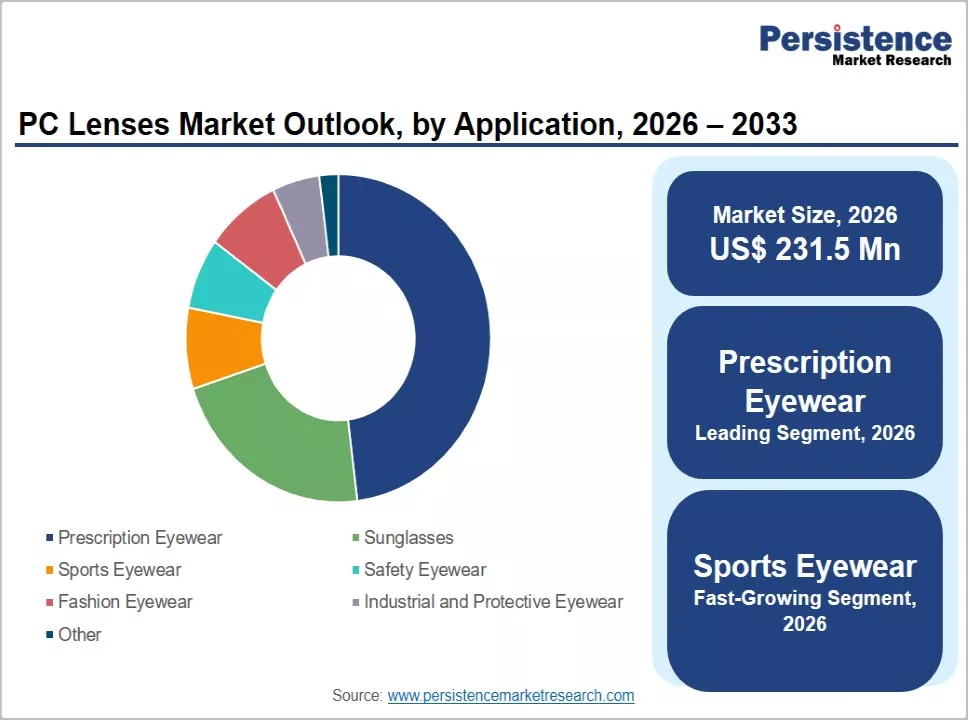
Prescription eyewear is expected to lead the segment hold around 48% of market share in 2026. Polycarbonate's status as the American National Standards Institute (ANSI)-recommended material for children's ophthalmic lenses sustains its dominance in prescription channels, where optometrists and dispensing opticians specify it by material name rather than leaving the choice to patient discretion. Vision insurance plans administered by VSP Vision Care and EyeMed in the U.S. typically reimburse polycarbonate as a covered upgrade for children and safety-sensitive occupations, reinforcing prescriber habits across the highest-volume dispensing environments.
Sports eyewear is likely to be the fastest-growing application segment. Nike Vision's 2024 launch of its Skylon Ace prescription sport frame featuring wrap-corrected polycarbonate single-vision lenses brought prescription-compatible sports optics into mainstream optical retail for the first time at accessible price points, catalyzing demand among recreational cyclists, runners, and padel players who previously had no prescription-compatible sport lens option.
What Is Driving the Growth of Online Retail in the PC Lenses Distribution Landscape?
Optical retail stores are expected to dominate and the fastest growing distribution channel account around 48% of market share in 2026. The segment leads due to polycarbonate lens dispensing requires pupillary distance measurement, frame fitting, and coating selection guidance that licensed opticians provide at the point of purchase a consultative process that sustains footfall at national optical multiples such as Alain Afflelou in Europe and National Vision in the U.S.
Regional Insights
North America PC Lenses Market Trends and Insights
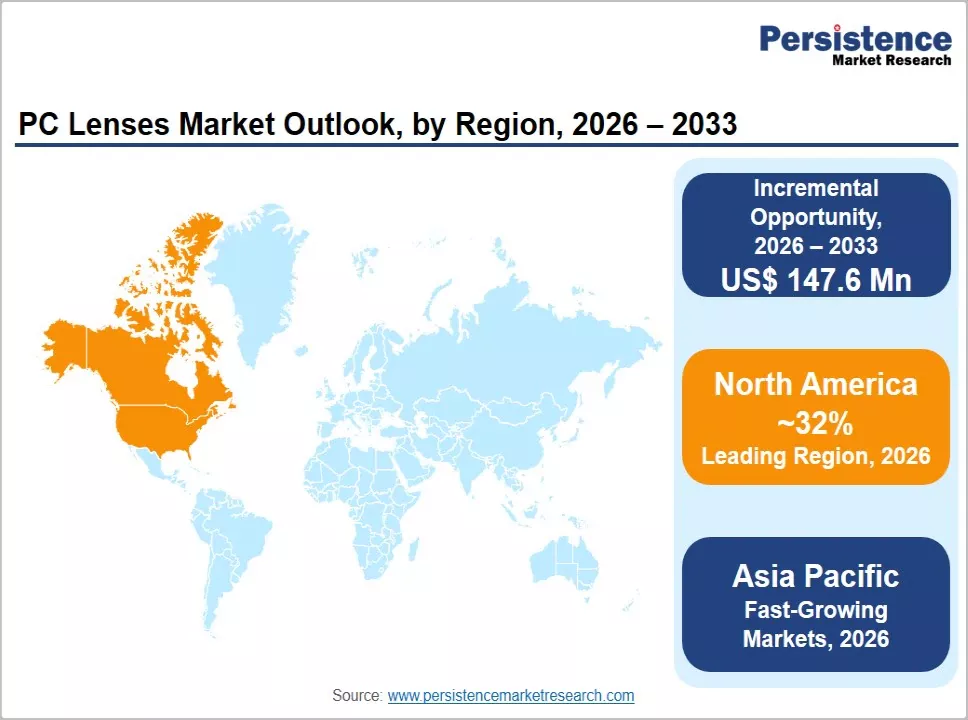
North America is projected to dominate the regional market capture 32% of the PC lenses market in 2026. The region's dominance reflects a mature vision care infrastructure anchored by employer-sponsored vision benefits, with VSP Vision Care covering approximately 88 million members across the U.S. OSHA safety compliance mandates sustain institutional procurement of polycarbonate safety lenses independent of consumer spending cycles. The forward trajectory remains positive, supported by expanding pediatric myopia management programs at leading optical chains.
U.S. PC Lenses Market Size
The U.S. is anticipated to account around 86% of the North America regional market in 2026. Demand is anchored by high per-capita optical expenditure and the widespread adoption of polycarbonate as the default lens material at high-volume optical retailers, including Walmart Vision Centers and Costco Optical. Continued expansion of vision benefit enrollment through the Affordable Care Act marketplace plans supports steady volume growth through 2033.
Canada PC Lenses Market Size
Canada is estimated to capture about 14% of the North America regional market in 2026. Provincial health programs in Ontario and British Columbia provide partial coverage for children's eyewear, reinforcing polycarbonate adoption among the pediatric prescriber base. Growth will accelerate modestly as optometry scope-of-practice expansions across Canadian provinces increase the number of prescribing practitioners and annual eye examination rates.
Europe PC Lenses Market Trends and Insights
Europe is projected to hold about 17% of PC lenses market share in 2026. The European Committee for Standardization (CEN) EN 166 framework drives specification-based purchasing of polycarbonate lenses across industrial and safety eyewear channels, sustaining a floor of institutional demand that insulates the region from pure consumer cyclicality. The European Spectacle Lens Association (ESLA) has actively lobbied for polycarbonate recognition under updated medical device classifications under the EU Medical Device Regulation (MDR 2017/745), a development that could formalize reimbursement pathways across multiple member states by 2026-2027.
Germany PC Lenses Market Size
Germany is anticipated to account nearly 22% of the Europe regional market in 2026. Germany's large industrial and manufacturing workforce governed by strict Berufsgenossenschaft (BG) occupational health and safety standards generates robust procurement of ANSI-equivalent polycarbonate safety lenses annually. As Germany's population ages, presbyopia-driven progressive polycarbonate lens volume will grow as a secondary demand engine through 2033.
U.K. PC Lenses Market Size
The U.K. is estimated to command aboout18% of the Europe regional market in 2026. The National Health Service (NHS) optical voucher scheme, which partially subsidizes children's and low-income eyewear, consistently directs dispensing toward polycarbonate materials given their mandatory-use recommendation for children under College of Optometrists clinical guidelines. Expansion of optical benefit coverage through NHS reforms under the UK Government's Primary Care Recovery Plan presents a forward growth catalyst for the UK PC lenses segment.
Which Region Will Drive the Fastest PC Lenses Growth Through 2033?
Asia Pacific is likely to be the fastest-growing during the forecast period between 2026 to 2033. The principal acceleration force is East Asia's myopia crisis: The Brien Holden Vision Institute estimates that approximately 90% of young adults in countries such as China, South Korea, and Singapore are myopic the highest prevalence rates globally. Rising middle-class incomes and expanding private optical retail networks across China, India, and Southeast Asia will progressively close the per-capita eyewear spending gap with North America and Europe through 2033.
China PC Lenses Market Size
China is projected to account around 38% of the Asia Pacific regional market in 2026. China's National Eye Health Plan (2021-2025), issued by the National Health Commission, mandated school-based vision screening and treatment protocols that have accelerated pediatric polycarbonate lens prescribing across urban optical chains. Domestic lens manufacturers are upgrading coating capabilities to compete with international brands on anti-reflective and blue-light-blocking polycarbonate products, compressing margins but expanding overall market volume.
Japan PC Lenses Market Size
Japan is expected to hold nearly 19% of the Asia Pacific regional market in 2026. Japan's aging population with 29% of citizens aged 65 or older per Statistics Bureau of Japan data drives sustained demand for progressive and reading polycarbonate lenses dispensed through the country's dense network of optical retail chains, led by Zoff and JINS. Premiumization trends and consumer appetite for thin, lightweight lens designs support continued share growth for coated polycarbonate formats through 2033.
Competitive Landscape
The global PC lenses market is moderately consolidated at the top, with EssilorLuxottica commanding disproportionate influence through its integrated lens manufacturing, coating laboratory, and retail dispensing assets a vertical model that competitors find difficult to replicate at scale.
HOYA Corporation and Carl Zeiss AG compete primarily on optical precision and coating technology, targeting independent opticians and premium optical retailers. Mid-tier players including Rodenstock GmbH, Seiko Optical Products Co., Ltd., and Shamir Optical Industry Ltd. differentiate through customization capabilities and direct laboratory partnerships. The primary basis of competition is coating technology breadth, prescription surfacing turnaround time, and the ability to supply validated lens designs compatible with branded frame collections not price alone.
Key Industry Developments
- In June 2026, Newton launched Sequel Computer and Sequel Meeting eyeglass lenses to address the visual demands associated with prolonged computer use and office work. Both lenses incorporated the company proprietary Convergence Boost technology, which helped reduce the strain on eye muscles caused by repeated convergence movements during extended screen use. Sequel Computer targeted individuals who spent several hours working on laptops and desktop computers. The lens positioned 50% of the total addition (ADD) power at the fitting point and supported optimal viewing distances of up to 4 feet.
- In April 2026, Johnson & Johnson launched the TECNIS Odyssey next-generation intraocular lens (IOL) in India to improve visual outcomes for cataract patients. The new lens offered clear vision across different distances and lighting conditions, helping patients achieve greater visual flexibility after cataract surgery. The lens incorporated advanced optical technology and proprietary materials from the TECNIS platform to deliver consistent, high-contrast vision in different lighting conditions. According to the company, 93% of patients achieved freedom from glasses at all distances.
Companies Covered in PC Lenses Market
- EssilorLuxottica
- HOYA Corporation
- Carl Zeiss AG
- Rodenstock GmbH
- Seiko Optical Products Co., Ltd.
- Nikon Corporation
- Shamir Optical Industry Ltd.
- Vision Ease
- Tokai Optical Co., Ltd.
- Younger Optics
Frequently Asked Questions
The global PC lenses market is valued at US$ 231.50 million in 2026.
Mandatory occupational eye protection standards enforced by bodies such as OSHA in the U.S. and EU-OSHA across Europe, and expanding vision benefit reimbursement coverage that incentivizes prescribers to specify polycarbonate materials.
Single vision lenses hold the largest product type share at 42% of the global PC lenses market, driven by their dominance in pediatric myopia correction where polycarbonate is the clinically preferred material per ANSI Z87.1 impact-resistance standards.
North America lead the market with a 32% share in 2026, supported by two structural factors: widespread employer-sponsored vision benefit programs administered through networks such as EyeMed, and federally mandated workplace eye protection standards under OSHA regulations.
The largest opportunity in the market through 2033 lies in pediatric myopia management a clinically formalized and premium-priced segment where polycarbonate is the mandated material per updated guidelines from the American Optometric Association.
Some leading companies include EssilorLuxottica, HOYA Corporation, and Carl Zeiss AG, which collectively define coating technology standards and premium lens design benchmarks across the industry.


