




- Metalworking & Fabrication
- Tile Saw Market
Tile Saw Market Size, Share, and Growth Forecast 2026 - 2033
Tile Saw Market by Product Type (Wet Tile Saws, Dry Tile Saws), Material (Ceramic Tile, Porcelain Tile, Marble Tile, Travertine Tile), Application (Industrial, Commercial, Residential), and Regional Analysis, 2026 - 2033

Tile Saw Market Size and Trends Analysis
The global tile saw market size is likely to be valued at US$3.6 billion in 2026 and is expected to reach US$5.3 billion by 2033, growing at a CAGR of 5.7% during the forecast period from 2026 to 2033, driven by rising construction and renovation activities across residential and commercial sectors. Increasing adoption of large-format and hard-surface tiles is increasing the demand for precision cutting tools.
Also, strict dust control regulations and the shift toward advanced, portable, and cordless tile saws are supporting steady demand.
Key Industry Highlights:
- Leading Region: Asia Pacific, with about a 45.6% share in 2026, backed by its massive tile manufacturing base and continuous investments in construction projects.
- Fast-growing Region: North America, spurred by increasing home renovation spending and surging adoption of large-format tiles.
- Leading Product Type: Wet tile saws, approximately 68.3% share in 2026, as they deliver clean and precise cuts.
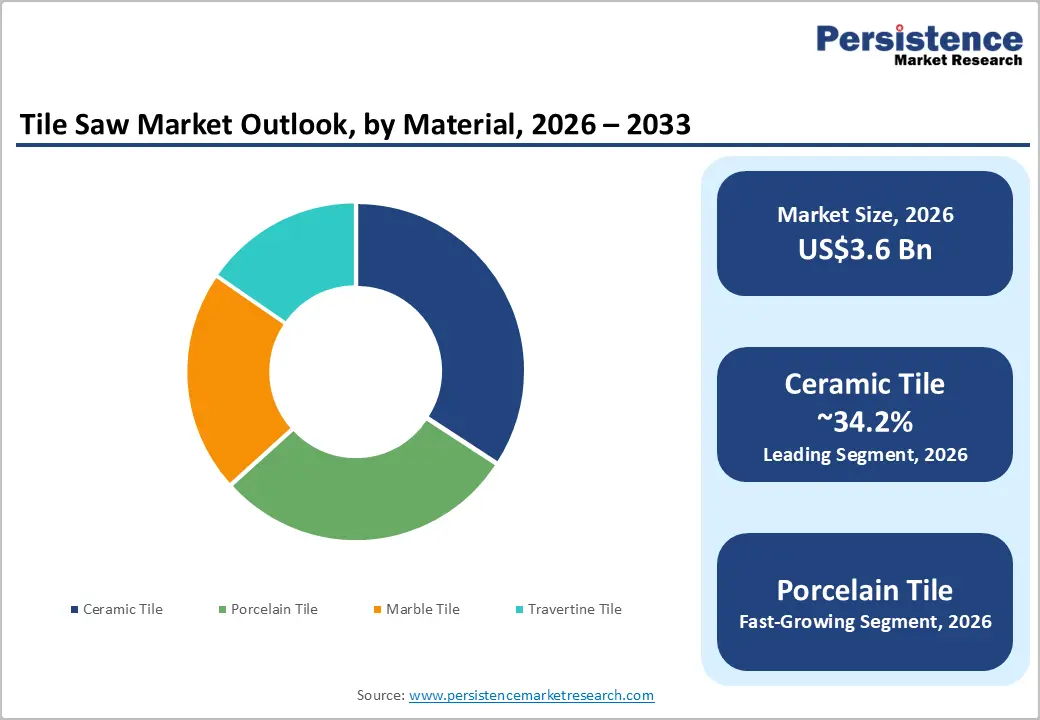
- Dominant Material: Ceramic tiles, with a nearly 34.2% share in 2026, as they are easier to cut than harder materials such as porcelain.
- New Product: In May 2026, Montolit launched the Masterpiuma P5 ITALICA tile cutter. The company stated that the new-generation cutter was redesigned to handle increasingly large and complex ceramic tile formats, incorporating technical improvements aimed at professional installers.

DRO Analysis
Driver - Surge in Dense and Hard-to-Cut Materials
The increasing use of dense materials such as porcelain, granite, quartz, and natural stone in modern construction has made wet tile saws a necessity on job sites. Manual snap cutters work fine for basic ceramic, but they simply cannot handle thick and hard tiles without cracking them.
Wet tile saws with diamond blades solve this by using a continuous water flow to cool the blade and reduce friction during cuts. As architects increasingly specify large-format porcelain slabs for smooth surfaces, the demand for precision cutting tools capable of handling these materials continues to rise steadily.
Boom in Home Renovation and DIY Projects
Kitchen and bathroom remodels remain the top renovation priorities for homeowners, and these projects almost always involve new tile work. According to a 2025 report from the Joint Center for Housing Studies at Harvard University, American homeowners spent more than US$600 billion on home renovation in 2024, 50% higher than pre-pandemic levels.
The 2025 Houzz & Home Study found that median spending on small primary bathroom remodels rose 13% year over year, reaching US$17,000 in 2024. As more homeowners take on flooring and wall tiling projects independently, the demand for capable and easy-to-use tile saws at the consumer level has grown significantly.
Restraint - Slurry Mess and Cleanup Burden
Wet tile saws produce a muddy wastewater byproduct called slurry, which is a mix of water, tile dust, and fine mineral particles. It splatters across the work area and is corrosive enough to damage surrounding surfaces. Beyond the mess, slurry disposal is strictly regulated. According to Portland's Bureau of Environmental Services, slurry and wash water from sawcutting materials such as tile and granite are prohibited from flowing into the city's stormwater system and requires authorization before being discharged to the sanitary sewer.
This is owing to the fact that several storm drains flow directly to rivers or streams without treatment. The Minnesota Pollution Control Agency similarly classifies tile cutting slurry as solid waste in most cases, requiring Best Management Practices (BMPs) to protect water quality. For indoor remodels or small residential jobs, managing and disposing of slurry properly adds significant time, cost, and hassle, making many users think twice before choosing a traditional wet saw.
Opportunity - Rise of Cordless and Job-Site-Ready Saws
Battery-powered tools have moved past basic drills. They now handle demanding cutting tasks that once required a corded power source. STIHL's TSA 230, the world's first commercial-grade cordless cut-off saw, runs on 36-volt lithium-ion battery technology with a maintenance-free brushless DC motor. This makes it lightweight enough for indoor job sites while still delivering superior cutting performance for brick, tile, and metal.
Separately, Bosch Power Tools announced in June 2025 a new round of additions to its 18V cordless portfolio, with tools engineered for power, versatility, and efficiency across a wide range of job site tasks, all on a single battery platform. For tile contractors working across multiple floors or in spaces without nearby power outlets, this cordless shift removes one of the most prominent friction points on the job.
Emergence of AI and Sensor-Backed Cutting Precision
Smart cutting technology is beginning to enter the power tools space, addressing one of the most common causes of tile waste, i.e., chipping caused by incorrect blade speed. Modern saws are now being equipped with electronic controls that adjust cutting parameters based on feedback from the material. Bosch's GTS 18V-70 Professional cordless table saw features an integrated soft start that protects the brushless motor and battery from abrupt starts.
It also includes an innovative braking system that quickly stops the blade, reducing the risk during operation. As AI-based adaptive speed controls move from industrial machinery into construction tools, tile saws that auto-adjust for material density, preventing blade overload on hard porcelain, represent a significant upgrade over fixed-speed models. This is especially useful for professionals working with expensive large-format tiles where a single bad cut is costly.
Category-wise Analysis
Product Type Insights
Wet tile saws are predicted to lead with a share of approximately 68.3% in 2026 as they deliver clean and precise cuts. The continuous water flow cools the diamond blade and reduces friction. This prevents chipping, which is a key issue when cutting brittle materials such as porcelain or glass tiles. The use of water also controls dust. This is critical, as respirable crystalline silica exposure is a prominent safety concern in construction. For example, the Occupational Safety and Health Administration (OSHA) mandates dust control methods such as wet cutting to reduce silica exposure during tile cutting.
Dry tile saws are estimated to be the fastest-growing segment over the forecast period, backed by their portability and ease of use. They do not require a water setup, which makes them suitable for quick jobs, repairs, and remote construction sites. Contractors working on small residential projects often prefer dry saws for fast setup and reduced maintenance. Another key factor is their suitability for outdoor or well-ventilated environments. In roadwork or exterior tiling, dust dispersion is less of a concern, making dry cutting practical.
Material Insights
Ceramic tiles are anticipated to dominate with a share of nearly 34.2% in 2026, as they are cost-effective and easy to work with. They are made from natural clay and require lower firing temperatures than advanced materials. This reduces production costs and makes them widely available. Their soft composition also makes them easy to cut using both wet and dry tile saws.
Porcelain tiles are expected to remain in the second position in 2026, fostered by their high strength and low water absorption. They are denser than ceramic tiles and are fired at higher temperatures. This makes them suitable for high-traffic areas such as airports, malls, and industrial floors. According to technical standards from the International Organization for Standardization, porcelain tiles have water absorption rates below 0.5%, which improves durability. Their increasing use in large-format slabs is another driver.
Regional Insights
Asia Pacific Tile Saw Market Trends
Asia Pacific is anticipated to dominate in 2026 with a share of nearly 45.6%, owing to rising construction activities and large-scale tile manufacturing. China and India are among the largest producers and consumers of ceramic tiles. China alone produces more than half of the world’s tiles, as highlighted in reports by the United Nations Industrial Development Organization. This augments demand for tile cutting tools, including tile saws. Urbanization is another key driver.
According to the World Bank, Asia Pacific continues to see speedy urban population growth, leading to high demand for housing and infrastructure. Governments are investing heavily in smart cities, metro systems, and affordable housing. These projects require large volumes of tiles, which increases the use of tile saws across construction sites.
China Tile Saw Market Trends
China will likely lead Asia Pacific in 2026 with a share of around 38.6%, owing to a booming real estate sector. The focus is now on renovation, infrastructure upgrades, and public housing projects. The country’s government has increased spending on infrastructure to support economic stability, which continues to push tile usage. China is also moving toward high-end tiles such as large-format porcelain slabs. Industry events, including Cersaie, have shown strong participation from China-based manufacturers in premium tile segments. This shift requires advanced cutting tools, especially wet tile saws, which support steady demand for high-performance equipment.
India Tile Saw Market Trends
In 2026, India is projected to account for a share of approximately 27.4%, boosted by housing and infrastructure expansion. Government programs such as those led by the Ministry of Housing and Urban Affairs are promoting affordable housing and urban development. Under schemes such as PMAY, millions of homes are being built or upgraded, increasing tile consumption. India is also a prominent tile exporter. According to the Ministry of Commerce and Industry, tile exports have grown significantly in recent years, especially to the U.S. and the Middle East. This has boosted domestic manufacturing clusters such as Morbi in Gujarat, where tile production and processing create steady demand for cutting tools.
North America Tile Saw Market Trends
North America is predicted to be the fastest-growing market in 2026 with a share of approximately 23.5%, due to rising renovation and remodeling activity. In the U.S., a large share of housing stock is aging. This has increased demand for kitchen and bathroom upgrades, where tiles are widely used. According to the Joint Center for Housing Studies of Harvard University, home improvement spending has remained steady in recent years, supporting tool demand.
U.S. Tile Saw Market Trends
A share of nearly 55.7% is expected to be held by the U.S. in 2026, backed by high spending on home improvement and infrastructure. The U.S. government has increased funding through acts such as the Infrastructure Investment and Jobs Act. This includes spending on public buildings, transport hubs, and utilities, where tile installation is common. There is also a strong DIY culture. Several homeowners undertake renovation projects themselves, increasing demand for compact and easy-to-use tile saws.
Europe Tile Saw Market Trends
Europe will likely see decent growth over the forecast period, with a share of nearly 17.2% in 2026, due to renovation-focused construction and sustainability goals. Countries across the region are investing in energy-efficient building upgrades. Tiles are widely used in these projects owing to their durability and low maintenance. The European Commission promotes building renovation under initiatives such as the Renovation Wave strategy. This encourages upgrading old buildings, which supports tile demand. Europe also has a strong tradition of tile usage in both residential and commercial spaces, maintaining consistent demand for tile cutting tools.
Germany Tile Saw Market Trends
Germany will likely register a substantial share of approximately 35.1% in 2026, augmented by renovation and commercial construction. The country has a large base of old buildings that require modernization. Government-backed energy efficiency programs are encouraging upgrades, including flooring and wall improvements. Germany is also known for high-quality construction standards. This increases demand for precision tools such as wet tile saws.
U.K. Tile Saw Market Trends
A share of around 17.5% is predicted to be held by the U.K. in 2026, fueled by home renovation and repair activity. Economic uncertainty has slowed new housing construction, but repair and maintenance work remains steady. Government initiatives focusing on housing upgrades and energy efficiency are supporting demand. For example, retrofit programs aimed at improving insulation and interiors often involve tile replacement. The U.K. also has a stable DIY market, similar to the U.S., which supports demand for compact tile saws.
Competitive Landscape
The global tile saw market is moderately fragmented with the presence of multinational power tool manufacturers and specialized tile-cutting equipment companies competing across professional, commercial, and DIY segments. Leading participants include Bosch, DeWalt, Husqvarna, MK Diamond, QEP, Rubi Tools, and Raimondi. These players collectively account for less than half of total market revenue, indicating a competitive environment where brand reputation, product reliability, and distribution strength are key differentiators.
Competition is now centered on precision cutting technology, portability, dust management, water-cooling efficiency, and cordless operation. Manufacturers are investing in laser-guided cutting systems, brushless motors, smart blade-alignment features, and advanced dust-suppression technologies to comply with strict workplace safety regulations and improve job-site productivity. Cordless and battery-powered tile saws are gaining traction among contractors seeking greater mobility, creating a new area of competition among leading brands.
Key Industry Developments
- In August 2025, RUBI launched the DC-250 Smart Advance, which it describes as the world's first intelligent tile cutter. It is designed to adapt automatically to the material being cut, adjusting its speed depending on the thickness and hardness of the tile, resulting in fewer mistakes, less blade wear, and a more polished finish.
- In June 2025, RUBI introduced new tile-cutting technologies at The Tiling Show 2025 in the U.K. Among the key launches was the TK Manual Tile Cutter, featuring an asymmetrical monoguide rail design that improves scoring-wheel visibility and cutting accuracy for professional users.
- In March 2025, Raimondi S.p.A. announced the acquisition of its long-time U.S. distributor, Donnelly Distribution Inc., and established Raimondi USA Corp. The company stated that the move would strengthen its presence in North America, improve customer service, and support the expansion of its professional tile installation and tile-cutting equipment portfolio in the region.
Companies Covered in Tile Saw Market
- Sawmaster Diamond Tools
- Kraft Tool Company
- DEWALT
- Battipav Srl
- GERMANS BOADA SA
- Husqvarna AB
- MK Diamonds Products Inc.
- E.P. Co., Inc.
- EDCO
- Lee Yeong Industrial Co., Ltd.
- Others
Frequently Asked Questions
The global tile saw market is projected to be valued at US$3.6 billion in 2026.
The tile saw market is expected to reach US$5.3 billion by 2033.
Key market trends include rising demand for cordless tile saws and increasing use of large-format porcelain slabs.
Ceramic tiles are expected to be the leading material with a share of nearly 34.2% in 2026, owing to their affordability and wide design variety.
The tile saw market is expected to grow at a CAGR of 5.7% from 2026 to 2033.
Sawmaster Diamond Tools, Kraft Tool Company, DEWALT, and Battipav Srl are a few key market players.


