




- Plastics, Polymers & Resins
- Thermosetting Plastics Market
Thermosetting Plastics Market Size, Share, and Growth Forecast, 2026 – 2033
Thermosetting Plastics Market by Product Type (Alkyds, Epoxies, Amino, Polyurethane, Phenolic, Vinyl Ester Resin), End-user (Construction, Adhesives and Sealants, Electronics & Appliances, Automotive), and Regional Analysis for 2026 – 2033

Thermosetting Plastics Market Size and Trends Analysis
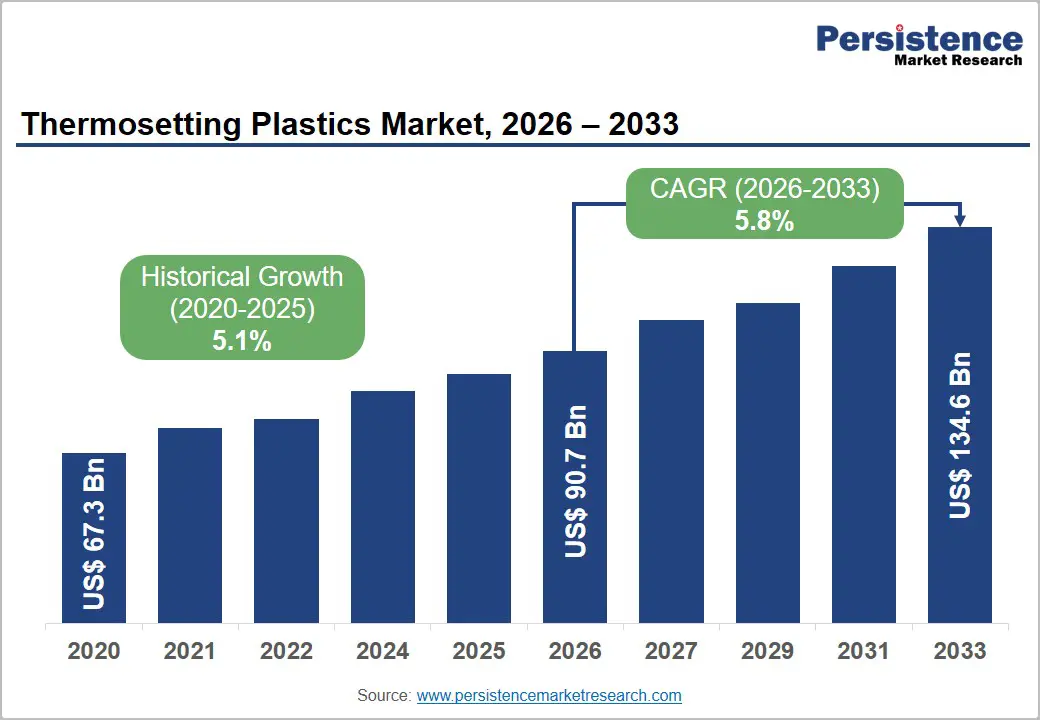
The global thermosetting plastics market size is likely to be valued at US$90.7 billion in 2026 and is expected to reach US$134.6 billion by 2033, growing at a CAGR of 5.8% during the forecast period from 2026 to 2033, driven by strong demand from automotive lightweighting, construction expansion, and increasing use in high-performance composites for electrical and industrial applications.
According to Plastics Europe’s 2024 industry outlook, thermoset materials remain critical in durable composite structures used across transportation and energy sectors. The European Chemicals Agency (ECHA, 2024) highlights growing regulatory focus on material safety and emissions compliance, influencing resin innovation and formulation improvements. The International Energy Agency (IEA, 2025) reports rising adoption of composite materials in renewable energy infrastructure, particularly wind turbine manufacturing, supporting thermoset consumption growth.
Key Industry Highlights:
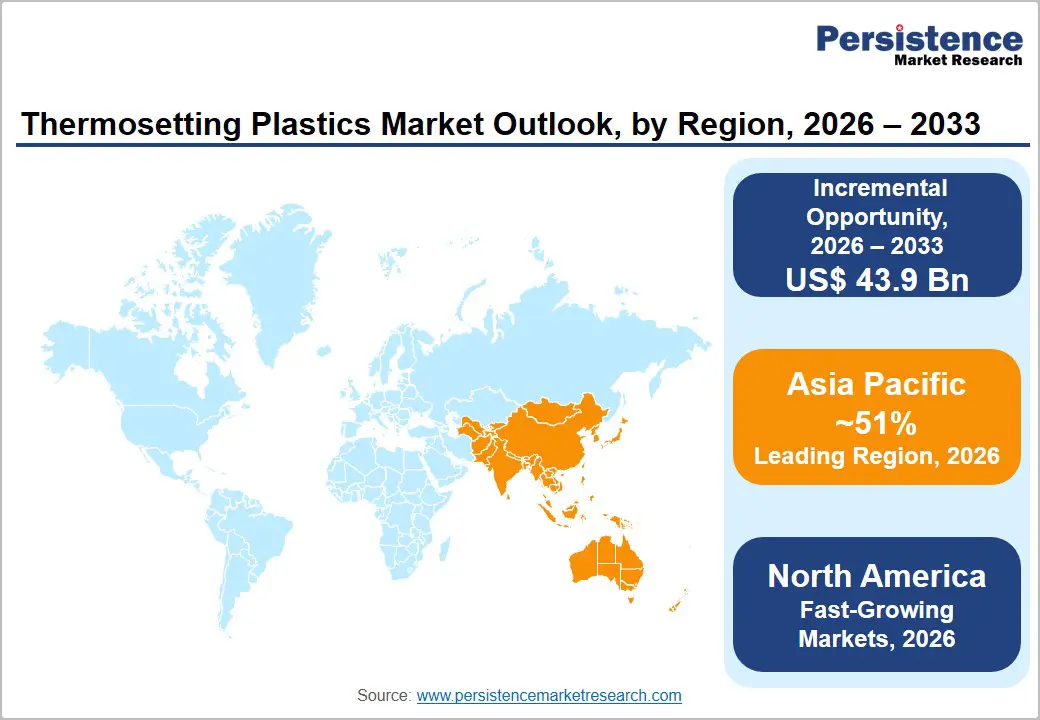
- Leading Region: Asia Pacific is anticipated to be the leading region, accounting for a market share of 51% in 2026, driven by rapid infrastructure development and strong automotive and electronics manufacturing.
- Fastest-growing Region: North America is likely to be the fastest-growing region, supported by strong U.S. leadership in advanced manufacturing, automotive, and construction demand.
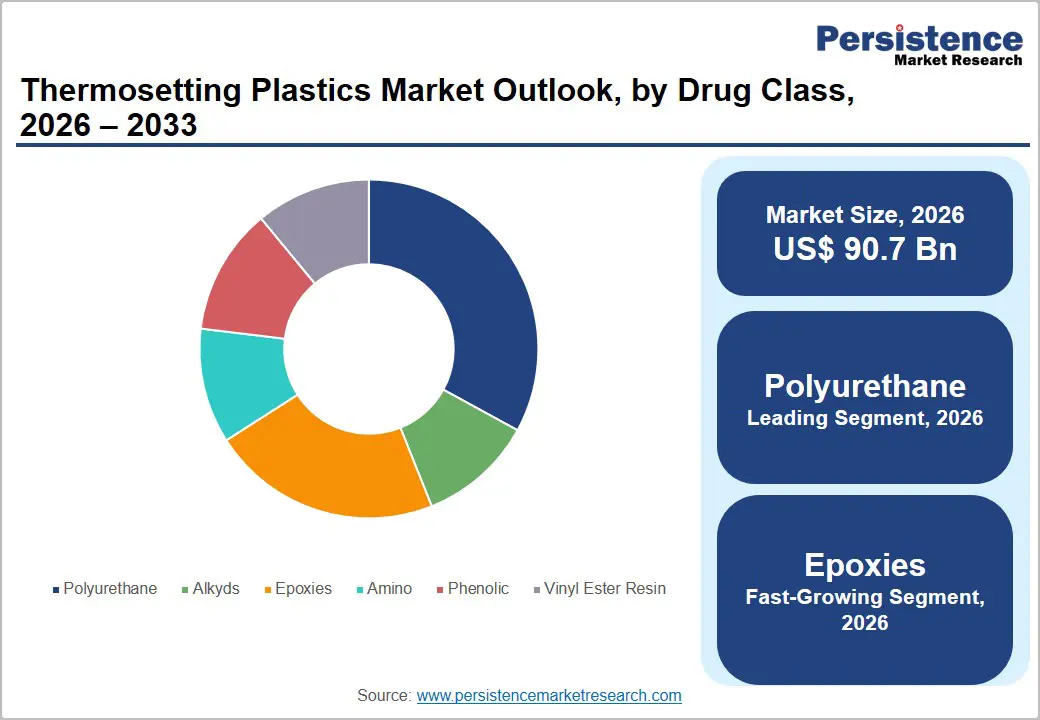
- Leading Product Type: Polyurethanes are projected to represent the leading product type in 2026, accounting for 40% of the revenue share, due to their versatility in construction and composite applications.
- Leading End-user: Construction is anticipated to be the leading end-user, accounting for over 55% of the revenue share in 2026, supported by large-scale infrastructure and durability requirements.
- Key Opportunity: The key market opportunity in the thermosetting plastics market is the growing shift toward sustainable, high-performance, and lightweight composite materials driven by electric vehicles, renewable energy expansion, and bio-based resin innovation across industrial applications.
DRO Analysis
Driver - Growing Automotive Sector Demand for Lightweight and High-Performance Materials
Manufacturers increasingly adopt lightweight and high-strength materials to improve fuel efficiency and reduce emissions. Thermosetting plastics such as epoxy, polyurethane, and vinyl ester resins are widely used in structural components, under-the-hood parts, and composite panels. The shift toward electric vehicles strengthens demand, as weight reduction directly enhances battery range and performance.
Automotive OEMs are also focusing on replacing metals with advanced composites to achieve durability, thermal resistance, and design flexibility, significantly increasing the consumption of thermosetting plastics across automotive production lines. Regulatory pressure for emission reduction and stringent fuel economy standards is accelerating material substitution trends in the automotive industry.
Thermosetting plastics offer superior mechanical strength, chemical resistance, and dimensional stability, making them ideal for high-performance automotive applications. Rising EV production in Asia Pacific, Europe, and North America is expanding usage in battery housings, insulation components, and interior systems. Increasing investments in lightweight composite technologies by major automakers are also supporting market expansion.
Restraint - Manufacturing Process Complexities
Once thermosets are molded and set, they cannot be remelted or reshaped, which limits flexibility during production and recycling. The curing process requires precise temperature, pressure, and chemical control, increasing production costs and operational challenges. Defects during curing can lead to material wastage and reduced product efficiency. These complexities make thermosetting plastics more difficult to process compared to thermoplastics, restricting their adoption in cost-sensitive applications and small-scale manufacturing environments across various industries.
The lack of recyclability of thermosetting plastics creates sustainability concerns and regulatory pressure, especially in regions with strict environmental policies. Disposal challenges increase end-of-life costs, limiting their attractiveness compared to recyclable alternatives. The need for specialized machinery and skilled labor adds to manufacturing expenses, creating barriers for new entrants. Process time for curing is also longer, reducing production efficiency in high-volume industries. These limitations collectively hinder large-scale adoption despite performance advantages.
Opportunity - Development of Bio-based and Sustainable Thermosets
Increasing environmental awareness and strict regulations on petrochemical-based materials are driving innovation toward renewable feedstocks such as plant oils, lignin, and bio-resins. These bio-based thermosets aim to reduce carbon footprint while maintaining essential properties such as strength, durability, and heat resistance. Industries such as automotive, construction, and electronics are actively exploring sustainable alternatives to meet ESG goals.
This shift is encouraging manufacturers to invest in research and development of eco-friendly resin systems, opening new avenues for market expansion and product differentiation. Advancements in green chemistry and polymer engineering are enabling improved performance of bio-based thermosetting materials, making them more competitive with conventional resins.
Growing consumer demand for eco-friendly products is also accelerating commercialization. Applications in wind energy, automotive interiors, and packaging materials are expanding rapidly due to sustainability requirements. Collaborations between chemical companies and research institutions are enhancing innovation in recyclable and partially bio-derived thermosets.
Category-wise Analysis
Product Type Insights
Polyurethanes are expected to account for 40% of revenue in 2026, due to their exceptional versatility, durability, and wide application range. They are extensively used in construction materials such as insulation foams, coatings, adhesives, and sealants due to their excellent thermal insulation and mechanical strength. For example, polyurethane foam insulation is widely used in modern building construction projects to enhance energy efficiency and reduce heating and cooling costs.
Epoxies are likely to represent the fastest-growing segment, supported by increasing demand for high-performance materials in electronics, automotive, aerospace, and corrosion-resistant applications. Their superior adhesive strength, chemical resistance, and mechanical properties make them ideal for advanced engineering uses. For instance, epoxy resins are extensively used in printed circuit boards (PCBs) in electronic devices, ensuring strong insulation and long-term reliability.
End-user Insights
The construction segment is projected to lead the market, capturing around 55% of the revenue share in 2026, supported by large-scale infrastructure development, urbanization, and increasing demand for durable building materials. Thermosetting plastics such as phenolic resins, polyurethanes, and epoxy systems are widely used in insulation panels, pipes, adhesives, flooring, and protective coatings. A notable example includes epoxy-based flooring systems, which are commonly used in industrial buildings and commercial facilities due to their durability and resistance to heavy traffic and chemicals.
The automotive segment is likely to be the fastest-growing end-user due to increasing demand for lightweight, fuel-efficient, and high-performance vehicles. Thermosetting plastics are widely used in vehicle body panels, interior components, under-the-hood applications, and structural composites due to their strength-to-weight ratio and thermal resistance. For example, epoxy and polyurethane composites are extensively used in EV battery housings and structural reinforcement components to improve safety and durability.
Regional Insights
North America Thermosetting Plastics Market Trends
North America is likely to be the fastest-growing region in thermosetting plastics in 2026, supported by strong demand from automotive lightweighting, aerospace innovation, and expanding construction renovation activities. Increasing adoption of electric vehicles and renewable energy infrastructure is increasing the demand for high-performance composite materials. For instance, Huntsman Corporation is actively developing advanced polyurethane and epoxy solutions used in automotive and industrial applications, supporting performance and sustainability goals.
U.S. Thermosetting Plastics Market Trends
The U.S. is expected to dominate the regional market, accounting for approximately 80% of the market share in 2026, driven by strong automotive, aerospace, and electronics industries. The country is experiencing rising demand for epoxy resins in EV battery systems and lightweight structural components. Recent federal infrastructure investments and clean energy initiatives are supporting increased use of thermoset composites in construction and wind energy projects.
Canada Thermosetting Plastics Market Trends
Canada is likely to be a significant market for thermosetting plastics, holding approximately 20% of the market share in 2026, supported by infrastructure modernization and renewable energy expansion, particularly in wind and hydroelectric projects. The country is increasingly using thermosetting plastics in construction, insulation, and transportation equipment manufacturing. Automotive component production is growing due to cross-border supply chain integration with the U.S. Rising investments in energy-efficient buildings and smart infrastructure projects are supporting demand.
Europe Thermosetting Plastics Market Trends
Europe is likely to be a significant market for thermosetting plastics in 2026, due to strict environmental regulations, circular economy initiatives, and rising demand for high-performance composite materials. Automotive electrification, renewable energy expansion, and advanced construction materials are the key growth drivers. A notable example includes BASF SE, which is developing innovative epoxy and polyurethane systems designed for lightweight automotive components and wind energy applications, supporting Europe’s sustainability goals.
U.K. Thermosetting Plastics Market Trends
The U.K. is likely to be a significant market for thermosetting plastics, estimates for 15% of Europe market share in 2026. Thermosetting plastics are widely used in insulation materials, adhesives, and composite structures. Government policies supporting net-zero emissions are encouraging adoption of eco-friendly resin technologies. Growth in aerospace manufacturing and automotive lightweighting is also driving demand. Investments in smart infrastructure and energy-efficient buildings are strengthening market expansion.
Germany Thermosetting Plastics Market Trends
Germany is anticipated to dominate the regional market, accounting for around 37% of the Europe market share in 2026, due to its strong automotive and industrial manufacturing base. The country is rapidly adopting epoxy and polyurethane composites in electric vehicles, machinery, and high-performance engineering applications. Government support for green mobility and renewable energy is accelerating demand for lightweight materials. Expansion of wind energy installations is increasing thermoset usage.
Asia Pacific Thermosetting Plastics Market Trends
The Asia Pacific region is anticipated to be the leading region, accounting for a market share of 51% in 2026, driven by its strong manufacturing capabilities and large-scale infrastructure development. The region is a major hub for automotive production, electronics manufacturing, and construction expansion, driving high demand for epoxy, polyurethane, and vinyl ester resins. For example, LG Chem is expanding its production of high-performance resin systems used in automotive, electronics, and industrial applications, supporting regional demand growth.
China Thermosetting Plastics Market Trends
China is projected to dominate the regional market, holding around a 30% share in 2026, driven by massive infrastructure development, EV production, and electronics manufacturing. The country is investing heavily in renewable energy, especially wind and solar, thereby increasing demand for thermoset composites. Strong government support for electric mobility is increasing epoxy resin consumption in battery systems and automotive components.
India Thermosetting Plastics Market Trends
India is expected to emerge as a significant market, accounting for approximately a 22% regional share in 2026, due to infrastructure development, urbanization, and rising automotive production. Increasing EV adoption is increasing the requirement for lightweight thermosetting plastics in automotive applications. Growth in electronics manufacturing and renewable energy installations is supporting market expansion. Rising foreign investments in manufacturing sectors are strengthening domestic production capabilities.
Competitive Landscape
The global thermosetting plastics market exhibits a moderately fragmented structure, driven by strong demand across automotive, construction, electronics, and industrial manufacturing sectors. Market growth is supported by continuous innovation in epoxy, polyurethane, phenolic, and vinyl ester resin systems, alongside rising adoption of high-performance composite materials. Increasing focus on lightweighting, energy efficiency, and durability has intensified competition among regional manufacturers.
With key leaders including BASF SE, Huntsman Corporation, Dow Inc., Covestro AG, and Hexion Inc. dominating through extensive product portfolios and global supply networks. These players compete through continuous product innovation, expansion of production capacities, strategic partnerships with automotive and aerospace OEMs, and investment in sustainable resin technologies. R&D-driven differentiation, cost optimization, and development of advanced composite solutions are key strategies used to strengthen market positioning.
Key Industry Developments:
- In February 2026, Toray Industries, Inc. announced a breakthrough technology enabling carbon fiber reinforced plastic (CFRP) structures using both thermosetting and thermoplastic resins to be bonded more efficiently for aerospace applications. The new process achieves significantly faster assembly speeds compared to conventional methods while improving bonding strength and structural performance.
- In January 2026, BASF SE showcased advanced thermoset-based composite and adhesive solutions across automotive, construction, and electronics applications, focusing on low-emission and recyclable resin systems.
Companies Covered in Thermosetting Plastics Market
- Alchemie Ltd.
- Asahi Kasei Corporation
- BASF SE
- BUFA GmbH & Co. KG
- Celanese Corporation
- Daicel Corporation
- DSM
- Eastman Chemical Company
- INEOS
- Kanoria Chembond Pvt. Ltd.
- Lanxess AG
- LG Chem
- Mitsubishi Engineering-Plastics Corporation
Frequently Asked Questions
The global thermosetting plastics market is projected to reach US$90.7 billion in 2026.
The market is driven by rising demand for lightweight, durable, and heat-resistant materials across automotive and construction, along with growing adoption of advanced composite materials and increasing infrastructure development.
The thermosetting plastics market is expected to grow at a CAGR of 5.8% from 2026 to 2033.
Key opportunities lie in the development of bio-based and sustainable thermosetting resins, expansion in electric vehicle and renewable energy applications.
Alchemie Ltd., Asahi Kasei Corporation, BASF SE, BUFA GmbH & Co. KG, Celanese Corporation, and Daicel Corporation are the leading players.


