




- Metals & Minerals
- Steel Tire Cord Market
Steel Tire Cord Market Size, Share, and Growth Forecast 2026 - 2033
Steel Tire Cord Market by Product Type (Brass Coated, Zinc Coated, Other Denatured Alcohol, Copper Coated, Others), Application (Passenger Vehicles (PV), Commercial Vehicles (CV)(Light Commercial Vehicles (LCV), Heavy Commercial Vehicles (HCV)), Off-the-Road (OTR) Tires, Two-Wheelers, Aircraft Tires), and Regional Analysis, 2026 - 2033

Steel Tire Cord Market Size and Trend Analysis
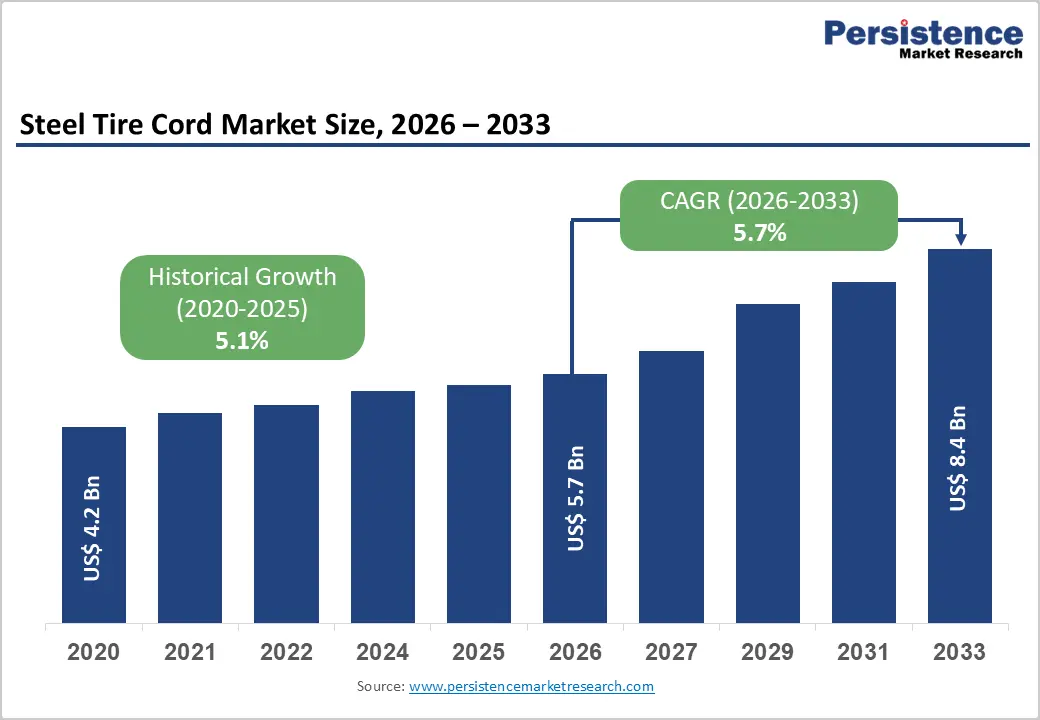
The global steel tire cord market size is expected to be valued at US$ 5.7 billion in 2026 and projected to reach US$ 8.4 billion by 2033, growing at a CAGR of 5.7% between 2026 and 2033. Growth is primarily driven by rising global vehicle production and increasing demand for durable, high-performance tires.
Steel tire cords offer superior tensile strength, fatigue resistance, and strong adhesion to rubber, improving tire safety and longevity. According to the International Organization of Motor Vehicle Manufacturers, global vehicle output reached 91.5 million units in 2023. Additionally, EV sales reached 14 million units in 2023, according to the International Energy Agency, further supporting demand.
Key Industry Highlights:
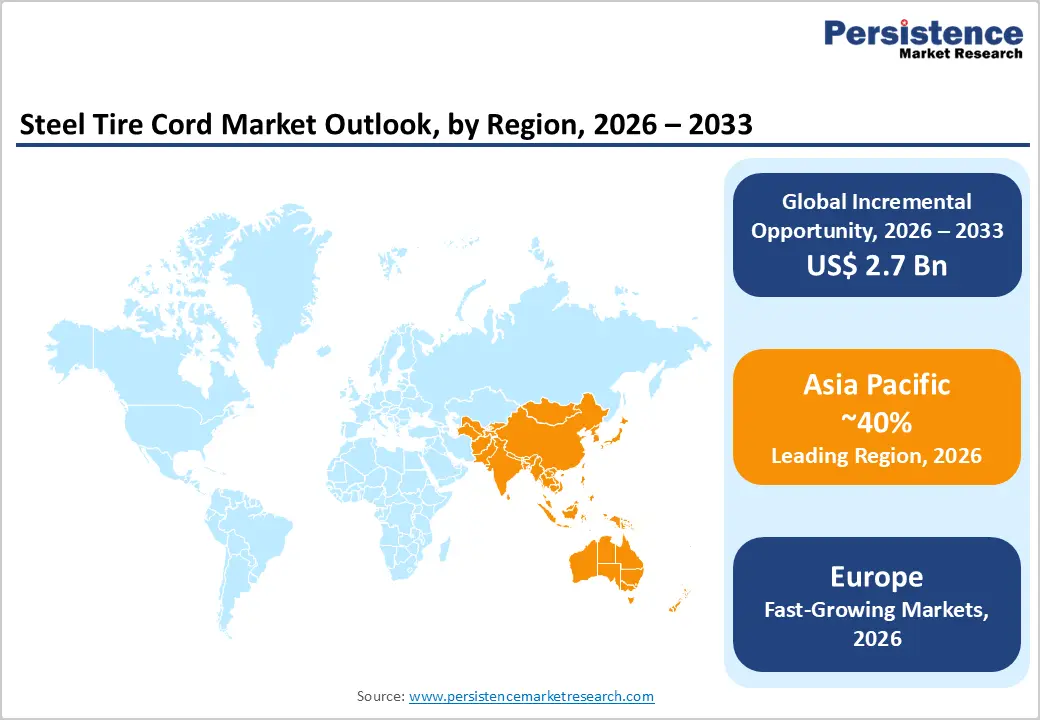
- Leading Region: Asia Pacific leads the Steel Tire Cord Market with a 39.5% share in 2025, supported by strong automotive production across China, India, and Southeast Asia.
- Fastest Growing Region: Europe is the fastest-growing region with a projected CAGR of 4.8% over the forecast period, driven by sustainability regulations and premium tire demand.
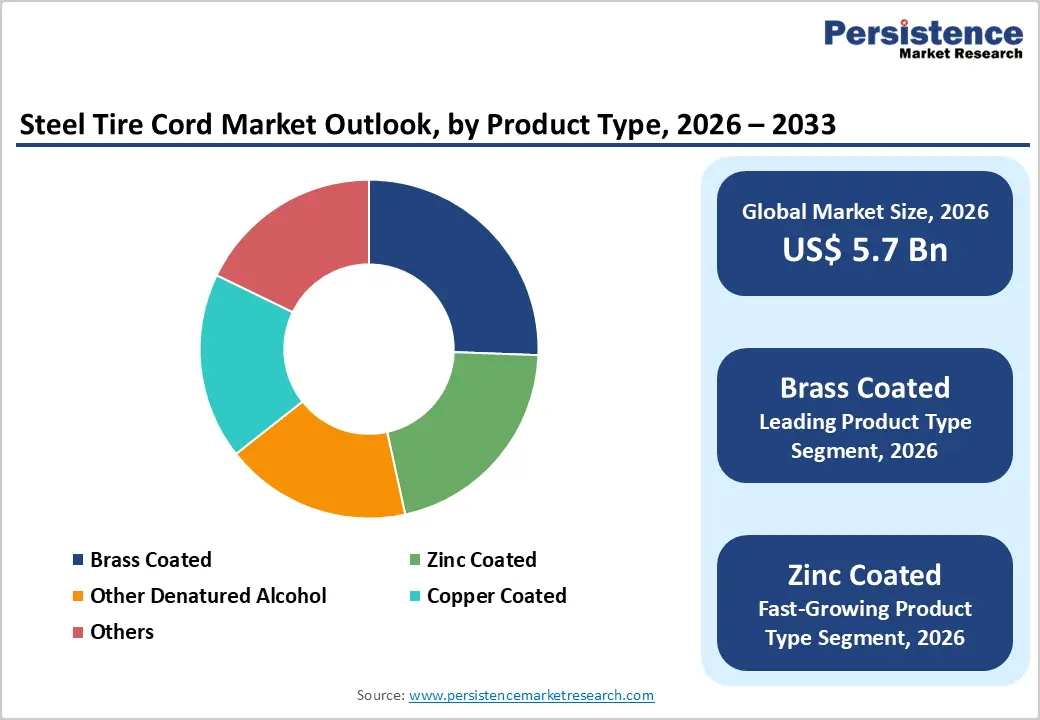
- Leading Product Category: Brass-coated steel tire cords dominate with a 55% share in 2025, owing to superior rubber adhesion and durability in radial tire applications.
- Leading Application Category: Passenger Vehicles (PV) account for 48% share in 2025, supported by steady global production and replacement tire demand.
- Key Opportunity: Rising demand for heavy-duty and sustainable OTR tires presents strong growth potential amid expanding infrastructure and industrial activities globally.
| Key Insights | Details |
|---|---|
| Steel Tire Cord Size (2026E) | US$ 5.7 billion |
| Market Value Forecast (2033F) | US$ 8.4 billion |
| Projected Growth CAGR (2026 - 2033) | 5.7% |
| Historical Market Growth (2020 - 2025) | 5.1% |
Market Dynamics
Drivers - Rising Global Vehicle Production and Expanding Automotive Fleet Supporting Reinforced Tire Demand
Global vehicle production growth remains a primary driver for the steel tire cord market, as steel cords are essential reinforcement materials in modern radial tires used across passenger and commercial vehicles. According to the International Organization of Motor Vehicle Manufacturers, global vehicle production has steadily recovered post-pandemic, strengthening OEM tire demand across Asia and North America.
Steel tire cords enhance tensile strength, durability, and resistance to fatigue, improving overall tire safety and lifespan. Increasing mobility needs, infrastructure development, and rising vehicle ownership in emerging economies continue to elevate tire replacement cycles, thereby supporting consistent demand from both OEM and aftermarket segments through the forecast period.
Rapid Expansion of Electric Vehicle Production Driving Demand for High-Strength Tire Reinforcement
The accelerating adoption of electric vehicles (EVs) is creating incremental demand for advanced tire reinforcement solutions. The International Energy Agency reports sustained growth in global EV sales, reflecting structural transformation in the automotive sector. EVs typically require reinforced tires to manage higher torque output and battery weight.
Steel tire cords provide the high tensile strength and structural stability necessary for EV-specific tire designs, including low rolling resistance and improved load-bearing capacity. As automakers expand EV portfolios and governments promote electrification targets, demand for durable, high-performance tire reinforcement materials is expected to strengthen steadily over the coming years.
Restraints - Fluctuating Steel and Raw Material Prices Creating Cost Pressures Across the Tire Reinforcement Value Chain
Volatility in global steel prices remains a significant restraint for steel tire cord manufacturers, as high-carbon steel wire rod is a primary input. According to the World Steel Association, steel markets have experienced price fluctuations due to supply-demand imbalances, geopolitical tensions, and trade measures, directly impacting production costs for reinforcement materials.
Such variability compresses manufacturer margins, particularly under long-term supply contracts with tire OEMs where pricing flexibility is limited. Smaller producers face greater exposure to cost swings, reducing profitability and constraining investments in advanced cord technologies, capacity expansion, and process modernization across the supply chain.
Increasing Environmental and Tire Recycling Regulations Complicating Steel Cord Recovery and Compliance
Stringent environmental policies surrounding tire recyclability present structural challenges for the steel tire cord market. Regulatory frameworks in Europe and North America emphasize higher recycling and recovery rates for end-of-life vehicles and tires, encouraging sustainable material usage and improved waste management practices.
The United States Environmental Protection Agency highlights ongoing efforts to improve scrap tire recycling efficiency. However, separating steel cords from rubber compounds requires advanced processing technologies, increasing operational costs for recyclers and manufacturers. Compliance pressures may accelerate the shift toward alternative materials or modified coatings, potentially limiting demand for conventional steel cord formulations.
Opportunities - Rising Demand for Sustainable and High-Performance Tires Creating Innovation Pathways in Reinforcement Materials
Growing consumer preference for sustainable mobility is generating opportunities for advanced steel tire cord solutions in eco-friendly and premium tire segments. The European Tyre and Rubber Manufacturers' Association highlights increasing integration of sustainable materials and circular manufacturing practices across European tire production, reflecting broader environmental commitments.
Manufacturers can invest in improved coating technologies and lightweight high-tensile cords that enhance durability while supporting fuel efficiency and lower rolling resistance. As regulatory incentives encourage low-emission materials and EV adoption expands globally, companies focusing on sustainable reinforcement solutions can strengthen their position in high-performance and next-generation tire markets.
Expanding Off-Highway and Commercial Vehicle Segments Strengthening Demand for Heavy-Duty Tire Reinforcement
Infrastructure expansion, mining activities, and construction growth are boosting demand for off-the-road (OTR) and heavy commercial vehicle tires, creating strong opportunities for steel tire cord suppliers. Large equipment fleets operating under high-load conditions require durable radial tires reinforced with high-modulus steel cords.
According to the Asian Development Bank, infrastructure investments across emerging Asian economies remain robust, supporting construction equipment demand. Steel tire cords designed for extreme load-bearing capacity and fatigue resistance enable longer service life in OTR applications, positioning manufacturers to benefit from rising industrialization and global infrastructure development initiatives.
Category-wise Analysis
Product Type Insights
Brass coated steel tire cords dominate the market, accounting for approximately 55% share in 2025, primarily due to their superior adhesion properties with rubber compounds used in radial tires. Their strong bonding capability enhances durability, fatigue resistance, and high-speed stability, making them the preferred choice among major tire manufacturers. Brass coating also provides improved corrosion resistance, supporting performance in varying climatic conditions and extending overall tire lifespan.
Zinc-coated and advanced alloy-coated steel cords are emerging as the fastest-growing product categories. Growing emphasis on sustainability, recyclability, and improved environmental performance is encouraging manufacturers to explore alternative coating technologies. These variants offer improved corrosion resistance and compatibility with evolving tire formulations, particularly in electric and specialty vehicle applications, supporting gradual diversification in product portfolios.
Application Insights
Passenger Vehicles (PV) lead the steel tire cord market with an estimated 48% share in 2025, driven by strong global production volumes and consistent replacement demand. Passenger car tires require fine-gauge, high-tensile steel cords to balance strength, ride comfort, and fuel efficiency. Rising urbanization, expanding middle-class vehicle ownership, and stable OEM production continue to reinforce dominance in this segment.
Off-the-road (OTR) and heavy commercial vehicle applications represent the fastest-growing segment due to increasing infrastructure development, mining activities, and logistics expansion. These applications require high-modulus, heavy-duty steel cords capable of withstanding extreme loads and harsh operating conditions, creating strong growth prospects for specialized reinforcement solutions.
Regional Insights
North America Steel Tire Cord Market Trends
North America accounts for approximately 28% of the global steel tire cord market share in 2025, supported by strong automotive production and replacement demand. The United States remains the regional growth engine, driven by technological advancements and regulatory standards such as FMVSS No. 139 enforced by the National Highway Traffic Safety Administration. Increasing electric vehicle production and premium tire manufacturing further stimulate demand for high-tensile steel cords across OEM channels. The region benefits from advanced manufacturing infrastructure and R&D investments in next-generation tire reinforcement materials. Growing EV production, modernization of tire plants, and strong aftermarket replacement cycles continue to sustain steady demand for performance-oriented steel tire cords across passenger and commercial vehicle segments.
Europe Steel Tire Cord Market Trends
Europe is projected to grow at a CAGR of 4.8% over the forecast period, supported by regulatory alignment and a strong premium vehicle segment. Compliance with UNECE tire performance standards and sustainability frameworks is influencing reinforcement material selection. The European Tyre and Rubber Manufacturers' Association highlights steady replacement demand across Germany, France, and Italy. Sustainability initiatives under the European Green Deal are encouraging innovation in recyclable coatings and environmentally optimized tire structures. Manufacturers are focusing on advanced steel cord formulations that improve durability while supporting circular economy targets, reinforcing Europe’s position as a technology-driven market.
Asia Pacific Steel Tire Cord Market Trends
Asia Pacific leads the global steel tire cord market with an estimated 39.5% share in 2025, driven by high automotive production volumes across China, India, Japan, and Southeast Asia. Rapid industrialization and expanding vehicle ownership underpin strong OEM and replacement tire demand throughout the region.
China is a dominant contributor, while India and ASEAN countries benefit from infrastructure expansion and growing commercial vehicle fleets. Competitive manufacturing costs, large-scale steel production capacity, and export-oriented tire industries position Asia Pacific as the primary growth engine for steel tire cord demand globally.
Competitive Landscape
The steel tire cord market is moderately consolidated, characterized by strong vertical integration across steel wire production, coating technologies, and supply agreements with tire manufacturers. Leading participants focus on expanding manufacturing capacity in high-growth regions, particularly in Asia Pacific, to strengthen supply chain efficiency and meet rising OEM demand. Continuous investment in advanced tensile formulations and coating innovations supports product differentiation.
Competition is increasingly driven by technological expertise in adhesion performance, fatigue resistance, and customization for passenger, commercial, and off-the-road tire applications. Market participants are also forming recycling and circular economy partnerships to improve sustainability credentials and align with evolving environmental regulations worldwide.
Key Developments:
- In March 2025, Hyosung Advanced Materials launched high-strength zinc-coated steel tire cords engineered for off-the-road tire applications, enhancing load-bearing capability, durability, and resistance to harsh operating environments.
- In June 2024, Bekaert introduced eco-friendly brass-coated steel tire cords designed to align with evolving European recyclability requirements, improving environmental performance and reducing production-related carbon footprint through optimized coating processes and enhanced material efficiency.
- In October 2024, Kiswire Ltd. expanded its Vietnam manufacturing facility, increasing production capacity to support rising demand for steel tire cords across Asia, particularly for electric vehicle and high-performance tire applications.
Companies Covered in Steel Tire Cord Market
- Bekaert
- Jiangsu Xingda Steel Cord Co., Ltd.
- Hyosung Advanced Materials
- ArcelorMittal
- Shandong SNTON Steel Cord Co., Ltd.
- Bridgestone Corporation
- Tokyo Rope MFG Co., Ltd.
- Sumitomo Electric Industries, Ltd.
- KISWIRE Ltd.
- Tire Steel Cord Co., Ltd.
- Tokusen Kogyo Co., Ltd.
- Hubei Fuxing New Material Co., Ltd.
- BMZ Group
- Henan Hengxing Science & Technology Co., Ltd.
- Zhangjiagang Junma Steel Cord Co., Ltd.
Frequently Asked Questions
The global Steel Tire Cord Market is projected to reach US$ 5.7 billion in 2026, supported by strong demand across passenger and commercial vehicle segments.
Rising electric vehicle adoption is a major driver, increasing demand for high-tensile reinforcement materials in advanced tire applications.
Asia Pacific leads with a 39.5% share in 2025, driven by large-scale automotive production in China, India, and ASEAN countries.
Growing demand for heavy-duty and sustainable OTR tires presents strong opportunity amid expanding global infrastructure activities.
Leading firms include Bekaert, Kiswire, Hyosung, and Sumitomo Electric, focusing on innovation and expansion.


