




- Beauty & Personal Care
- Spa Products Market
Spa Products Market Size, Share, and Growth Forecast, 2026 - 2033
Spa Products Market By Product Type (Face Skin Care, Aromatherapy Oils, Diffusers & Sensory Wellness), Application (Stress Management & Relaxation, Anti-aging & Facial Rejuvenation), End User, Spa Setting and Regional Analysis for 2026 - 2033

Spa Products Market Size and Trends Analysis
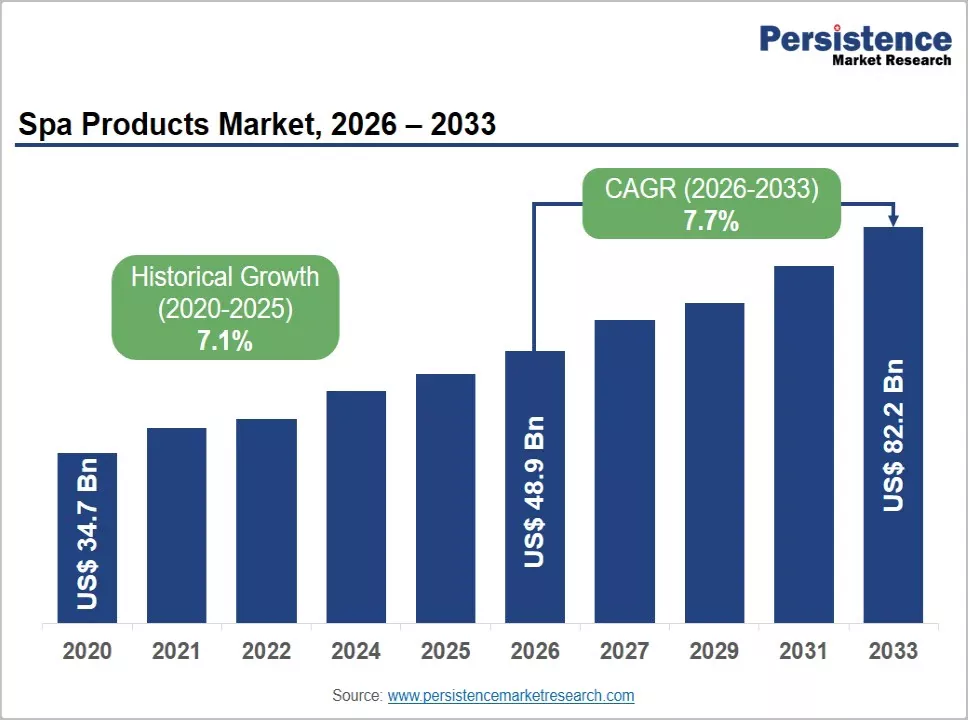
The global spa products market size is likely to be valued at US$ 48.9 billion in 2026 and is expected to reach US$ 82.2 billion by 2033, growing at a CAGR of 7.7% between 2026 and 2033, driven by rising consumer spending on wellness, expansion of hotel and medical spa networks, and growing demand for professional-grade skin and body care. Brands are extending professional treatment ranges into home regimens and e-commerce, which widens the customer base beyond spa visitors.
Key Industry Highlights
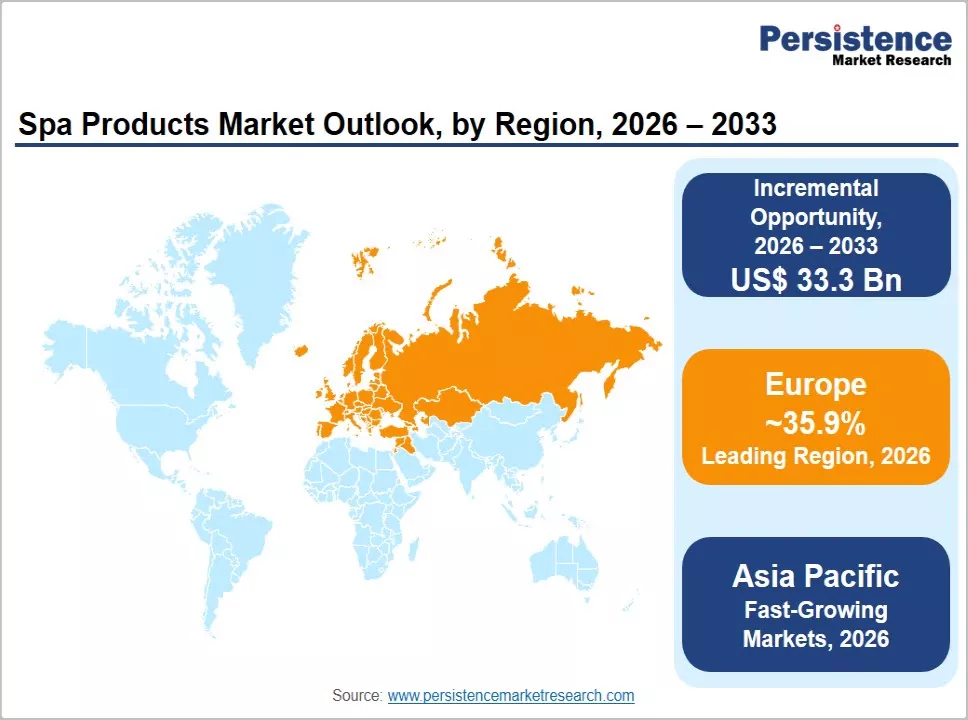
- Leading Region: Europe, accounting for 35.9% of global revenue, supported by established thermal and hotel spa traditions, strong professional skin care manufacturers, and a harmonized cosmetics regulatory framework.
- Fastest-growing Region: Asia Pacific, driven by rising disposable incomes, expanding wellness tourism, and growing spa participation in China, India, and ASEAN.
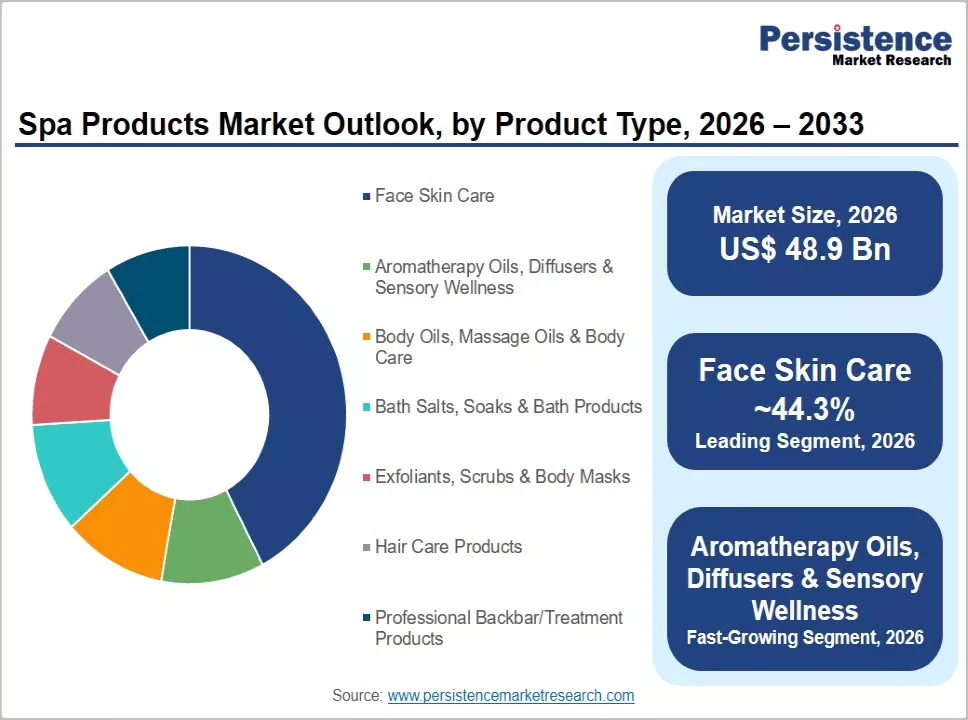
- Leading Product Type: Face skin care, accounting for approximately 44.3% of the market share in 2026, supported by recurring facial treatments, anti-aging demand, and regimen-based home continuation products.
- Leading Spa Setting: Hotel & resort spas, anticipated to account for 31.2% of the market share in 2026, supported by luxury hospitality investment, in-room amenities, and branded retail ranges.
DRO Analysis
Drivers - Rising Wellness Spending Is Strengthening Demand for Spa Products
Consumers are directing a larger share of discretionary income toward skin care, relaxation, and self-care. Industry wellness economy data show global wellness spending grew 8.9% between 2024 and 2025 to reach US$7.52 trillion, with personal care and beauty ranking among the three largest components. This trend increases demand for professional-grade serums, masks, oils, and body treatments.
Spa operators benefit directly because treatment and retail products add revenue beyond service labor. The International Spa Association reported U.S. spa industry revenue of US$23.5 billion in 2025, compared with US$22.5 billion in 2024, indicating sustained treatment volumes and recurring product consumption.
Hotel, Medical Spa, and Wellness Tourism Expansion Is Widening Product Distribution
Hospitality groups and independent operators are adding spa and wellness capacity to differentiate guest experiences, and skin care brands are responding with partnership programs. In June 2026, Guerlain outlined plans to open up to five spas a year with partners as part of its global expansion.
Medical spas add a second growth channel by combining aesthetic procedures with physician-dispensed skin care, which raises demand for clinically positioned products used before and after treatments. Wellness tourism further extends reach, as travelers purchase products first experienced in a treatment room.
Restraint - Ingredient Regulation, Compliance Costs, and Price Sensitivity Limit Market Expansion
Cosmetic products face rigorous regulation in major markets. The European Union applies Regulation (EC) No 1223/2009, which requires safety assessments, a designated responsible person, and product notification before sale. The U.S. Modernization of Cosmetics Regulation Act of 2022 introduced facility registration, product listing, and adverse-event reporting requirements.
Compliance and reformulation costs are likely to weigh most on smaller independent brands that lack dedicated regulatory teams. Premium professional ranges also face price sensitivity, as consumers shift toward lower-priced alternatives during periods of inflationary pressure.
Opportunities - Home Spa and E-commerce Channels Extend Brand Reach
Consumers increasingly replicate spa treatments at home, creating a route for professional brands to sell regimen-based products directly. Brands are packaging in-spa treatments as take-home kits and entering consumer retail. In June 2026, JUARA, whose treatments are featured in luxury spas in Indonesia and New Zealand, launched on Nordstrom.com, illustrating the crossover between professional and retail channels.
Asia Pacific Offers Strong Expansion Potential through Rising Spa Participation
Asia Pacific presents substantial potential because of expanding middle-class populations and growth in wellness tourism. Industry data show the regional wellness economy reached US$2.28 trillion in 2025 and grew 9.7% during the year. Among the world’s largest spa markets, India (8.1% annually) and China (7.6%) have recorded some of the fastest growth over the last five years. International and domestic brands are likely to prioritize distribution partnerships, local formulation, and therapist training programs to capture this growth.
Category-wise Analysis
Product Type Insights
Face skin care accounted for approximately 44.3% of the market share in 2026. It includes cleansers, serums, moisturizers, masks, peels, and treatment creams used in professional facials and sold for home continuation. Facials remain a core spa menu item, and the products used in them are repeatable and regimen-based. For example, IMAGE Skincare expanded its IMAGE MD medical-grade collection in April 2026 with three products designed to soothe and restore skin after lasers and chemical peels. Anti-aging actives such as retinol, peptides, and acids, together with growing interest in skin barrier repair, continue to support demand.
Aromatherapy oils, diffusers & sensory wellness is anticipated to be the fastest-growing segment, expanding at approximately 8.7% annually, as spas and consumers place greater emphasis on stress relief, sleep, and multisensory experiences. For example, a resort spa pairs an aromatherapy massage with a diffuser blend in the treatment room and a take-home oil for the guest. Growth in at-home wellness routines and commercial diffuser installations in hotels and spas, particularly across Asia Pacific, is expected to sustain momentum.
Spa Setting Insights
Hotel & resort spas are anticipated to account for 31.2% of the market share in 2026. These spas use professional products in treatments and also generate retail sales, in-room amenities, and branded product ranges. Luxury skin care brands are strengthening partnerships with hospitality operators. For example, Guerlain’s plan to open up to five partner spas a year reflects the importance of resort and hotel settings in brand visibility.
Medical spas are anticipated to be the fastest-growing spa setting, expanding at a CAGR of 9.6%, driven by demand for non-surgical aesthetic treatments and physician-dispensed skin care. Products for pre- and post-procedure care, including barrier repair, sun protection, and peptide-based regeneration, are used alongside lasers, peels, and injectables. For example, in July 2026, Woodhouse Spa introduced medspa offerings alongside enhanced skin care partnerships, integrating clinical services with long-term skin health programs.
Regional Insights
North America Spa Products Market Trends
North America is a major regional market for spa products, supported by a large professional spa base, high consumer spending on skin care and wellness, and established distribution through hotel, day, and medical spas.
U.S. Spa Products Market Trends
The U.S. remains the dominant market in North America due to its large spa industry, strong medical spa network, and high retail attach rates for professional products. U.S. spa industry revenue reached US$23.5 billion in 2025, according to the International Spa Association. The Modernization of Cosmetics Regulation Act of 2022 raised compliance standards through facility registration and product listing requirements.
In April 2026, IMAGE Skincare, a Florida-based professional spa and salon brand, expanded its IMAGE MD line with three new products for sensitive or compromised skin. In July 2026, Woodhouse Spa expanded its medspa and skin care offerings, reflecting the integration of spa services with long-term skin health products.
Canada Spa Products Market Trends
Canada represents an important secondary market, supported by wellness tourism, Nordic-style thermal spas, and growing demand for natural and clean skin care. Cosmetics are regulated by Health Canada under the Food and Drugs Act and the Cosmetic Regulations, which require product notification and restrict hazardous ingredients.
Europe Spa Products Market Trends
Europe is the leading regional market, accounting for 35.9% of global revenue. The region benefits from long-standing thermal, balneology, and thalassotherapy traditions and a dense base of professional skin care manufacturers in France, Germany, Italy, and Spain. Regulation (EC) No 1223/2009 harmonizes safety requirements across member states, which simplifies cross-border distribution, while ingredient restrictions and sustainability expectations influence formulation and packaging.
Germany Spa Products Market Trends
Germany represents a major European market due to its established wellness hotel sector, tradition of medical spa towns, and strong base of professional skin care manufacturers, including Aachen-based Babor. Consumers show strong interest in dermatologically tested, natural, and certified cosmetics, supporting demand for science-led and organic ranges.
The EU safety assessment and responsible-person requirements create consistent compliance standards for brands selling across Germany and neighboring markets.
U.K. Spa Products Market Trends
The U.K. remains an important market for hotel, day, and destination spas. The UK Cosmetics Regulation requires a UK-based responsible person and product notification, which international brands factor into market entry plans.
In June 2026, Spain-based Natura Bissé appointed Exclusive Beauty Ltd as its spa distribution partner for the UK and Ireland. The appointment reflects a broader trend of international luxury brands using local distributors to expand in the spa channel.
Asia Pacific Spa Products Market Trends
Asia Pacific is anticipated to be the fastest-growing regional market due to rising disposable incomes, expanding wellness tourism, and a growing middle class adopting spa treatments and premium skin care. The regional wellness economy reached US$2.28 trillion in 2025, growing 9.7% during the year, according to industry wellness economy data.
China Spa Products Market Trends
China is one of the largest spa markets in the region and has recorded annual growth of approximately 7.6% over the last five years. Demand combines traditional Chinese medicine-inspired treatments with international luxury spa brands, supported by an expanding urban middle class.
The Cosmetic Supervision and Administration Regulation, effective January 2021, strengthened product registration, filing, and safety assessment requirements overseen by the National Medical Products Administration.
India Spa Products Market Trends
India is emerging as a major growth market, recording annual spa growth of approximately 8.1% over the last five years. Rising urban incomes, expanding hospitality infrastructure, and strong interest in Ayurveda-inspired formulations are supporting demand for spa and wellness products. Cosmetics are regulated under the Cosmetics Rules, 2020, administered by the Central Drugs Standard Control Organization.
In June 2026, Atmantan Wellness Centre, based in Mulshi near Pune, announced a new centre in Hyderabad planned to open between 2028 and 2029.
Competitive Landscape
The global spa products market is fragmented, with competition among diversified beauty groups, dermatology-led skin care companies, professional spa brands, and natural and organic specialists. Major companies compete based on clinical credibility, ingredient innovation, positioning in luxury hospitality, therapist training, and breadth of retail and e-commerce distribution.
Leading companies are focusing on partnerships with hotels and medical spas, expansion of medical-grade ranges, and take-home product lines that connect in-spa treatments with consumer retail.
Key Industry Developments
- In October 2026, Galderma signed an agreement to acquire ZO Skin Health for an enterprise value of US$1.5 billion in an all-cash transaction. ZO Skin Health is sold through more than 16,500 physician, medical spa, and online accounts in more than 40 countries, and the transaction is expected to close in the fourth quarter of 2026 or early 2027, subject to regulatory approvals.
- In June 2026, Guerlain outlined plans to launch up to five spas a year with partners, strengthening its presence in luxury hotel and resort spa settings.
- In May 2026, Yobee, a physician-founded scalp care brand, launched a product line for the spa industry, extending microbiome-focused scalp and hair care into luxury spa treatment menus.
Companies Covered in Spa Products Market
- L’Oréal S.A.
- The Estée Lauder Companies Inc.
- Unilever PLC
- LVMH Moët Hennessy Louis Vuitton SE
- Beiersdorf AG
- Shiseido Company, Limited
- Galderma Group AG
- L’Occitane International S.A.
- Dr. Babor GmbH & Co. KG
- The Beauty Health Company
- WALA Heilmittel GmbH (Dr. Hauschka)
- Davines Group (Comfort Zone)
- Phytomer
- Natura Bissé
- IMAGE Skincare
Frequently Asked Questions
The global spa products market is projected to be valued at US$ 48.9 billion in 2026.
The market is expected to reach US$ 82.2 billion by 2033.
Key trends include the growth of medical-grade and physician-dispensed skin care, aromatherapy and sensory wellness products, home spa and e-commerce channels, hotel and resort spa partnerships, and sustainable formulations and packaging.
Face skin care is anticipated to remain the leading product type, accounting for approximately 44.3% of the market share in 2025.
The market is projected to expand at a CAGR of 7.7% between 2026 and 2033.
Major companies include L’Oréal S.A., The Estée Lauder Companies Inc., Unilever PLC, LVMH, and Beiersdorf AG.


