




- Beauty & Personal Care
- Liquid Hand Soap Market
Liquid Hand Soap Market Size, Share, and Growth Forecast 2026–2033
Liquid Hand Soap Market by Product Type (Antibacterial Liquid Soap, Moisturizing / Herbal Liquid Soap, Fragrance / Perfumed Liquid Soap), Distribution Channel (Supermarkets & Hypermarkets, Pharmacies & Drugstores), and Regional Analysis, 2026–2033

Liquid Hand Soap Market Size and Trend Analysis
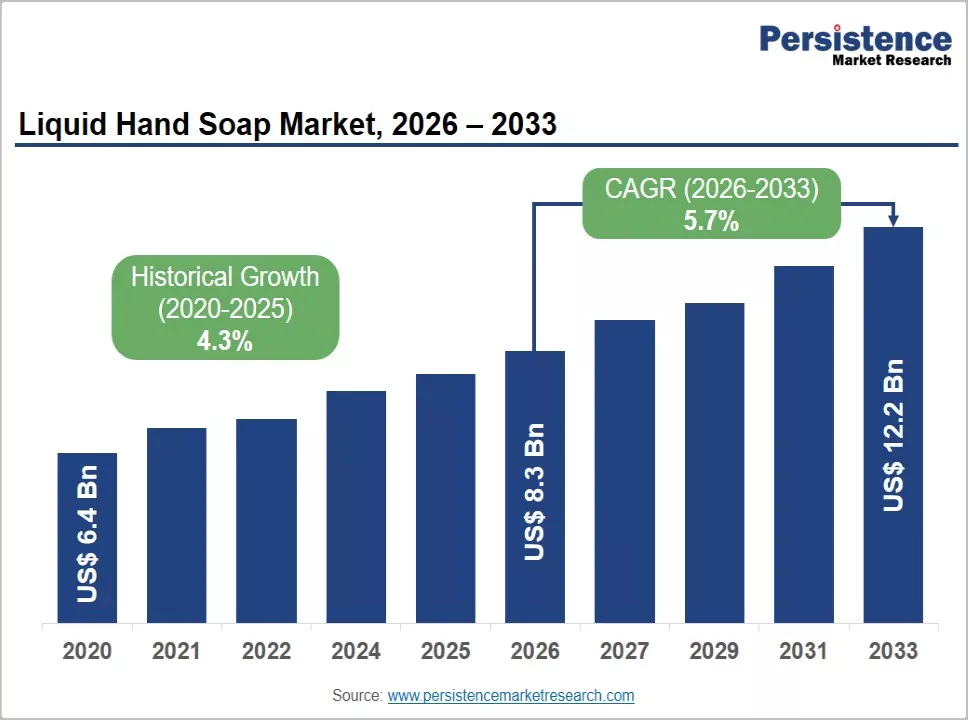
The global liquid hand soap market size is likely to be valued at US$ 8.3 billion in 2026, and is estimated to reach US$ 12.2 billion by 2033, growing at a CAGR of 5.7% during the forecast period 2026−2033. Growth is underpinned by entrenched hand hygiene habits, rising demand for skin-friendly and naturally derived formulations, and the steady shift from bar soap to dispensed liquid formats across households, workplaces, and hospitality settings.
The market recorded moderate expansion over 2020−2025 as pandemic-era demand peaks normalized and consumers traded down toward value brands. However, the forecast period anticipates firmer momentum as premiumization, refill and concentrate formats, and e-commerce penetration widen the addressable base, particularly in Asia Pacific and other urbanizing regions where per-capita liquid soap consumption remains well below developed-market levels.
Key Industry Highlights
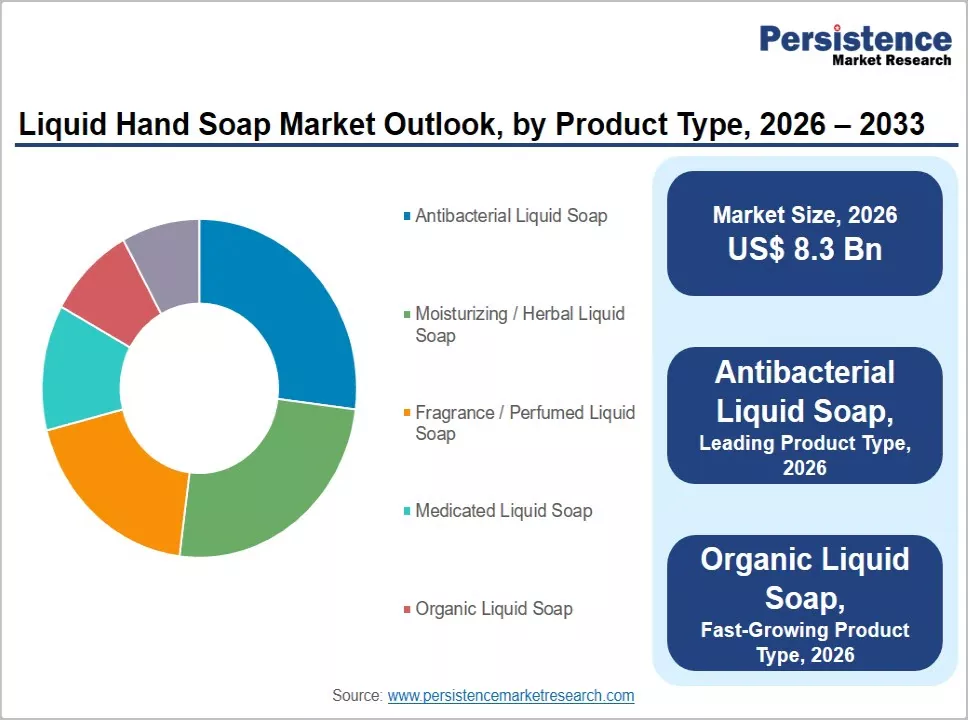
- Dominant Product Type: Antibacterial liquid soap is set to command around 32% of the revenue share in 2026, while organic liquid soap is likely to grow the fastest at about 7.9% CAGR through 2033, as consumers seek plant-based, free-from formulations.
- Leading Distribution Channel: Supermarkets and hypermarkets are expected to lead with about 42% share in 2026, while online retail and e-commerce are likely to be the fastest-growing channel at around 8.6% CAGR during 2026–2033, supported by subscription refills and bulk packs.
- Format and Packaging Innovation: Refill pouches, concentrates, and foaming dispensers are gaining traction as brands respond to plastic-reduction targets and consumer demand for value, with paper-based and concentrated formats entering mainstream retail.
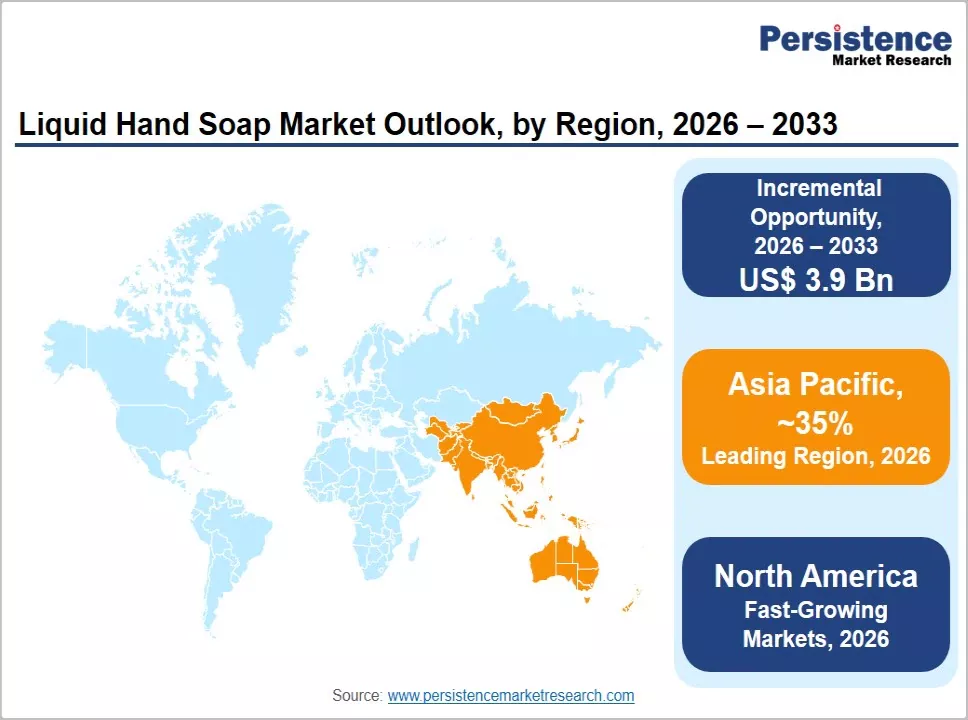
- Regional Leadership: Asia Pacific is poised to dominate with an estimated 35% share in 2026 and register a 6.8% CAGR through 2033, led by urbanization, rising disposable incomes, and hygiene awareness campaigns in China, India, and Southeast Asia.
- Competitive Environment: Competitive dynamics include portfolio consolidation, such as the announced acquisition of GOJO Industries by Clorox, premium fragrance-led launches, and sustainability-focused entrants targeting refill and concentrate formats.
DRO Analysis
Drivers: Lasting Hygiene Awareness and Premiumization as Primary Growth Catalysts
Sustained hand hygiene awareness is the leading force driving the liquid hand soap market growth, as the behavioral shifts seeded by the COVID-19 pandemic have settled into everyday routines in homes, schools, offices, and healthcare facilities. Public health campaigns led by the World Health Organization (WHO), national sanitation missions, and annual observances such as Global Handwashing Day continue to reinforce the link between handwashing and reduced infectious disease burden, particularly in developing economies.
Liquid formats benefit from perceived hygiene advantages over shared bar soap, convenient dispensing, and compatibility with touchless and wall-mounted dispensers. Institutional demand from hospitals, restaurants, hotels, and public restrooms provides a stable replenishment base, while households increasingly stock multiple variants for kitchens, bathrooms, and guest use.
Skin-Care-Led Premiumization and Fragrance Innovation
Manufacturers are positioning hand soap as an extension of personal care rather than a purely functional commodity. Formulations enriched with moisturizers, vitamin E, shea extract, and aloe, as well as seasonal and designer fragrances, allow brands to command higher price points and encourage multi-bottle purchasing.
Launches such as Bath & Body Works' Daily Moisturizing Hand Soap and Revitalizing Hand Soap in 2026 illustrate how fragrance retailers and skincare brands are borrowing from beauty playbooks to elevate everyday handwashing. This premiumization trend is expected to lift average selling prices and sustain value growth even where volume expansion is modest.
Restraints: Bar Soap Substitution, Regulatory Scrutiny, and Plastic Waste Pressure
Price-sensitive consumers in emerging markets continue to rely on bar soap, which is cheaper per wash and widely available through informal retail, limiting the pace of conversion to liquid formats. Antibacterial claims also face sustained regulatory scrutiny. In the U.S., the Food and Drug Administration (FDA) prohibited triclosan, triclocarban, and a number of other active ingredients in consumer antiseptic washes, and comparable restrictions on biocidal actives have emerged in the European Union and other jurisdictions. Manufacturers must therefore reformulate, validate efficacy claims, and navigate differing national rules, which raises development costs and slows cross-border product rollouts.
Raw Material Volatility and Packaging Sustainability Challenges
Liquid hand soap relies on surfactants, glycerin, fragrance compounds, and plastic packaging, all of which are exposed to petrochemical and agricultural price swings. Margin pressure is most acute for private-label and mid-tier brands that cannot easily pass costs on to retailers. At the same time, single-use plastic pumps and bottles attract regulatory and consumer criticism, with extended producer responsibility schemes in Europe and several Asian economies raising compliance costs. Investing in recycled-content bottles, refill systems, and concentrates requires capital and supply chain redesign, which can be difficult for smaller manufacturers and tends to delay adoption of more sustainable formats.
Opportunities: Refill and Concentrate Formats and Emerging Market Penetration
Refill pouches, concentrates, tablets, and paper-based packaging offer a path to reconcile affordability with sustainability. Concentrated formulations reduce transport weight and packaging volume, while refills reward repeat purchase and brand loyalty. In October 2026, Clean Cult expanded its paper-carton portfolio with a concentrated castile soap positioned for hand soap and multi-surface cleaning, reflecting how indie brands are using concentrates to broaden household use cases. Large manufacturers are also scaling refill systems for mainstream shoppers, creating opportunities for packaging suppliers, contract manufacturers, and dispenser providers.
E-commerce Growth and Rising Per-Capita Consumption in Emerging Economies
Urbanizing economies across South Asia, Southeast Asia, Africa, and Latin America remain under-penetrated in liquid hand soap, offering long-term volume growth as incomes rise and modern retail expands. Online platforms and quick-commerce services are shortening the path to purchase, enabling bulk packs, subscription refills, and targeted promotion of herbal and dermatologically positioned variants. As institutional hygiene standards tighten in schools, hospitals, and food service, demand for professional-grade soaps and dispenser systems is also expected to rise, creating additional opportunities for suppliers with both consumer and business-to-business capabilities.
Category-wise Insights
Product Type Analysis
Why Do Antibacterial Liquid Soaps Lead the Liquid Hand Soap Market?
Antibacterial liquid soap is the leading product type segment, expected to hold about 32% of the liquid hand soap market revenue share in 2026. Strong brand recognition from Dettol, Lifebuoy, Dial, and Softsoap, together with persistent consumer association of germ protection with cleanliness, supports its leadership. Healthcare facilities, schools, food service operators, and households with young children or elderly members favor antibacterial claims as a safeguard against infection. Manufacturers are reformulating around permitted active ingredients and emphasizing mild, skin-conditioning bases to address concerns about dryness from frequent washing. Wide availability across mass retail and institutional channels keeps the segment a stable contributor to category revenue.
Organic liquid soap is likely to grow the fastest through 2033, at an estimated 7.9% CAGR. Consumers are scrutinizing ingredient lists and gravitating toward plant-based surfactants, certified organic botanicals, and formulations free from parabens, sulfates, synthetic dyes, and artificial fragrance. Brands in this segment often pair certifications with refill packs and recyclable packaging, strengthening sustainability credentials. Although higher prices limit penetration in value-oriented markets, premium retail, specialty stores, and online platforms are expanding availability. Moisturizing and herbal liquid soaps are also gaining share, supported by Ayurvedic and botanical positioning in Asia, while fragrance-led and medicated variants serve differentiated occasions and clinical needs.
Fragrance and perfumed liquid soaps remain an important value pool, supported by seasonal collections, gifting, and the growing use of hand soap as a home decor and fragrance extension. Medicated liquid soaps, including those positioned for dry-skin conditions, surgical scrubs, and post-procedure care, occupy a smaller but clinically important niche, with demand tied to hospital procurement, dermatologist recommendations, and pharmacy retail. Both segments are expected to grow in line with the broader category, with innovation centered on skin-barrier-supporting ingredients and gentler preservative systems.
Distribution Channel Analysis
Why Do Supermarkets and Hypermarkets Lead Liquid Hand Soap Distribution?
Supermarkets and hypermarkets are poised to lead with an estimated 42% share in 2026, favored for their extensive assortment, promotional pricing, and the convenience of bundling hand soap with household staples. Large retailers allocate prominent shelf space to multi-brand ranges and private labels, and multipack and refill formats perform well in these stores. Retail media programmes and in-store sampling are increasingly used by leading brands to defend share and trade consumers up to premium variants. The channel is expected to grow steadily, driven mainly by modern retail expansion in emerging markets rather than by any structural shift away from physical shopping.
Online retail and e-commerce is the fastest-growing distribution channel, expected to showcase an approximate 8.6% CAGR through 2033. Subscription refills, bulk purchasing, and direct-to-consumer brand stores appeal to households that value convenience and recurring replenishment. Quick-commerce platforms in India, China, and Southeast Asia are accelerating same-day delivery of everyday personal care items. Pharmacies and drugstores retain relevance for medicated and dermatologist-recommended variants, while convenience stores serve impulse and small-pack purchases, and specialty personal care stores support premium and fragrance-led assortments that benefit from experiential merchandising and gifting occasions.
Channel dynamics are also being reshaped by omnichannel strategies, as retailers integrate click-and-collect, loyalty programmes, and app-based replenishment to retain shopper traffic. Manufacturers are tailoring pack sizes and price tiers by channel, offering large-format refills in hypermarkets and online stores, and compact, travel-friendly packs in convenience outlets. Data-driven category management is expected to improve assortment productivity and strengthen collaboration between brand owners and retailers through 2033.
Regional Insights
North America Liquid Hand Soap Market Trends and Insights
North America is anticipated to account for an estimated 26% of the global liquid hand soap market in 2026. The region's market is likely to benefit from a premiumization-oriented consumer base, strong private-label and specialty fragrance retail, and sustained institutional demand from healthcare, education, and hospitality. Corporate activity is reshaping the competitive field, with Clorox's announced US$ 2.25 billion acquisition of GOJO Industries, maker of Purell, expected to bring a major hand hygiene portfolio and an extensive dispenser network under a household cleaning leader. Retailer-owned brands and indie entrants are also expected to intensify competition through refill and concentrate formats through 2033.
U.S. Liquid Hand Soap Market Size
The U.S. is estimated to account for approximately 80% of the North America liquid hand soap market in 2026. Market growth is likely to be supported by premium fragrance innovation, retailer-led personal care assortments, and institutional replenishment in healthcare and foodservice. Established brands such as Softsoap, Dial, and Method compete with fragrance retailers and eco-positioned challengers, encouraging frequent launches and limited-edition scents. Regulatory restrictions on certain antibacterial actives have steered formulation toward alternative mild cleansers, while growing interest in refills and recyclable packaging is anticipated to influence assortment decisions at major retailers through 2033.
Canada Liquid Hand Soap Market Size
Canada is projected to represent approximately 20% of the North America liquid hand soap market in 2026. Market expansion is expected to be driven by consumer preference for natural, fragrance-free, and sensitive-skin formulations, as well as institutional demand across healthcare and public facilities. Retailers and grocery chains are likely to expand private-label and eco-certified ranges, while extended producer responsibility frameworks in several provinces are encouraging recyclable and refillable packaging. E-commerce and club-store channels are anticipated to support multipack purchasing, helping Canadian demand grow steadily through 2033.
Europe Liquid Hand Soap Market Trends and Insights
Europe is estimated to account for approximately 13% of the global liquid hand soap market in 2026. The region's market is expected to benefit from high hygiene standards, consumer preference for eco-labelled and dermatologically tested products, and strict chemical and packaging regulations. The European Union's Packaging and Packaging Waste Regulation is likely to encourage recycled content and reuse systems, favoring refills and concentrates. Biocidal product rules also shape antibacterial claims, steering brands toward gentle formulations. Established multinationals are likely to retain competitive advantages through scale, while private-label brands from large grocery chains continue to gain share in value segments.
Germany Liquid Hand Soap Market Size
Germany is anticipated to account for approximately 21% of the Europe liquid hand soap market in 2026. Demand is expected to be supported by a strong drugstore retail network, consumer interest in eco-certified and skin-friendly products, and widespread use of refill pouches. Retailers such as dm and Rossmann operate prominent private-label ranges, intensifying price competition and raising sustainability expectations for national brands. Institutional demand from hospitals, care homes, and public buildings is also expected to sustain consumption of professional-grade soaps. Continued focus on recyclability and ingredient transparency is projected to support market expansion through 2033.
Why Is Asia Pacific Expected to Lead the Liquid Hand Soap Market?
Asia Pacific is projected to account for approximately 35% of the global liquid hand soap market in 2026, making it the largest regional market. The region is also anticipated to register the fastest growth, expanding at an estimated CAGR of 6.8% through 2033. Market expansion is likely to be driven by population scale, urbanization, rising disposable incomes, and expanding modern and online retail. Government-led sanitation and hygiene initiatives, together with a shift from bar soap to liquid formats, are expected to broaden consumption. Local and regional brands, including herbal and Ayurvedic-positioned players, are also gaining ground alongside global multinationals.
China Liquid Hand Soap Market Size
China is estimated to represent approximately 34% of the Asia Pacific liquid hand soap market in 2026. The country's market is expected to benefit from rising urban incomes, e-commerce penetration through large online platforms, and growing demand for gentle, fragrance-differentiated products. Domestic personal care brands are expanding with ingredient-led and gender-neutral positioning, while multinationals emphasize premium antibacterial and skin-care-driven ranges. Livestreaming and social commerce are anticipated to accelerate new product trials, and continued consumer interest in hygiene is projected to sustain China's regional market leadership through 2033.
India Liquid Hand Soap Market Size
India is projected to account for approximately 20% of the Asia Pacific liquid hand soap market in 2026. The market is expected to witness strong expansion, supported by the shift from bar soap to hand wash, sanitation-focused campaigns, and growing modern trade and quick-commerce reach. Brands such as Dettol, Lifebuoy, Savlon, and Godrej Protekt are expanding refill pouches and small-denomination packs to improve affordability in tier-2 and tier-3 cities. Herbal and Ayurvedic-positioned variants are also likely to gain traction, supporting both volume growth and premiumization through 2033.
Competitive Landscape
The global liquid hand soap market structure is moderately fragmented, with leading multinationals, including Unilever, Reckitt, Colgate-Palmolive, Henkel, and Clorox, accounting for a significant share of branded revenue. These players leverage strong brand equity, extensive distribution reach, and sustained investment in fragrance science, dermatological testing, and packaging innovation. Private-label products from large grocery and drugstore chains compete aggressively on price, particularly in North America and Europe.
Regional and niche competitors such as Godrej Consumer Products, ITC, Lion Corporation, and specialty clean-beauty brands are focusing on herbal, organic, and refill-led propositions. Barriers to entry for basic formulations are low, yet scale in manufacturing, retail relationships, and regulatory compliance limit rapid expansion. Industry consolidation is expected to continue, as large companies acquire hygiene specialists and sustainable challengers to broaden portfolios and strengthen business-to-business positions, while professional hygiene suppliers deepen dispenser-and-refill ecosystems.
Key Market Developments
- In January 2026, Clorox announced the acquisition of GOJO Industries, maker of Purell, for US$ 2.25 billion, adding a leading hand hygiene portfolio and an extensive installed base of soap and sanitizer dispensers across consumer and professional channels.
- In March 2026, Bath & Body Works introduced Revitalizing Hand Soap, featuring dissolvable wax beads and skin-conditioning ingredients such as vitamin E, shea extract, and aloe, following the early-2026 launch of its Daily Moisturizing Hand Soap.
- In October 2026, Clean Cult launched a concentrated castile soap in paper-based cartons, alongside new equity and venture debt financing, to expand its sustainable personal care and cleaning portfolio through Sprouts, Amazon, and wider retail rollout.
Companies Covered in Liquid Hand Soap Market
- Unilever PLC
- Reckitt Benckiser Group plc
- Colgate-Palmolive Company
- Henkel AG & Co. KGaA
- The Clorox Company
- GOJO Industries, Inc.
- Ecolab Inc.
- S. C. Johnson & Son, Inc.
- Godrej Consumer Products Limited
- ITC Limited
- Lion Corporation
Frequently Asked Questions
The global liquid hand soap market is valued at US$ 8.3 billion in 2026 and is projected to reach US$ 12.2 billion by 2033, expanding at a CAGR of 5.7% during 2026–2033.
Sustained hand hygiene awareness, skin-care-led premiumization, the shift from bar soap to liquid formats, and the rapid expansion of refill, concentrate, and online retail formats are driving the market.
Antibacterial liquid soap leads product types with about 32% share, while supermarkets and hypermarkets lead distribution channels with an estimated 42% share in 2026.
Asia Pacific dominates the market with an estimated 35% share in 2026 and is projected to register a 6.8% CAGR through 2033, led by urbanization, rising incomes, and hygiene awareness in China, India, and Southeast Asia.
Refill and concentrate formats, organic and herbal formulations, e-commerce and subscription models, and rising per-capita consumption in emerging economies are key market opportunities.
The market is moderately fragmented, with Unilever, Reckitt, Colgate-Palmolive, Henkel, and Clorox holding a significant share of branded revenue, alongside strong private-label competition.


