




- Inks, Coatings, Adhesives & Sealants (ICAS)
- Solvent-Borne Coatings Market
Solvent-Borne Coatings Market Size, Share, and Growth Forecast, 2026 – 2033
Solvent-Borne Coatings Market by Product Type (One Component System Coatings, Two Component System Coatings), Application (Automotive Coatings, Industrial Coatings, Printing Inks, Others), End-User (Transportation & Automotive Sector, Oil & Gas Industry, Manufacturing & Machinery, Others), and Regional Analysis for 2026-2033

Solvent-Borne Coatings Market Share and Trends Analysis
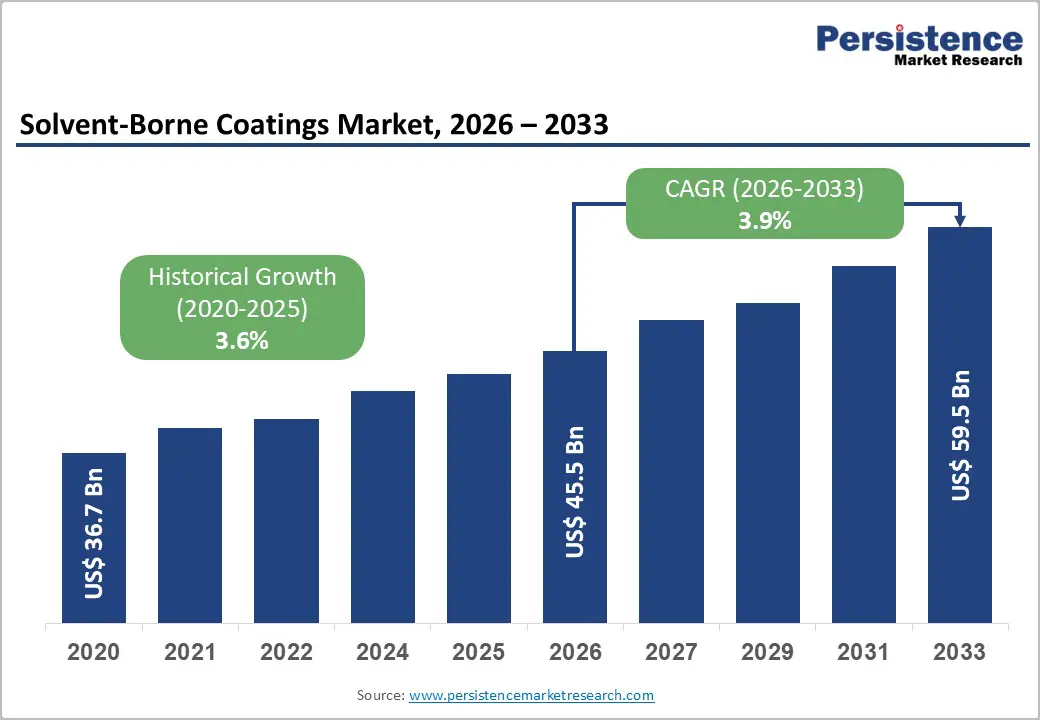
The global solvent-borne coatings market size is likely to be valued at US$ 45.5 billion in 2026, and is projected to reach US$ 59.5 billion by 2033, growing at a CAGR of 3.9% during the forecast period 2026−2033. Growth is primarily driven by increased industrial production and rising demand for durable, high-performance coatings across automotive, industrial, and manufacturing sectors. Technological integration in coating application methods, including spray, roll, and dip techniques, improves operational efficiency and surface performance, fostering adoption. Regulatory emphasis on quality and safety standards promotes higher consumption of solvent-borne coatings, especially in transportation and heavy manufacturing. Urbanization and expanding infrastructure development in emerging economies generate increased demand for protective and decorative coatings. Rising awareness among industrial stakeholders regarding long-term cost savings through maintenance reduction contributes to market expansion. Investment in research & development (R&D) for advanced resin and solvent combinations facilitates product differentiation, enhancing applicability across multiple substrates and environments.
Key Industry Highlights
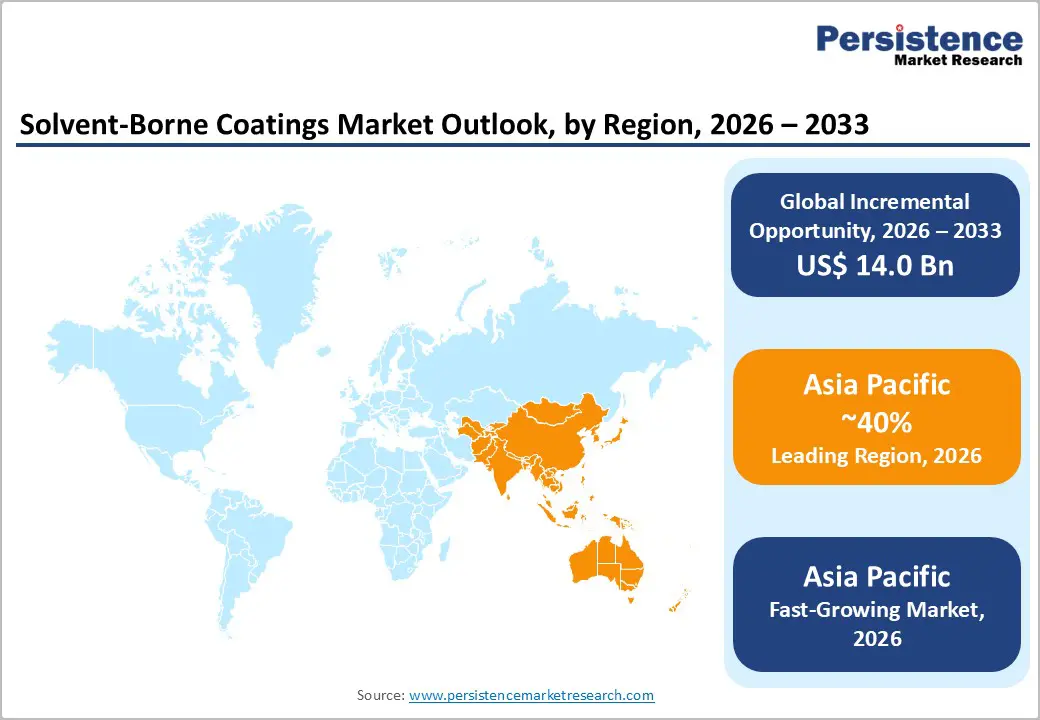
- Dominant Region: Asia Pacific is expected to hold about 40% market share, driven by high-volume manufacturing and rapid automotive production, where the demand for advanced coatings is massive.
- Fastest-growing Market: Asia Pacific is forecasted to be the fastest-growing market through 2033, fueled by automation adoption and rising demand for durable industrial and automotive surface protection.
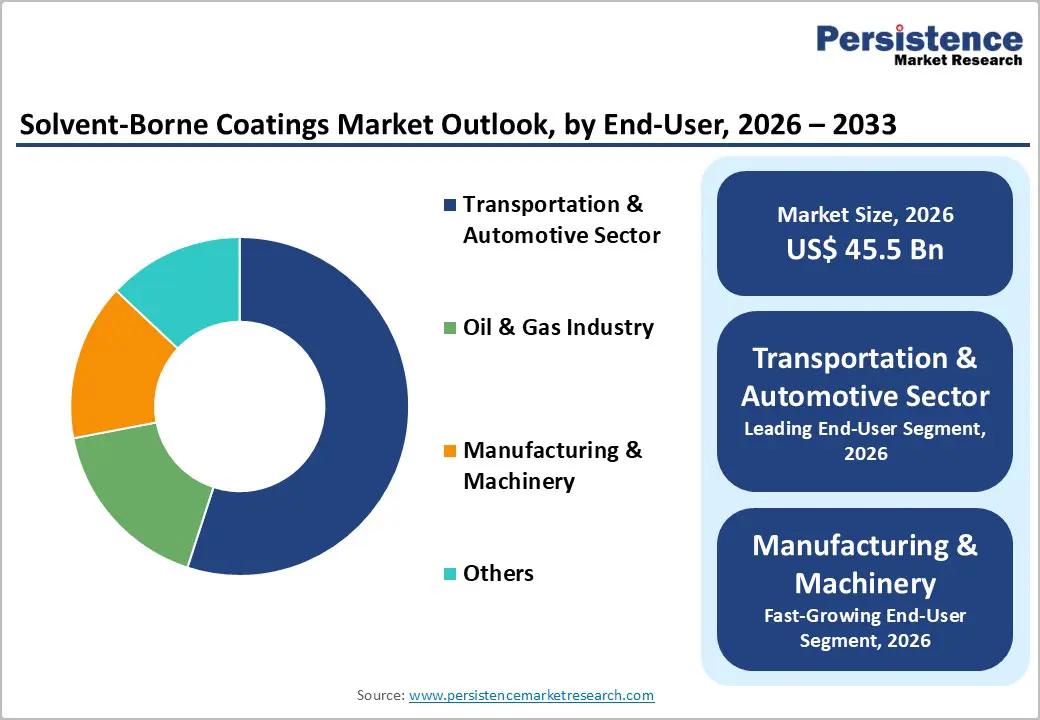
- Leading End-User: The transportation and automotive segment is likely to lead with about 55% revenue share in 2026, owing to continuous vehicle production and stringent performance standards.
- Fastest-growing End-User: Manufacturing and machinery is expected to be the fastest-growing segment, supported by a strong demand for durable, high-performance coatings for equipment and infrastructure.
| Report Attribute | Details |
|---|---|
|
Solvent-Borne Coatings Market Size (2026E) |
US$ 45.5 Bn |
|
Market Value Forecast (2033F) |
US$ 59.5 Bn |
|
Projected Growth (CAGR 2026 to 2033) |
3.9% |
|
Historical Market Growth (CAGR 2020 to 2025) |
3.6% |
Market Factors – Growth, Barriers, and Opportunity Analysis
Industrial Expansion and Infrastructure Development
Rapid growth in construction, manufacturing, and heavy industries has led to increased demand for durable and protective surface coatings. Solvent borne coatings are preferred in many industrial applications due to their strong adhesion, chemical resistance, and ability to withstand harsh environmental conditions. Expansion of industrial plants, warehouses, and transportation infrastructure requires coatings that ensure longevity and reduce maintenance costs. Large-scale industrial projects and modern infrastructure initiatives frequently rely on coatings capable of protecting metal, concrete, and composite surfaces from corrosion, wear, and environmental degradation. This demand is further amplified by strict regulatory standards for safety and performance in industrial and commercial facilities, creating a steady requirement for high-performance coating solutions.
Urbanization and modernization of infrastructure contribute to higher consumption of solvent-based coatings in sectors such as bridges, tunnels, railways, and airports. Industrial facilities undergoing upgrades or retrofitting operations require coatings with specialized properties to meet functional and aesthetic standards. The need for long-lasting performance in high-stress environments drives investment in coatings with superior durability and fast curing capabilities. Supply chain enhancements and rising investment in industrial zones accelerate project execution, translating into increased adoption of solvent-based coatings for both new construction and refurbishment projects.
Automotive and Transportation Sector Demand
The solvent-borne coatings market growth is significantly influenced by the robust demand from the automotive and transportation sector, driven by the need for durable, high-performance finishes. Vehicles and transportation equipment require coatings that offer resistance to abrasion, corrosion, and chemical exposure while maintaining aesthetic appeal. Solvent-borne coatings provide superior adhesion, hardness, and flexibility, which align with the rigorous standards of vehicle manufacturing. Rising production of passenger cars, commercial vehicles, and specialty vehicles across emerging and developed regions has created a sustained demand for advanced coating solutions. The adoption of lightweight materials in automotive manufacturing, such as aluminum and composite structures, has further increased the requirement for coatings capable of ensuring long-term protection and performance under diverse environmental conditions.
Shifts in consumer expectations for premium finishes and innovative color solutions also drive the application of solvent-borne coatings. Transportation companies seek coatings that enhance durability and reduce maintenance costs over the product lifecycle. Solvent-based formulations offer a faster drying rate and high gloss finish, making them suitable for high-volume production environments and specialty applications within the sector. Regulatory frameworks governing vehicle safety and performance indirectly support the demand by emphasizing protective and performance-enhancing surface treatments. Investments in fleet modernization and expansion of public transport infrastructure further amplify the adoption of solvent-borne coatings.
Stringent Environmental Regulations on VOC Emissions
Strict limitations on volatile organic compound (VOC) emissions significantly influence production and formulation strategies within the coatings industry. VOCs, present in high concentrations in solvent-based coatings, contribute to air pollution and pose health risks, prompting regulatory authorities to enforce strict compliance standards. Manufacturers are required to invest in advanced technologies and reformulate products to meet emission limits, which increases operational costs and can slow product development cycles. Compliance with regional regulations, which vary widely, adds complexity to supply chain management and affects global market distribution. The need to balance performance characteristics, such as durability and drying time, with emission standards creates technical challenges, constraining the adoption of solvent-based solutions in environmentally sensitive applications.
The regulatory landscape also affects market competitiveness and investment decisions. Companies must allocate significant resources toward testing, certification, and monitoring to ensure adherence to emission guidelines. Firms unable to meet these requirements face legal penalties, product recalls, or restrictions on market access, limiting growth opportunities in regions with stringent environmental standards. Consumer preference is increasingly shifting toward low-emission alternatives, impacting demand for traditional solvent-based offerings.
Competition from Water-Borne and Powder Alternatives
The shift toward water-borne and powder coatings is driven by increasing regulatory pressures on VOC emissions and heightened environmental compliance requirements. These alternatives offer low VOC content, aligning with global sustainability initiatives and corporate environmental, social, & governance (ESG) goals. Water-borne and powder formulations reduce hazardous air pollutants, lower health risks for workers, and minimize environmental impact, which appeals to manufacturers seeking eco-efficient production processes. The operational efficiency of these alternatives, including lower energy consumption during curing and simplified waste management, enhances their attractiveness across automotive, industrial, and construction sectors.
Consumer perception and end-user preference further reinforce this transition. Clients increasingly prioritize sustainable solutions, which influences procurement decisions across key industrial and decorative segments. Performance enhancements in water-borne and powder coatings, such as improved corrosion resistance, faster curing times, and enhanced durability, narrow the functional gap with solvent-based coatings. Combined with supportive government policies, tax incentives, and subsidies for eco-friendly coatings, these factors accelerate market penetration of alternatives.
Technological Innovation and Product Differentiation
The adoption of advanced technologies is reshaping product development and application processes in this sector. Enhanced formulation techniques enable coatings to deliver superior durability, chemical resistance, and aesthetic performance, meeting increasingly stringent industrial and regulatory standards. Manufacturers leverage nanotechnology, polymer chemistry, and eco-efficient solvents to create high-performance solutions that address evolving customer requirements. Customization of properties such as drying time, viscosity, and adhesion provides a competitive advantage, allowing suppliers to cater to specialized applications across automotive, construction, and industrial segments. These innovations also support sustainability goals by reducing VOC content while maintaining performance, aligning with regulatory compliance and corporate responsibility strategies.
Distinct product positioning drives differentiation in a highly competitive landscape. Companies focus on unique attributes such as enhanced weathering resistance, corrosion protection, or decorative finishes to attract discerning clients and secure long-term contracts. Investment in research and development enables rapid response to emerging trends, including lightweight coatings, multifunctional surfaces, and hybrid formulations that integrate multiple performance characteristics. Marketing these specialized offerings strengthens brand perception and supports premium pricing strategies.
Expansion in Emerging Industrial Markets
Emerging industrial markets are witnessing accelerated growth in sectors such as automotive, construction, and machinery manufacturing, driving increased demand for advanced coating solutions. Rapid urbanization, infrastructure development, and rising industrial production in countries across Asia Pacific, Latin America, and the Middle East are creating a favorable environment for high-performance surface protection technologies. Manufacturers in these regions are adopting sophisticated coating systems to enhance product durability, aesthetic appeal, and regulatory compliance, leading to significant uptake of solvent-based solutions that offer superior adhesion, corrosion resistance, and chemical stability.
The trend is further reinforced by the growing focus on quality standards and international certifications within industrial supply chains. Companies are increasingly seeking coatings that meet stringent environmental and safety regulations while maintaining operational efficiency. Solvent-based technologies provide versatile application methods suitable for large-scale industrial equipment and infrastructure projects, supporting long-term performance and cost-effectiveness. The combination of rising manufacturing investments, modernization of production processes, and adoption of durable surface treatment technologies positions these regions as high-potential growth areas.
Category-wise Analysis
Product Type Insights
One-component system coatings are likely to be the leading segment with 60% revenue share in 2026, due to ease of application, faster curing times, and reduced maintenance requirements. These coatings simplify operational workflows by requiring minimal equipment and labor, making them highly suitable for industries focused on efficiency. Their versatile formulations allow compatibility with a wide range of substrates, including metals, plastics, and composites, facilitating adoption across automotive, industrial, and manufacturing sectors. Ready-to-use nature minimizes preparation time and reduces errors, improving overall productivity and consistency.
Two-component system coatings are expected to witness the fastest growth between 2026 and 2033, as they provide superior chemical resistance, durability, and performance on demanding industrial surfaces. These coatings deliver enhanced protection for high-stress equipment and infrastructure, extending product lifespan and reducing downtime. Customization options allow providers to adjust curing times, adhesion properties, and surface finishes according to specific industrial requirements. Adoption is driven by the need for long-term operational efficiency, compliance with safety and environmental standards, and specialized applications. Continuous innovation in hardeners and resin blends strengthens performance for niche and complex use cases.
End-User Insights
Transportation and automotive sector is positioned as the leading segment with nearly 55% of the solvent-borne coatings market revenue share in 2026, supported by continuous vehicle production, original equipment manufacturer (OEM) partnerships, and stringent performance standards. High-volume manufacturing operations require coatings that deliver consistent quality, corrosion resistance, and long-term durability. OEMs prioritize solutions that reduce maintenance cycles while enhancing visual appeal, ensuring vehicles meet consumer expectations and brand reputation standards. Material quality, regulatory compliance, and adherence to industry certifications guide procurement decisions. Advancements in coating technology, including faster curing and environmentally compliant formulations, further strengthen adoption across automotive assembly lines and aftermarket applications.
Manufacturing and machinery is expected to emerge as the fastest-growing segment between 2026 and 2033, driven by industrial expansion, increasing mechanization, and need for durable coatings on equipment. Industrial stakeholders are investing in coatings that withstand high temperatures, mechanical wear, and chemical exposure, supporting operational longevity. Performance-focused solutions enhance productivity and reduce downtime, contributing to overall cost efficiency. Integration of advanced application technologies, automated spraying systems, and workforce training programs ensures consistent coating performance. Demand for specialized coatings tailored to machinery components, infrastructure, and precision tools reinforces growth potential across manufacturing and industrial sectors globally.
Regional Insights
North America Solvent Borne Coatings Market Trends
North America maintains a well-established solvent borne coatings market, driven by mature industrial infrastructure, advanced automotive production, and stringent regulatory frameworks. High standards for environmental compliance, safety, and product quality shape demand for coatings that offer long-term durability, chemical resistance, and superior surface protection. Automotive manufacturers and industrial equipment producers prioritize operational efficiency and performance consistency, encouraging adoption of advanced solvent-based solutions. Strong OEM networks and extensive research capabilities support the development of specialized formulations tailored for complex substrates, premium vehicles, and heavy machinery. Integration of automated application systems enhances coating uniformity, reduces waste, and improves productivity, while established supply chains enable efficient distribution of high-performance products across multiple industrial segments.
Market growth is supported by modernization of manufacturing processes, increasing mechanization, and adoption of advanced coating technologies across commercial and industrial sectors. Industrial stakeholders seek solutions that reduce maintenance costs, extend equipment lifespan, and meet evolving environmental and quality standards. Innovations in resin, solvent, and hardener systems enable customization for challenging surfaces, enhancing durability and performance in automotive, construction, and machinery applications. Refurbishment and retrofitting projects in infrastructure, combined with continued expansion of commercial vehicle manufacturing, further drive demand.
Europe Solvent Borne Coatings Market Trends
Europe is characterized by a mature solvent borne coatings landscape, driven by stringent environmental and safety standards that shape product adoption. Automotive and industrial manufacturing sectors prioritize long-term durability, operational efficiency, and surface protection, leading to widespread use of coatings with superior corrosion resistance, chemical stability, and aesthetic performance. Strong OEM networks and advanced research capabilities support development of specialized formulations for premium vehicles, heavy machinery, and infrastructure projects. High integration of automated application systems ensures consistent coating quality, minimizes material waste, and supports compliance with regulatory requirements. Efficient supply chains and skilled labor facilitate reliable production and distribution of advanced solvent-based solutions across diverse industrial applications, reinforcing a focus on innovation and high-quality coatings.
Growth is expected to be steady, driven by modernization of production processes, adoption of advanced coatings in machinery, and increasing demand for maintenance-reducing surface treatments. Industrial stakeholders increasingly focus on solutions that extend equipment lifespan while meeting evolving quality and environmental requirements. Innovation in resin, hardener, and solvent formulations enables tailored performance for complex substrates, expanding application potential across automotive, construction, and industrial sectors. Refurbishment and retrofitting projects in infrastructure, along with expansion of high-end commercial vehicle production, further stimulate demand.
Asia Pacific Solvent Borne Coatings Market Trends
Asia Pacific is expected to dominate with an estimated 40% of the solvent-borne coatings market share in 2026, reflecting a combination of high-volume manufacturing, rapid automotive production, and extensive infrastructure development. Industrial clusters in the region provide efficient supply chains and streamlined logistics, enabling large-scale adoption of coatings that deliver corrosion resistance, chemical stability, and long-term surface protection. Strategic collaborations between coating providers and OEMs enhance access to advanced formulations tailored for specific substrates and performance requirements. Growing emphasis on visual quality, regulatory compliance, and operational efficiency further supports market penetration. Investments in localized production and R&D centers allow providers to introduce innovative, cost-effective solutions that address both functional and aesthetic needs across automotive, industrial, and machinery applications.
Asia Pacific is forecasted to be the fastest-growing regional market for solvent-borne coatings between 2026 and 2033, fueled by rising mechanization, modernization of production lines, and automation adoption across key industries. Increasing industrial output and international trade integration are creating high-volume demand for protective coatings that reduce maintenance and enhance asset longevity. Technological innovations in resin blends and solvent formulations allow tailored performance for challenging industrial environments, driving adoption in machinery, infrastructure, and commercial vehicles. Cost advantages arising from raw material availability and efficient manufacturing infrastructure encourage competitive pricing and wider penetration.
Competitive Landscape
The global solvent-borne coatings market exhibits a moderately fragmented structure, with several major players holding substantial influence through technological expertise and strategic initiatives. Companies such as BASF, PPG Industries, Inc., The Sherwin-Williams Company, AkzoNobel N.V., and Nippon Paint Automotive leverage advanced research and development to introduce high-performance solvent-based coatings that meet industrial, automotive, and infrastructure requirements. Focus on innovation allows these players to develop formulations that enhance durability, corrosion resistance, chemical stability, and aesthetic quality, catering to both standard and specialized applications. Strategic collaborations with OEMs and industrial manufacturers reinforce market presence, enabling faster adoption of new products and alignment with sector-specific standards. Global distribution networks and well-established supply chains further strengthen competitive positioning, ensuring consistent availability of coatings across multiple geographies and industrial segments.
Competition among these companies emphasizes not only technological differentiation but also service quality and operational efficiency. BASF and PPG Industries, Inc. focus on integrated solutions and product customization, while The Sherwin-Williams Company and AkzoNobel N.V. prioritize comprehensive support and global reach. Nippon Paint Automotive emphasizes performance-driven coatings for vehicle applications, targeting OEMs with specialized products. Investments in sustainable technologies and eco-friendly formulations are becoming central to maintaining competitive advantage, as regulatory standards and customer expectations evolve.
Key Industry Developments
- In February 2026, Evonik Coating Additives is implementing a streamlined distribution network for its coatings and inks product range across the United States and Canada, effective May 1, 2026, to strengthen regional coverage and customer support. The new structure appoints multiple U.S. partners with targeted regional responsibilities and designates Andicor Specialty Chemicals as the exclusive distributor in Canada.
- In November 2025, Sun Chemical and DIC showcased their latest pigment and resin innovations for automotive, industrial, and sustainable coatings at CHINACOAT 2025, featuring new high performance effect pigments suitable for solvent borne and waterborne systems along with advanced resin technologies aimed at enhancing durability, aesthetics, and production efficiency.
- In May 2025, Milliken’s Borchers brand introduced Borchi® Dragon Low VOC, a high-performance, low-volatile organic compound catalyst for solvent borne coatings that delivers outstanding drying performance while supporting compliance with tightening VOC regulations and avoiding cobalt-based driers.
Companies Covered in Solvent-Borne Coatings Market
- BASF
- PPG Industries, Inc.
- The Sherwin-Williams Company
- AkzoNobel N.V.
- Nippon Paint Automotive
- Kansai Paint Co.,Ltd.
- Axalta Coating Systems
- RPM International Inc.
- Jotun
- Asian Paints Ltd.
Frequently Asked Questions
The global solvent-borne coatings market is projected to reach US$ 45.5 billion in 2026.
Rapid industrialization, automotive production, infrastructure development, and demand for durable, high-performance surface protection are driving the market.
The market is poised to witness a CAGR of 3.9% from 2026 to 2033.
Expansion in emerging industrial sectors, adoption of advanced coating technologies, and demand for durable, customized surface protection represent key market opportunities.
Some of the key market players include BASF, PPG Industries, Inc., The Sherwin-Williams Company, AkzoNobel N.V., and Nippon Paint Automotive.


