




- Medical Devices
- Smart Hospital Beds Market
Smart Hospital Beds Market Size, Share, and Growth Forecast, 2026 – 2033
Smart Hospital Beds Market by Product Type (Electric Beds, Semi-electric Beds, Wireless Beds), Application (Intensive Care Unit, General Wards, Long-term Care, Others), End-user (Hospitals, Specialty Clinics, Nursing Homes, Others), and Regional Analysis for 2026 - 2033

Smart Hospital Beds Market Share and Trends Analysis
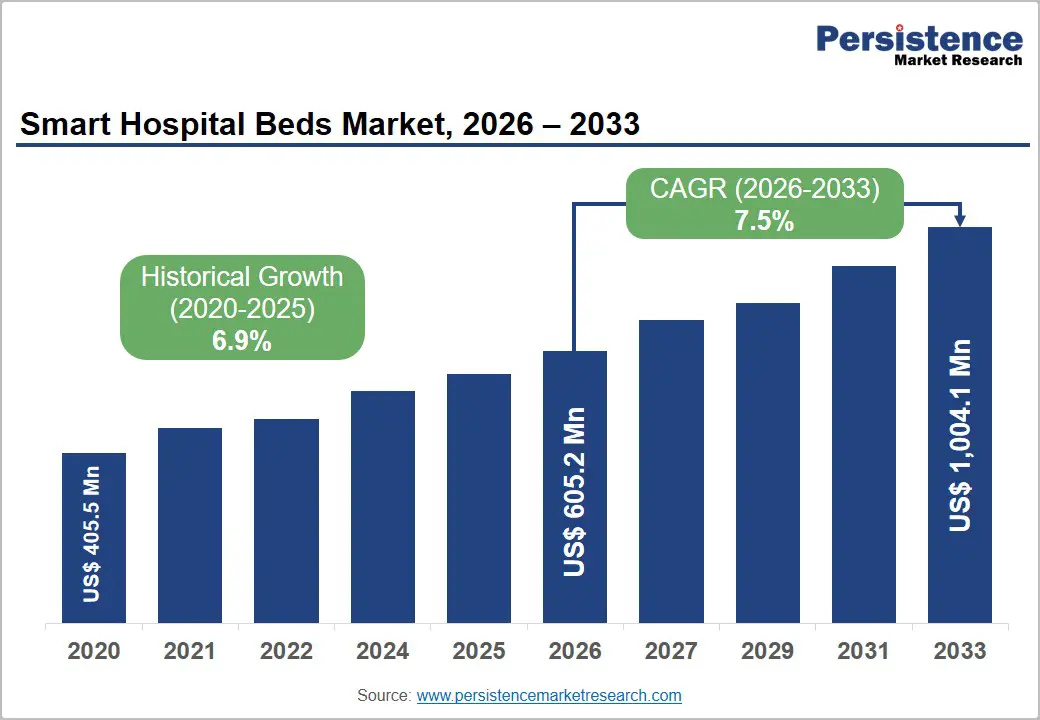
The global smart hospital beds market size is likely to be valued at US$605.2 million in 2026 and is estimated to reach US$1,004.1 million by 2033, growing at a CAGR of 7.5% during the forecast period from 2026 to 2033, driven by the rising demand for connected healthcare infrastructure and increasing emphasis on patient safety and clinical efficiency. Aging population groups are generating higher hospitalization rates, creating demand for technologically advanced patient monitoring systems integrated into hospital beds. Regulatory focus on healthcare quality standards is encouraging the adoption of digital care solutions that support real-time monitoring and workflow optimization.
Key Industry Highlights:
- Leading Product Type: Electric beds are set to hold around 55% revenue share in 2026, driven by full automation needs in acute care.
- Fastest-Growing Product Type: Wireless beds are projected as the fastest-growing segment, supported by IoT expansion and flexibility in varied settings.
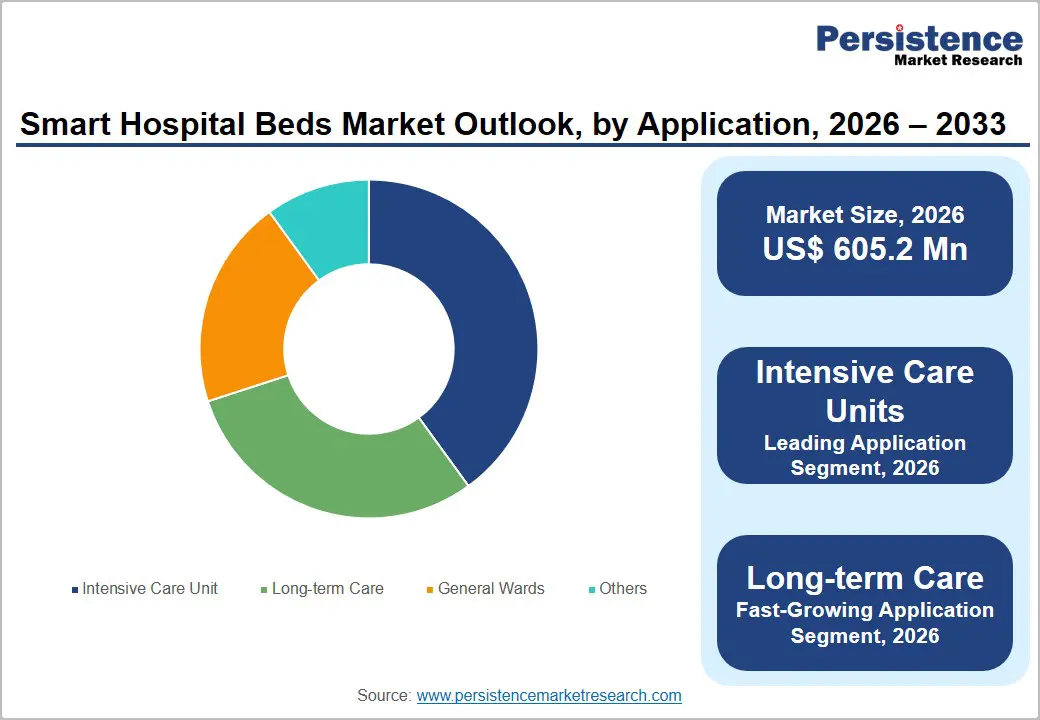
- Leading Application: Intensive care units are estimated to hold roughly a 40% revenue share in 2026, due to critical monitoring demands and outcome improvements.
- Fastest-Growing Application: Long-term care is forecast to record the fastest growth, driven by demographic trends and policy support for extended care.
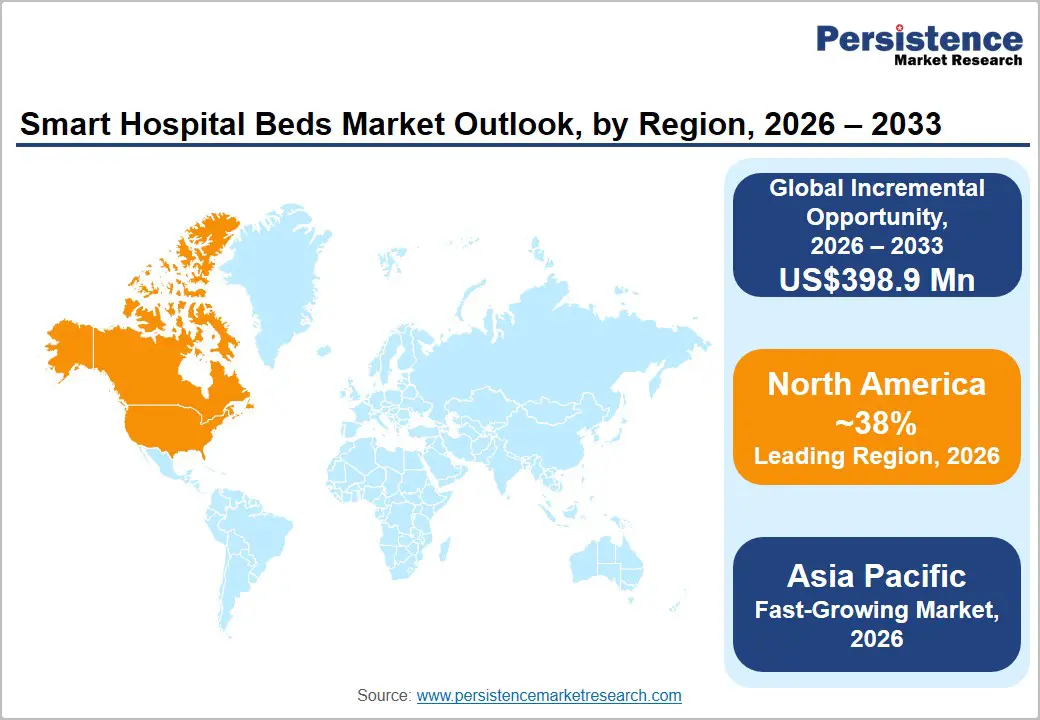
- Regional Leadership: North America is expected to capture approximately 38% market share in 2026, driven by advanced healthcare digitization initiatives.
DRO Analysis
Driver - Rising Demand from Aging Population and Chronic Disease Burden
Population aging is increasing demand for hospital admissions, rehabilitation services, and long-term patient management. Smart hospital beds provide automated positioning, pressure injury prevention, and continuous monitoring functions that improve patient outcomes while reducing caregiver workload. Healthcare facilities are investing in connected care infrastructure to accommodate increasing patient volumes and improve operational efficiency.
According to the United States Census Bureau, adults aged 65 years and above are projected to reach approximately 82 million by 2050, representing a significant increase from current levels. Growth in elderly populations is creating sustained demand for advanced patient care equipment capable of supporting mobility assistance, remote monitoring, and fall prevention. Healthcare providers are adopting intelligent bed technologies to improve quality metrics and optimize resource utilization.
Restraint - High Acquisition and Integration Costs
Smart hospital beds require substantial upfront investment due to embedded sensors, communication systems, software platforms, and advanced mechanical components. Healthcare facilities operating under constrained capital budgets often prioritize essential medical equipment, slowing procurement cycles. Elevated implementation costs can extend return-on-investment periods and reduce adoption among smaller healthcare institutions.
Integration with hospital information systems requires additional expenditure related to software customization, cybersecurity measures, and staff training. These requirements increase deployment complexity and can affect operating margins. Cost pressures create barriers to scalability, particularly in healthcare systems undergoing budget optimization initiatives.
Opportunity - Expansion of Remote Patient Monitoring Ecosystems
Healthcare providers are increasingly implementing remote monitoring strategies to improve clinical outcomes and optimize staffing resources. Smart hospital beds equipped with biometric sensors can serve as central data collection platforms within connected care environments. Integration with monitoring software creates opportunities for continuous patient assessment and predictive intervention.
Healthcare organizations can develop comprehensive patient management programs by linking smart beds with wearable devices, nurse call systems, and clinical analytics platforms. Regulatory support for digital health initiatives is encouraging the adoption of technologies that improve care coordination. These developments create pathways for broader deployment across hospitals, rehabilitation facilities, and long-term care settings.
Category-wise Analysis
Product Type Insights
Electric beds are expected to lead the smart hospital beds market, accounting for approximately 55% of revenue in 2026. These beds deliver full motorized control over height, head, and foot sections, enabling precise positioning that reduces caregiver strain and patient complications. For instance, Stryker’s ProCuity series incorporates fall prevention alerts integrated with nurse call systems in active hospital deployments. Demand stems from the need for seamless adjustments in high-acuity environments, supporting faster recovery and efficient staff workflows. Total segment contribution reflects a strong preference where full automation justifies investment.
Wireless beds are likely to represent the fastest-growing segment, propelled by IoT connectivity that allows remote monitoring without physical tethers. These solutions minimize infection risks associated with cables while providing real-time data transmission. In one implementation at a European long-term care facility, wireless models from LINET enabled centralized oversight of multiple patients, streamlining rounds. Growth arises from flexibility in dynamic care settings and alignment with telehealth expansion.
Application Insights
The intensive care units (ICUs) are projected to lead the market, capturing around 40% of the revenue share in 2026. Critical monitoring requirements in ICUs favor beds with integrated sensors for vital signs and pressure mapping. A major U.S. hospital system utilized Hillrom Progressa beds to reduce pressure injury rates through automated repositioning protocols. This dominance results from the direct link between advanced features and lower mortality risks in high-dependency units.
Long-term care is likely to be the fastest-growing segment, fueled by demographic shifts toward extended residential care. Facilities adopt beds that support chronic condition management with minimal staff intervention. One nursing home network integrated semi-electric models to improve resident mobility and sleep quality. Expansion follows policy emphasis on quality of life metrics in non-acute settings.
End-user Insights
Hospitals are likely to be the leading segment with a projected 58% of the smart hospital beds market share in 2026 due to their large inpatient bed inventories, capital procurement capacity, and regulatory accountability for patient safety outcomes. Large acute care hospitals operate procurement cycles aligned with government health technology modernization mandates, creating predictable high-volume purchasing pipelines for smart bed manufacturers.
Home healthcare settings are anticipated to be the fastest-growing segment, fueled by reimbursement policy shifts enabling hospital-level monitoring for patients recovering in residential environments. The expansion of remote patient management programs under national telehealth frameworks is creating demand for compact smart bed variants with integrated connectivity.
Regional Insights
North America Smart Hospital Beds Market Trends
North America is anticipated to be the leading region, accounting for a market share of 38% in 2026, driven by widespread deployment of connected healthcare infrastructure, strong hospital modernization spending, and integration of digital patient monitoring systems. Adoption of smart clinical equipment is supported by healthcare quality initiatives and electronic health record connectivity.
U.S. Smart Hospital Beds Market Insights
The U.S. is projected to account for approximately 82% of North American revenue in 2026. High healthcare expenditure, advanced hospital infrastructure, and broad adoption of digital health technologies are supporting the deployment of intelligent patient care equipment. Healthcare providers are investing in connected monitoring platforms to improve operational efficiency.
Canada Smart Hospital Beds Market Insights
Canada is expected to contribute nearly 18% of North America revenue in 2026. Healthcare modernization programs and investments in hospital infrastructure are supporting adoption of advanced patient management technologies. Growing emphasis on long-term care quality and patient safety is increasing the procurement of connected healthcare equipment.
Europe Smart Hospital Beds Market Trends
Europe is anticipated to account for a market share of 27% in 2026, driven by healthcare digitization initiatives, aging population growth, and strong regulatory focus on patient safety. Hospitals across the region are implementing connected care technologies to improve monitoring efficiency and clinical outcomes.
Germany Smart Hospital Beds Market Insights
Germany is forecast to represent approximately 24% of Europe's revenue in 2026. Expansion of digital healthcare programs and modernization of hospital facilities are accelerating the adoption of smart patient care solutions. Healthcare providers are prioritizing technologies that enhance monitoring accuracy and optimize nursing workflows.
U.K. Smart Hospital Beds Market Insights
The U.K. is likely to account for nearly 17% of Europe's revenue in 2026. National healthcare digitization initiatives are encouraging the implementation of connected medical equipment. Hospitals are investing in advanced patient safety systems and automated care technologies to improve operational performance.
Asia Pacific Smart Hospital Beds Market Trends
Asia Pacific is forecast to be the fastest-growing market for smart hospital beds, stimulated by rapid healthcare infrastructure expansion, increasing hospital construction activity, and rising investments in digital healthcare technologies. Growing healthcare access and higher patient volumes are encouraging the adoption of intelligent patient management systems.
China Smart Hospital Beds Market Insights
China is projected to account for approximately 36% of Asia Pacific revenue in 2026. Large-scale hospital expansion programs and increasing healthcare technology investments are supporting demand for connected patient care equipment. Domestic healthcare providers are integrating smart monitoring systems to improve patient management efficiency.
India Smart Hospital Beds Market Insights
India is expected to contribute around 15% of Asia Pacific revenue in 2026. Expansion of healthcare infrastructure, rising private hospital investments, and increasing adoption of digital health technologies are supporting market development. Healthcare providers are deploying advanced patient monitoring solutions to improve care quality and operational efficiency.
Competitive Landscape
The global smart hospital beds market is moderately consolidated, with a small number of established multinational manufacturers capturing the majority of institutional procurement revenue through long-term supply agreements and healthcare system framework contracts. Stryker Corporation, Baxter International (Hill-Rom), Invacare Corporation, Linet Group, and Paramount Bed Holdings collectively account for an estimated 55–60% of total market revenue, supported by entrenched distribution networks, service infrastructure, and regulatory approvals across key geographies.
The remaining revenue share is distributed among regional manufacturers and specialized technology integrators that compete on price, customization capability, and compatibility with locally deployed hospital information systems. Competitive differentiation is increasingly driven by software ecosystem strength, remote monitoring platform capabilities, and total cost of ownership models rather than hardware specifications alone. New entrants face significant barriers related to clinical validation requirements, procurement cycle access, and post-sale service network establishment.
Key Industry Developments:
- In April 2026, Apollo Hospitals launched a 400-bed smart hospital in Hyderabad featuring AI-enabled clinical systems and advanced diagnostics, expanding its national network to 76 hospitals and strengthening technology-driven healthcare infrastructure in India.
- In January 2026, Baxter International introduced the Dynamo Series smart stretcher, featuring connected safety technologies and advanced patient-handling capabilities designed to reduce caregiver burden and improve patient safety across hospital settings.
Companies Covered in Smart Hospital Beds Market
- Stryker Corporation
- Baxter International Inc. (Hill-Rom)
- Linet Group SE
- Paramount Bed Holdings Co., Ltd.
- Stiegelmeyer GmbH & Co. KG
- France Bed Co., Ltd.
- ArjoHuntleigh AB
- Medline Industries LP
- Joerns Healthcare LLC
- Sizewise
- Med-Mizer Inc.
- Elektra Beckum GmbH
- Transfer Master Products Inc.
- Wissner-Bosserhoff GmbH
Frequently Asked Questions
The global smart hospital beds market is projected to reach US$605.2 million in 2026.
Rising adoption of connected healthcare technologies, increasing elderly patient populations, and growing demand for real-time patient monitoring are driving the smart hospital beds market.
The smart hospital beds market is poised to witness a CAGR of 7.5% from 2026 to 2033.
The expansion of remote patient monitoring ecosystems and increasing adoption of smart healthcare solutions in home healthcare and long-term care settings are creating key market opportunities.
Some of the key market players include Stryker Corporation, Baxter International (Hill-Rom), Invacare Corporation, Linet Group, and Paramount Bed Holdings.


