




- Home Care & Utilities
- Skylights Market
Skylights Market Size, Share, and Growth Forecast 2026 - 2033
Skylights Market by Product Type (Fixed Skylights, Ventilated Skylights, Tubular Skylights, Custom Skylights), Material (Glass, Plastic), Application (Residential, Commercial), Installation Type (New Installation, Replacement), and Regional Analysis, 2026 - 2033

Skylights Market Size and Trend Analysis
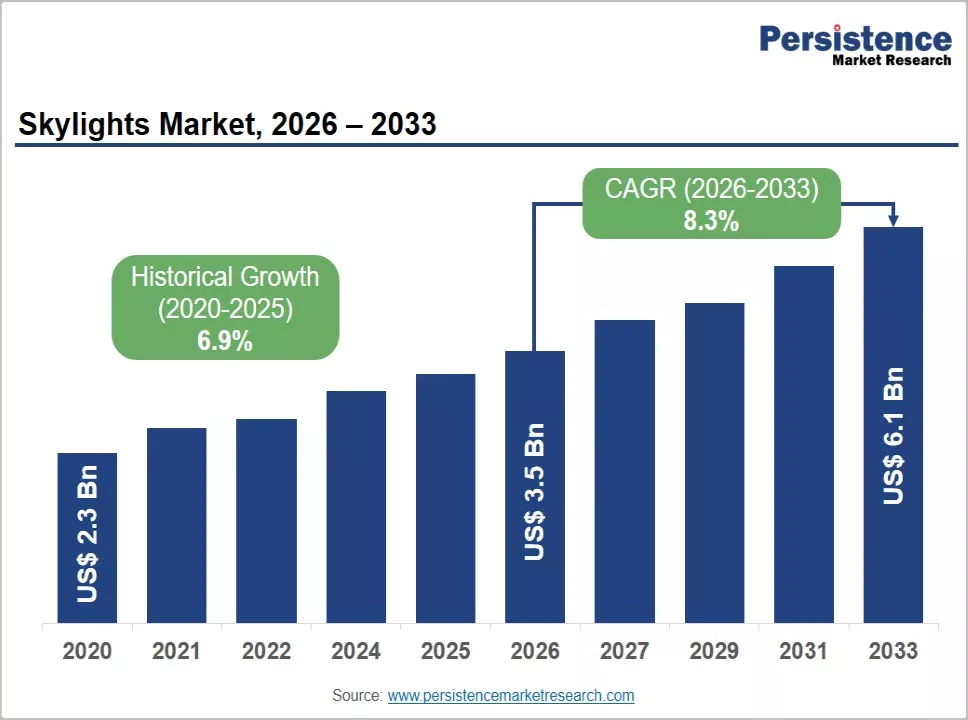
The global skylights market size is likely to be valued at US$ 3.5 billion in 2026, and is estimated to reach US$ 6.1 billion by 2033, growing at a CAGR of 8.3% during the forecast period 2026 - 2033.
Growth is underpinned by the growing emphasis on natural daylighting and energy-efficient building design, a large base of homes and commercial buildings due for renovation, and technological advances in glazing, solar-powered venting, and tubular daylighting across developed and emerging economies.
The market registered a historical CAGR of 6.9% during 2020 - 2025, reflecting cyclical housing activity, elevated material costs, and installation labor constraints. However, the forecast period anticipates stronger acceleration as green building codes tighten, homeowners invest in healthier living spaces, and manufacturers introduce smarter, more weather-resistant products that lower the cost and complexity of installation.
Key Industry Highlights
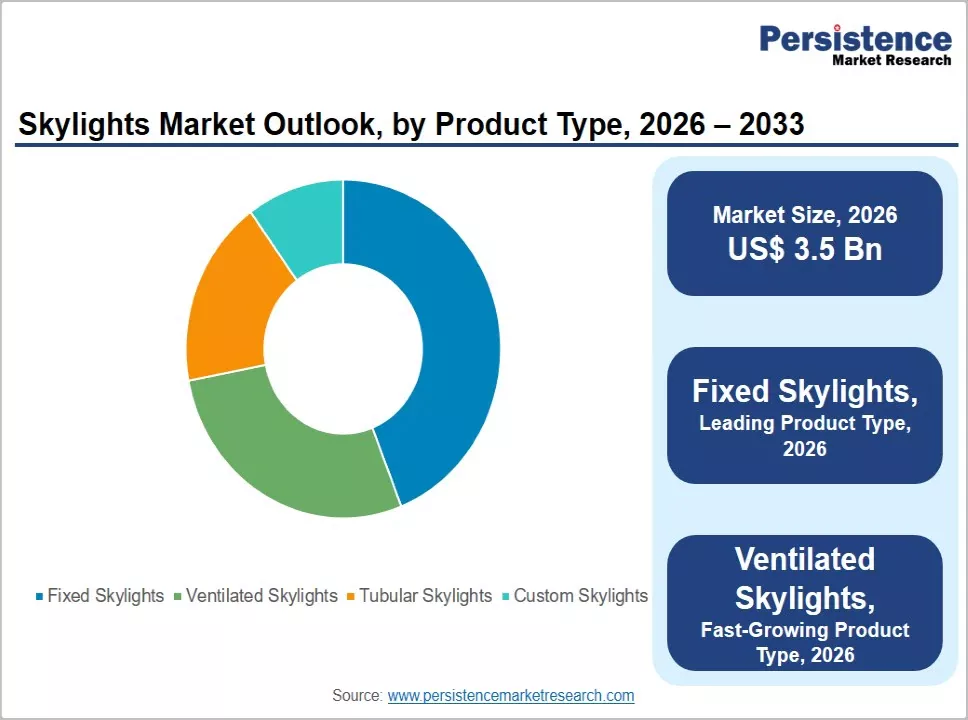
- Dominant Product Type: Fixed skylights are set to command around 42% of the revenue share in 2026, while tubular skylights are likely to grow the fastest at about 10.2% CAGR through 2033, as compact installation and glare-controlled daylight attract renovation customers.
- Leading Material: Glass is expected to lead with 41% in 2026, while polycarbonate is likely to be the fastest-growing at about 10.6% CAGR during 2026 - 2033, reflecting demand for impact-resistant, lightweight, and hail-tolerant glazing.
- Dominant Application: Residential is anticipated to lead with an estimated 54% share in 2026, while commercial applications are slated to represent the fastest-growing segment at 9.4% CAGR from 2026 to 2033.
- Leading Installation Type: Replacement is poised to hold about 53% share in 2026, while new installation is projected to be the fastest-growing at 8.9% CAGR through 2033, supported by green building mandates and new construction recovery.
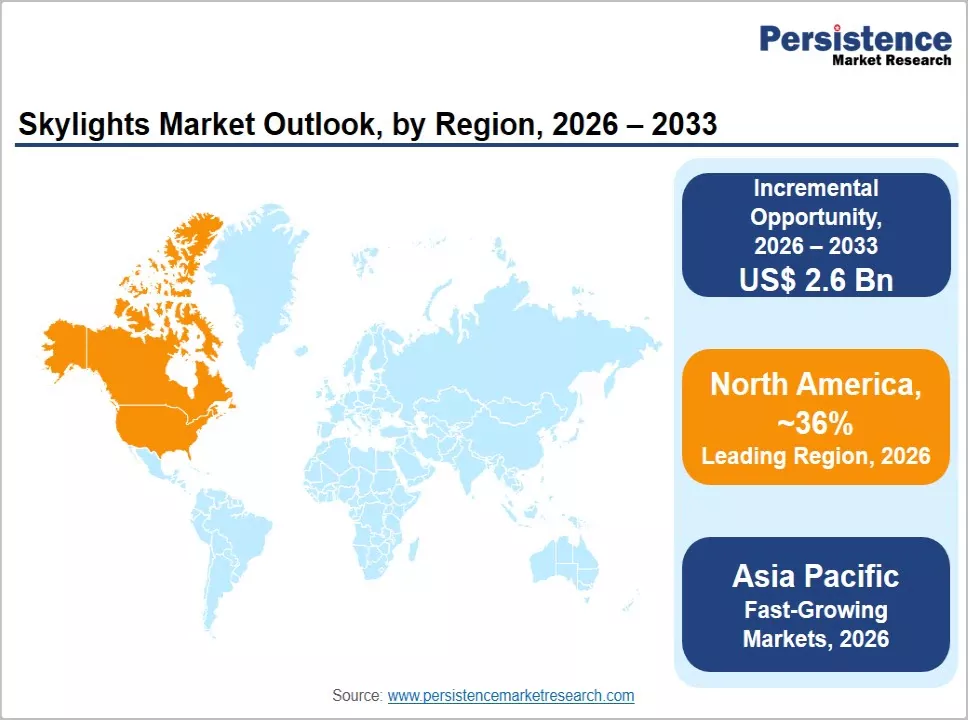
- Regional Leadership: North America is poised to dominate with an estimated 36% share in 2026, while Asia Pacific is expected to register the fastest growth at 10.4% CAGR through 2033, led by urbanization and commercial construction in China and India.
- Competitive Environment: Competitive dynamics include product launches focused on weather resistance and smart controls, expanded certified installer networks, and brand investments in homeowner education.
DRO Analysis
Drivers: Energy-Efficient Building Design and Natural Daylighting as Primary Growth Catalyst
Energy-efficient building design is the leading force driving the skylights market growth, as building owners, developers, and homeowners look to cut lighting and cooling loads while improving occupant comfort. Skylights deliver higher daylight levels than wall windows of the same area, and modern products with low-emissivity coatings, insulated frames, and integrated shades reduce heat loss and solar gain. Building energy codes, green building rating systems, and daylighting credits in certification programs are encouraging architects to specify roof glazing in schools, offices, warehouses, retail spaces, and homes. Growing awareness of the connection between natural light, mood, and sleep quality is also pushing demand in residential renovation and remodeling projects.
Smart, Solar-Powered, and Easy-Install Products
Product innovation is making skylights easier to adopt. Solar-powered venting skylights with automatic shades, rain sensors, and remote control have removed the need for electrical wiring, while tubular skylights can often be installed in a few hours without reframing or drywall work. These advances, combined with industry awards and contractor training programs, are increasing consumer confidence and encouraging adoption in both new and existing buildings through 2033.
Restraints: Leakage Concerns, Installation Complexity, and Cyclical Construction Activity
Water leakage, condensation, and heat gain remain the most commonly cited concerns for skylights, and these perceptions can deter homeowners and contractors even though modern flashing systems and glazing have improved reliability significantly. Roof penetrations require skilled installation, and poor workmanship can lead to warranty claims and reputational damage for manufacturers. In addition, the shortage of qualified roofing and glazing labor in several regions lengthens project timelines and raises installed costs.
Cost Pressures and Market Cyclicality
The market is closely linked to housing starts, remodeling expenditure, and commercial construction, all of which are sensitive to interest rates, material costs, and consumer confidence. Fluctuations in prices of glass, aluminum, polymers, and wood framing materials can compress margins, while tariffs and logistics disruptions add further uncertainty. Extreme weather events, such as hail and storms, also raise performance requirements and can increase product costs. These factors collectively restrain faster adoption, highlighting the need for durable, simple, and cost-effective designs and strong installer training.
Opportunities: Renovation Demand, Green Building Mandates, and Emerging Market Urbanization
A large stock of older homes and commercial buildings in North America and Europe represents a significant replacement and retrofit opportunity. Owners are upgrading to energy-efficient glazing, adding venting skylights to improve ventilation, and installing tubular devices in dark interior rooms such as hallways, bathrooms, and closets. Government incentives for energy renovation and stricter requirements for new buildings are expected to encourage upgrades that include roof glazing and daylight control systems.
Urbanization and Premium Daylighting Solutions
Rapid urbanization in Asia Pacific, the Middle East, and Latin America is leading to the construction of shopping centers, airports, schools, hospitals, and logistics facilities that benefit from daylighting to reduce operating costs. Manufacturers are also developing custom skylights, modular roof glazing, and daylight systems integrated with smart building controls, which can command premium prices. Expanded dealer networks, virtual design tools, and consumer experience programs are expected to open additional customer segments through 2033. Partnerships with roofing contractors, homebuilders, and building automation providers are also likely to improve project visibility.
Category-wise Insights
Product Type Analysis
Why Do Fixed Skylights Lead the Skylights Market?
Fixed skylights are the leading product type segment, expected to hold about 42% of the skylights market revenue share in 2026. They are widely used in residential and commercial projects because of their simple construction, lower cost, and strong weather resistance compared with operable models. Fixed units provide high daylight levels with minimal maintenance and are available in a broad range of sizes and glazing options. Their suitability for new construction and straightforward replacement also supports steady demand across architects, builders, and roofing contractors. Improvements in flashing kits and pre-assembled curb systems are also reducing installation time and risk of leakage.
Tubular skylights are likely to grow the fastest through 2033. These systems capture daylight with a rooftop dome and channel it through reflective tubing into interior spaces, delivering light to areas that conventional skylights cannot reach. Installers can typically complete a tubular installation in a few hours with limited structural work, which makes them attractive to renovation customers. Newer designs add glare-controlling optics, improved thermal performance, and decorative diffusers. Ventilated and custom skylights remain important for premium homes, atria, and architectural projects.
Material Analysis
Why Does Glass Lead Skylight Materials?
Glass is the leading material segment, projected to capture about 41% of the revenue share in 2026. It offers excellent clarity, durability, scratch resistance, and long-term performance, and can be combined with low-emissivity coatings, laminated layers, and insulated glazing units to meet energy and safety codes. Premium residential and commercial buyers prefer glass for its appearance and longevity. Advances in tempered and laminated glass have also improved resistance to breakage, extending its use in demanding applications. Continuous improvements in spacer systems and warm-edge technology are also extending seal life and thermal performance.
Polycarbonate represents the fastest-growing material segment, anticipated to achieve about 10.6% CAGR during the 2026 - 2033 period. It is lightweight and highly impact resistant, which is valuable in regions prone to hail and storms. Manufacturers are introducing polycarbonate dome skylights for severe weather markets, backed by extended hail warranties. Acrylic and other plastics remain popular in cost-sensitive and industrial uses, as these materials are light and economical, while advances in coatings are improving resistance to yellowing and ultraviolet exposure.
Application Analysis
Why Does Residential Lead Skylights Applications?
Residential is the leading application segment, expected to hold about 54% of the market revenue share in 2026. Homeowners use skylights to brighten interiors, add ventilation, and improve energy performance, particularly in attics, kitchens, bathrooms, and loft conversions. Remodeling and renovation projects are the primary demand source, supported by home equity, a large stock of aging housing, and growing interest in healthier indoor environments. Recent product recognition for solar-powered fresh air skylights has also increased consumer awareness of the category. Rising use of venting models for passive cooling is also helping homeowners reduce reliance on air conditioning during warm months.
Commercial applications are the fastest-growing application segment, expected to rise at about 9.4% CAGR through 2033. Offices, retail stores, hospitality venues, and mixed-use developments are adopting skylights to support sustainability goals and to enhance the customer and employee experience. Industrial buildings use roof glazing to reduce lighting energy in warehouses and factories, while institutional users, including schools, hospitals, and libraries, value daylight for comfort, learning, and well-being.
Installation Type Analysis
Why Does Replacement Lead Skylights Installation Types?
Replacement is the leading installation type, estimated to account for about 53% of the revenue share in 2026. Skylights typically need replacement after one or two decades because of seal failure, leakage, and outdated glazing performance. Homeowners and building managers often use the opportunity to upgrade to energy-efficient or venting models. Roof replacement projects also frequently include skylight changes, ensuring a steady stream of demand. Manufacturers are also supporting this trend through extended warranties and simplified retrofit kits that fit standard roof openings.
New installation is anticipated to grow the fastest at about 8.9% CAGR through 2033. A recovery in housing and non-residential construction, stricter energy codes, and daylighting requirements in green building programs are encouraging the specification of roof glazing at the design stage. Prefabricated and modular skylight systems are further simplifying installation in new projects.
Regional Insights
North America Skylights Market Trends and Insights
North America is anticipated to account for an estimated 36% of the global skylights market in 2026. The region's skylights industry is likely to benefit from a large renovation market, strong residential roofing and remodeling activity, and rising interest in energy-efficient homes. Energy rating requirements and incentives for efficient glazing are expected to encourage upgrades, while product innovation in solar-powered venting systems and hail-resistant glazing is expected to support premium sales.
Competition among established manufacturers and specialist daylighting companies is also expected to intensify through 2033. Growing use of skylights in multi-family, retail, and warehouse buildings is also expected to broaden demand beyond single-family homes.
U.S. Skylights Market Size
The U.S. is estimated to account for approximately 85% of the North America skylights market in 2026. Market growth is likely to be supported by homeowner remodeling spending, a large inventory of older homes, and demand for severe weather-resistant products. In April 2026, VELUX launched residential polycarbonate dome skylights for select Southern markets with a five-year hail warranty, and later announced a national mobile experience tour to promote skylights to homeowners. Increasing adoption of solar-powered venting systems and strong contractor networks are likely to further support investments through 2033.
Canada Skylights Market Size
Canada is projected to represent approximately 15% of the North America skylights market in 2026. Market expansion is expected to be driven by energy-efficiency programs, cold-climate performance requirements, and demand for natural light during long winters. Insulated, thermally broken, and triple-glazed products are likely to gain preference, while residential renovation and multi-unit construction are anticipated to support wider adoption through 2033. Government retrofit programs and utility rebates for efficient building components are also expected to support replacement activity.
Europe Skylights Market Trends and Insights
Europe is estimated to account for approximately 31% of the global skylights market in 2026. The region's market is expected to benefit from the Energy Performance of Buildings Directive, renovation wave initiatives, and a strong culture of attic conversion and roof window use.
Established European manufacturers are likely to retain competitive advantages through brand strength, engineering expertise, and extensive distribution networks. Commercial and institutional demand is also supported by daylighting requirements in schools and public buildings, and new modular dim-out solutions are being introduced to meet specifier needs. Growing attention to indoor air quality and summer overheating is also boosting interest in venting and solar-controlled models.
Germany Skylights Market Size
Germany is anticipated to account for approximately 24% of the Europe skylights market in 2026. Demand is expected to be supported by strict building energy regulations, a high rate of existing building renovation, and strong demand for high-performance glazing and roof windows. The presence of leading daylighting and window hardware manufacturers is likely to promote innovation in continuous rooflights, smoke ventilation, and automated systems. Investments in energy retrofits and commercial building upgrades are projected to support market expansion through 2033.
Why Is Asia Pacific Expected to Be the Fastest-Growing Region in the Skylights Market?
Asia Pacific is projected to account for approximately 22% of the global skylights market in 2026, and is anticipated to register the fastest growth, expanding at an estimated CAGR of 10.4% through 2033. Market expansion is likely to be driven by rapid urbanization, commercial and institutional construction, and rising middle-class spending on housing quality. China and India are expected to remain the primary demand centers, while Japan, South Korea, Australia, and Southeast Asian countries are also likely to increase adoption in premium residential and public building projects. Government housing programs and expanding commercial real estate pipelines are also supporting regional demand.
China Skylights Market Size
China is estimated to represent approximately 39% of the Asia Pacific skylights market in 2026. The country's market is expected to benefit from large-scale commercial construction, green building standards, and infrastructure projects such as airports, railway stations, and exhibition centers that use extensive roof glazing. Domestic glass and aluminum manufacturers are likely to strengthen their competitive positions, while demand for premium residential daylighting products is expected to grow in urban centers through 2033. Rising consumer interest in bright, healthy living spaces is also encouraging developers to add skylights in upscale apartments and villas.
India Skylights Market Size
India is projected to account for approximately 17% of the Asia Pacific skylights market in 2026. The market is expected to witness strong expansion, supported by green building rating programs, the Energy Conservation Building Code, and rising construction of commercial and institutional facilities. Industrial and warehouse developments are likely to use polycarbonate and acrylic roof glazing to reduce lighting costs, while premium housing projects are increasingly specifying daylighting features. Growing interest in energy-efficient factory roofs and cold storage facilities is also expected to widen the customer base.
Competitive Landscape
The global skylights market structure is moderately consolidated, with the top vendors, including VELUX Group, FAKRO, Roto, and Solatube International, controlling around 45% of the revenue share. These established players have been leveraging their strong brands, certified installer networks, and broad product portfolios that span fixed, ventilated, and tubular products. They are also known to invest in R&D to maintain leadership in smart controls, solar-powered systems, and weather-resistant glazing. Strategic emphasis on training and certifying installers is also viewed as a key differentiator, since installation quality strongly influences product performance and customer satisfaction.
Regional and niche competitors such as Kingspan Group, LAMILUX, Wasco Products, and Columbia Skylights are focusing on commercial rooflights, smoke ventilation, and customized architectural solutions. Barriers such as brand reputation, installer training, and weather performance certification limit new entrants, but online sales and virtual design tools are enabling smaller companies to reach new customers. Market consolidation is expected to increase gradually as global leaders acquire regional manufacturers to expand geographically, while building product suppliers continue partnering on integrated roofing and daylighting systems.
Key Market Developments
- In May 2026, VELUX Commercial UK&I launched a new modular skylight dim-out solution to give specifiers a more complete and flexible system for controlling daylight in commercial buildings.
- In May 2026, Solatube International released the next generation of its Brighten Up Skylight Series, offering expanded design options and improved thermal performance for tubular daylighting, with most installations completed in as little as two hours.
- In April 2026, VELUX launched residential polycarbonate dome skylights for select Southern U.S. markets, featuring what it described as the industry's first five-year hail warranty.
Companies Covered in Skylights Market
- VELUX Group
- FAKRO
- Solatube International, Inc.
- Roto Frank AG
- Kingspan Group plc
- LAMILUX Heinrich Strunz Group
- Wasco Products, Inc.
- Columbia Skylights
- Bristolite Skylights
- Natural Light Energy Systems
Frequently Asked Questions
The global skylights market is valued at US$ 3.5 billion in 2026 and is projected to reach US$ 6.1 billion by 2033, expanding at a CAGR of 8.3% during 2026 - 2033.
Growing emphasis on natural daylighting and energy-efficient building design, a large base of buildings due for renovation, and technological advances in glazing and solar-powered venting are driving the market. Tightening energy codes and growing homeowner interest in healthier living spaces are further supporting demand across developed and emerging economies.
Fixed skylights lead product types with about 42% share, glass leads materials with about 41%, residential leads applications with about 54%, and replacement leads installation types with an estimated 53% in 2026. Tubular skylights, polycarbonate, commercial applications, and new installation are the fastest-growing segments, at about 10.2%, 10.6%, 9.4%, and 8.9% CAGR respectively.
North America dominates the market with an estimated 36% share in 2026, supported by a large renovation market and strong demand for energy-efficient and weather-resistant products. Asia Pacific is projected to be the fastest-growing region at a 10.4% CAGR through 2033.
Renovation and replacement demand, green building mandates, urbanization in emerging economies, and premium smart daylighting systems are key market opportunities. Expanded dealer networks and virtual design tools are also expected to open new customer segments.
The market is moderately consolidated, with VELUX Group, FAKRO, Roto, and Solatube International controlling around 45% of the revenue share.


