Sea Bream Market Size, Share, Growth, and Regional Forecast, 2026 - 2033

Sea Bream Market is segmented by Product Type (Wild-caught, Farmed/Aquaculture), Nature (Whole, Fillets, Gutted, Others), End-user (Food Service / HoReCa, Food Processing Industry, Household Retail, Animal Feed / Aquafeed, Others), and Regional Analysis, 2026 - 2033

ID: PMRREP36350
Calendar

March 2026

243 Pages

Author : Amol Patil

Key Industry Highlights:

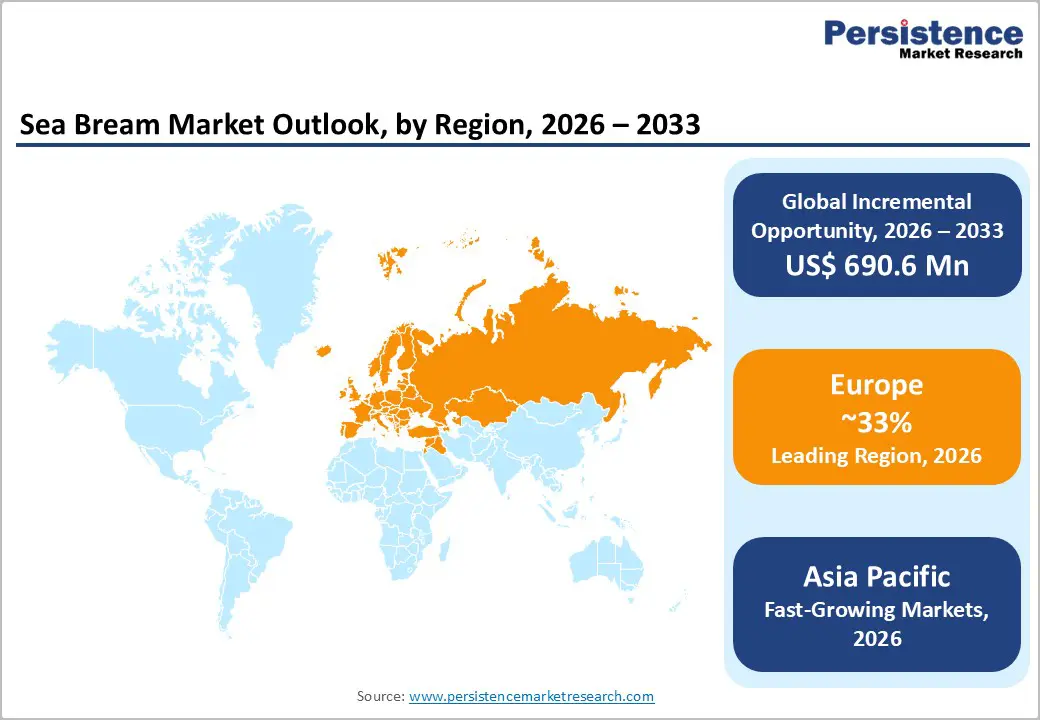
  • Leading Region: Europe, holding around 33% market share, supported by strong aquaculture infrastructure, high seafood consumption in Mediterranean countries, and established export networks across Greece, Turkey, and Spain.
  • Fastest-Growing Region: Asia Pacific, driven by rising disposable incomes, expanding cold-chain logistics, strong cultural demand for sea bream in Japan and China, and rapid modernization of seafood retail channels.
  • Fastest-Growing Form Segment: Fillets, fueled by rising demand for convenient, ready-to-cook seafood products among household consumers and increasing retail availability of deboned, vacuum-packed portions.
  • Leading Source Segment: Farmed/Aquaculture Sea Bream, dominating global supply due to consistent quality, controlled production cycles, year-round availability, and scalability compared to limited wild catches.
  • Market Drivers: Rising demand for premium lean seafood proteins in the global foodservice sector is accelerating sea bream adoption as an affordable yet high-quality menu option for restaurants and hospitality chains.
  • Opportunities: Rapid expansion of ready-to-cook sea bream fillets in retail markets, supported by advanced chip packaging technologies, sustainability certifications, and growing home-chef cooking trends.
  • Key Developments: In June 2025, Buan Fisheries Cooperative released over 316,000 sea bream fingerlings in South Korea to support marine resource sustainability. In May 2025, Blue Waters showcased Premium Omani Sea Bream at HORECA Oman 2025, highlighting its focus on premium aquaculture products for the hospitality sector.
Key Insights Details
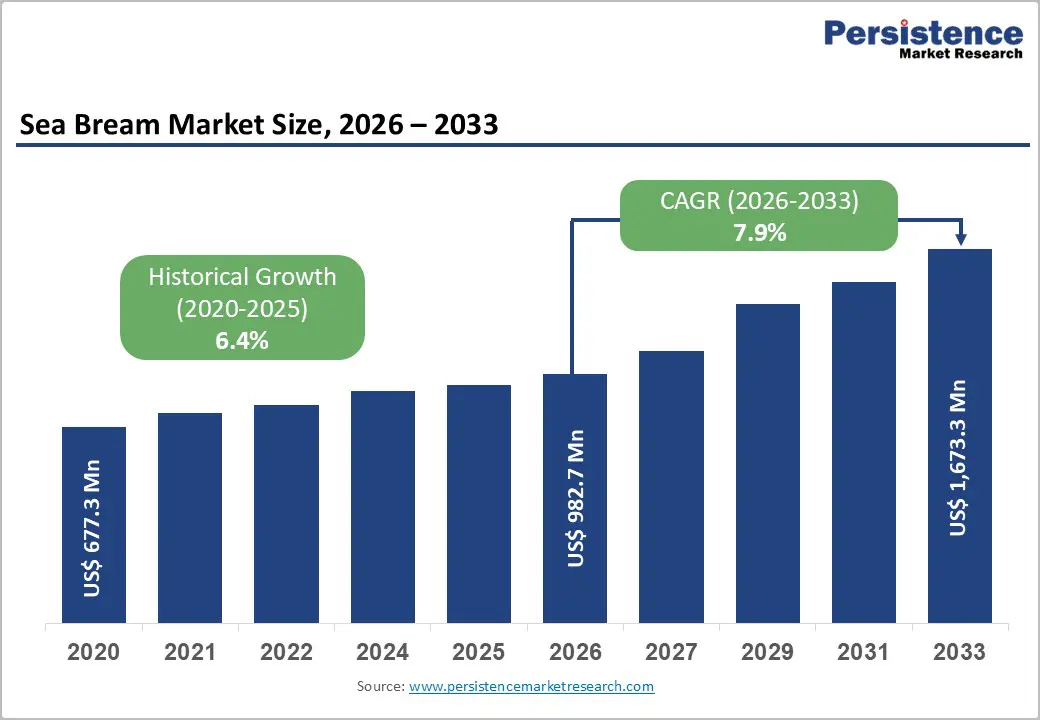
Global Sea Bream Market Size (2026E) US$ 982.7 Mn
Market Value Forecast (2033F) US$ 1,673.3 Mn
Projected Growth (CAGR 2026 to 2033) 7.9%
Historical Market Growth (CAGR 2020 to 2025) 6.4%

sea-bream-market-size-2026-2033

Market Dynamics

Driver - Rising Demand for Premium Lean Proteins in the Global Foodservice Sector

The primary driver for the sea bream industry is the significant shift in the HoReCa (Hotel, Restaurant, and Cafe) sector toward high-quality, versatile white fish. According to the Food and Agriculture Organization (FAO), sea bream is highly valued in Mediterranean and Asian cuisines for its delicate flavor and firm texture, making it a staple for professional chefs. As global tourism and fine-dining experiences recover and expand, the demand for sustainably sourced fish has spiked. Major aquaculture players like Kiliç Seafood and PHILOSOFISH S.A. are leveraging advanced logistics to provide fresh, high-grade sea bream to international restaurant chains. This institutional demand ensures high volume movement, as sea bream is often positioned as an affordable yet premium alternative to more expensive species like sea bass or snapper.

Restraints - Stringent Environmental Regulations and Coastal Zoning Laws

Aquaculture operations, particularly in Europe, face rigorous scrutiny regarding their environmental footprint and impact on local ecosystems. The European Commission maintains strict guidelines on nutrient discharge, escapes, and the use of veterinary medicines in fish farms to prevent the degradation of coastal waters. These regulations often limit the number of available sites for new farm installations, creating a bottleneck for capacity expansion. Furthermore, conflicts with the tourism industry over the use of coastal space can lead to lengthy permitting processes. Such regulatory hurdles and zoning constraints can delay project timelines for companies like True North Seafood Co. Ltd., potentially slowing down the entry of new participants into the market and limiting the volume growth in traditionally dominant production hubs.

Opportunity - Rapid Expansion of Ready-to-Cook (RTC) Fillets in Household Retail

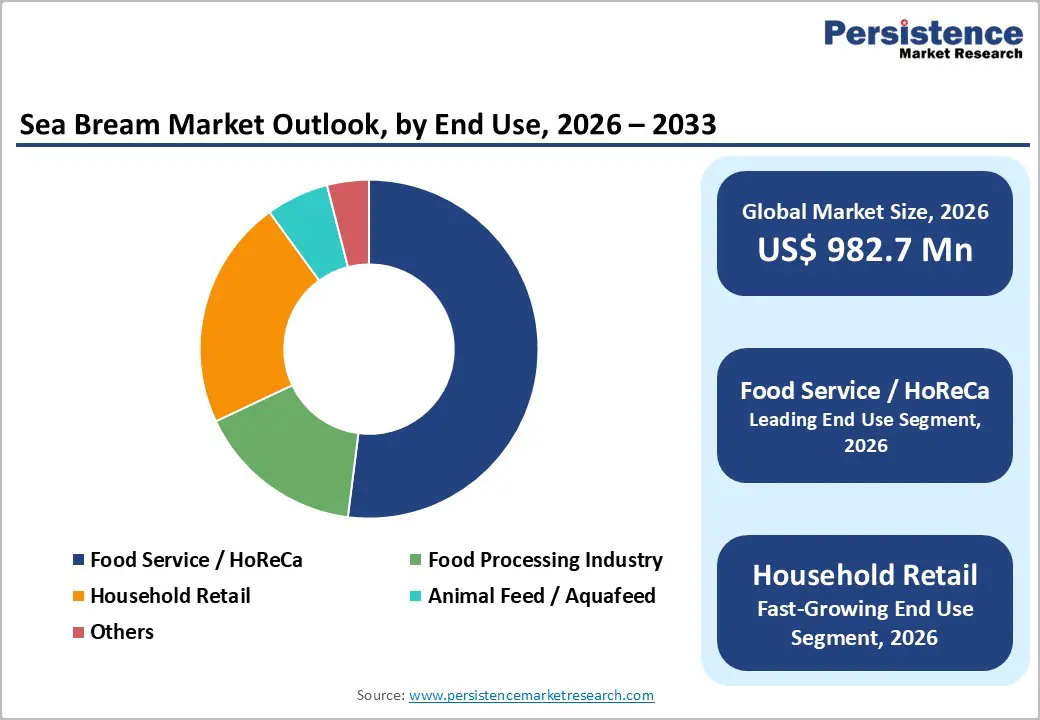
The Household Retail segment represents a massive opportunity as the fastest-growing end-use category through 2033. Modern consumers are increasingly seeking convenience without compromising on health, leading to a surge in demand for skin-on, deboned, and pre-marinated sea bream Fillets. According to reports from the National Fisheries Institute (NFI), the home-chef trend is encouraging supermarkets to stock premium, vacuum-packed fish portions that are easy to prepare. Companies that invest in high-tech processing and MAP (Modified Atmosphere Packaging) technology can capture this high-margin retail segment. By providing clear traceability and sustainability labels such as ASC or MSC certifications brands can build trust with health-conscious shoppers who are willing to pay a premium for verified sustainable products.

Category-wise Analysis

Product Type Insights

The Farmed/Aquaculture segment is the dominant force in the market, capturing the vast majority of the revenue share. This leadership is justified by the consistency in size, quality, and supply that aquaculture provides compared to the Wild-caught segment. While wild sea bream is often sought after in high-end gourmet circles for its perceived superior taste, the volume is strictly limited by fishing quotas and seasonal availability. Consequently, the industrial-scale operations of aquaculture giants ensure that sea bream remains a globally accessible commodity. As the industry moves toward Organic Farmed certifications, the gap between farmed and wild-caught perceptions is narrowing, allowing farmed products to command higher price points in premium Specialty Stores.

Nature Insights

The whole fish segment continues to hold a leading position in 2025, particularly in traditional Mediterranean and Middle Eastern markets where the fish is typically grilled or baked in its entirety. This format is favored in the Food Service / HoReCa channel for its visual appeal in restaurant presentations. However, the Fillets segment is identified as the fastest growing segment through 2032. The shift is driven by the Western consumer's demand for convenience and the reduction of food waste. Processed fillets eliminate the need for cleaning and deboning at home, making sea bream more attractive to younger demographics. Manufacturers are increasingly utilizing advanced skinning and portioning machines to meet the high standards of the Food Processing Industry.
sea-bream-market-outlook-by-end-use-2026-2033

Regional Insights

Europe Sea Bream Market Trends and Insights

Europe currently holds the leading market share of 33% in 2025, underpinned by a deep-rooted cultural affinity for Mediterranean seafood and a highly mature aquaculture infrastructure. Greece, Turkey, and Spain are the primary production hubs, with Turkey being the largest exporter of sea bream to the European Union. The region benefits from a highly coordinated regulatory framework that ensures product safety and environmental compliance.

Innovation in the European market is focused on sustainability and product differentiation. There is a notable trend toward antibiotic-free and non-GMO farmed fish, catering to the stringent demands of European retailers. The presence of key industry associations like Federation of European Aquaculture Producers (FEAP) facilitates knowledge sharing and technical standards. Furthermore, the strong integration of sea bream into the regional Food Service industry, combined with the high per-capita consumption of seafood in Mediterranean countries, ensures that Europe remains the strategic heart of the global sea bream trade.

Asia Pacific Sea Bream Market Trends and Insights

Asia Pacific is projected to be the fastest growing segment globally, with a high CAGR through 2032. This rapid expansion is primarily driven by the massive population bases and rising disposable incomes in China, Japan, and South Korea. Japan has a long history of consuming red sea bream (Madai), which is considered a symbol of good luck and is essential for traditional celebrations.

Growth dynamics in the region are shifting as modern retail formats replace traditional wet markets. The manufacturing advantages in countries like Vietnam and Thailand for seafood processing are also attracting global players to set up regional hubs. In China, the rapid growth of the Cold Chain logistics industry is enabling the distribution of fresh sea bream to inland cities, far beyond the coastal provinces. As the region's aquaculture technology catches up with European standards, Asia Pacific is expected to transition from a major importer to a significant producer, fundamentally altering the global supply landscape.
sea-bream-market-outlook-by-region-2026-2033

Competitive Landscape

The Sea Bream Market exhibits a moderately consolidated structure, where a few large-scale aquaculture corporations hold significant influence over global supply chains. Key market leaders like Maruha Nichiro Corporation, Kiliç Seafood, and Bakkafrost dominate the industry through vertical integration controlling everything from hatchery operations and feed production to processing and global distribution. These companies employ strategies focused on geographic expansion, technological innovation in RAS, and strategic acquisitions of smaller local farms to consolidate their market position. Key differentiators include the ability to provide consistent year-round supply and the attainment of global sustainability certifications. Emerging business model trends show a move toward Direct-to-Retail partnerships, where producers work directly with supermarket chains to shorten the supply chain and ensure maximum product freshness.

Key Developments:

  • In June 2025, the Buan Fisheries Cooperative released 316,100 sea bream fingerlings into the coastal waters of Wido-myeon, Buan-gun, as part of an initiative to strengthen sea bream resource cultivation and support long-term marine stock sustainability.
  • In May 2025, Blue Waters showcased its Premium Omani Sea Bream at HORECA Oman 2025, highlighting the company’s focus on high-quality aquaculture products and expanding market visibility within the hospitality and foodservice sector.

Companies Covered in Sea Bream Market

  • Maruha Nichiro Corporation
  • Kılıç Seafood
  • P/F Bakkafrost
  • Tumay Seafood
  • GRUPO DELFÍN
  • Dalga Seafood
  • True North Seafood Co. Ltd.
  • PHILOSOFISH S.A.
  • Eastern Fish Company
  • Galaxidi Marine Farm
  • Corfu Sea Farm S.A.
  • Others
Frequently Asked Questions

The global Sea Bream market is projected to be valued at US$ 982.7 Mn in 2026.

Rising Demand for Premium Lean Proteins in the Global Foodservice Sector is a major factor driving the global Sea Bream market.

The Global Sea Bream market is poised to witness a CAGR of 7.9% between 2026 and 2033.

Rapid Expansion of Ready-to-Cook (RTC) Fillets in Household Retail is a significant opportunity in the Sea Bream market.

Major players in the Global Sea Bream market include Maruha Nichiro Corporation, P/F Bakkafrost, GRUPO DELFÍN, Dalga Seafood, True North Seafood Co. Ltd., Eastern Fish Company, and others.

Sea Bream Market Report Scope
Report Attribute Details
Historical Data/Actuals 2020 - 2025
Forecast Period 2026 - 2033
Market Analysis Value: US$ Mn
Geographical Coverage
  • North America
  • Europe
  • East Asia
  • South Asia and Oceania
  • Middle East and Africa
  • Latin America
Segmental Coverage
  • Source
  • Form
  • End Use
  • Region
Competitive Analysis
  • Maruha Nichiro Corporation
  • Kiliç Seafood
  • P/F Bakkafrost
  • Tumay Seafood
  • GRUPO DELFÍN
  • Dalga Seafood
  • True North Seafood Co. Ltd.
  • PHILOSOFISH S.A.
  • Eastern Fish Company
  • Galaxidi Marine Farm
  • Corfu Sea Farm S.A.
  • Others
Report Highlights
  • Market Forecast and Trends
  • Competitive Intelligence & Share Analysis
  • Growth Factors and Challenges
  • Strategic Growth Initiatives
  • Future Opportunities and Revenue Pockets
  • Market Analysis Tools
Market Segmentation

By Product Type

  • Wild-caught
  • Farmed/Aquaculture

By Form

  • Whole
  • Fillets
  • Gutted
  • Others

By End-user

  • Food Service / HoReCa
  • Food Processing Industry
  • Household Retail
  • Animal Feed / Aquafeed
  • Others

By Region

  • North America
  • Europe
  • East Asia
  • South Asia and Oceania
  • Latin America
  • Middle East and Africa

Related Reports

  1. Executive Summary
    1. Global Sea Bream Market Snapshot 2026 and 2033
    2. Market Opportunity Assessment, 2026-2033, US$ Mn
    3. Key Market Trends
    4. Industry Developments and Key Market Events
    5. Demand Side and Supply Side Analysis
    6. PMR Analysis and Recommendations
  2. Market Overview
    1. Market Scope and Definitions
    2. Market Dynamics
      1. Driver
      2. Restraint
      3. Opportunities
      4. Trends
    3. Macro-Economic Factors
    4. Forecast Factors - Relevance and Impact
    5. COVID-19 Impact Assessment
  3. Value Added Insights
    1. Value Chain analysis
    2. Key Market Players
    3. Key Promotional Strategies by key players
    4. PESTLE Analysis
    5. Porter's Five Forces Analysis
    6. Regulatory Landscape
  4. Price Trend Analysis, 2025
    1. Region-wise Price Analysis
    2. Price by Segments
    3. Price Impact Factors
  5. Global Sea Bream Market Outlook: Historical (2020 - 2025) and Forecast (2026 - 2033)
    1. Key Highlights
    2. Global Sea Bream Market Outlook: Product Type
      1. Introduction/Key Findings
      2. Historical Market Size (US$ Mn) Analysis by Product Type, 2020-2025
      3. Current Market Size (US$ Mn) Forecast, by Product Type, 2026-2033
        1. Wild-caught
        2. Farmed/Aquaculture
      4. Market Attractiveness Analysis: Product Type
    3. Global Sea Bream Market Outlook: Nature
      1. Introduction/Key Findings
      2. Historical Market Size (US$ Mn) Analysis by Nature, 2020-2025
      3. Current Market Size (US$ Mn) Forecast, by Nature, 2026-2033
        1. Whole
        2. Fillets
        3. Gutted
        4. Others
      4. Market Attractiveness Analysis: Nature
    4. Global Sea Bream Market Outlook: End Use
      1. Introduction/Key Findings
      2. Historical Market Size (US$ Mn) Analysis by End Use, 2020-2025
      3. Current Market Size (US$ Mn) Forecast, by End Use, 2026-2033
        1. Food Service / HoReCa
        2. Food Processing Industry
        3. Household Retail
        4. Animal Feed / Aquafeed
        5. Others
      4. Market Attractiveness Analysis: End Use
  6. Global Sea Bream Market Outlook: Region
    1. Key Highlights
    2. Historical Market Size (US$ Mn) Analysis by Region, 2020-2025
    3. Current Market Size (US$ Mn) Forecast, by Region, 2026-2033
      1. North America
      2. Europe
      3. East Asia
      4. South Asia & Oceania
      5. Latin America
      6. Middle East & Africa
    4. Market Attractiveness Analysis: Region
  7. North America Sea Bream Market Outlook: Historical (2020 - 2025) and Forecast (2026 - 2033)
    1. Key Highlights
    2. Pricing Analysis
    3. North America Market Size (US$ Mn) Forecast, by Country, 2026-2033
      1. U.S.
      2. Canada
    4. North America Market Size (US$ Mn) Forecast, by Product Type, 2026-2033
      1. Wild-caught
      2. Farmed/Aquaculture
    5. North America Market Size (US$ Mn) Forecast, by Nature, 2026-2033
      1. Whole
      2. Fillets
      3. Gutted
      4. Others
    6. North America Market Size (US$ Mn) Forecast, by End Use, 2026-2033
      1. Food Service / HoReCa
      2. Food Processing Industry
      3. Household Retail
      4. Animal Feed / Aquafeed
      5. Others
  8. Europe Sea Bream Market Outlook: Historical (2020 - 2025) and Forecast (2026 - 2033)
    1. Key Highlights
    2. Pricing Analysis
    3. Europe Market Size (US$ Mn) Forecast, by Country, 2026-2033
      1. Germany
      2. Italy
      3. France
      4. U.K.
      5. Spain
      6. Russia
      7. Rest of Europe
    4. Europe Market Size (US$ Mn) Forecast, by Product Type, 2026-2033
      1. Wild-caught
      2. Farmed/Aquaculture
    5. Europe Market Size (US$ Mn) Forecast, by Nature, 2026-2033
      1. Whole
      2. Fillets
      3. Gutted
      4. Others
    6. Europe Market Size (US$ Mn) Forecast, by End Use, 2026-2033
      1. Food Service / HoReCa
      2. Food Processing Industry
      3. Household Retail
      4. Animal Feed / Aquafeed
      5. Others
  9. East Asia Sea Bream Market Outlook: Historical (2020 - 2025) and Forecast (2026 - 2033)
    1. Key Highlights
    2. Pricing Analysis
    3. East Asia Market Size (US$ Mn) Forecast, by Country, 2026-2033
      1. China
      2. Japan
      3. South Korea
    4. East Asia Market Size (US$ Mn) Forecast, by Product Type, 2026-2033
      1. Wild-caught
      2. Farmed/Aquaculture
    5. East Asia Market Size (US$ Mn) Forecast, by Nature, 2026-2033
      1. Whole
      2. Fillets
      3. Gutted
      4. Others
    6. East Asia Market Size (US$ Mn) Forecast, by End Use, 2026-2033
      1. Food Service / HoReCa
      2. Food Processing Industry
      3. Household Retail
      4. Animal Feed / Aquafeed
      5. Others
  10. South Asia & Oceania Sea Bream Market Outlook: Historical (2020 - 2025) and Forecast (2026 - 2033)
    1. Key Highlights
    2. Pricing Analysis
    3. South Asia & Oceania Market Size (US$ Mn) Forecast, by Country, 2026-2033
      1. India
      2. Southeast Asia
      3. ANZ
      4. Rest of SAO
    4. South Asia & Oceania Market Size (US$ Mn) Forecast, by Product Type, 2026-2033
      1. Wild-caught
      2. Farmed/Aquaculture
    5. South Asia & Oceania Market Size (US$ Mn) Forecast, by Nature, 2026-2033
      1. Whole
      2. Fillets
      3. Gutted
      4. Others
    6. South Asia & Oceania Market Size (US$ Mn) Forecast, by End Use, 2026-2033
      1. Food Service / HoReCa
      2. Food Processing Industry
      3. Household Retail
      4. Animal Feed / Aquafeed
      5. Others
  11. Latin America Sea Bream Market Outlook: Historical (2020 - 2025) and Forecast (2026 - 2033)
    1. Key Highlights
    2. Pricing Analysis
    3. Latin America Market Size (US$ Mn) Forecast, by Country, 2026-2033
      1. Brazil
      2. Mexico
      3. Rest of LATAM
    4. Latin America Market Size (US$ Mn) Forecast, by Product Type, 2026-2033
      1. Wild-caught
      2. Farmed/Aquaculture
    5. Latin America Market Size (US$ Mn) Forecast, by Nature, 2026-2033
      1. Whole
      2. Fillets
      3. Gutted
      4. Others
    6. Latin America Market Size (US$ Mn) Forecast, by End Use, 2026-2033
      1. Food Service / HoReCa
      2. Food Processing Industry
      3. Household Retail
      4. Animal Feed / Aquafeed
      5. Others
  12. Middle East & Africa Sea Bream Market Outlook: Historical (2020 - 2025) and Forecast (2026 - 2033)
    1. Key Highlights
    2. Pricing Analysis
    3. Middle East & Africa Market Size (US$ Mn) Forecast, by Country, 2026-2033
      1. GCC Countries
      2. South Africa
      3. Northern Africa
      4. Rest of MEA
    4. Middle East & Africa Market Size (US$ Mn) Forecast, by Product Type, 2026-2033
      1. Wild-caught
      2. Farmed/Aquaculture
    5. Middle East & Africa Market Size (US$ Mn) Forecast, by Nature, 2026-2033
      1. Whole
      2. Fillets
      3. Gutted
      4. Others
    6. Middle East & Africa Market Size (US$ Mn) Forecast, by End Use, 2026-2033
      1. Food Service / HoReCa
      2. Food Processing Industry
      3. Household Retail
      4. Animal Feed / Aquafeed
      5. Others
  13. Competition Landscape
    1. Market Share Analysis, 2025
    2. Market Structure
      1. Competition Intensity Mapping
      2. Competition Dashboard
    3. Company Profiles
      1. Maruha Nichiro Corporation
        1. Company Overview
        2. Product Portfolio/Offerings
        3. Key Financials
        4. SWOT Analysis
        5. Company Strategy and Key Developments
      2. Kılıç Seafood
      3. P/F Bakkafrost
      4. Tumay Seafood
      5. GRUPO DELFÍN
      6. Dalga Seafood
      7. True North Seafood Co. Ltd.
      8. PHILOSOFISH S.A.
      9. Eastern Fish Company
      10. Galaxidi Marine Farm
      11. Corfu Sea Farm S.A.
      12. Others
  14. Appendix
    1. Research Methodology
    2. Research Assumptions
    3. Acronyms and Abbreviations

Research Methodology Framework for Market Research Excellence

At Persistence Market Research, we implement a comprehensive, validated, and multi-dimensional approachto market analysis that delivers actionable insights across complex market landscapes. Our methodology combines the analytical rigor of leading consulting firms with innovative research techniques, ensuring robust market assessments that guide strategic decision-making with confidence.

Core Research Philosophy

Our methodology is built on four foundational pillars:

Research Philosophy Image

At Persistence Market Research, our methodology is designed to transcend conventional market studies by combining analytical rigor, multi-source validation, and future-focused insights.

We integrate advanced research frameworks, robust data collection strategies, cutting-edge analytics, and innovative technologies to deliver a 360-degree view of complex markets.

We integrate advanced research frameworks, robust data collection strategies, cutting-edge analytics, and innovative technologies to deliver a 360-degree view of complex markets.

Each stage spanning from strategic scoping and hypothesis-building to competitive intelligence, quality validation, and actionable recommendations is engineered to provide clients with unmatched clarity, precision, and confidence in decision-making.

By embedding innovation and technology at the core, our approach ensures that insights are not only comprehensive but also predictive, empowering businesses to seize opportunities, mitigate risks, and achieve sustainable growth

Research Philosophy Image

Capturing Key Information and Events

During this phase, key research objectives focus on essential information and data points for assessing the market, including:

Research Philosophy Image

TAM-SAM-SOM Framework Implementation

We employ both top-down and bottom-up approaches to ensure accurate market sizing.

Top-Down Market SizingBottom-Up Market Sizing
Universe Definition: Total global/regional market identificationUnit Economics: Average transaction values, purchase frequencies, customer lifecycle
Segmentation Filters: Geographic, demographic, and behavioral constraintsCustomer Segmentation: Detailed buyer persona development and sizing
Market Share Analysis: Competitive landscape assessment and share allocationPenetration Analysis: Market penetration rates by segment and geography
Growth Rate Application: Historical trends and forward-looking growth assumptionsScaling Methodology: Extrapolation techniques with confidence intervals

Validation & Cross-Verification

  • Triangulation: Comparing top-down and bottom-up results for consistency
  • Sensitivity Analysis: Testing key assumptions and parameter variations
  • Peer Benchmarking: Comparison with analogous markets and industry benchmarks
  • Expert Review: External validation through industry specialist consultation

Research Philosophy Image

Forecasting & Projection Modeling

Our proprietary forecasting models incorporate multiple variables and scenarios.

Forecasting Components

  • Historical Trend Analysis: 10-year historical growth patterns and cyclical variations
  • Driver-Based Modeling: Economic indicators, demographic shifts, technology adoption
  • Scenario Planning: Base case, optimistic, and conservative projections
  • Monte Carlo Simulations: Probability-weighted outcomes and risk assessments

Model Validation

  • Back-Testing: Historical accuracy assessment over 3–5-year periods
  • Cross-Validation: Multiple modeling approaches for result comparison
  • External Benchmarking: Comparison with established market forecasts
  • Continuous Calibration: Quarterly model updates based on new data

Comprehensive Data Collection Strategy

Our secondary research phase establishes a robust knowledge base utilizing diverse, credible sources.

Secondary Data Sourcess

  • Industry Publications & Reports
  • Government & Regulatory Data
  • Financial Intelligence (filings & reports)
  • Academic Research & Digital Intelligence

Quality Assurance Protocol

  • Source credibility assessment and publication date validation
  • Data consistency checks across multiple sources
  • Bias identification and neutralization techniques
  • Information gap tracking for primary research prioritization

Research Philosophy Image

Primary Research Excellence

Our primary research methodology employs best-in-class techniques to capture unique market insights.

Quantitative Research Methods

  • Large-Scale Surveys: Statistically representative samples with 95% confidence intervals
  • Survey Methodology: Multi-channel deployment (online, telephone, in-person)
  • Question Architecture and Response Optimization

Qualitative Research Methods

  • Executive Interviews
  • Focus Groups
  • Expert Consultations

Quality Assurance & Validation Framework

Multi-Stage Validation Process

  • Source Verification and Consistency Testing
  • Outlier Detection and Bias Assessment
  • Peer Review Process and External Validation
  • Sensitivity Analysis and Confidence Intervals

Research Philosophy Image

Methodology Validation & Credibility

Our research methodology has been extensively validated through:

  • Academic Partnerships: Collaborations with top-tier business schools and research institutions
  • Client Success Stories: Documented case studies demonstrating research impact and ROI
  • Continuous Benchmarking: Performance comparison with leading global research firms

This comprehensive methodology framework positions Persistence Market Research at the forefront of market intelligence, combining the analytical sophistication of top-tier consulting firms with innovative research techniques. Our approach ensures that every market assessment delivers precise, actionable, and strategically valuable insights that drive business success in competitive market environments.

Ready to unlock your market potential? Contact our research experts to discuss how our validated methodology can transform your strategic decision-making with data-driven market intelligence.

Copyright © 2026 Persistence Market Research. All Rights Reserved

Connect With Us -