




- Nutraceuticals & Functional Foods
- Rose Extract Market
Rose Extract Market Size, Share, and Growth Forecast, 2026 - 2033
Rose Extract Market by Nature (Organic, Conventional), Application (Cosmetics, Food & Beverages, Pharmaceutical, Personal Care), Distribution Channel (Online Stores, Supermarkets), and Regional Analysis for 2026-2033

Rose Extract Market Share and Trends Analysis
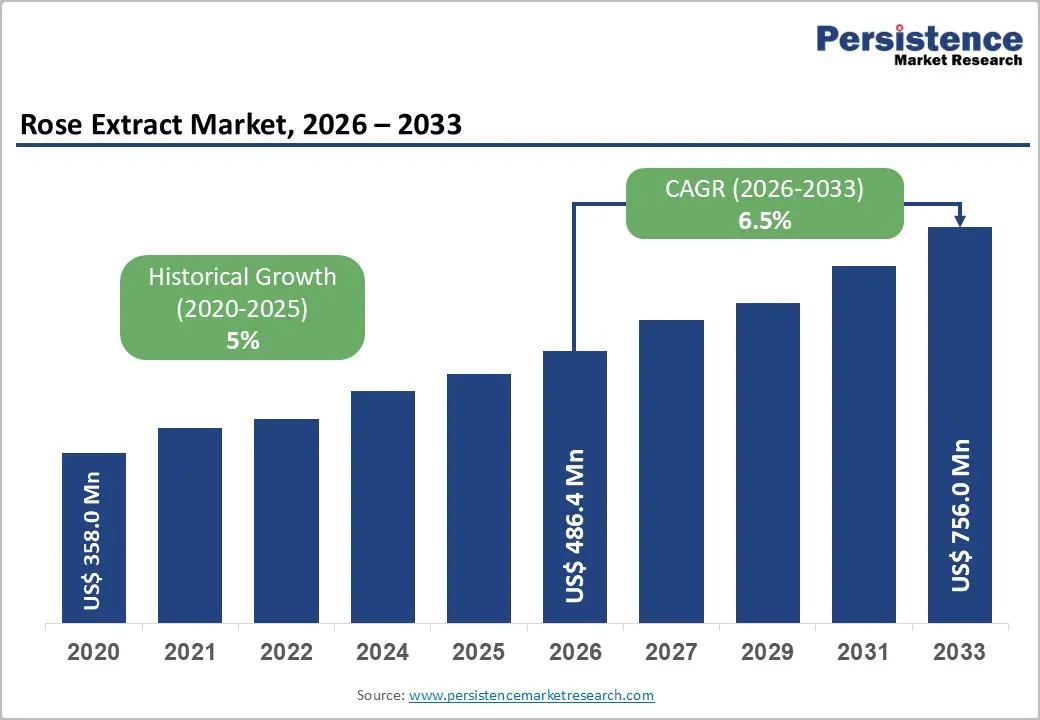
The global rose extract market size is likely to be valued at US$ 486.4 million in 2026, and is projected to reach US$ 756.0 million by 2033, growing at a CAGR of 6.5% during the forecast period 2026−2033. This growth trajectory is primarily driven by increasing consumer preference for natural and organic ingredients in cosmetics and personal care products, expanding applications in the food and beverage industry, and rising demand for aromatherapy and wellness products.
The market benefits from growing awareness of rose extract's antimicrobial, anti-inflammatory, and antioxidant properties, coupled with the premium positioning of rose-based products across multiple end-use industries.
Key Industry Highlights
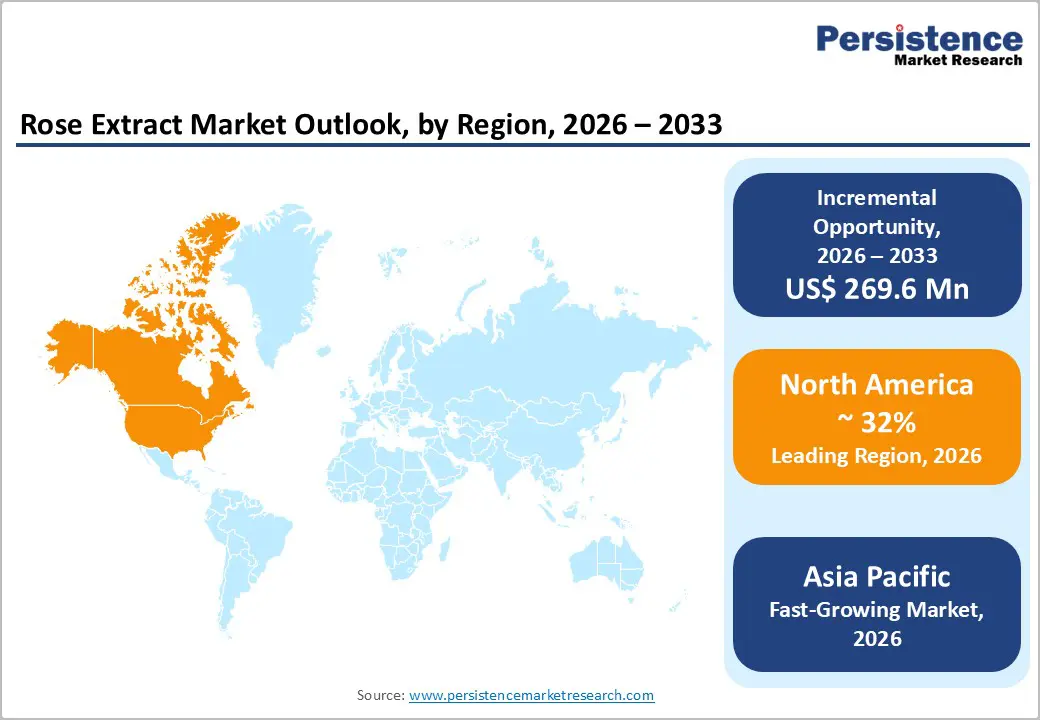
- Dominant Region: North America is expected to hold around 32% of the market share in 2026, on the back of a strong consumer interest in natural ingredients.
- Fastest-growing Market: Asia Pacific is anticipated to be the fastest-growing market between 2026 and 2033, on account of booming populations and cultural roots in natural remedies.
- Leading & Fastest-growing Nature: Organic extracts are poised to command approximately 60% of the market revenues in 2026, whereas conventional extracts are likely to be the fastest-growing segment during the 2026-2033 forecast period.
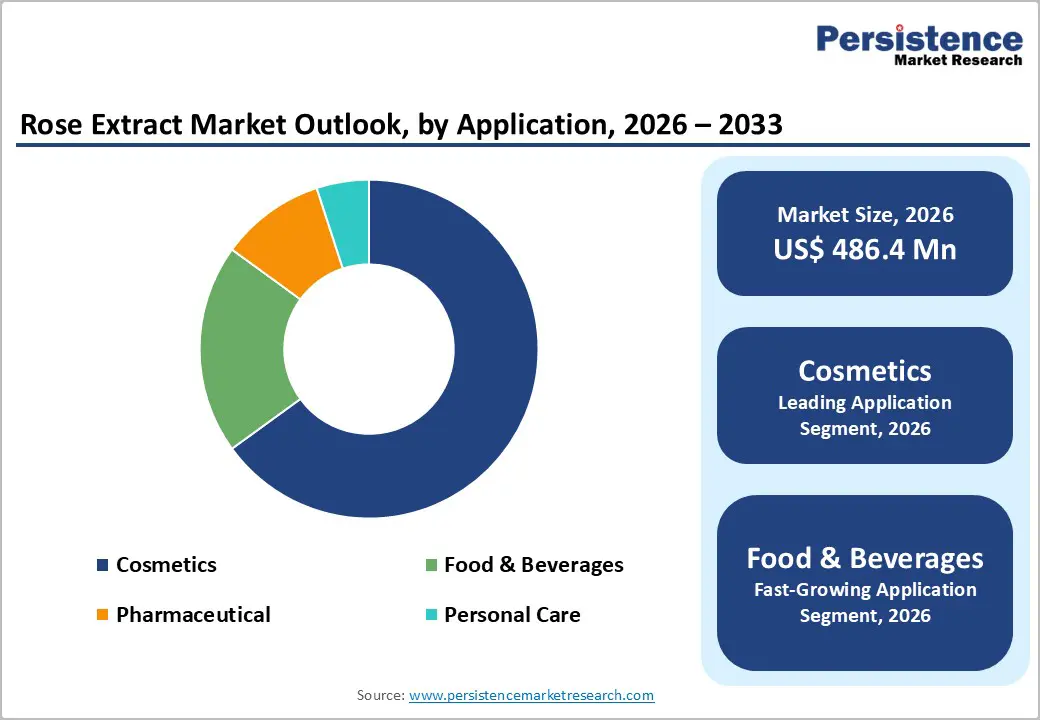
- Leading & Fastest-growing Application: Cosmetics are set to lead by capturing approximately 65% of market revenue share in 2026, while food & beverages are expected to be the fastest-growing segment over the 2026-2033 forecast period.
- December 2025: Sol de Janeiro launched Rosa Charmosa Dewy Cream and Cheirosa 91 Perfume Mist, exclusively at Sephora, reimagining rose with a vibrant Brazilian twist featuring Rio Pink Rose, passionfruit, and honey caramel, among others.
| Key Insights | Details |
|---|---|
| Rose Extract Market Size (2026E) | US$ 486.4 Mn |
| Market Value Forecast (2033F) | US$ 756.0 Mn |
| Projected Growth (CAGR 2026 to 2033) | 6.5% |
| Historical Market Growth (CAGR 2020 to 2025) | 5% |
Market Factors – Growth, Barriers, and Opportunity Analysis
Rising Demand for Natural and Organic Cosmetic Ingredients
The global shift toward clean beauty and natural personal care products drives strong expansion in the rose extract market. Consumers prioritize botanical alternatives over synthetic compounds. They examine ingredient lists with great care before making purchases. Rose extract emerges as a top premium ingredient thanks to its deep moisturizing qualities, proven anti-aging results, and gentle skin-soothing actions. Major brands integrate it seamlessly into key products such as facial serums, nourishing creams, refreshing toners, and hydrating masks. This versatile component supplies vital vitamins, powerful antioxidants, and beneficial essential fatty acids. These elements perfectly address the rising need for multi-purpose natural substances that fit seamlessly into everyday skincare routines. Companies recognize this momentum as a chance to refine their offerings and capture loyal customer bases.
Manufacturers secure a clear competitive advantage when they highlight rose extract in their product lines. Shoppers embrace these options even at elevated price points, which in turn elevates company revenues. This consistent consumer choice underpins reliable progress throughout the cosmetics industry. Savvy businesses seize the opportunity with precise marketing campaigns that emphasize exceptional purity and tangible efficacy. Progressive enterprises further commit to sustainable sourcing practices, which foster enduring confidence among purchasers. These approaches not only solidify strong market positions but also spark fresh ideas in product creation. Leaders who adopt such tactics position themselves for sustained success amid evolving preferences.
Expanding Applications in Food, Beverage, and Aromatherapy Industries
Rose extract applications extend well beyond conventional cosmetics into diverse culinary uses, functional drinks, and wellness items. Food and beverage companies embrace this ingredient for upscale sweets, gourmet pastries, specialty beverages, and flavor enhancers. Chefs draw from Middle Eastern, South Asian, and European traditions to infuse authentic tastes into their creations. This shift opens new revenue streams for suppliers who target premium niches. Businesses benefit by aligning with consumer desires for unique, natural flavors that elevate everyday indulgences.
Wellness enthusiasts propel demand through aromatherapy and essential oil products. Rose extract shines in diffuser combinations, body massage blends, and healing mixtures. Individuals turn to these options for relaxation and stress relief amid fast-paced lives. Suppliers can gain a foothold by emphasizing purity and therapeutic value in their offerings. Companies that innovate in this space can build lasting customer loyalty, while firms that explore partnerships with spas and retailers can expand reach.
Quality Standardization and Adulteration Concerns
Rose extract manufacturers are facing ongoing challenges in maintaining consistent product quality, accurate standardization, and reliable authentication across supply chains. Variations in extract potency are occurring because of differences in rose species, geographic cultivation conditions, agricultural practices, and processing techniques, which are making batch uniformity difficult to achieve. The absence of universally accepted quality benchmarks is complicating efforts to ensure predictable performance in finished products. Adulteration risks are also increasing due to the addition of synthetic fragrances or lower-cost botanical substitutes, which is undermining supply chain credibility and consumer confidence. Companies are therefore implementing rigorous testing protocols and quality assurance systems to verify purity from raw material sourcing through final product packaging. These measures are becoming essential to protect brand reputation and maintain compliance with industry standards.
Quality variability is creating barriers in international trade and consumer acceptance, as regulatory requirements differ across countries and are increasing compliance complexity and operational costs. Inconsistent product performance or inaccurate labeling can lead to customer dissatisfaction and reduced repeat purchasing, which is affecting brand loyalty. Manufacturers are investing in advanced analytical technologies and blockchain-enabled traceability systems to improve authentication and transparency across supply networks. Strategic partnerships with certified growers are helping companies to secure high-quality raw materials while stabilizing supply reliability. These proactive initiatives are reducing risks and strengthening premium brand positioning. Organizations that are prioritizing transparency, traceability, and quality control are gaining competitive advantages while building long-term customer trust in a highly competitive botanical extract market.
Climate Variability Threatening Rose Cultivation Sustainability
Rose cultivation is becoming increasingly vulnerable to climate change impacts, which is raising supply chain risks for the rose extract market. The crop requires specific temperature ranges, consistent water availability, and stable seasonal cycles to achieve optimal yield and oil quality. Irregular weather patterns are disrupting these conditions across major producing regions such as Bulgaria’s Rose Valley, Turkey’s Isparta region, and Iran’s Kashan district, where sudden frost events, extended drought periods, and extreme heat are causing fluctuations in harvest volumes. Farmers are responding by modifying planting schedules, introducing climate-resilient plant varieties, and adjusting cultivation practices, yet these adaptations are increasing production uncertainty and operational costs.
Market participants are encountering pricing volatility and challenges in negotiating long-term supply agreements because buyers are seeking reliability assurances before committing to procurement contracts. Uncertainty in raw material availability is placing pressure on margins and complicating production planning. Companies are investing in climate-resilient agricultural techniques such as precision irrigation systems, greenhouse-assisted cultivation, and drought-tolerant hybrids to improve crop stability. Geographic diversification of sourcing regions is also helping reduce dependency on single-origin production areas. Advanced climate modeling tools are enabling firms to anticipate environmental changes and manage supply risks more effectively. These proactive measures are stabilizing operations, preserving product quality standards, and creating opportunities for premium positioning through sustainability-focused sourcing practices.
Technological Advancements in Extraction and Formulation
Advances in extraction technologies and formulation science are creating significant opportunities for expansion in the rose extract market by improving efficiency, product quality, and environmental performance. Manufacturers are adopting techniques such as supercritical carbon dioxide (CO2) extraction, ultrasound-assisted extraction, and enzyme-assisted processing to increase yield while preserving sensitive bioactive compounds. These methods are reducing solvent usage and minimizing environmental impact compared with traditional extraction approaches, which is helping companies meet sustainability expectations and regulatory requirements. Improved process control is enabling consistent batch quality, which is critical for applications in cosmetics, nutraceuticals, and pharmaceuticals where ingredient reliability is essential. By optimizing production workflows and enhancing active compound retention, suppliers are strengthening their ability to serve diverse industries with standardized, high-performance extracts.
Organizations that are prioritizing research & development (R&D) are gaining competitive advantages through innovation in delivery systems and formulation technologies. Techniques such as encapsulation, nano-emulsion systems, and targeted carrier platforms are improving ingredient stability, bioavailability, and functional performance in end-use products such as skincare formulations and dietary supplements. These innovations are allowing companies to address specialized requirements including enhanced skin penetration, prolonged efficacy, and controlled release profiles, which are opening opportunities in premium market segments. Strategic collaborations with technology providers and research institutions are accelerating product development and reducing commercialization timelines.
Integration into Functional Foods and Nutraceutical Products
The convergence of food, health, and beauty sectors is creating new growth pathways for rose extract through applications in functional foods, dietary supplements, and ingestible beauty products. Consumers are increasingly adopting nutricosmetics and edible wellness solutions that support skin health, digestive balance, and emotional well-being from within. Rose extract is gaining attention because it contains antioxidant compounds, anti-inflammatory properties, and sensory appeal that align with holistic health positioning. Suppliers are working to secure food-grade regulatory approvals in major markets to expand application potential, while scientific studies demonstrating functional benefits are strengthening product credibility and marketing claims.
Strategic partnerships between botanical extract producers and food or nutraceutical manufacturers are accelerating innovation and commercialization in this emerging category. Collaborative product development is enabling the creation of targeted formulations that combine internal nutrition with external beauty benefits, which is attracting consumers seeking integrated wellness solutions. These alliances are improving efficiency in product testing, regulatory approval, and market entry timelines. Companies are investing in clinical validation to support efficacy claims and differentiate offerings in premium market segments where consumers prioritize measurable results. Early adopters are capturing brand loyalty and establishing quality benchmarks in a rapidly evolving cross-industry market landscape.
Category-wise Analysis
Nature Insights
The organic segment is expected to lead with nearly 60% of the rose extract market revenue share in 2026, reflecting strong consumer preference for certified organic ingredients in premium personal care and cosmetic applications. Demand is particularly strong in developed markets such as North America and Europe, where consumers are prioritizing ingredient transparency, environmental responsibility, and perceived product safety. Organic certification is providing assurance regarding pesticide-free cultivation, sustainable farming practices, and traceable sourcing, which is enabling manufacturers to position products at higher price points while strengthening brand credibility. Regulatory frameworks that support organic labeling standards, along with the growing retail presence of clean beauty products, are reinforcing segment dominance. Major cosmetic companies are expanding organic product portfolios to meet consumer expectations, which is generating consistent procurement demand for certified organic rose extract.
The conventional segment is set to experience the fastest expansion between 2026 and 2033 owing to its cost advantages, reliable supply availability, and suitability for high-volume production environments. Conventional rose extract is enabling manufacturers to serve price-sensitive product categories such as daily skincare, hair care products, and personal hygiene formulations without the additional expenses associated with certification processes. Producers are scaling operations efficiently due to fewer regulatory constraints, which is ensuring consistent supply for large retailers and contract manufacturers. Suppliers are incorporating environmentally responsible cultivation practices such as water-efficient irrigation and reduced chemical usage to address sustainability concerns while maintaining competitive pricing. This approach is narrowing the perception gap between organic and conventional offerings and is supporting the emergence of hybrid positioning strategies.
Application Insights
Cosmetics is poised to dominate in 2026, projected to hold an estimated 65% of the rose extract market share in 2026, driven by strong demand for botanical ingredients that provide both functional performance and sensory appeal. Rose extract is widely incorporated into skincare formulations such as moisturizers, toners, serums, and facial treatments because it offers hydration support, soothing properties, and antioxidant protection. These characteristics are helping protect skin from oxidative stress, which is associated with premature aging signs such as fine lines and reduced elasticity. Manufacturers are positioning rose extract as a key ingredient in anti-aging and skin revitalization products that aim to improve texture, brightness, and overall appearance. Consumer preference for natural beauty solutions is strengthening adoption, with brands responding by integrating rose extract into clean-label product lines across both premium and mid-range price categories.
Food and beverage applications are is expected to record the fastest 2026-2033 growth, as demand escalates for natural flavoring ingredients and sensory-enhancing components. Rose extract is being used to impart floral aroma and taste in products such as herbal teas, confectionery items, dairy desserts, and specialty beverages, where it enhances product differentiation and consumer experience. Its compatibility with both sweet and savory formulations is enabling manufacturers to experiment with innovative recipes while maintaining natural ingredient positioning. Consumers are driving expansion through growing preference for clean-label foods that avoid artificial additives and synthetic flavoring agents. Food producers are incorporating rose extract into premium and gourmet product lines to strengthen brand identity and appeal to health-conscious customers.
Regional Insights
North America Rose Extract Market Trends
North America is projected to account for approximately 32% of the rose extract market value in 2026, supported by strong consumer interest in plant-derived ingredients and well-established distribution systems for botanical products. The United States is driving most regional demand due to its advanced cosmetics industry, high spending on premium personal care items, and widespread availability of specialty ingredients through both retail and digital channels. Consumers are increasingly adopting clean beauty formulations, which is encouraging brands and retailers to prioritize natural ingredient sourcing and transparent labeling practices. Rose extract is gaining prominence in luxury skincare lines as well as products from emerging natural beauty companies because it aligns with consumer expectations for authenticity and performance.
The regional wellness movement is further supporting market expansion through applications in aromatherapy, holistic health products, and therapeutic formulations that address stress management and emotional well-being. Consumers are seeking solutions that promote relaxation and overall balance, which is increasing demand for essential oils and botanical extracts across multiple product categories. Regulatory oversight from agencies such as the United States Food and Drug Administration (FDA), along with certification programs including the United States Department of Agriculture (USDA) Organic and the National Sanitation Foundation (NSF), is ensuring quality standards while encouraging innovation. Suppliers are competing by providing traceable sourcing, environmentally responsible cultivation, and transparent supply chains to meet consumer expectations. Investment is increasing in both domestic cultivation initiatives and international supplier partnerships to secure reliable raw material availability. E-commerce platforms are expanding consumer access alongside specialty retailers such as Whole Foods, Sephora, and Ulta Beauty, enabling brands to reach targeted customer segments more effectively.
Europe Rose Extract Market Trends
Europe stands as a lucrative market for rose extract, powered by long-standing cultural connections to botanical ingredients and well-developed cosmetic and fragrance industries. Countries such as Germany, France, the United Kingdom, Italy, and Spain are driving regional consumption through strong manufacturing capabilities and consumer preference for plant-based formulations. Germany is recognized for large-scale production efficiency, while France maintains leadership in luxury perfumery and premium skincare segments where rose-derived ingredients are widely utilized. Consumers across the region are prioritizing naturally sourced components, which is influencing product development strategies and formulation trends. Proximity to established cultivation regions such as Bulgaria, Turkey, and parts of France is ensuring access to authentic raw materials, allowing companies to highlight heritage and origin authenticity in branding efforts.
Regulatory alignment under the European Union (EU) Cosmetics Regulation is restricting the use of certain synthetic ingredients and requiring transparent labeling, which is strengthening consumer confidence in natural alternatives such as rose extract. Certification frameworks including the EU Organic Regulation and COSMOS standards are verifying ingredient purity and sustainability credentials, particularly for premium product categories. Suppliers are competing through environmentally responsible sourcing, biodiversity conservation initiatives, and ethical supply chain practices that align with regional sustainability priorities. Investments are increasing in regenerative agriculture, carbon reduction initiatives, and waste minimization processes to meet regulatory expectations and consumer demand. Aromatherapy applications are also expanding across wellness centers and spa environments where rose oil is incorporated into therapeutic treatments. Digital commerce platforms are growing alongside specialty retailers such as Douglas and Marionnaud, as well as independent natural product stores, which is improving accessibility for consumers.
Asia Pacific Rose Extract Market Trends
Asia Pacific is expected to emerge as the fastest-growing market for rose extract, supported by large population bases, increasing disposable income, and long-standing cultural acceptance of plant-based remedies. China, Japan, India, South Korea, and ASEAN members are driving regional expansion through strong demand across cosmetics, wellness, and traditional medicine sectors. China is leading consumption due to its extensive personal care industry and growing adoption of Traditional Chinese Medicine (TCM) inspired wellness products that incorporate botanical ingredients. Japan is attracting consumers who prioritize high-purity extracts for premium skincare and relaxation therapies, while India is combining traditional rose water usage with modern beauty trends among urban populations. Manufacturers are benefiting from proximity to cultivation regions, competitive labor costs, and expanding processing infrastructure, which is enabling cost-efficient production and export opportunities for both regional and international markets.
Regulatory environments across Asia Pacific are diverse, with countries such as Japan and South Korea implementing stringent safety and quality standards, while other nations are continuing to strengthen regulatory frameworks to support industry development. Competitive dynamics include multinational ingredient suppliers alongside regional producers and cosmetic companies that are developing in-house botanical extraction capabilities. Investment is increasing in manufacturing facilities, digital distribution platforms, and targeted marketing campaigns aimed at urban consumers with rising purchasing power. E-commerce platforms such as Nykaa and regional specialty retailers are transforming product accessibility, while digital communities and influencer-driven marketing are influencing purchasing behavior among younger demographics.
Competitive Landscape
The global rose extract market structure is moderately fragmented. Firmenich, Givaudan, Symrise, Mane, and Alteya Organics collectively account for approximately 43% of total market share. These multinational fragrance and ingredient manufacturers are maintaining competitive influence through extensive research capabilities, established supply networks, and diversified product portfolios that serve cosmetics, food, and wellness industries. Demand for natural and organic ingredients is increasing across end-use sectors, which is encouraging companies to expand botanical offerings and develop specialized formulations that meet evolving consumer preferences. The presence of both established corporations and emerging niche producers is creating a dynamic competitive environment where innovation and product differentiation remain critical success factors.
Competition is intensifying as companies are pursuing strategic partnerships, mergers, and acquisitions to strengthen market presence and expand geographic reach. Manufacturers are focusing on customized formulations that align with specific application requirements, regulatory standards, and consumer expectations for sustainability and authenticity. Regional producers are contributing to market diversity by offering locally sourced extracts and flexible production solutions, which is increasing competitive pressure on global players. Multinational firms are further leveraging technological expertise, brand reputation, and large-scale operations to maintain leadership positions.
Key Industry Developments
- In June 2025, Mibelle Biochemistry launched LunaRose™, an organic active ingredient from the rose hips of a unique Finnish Rosa rugosa hybrid. Inspired by Finland’s extreme day-night cycles, it mimics melatonin to restore skin’s circadian rhythm, upregulating melatonin receptors and boosting antioxidant protection.
- In April 2025, Santa Margherita Wines partnered with fashion brand LoveShackFancy to launch a limited-edition 1.5L Rosé Magnum, marking the winery's first bottle collaboration and magnum format. The bottle features LoveShackFancy's signature pink floral label and comes in a keepsake gift box, blending Italian winemaking from Trevenezie.
- In February 2025, Nuxe launched the Very Rose Plumping Lip Serum, enhancing its popular Very Rose range with a formula featuring rose oil extract, natural hyaluronic acid, pepper fruit extract, and menthol for 24-hour hydration, instant plumping, and a cooling, glossy finish.
Companies Covered in Rose Extract Market
- Firmenich SA
- Givaudan SA
- Symrise AG
- Mane SA
- International Flavors & Fragrances Inc.
- Robertet Group
- Takasago International Corporation
- Alteya Organics
- Enio Bonchev Production
- Sigma-Aldrich Corporation
- India Essential Oils
- Young Living Essential Oils
- doTERRA International
- Ayus GmbH
- Albert Vieille SAS
Frequently Asked Questions
The global rose extract market is projected to reach US$ 486.4 million in 2026
The market is driven by rising clean beauty trends, natural cosmetics demand, and wellness applications.
The market is poised to witness a CAGR of 6.5% from 2026 to 2033.
Major opportunities lie in the emerging Asia-Pacific wellness sectors, extraction tech innovations, and nutricosmetics convergence, which offer strong potential.
Firmenich SA, Givaudan SA, Symrise AG, Mane SA, and Alteya Organics are some of the key players in the market.


