RF Test Equipment Market Size, Share, Trends, Growth, and Forecasts (2025 - 2032)

RF Test Equipment Market by Type (Oscilloscopes, Signal Generators, Spectrum Analyzers, Network Analyzers, Others), by Form Factor (Benchtop, Portable, Modular), by Frequency (Less than 1 GHz, 1 GHz to 6 GHz, More than 6 GHz), and Regional Analysis

ID: PMRREP33484
Calendar

July 2025

303 Pages

Author : Sayali Mali

PreviewSegmentation

RF Test Equipment Market Size and Forecast Analysis

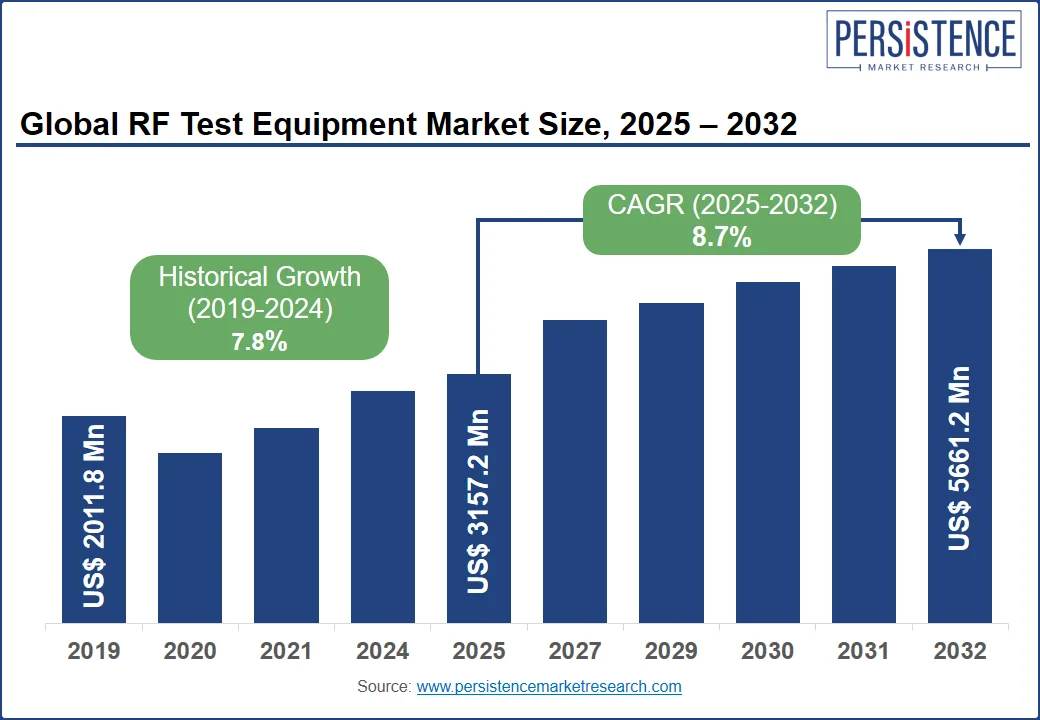
According to Persistence Market Research, the RF test equipment market is projected to reach US$ 3,157.20 million by 2025. According to the report, the global market for RF test equipment is expected to reach US$ 5,661.20 million by 2032, with a CAGR of 8.7%.

The advancement of new telecommunications technology has led to the development of new products that can better transmit signal information. The enhanced capabilities of RF testers are driving demand for the RF tester market worldwide. Frequency testers have become essential in industries like automotive, energy, utilities, aerospace & defense, telecommunications, and energy.

Designing state-of-the-art wireless network equipment and components while meeting economies of scale and cost is a constant challenge for global and emerging wireless network equipment and component companies. Researchers are developing advanced versions of RF testers for satellite communication and radio frequency signals in order to eliminate faults. Scientists are focusing on developing RF testers that have precise control, energy, and accuracy, among other characteristics.

For instance, a new US$153 million expansion of Robert Gabriel Mugabe International Airport includes the installation of a state-of-the-art radio navigation system that can communicate with 200 airplanes at once. Currently, RGM International Airport handles 2.5 million passengers a year, but it will be able to handle up to 6 million once it becomes a regional aviation hub.

RF Test Equipment Market Size 2025 - 2032

Report Attributes Details

RF test equipment Market Size (2025)

US$ 3,157.20 Million

RF test equipment Projected Market Value (2032)

US$ 5,661.20 Million

RF test equipment Market CAGR (2025 to 2032)

8.7%

2019 to 2024 RF test equipment Market Outlook Compare to 2025-2032 Forecast

As per Persistence Market Research (PMR), RF test equipment sales grew at a CAGR of 7.8% between 2019 and 2024. Analysts predict a 8.7% growth in global sales between 2025 and 2032.

With the increasing demand for connectivity, RF devices have grown in demand at an explosive rate. Thus, the RF test equipment market has been experiencing an increase in demand.

The number of wireless communication users and services continues to grow, resulting in an ever-increasing demand. In addition, wireless communication traffic is shifting from voice to data, which requires faster data speeds. These factors are expected to grow the demand for RF test equipment in the market.

Manufacturers of test equipment are striving to offer affordable options without sacrificing performance. SMEs with limited budgets needing RF test equipment are most likely to benefit from this trend. Increasing data rates is being achieved through the use of new transmission methods, such as MIMO. The generation of RF test equipment is becoming more complex as it is developed, which presents challenges to test engineers.

Regulatory agencies require quality test equipment in order to approve devices based on the specifications and standards that they establish. In this process, measurements are made for parameters such as the output power, frequency accuracy, modulation quality, and electromagnetic compatibility (EMC). Additionally, several industries are focusing on developing 5G-based testers across a wide range of regions.

Country-wise Insights

How will the North American RF Test Equipment Market Grow?

Growth of the Consumer Electronics Industry and IoT Technologies to Contribute to Market Growth

United States (2025-2032) Projected Market Value

RF Test Equipment in United States Market Size (2025)

US$ 528.2 million

RF Test Equipment in United States Market Size (2032)

US$ 1 billion

RF Test Equipment in United States Market (CAGR)

6.6%

North America is expected to dominate the RF test equipment market. According to PMR, the North American RF test equipment market will reach US$ 1.7 billion by 2032. As a major player in generating instruments and testing tools, North America is expected to contribute significantly to the global market.

Growing wireless communication, 5G investments, and advanced test and measurement solutions drive the growth of the market. Smartphones that conform to the most recent wireless standards account for their high adoption rates. Consumer electronics companies in the United States are significantly driving the market, as they are increasingly developing their own wireless signal testing equipment in the market.

Automotive and aerospace industries, which need RF test equipment constantly, have also seen an increase in demand for RF test equipment. With advancements in RF devices, a heightened incidence of chronic diseases, and increased healthcare expenditures, the market is expected to grow in the United States in the coming years.

Why is Asia Pacific Region Witnessing a Rise in Sales of RF Test Equipment?

Growth in the Telecom Sector to Push the Market for RF Test Equipment Sales

Projected Market Value (2032):

Countries Details
China US$ 1.6 billion

Projected CAGR (2025 to 2032):

Countries Details
China 9.3%

Projected Market Value (2032):

Countries Details
South Korea US$ 395.7 million

Projected CAGR (2025 to 2032):

Countries Details
South Korea 8.3%

The Asia Pacific region is expected to dominate the global RF tester market for the forecast period. Telecommunications, aerospace, and defense sectors are growing rapidly, creating the potential for RF testers.

RF test equipment sales in Asia Pacific are expected to reach US$ 3.1 billion by 2032. A growing smartphone market and research and development activities will increase RF equipment demand.

Developing regions in the Asia Pacific such as China and India are increasing their spending on aerospace, defense, and telecommunications, which will drive the RF tester market in the region.

Increasing demand for LTE and 5G technologies is expected to drive market growth. A rapid increase in industrialization and automation is expected to substantially drive market growth. Chinese telecom operators, according to the Ministry of Industry and Information Technology (MIIT), have deployed over 1.3 million 5G base stations in China. By November 2021, about 497 million people were using 5G in the country. Further increasing usage of RF components in 5G base stations is the integration of modems, routers, and antennas.

Category-wise Insights

Which RF Test Equipment Type is expected to expand Demand in Coming Years?

Oscilloscopes Type is Likely to Lead Market for RF Test Equipment Market

Based on RF test equipment type market is segmented into oscilloscopes, signal generators, spectrum analyzers, network analyzers, and others. Oscilloscope sales are expected to grow in the coming years. According to the forecast, the market is expected to grow at a CAGR of 7.6% by 2032.

A solid infrastructure and supporting technologies are necessary for the installation of technologies. Obtaining error-free transmission requires a high transmission power and modulation frequency. Oscilloscopes contribute to the quality of real-time signals. In addition to analyzing time-domain signals, they can also analyze frequency-domain signals, allowing them to be used for a wide variety of tests and measurements.

Having built-in spectrum analyzers and waveform generators combined with oscilloscopes, modern oscilloscopes have become highly versatile and capable of adapting to a variety of testing requirements, making them more responsive and useful. For instance, A new 2 Series Mixed Oscilloscope for Tektronix was launched in June 2022 for seamless transitions between the bench and the field. In addition to being extremely thin, the device is also highly portable.

Which Form Factor will lead the RF Test Equipment Market in the Future?

Benchtops will Dominate the Market in RF Test Equipment

Benchtop RF test equipment will dominate the market over the projected period. The technology has been widely adopted in various industries, including telecommunications, automotive, consumer electronics, and more. The benchtop market is expected to grow at a CAGR of 7.4% over the next few years. Compared to portable or modular devices, benchtop devices offer a bigger display, more features, and more accurate measurements.

Benchtop test equipment is widely used in laboratories and manufacturing plants where space isn't a problem and multiple instruments are needed for complex testing. As benchtop test equipment has advanced into portable and handheld instruments over the past few years, allowing wireless industries to benefit from the benchtop equipment's capabilities.

Both bench-top and portable test equipment manufacturers have begun integrating additional test functions into their products. The growing use of RFID technology and the demand for IoT devices are also anticipated to boost market growth. A growing need for advanced testing solutions and high-speed data transmission is also expected to drive market growth. As RF test equipment becomes more sophisticated and advanced testing solutions become more prevalent, demand is expected to increase for these products.

Competitive Landscape

RF tester manufacturers are continuously developing new products while also incorporating innovations and modifying existing products to meet the requirements of a range of applications such as expanding the frequency range, improving accuracy, and increasing variability. Vendors of RF test equipment also focus on increasing distribution centers and developing customer contacts as one of their key strategies.

RF test equipment manufacturers include Fortive, Rohde & Schwarz, Teradyne, National Instruments, Viavi Solutions, Chroma ATE, Good Will Instruments, Teledyne Technologies, Yokogawa Electric, and Anritsu

  • In May 2023, Menlo Microsystems, Inc., a company responsible for creating the most significant advancement in electronic component technology since the transistor, has announced an update to the MM5140 DC-to-8 GHz SP4T switch specifications. Broadband wireless applications up to 8 GHz, including the ever-growing O-RAN frequency bands, are addressed by this product in the rapidly evolving 5G New Radio (NR) sub-6 GHz RF networks.
  • In May 2023, a definitive agreement was entered into by Maury Microwave Inc., one of the top providers of RF calibration and measurement. Upon approval by Wireless Telecom Group shareholders and compliance with other closing conditions, the transaction should close in the third quarter of 2023. Radio frequency ("RF") and microwave technology can be pushed to new limits with WTT's technology portfolio.

Companies Covered in RF Test Equipment Market

  • Fortive
  • Rohde & Schwarz
  • National Instruments
  • Teradyne
  • Viavi Solutions
  • Chroma ATE
  • Good Will Instruments
  • Teledyne Technologies
  • Yokogawa Electric
  • Anritsu
Frequently Asked Questions

The market is expected to reach US$ 3,157.20 million by 2025.

It is projected to reach US$ 5,661.20 million by 2032.

The market is expected to grow at a CAGR of 8.7% during this period.

Growth is driven by advancements in telecommunications technology and enhanced capabilities of RF testers.

Industries include automotive, energy, utilities, aerospace & defense, and telecommunications.

RF Test Equipment Industry Report Scope
Attribute Details

Forecast Period

2025 to 2032

Historical Data Available for

2019 to 2024

Market Analysis

US$ million/billion for Value

Key Countries Covered

  • United States
  • Canada
  • Brazil
  • Mexico
  • Rest of Latin America
  • Germany
  • United Kingdom
  • France
  • Spain
  • Italy
  • Rest of Europe
  • China
  • Japan
  • South Korea
  • Singapore
  • Thailand
  • Indonesia
  • Australia
  • New Zealand
  • Rest of Asia Pacific
  • GCC Countries
  • South Africa
  • Israel
  • Rest of MEA

Key Market Segments Covered

  • Type
  • Form Factor
  • Frequency
  • Application
  • Region

Key Companies Profiled

  • Fortive
  • Rohde & Schwarz
  • National Instruments
  • Teradyne
  • Viavi Solutions
  • Chroma ATE
  • Good Will Instruments
  • Teledyne Technologies
  • Yokogawa Electric
  • Anritsu

Pricing

Available upon Request

Market Segmentation

By Type:

  • Oscilloscopes
  • Signal Generators
  • Spectrum Analyzers
  • Network Analyzers
  • Others

By Form Factor:

  • Benchtop
  • Portable
  • Modular

By Frequency:

  • Less than 1 GHz
  • 1 GHz to 6 GHz
  • More than 6 GHz

By Application:

  • Telecommunications
  • Consumer Electronics
  • Automotive
  • Aerospace & Defense
  • Industrial
  • Medical
  • Research & Education

By Region:

  • North America
  • Latin America
  • Europe
  • Asia Pacific
  • Middle East and Africa

Related Reports

1. Executive Summary

    1.1. Global Market Outlook

    1.2. Demand-side Trends

    1.3. Supply-side Trends

    1.4. Technology Roadmap Analysis

    1.5. Analysis and Recommendations

2. Market Overview

    2.1. Market Coverage / Taxonomy

    2.2. Market Definition / Scope / Limitations

3. Market Background

    3.1. Market Dynamics

        3.1.1. Drivers

        3.1.2. Restraints

        3.1.3. Opportunity

        3.1.4. Trends

    3.2. Scenario Forecast

        3.2.1. Demand in Optimistic Scenario

        3.2.2. Demand in Likely Scenario

        3.2.3. Demand in Conservative Scenario

    3.3. Opportunity Map Analysis

    3.4. Product Life Cycle Analysis

    3.5. Supply Chain Analysis

        3.5.1. Supply Side Participants and their Roles

            3.5.1.1. Producers

            3.5.1.2. Mid-Level Participants (Traders/ Agents/ Brokers)

            3.5.1.3. Wholesalers and Distributors

        3.5.2. Value Added and Value Created at Node in the Supply Chain

        3.5.3. List of Raw Material Suppliers

        3.5.4. List of Existing and Potential Buyer’s

    3.6. Investment Feasibility Matrix

    3.7. Value Chain Analysis

        3.7.1. Profit Margin Analysis

        3.7.2. Wholesalers and Distributors

        3.7.3. Retailers

    3.8. PESTLE and Porter’s Analysis

    3.9. Regulatory Landscape

        3.9.1. By Key Regions

        3.9.2. By Key Countries

    3.10. Regional Parent Market Outlook

    3.11. Production and Consumption Statistics

    3.12. Import and Export Statistics

4. Global RF Test Equipment Market Analysis 2019-2024 and Forecast, 2025-2032

    4.1. Historical Market Size Value (US$ Mn) & Volume (Units) Analysis, 2019-2024

    4.2. Current and Future Market Size Value (US$ Mn) & Volume (Units) Projections, 2025-2032

        4.2.1. Y-o-Y Growth Trend Analysis

        4.2.2. Absolute $ Opportunity Analysis

5. Global RF Test Equipment Market Analysis 2019-2024 and Forecast 2025-2032, By Type

    5.1. Introduction / Key Findings

    5.2. Historical Market Size Value (US$ Mn) & Volume (Units) Analysis By Type, 2019-2024

    5.3. Current and Future Market Size Value (US$ Mn) & Volume (Units) Analysis and Forecast By Type, 2025-2032

        5.3.1. Oscilloscopes

        5.3.2. Signal Generators

        5.3.3. Spectrum Analyzers

        5.3.4. Network Analyzers

        5.3.5. Others

    5.4. Y-o-Y Growth Trend Analysis By Type, 2019-2024

    5.5. Absolute $ Opportunity Analysis By Type, 2025-2032

6. Global RF Test Equipment Market Analysis 2019-2024 and Forecast 2025-2032, By Form Factor

    6.1. Introduction / Key Findings

    6.2. Historical Market Size Value (US$ Mn) & Volume (Units) Analysis By Form Factor, 2019-2024

    6.3. Current and Future Market Size Value (US$ Mn) & Volume (Units) Analysis and Forecast By Form Factor, 2025-2032

        6.3.1. Benchtop

        6.3.2. Portable

        6.3.3. Modular

    6.4. Y-o-Y Growth Trend Analysis By Form Factor, 2019-2024

    6.5. Absolute $ Opportunity Analysis By Form Factor, 2025-2032

7. Global RF Test Equipment Market Analysis 2019-2024 and Forecast 2025-2032, By Frequency

    7.1. Introduction / Key Findings

    7.2. Historical Market Size Value (US$ Mn) & Volume (Units) Analysis By Frequency, 2019-2024

    7.3. Current and Future Market Size Value (US$ Mn) & Volume (Units) Analysis and Forecast By Frequency, 2025-2032

        7.3.1. Less than 1 GHz

        7.3.2. 1 GHz to 6 GHz

        7.3.3. More than 6 GHz

    7.4. Y-o-Y Growth Trend Analysis By Frequency, 2019-2024

    7.5. Absolute $ Opportunity Analysis By Frequency, 2025-2032

8. Global RF Test Equipment Market Analysis 2019-2024 and Forecast 2025-2032, By Application

    8.1. Introduction / Key Findings

    8.2. Historical Market Size Value (US$ Mn) & Volume (Units) Analysis By Application, 2019-2024

    8.3. Current and Future Market Size Value (US$ Mn) & Volume (Units) Analysis and Forecast By Application, 2025-2032

        8.3.1. Telecommunications

        8.3.2. Consumer Electronics

        8.3.3. Automotive

        8.3.4. Aerospace & Defense

        8.3.5. Industrial

        8.3.6. Medical

        8.3.7. Research & Education

    8.4. Y-o-Y Growth Trend Analysis By Application, 2019-2024

    8.5. Absolute $ Opportunity Analysis By Application, 2025-2032

9. Global RF Test Equipment Market Analysis 2019-2024 and Forecast 2025-2032, By Region

    9.1. Introduction

    9.2. Historical Market Size Value (US$ Mn) & Volume (Units) Analysis By Region, 2019-2024

    9.3. Current Market Size Value (US$ Mn) & Volume (Units) Analysis and Forecast By Region, 2025-2032

        9.3.1. North America

        9.3.2. Latin America

        9.3.3. Europe

        9.3.4. Asia Pacific

        9.3.5. MEA

    9.4. Market Attractiveness Analysis By Region

10. North America RF Test Equipment Market Analysis 2019-2024 and Forecast 2025-2032, By Country

    10.1. Historical Market Size Value (US$ Mn) & Volume (Units) Trend Analysis By Market Taxonomy, 2019-2024

    10.2. Market Size Value (US$ Mn) & Volume (Units) Forecast By Market Taxonomy, 2025-2032

        10.2.1. By Country

            10.2.1.1. U.S.

            10.2.1.2. Canada

        10.2.2. By Type

        10.2.3. By Form Factor

        10.2.4. By Frequency

        10.2.5. By Application

    10.3. Market Attractiveness Analysis

        10.3.1. By Country

        10.3.2. By Type

        10.3.3. By Form Factor

        10.3.4. By Frequency

        10.3.5. By Application

    10.4. Key Takeaways

11. Latin America RF Test Equipment Market Analysis 2019-2024 and Forecast 2025-2032, By Country

    11.1. Historical Market Size Value (US$ Mn) & Volume (Units) Trend Analysis By Market Taxonomy, 2019-2024

    11.2. Market Size Value (US$ Mn) & Volume (Units) Forecast By Market Taxonomy, 2025-2032

        11.2.1. By Country

            11.2.1.1. Brazil

            11.2.1.2. Mexico

            11.2.1.3. Rest of Latin America

        11.2.2. By Type

        11.2.3. By Form Factor

        11.2.4. By Frequency

        11.2.5. By Application

    11.3. Market Attractiveness Analysis

        11.3.1. By Country

        11.3.2. By Type

        11.3.3. By Form Factor

        11.3.4. By Frequency

        11.3.5. By Application

    11.4. Key Takeaways

12. Europe RF Test Equipment Market Analysis 2019-2024 and Forecast 2025-2032, By Country

    12.1. Historical Market Size Value (US$ Mn) & Volume (Units) Trend Analysis By Market Taxonomy, 2019-2024

    12.2. Market Size Value (US$ Mn) & Volume (Units) Forecast By Market Taxonomy, 2025-2032

        12.2.1. By Country

            12.2.1.1. Germany

            12.2.1.2. U.K.

            12.2.1.3. France

            12.2.1.4. Spain

            12.2.1.5. Italy

            12.2.1.6. Rest of Europe

        12.2.2. By Type

        12.2.3. By Form Factor

        12.2.4. By Frequency

        12.2.5. By Application

    12.3. Market Attractiveness Analysis

        12.3.1. By Country

        12.3.2. By Type

        12.3.3. By Form Factor

        12.3.4. By Frequency

        12.3.5. By Application

    12.4. Key Takeaways

13. Asia Pacific RF Test Equipment Market Analysis 2019-2024 and Forecast 2025-2032, By Country

    13.1. Historical Market Size Value (US$ Mn) & Volume (Units) Trend Analysis By Market Taxonomy, 2019-2024

    13.2. Market Size Value (US$ Mn) & Volume (Units) Forecast By Market Taxonomy, 2025-2032

        13.2.1. By Country

            13.2.1.1. China

            13.2.1.2. Japan

            13.2.1.3. South Korea

            13.2.1.4. Singapore

            13.2.1.5. Thailand

            13.2.1.6. Indonesia

            13.2.1.7. Australia

            13.2.1.8. New Zealand

            13.2.1.9. Rest of Asia Pacific

        13.2.2. By Type

        13.2.3. By Form Factor

        13.2.4. By Frequency

        13.2.5. By Application

    13.3. Market Attractiveness Analysis

        13.3.1. By Country

        13.3.2. By Type

        13.3.3. By Form Factor

        13.3.4. By Frequency

        13.3.5. By Application

    13.4. Key Takeaways

14. MEA RF Test Equipment Market Analysis 2019-2024 and Forecast 2025-2032, By Country

    14.1. Historical Market Size Value (US$ Mn) & Volume (Units) Trend Analysis By Market Taxonomy, 2019-2024

    14.2. Market Size Value (US$ Mn) & Volume (Units) Forecast By Market Taxonomy, 2025-2032

        14.2.1. By Country

            14.2.1.1. GCC Countries

            14.2.1.2. South Africa

            14.2.1.3. Israel

            14.2.1.4. Rest of MEA

        14.2.2. By Type

        14.2.3. By Form Factor

        14.2.4. By Frequency

        14.2.5. By Application

    14.3. Market Attractiveness Analysis

        14.3.1. By Country

        14.3.2. By Type

        14.3.3. By Form Factor

        14.3.4. By Frequency

        14.3.5. By Application

    14.4. Key Takeaways

15. Key Countries RF Test Equipment Market Analysis

    15.1. U.S.

        15.1.1. Pricing Analysis

        15.1.2. Market Share Analysis, 2024

            15.1.2.1. By Type

            15.1.2.2. By Form Factor

            15.1.2.3. By Frequency

            15.1.2.4. By Application

    15.2. Canada

        15.2.1. Pricing Analysis

        15.2.2. Market Share Analysis, 2024

            15.2.2.1. By Type

            15.2.2.2. By Form Factor

            15.2.2.3. By Frequency

            15.2.2.4. By Application

    15.3. Brazil

        15.3.1. Pricing Analysis

        15.3.2. Market Share Analysis, 2024

            15.3.2.1. By Type

            15.3.2.2. By Form Factor

            15.3.2.3. By Frequency

            15.3.2.4. By Application

    15.4. Mexico

        15.4.1. Pricing Analysis

        15.4.2. Market Share Analysis, 2024

            15.4.2.1. By Type

            15.4.2.2. By Form Factor

            15.4.2.3. By Frequency

            15.4.2.4. By Application

    15.5. Germany

        15.5.1. Pricing Analysis

        15.5.2. Market Share Analysis, 2024

            15.5.2.1. By Type

            15.5.2.2. By Form Factor

            15.5.2.3. By Frequency

            15.5.2.4. By Application

    15.6. U.K.

        15.6.1. Pricing Analysis

        15.6.2. Market Share Analysis, 2024

            15.6.2.1. By Type

            15.6.2.2. By Form Factor

            15.6.2.3. By Frequency

            15.6.2.4. By Application

    15.7. France

        15.7.1. Pricing Analysis

        15.7.2. Market Share Analysis, 2024

            15.7.2.1. By Type

            15.7.2.2. By Form Factor

            15.7.2.3. By Frequency

            15.7.2.4. By Application

    15.8. Spain

        15.8.1. Pricing Analysis

        15.8.2. Market Share Analysis, 2024

            15.8.2.1. By Type

            15.8.2.2. By Form Factor

            15.8.2.3. By Frequency

            15.8.2.4. By Application

    15.9. Italy

        15.9.1. Pricing Analysis

        15.9.2. Market Share Analysis, 2024

            15.9.2.1. By Type

            15.9.2.2. By Form Factor

            15.9.2.3. By Frequency

            15.9.2.4. By Application

    15.10. China

        15.10.1. Pricing Analysis

        15.10.2. Market Share Analysis, 2024

            15.10.2.1. By Type

            15.10.2.2. By Form Factor

            15.10.2.3. By Frequency

            15.10.2.4. By Application

    15.11. Japan

        15.11.1. Pricing Analysis

        15.11.2. Market Share Analysis, 2024

            15.11.2.1. By Type

            15.11.2.2. By Form Factor

            15.11.2.3. By Frequency

            15.11.2.4. By Application

    15.12. South Korea

        15.12.1. Pricing Analysis

        15.12.2. Market Share Analysis, 2024

            15.12.2.1. By Type

            15.12.2.2. By Form Factor

            15.12.2.3. By Frequency

            15.12.2.4. By Application

    15.13. Singapore

        15.13.1. Pricing Analysis

        15.13.2. Market Share Analysis, 2024

            15.13.2.1. By Type

            15.13.2.2. By Form Factor

            15.13.2.3. By Frequency

            15.13.2.4. By Application

    15.14. Thailand

        15.14.1. Pricing Analysis

        15.14.2. Market Share Analysis, 2024

            15.14.2.1. By Type

            15.14.2.2. By Form Factor

            15.14.2.3. By Frequency

            15.14.2.4. By Application

    15.15. Indonesia

        15.15.1. Pricing Analysis

        15.15.2. Market Share Analysis, 2024

            15.15.2.1. By Type

            15.15.2.2. By Form Factor

            15.15.2.3. By Frequency

            15.15.2.4. By Application

    15.16. Australia

        15.16.1. Pricing Analysis

        15.16.2. Market Share Analysis, 2024

            15.16.2.1. By Type

            15.16.2.2. By Form Factor

            15.16.2.3. By Frequency

            15.16.2.4. By Application

    15.17. New Zealand

        15.17.1. Pricing Analysis

        15.17.2. Market Share Analysis, 2024

            15.17.2.1. By Type

            15.17.2.2. By Form Factor

            15.17.2.3. By Frequency

            15.17.2.4. By Application

    15.18. GCC Countries

        15.18.1. Pricing Analysis

        15.18.2. Market Share Analysis, 2024

            15.18.2.1. By Type

            15.18.2.2. By Form Factor

            15.18.2.3. By Frequency

            15.18.2.4. By Application

    15.19. South Africa

        15.19.1. Pricing Analysis

        15.19.2. Market Share Analysis, 2024

            15.19.2.1. By Type

            15.19.2.2. By Form Factor

            15.19.2.3. By Frequency

            15.19.2.4. By Application

    15.20. Israel

        15.20.1. Pricing Analysis

        15.20.2. Market Share Analysis, 2024

            15.20.2.1. By Type

            15.20.2.2. By Form Factor

            15.20.2.3. By Frequency

            15.20.2.4. By Application

16. Market Structure Analysis

    16.1. Competition Dashboard

    16.2. Competition Benchmarking

    16.3. Market Share Analysis of Top Players

        16.3.1. By Regional

        16.3.2. By Type

        16.3.3. By Form Factor

        16.3.4. By Frequency

        16.3.5. By Application

17. Competition Analysis

    17.1. Competition Deep Dive

        17.1.1. Fortive

            17.1.1.1. Overview

            17.1.1.2. Product Portfolio

            17.1.1.3. Profitability by Market Segments

            17.1.1.4. Sales Footprint

            17.1.1.5. Strategy Overview

                17.1.1.5.1. Marketing Strategy

                17.1.1.5.2. Product Strategy

                17.1.1.5.3. Channel Strategy

        17.1.2. Rohde & Schwarz

            17.1.2.1. Overview

            17.1.2.2. Product Portfolio

            17.1.2.3. Profitability by Market Segments

            17.1.2.4. Sales Footprint

            17.1.2.5. Strategy Overview

                17.1.2.5.1. Marketing Strategy

                17.1.2.5.2. Product Strategy

                17.1.2.5.3. Channel Strategy

        17.1.3. National Instruments

            17.1.3.1. Overview

            17.1.3.2. Product Portfolio

            17.1.3.3. Profitability by Market Segments

            17.1.3.4. Sales Footprint

            17.1.3.5. Strategy Overview

                17.1.3.5.1. Marketing Strategy

                17.1.3.5.2. Product Strategy

                17.1.3.5.3. Channel Strategy

        17.1.4. Teradyne

            17.1.4.1. Overview

            17.1.4.2. Product Portfolio

            17.1.4.3. Profitability by Market Segments

            17.1.4.4. Sales Footprint

            17.1.4.5. Strategy Overview

                17.1.4.5.1. Marketing Strategy

                17.1.4.5.2. Product Strategy

                17.1.4.5.3. Channel Strategy

        17.1.5. Viavi Solutions

            17.1.5.1. Overview

            17.1.5.2. Product Portfolio

            17.1.5.3. Profitability by Market Segments

            17.1.5.4. Sales Footprint

            17.1.5.5. Strategy Overview

                17.1.5.5.1. Marketing Strategy

                17.1.5.5.2. Product Strategy

                17.1.5.5.3. Channel Strategy

        17.1.6. Chroma ATE

            17.1.6.1. Overview

            17.1.6.2. Product Portfolio

            17.1.6.3. Profitability by Market Segments

            17.1.6.4. Sales Footprint

            17.1.6.5. Strategy Overview

                17.1.6.5.1. Marketing Strategy

                17.1.6.5.2. Product Strategy

                17.1.6.5.3. Channel Strategy

        17.1.7. Good Will Instruments

            17.1.7.1. Overview

            17.1.7.2. Product Portfolio

            17.1.7.3. Profitability by Market Segments

            17.1.7.4. Sales Footprint

            17.1.7.5. Strategy Overview

                17.1.7.5.1. Marketing Strategy

                17.1.7.5.2. Product Strategy

                17.1.7.5.3. Channel Strategy

        17.1.8. Teledyne Technologies

            17.1.8.1. Overview

            17.1.8.2. Product Portfolio

            17.1.8.3. Profitability by Market Segments

            17.1.8.4. Sales Footprint

            17.1.8.5. Strategy Overview

                17.1.8.5.1. Marketing Strategy

                17.1.8.5.2. Product Strategy

                17.1.8.5.3. Channel Strategy

        17.1.9. Yokogawa Electric

            17.1.9.1. Overview

            17.1.9.2. Product Portfolio

            17.1.9.3. Profitability by Market Segments

            17.1.9.4. Sales Footprint

            17.1.9.5. Strategy Overview

                17.1.9.5.1. Marketing Strategy

                17.1.9.5.2. Product Strategy

                17.1.9.5.3. Channel Strategy

        17.1.10. Anritsu

            17.1.10.1. Overview

            17.1.10.2. Product Portfolio

            17.1.10.3. Profitability by Market Segments

            17.1.10.4. Sales Footprint

            17.1.10.5. Strategy Overview

                17.1.10.5.1. Marketing Strategy

                17.1.10.5.2. Product Strategy

                17.1.10.5.3. Channel Strategy

18. Assumptions & Acronyms Used

19. Research Methodology

Research Methodology Framework for Market Research Excellence

At Persistence Market Research, we implement a comprehensive, validated, and multi-dimensional approachto market analysis that delivers actionable insights across complex market landscapes. Our methodology combines the analytical rigor of leading consulting firms with innovative research techniques, ensuring robust market assessments that guide strategic decision-making with confidence.

Core Research Philosophy

Our methodology is built on four foundational pillars:

Research Philosophy Image

At Persistence Market Research, our methodology is designed to transcend conventional market studies by combining analytical rigor, multi-source validation, and future-focused insights.

We integrate advanced research frameworks, robust data collection strategies, cutting-edge analytics, and innovative technologies to deliver a 360-degree view of complex markets.

We integrate advanced research frameworks, robust data collection strategies, cutting-edge analytics, and innovative technologies to deliver a 360-degree view of complex markets.

Each stage spanning from strategic scoping and hypothesis-building to competitive intelligence, quality validation, and actionable recommendations is engineered to provide clients with unmatched clarity, precision, and confidence in decision-making.

By embedding innovation and technology at the core, our approach ensures that insights are not only comprehensive but also predictive, empowering businesses to seize opportunities, mitigate risks, and achieve sustainable growth

Research Philosophy Image

Capturing Key Information and Events

During this phase, key research objectives focus on essential information and data points for assessing the market, including:

Research Philosophy Image

TAM-SAM-SOM Framework Implementation

We employ both top-down and bottom-up approaches to ensure accurate market sizing.

Top-Down Market SizingBottom-Up Market Sizing
Universe Definition: Total global/regional market identificationUnit Economics: Average transaction values, purchase frequencies, customer lifecycle
Segmentation Filters: Geographic, demographic, and behavioral constraintsCustomer Segmentation: Detailed buyer persona development and sizing
Market Share Analysis: Competitive landscape assessment and share allocationPenetration Analysis: Market penetration rates by segment and geography
Growth Rate Application: Historical trends and forward-looking growth assumptionsScaling Methodology: Extrapolation techniques with confidence intervals

Validation & Cross-Verification

  • Triangulation: Comparing top-down and bottom-up results for consistency
  • Sensitivity Analysis: Testing key assumptions and parameter variations
  • Peer Benchmarking: Comparison with analogous markets and industry benchmarks
  • Expert Review: External validation through industry specialist consultation

Research Philosophy Image

Forecasting & Projection Modeling

Our proprietary forecasting models incorporate multiple variables and scenarios.

Forecasting Components

  • Historical Trend Analysis: 10-year historical growth patterns and cyclical variations
  • Driver-Based Modeling: Economic indicators, demographic shifts, technology adoption
  • Scenario Planning: Base case, optimistic, and conservative projections
  • Monte Carlo Simulations: Probability-weighted outcomes and risk assessments

Model Validation

  • Back-Testing: Historical accuracy assessment over 3–5-year periods
  • Cross-Validation: Multiple modeling approaches for result comparison
  • External Benchmarking: Comparison with established market forecasts
  • Continuous Calibration: Quarterly model updates based on new data

Comprehensive Data Collection Strategy

Our secondary research phase establishes a robust knowledge base utilizing diverse, credible sources.

Secondary Data Sourcess

  • Industry Publications & Reports
  • Government & Regulatory Data
  • Financial Intelligence (filings & reports)
  • Academic Research & Digital Intelligence

Quality Assurance Protocol

  • Source credibility assessment and publication date validation
  • Data consistency checks across multiple sources
  • Bias identification and neutralization techniques
  • Information gap tracking for primary research prioritization

Research Philosophy Image

Primary Research Excellence

Our primary research methodology employs best-in-class techniques to capture unique market insights.

Quantitative Research Methods

  • Large-Scale Surveys: Statistically representative samples with 95% confidence intervals
  • Survey Methodology: Multi-channel deployment (online, telephone, in-person)
  • Question Architecture and Response Optimization

Qualitative Research Methods

  • Executive Interviews
  • Focus Groups
  • Expert Consultations

Quality Assurance & Validation Framework

Multi-Stage Validation Process

  • Source Verification and Consistency Testing
  • Outlier Detection and Bias Assessment
  • Peer Review Process and External Validation
  • Sensitivity Analysis and Confidence Intervals

Research Philosophy Image

Methodology Validation & Credibility

Our research methodology has been extensively validated through:

  • Academic Partnerships: Collaborations with top-tier business schools and research institutions
  • Client Success Stories: Documented case studies demonstrating research impact and ROI
  • Continuous Benchmarking: Performance comparison with leading global research firms

This comprehensive methodology framework positions Persistence Market Research at the forefront of market intelligence, combining the analytical sophistication of top-tier consulting firms with innovative research techniques. Our approach ensures that every market assessment delivers precise, actionable, and strategically valuable insights that drive business success in competitive market environments.

Ready to unlock your market potential? Contact our research experts to discuss how our validated methodology can transform your strategic decision-making with data-driven market intelligence.

Copyright © 2026 Persistence Market Research. All Rights Reserved

Connect With Us -