




- Testing, Inspection, & Certification
- Railway Management System Market
Railway Management System Market Size, Share, and Growth Forecast, 2025 - 2032
Railway Management System Market By Component (Solutions, Services), Rail Type (Passenger Rail, Freight Rail, High-Speed Rail, Urban and Light Rail), End-use, and Regional Analysis for 2025 - 2032

Railway Management System Market Size and Trends Analysis
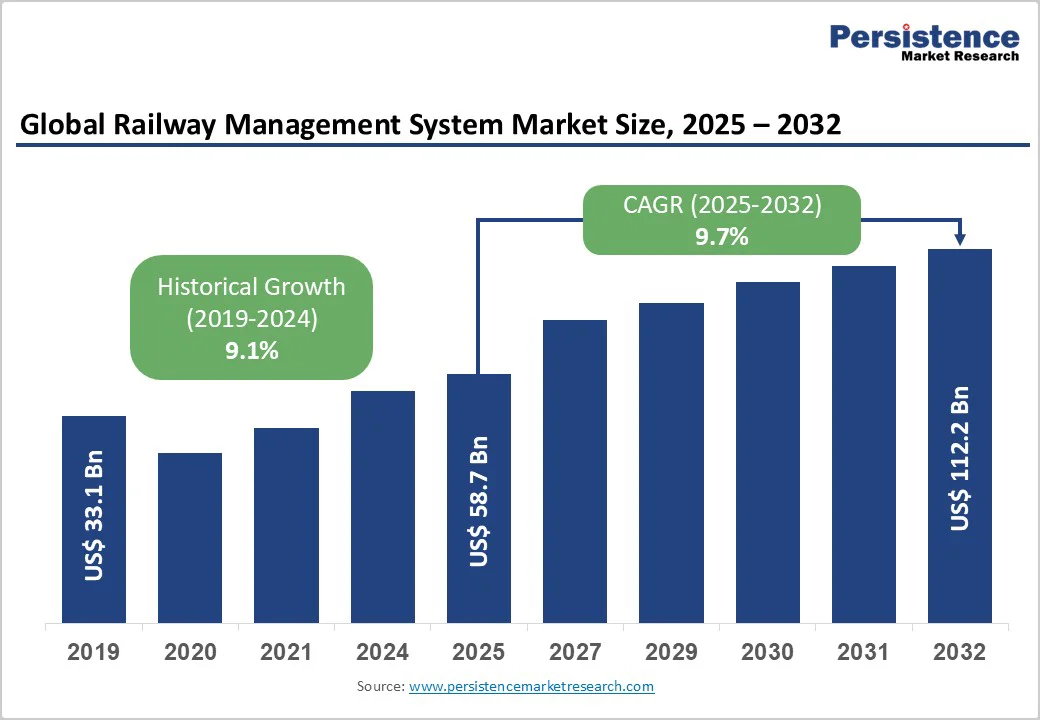
The global railway management system market size is likely to be valued US$ US$58.7 billion in 2025, expected to US$112.2 Billion by 2032, growing at a CAGR of 9.7% during the forecast period from 2025 to 2032, driven by the increasing prevalence of digital transformation in rail operations, rising demand for efficient traffic management, and advancements in IoT and AI technologies.
The need for real-time monitoring and predictive maintenance, particularly in high-speed networks, has significantly boosted the adoption of railway management systems across various demographics.
The market is further propelled by innovations in solutions and services, catering to preferences for integrated and scalable options. The growing acceptance of railway management systems as essential for safety and capacity optimization, particularly in urban rail, is a key growth factor.
Key Industry Highlights:
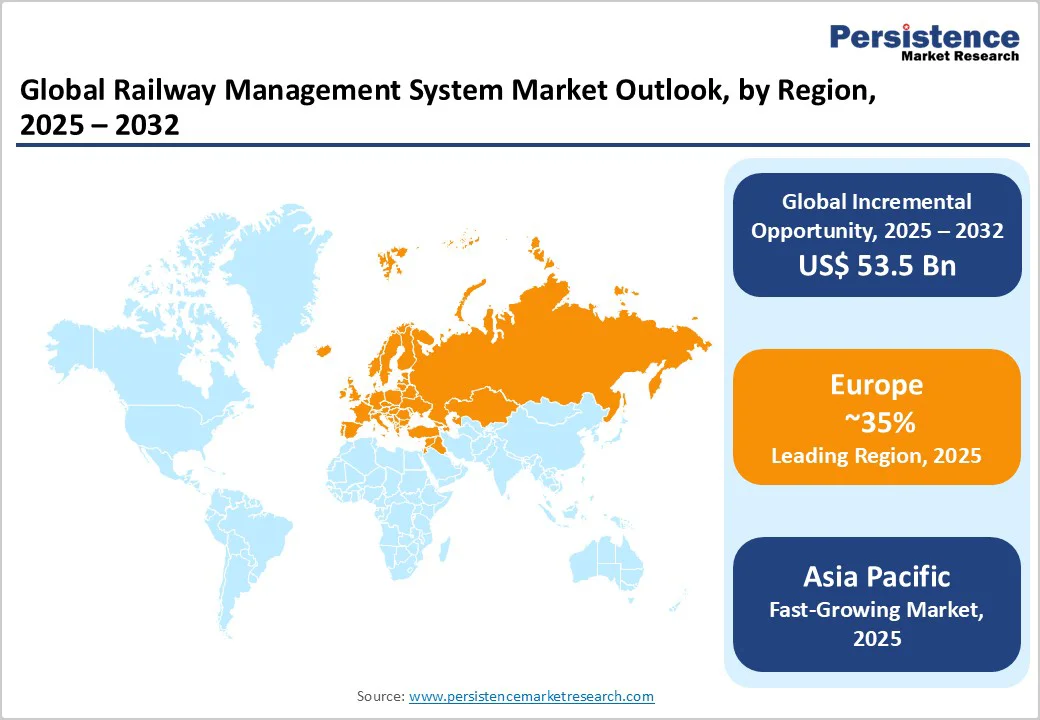
- Leading Region: Europe, commanding a 35% market share in 2025, driven by extensive rail networks, high prevalence of high-speed projects, and strong R&D activities in Germany.
- Fastest-growing Region: Asia Pacific, fueled by massive rail expansion, rising awareness of smart mobility, and growing investments in urban transit in China and India.
- Dominant Component: Solutions, holding approximately 65% of the market share, due to core software demand.
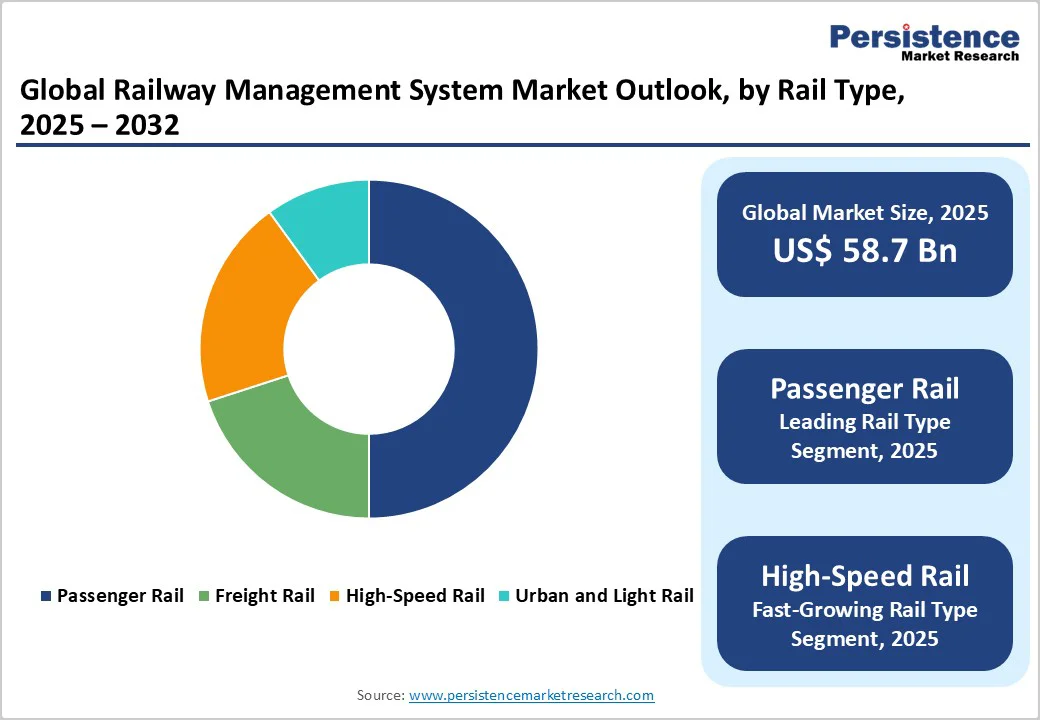
- Leading Rail Type: Passenger Rail, accounting for over 50% of market revenue, driven by commuter needs.
- Leading End-use: Railway Operators, contributing nearly 45% of market revenue, due to operational control.
- Key Market Driver: Increasing demand for real-time monitoring, automation, and enhanced passenger safety further accelerates market growth globally.
- Market Opportunity: The expansion of high-speed rail projects and the adoption of IoT-based rail solutions present major growth opportunities.
| Key Insights | Details |
|---|---|
|
Railway Management System Market Size (2025E) |
US$58.7 Bn |
|
Market Value Forecast (2032F) |
US$112.2 Bn |
|
Projected Growth (CAGR 2025 to 2032) |
9.7% |
|
Historical Market Growth (CAGR 2019 to 2024) |
9.1% |
Market Factors - Growth, Barriers, and Opportunity Analysis
Rising Prevalence of Digital Transformation and Demand for Efficient Rail Operations
The global increase in digital transformation in rail is a primary driver of the railway management system market. As railway networks expand and passenger volumes increase, operators are turning to advanced digital solutions to enhance safety, reliability, and performance. The adoption of AI, IoT, big data analytics, and cloud computing enables real-time monitoring, predictive maintenance, and automated control systems, significantly reducing delays and operational inefficiencies.
Digital transformation also facilitates data-driven decision-making, allowing operators to optimize train scheduling, asset utilization, and energy management. Integration of smart ticketing, communication-based train control (CBTC), and passenger information systems enhances the travel experience and improves service transparency. Furthermore, governments and rail authorities are prioritizing smart infrastructure investments to meet sustainability goals and accommodate rapid urbanization. The shift toward connected, automated, and intelligent railway networks ensures greater safety, lower maintenance costs, and better resource allocation.
High Implementation and Integration Costs
The high costs associated with the implementation and integration of railway management systems pose a significant restraint on market growth. Deploying advanced digital solutions such as AI, IoT, and 5G-based management platforms requires substantial investment in both infrastructure and technology. The process involves upgrading legacy systems, installing new communication networks, and integrating subsystems such as signaling, control, and ticketing into a unified digital framework. These tasks demand specialized expertise, advanced hardware, and software customization, significantly increasing upfront capital expenditure.
Integrating new systems with existing rail infrastructure often causes operational disruptions and extended project timelines. Maintenance and software updates further add to long-term costs. Smaller railway operators and developing regions face greater financial strain due to limited budgets and a lack of technical resources. Cybersecurity measures and compliance with safety and interoperability standards also elevate implementation expenses.
Advancements in AI-Driven Predictive Maintenance and 5G Connectivity
Advancements in AI-driven predictive maintenance and 5G connectivity present significant growth opportunities for the railway management system market. Artificial intelligence (AI) enables railway operators to analyze massive datasets from sensors, onboard systems, and infrastructure components to predict equipment failures before they occur. This predictive approach minimizes unplanned downtime, reduces maintenance costs, and extends asset lifespan. It also enhances operational safety by detecting anomalies in real time, allowing maintenance teams to act proactively rather than reactively.
5G connectivity is revolutionizing railway communication by providing ultra-fast, low-latency data transmission. This enables seamless real-time coordination between trains, control centers, and infrastructure, supporting applications such as autonomous train operations, remote diagnostics, and dynamic traffic management. The combination of AI and 5G fosters a fully connected ecosystem, improving passenger experience through real-time updates and advanced ticketing systems.
Category-wise Analysis
Component Insights
Solutions dominate the market, expected to account for approximately 65% of the market share in 2025. Its dominance is driven by software core, scalability, and integration, making it preferred for operators. Solutions, such as those from ABB Ltd., provide traffic management to ensure efficiency. Its modularity and updates make it preferred for manufacturers.
Services are the fastest-growing segment, driven by maintenance needs and increasing adoption in upgrades. Services offer customization, appealing to legacy. Focus on cloud innovation accelerates adoption in North America and Europe.
Rail Type Insights
Passenger Rail leads the market, holding a 50% share in 2025. Dominance is driven by rising commuter volumes, expanding metro networks, and growing demand for smart ticketing and real-time information systems. Increasing urbanization and government investments in modern, efficient public transport continue to strengthen passenger rail’s leadership globally.
High-speed rail is the fastest-growing segment, propelled by the development of new speed corridors and network expansion projects. Its growing adoption is fueled by high passenger capacity, reduced travel time, and enhanced safety features. Governments’ focus on sustainable, efficient transportation further accelerates investment in high-speed rail infrastructure globally.
End-use Insights
Railway Operators dominate the market, contributing nearly 45% of revenue in 2025. Their dominance stems from their central role in controlling operations, scheduling, and network optimization. With comprehensive oversight of passenger and freight services, operators leverage digital platforms for efficiency, safety, and real-time decision-making, ensuring seamless railway performance and reliability.
Infrastructure Managers is the fastest-growing segment, driven by the rising need for asset tracking and predictive maintenance. Advanced digital tools enable efficient monitoring of tracks, signaling, and equipment, reducing downtime and costs. The integration of analytics and automation enhances operational reliability, boosting adoption across rail networks globally.
Regional Insights
Europe Railway Management System Market Trends
Europe accounts for 35% of the market share in 2025, driven by strong regulatory frameworks, advanced rail infrastructure, and early adoption of smart technologies. Countries such as Germany, France, the U.K., and Spain are investing heavily in digital rail transformation, focusing on automation, predictive maintenance, and energy efficiency. The European Union’s emphasis on sustainable mobility and cross-border rail connectivity, through initiatives such as the “EU Green Deal” and the “Shift2Rail” program, further supports market expansion.
Leading players such as Siemens AG, Alstom SA, and ABB Ltd. dominate the regional market through continuous innovation, integration of AI, IoT, and cloud-based control systems, and strong collaboration with national rail operators. These technologies enhance train scheduling, traffic control, and passenger information systems, improving operational reliability and safety. The growing focus on high-speed rail networks and smart urban transit solutions is creating new opportunities for digital railway management systems.
North America Railway Management System Market Trends
North America accounts for nearly a 25% share in 2025, driven by the modernization of aging rail infrastructure and increasing demand for automation, safety, and efficiency. The United States and Canada are investing significantly in upgrading signaling systems, rail traffic control, and predictive maintenance solutions to support freight and passenger operations. The adoption of digital technologies such as AI, IoT, and cloud-based analytics is enhancing real-time monitoring, asset tracking, and operational optimization across the rail network.
Key players such as Wabtec Corporation, IBM Corporation, and Cisco Systems Inc. are leading the market through strong R&D initiatives and partnerships with transportation authorities. The growing shift toward Positive Train Control (PTC) systems and smart communication networks is improving safety compliance and reducing human error. Furthermore, the rise of intercity and high-speed rail projects, along with government support for sustainable mobility, is accelerating the adoption of intelligent railway solutions.
Asia Pacific Railway Management System Market Trends
Asia Pacific is the fastest-growing market for railway management systems, driven by large-scale investments in rail modernization and smart infrastructure development. Countries such as China, India, Japan, and South Korea are leading regional progress through extensive urban transit projects, high-speed rail expansion, and digital signaling upgrades. Growing urbanization and population density are boosting demand for efficient, safe, and automated railway systems to manage increasing passenger and freight volumes.
Governments are prioritizing digital transformation initiatives, including the integration of AI, IoT, cloud computing, and big data analytics for real-time monitoring, predictive maintenance, and improved operational efficiency. Local players, along with global firms like Hitachi Ltd., Huawei Technologies, and Hyundai Rotem, are offering customized solutions aligned with regional infrastructure and regulatory needs. The emphasis on sustainable and energy-efficient rail operations is also promoting the adoption of intelligent traffic management and communication systems.
Competitive Landscape
The global railway management system industry is highly competitive, comprising a mix of established rail giants and advanced technology providers. In developed regions such as Europe and North America, companies such as Siemens AG and ABB Ltd. lead the market through extensive R&D, strong regional networks, and expertise in automation and signaling technologies. These players focus on integrating advanced analytics, predictive maintenance, and cloud-based systems to enhance rail efficiency and safety.
In the Asia Pacific region, Hitachi Ltd. and other regional players are expanding rapidly by offering localized, cost-effective solutions tailored to diverse railway infrastructures. Governments across India, China, and Japan are investing heavily in smart rail initiatives and digital transformation projects, creating a favorable environment for technological innovation. The growing adoption of AI, IoT, and big data analytics is revolutionizing train control, scheduling, and asset management. Additionally, strategic partnerships, mergers, and acquisitions among global and regional firms are reshaping the competitive landscape.
Key Industry Developments
- In June 2025, Network Rail and partners launched Project Reach to install 1,000 km of fiber along major UK routes, alleviating coverage gaps and improving backhaul for digital applications.
- In February 2024, Siemens Mobility and Leonhard Weiss secured a EUR 2.8 billion (USD 3.0 billion) multi-year control-and-safety framework with Deutsche Bahn, underscoring the strategic shift toward long-term digitalization alliances.
Companies Covered in Railway Management System Market
- Alstom SA
- Siemens AG
- Hitachi Ltd.
- Huawei Technologies Co. Ltd.
- Wabtec Corporation
- Cisco Systems Inc.
- ABB Ltd.
- Indra Sistemas S.A.
- IBM Corporation
- CAF Construcciones y Auxiliar de Ferrocarriles S.A.
- Honeywell International Inc.
- Hyundai appelle
- Huawei
Frequently Asked Questions
The global Railway Management System Market is projected to reach US$ 58.7 Bn in 2025.
The rising prevalence of digital transformation and demand for efficient rail operations are key drivers.
The market is poised to witness a CAGR of 9.7% from 2025 to 2032.
Advancements in AI-driven predictive maintenance and 5G connectivity are a key opportunity.
Alstom SA, Siemens AG, Hitachi Ltd., Huawei Technologies Co. Ltd., and Wabtec Corporation are key players.


