




- Pharmaceuticals
- Radioligand Therapy Market
Radioligand Therapy Market Size, Share, Growth, and Regional Forecast, 2026 to 2033
Radioligand Therapy Market by Isotope (Lutetium-177 (Lu-177), Actinium-225 (Ac-225), Iodine-131 (I-131), Radium-223, Gallium-68, Fluorine-18, Others), Target (Prostate-Specific Membrane Antigen (PSMA), Somatostatin Receptor (SSTR), Epidermal Growth Factor Receptor (EGFR), Gastrin-Releasing Peptide Receptor (GRPR), Others), Indication (Prostate Cancer, Neuroendocrine Tumors (NETs), Breast Cancer, Lung Cancer, Pancreatic Cancer, Others), End-user, and Regional Analysis from 2026 - 2033

Radiologand Therapy Market Share and Trends Analysis
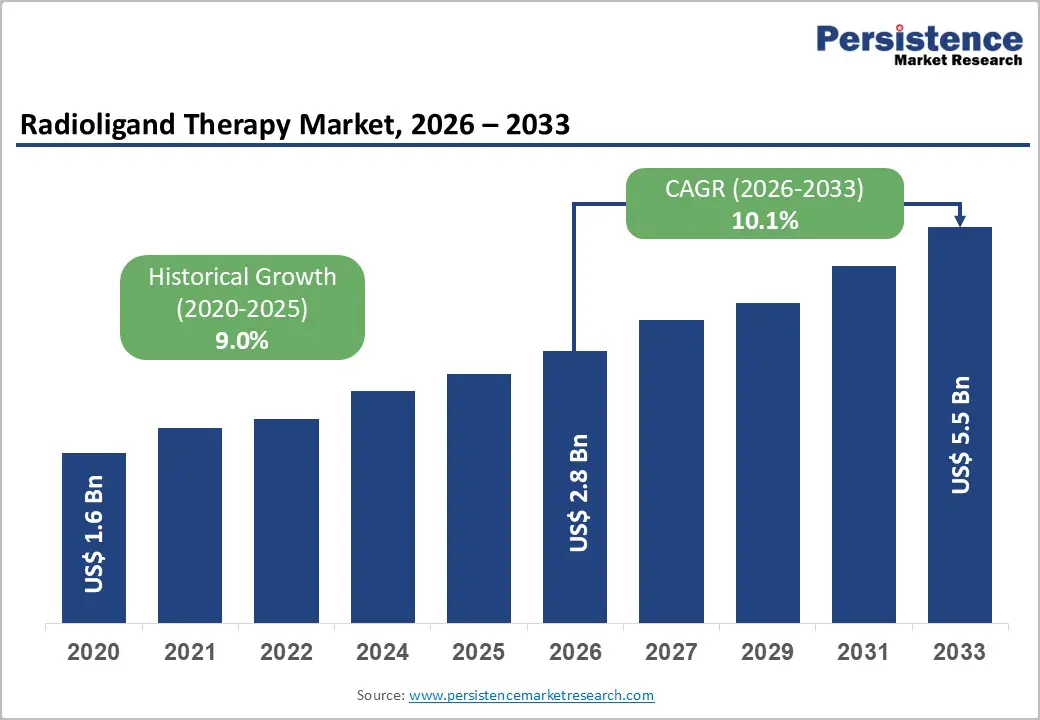
The global radioligand therapy market is estimated to grow from US$ 2.8 billion in 2026 to US$ 5.5 billion by 2033. The market is projected to record a CAGR of 10.1% during the forecast period from 2026 to 2033.
The global market is expanding due to the increasing prevalence of cancer, particularly prostate and neuroendocrine tumors, and the growing adoption of targeted radiopharmaceutical treatments. Advances in nuclear medicine and imaging technologies further support market growth. North America leads with strong clinical adoption, while the Asia Pacific is projected to be the fastest-growing region due to improving healthcare infrastructure and rising cancer diagnoses.
Key Industry Highlights:
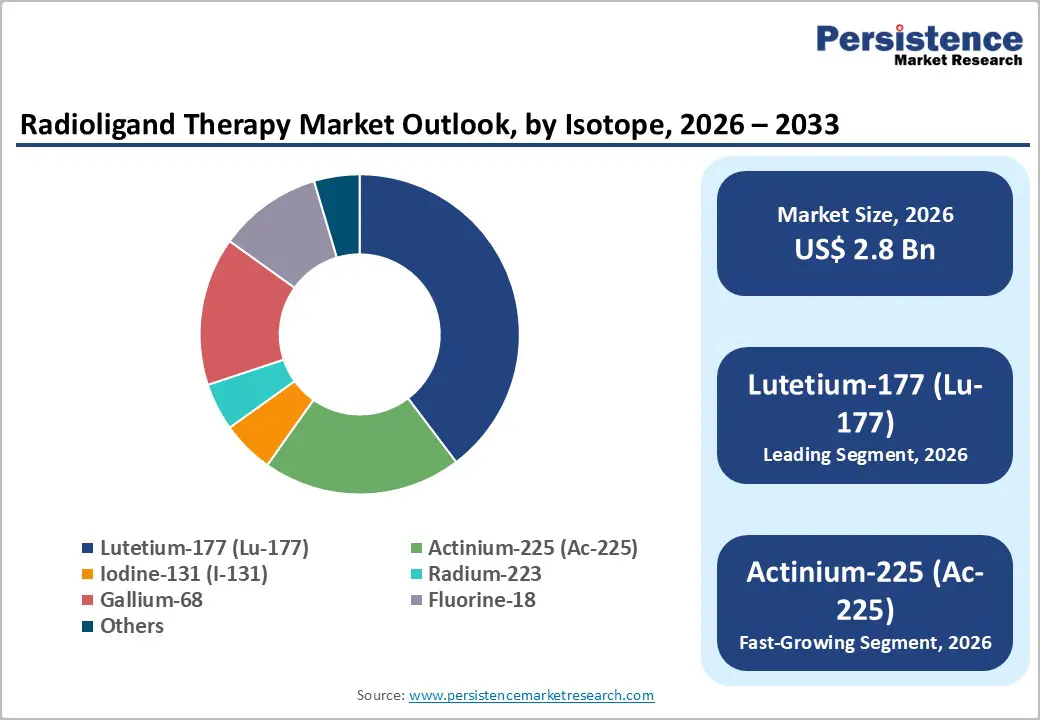
- Dominant Isotopes: Lutetium-177 (Lu-177) accounted for 39.7% share in 2025, driven by strong adoption of Lu-177-based radioligand therapies for prostate cancer and neuroendocrine tumors. Increasing clinical approvals, favorable therapeutic outcomes, and expanding use of targeted radiopharmaceuticals such as Lu-177 PSMA therapies have significantly supported segment growth.
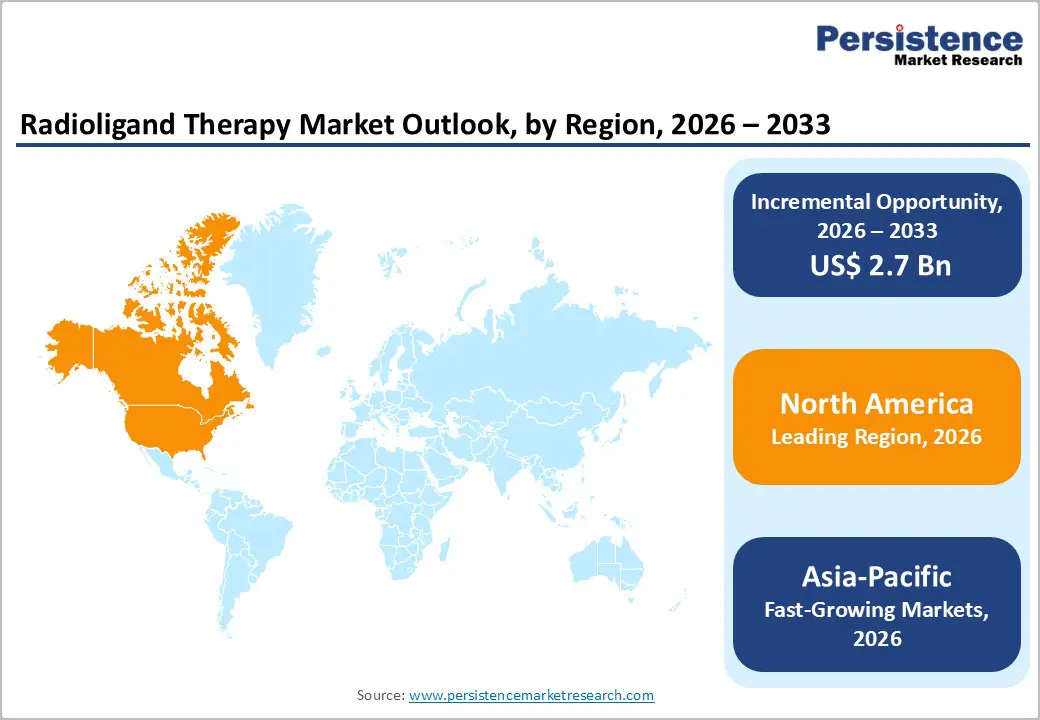
- Regional Leadership: North America is the leading region in the radioligand therapy market with 42.6% share in 2025, supported by strong nuclear medicine infrastructure, high cancer prevalence, early adoption of advanced radiopharmaceutical therapies, favorable reimbursement policies, and the presence of major pharmaceutical and radiopharmaceutical companies.
- Growth Indicators: Growth is driven by the increasing incidence of cancer, particularly prostate and neuroendocrine tumors, rising adoption of targeted radioligand therapies, advancements in nuclear medicine and radiopharmaceutical development, expanding clinical trials, and growing investments by pharmaceutical companies in precision oncology treatments.
- Opportunity: Opportunities include development of alpha-emitting radioligand therapies, expansion of isotope production infrastructure, increasing clinical trials for new cancer indications, integration of advanced imaging diagnostics for targeted treatment, and rising adoption of personalized oncology therapies in emerging healthcare markets.
| Key Insights | Details |
|---|---|
| Global Radioligand Therapy Market Size (2026E) | US$ 2.8 Bn |
| Market Value Forecast (2033F) | US$ 5.5 Bn |
| Projected Growth (CAGR 2026 to 2033) | 10.1% |
| Historical Market Growth (CAGR 2020 to 2025) | 9.0% |
Market Dynamics
Driver: Increasing adoption of targeted radiopharmaceutical therapies
The increasing adoption of targeted radiopharmaceutical therapies is a major driver for the Radioligand Therapy Market. Radioligand therapy works by attaching a radioactive isotope to a molecule that specifically binds to receptors expressed on cancer cells, enabling precise delivery of radiation while minimizing damage to surrounding healthy tissues. This precision approach is particularly important in cancers such as prostate cancer and neuroendocrine tumors. According to the International Agency for Research on Cancer (IARC), prostate cancer alone accounted for around 1.5 million new cases globally in 2022, and this number is projected to reach 1.8 million cases by 2030, creating a growing demand for advanced targeted treatments.
Targeted radiopharmaceuticals are also gaining attention because of their clinical effectiveness in late-stage cancers where conventional therapies may fail. For instance, prostate cancer is one of the most commonly diagnosed cancers among men, with the American Cancer Society estimating about 268,490 new cases and 34,500 deaths in the United States in 2022. These increasing cancer cases are encouraging the use of precision treatments such as radioligand therapy. In addition, radioligand therapies have demonstrated improved progression-free survival in clinical trials for neuroendocrine tumors and metastatic prostate cancer, which is further accelerating their adoption in oncology practice.
Restraint: Complex manufacturing and supply chain requirements
Despite strong clinical potential, the radioligand therapy market faces significant restraints due to complex manufacturing and supply chain requirements. Radioligand therapies depend on the production of short-lived radioactive isotopes such as Lutetium-177 and Actinium-225, which require specialized nuclear reactors or cyclotrons for production. These isotopes also have limited half-lives, meaning they must be manufactured, processed, and transported to hospitals within a very short time frame. Any delay in this process can render the isotope unusable, making logistics and distribution extremely challenging.
Another challenge is the limited global production capacity of certain therapeutic isotopes. For example, the global supply of Actinium-225 is extremely limited, with production facilities in a few locations such as Oak Ridge National Laboratory and other research centers producing only tens of gigabecquerels annually, sufficient for only a few thousand treatment doses worldwide. This restricted isotope availability limits large-scale commercialization and slows the expansion of radioligand therapy programs. In addition, healthcare facilities must have specialized nuclear medicine infrastructure, radiation safety systems, and trained personnel to safely handle these therapies, further complicating supply chain scalability.
Opportunity: Development of alpha-emitting radioligand therapies
The development of alpha-emitting radioligand therapies represents a significant opportunity for the Radioligand Therapy Market. Unlike traditional beta-emitting isotopes such as Lutetium-177, alpha emitters such as Actinium-225 deliver highly potent radiation over a very short range, causing severe DNA damage specifically in cancer cells while minimizing impact on surrounding healthy tissues. This mechanism increases treatment precision and has shown promising results in patients with advanced or treatment-resistant cancers, especially metastatic prostate cancer.
Clinical studies have demonstrated strong therapeutic outcomes for alpha-emitting therapies. For example, studies evaluating Actinium-225-PSMA-617 therapy reported that more than 80% of patients experienced a reduction in prostate-specific antigen (PSA) levels, while around 60% achieved more than a 50% reduction, indicating significant tumor response. Additionally, early trials reported that some patients achieved near-complete remission within 12 months. These promising clinical outcomes are encouraging pharmaceutical companies and research institutions to invest heavily in alpha-emitter development, which could expand radioligand therapy to multiple cancers including breast, pancreatic, and lung cancers in the future.
Category-wise Analysis
By Isotope Insights
Lutetium?177 (Lu?177) dominates the radioligand therapy market because it is the principal radioisotope in the majority of approved and commercially used therapies. Lu?177’s physical properties, beta emission with limited tissue penetration and a ~6.6?day half?life-allow effective tumor irradiation while sparing healthy tissue, enabling both therapeutic and imaging (“theranostic”) applications. In 2024, Lu?177 accounted for around 87.8% of the radioligand therapy market share, with top products like Pluvicto and Lutathera generating ~$2.1?billion in sales. Its established production methods and compatibility with automated synthesis make it practical for widespread clinical use. These factors, backed by regulatory approvals and extensive clinical adoption, keep Lu?177 as the leading radionuclide in RLT.
By Target Insights
Prostate?Specific Membrane Antigen (PSMA) dominates the target segment in radioligand therapy because it is highly overexpressed on prostate cancer cells compared to most normal tissues, providing precise targeting. PSMA?targeted therapy with Lu?177?labeled ligands, such as lutetium Lu?177?vipivotide tetraxetan (Pluvicto), has FDA approval for PSMA positive metastatic prostate cancer, demonstrating meaningful clinical benefit (e.g., improved progression-free survival in late?stage disease). PSMA expression levels are significantly elevated in malignant prostate cells, making it a reliable therapeutic target. This specificity has translated into strong clinical adoption in metastatic castration-resistant prostate cancer, where a large proportion of advanced patients express PSMA, justifying its leading role among RLT targets.
Regional Insights
North America Radioligand Therapy Market Trends
North America leads the global radioligand therapy market due to its advanced healthcare infrastructure, robust regulatory support, and high clinical adoption. In 2024, North America accounted for a dominant ~78.9% of the global radioligand therapy revenue; key products Pluvicto and Lutathera generated most of their sales in the U.S., with approximately 83% and 71% of global sales coming from the U.S. respectively. The region’s strong reimbursement systems and widespread availability of PET diagnostics make precision oncology more accessible. Further, intensive cancer research funding and supportive FDA regulatory pathways accelerate approval and market uptake of innovative radioligand therapies, particularly for prostate and neuroendocrine cancers, sustaining North America’s leadership position.
Europe Radioligand Therapy Market Trends
Europe represents a major radioligand therapy market due to its extensive nuclear medicine infrastructure and coordinated public healthcare systems. The region has seen increased adoption of radioligand therapies, supported by regulatory frameworks such as the European Medicines Agency that facilitate approvals across multiple countries. Clinical activity is significant, with Europe contributing a large portion of global PSMA PET and radioligand therapy procedures, and many centers performing over 100,000 PSMA PET scans annually, representing a substantial share of global volume. European cancer research collaborations and strong reimbursement coverage in countries like Germany, France, and the U.K. have further driven adoption across oncology indications, reinforcing Europe’s role as a key market for radioligand therapy.
Asia-Pacific Radioligand Therapy Market Trends
Asia Pacific is the fastest-growing radioligand therapy region due to rapidly rising cancer incidence and expanding healthcare infrastructure in large populations. Governments in China, Japan, India, and South Korea are investing heavily in nuclear medicine facilities and advanced oncology care, increasing the accessibility of diagnostic and therapeutic radioligand services. The region’s nuclear medicine capacity has grown with tens of thousands of PSMA PET scans performed annually, and approvals for theranostic agents increasing uptake. These investments, coupled with rising healthcare spending and growing clinical trial involvement, support a higher compound annual growth rate than Western markets, positioning Asia Pacific as the fastest?expanding region globally.
Competitive Landscape
The radioligand therapy market is competitive, led by Novartis, Bayer, Endocyte, and ITM. Companies focus on Lu-177 therapies, PSMA targeting, and theranostics, expanding clinical trials, enhancing isotope production, and forming hospital collaborations. Strategic partnerships, regulatory approvals, and global distribution efforts drive adoption, improve patient access, and strengthen market presence, accelerating growth in oncology-focused radioligand therapies.
Key Industry Developments:
- In February 2026, Novartis completed construction of a new radioligand therapy facility in Denton, Texas, aimed at delivering next?generation treatments to patients. The site enhances the company’s production capacity for Lu?177?based therapies, supporting both clinical demand and global distribution. This expansion reflects Novartis’ commitment to advancing precision oncology, improving patient access, and accelerating the availability of innovative radioligand therapies across multiple cancer indications.
- In February 2026, Bayer announced that combining Xofigo with Xtandi extended overall survival in patients with metastatic castration?resistant prostate cancer (mCRPC) who had bone metastases. Clinical trial results showed a significant improvement in patient outcomes compared to standard therapy alone. This combination therapy highlighted Bayer’s focus on innovative radiopharmaceutical strategies, reinforcing its role in advanced prostate cancer management.
Companies Covered in Radioligand Therapy Market
- Novartis
- Bayer
- Curium
- Eli Lilly
- AstraZeneca
- Ariceum Therapeutics
- Telix Pharmaceuticals
- ITM Isotope Technologies Munich SE
- Convergent Radiopharma
- Actinium Pharmaceuticals
- Perspective Therapeutics
- Clarity Pharmaceuticals
- Others
Frequently Asked Questions
The global radioligand therapy market is projected to be valued at US$ 2.8 Bn in 2026.
Rising cancer incidence, advanced nuclear medicine infrastructure, FDA approvals, theranostic adoption, and increasing patient awareness drive growth.
The global radioligand therapy market is poised to witness a CAGR of 10.1% between 2026 and 2033.
Expanding PSMA and neuroendocrine therapy applications, emerging Asia Pacific markets, and novel isotope development offer growth opportunities.
Novartis, Bayer, Curium, Eli Lilly, AstraZeneca, Ariceum Therapeutics.


