




- Nutraceuticals & Functional Foods
- Protease Market
Protease Market Size, Share, Trends and Growth Forecast 2026 - 2033
Protease Market by Source (Microbial, Plant-Based, Animal-Derived), by Catalytic Type (Serine Proteases, Aspartic Proteases, Cysteine Proteases, Metalloproteases, Threonine Proteases), by Industry, by Regional Analysis, 2026 - 2033

Protease Market Share and Trends Analysis
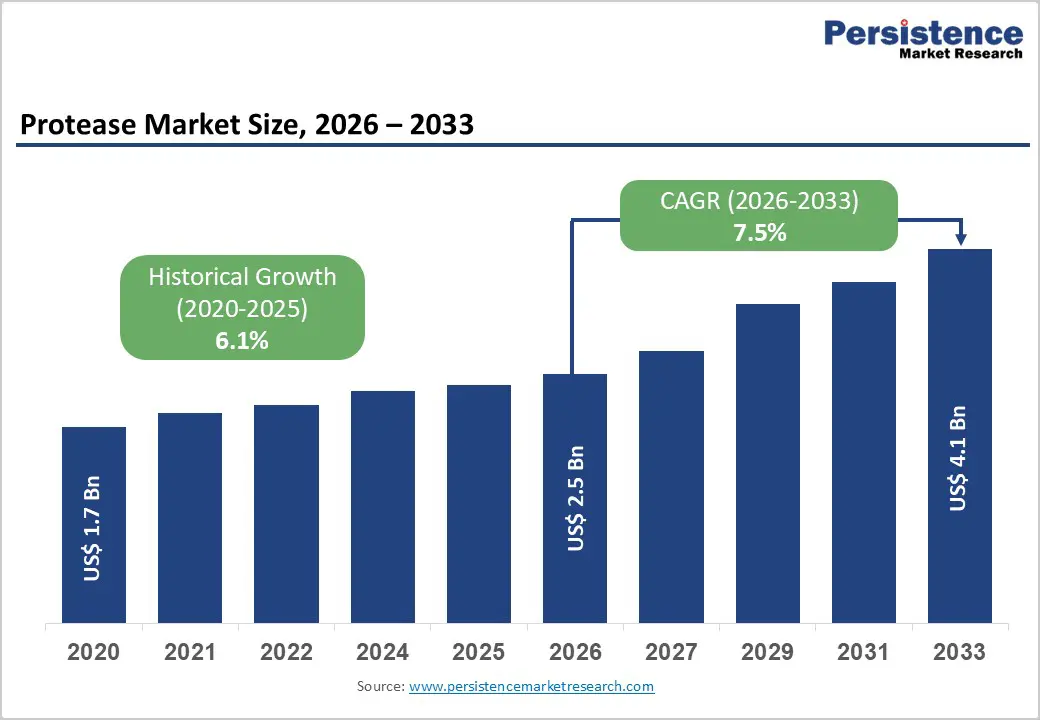
The global protease market size is expected to be valued at US$ 2.5 billion in 2026 and projected to reach US$ 4.1 billion by 2033, growing at a CAGR of 7.5% between 2026 and 2033.
Rising adoption of proteases across food processing, detergents, pharmaceuticals, and animal nutrition is the primary driver of this expansion, as enzymes are replacing harsher chemical catalysts in many industrial processes. Strong preference for eco-efficient and energy-saving manufacturing, combined with rapid innovation in microbial and recombinant protease production, is further accelerating commercialization. Historically, proteases have constituted around 60-70% of industrial enzyme consumption, underlining their central role in the broader industrial enzymes value chain and supporting sustained growth from 2020 - 2025.
Key Industry Highlights:
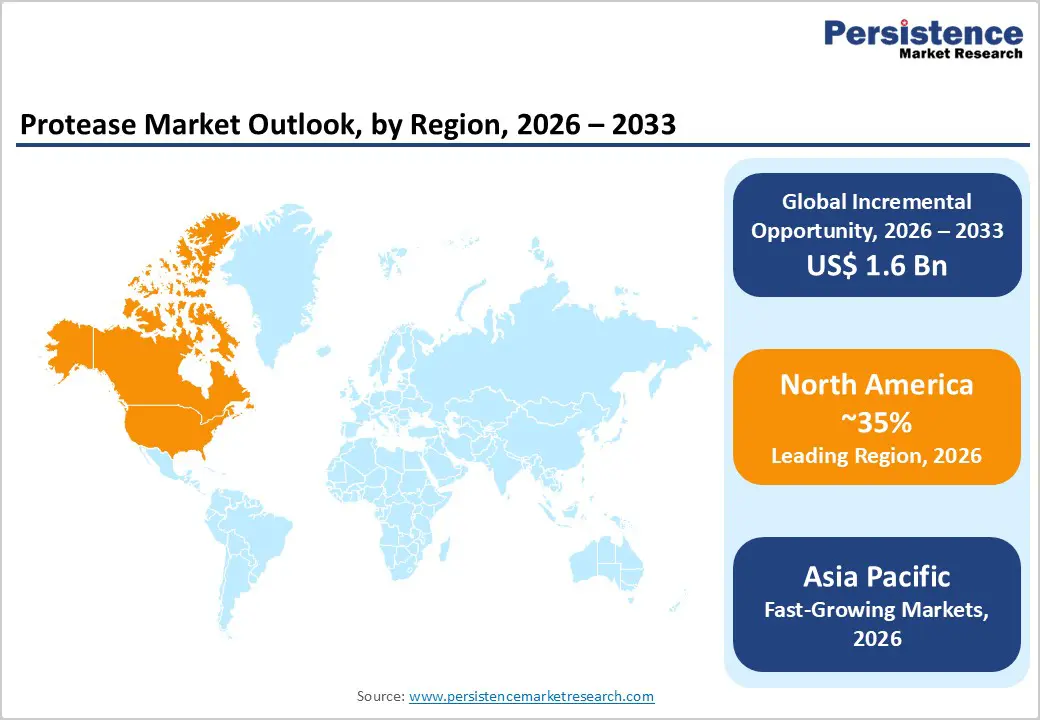
- North America is expected to remain the leading regional market for proteases through 2033, supported by strong biotechnology capabilities, high-value food and pharma applications, and robust regulatory frameworks that favor sustainable enzyme-based processes.
- The Asia Pacific region is projected to record the fastest growth in protease consumption between 2026 and 2033, driven by expanding detergent, food-processing, and animal-feed sectors in China, India, Japan, and ASEAN economies.
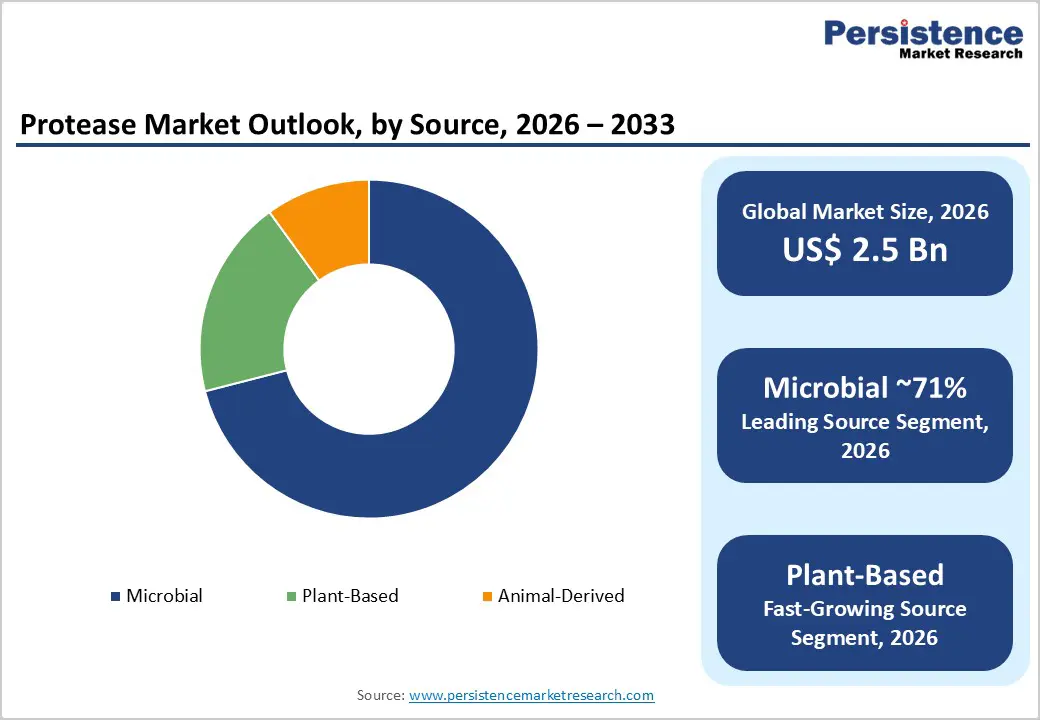
- Microbial proteases dominate the global market with an estimated 71% share in 2025, reflecting their superior productivity, stability, and suitability for large-scale industrial applications compared with plant- or animal-derived enzymes.
- Among catalytic classes, serine proteases are anticipated to maintain the largest share owing to their proven performance in alkaline detergents and diverse roles in food, leather, and textile processing, while specialty metalloproteases and threonine proteases address focused high-value niches.
- A key opportunity for market participants lies in developing plant-based and engineered microbial proteases that meet clean-label, sustainability, and performance expectations, particularly in vegan foods, next-generation detergents, biomedical applications, and environmentally focused industrial processes.
| Key Insights | Details |
|---|---|
| Protease Market Size (2026E) | US$ 2.5 billion |
| Market Value Forecast (2033F) | US$ 4.1 billion |
| Projected Growth CAGR (2026 - 2033) | 7.5% |
| Historical Market Growth (2020 - 2025) | 6.1% |
Market Dynamics
Drivers - Growing penetration of proteases in detergents and cleaning products
One of the strongest demand drivers for the protease market is the deepening integration of proteases into household and industrial detergents. Enzymes account for roughly 25% of global detergent formulations by value, with proteases the dominant class due to their effectiveness against proteinaceous stains such as blood, milk, and food residues. Academic reviews estimate that proteases represent up to 60% of total enzyme sales, largely due to their extensive use in laundry and dishwashing detergents, institutional cleaning products, and contact-lens cleaners. These enzymes enable effective washing at lower temperatures, cutting energy consumption and aligning with sustainability targets set by regulators and detergent brands. As new EU detergent regulations promote stricter biodegradability and support microbial cleaning products, protease-containing formulations are expected to gain further share in premium and eco-labelled product lines.
Expanding application base in foods, beverages, and nutrition
A second major growth driver is the rapid expansion of protease applications in the food, beverage, and nutrition sectors. Scientific literature highlights that proteases are widely used to improve protein digestibility, solubility, foaming, and flavor in dairy, meat, bakery, and plant-protein products, enabling the development of higher-protein and better-textured foods. Reviews of microbial proteases show that controlled hydrolysis can reduce allergenicity of food proteins and create bioactive peptides with health benefits, which is increasingly relevant as global protein consumption and demand for functional foods rise. In parallel, proteases play critical roles in brewing for haze removal and in cheese manufacture for curd formation and ripening, supporting large-volume, recurring consumption by the food industry. These advantages, coupled with consumer interest in digestive wellness and clean-label processing aids, are reinforcing steady demand growth from the foods and beverages segment.
Restraints- Production cost, process complexity, and price sensitivity in downstream industries
Despite attractive growth prospects, protease manufacturers face cost and process-related restraints that can hinder penetration in highly price-sensitive applications. Industrial production of microbial proteases typically relies on submerged or solid-state fermentation, followed by downstream concentration and purification steps that must balance purity, yield, and stability. Energy-intensive aeration, sterilization, and drying operations increase operating costs, while stringent quality requirements for pharmaceutical- and food-grade enzymes add analytical and regulatory expenses. For buyers in commoditized detergent or animal-feed segments, even modest enzyme price premiums can limit switching from traditional chemicals or lower-grade enzymes, especially in regions where utility costs and logistics remain volatile. As a result, achieving cost-effective scale and robust supply chains is a key challenge for smaller or regional protease producers.
Regulatory, safety, and allergenicity concerns around enzyme use
Another restraint stems from the evolving regulatory landscape and safety considerations for enzyme-containing products. In Europe, all food enzymes, including proteases, must undergo safety evaluation by EFSA and be approved by the European Commission under Regulation EC No 1332/2008, adding time and cost to market entry. Enzymes are also classified as potential respiratory sensitizers, prompting the European Chemicals Agency (ECHA) and associations such as AMFEP to emphasize strict exposure controls and worker-protection measures in manufacturing and handling. While decades of monitoring show a strong safety record for properly formulated enzymes, any cases of occupational sensitization or mislabelled products can trigger recalls or stricter oversight. These regulatory hurdles may slow the introduction of novel protease types or delay expansions into new application areas, particularly for smaller companies lacking specialized regulatory capabilities.
Opportunities- High-growth potential for plant-based and clean-label proteases
One of the most compelling opportunities in the protease market lies in plant-based proteases derived from sources such as papaya (papain), pineapple (bromelain), and fig (ficin). These enzymes are inherently aligned with vegan, halal, and kosher dietary preferences and are widely recognized by consumers as natural processing aids. As food and beverage brands reformulate toward clean-label and minimally processed products, demand for plant-based hydrolysates, meat tenderizers, and digestive supplements is expanding rapidly. Scientific studies document the effectiveness of papain and bromelain in meat tenderization, debittering of protein hydrolysates, and production of hypoallergenic infant formulas, underscoring their versatility. With plant-based foods and meat analogues recording double-digit growth in many markets, suppliers that can provide standardized, high-purity plant proteases with clear labelling and validated allergen profiles are well positioned to capture premium pricing and long-term contracts.
Engineered microbial proteases for specialized industrial and biomedical uses
A second major opportunity is the development of engineered microbial proteases with tailored catalytic properties for specialized industrial, environmental, and biomedical applications. Recent reviews underline how advances in strain engineering, directed evolution, and enzyme immobilization are yielding proteases that retain high activity over broad pH (7-12) and temperature (30-75°C) ranges, with improved solvent and surfactant tolerance. Such characteristics are crucial for next-generation detergents, leather processing, and waste-management solutions that must operate under harsh conditions while meeting stricter environmental standards. In biomedicine, proteases are also being explored for wound debridement, anti-inflammatory therapies, and targeted drug delivery, where controlled proteolysis can unlock new treatment pathways. Companies capable of integrating bioprocess optimization with application-specific enzyme design can therefore access high-value niches beyond commodity detergents and foods, supporting margin expansion and differentiated portfolios.
Category-wise Analysis
Source Insights
Microbial proteases are the undisputed leaders in the protease market, accounting for approximately 71% share in 2025. Academic and industry literature consistently notes that microbial sources are preferred over plant or animal sources because they yield higher enzyme titers in shorter fermentation cycles, allow production in compact bioreactors, and facilitate straightforward genetic improvement. Bacterial and fungal strains such as Bacillus and Aspergillus can be cultivated at an industrial scale, secrete extracellular proteases directly into the medium, and deliver long shelf-life products with high stability in alkaline and elevated-temperature environments, attributes essential for detergents, leather, and some food processes. In contrast, plant- and animal-derived proteases often face seasonal supply constraints, lower yields, and greater variability in activity. As sustainability concerns intensify, microbial fermentation using renewable feedstocks further strengthens the strategic position of microbial proteases across global markets.
Industry Insights
Across industries, soap & detergents represent one of the most influential demand centers for proteases, and are commonly assessed as holding a leading share of the industrial consumption mix. Reviews of enzyme applications estimate that detergent formulations alone account for roughly 25% of total global enzyme sales, with proteases acting as the primary class used for stain removal in both domestic and institutional laundry. The ability of proteases to hydrolyze dried blood, milk, egg, and grass stains at moderate temperatures supports the shift toward cold- and low-temperature washing, an important lever for reducing household energy use and associated emissions. Detergent manufacturers are also introducing multi-enzyme blends that combine proteases with lipases and amylases to deliver broad-spectrum cleaning while reducing the load of builders and bleach, advancing compliance with tightening environmental regulations and retailer eco-label schemes. These dynamics ensure that detergents remain a cornerstone end-use segment for protease suppliers, even as pharmaceuticals, foods, and animal feed contribute to increasing incremental growth.
Regional Insights
North America Protease Market Trends and Insights
North America is the leading regional market for proteases, accounting for about 35% of global revenues in 2025, underpinned by the strong biotechnology ecosystem of the United States and Canada. Broader enzyme-industry analyses highlight that North America holds the largest share of the global enzymes market, thanks to advanced R&D capabilities, high adoption of enzyme-enabled processing in food, detergents, and biofuels, and the presence of major multinational producers. In the U.S., robust biopharmaceutical pipelines, an extensive processed-food sector, and stringent environmental expectations from regulators such as the U.S. Environmental Protection Agency (EPA) and the Food and Drug Administration (FDA) promote continuous innovation in safer, more efficient protease formulations for both industrial and medical applications.
In addition, North America benefits from a mature regulatory and intellectual-property framework that encourages long-term investments in strain engineering, enzyme immobilization, and digitalization of bioprocess control. Collaborations between universities, public research agencies, and companies such as Novonesis, IFF, BASF, and Kerry Group support the development of high-performance detergent and food enzymes tailored to local sustainability priorities. Growing consumer demand for high-protein foods, eco-friendly detergents, and enzymatic textile and leather processing solutions further sustains regional growth momentum, ensuring that North America remains a benchmark market for innovation and performance in protease technologies.
Asia Pacific Protease Market Trends and Insights
The Asia Pacific region is the fastest-growing geography for the protease market, supported by rapid industrialization, expanding food and detergent sectors, and competitive manufacturing costs in countries such as China, India, Japan, and members of the ASEAN bloc. Analyses of the broader industrial enzymes space show that Asia Pacific is expected to record the highest growth rates globally, driven by rising consumption of processed foods and beverages, increasing urbanization, and growing environmental awareness. In China and India, proteases are extensively deployed in detergent powders and liquids, as well as in leather, textiles, and flour improvement, reflecting their importance in everyday consumer products.
Simultaneously, the region is becoming a major hub for contract manufacturing and export of microbial proteases, leveraging cost-effective feedstocks, improving infrastructure, and expanding technical expertise in fermentation and downstream processing. Government policies in several Asia Pacific economies promote bio-based manufacturing and greener industrial processes, supporting wider substitution of chemical catalysts with enzyme-based solutions in textiles, pulp & paper, and biofuels. As local players scale up and global producers invest in regional production and application labs, Asia Pacific is likely to maintain a superior growth trajectory through 2033, particularly in detergents, animal feed, and food-processing applications.
Competitive Landscape
The protease market is characterized by strong competition driven by increasing demand across food processing, detergents, pharmaceuticals, and animal feed industries. Market participants focus on expanding enzyme portfolios, improving enzyme stability, and enhancing efficiency for industrial applications. Companies are investing in advanced fermentation technologies and biotechnology-based production methods to improve yield and reduce manufacturing costs. Strategic collaborations, product innovations, and geographic expansion are common approaches used to strengthen market presence. Additionally, growing emphasis on sustainable and bio-based solutions has encouraged manufacturers to develop environmentally friendly enzyme formulations, further intensifying competition while supporting innovation and technological advancement across the global protease market.
Key Developments:
- In January 2024, Novozymes and Chr. Hansen completed their merger to establish Novonesis, forming a global biosolutions company. The merger strengthened the company’s enzyme portfolio, including protease solutions used in detergents, food processing, and animal feed applications.
- In January 2023, Selecta Biosciences and Astellas Pharma announced an exclusive licensing and development agreement for IdeXork (Xork). Under this collaboration, the companies agreed to jointly advance the development of the therapy, combining Selecta’s expertise in immune tolerance technology with Astellas’ capabilities in gene therapy development.
Companies Covered in Protease Market
- Novonesis
- IFF (Danisco/Genencor)
- DSM-Firmenich
- Enzyme Development Corporation
- Biocatalysts Ltd
- Specialty Enzymes and Biotechnologies
- BASF
- AB Enzymes
- Amano Enzyme
- Advanced Enzyme Technologies
- Kerry Group
- Sunson Industry Group
- Aum Enzymes
- Dyadic International
- Others
Frequently Asked Questions
The Protease Market is expected to reach around US$ 2.5 billion in 2026.
Key demand drivers include growing use of proteases in detergents, where they enable effective low-temperature washing, and in foods & beverages, where they improve protein functionality, digestibility, and texture in dairy, meat, bakery, and plant-based products.
North America currently leads the global Protease Market, supported by advanced biotechnology infrastructure, strong participation from major enzyme producers, and high adoption of enzyme-based solutions across food, detergents, pharmaceuticals, and biofuels.
A major growth opportunity lies in developing plant-based and engineered microbial proteases that address clean-label, sustainability, and performance requirements in vegan foods, advanced detergents, biomedical products, and environmentally friendly industrial processes.
Prominent companies include Novonesis, IFF (Danisco/Genencor), DSM-Firmenich, BASF, AB Enzymes, Amano Enzyme, Advanced Enzyme Technologies, Kerry Group, and several specialized regional producers, all competing through innovation, application support, and global reach.


