




- Aerospace & Defense
- Predictive Airplane Maintenance Market
Predictive Airplane Maintenance Market Size, Share, and Growth Forecast, 2026 – 2033
Predictive Airplane Maintenance Market by Aircraft Type (Commercial Aircraft, Others), Maintenance Type (Airframe Maintenance, Others), Technology (Condition-Based Maintenance (CBM), Others), and Regional Analysis for 2026 – 2033

Predictive Airplane Maintenance Market Size and Trends Analysis
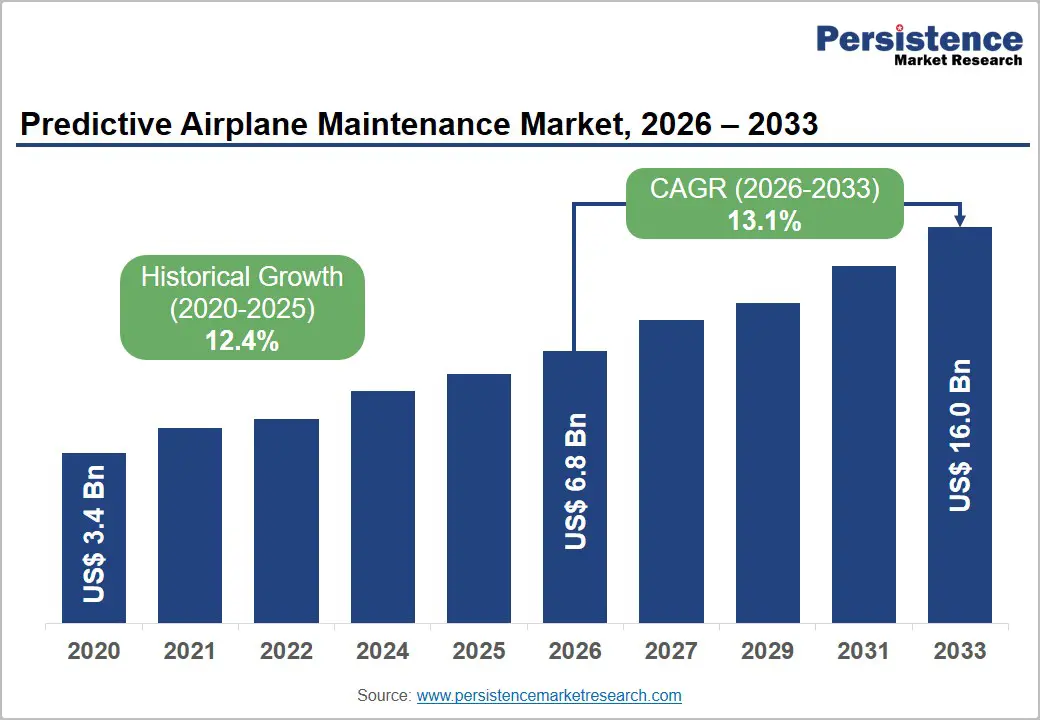
The global predictive airplane maintenance market size is likely to be valued at US$6.8 billion in 2026 and is expected to reach US$16.0 billion by 2033, growing at a CAGR of 13.1% during the forecast period from 2026 to 2033, driven by the increasing adoption of artificial intelligence (AI), Internet of Things (IoT), machine learning, and digital twin technologies by airlines, aircraft manufacturers, and maintenance, repair, and overhaul (MRO) providers to improve aircraft reliability, optimize maintenance scheduling, and minimize unplanned downtime.
The expanding global commercial aircraft fleet, higher aircraft utilization, and stringent aviation safety regulations are driving market growth. According to the International Air Transport Association (IATA), the global commercial fleet comprised approximately 35,550 aircraft as of June 2025, while the International Civil Aviation Organization (ICAO) reported over 37 million scheduled commercial departures in 2024, highlighting the growing need for predictive maintenance solutions to improve operational efficiency and flight safety.
Key Industry Highlights:
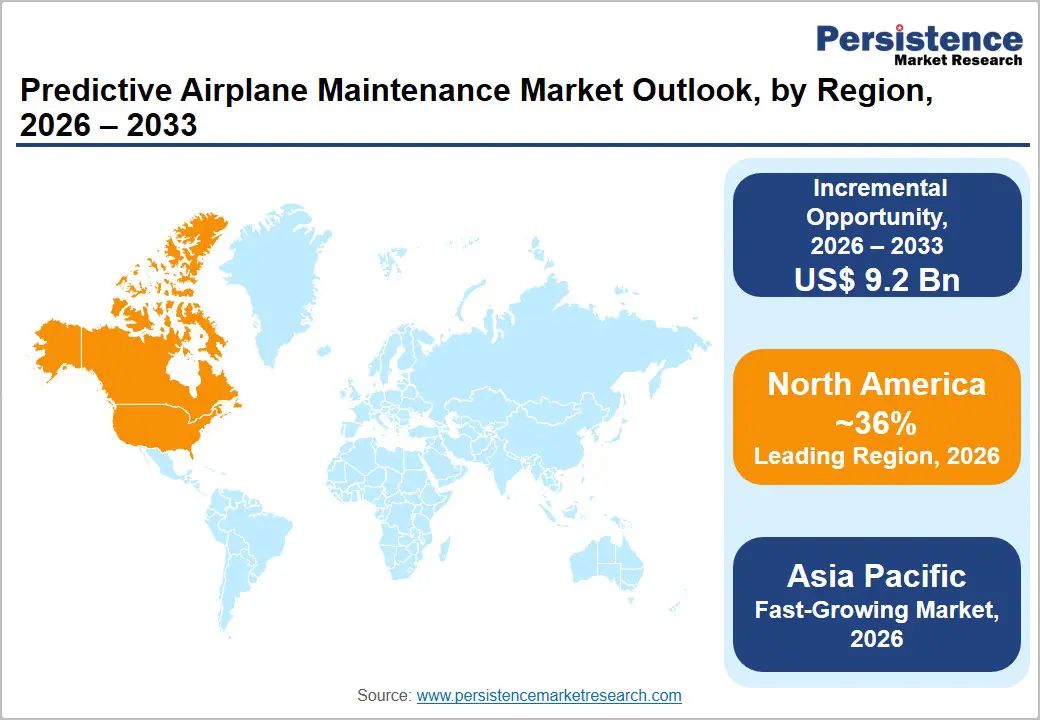
- Leading Region: North America is anticipated to be the leading region, accounting for a market share of 36% in 2026, driven by widespread adoption of AI-enabled maintenance solutions, a strong aviation ecosystem, and advanced MRO infrastructure.
- Fastest-growing Region: Asia Pacific is likely to be the fastest-growing region, supported by rapid fleet expansion, increasing air passenger traffic, and growing investments in digital aviation maintenance technologies.
- Leading Aircraft Type: The commercial aircraft segment is projected to dominate the market in 2026, accounting for approximately 68% of the revenue share, driven by the large size of commercial fleets and high aircraft utilization rates.
- Leading Maintenance Type: Airframe maintenance is anticipated to be the leading maintenance type, accounting for over 38% of the revenue share in 2026, owing to stringent inspection requirements and extensive structural maintenance.
- Key Opportunity: The growing digital transformation of the aviation industry through AI, IoT, digital twins, and predictive analytics presents significant opportunities to enhance fleet reliability, optimize maintenance operations, and reduce lifecycle costs across commercial and military aviation.
DRO Analysis
Driver - Rising Air Traffic, Fleet Expansion, and Operational Efficiency Demands
Airlines are operating larger fleets with higher aircraft utilization, increasing the need for efficient maintenance strategies that minimize disruptions and maximize availability. Traditional scheduled maintenance often results in unnecessary inspections or unexpected failures, making predictive approaches more attractive.
By using connected sensors, artificial intelligence, and aircraft health monitoring systems, operators can identify component degradation before failures occur. This enables airlines to improve maintenance planning, reduce aircraft-on-ground events, optimize maintenance resources, and ensure greater operational reliability while meeting growing passenger expectations and regulatory safety requirements.
Operational efficiency has become a strategic priority for airlines, aircraft manufacturers, and maintenance providers seeking to improve profitability while maintaining high safety standards. Predictive maintenance supports this objective by enabling condition-based servicing, reducing unnecessary part replacements, and improving maintenance scheduling accuracy. Advanced analytics continuously monitor engines, airframes, and critical systems to provide actionable maintenance insights.
Restraint - Data Quality, Integration, and Legacy System Challenges
Despite significant technological advancements, predictive airplane maintenance faces challenges related to data quality, interoperability, and legacy aircraft systems. Modern predictive models require accurate, continuous, and standardized operational data collected from multiple onboard systems. However, inconsistent sensor performance, incomplete historical maintenance records, and fragmented data sources can reduce prediction accuracy.
Integration challenges also extend across airline operations, maintenance software, enterprise resource planning platforms, and OEM digital ecosystems. Different data formats, proprietary software, and cybersecurity requirements complicate seamless information sharing among stakeholders. Airlines must invest in data governance, cloud infrastructure, and workforce training to fully benefit from predictive maintenance capabilities.
Opportunity - Technological Convergence and New Business Models
Rapid convergence of artificial intelligence, machine learning, Internet of Things, digital twins, cloud computing, and advanced analytics is creating significant growth opportunities for the predictive airplane maintenance market. These technologies enable continuous aircraft health monitoring, real-time diagnostics, and highly accurate failure prediction across critical aircraft systems.
Airlines and maintenance organizations can leverage integrated digital platforms to improve maintenance planning, optimize resource allocation, and extend component service life. Digital twins enhance maintenance decision-making by simulating aircraft performance under various operating conditions.
The market is also witnessing new business models centered on subscription-based predictive maintenance services, performance-based contracts, and connected aftermarket solutions. Aircraft manufacturers, engine suppliers, and MRO providers increasingly offer integrated digital services that combine monitoring, analytics, and maintenance support under long-term agreements. These models help airlines reduce capital investment while gaining access to advanced predictive capabilities and continuous software updates.
Category-wise Analysis
Aircraft Type Insights
The commercial aircraft segment is expected to lead, accounting for 68% of revenue in 2026, due to its extensive fleet, high daily flight frequency, and stringent maintenance requirements. Commercial airlines rely heavily on predictive maintenance to improve fleet reliability, reduce unexpected technical failures, and optimize aircraft availability. For example, Boeing's Airplane Health Management (AHM) platform enables commercial airlines to monitor aircraft systems in real time, supporting predictive maintenance and improving fleet reliability.
Private aircraft is likely to represent the fastest-growing segment, supported by increasing business aviation activity, rising ownership of corporate jets, and growing demand for premium aircraft reliability. For instance, CAMP Systems provides predictive maintenance and aircraft health monitoring solutions widely used by business jet operators to optimize maintenance planning and improve aircraft availability.
Maintenance Type Insights
Airframe maintenance is projected to lead the market, capturing around 38% of the revenue share in 2026, supported by stringent regulatory inspection requirements and the structural complexity of modern aircraft. Predictive maintenance technologies improve inspection accuracy while reducing unnecessary maintenance activities and minimizing aircraft downtime. A notable example includes Airbus, which uses its Skywise digital platform to support predictive structural maintenance and improve airframe health monitoring for airline operators.
Engine maintenance is likely to be the fastest-growing maintenance type due to the vast amount of operational data generated by aircraft engines that can be analyzed to predict component degradation and optimize maintenance schedules. Airlines increasingly rely on artificial intelligence, digital twins, and advanced analytics to improve engine health management and extend service intervals. For instance, GE Aerospace's Predix-based engine monitoring solutions provide predictive analytics that help airlines improve engine performance, reduce downtime, and optimize maintenance planning.
Technology Insights
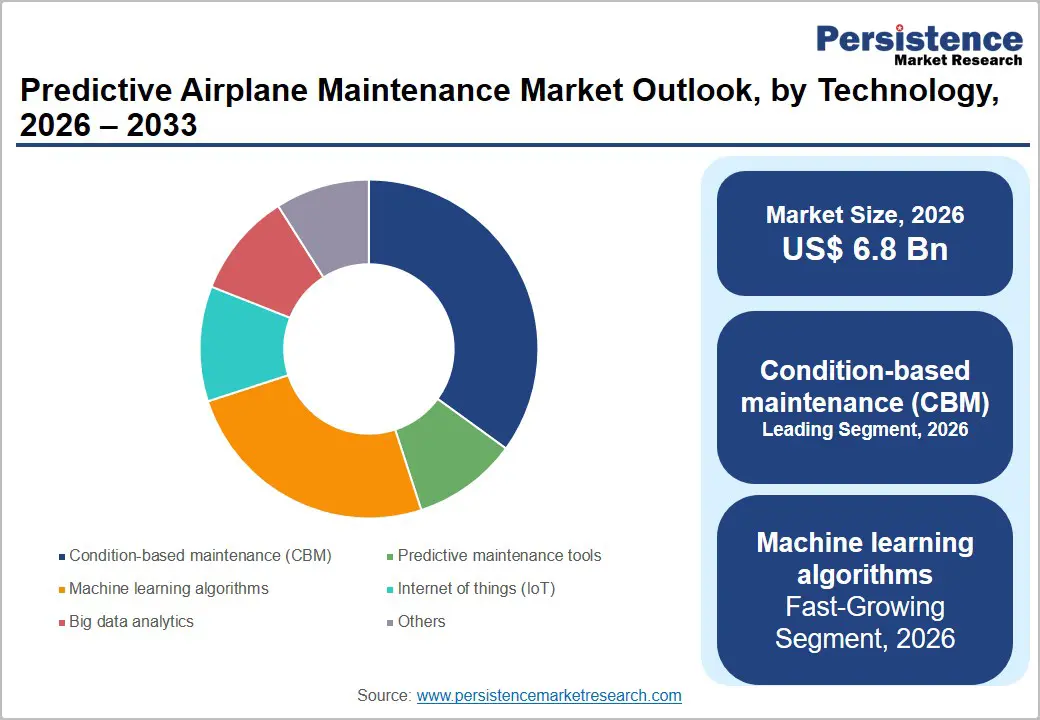
Condition-based maintenance (CBM) is expected to lead, accounting for 34% of revenue in 2026, due to its widespread implementation across modern aviation maintenance programs. CBM continuously evaluates the actual condition of aircraft systems using sensors, diagnostics, and performance monitoring instead of relying solely on fixed maintenance schedules. For example, Lufthansa Technik's AVIATAR platform supports condition-based maintenance by continuously monitoring aircraft health and providing predictive maintenance recommendations to airline operators.
Machine learning algorithms are expected to be the fastest-growing segment, driven by the increasing adoption of artificial intelligence to analyze large volumes of aircraft operational data and predict maintenance requirements with greater accuracy. These capabilities enable maintenance teams to identify potential failure patterns, prioritize inspections, and optimize maintenance schedules before operational disruptions occur. For example, IBM Maximo Application Suite leverages machine learning to analyze aircraft asset data and support predictive maintenance across aviation operations.
Regional Insights
North America Predictive Airplane Maintenance Market Trends
North America is anticipated to be the leading region, accounting for a market share of 36% in 2026, supported by the presence of major aircraft manufacturers, advanced MRO providers, and widespread adoption of digital aviation technologies. For instance, Honeywell Aerospace's Forge platform enables airlines to monitor aircraft health in real time and optimize predictive maintenance planning across connected fleets.
U.S. Predictive Airplane Maintenance Market Trends
The U.S. is expected to dominate the regional market, accounting for approximately 80% of the market share in 2026, driven by its large commercial aviation sector, advanced digital infrastructure, and extensive MRO network. Airlines continue investing in AI-driven predictive maintenance to improve aircraft availability and reduce operational disruptions. The presence of leading OEMs, engine manufacturers, and aviation software providers accelerates technological innovation across the maintenance ecosystem. The FAA continues to support digital transformation through data-driven maintenance practices and aircraft health monitoring initiatives.
Canada Predictive Airplane Maintenance Market Trends
Canada is expected to be a significant market for predictive airplane maintenance, accounting for approximately 20% of the regional market share in 2026. Growth is driven by increasing investments from airlines and MRO providers in connected aircraft technologies, predictive analytics, and condition-based maintenance to improve fleet reliability and operational efficiency. The country's strong aerospace manufacturing base and government initiatives supporting advanced manufacturing and digital innovation are further accelerating the adoption of intelligent aircraft maintenance solutions.
Europe Predictive Airplane Maintenance Market Trends
Europe is expected to be a significant market for predictive airplane maintenance, driven by the accelerating digital transformation of aviation operations among airlines, aircraft manufacturers, and MRO providers. Increasing adoption of artificial intelligence, machine learning, digital twins, cloud computing, and real-time aircraft health monitoring is enabling operators to optimize maintenance planning, reduce unplanned failures, and lower operational costs. For example, Lufthansa Technik continues to expand its AVIATAR digital platform, offering predictive maintenance, aircraft health monitoring, and advanced analytics to help airlines improve fleet performance and operational efficiency.
U.K. Predictive Airplane Maintenance Market Trends
The U.K. is likely to be a significant market for predictive airplane maintenance, accounting for 15% of Europe market share in 2026, supported by growing investments in digital aviation technologies and advanced aerospace innovation. Airlines and maintenance organizations increasingly adopt AI-driven diagnostics, cloud-based maintenance management, and connected aircraft monitoring systems to improve operational performance. The country's well-established aerospace industry supports continuous research into predictive maintenance applications for commercial aviation.
Germany Predictive Airplane Maintenance Market Trends
Germany is anticipated to dominate the regional market, accounting for around 37% of the Europe market share in 2026, due to its strong aerospace manufacturing capabilities and leadership in industrial digitalization. Aircraft manufacturers, technology companies, and maintenance providers actively invest in AI-powered maintenance solutions that improve fleet reliability and maintenance efficiency. Digital twin technology, industrial IoT, and predictive analytics are increasingly integrated into aircraft lifecycle management programs.
Asia Pacific Predictive Airplane Maintenance Market Trends
The Asia Pacific region is likely to be the fastest-growing region, driven by rapidly expanding fleets to meet increasing passenger demand and international connectivity. Aviation companies across the region are investing heavily in artificial intelligence, IoT-enabled aircraft monitoring, cloud computing, machine learning, and predictive analytics to improve maintenance efficiency and reduce operational disruptions. A notable example includes SIA Engineering Company, which has expanded digital maintenance capabilities by integrating predictive analytics and aircraft health monitoring technologies to enhance maintenance efficiency.
China Predictive Airplane Maintenance Market Trends
China is projected to dominate the regional market, holding around a 30% share of the market in 2026, due to the expansion of its commercial aviation sector and increasing investments in indigenous aerospace capabilities. Airlines are adopting intelligent maintenance systems that utilize artificial intelligence, IoT sensors, and real-time aircraft monitoring to improve fleet performance and reduce maintenance costs. The country's expanding MRO industry supports wider implementation of predictive maintenance technologies across commercial fleets.
India Predictive Airplane Maintenance Market Trends
India is expected to emerge as a significant market, accounting for approximately a 22% share in 2026, due to rapid airline fleet expansion, increasing domestic air travel, and growing investments in aviation infrastructure. Airlines are modernizing maintenance operations by implementing digital aircraft health monitoring, AI-powered analytics, and predictive maintenance software that improve fleet availability and operational efficiency. Expansion of domestic MRO facilities and government initiatives promoting aircraft maintenance within the country continue to support technology adoption.
Competitive Landscape
The global predictive airplane maintenance market exhibits a moderately fragmented structure, driven by the presence of established aircraft manufacturers, engine OEMs, aviation software providers, maintenance, repair, and overhaul (MRO) organizations, and specialized predictive analytics companies. Growing demand for AI-enabled maintenance, digital twins, IoT-based aircraft health monitoring, and cloud-connected maintenance platforms is intensifying competition across the industry.
With key leaders, including Boeing, Airbus, General Electric, CAMP Systems, Delta TechOps, Aviation Intertec, AeroSoft Systems, GMF AeroAsia, and Air France KLM, the competitive landscape continues to evolve through continuous innovation and digital transformation. These players compete through advanced predictive analytics platforms, artificial intelligence, machine learning algorithms, aircraft health monitoring systems, cloud-based maintenance software, and integrated MRO services.
Key Industry Developments:
- In June 2026, Rolls-Royce and Bombardier launched an enhanced aircraft and engine health monitoring solution for Global 5500 and Global 6500 business jets, integrating Smart Link Plus with Rolls-Royce's Engine Vibration & Health Monitoring Unit (EVHMU).
- In February 2026, OxMaint introduced an AI-powered predictive maintenance platform for airports that uses IoT sensors, machine learning, and real-time analytics to monitor ground support equipment and critical airport assets.
Companies Covered in Predictive Airplane Maintenance Market
- AeroSoft Systems
- Air France KLM
- Airbus
- Aviation Intertec
- Boeing
- CAMP Systems
- Delta TechOps
- General Electric
- GMF AeroAsia
Frequently Asked Questions
The global predictive airplane maintenance market is projected to reach US$6.8 billion in 2026.
Rising air traffic, expanding aircraft fleets, and increasing adoption of AI- and IoT-based predictive maintenance technologies drive market growth.
The predictive airplane maintenance market is expected to grow at a CAGR of 13.1% from 2026 to 2033.
Growing integration of digital twins, machine learning, and cloud-based aircraft health monitoring platforms creates significant opportunities for predictive airplane maintenance providers.
AeroSoft Systems, Air France KLM, Airbus, and Aviation Intertec are the leading players.


