




- Technology
- Precision Livestock Farming System Market
Precision Livestock Farming System Market Size, Share, and Growth Forecast 2026 - 2033
Precision Livestock Farming System Market by Livestock (Cattle, Swine, Poultry, Sheep & Goats, Others), System Type (Livestock Monitoring Systems, Feeding Management Systems, Milking Management Systems, Environmental Monitoring & Control Systems, Breeding & Reproduction Management Systems, Animal Health Management Systems, Others), Farm Size (Small Farms, Medium Farms, Large Farms), and Regional Analysis for 2026 - 2033

Precision Livestock Farming System Market Size and Trends Analysis
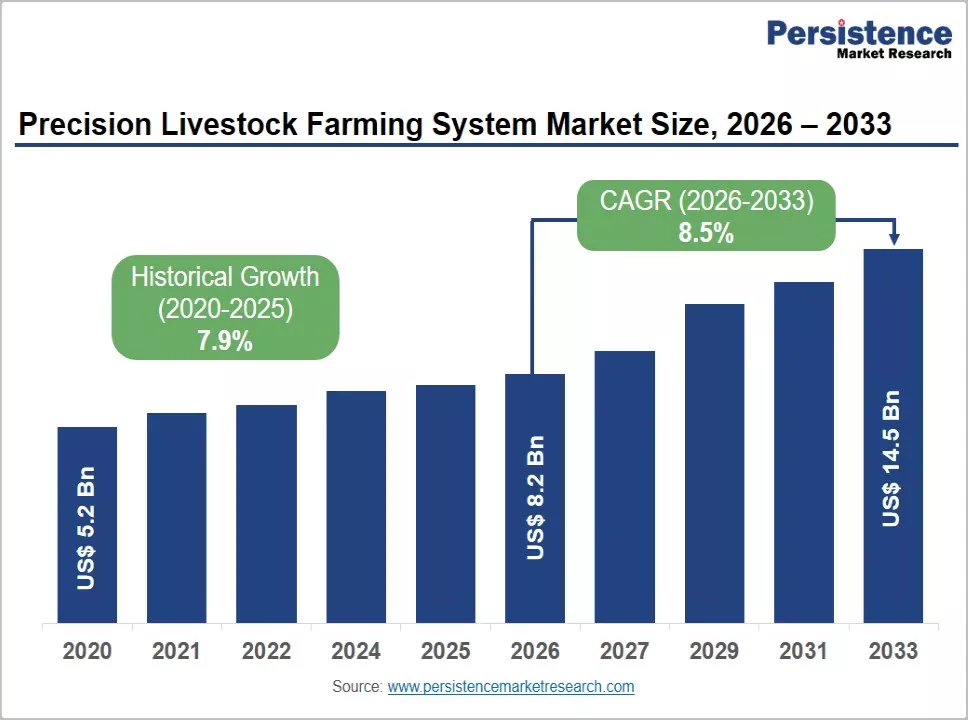
The global precision livestock farming system market is expected to be valued at US$ 8.2 Billion in 2026 and is projected to reach US$ 14.5 Billion by 2033, growing at a CAGR of 8.5% between 2026 and 2033.
Rising labor shortages are encouraging farmers to shift toward automated monitoring tools. Farmers increasingly need better data to track animal health and productivity closely. Declining sensor and software costs are making adoption easier for mid-sized farms. Rising milk and meat demand is further encouraging farmers to adopt efficiency-enhancing technologies. Growing consumer demand for traceable, sustainably produced food is adding pressure for digital record-keeping.
Key Industry Highlights
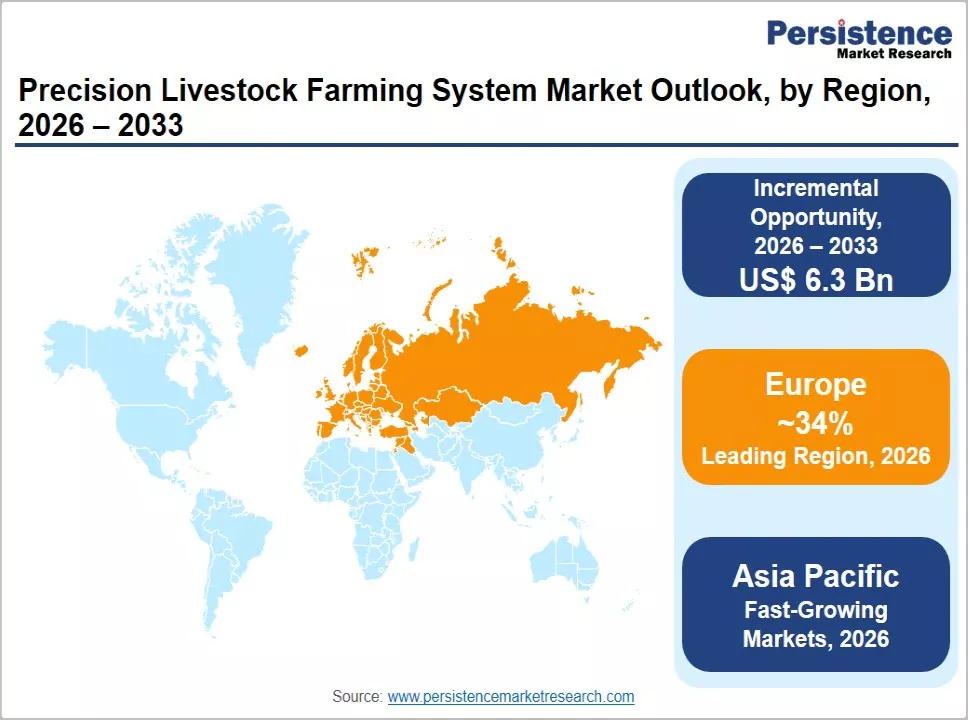
- Leading Region: Europe is likely to lead the precision livestock farming system market with around 34% share in 2026, supported by advanced livestock farming infrastructure, high adoption of automation technologies, and strong demand for data-driven animal health and productivity monitoring.
- Fastest-growing Region: Asia Pacific represents the fastest-growing market, expanding at a CAGR of 10.1% through 2033, driven by expanding livestock production, rising labor shortages, increasing adoption of farm automation, and growing investments in digital agriculture technologies.
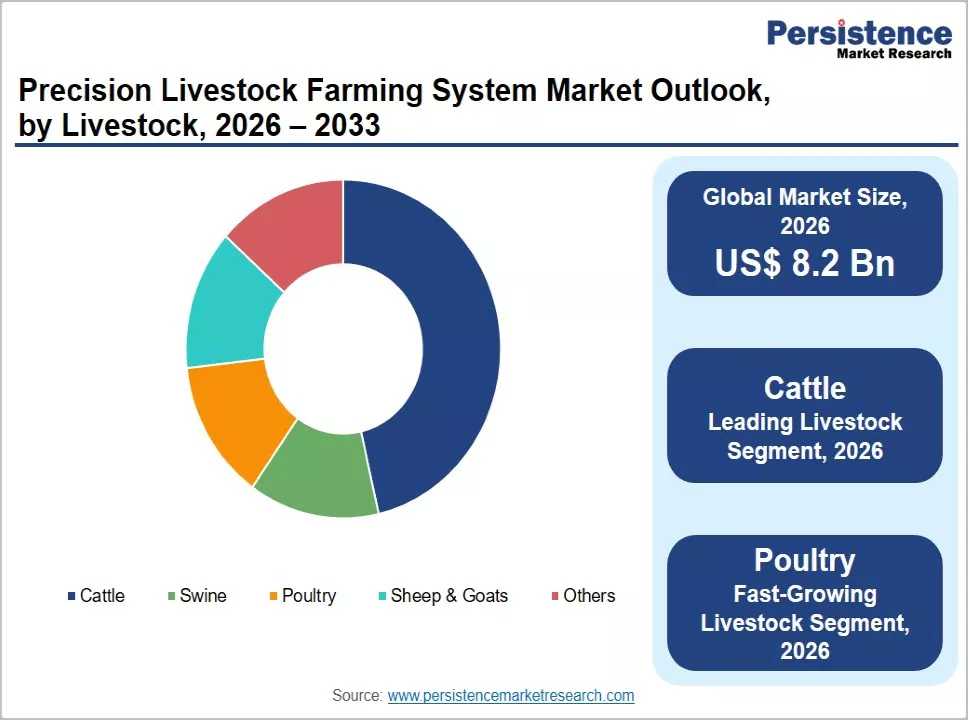
- Leading Segment: Cattle is the leading livestock segment, holding around 42% share in 2026, supported by strong demand from high-value dairy and beef operations and the growing use of monitoring systems for herd health, productivity, and reproductive management.
- Fastest-growing Segment: Poultry is the fastest-growing livestock segment, driven by large-scale flock operations, rising demand for automated monitoring, and the need for efficient management of animal health, feeding, and productivity.
- Key Market Opportunity: Artificial intelligence-based health prediction represents a key market opportunity, driven by growing demand for early illness detection, predictive herd management, reduced disease-related losses, and data-driven livestock health monitoring.
Market Dynamics
Drivers - Rising Farm Labor Shortages Worldwide
Farmers adopting precision livestock systems gain a practical way to offset shrinking workforce availability across dairy, poultry, and swine operations facing chronic staffing gaps. Rural labor shortages continue affecting dairy and poultry operations across many developed countries, as younger workers move toward urban employment and fewer people choose agricultural careers. Organizations such as the International Dairy Federation note rising automation interest among dairy producers seeking to maintain herd size without expanding payroll.
Labor shortage encourages farm owners to shift toward sensor-based monitoring that reduces daily manual labor needs by automating tasks such as health checks, feeding schedules, and milking routines that previously required constant human attention. Vendors offering reliable, easy-to-install automation systems gain traction among farms seeking to reduce dependence on labor-intensive operating models. Seasonal labor volatility further reinforces demand, as automated systems provide consistent monitoring despite fluctuations in farm staffing.
Growing Demand for Traceability And Food Safety
Consumers increasingly demand transparent, traceable meat and dairy supply chains, driven by rising awareness of animal welfare practices and food origin concerns across major consumer markets. Retailers and food processors increasingly require verified animal health and handling records before purchase, making traceability documentation a contractual requirement for many supplier relationships rather than an optional differentiator. This requirement pushes farmers toward digital tracking and monitoring systems capable of generating auditable records covering feeding, medication, and movement history for individual animals.
Rising regulatory scrutiny around animal welfare further supports demand for verified, data-backed farm practices, with several major export markets tightening disclosure requirements tied to trade agreements. Vendors building strong traceability features gain traction among export-focused, safety-conscious producers competing for premium retail contracts that reward documented compliance. Blockchain-based recordkeeping pilots among leading processors also signal growing institutional interest in tamper-resistant traceability infrastructure.
Restraints - High Upfront Costs
Precision livestock systems require significant upfront spending on sensors, software licensing, and network infrastructure that smaller farm operations often struggle to absorb within tight seasonal cash flows. That cost burden makes advanced systems less accessible for smaller farm operations already managing thin margins tied to volatile commodity prices and input costs. Budget-conscious farmers often delay adoption, favoring traditional manual monitoring methods instead of committing capital to technology investments during uncertain market cycles.
Smaller farms frequently lack the capital access needed for full system deployment, facing limited collateral and cautious agricultural lending practices in many regions. Price sensitivity limits advanced system adoption among cash-constrained farming segments, particularly smallholder and family-run operations without access to cooperative purchasing programs. Vendors offering modular, pay-as-you-scale sensor packages and equipment leasing arrangements can gradually narrow that adoption gap across price-sensitive farming communities.
Limited Digital Literacy Among Farm Workers
Many farm workers lack the training needed to operate complex monitoring software confidently, particularly on operations where staff turnover remains high and formal technology onboarding is limited. That skills gap slows adoption even when farmers can afford new technology systems, as unused or misconfigured software delivers little return on the initial hardware investment. Training programs add further cost and time burdens for smaller farm operations already stretched thin during peak seasonal workloads such as calving or harvest periods.
Older farm operators in particular report hesitation toward dashboard-heavy interfaces requiring frequent data interpretation rather than simple alert-based decision-making. Vendors offering simple, intuitive interfaces with plain-language alerts and mobile-first designs can bridge that adoption gap more effectively, reducing reliance on specialized technical staff. Regional agricultural extension programs partnering with technology vendors on hands-on training sessions can further improve sustained usage rates.
Opportunities - Growth of Artificial Intelligence-Based Health Prediction
Farmers increasingly want tools that predict illness before visible symptoms appear, reducing mortality losses and limiting disease spread within densely housed herds and flocks. Rising investment in machine learning models trained on animal behavior data, including feeding patterns, movement, and vocalization, supports the shift toward predictive rather than reactive herd management. Vendors building predictive health analytics can capture a growing, high-value customer segment willing to pay premium subscription pricing for measurable reductions in veterinary costs and lost production.
Rising interest in reducing antibiotic use further supports demand for early detection technology, as regulators and retailers increasingly encourage operations demonstrating lower treatment rates. Early movers building strong predictive analytics capabilities can secure durable farmer relationships as adoption expands across larger integrated farming operations. Pilot programs reporting double-digit reductions in disease losses continue strengthening the commercial case for broader rollout.
Growing Emphasis on Improving Yields
Smallholder farmers across developing regions increasingly seek affordable, scalable monitoring tools capable of improving yields without requiring large capital outlays or specialized technical staff. Falling sensor hardware costs are making basic systems more accessible to smaller operations, narrowing the price gap that historically confined precision livestock technology to large commercial farms. Vendors offering low-cost, mobile-based monitoring can capture this expanding underserved segment, particularly where smartphone penetration already supports app-based farm management tools.
Rising government support for agricultural modernization further supports smallholder technology adoption, with several developing economies offering subsidies or low-interest financing tied to productivity-enhancing equipment purchases. Suppliers building strong local distribution partnerships, including relationships with agricultural cooperatives and microfinance institutions, gain greater market access over vendors relying solely on direct enterprise sales. Localized product design accounting for limited connectivity further supports adoption in rural markets.
Category-wise Analysis
Which Livestock Segment Leads the Market?
Cattle is the leading segment, holding around 42% share of the market in 2026. High-value dairy and beef operations support its strong position, owing to the growing use of precision systems for milk yield, animal health, and herd performance tracking. Large-scale dairy farms increasingly favor these systems for improving monitoring efficiency and supporting data-driven herd management. Vendors serving multiple livestock types also capture broader revenue across diverse farm operations, keeping cattle central to overall market growth.
Poultry represents the fastest-growing livestock segment, expanding at a projected CAGR of 9.8% through 2033, driven by rising adoption of automated flock monitoring among large-scale poultry operations seeking greater efficiency. Increasing use of sensors, automated feeding systems, and real-time health monitoring is further supporting adoption across commercial poultry farms.
Cattle vs. Poultry
| Attribute | Cattle | Poultry |
| Market Share (2026) | 42% Share | Smaller share, but highest forecast CAGR through 2033 |
| Core Purchase Driver | Milk yield and health tracking on high-value dairy and beef operations | Automated flock-level monitoring for efficiency at large-scale operations |
| Typical System Focus | Milking management, breeding, and individual animal health tracking | Environmental control and flock-wide monitoring across large housing units |
| Key Growth Driver | Rising dairy and beef productivity demands on established operations | Rising adoption of automated monitoring among large-scale poultry producers |
| Typical Buyer | Large-scale dairy and beef farms managing individual animal records | Large-scale poultry operations managing thousands of birds per flock |
System Type Insights
Milking management systems represent the leading system type, holding around 26% share of the livestock farming system market in 2026. Direct productivity gains and labor savings support this leadership position, owing to the increasing use of automation across dairy operations. Dairy farmers favor automated milking systems for consistent, round-the-clock operation and improved herd management efficiency. Integration with sensors, herd management software, and automated data collection further enhances milk yield monitoring and supports more informed farm-level decision-making.
Livestock monitoring systems represent the fastest-growing system type, driven by rising adoption of wearable sensors and strong demand for real-time animal health and location tracking tools. Growing emphasis on early health detection and data-driven herd management is further supporting adoption. Advances in connected sensors, GPS-enabled devices, and automated alerts are expanding the use of monitoring solutions across commercial livestock operations.
Farm Size Insights
Large farms represent the dominant farm size segment, holding an estimated 48% share of the market in 2026. Greater capital access and scale economies support this leadership position, as large operations favor precision systems for managing thousands of animals efficiently. Higher animal densities and complex farm operations also increase the value of automated monitoring, data analytics, and centralized management platforms.
Medium farms represent the fastest-growing segment, driven by falling technology costs and rising awareness among mid-sized operations seeking competitive efficiency gains. Increasing availability of modular and scalable solutions is improving accessibility for farms with moderate technology budgets. Cloud-based platforms, subscription-based models, and lower-cost sensors are further enabling medium-sized farms to adopt precision technologies without extensive infrastructure investments.
Regional Analysis
Which Region Leads the Precision Livestock Farming System Market?
Europe is expected to lead the global precision livestock farming system market by holding around 34% share in 2026. Strict animal welfare regulations under frameworks tied to the European Commission are shaping farm technology adoption across the region. Established manufacturers across Germany, France, and the United Kingdom support steady regional demand through advanced livestock automation solutions. Rising sustainability and traceability requirements further support investment in digital monitoring and farm management systems. The region is likely to maintain its leadership as animal welfare, traceability, and farm efficiency requirements continue influencing technology investment.
Germany Precision Livestock Farming System Market Size
Germany accounts for an estimated 19% of European market revenue, representing the largest share among regional peers. Strong dairy and swine farming traditions support steady domestic demand for precision livestock systems. National sustainability standards encourage farmers to adopt verified, data-backed farming practices. Strong domestic engineering expertise further supports product innovation among regional equipment suppliers. Demand is likely to remain steady as investments in sustainable and automated farming technologies expand nationwide.
U.K. Precision Livestock Farming System Market Size
The U.K. is projected to hold a significant share of the European market in 2026. Strong dairy sector investment supports consistent demand for precision livestock systems nationally. Suppliers benefit from established domestic research capabilities and agricultural technology development programs. Established dairy cooperatives increasingly encourage member farms to adopt digital monitoring solutions. Demand is likely to remain steady as farms increase investment in efficiency-enhancing technologies.
France Precision Livestock Farming System Market Size
France is anticipated to hold a considerable share of the European market in 2026. Strong dairy and beef production traditions support consistent domestic demand for precision livestock systems. National agricultural modernization programs encourage farmers to adopt digital monitoring technologies. Rising cooperative-led technology adoption programs further support domestic system demand. The market in the country is expected to grow at a steady rate as investment in farm modernization and automation continues expanding nationwide.
Which Region Is Growing Fastest in the Precision Livestock Farming System Market?
Asia Pacific is expected to register a CAGR of 10.1% through 2033. China's expanding large-scale dairy and poultry operations are driving strong regional demand for precision livestock technologies. Rising government support for agricultural modernization is supporting broader system adoption across the region. Local manufacturers increasingly compete with established suppliers through cost-efficient solutions and faster delivery capabilities. Growing domestic manufacturing capacity further strengthens the region's supply base and supports long-term market expansion.
India Precision Livestock Farming System Market Size
India is projected to hold about 15% share of the Asia Pacific market in 2026. Rising dairy cooperative modernization programs support expanding demand for precision livestock systems nationally. Domestic technology providers increasingly partner with established international system vendors to expand solution capabilities and market reach. Expanding rural connectivity infrastructure further supports broader technology access across smaller villages and farming communities. Demand is likely to accelerate as investment in domestic farm modernization and digital agriculture continues expanding.
Japan Precision Livestock Farming System Market Size
Japan is anticipated to hold a substantial share of the Asia Pacific market in 2026. Strong dairy and swine farming automation investment supports consistent demand for precision livestock systems. Established suppliers maintain long-standing relationships with major domestic agricultural cooperatives, supporting continued technology deployment. An aging farmer population further encourages cooperatives to adopt automated, labor-saving systems.
South Korea Precision Livestock Farming System Market Size
South Korea is expected to hold a notable share of the Asia Pacific market in 2026. Rising swine and poultry farm automation investment supports steady domestic demand for precision livestock systems. Domestic manufacturers increasingly build capabilities alongside established international suppliers, strengthening the local technology ecosystem. Rising domestic agricultural technology expertise further supports the development of locally manufactured solutions. Demand is likely to grow steadily as farm technology investment expands across major farming regions.
North America Precision Livestock Farming System Market Trends and Insights
North America is expected to hold about 28% share of the precision livestock farming system market in 2026. Strong dairy and beef industry investment supports steady demand across the region. Established vendors maintain deep relationships with large commercial farming operations, supporting continued deployment of precision technologies. Rising farm labor shortages further expand demand for automated monitoring systems. Large commercial dairy cooperatives across the region continue supporting technology adoption through investments in herd management and operational efficiency.
U.S. Precision Livestock Farming System Market Size
The U.S. accounts for an estimated 84% of North American market revenue. Large-scale dairy and beef operations drive strong domestic adoption of precision livestock systems. Rising farm labor costs further encourage producers to adopt automated monitoring solutions. Growing consolidation among large dairy operations also supports demand for centralized monitoring and data management systems. The market within the U.S. is likely to grow at a rapid pace as commercial farms continue investing in automation and productivity-enhancing technologies.
Competitive Landscape
The global precision livestock farming system market is highly competitive. Established vendors compete through broad portfolios spanning monitoring, feeding, and milking system categories. Smaller specialized firms compete effectively through niche livestock or regional positioning. Larger players increasingly invest in artificial intelligence analytics and cloud-based data platforms. Differentiation increasingly rests on sensor accuracy, software usability, and after-sales farmer support.
New entrants find it easier to compete through specialized smallholder or emerging market positioning. Data analytics investment is becoming a key competitive battleground across established suppliers. Overall competitive intensity remains high given long farmer relationships and demanding reliability requirements.
Key Industry Developments
- September 2026, NoFence launched its third-generation N3 cattle collar alongside a precision livestock management platform, expanding automated grazing reports and health tracking features to enhance land and herd management for ranchers.
- May 2026, De Heus Animal Nutrition India and partners launched a precision poultry farming project in India to introduce data-driven technologies, automation, and precision feeding systems to empower independent poultry producers.
Companies Covered in Precision Livestock Farming System Market
- DeLaval
- GEA Group
- Lely
- Afimilk
- Nedap
- BouMatic
- Allflex Livestock Intelligence
- Dairymaster
- Fancom
- Fullwood JOZ
- Waikato Milking Systems
- VDL Agrotech
- Trioliet
- Big Dutchman
- Connecterra
- SCR Dairy (Allflex)
- Merck Animal Health
Frequently Asked Questions
The global precision livestock farming system market is expected to be valued at US$ 8.2 Billion in 2026.
Rising farm labor shortages worldwide and growing demand for traceability and food safety are key demand drivers.
Europe is likely to lead the precision livestock farming system market with an estimated 34% share in 2026, supported by strict animal welfare and sustainability regulations.
Rising demand for artificial intelligence-based health prediction offers vendors a strong opportunity.
Key players include DeLaval, GEA Group, Lely, Afimilk, and Nedap, among other established suppliers.


