




- Medical Devices
- Particulate Respirators Market
Particulate Respirators Market Size, Share, and Growth Forecast 2026–2033
Particulate Respirators Market by Product Type (Respirators, Filter Pad, Cartridges), End User (Hospitals, Pharmaceutical Industries), and Regional Analysis, 2026–2033

Particulate Respirators Market Size and Trend Analysis
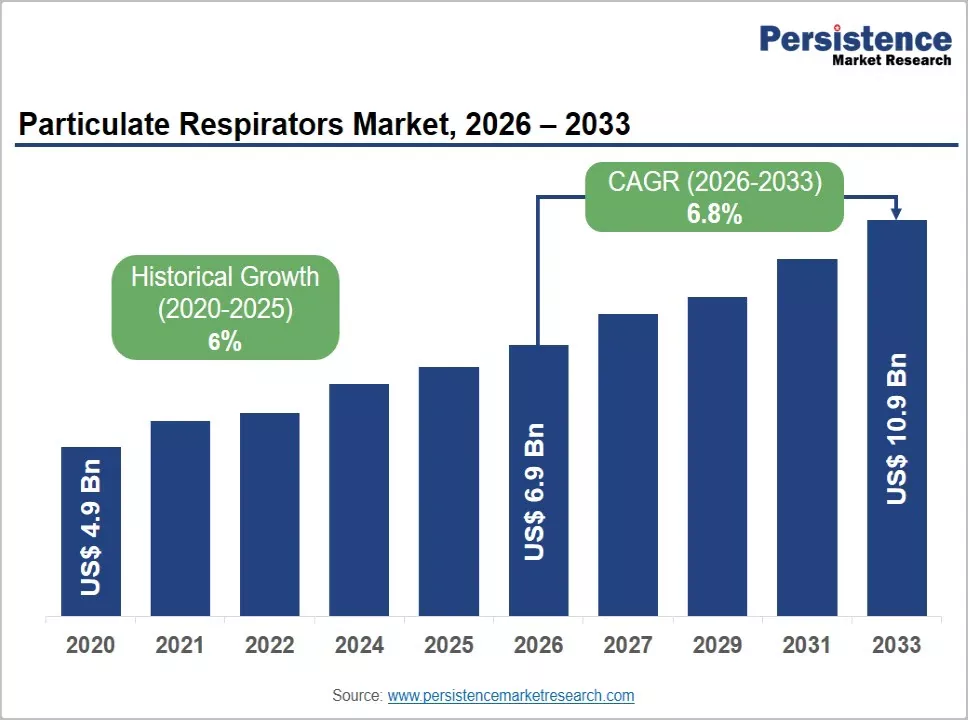
The global particulate respirators market size is likely to be valued at US$ 6.90 billion in 2026 and is projected to reach US$ 10.90 billion by 2033, growing at a CAGR of 6.8% during the forecast period between 2026 and 2033.
Product innovation is centered on comfort, fit, and sustainability. Manufacturers are introducing lighter, flatter-folding models, improved nose seals, and reusable elastomeric half masks with replaceable filters, which lower waste and total cost for frequent users. Fit testing technology and training services are also becoming part of the purchase, as employers aim to meet occupational standards and reduce liability.
Key Industry Highlights
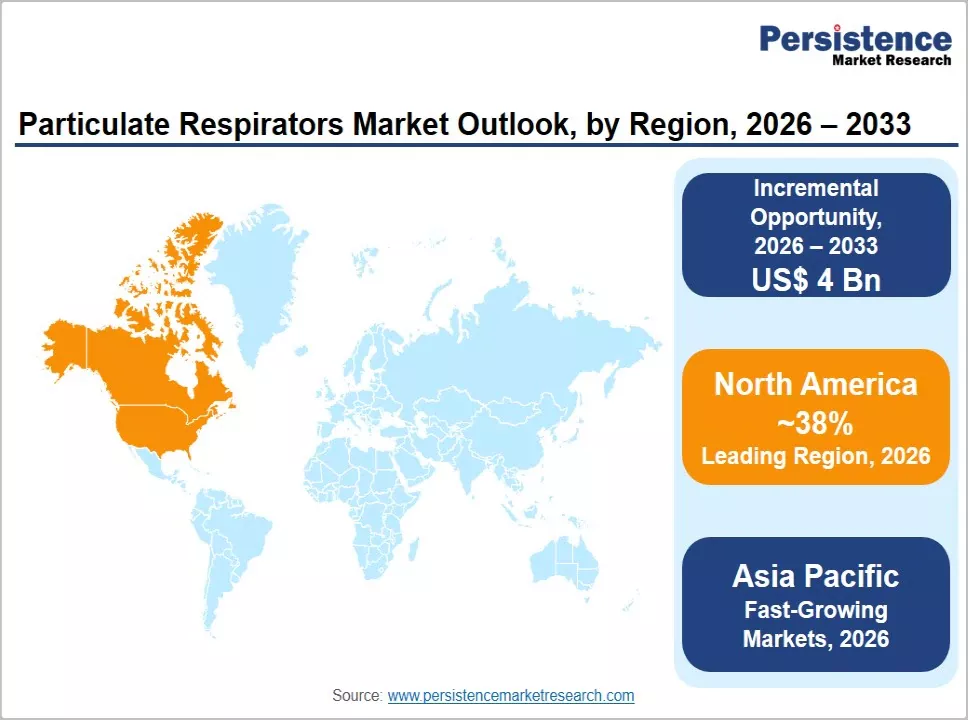
- Dominant Region: North America is forecast to command around 38% of particulate respirators market share in 2026, propelled by strict workplace safety rules, NIOSH certification requirements, large healthcare stockpiling programs, and growing demand for wildfire smoke protection, dynamics that will sustain regional leadership through 2033.
- Fastest growing Region: Asia Pacific is likely to be the fastest growing region, expanding at an estimated CAGR of 8.2%, as industrialization, stricter occupational health enforcement, and severe urban air pollution in China and India raise demand for certified respiratory protection.
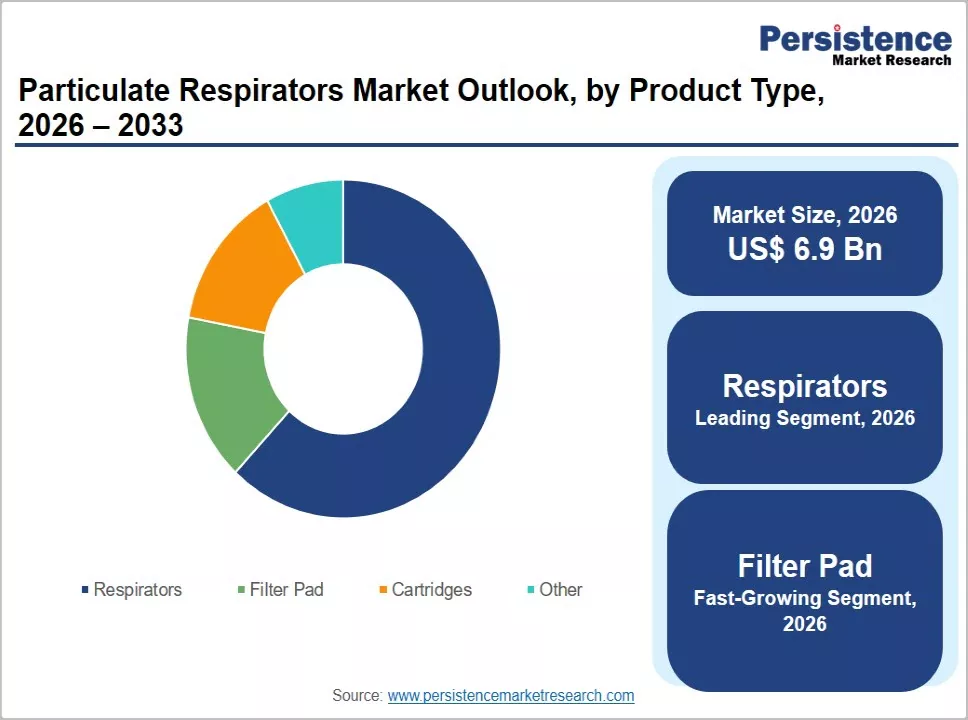
- Leading Product Type: Respirators hold around 62% of market share in 2026, because disposable filtering facepiece models are used widely in healthcare and industry, while cartridges are the fastest-growing product as reusable half and full-face masks gain adoption.
- Dominant End User: Hospitals lead with nearly 44% end user share, driven by infection control protocols and stockpiles, while pharmaceutical industries are the fastest-growing end user as cleanroom and potent compound handling standards tighten.
- Regulatory Influence: Certification by bodies such as the National Institute for Occupational Safety and Health is a prerequisite for sales in many markets, favoring manufacturers with testing capability and strong quality systems.
DRO Analysis
Driver- Stricter Occupational Safety Enforcement and Sustained Healthcare Demand for Respiratory Protection
Employers in construction, mining, metal working, and chemicals are required to protect workers from silica, welding fume, and other particulates, and enforcement is intensifying as the long-term health costs of exposure become clearer. Healthcare systems, having experienced shortages in 2020, now maintain strategic reserves and expect certified N95 or equivalent products for airborne precautions.
Wildfire seasons that grow longer and more severe add emergency demand from public agencies and consumers, as seen when New York distributed masks to residents during a wildfire smoke emergency in July 2026. These recurring needs provide a stable base of demand. Growing awareness of silicosis and other occupational lung diseases among younger workers is also pushing employers to formalize respirator programs, including medical evaluation and fit testing, which increases consumption of replacement filters and masks.
Restraint- Counterfeit Products, Price Competition, and Compliance Burden
Counterfeit and misrepresented respirators remain a persistent risk, and NIOSH regularly issues notices about fraudulent products falsely claiming certification. Low-priced imports compete with domestic production, and trade groups representing U.S. mask makers have criticized public agencies that procure from overseas suppliers.
Certification and testing add cost and time, and changes in labelling or approval holders require manufacturers and distributors to update documentation. Excess inventory built during the pandemic and reduced stockpiling by some buyers can also cause uneven demand from year to year. Comfort problems such as breathing resistance, heat, and communication difficulty also lead to inconsistent use, which limits the effectiveness of programs and the volume of replacements purchased.
Opportunity- Domestic Manufacturing Expansion, Reusable Respirators, and Smart Fit Solutions
Government interest in resilient supply chains is encouraging investment in domestic N95 manufacturing, and reusable elastomeric respirators with replaceable cartridges and filter pads offer lower lifetime cost and less waste than disposable models. Demand for fit testing equipment, powered air-purifying respirators, and connected monitoring is rising in industry. In July 2026, final rules updating tests and standards for NIOSH-approved respirators, including powered air-purifying respirators, were reported to be scheduled for this year, which could reset product requirements and create replacement demand.
Category-wise Analysis
Why Do Respirators Account for Over 60% of the Particulate Respirators Market?
Respirators are projected to dominate the product type segment, accounting for around 62% of market share in 2026. Disposable filtering facepiece models such as N95, FFP2, and KN95 are the main products used in hospitals, laboratories, and general industry because they are convenient, require no maintenance, and are inexpensive per unit. Their use in both healthcare and industrial settings gives the segment high volumes and broad distribution through safety suppliers, medical distributors, and retail.
Filter pads and cartridges are likely to be the fastest-growing group, particularly cartridges, as industrial employers shift toward reusable half and full-face masks to reduce long-term cost. Replaceable filters allow protection against particulates and, in combination cartridges, gases and vapors, creating a recurring consumables market. The other segment includes accessories such as fit test kits, straps, and storage solutions.
Sustainability is shaping product design across the segment. Disposable respirators generate significant waste, so manufacturers are testing recyclable materials and take-back programs, while reusable systems are promoted on lifetime cost. Procurement teams in healthcare and industry increasingly weigh environmental criteria alongside price and certification when selecting suppliers.
End User Insights
Hospitals are estimated to dominate the end user segment, capturing nearly 44% of market share in 2026. Infection prevention policies for tuberculosis, measles, and respiratory viruses call for certified respirators, and fit testing programs require regular replenishment. Many health systems also hold stockpiles that are rotated on a schedule, keeping baseline orders high.
Pharmaceutical industries are likely to be the fastest-growing end user, as sterile manufacturing, powder handling, and potent compound production require reliable respiratory protection and particle control in cleanrooms. Tighter exposure limits for active ingredients are driving the use of powered and reusable respirators.
The other segment covers construction, mining, manufacturing, agriculture, and emergency services, as well as the public and consumers buying masks during wildfire smoke events and pollution episodes. This broad group provides diversification and cushions the market when healthcare demand is flat.
Procurement is increasingly centralized, with group purchasing organizations and national supply agencies setting specifications and approved supplier lists, which favors manufacturers with documented quality systems and consistent delivery.
Regional Insights
North America Particulate Respirators Market Trends and Insights
North America is projected to dominate the regional market, commanding around 38% of market share in 2026. Workplace safety rules, NIOSH approval requirements, and large healthcare purchasing networks sustain demand, while wildfire smoke episodes have made respirators a seasonal consumer and public agency item. In October 2026, NIOSH’s National Personal Protective Technology Laboratory issued information on required labelling of NIOSH-approved N95 filtering facepiece respirators to help users identify genuine products.
U.S. Particulate Respirators Market Size
The U.S. is anticipated to capture nearly 88% of the North America regional market in 2026. Domestic manufacturers continue to expand N95 capacity, and industry groups have pressed governments to buy American-made products during emergencies, while the Occupational Safety and Health Administration’s respiratory protection standard sustains industrial demand.
Canada Particulate Respirators Market Size
Canada is estimated to account for 12% of the North America regional market in 2026. Wildfire seasons, mining and forestry employers, and provincial health authorities drive purchases, and NIOSH approval of Canadian-made N95 models supports local production.
Europe Particulate Respirators Market Trends and Insights
Europe is projected to hold about 17% of market share in 2026. Products are certified under the EU personal protective equipment regulation and standards for FFP filtering masks, and strong occupational health regimes in manufacturing, chemicals, and healthcare keep demand stable. Several European companies are leaders in reusable respirators and powered systems.
Germany Particulate Respirators Market Size
Germany is anticipated to command around 28% of the Europe regional market in 2026. A large industrial base, strict workplace exposure limits, and home-grown respiratory protection suppliers support consistent demand for FFP masks, cartridges, and filters.
U.K. Particulate Respirators Market Size
The U.K. is expected to hold nearly 17% of the Europe regional market in 2026. National Health Service infection control policies, construction activity, and health and safety regulation drive purchases, and UK conformity assessment requirements apply to products sold in Great Britain.
What Is Driving Asia Pacific’s Position as the Fastest-Growing Region in the Particulate Respirators Market?
Asia Pacific is likely to be the fastest growing regional market, expanding at a CAGR of 8.2% during the forecast period between 2026 and 2033, and is estimated to hold nearly 25% of market share in 2026. Large manufacturing and construction sectors, expanding hospital capacity, and serious urban air pollution are raising demand for certified protection, while the region is also the main production base for disposable masks.
China Particulate Respirators Market Size
China is estimated to capture nearly 42% of the Asia Pacific regional market in 2026. The country is the world’s largest producer of disposable respirators and a growing consumer of high-grade products, supported by stricter occupational health enforcement and heavy industry.
India Particulate Respirators Market Size
India is projected to hold nearly 15% of the Asia Pacific regional market in 2026. Severe winter air pollution in northern cities, growth in construction and manufacturing, and rising awareness of occupational lung disease are encouraging use of certified masks and reusable respirators.
Competitive Landscape
The global particulate respirators market is moderately fragmented, with a few global safety companies holding strong brands and a long tail of regional manufacturers. 3M Company, Moldex-Metric, MSA Safety, Dräger, Kimberly-Clark, Ansell, Protective Industrial Products, Alpha Pro Tech, Owens & Minor, and Uvex Safety compete across disposable, reusable, and powered products for healthcare and industrial customers. Regional manufacturers in Asia, Europe, and Latin America compete mainly on price in disposable products, while global brands defend share through certification, distribution reach, and training services.
Competition increasingly revolves around certification credibility, comfort, fit, supply reliability, and sustainability. Brand and portfolio changes, such as the transfer of respirators formerly sold under the Honeywell name to PIP, show how companies are reshaping safety portfolios, and domestic capacity commitments are being used as a differentiator in government and hospital contracts.
Key Industry Developments
- In October 2026, NIOSH’s National Personal Protective Technology Laboratory published information on the required labelling of NIOSH-approved N95 filtering facepiece respirators. The guidance explains the markings that genuine approved products must carry, supporting purchasers, safety managers, and distributors in distinguishing certified respirators from counterfeit or misrepresented products.
- In July 2026, The American Industrial Hygiene Association reported that final rules on tests and standards for NIOSH-approved respirators were scheduled for this year, as part of the federal regulatory agenda. The planned changes concern requirements for respirator performance testing and certification, which manufacturers will need to follow, potentially driving redesign and recertification of products.
Companies Covered in Particulate Respirators Market
- 3M Company
- Moldex-Metric, Inc.
- MSA Safety Incorporated
- Drägerwerk AG & Co. KGaA
- Kimberly-Clark Corporation
- Ansell Limited
- Protective Industrial Products (PIP)
- Alpha Pro Tech, Ltd.
- Owens & Minor, Inc.
- Uvex Safety Group
Frequently Asked Questions
The global particulate respirators market is valued at US$ 6.90 billion in 2026 and is projected to reach US$ 10.90 billion by 2033.
Growth is driven by stricter occupational safety enforcement, sustained healthcare demand for certified respiratory protection, and rising need for wildfire smoke and air pollution protection.
Respirators hold around 62% of market share in 2026, because disposable filtering facepiece models are widely used in healthcare and industry and are convenient and low cost.
North America dominates the market with a 38% share in 2026, supported by strict workplace safety rules, NIOSH certification, and large healthcare purchasing programs.
The largest opportunities lie in domestic manufacturing expansion, reusable respirators with replaceable cartridges, and fit testing and powered air-purifying solutions.
Leading companies include 3M, Moldex-Metric, MSA Safety, Dräger, Kimberly-Clark, Ansell, PIP, Alpha Pro Tech, Owens & Minor, and Uvex Safety, competing in a moderately fragmented landscape.


