




- Medical Devices
- Paracentesis Drainage Systems Market
Paracentesis Drainage Systems Market Size, Share, Growth, and Regional Forecast, 2026 to 2033
Paracentesis Drainage Systems Market by Product (Catheters, Needles, Drainage Bags, Others), by Application (Diagnostic procedures, Treatment of Respiratory Distress, Evaluation of Acute Abdomen, Evaluation of Acute Pancreatitis, and Others), by End User (Hospitals, Specialty Clinics, and Ambulatory Surgical Centers), and Regional Analysis from 2026 to 2033.

Paracentesis Drainage Systems Market Trends and Analysis
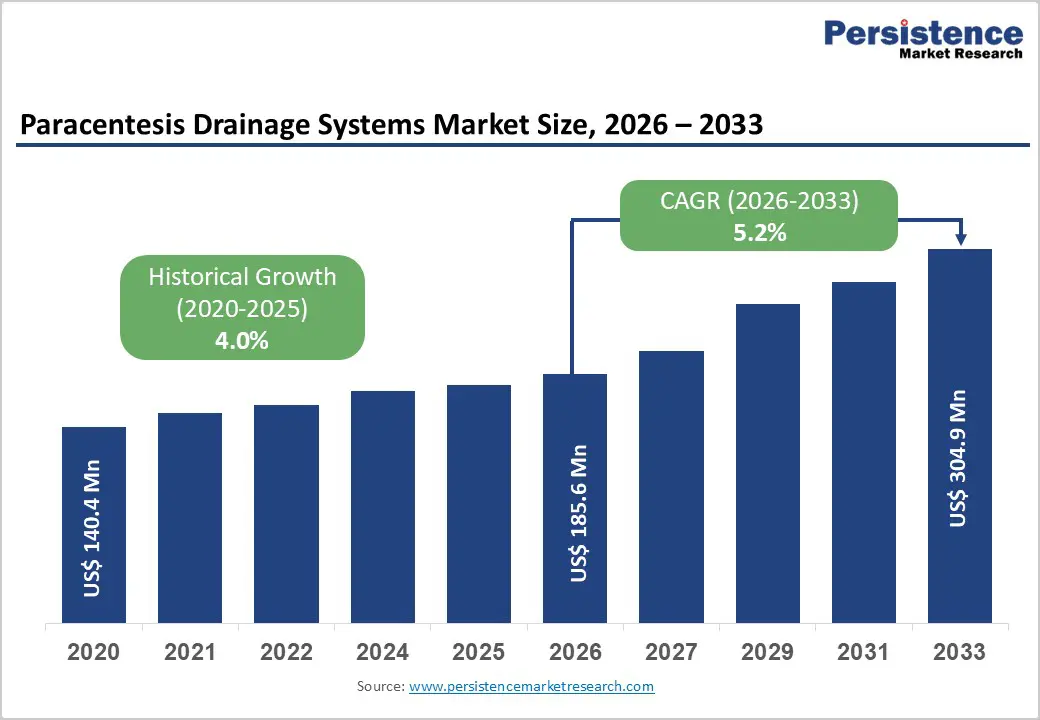
The global paracentesis drainage systems market size is estimated to grow from US$ 185.6 Mn in 2026 to US$ 304.9 Mn by 2033. The market is projected to record a CAGR of 5.2% during the forecast period from 2026 to 2033.
Global demand for paracentesis drainage systems is rising steadily, driven by the increasing prevalence of liver-related disorders, malignancies, renal disease, and gastrointestinal conditions that result in ascites and abnormal peritoneal fluid accumulation. The growing burden of chronic liver diseases such as cirrhosis, hepatitis, and non-alcoholic fatty liver disease, along with cancer-associated ascites, is significantly increasing the need for both diagnostic and therapeutic paracentesis procedures.
Improving survival rates among patients with chronic and oncologic conditions, coupled with aging populations, are increasing the frequency of repeat drainage procedures and long-term fluid management requirements. Expanding access to hospital-based and ambulatory care, rising adoption of ultrasound-guided paracentesis, and growing clinician awareness of minimally invasive abdominal interventions are supporting sustained procedure volumes. Technological advancements in catheter design, closed drainage systems, and infection-prevention features are improving procedural safety and efficiency.
Increasing healthcare investments in tertiary hospitals, emergency care infrastructure, and interventional radiology services are further accelerating global adoption. Concurrently, continued clinical emphasis on early diagnosis, rapid symptom relief, and reduced hospitalization is reinforcing long-term market expansion across both developed and emerging regions.
Key Industry Highlights
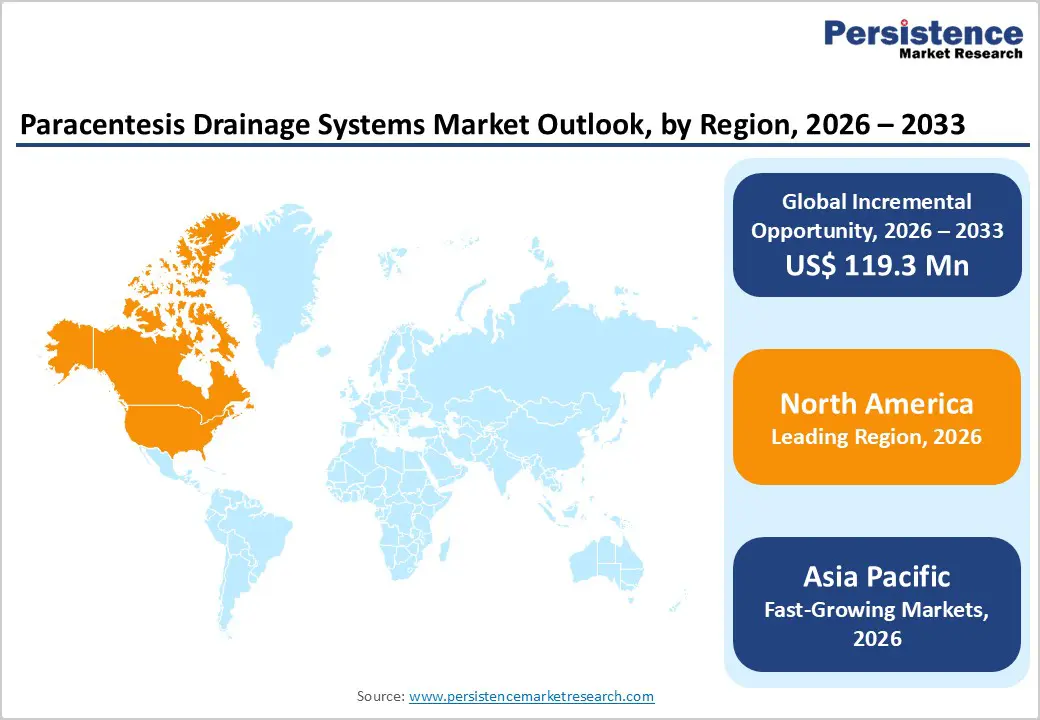
- Leading Region: North America holds the largest market share at 47.7%, supported by advanced hospital infrastructure, high paracentesis procedure volumes, favorable reimbursement policies, and widespread adoption of ultrasound-guided drainage techniques.
- Fastest-Growing Region: Asia Pacific is expanding at the fastest pace due to a large patient pool with liver and gastrointestinal disorders, rapid healthcare infrastructure development, increasing hospital admissions, and improving access to minimally invasive procedures.
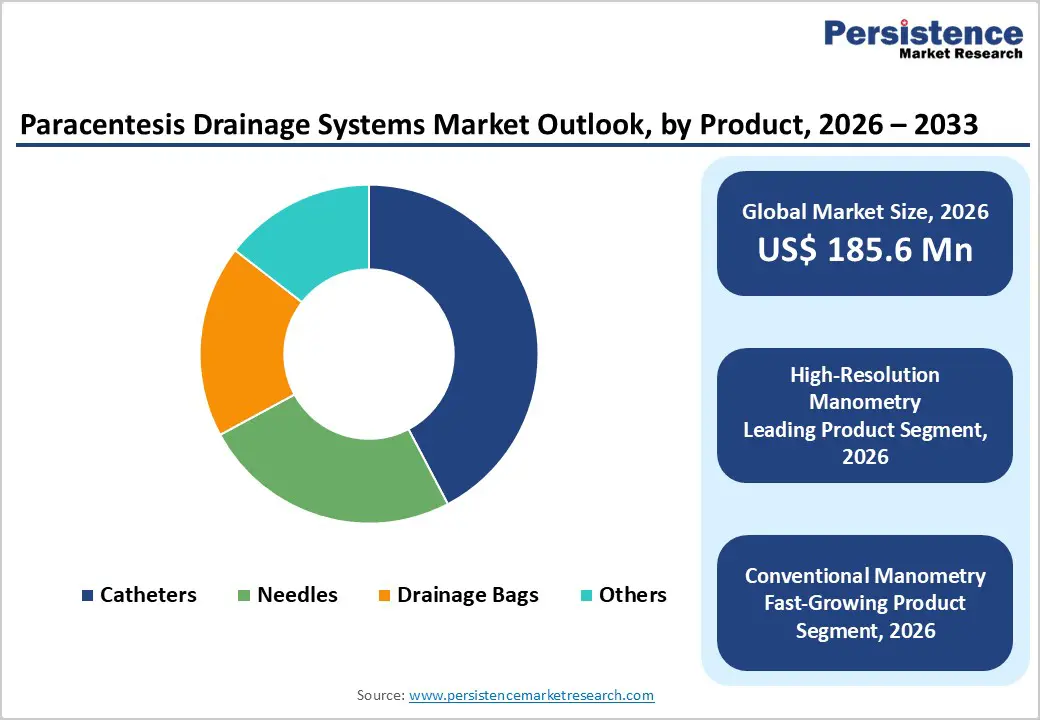
- Leading Product Segment: Catheters dominate the market owing to their essential clinical role, cost-effectiveness, high procedural reliability, and suitability for both diagnostic and large-volume therapeutic paracentesis.
- Fastest-Growing Product Segment: Needles are witnessing rapid growth as their use expands in emergency settings and image-guided diagnostic paracentesis requiring quick access and precision.
- Leading Application Segment: Evaluation of acute abdomen represents the largest application segment due to high utilization in emergency and inpatient settings for rapid diagnosis of abdominal fluid-related conditions.
- Fastest-Growing Application Segment: Diagnostic procedures are expanding rapidly as early diagnosis initiatives, increased use of bedside ultrasound, and growing emphasis on prompt clinical decision-making gain momentum globally.
| Key Insights | Details |
|---|---|
| Paracentesis Drainage Systems Market Size (2026E) | US$185.6 Mn |
| Market Value Forecast (2033F) | US$304.9 Mn |
| Projected Growth (CAGR 2026 to 2033) | 5.2% |
| Historical Market Growth (CAGR 2020 to 2025) | 4.0% |
Market Dynamics
Driver – Rising Burden of Liver Disease and Growing Adoption of Minimally Invasive Procedures Driving Market Growth
The increasing global prevalence of liver-related disorders is a primary driver fueling sustained demand for paracentesis drainage systems. Conditions such as liver cirrhosis, hepatitis, non-alcoholic fatty liver disease (NAFLD), and hepatocellular carcinoma frequently result in ascites, necessitating repeated diagnostic and therapeutic paracentesis procedures. Rising alcohol consumption, obesity, metabolic syndrome, and viral hepatitis infections are significantly expanding the patient pool, particularly across aging populations. In addition, the growing incidence of abdominal malignancies and renal disorders further contributes to procedure volumes.
Advancements in minimally invasive care are accelerating market growth. Widespread adoption of ultrasound-guided paracentesis has improved procedural safety, reduced complication rates, and increased clinician confidence, supporting routine use in both emergency and elective settings. Technological improvements in catheter materials, closed drainage systems, and infection-prevention features are enhancing clinical outcomes and patient comfort. Hospitals and ambulatory care facilities increasingly prefer standardized drainage systems that offer efficiency, cost control, and reproducibility. Collectively, the rising burden of chronic diseases, increasing hospital admissions, and preference for minimally invasive diagnostic and therapeutic solutions are driving steady and long-term expansion of the global paracentesis drainage systems market.
Restraints – Procedure-Related Risks and Limited Access in Resource-Constrained Settings Limiting Market Adoption
The procedure related risks and healthcare access disparities remain key restraints for the global paracentesis drainage systems market. Complications such as bleeding, infection, bowel perforation, hypotension, and paracentesis-induced circulatory dysfunction can limit adoption, particularly in settings lacking trained personnel or imaging guidance. While modern devices reduce risk, improper technique and inadequate post-procedure monitoring continue to pose clinical challenges. These concerns may result in cautious utilization, especially for large volume or repeat procedures.
Limited access to skilled clinicians and ultrasound equipment in low- and middle-income regions further restricts market penetration. In many emerging markets, shortages of gastroenterologists, interventional radiologists, and trained nursing staff constrain procedural capacity. Cost pressures within public healthcare systems may also limit procurement of advanced drainage systems, leading to reliance on basic or reusable alternatives. Inadequate reimbursement structures and budgetary constraints can discourage adoption of premium products. Additionally, lack of standardized protocols and variable clinical training across regions may affect procedural consistency and outcomes. These structural, economic, and clinical barriers collectively restrain broader market adoption despite rising clinical need.
Opportunity – Expansion of Outpatient Care and Technological Innovation Creating New Growth Avenues
The growing shift toward outpatient and ambulatory care settings represents a significant opportunity for the global paracentesis drainage systems market. Increasing emphasis on cost containment, reduced hospital stays, and same-day procedures is driving adoption of paracentesis in ambulatory surgical centers and specialty clinics. This transition is creating demand for portable, easy-to-use, and closed-system drainage solutions that support safe outpatient procedures. As healthcare systems prioritize efficiency, devices that minimize procedure time and complications are gaining traction.
Technological innovation presents additional growth potential. Development of advanced catheters with improved flow control, antimicrobial coatings, and enhanced patient comfort is strengthening product differentiation. Integration of ultrasound compatibility and standardized kits is simplifying procedural workflows, particularly for high-volume centers. Emerging markets also present untapped opportunities as healthcare infrastructure expands and awareness of minimally invasive abdominal procedures increases. Investments in clinician training programs, hospital modernization, and government-led liver disease management initiatives are expected to support adoption. As demand for early diagnosis and effective fluid management grows, manufacturers offering cost-effective, safe, and scalable solutions are well positioned to capitalize on long-term market opportunities.
Category-wise Analysis
By Product, Catheters Lead Due to Procedural Necessity and Cost Efficiency
The catheters segment is projected to dominate the global paracentesis drainage systems market in 2026, accounting for a revenue share of 42.3%. Segment leadership is driven by the essential role of catheters in both diagnostic and therapeutic paracentesis procedures, particularly for controlled and continuous fluid removal in patients with ascites. Growing clinical preference for soft-tip, kink-resistant, and multi-lumen catheters supports improved procedural safety, reduced complication rates, and enhanced patient comfort.
Catheters offer a favorable balance between cost efficiency and clinical effectiveness, making them suitable for repeated use across hospital and outpatient settings. Rising adoption of ultrasound-guided paracentesis has further increased demand for precision-engineered catheters that enable accurate placement and reduced risk of organ perforation. Established clinical guidelines, high physician familiarity, and compatibility with closed drainage systems continue to support widespread use. While ancillary components remain important, catheters remain the core revenue-generating product within paracentesis drainage systems due to their indispensable clinical function.
By Application, Evaluation of Acute Abdomen Dominates Driven by Emergency Care Demand
The evaluation of the acute abdomen segment is projected to dominate the global paracentesis drainage systems market in 2026, accounting for a revenue share of 39.5%. This dominance is primarily attributed to the high incidence of abdominal emergencies associated with liver disease, intra-abdominal infections, malignancies, and traumatic conditions, where rapid fluid assessment is clinically critical. Paracentesis plays a key role in differentiating causes of acute abdominal pain by enabling prompt diagnostic analysis of ascitic fluid.
Increasing hospital admissions for cirrhosis-related complications, spontaneous bacterial peritonitis, and acute inflammatory conditions are supporting sustained demand within this segment. Emergency departments and intensive care units frequently rely on paracentesis as a frontline diagnostic tool, reinforcing its routine clinical use. Advancements in bedside ultrasound and minimally invasive procedural techniques have further improved safety and turnaround time, strengthening adoption. As healthcare systems emphasize early diagnosis and timely intervention, demand for paracentesis in acute abdomen evaluation is expected to remain robust.
By End User, Hospitals Maintain Dominance Due to High Procedure Volumes
The hospitals segment is projected to dominate the global paracentesis drainage systems market in 2026, accounting for 63.8% of revenue. Hospitals serve as primary centers for managing complex conditions such as liver cirrhosis, oncology-related ascites, renal failure, and acute abdominal disorders, all of which frequently require paracentesis. Availability of skilled clinicians, advanced imaging infrastructure, and sterile procedural environments enables hospitals to safely perform both diagnostic and large-volume therapeutic paracentesis.
High inpatient and emergency case volumes significantly contribute to recurring device demand. Hospitals also play a central role in protocol standardization, clinician training, and the adoption of ultrasound-guided techniques, supporting consistent utilization. Tertiary care and academic hospitals often manage high-risk patients requiring repeated drainage, further reinforcing segment leadership. Ongoing investments in hospital infrastructure, the rising burden of chronic liver disease, and the increasing focus on minimally invasive procedures continue to sustain hospitals' dominant position in the market.
Region-wise Insights
North America Paracentesis Drainage Systems Market Trends
North America is expected to dominate the global paracentesis drainage systems market with a value share of 47.6% in 2026, led primarily by the United States. The region benefits from a well-established healthcare infrastructure, high procedural volumes, and strong adoption of minimally invasive diagnostic and therapeutic techniques. A rising prevalence of chronic liver disease, alcohol-related cirrhosis, obesity-linked non-alcoholic fatty liver disease, and cancer-associated ascites is driving sustained demand for paracentesis procedures. Hospitals and ambulatory care centers in North America widely utilize ultrasound-guided paracentesis, supporting demand for advanced drainage systems with enhanced safety features.
Favorable reimbursement frameworks and strong clinician awareness further facilitate routine use. The presence of leading medical device manufacturers, along with continuous product innovation focused on infection control and patient safety, strengthens regional market maturity. Additionally, high healthcare spending, early adoption of clinical best practices, and strong regulatory oversight contribute to consistent demand growth across both diagnostic and therapeutic applications.
Europe Paracentesis Drainage Systems Market Trends
The Europe paracentesis drainage systems market is expected to grow steadily, supported by a strong emphasis on evidence-based clinical practice and expanding management of chronic liver and gastrointestinal disorders. Countries such as Germany, the United Kingdom, France, Italy, and the Nordic nations are key contributors due to robust public healthcare systems and high hospital penetration. Rising incidence of cirrhosis, hepatitis-related complications, and oncology cases requiring ascites management is driving procedural demand. European healthcare systems prioritize patient safety and standardized protocols, encouraging adoption of closed and ultrasound-guided paracentesis techniques. Increasing availability of trained interventional radiologists and gastroenterologists further supports market growth.
Government-funded healthcare coverage ensures accessibility of paracentesis procedures across hospital settings, sustaining consistent device utilization. Cross-country clinical guidelines and harmonized regulatory pathways also facilitate adoption of advanced drainage systems. Continued investment in hospital modernization and minimally invasive care delivery is expected to support long-term market expansion across Europe.
Asia Pacific Paracentesis Drainage Systems Market Trends
The Asia Pacific paracentesis drainage systems market is expected to register the fastest growth, with a CAGR of approximately 7.1% between 2026 and 2033, driven by expanding healthcare infrastructure and a large patient population affected by liver and gastrointestinal diseases. Countries such as China, India, Japan, South Korea, and Australia are witnessing rising incidence of hepatitis, alcohol-related liver disease, and cancer-associated ascites, increasing demand for paracentesis procedures. Rapid urbanization, lifestyle changes, and improved disease diagnosis are contributing to higher hospital admissions for abdominal disorders. Growing investments in hospital capacity, diagnostic imaging, and interventional care are enhancing procedural accessibility.
Government-led healthcare reforms and expanding insurance coverage are improving patient access to minimally invasive treatments. Increasing training of clinicians in ultrasound-guided paracentesis and partnerships with global medical device manufacturers are accelerating technology adoption. As healthcare spending continues to rise, Asia Pacific is expected to remain the fastest-growing regional market.
Market Competitive Landscape
The global paracentesis drainage systems market is highly competitive, with key players such as Merit Medical Systems, Cardinal Health, Avanos Medical Devices, Teleflex Incorporated., ITL Australia Pty Ltd, amd Boston Scientific Corporation leveraging broad product portfolios, strong clinical expertise, and well-established global distribution networks to strengthen their market presence. These companies are focused on expanding procedural applications, enhancing device safety and ease of use, optimizing fluid management and drainage efficiency, and improving clinical outcomes to support physician adoption and regulatory compliance.
Competition is further intensified by sustained investments in product innovation, clinician training programs, hospital collaborations, and geographic expansion into emerging markets. Continuous advancements in catheter design, closed drainage systems, infection-control features, and procedure standardization are driving differentiation, supporting long-term market
Key Industry Developments:
- In January 2024, Laborie Medical Technologies, Inc. announced the launch of the RenovaRP™ Centesis System, a next-generation fluid drainage device designed to enhance patient care and procedural efficiency. The system expands the capabilities of the RenovaRP paracentesis pump to include thoracentesis and incorporates ergonomic design improvements to the handle and device nest, improving ease of use for healthcare professionals.
Companies Covered in Paracentesis Drainage Systems Market
- EB Neuro S.p.A.
- Medtronic
- Boston Scientific Corporation
- Medspira
- PENTAX Medical
- CooperSurgical Inc.
- PENNINE HEALTHCARE
- Medica S.p.A.
- Panmed US
- RMS Medical Devices
- Dentsleeve International Ltd
- LABORIE.
- Others
Frequently Asked Questions
The global paracentesis drainage systems market is projected to be valued at US$ 185.6Mn in 2026.
Increasing prevalence of conditions causing ascites (e.g., liver cirrhosis, cancers) and rising adoption of minimally invasive, ultrasound-guided drainage procedures globally.
The global paracentesis drainage systems market is poised to witness a CAGR of 5.2% between 2026 and 2033.
Advancements in device technology (safer, efficient catheters/solutions) and expanding healthcare infrastructure in emerging economies offering unmet clinical demand.
Merit Medical Systems, Cardinal Health, Avanos Medical Devices, Teleflex Incorporated., ITL Australia Pty Ltd, and Boston Scientific Corporation are some of the key players in the paracentesis drainage systems market.


