




- Nutraceuticals & Functional Foods
- Papain Market
Papain Market Size, Share, and Growth Forecast, 2026 - 2033
Papain Market by Form (Powder, Liquid, Capsules, Others), Source (Natural Papain, Synthetic Papain), Application (Food & Beverage, Pharmaceuticals & Nutraceuticals, Cosmetics & Personal Care, Textile Industry, Animal Feed, Others), and Regional Analysis for 2026 - 2033

Papain Market Share and Trends Analysis
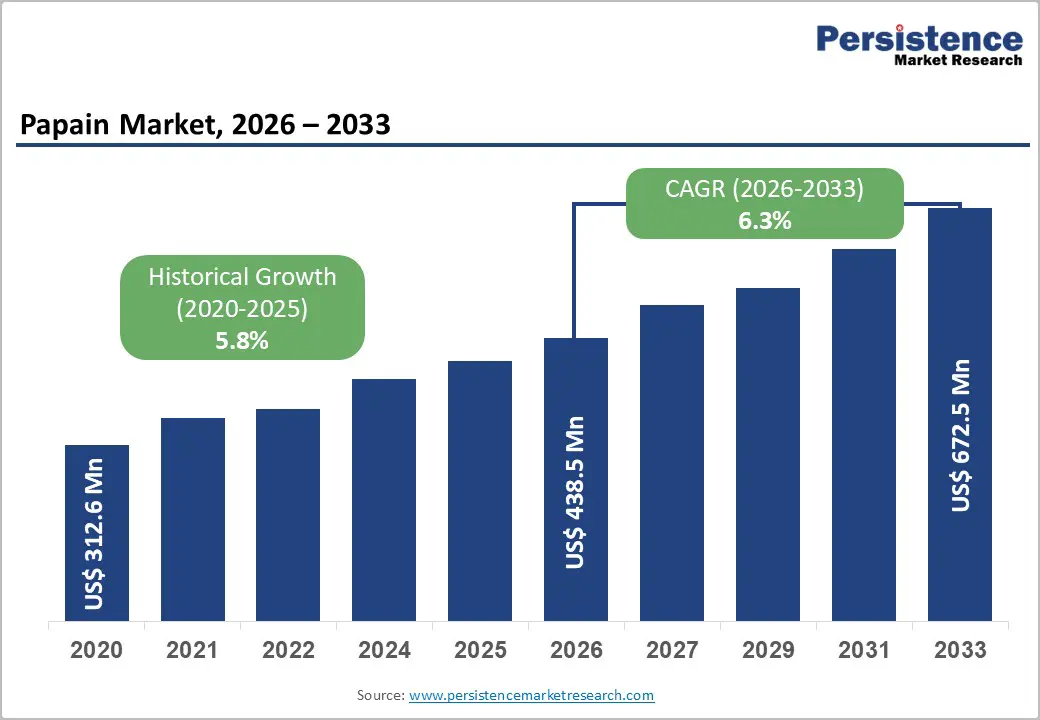
The global papain market size is likely to be valued at US$ 438.5 million in 2026 and is estimated to reach US$ 672.5 million by 2033, growing at a CAGR of 6.3% during the forecast period 2026 - 2033. Growth trajectory remains stable, supported by expanding application diversity and functional enzyme demand across industries.
Increasing utilization in food processing, pharmaceutical formulations, and personal care products reflects a shift toward bio-based solutions. Rise in global population and evolving dietary patterns drive demand for processed, protein-rich food, increasing reliance on enzymatic tenderizers and digestive aids. Clinical awareness of enzyme-based therapies supports adoption in healthcare and nutraceuticals. Papain enables digestive, wound care, and anti-inflammatory uses. Technological advancements improve efficiency and scalability. Industrial diversification and sustainability initiatives by Food and Agriculture Organization and the World Health Organization reinforce steady market demand.
Key Industry Highlights
- Leading Form: Powder form is set to command around 42% revenue share in 2026 due to stability, storage efficiency, and industrial compatibility.
- Fastest-Growing Form: Capsules are likely to grow the fastest through 2033 due to rising demand for nutraceutical and preventive healthcare solutions.
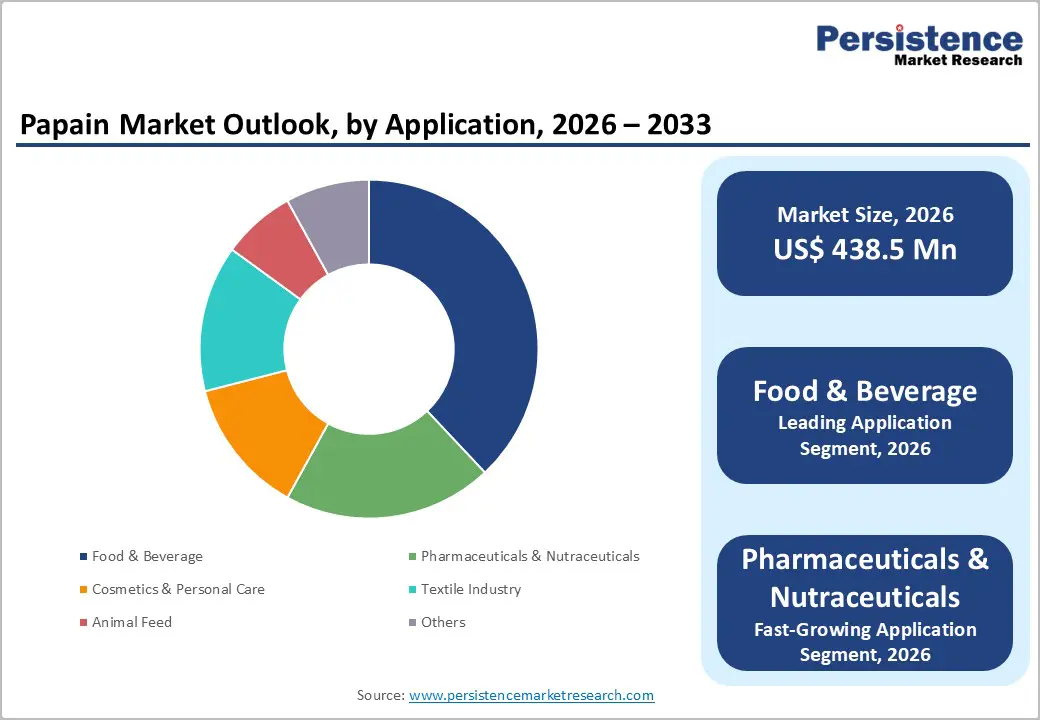
- Leading Application: Food & beverage is expected to dominate with approximately 38% market share in 2026, driven by extensive use in protein processing and enzymatic food manufacturing.
- Fastest-Growing Application: Pharmaceuticals and nutraceuticals are projected to be the fastest-growing market between 2026 and 2033 due to demand for clinical acceptance.
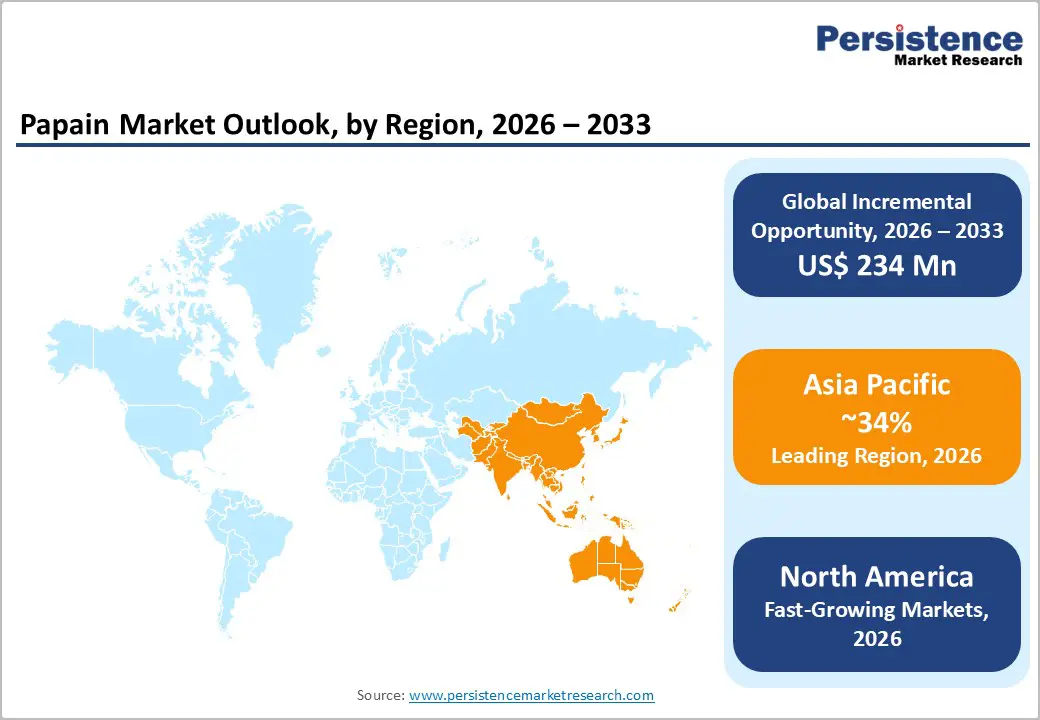
- Regional Leadership: Asia Pacific is poised to dominate with an estimated 34% share in 2026, while North America is forecasted to be the fastest-growing market between 2026 and 2033 due to nutraceutical demand and strong supplement distribution networks.
- Competitive Environment: Moderately fragmented structure with global leaders and regional manufacturers competing on innovation and cost efficiency.
- Innovation Trends: Advancements in enzyme engineering, encapsulation technologies, and sustainable production processes drive product development.
| Key Insights | Details |
|---|---|
| Papain Market Size (2026E) | US$ 438.5 Mn |
| Market Value Forecast (2033F) | US$ 672.5 Mn |
| Projected Growth (CAGR 2026 to 2033) | 6.3% |
| Historical Market Growth (CAGR 2020 to 2025) | 5.8% |
DRO Analysis
Driver - Rising Demand for Natural Enzymes in Food and Healthcare Applications
Expanding preference for natural enzymes in food processing and healthcare strengthens demand fundamentals for the Papain market. Food manufacturers prioritize clean-label formulations, driving the substitution of synthetic additives with plant-derived enzymes that improve texture, digestibility, and shelf stability. Enzymatic tenderization supports efficient protein processing, aligning with the rising consumption of meat and alternative proteins. Data from the Food and Agriculture Organization indicates global meat production reached approximately 374 million tonnes in 2025, reinforcing scale requirements for processing aids. This volume expansion elevates dependence on proteolytic enzymes that enhance yield efficiency, reduce processing time, and support standardized product quality across industrial operations.
Healthcare and nutraceutical sectors demonstrate parallel demand expansion driven by preventive care trends and clinical acceptance of enzyme-based formulations. Papain supports digestive health, wound debridement, and anti-inflammatory applications, enabling cost-efficient therapeutic alternatives within resource-constrained systems. Growth in aging populations and chronic disease prevalence increases reliance on supportive treatments that improve nutrient absorption and recovery outcomes. Manufacturing efficiency improves through enzyme stability and scalable extraction processes, reducing variability and ensuring a consistent supply. Regulatory alignment with bio-based ingredients accelerates product approvals, while consumer trust in plant-derived solutions strengthens adoption across pharmaceuticals, supplements, and personal care formulations.
Expansion of Industrial Applications and Sustainable Processing Practices
Industrial sectors continue to integrate papain into processing systems due to cost efficiency and functional versatility. Food processors rely on proteolytic activity to improve meat tenderness, protein hydrolysis, and beverage clarification, supporting higher product consistency and reduced processing time. Textile manufacturers apply enzyme-based treatments to replace harsh chemicals, improving fabric quality while lowering water and energy consumption. This operational shift reduces input costs and enhances throughput across large-scale facilities. Consistent performance and adaptability across multiple substrates strengthen its role in high-volume processing environments, reinforcing steady industrial demand and long-term integration into manufacturing value chains.
Sustainability priorities across industries accelerate adoption of bio-based processing inputs aligned with environmental compliance frameworks. Enzyme-driven systems reduce chemical discharge, minimize waste generation, and support resource-efficient manufacturing cycles. Personal care and pharmaceutical manufacturers integrate plant-derived actives to meet clean-label expectations and evolving regulatory standards, strengthening product positioning. Guidance from the World Health Organization and Food and Agriculture Organization promotes environmentally responsible production practices, influencing procurement strategies. This transition drives steady uptake of enzymatic solutions, reinforcing demand through efficiency gains, lower environmental impact, and alignment with sustainability-driven industrial transformation.
Restraint - Dependence on Natural Raw Material Supply and Agricultural Variability
Papain market faces structural constraints from reliance on papaya cultivation, which introduces supply volatility tied to climatic conditions and agricultural cycles. Crop yield fluctuations arise from irregular rainfall, temperature shifts, and pest outbreaks, creating inconsistent raw material availability. Seasonal harvesting patterns limit continuous enzyme extraction, affecting production scheduling and inventory planning. Price instability in agricultural inputs increases procurement costs and compresses margins for manufacturers. Limited geographic concentration of papaya farming restricts diversification options, intensifying exposure to regional disruptions. Supply chain fragmentation across rural sourcing networks reduces efficiency, delays processing timelines, and weakens standardization in raw material quality.
Variability in fruit maturity and latex content impacts enzyme yield and functional consistency, creating operational inefficiencies during the extraction and purification stages. Quality deviations require additional processing adjustments, raising energy use and production costs. Industrial buyers demand uniform enzyme performance, yet agricultural inconsistency complicates compliance with strict formulation standards. Expansion into high-value applications such as pharmaceuticals and nutraceuticals requires stable input quality, which remains difficult under fluctuating farm outputs. Investment in controlled cultivation or contract farming increases capital burden and operational complexity. Limited scalability of natural sourcing constrains capacity expansion and slows response to rising global demand across multiple industries.
Regulatory and Quality Compliance Challenges Across End-Use Industries
Stringent regulatory frameworks across the food, pharmaceutical, and cosmetic sectors impose complex approval pathways and strict documentation requirements. Variability in enzyme purity, activity levels, and microbial limits creates compliance risks during production and distribution. Manufacturers face high validation costs, frequent audits, and batch testing obligations that extend timelines and increase operational expenditure. Differences in regional standards across the United States, European Union, and Asia Pacific markets complicate cross-border trade and limit scalability. Small and mid-sized producers encounter resource constraints in maintaining certifications, which restricts capacity expansion and slows product commercialization cycles and constrain innovation pipelines across application segments globally.
Quality consistency challenges arise from natural raw material dependence and seasonal supply variations, leading to fluctuations in enzyme performance and shelf stability. End use industries demand standardized formulations with predictable efficacy, which requires advanced purification systems and controlled processing environments. Compliance with Good Manufacturing Practice standards and traceability norms increases capital investment and skilled labor requirements. Delays in regulatory approvals disrupt supply contracts and reduce buyer confidence in long-term sourcing agreements. Pricing pressure intensifies as compliance costs rise, limiting competitive positioning against synthetic alternatives and reducing adoption in price-sensitive industrial applications. Market entry barriers expand across regulatory jurisdictions.
Opportunity - Technological Advancements in Enzyme Engineering and Formulation
Advances in enzyme engineering and formulation create a strong opportunity for the papain market by improving catalytic efficiency, stability, and application precision. Engineered variants deliver consistent proteolytic performance under diverse temperature and pH conditions, supporting broader industrial integration. Standardized formulations reduce batch variability and enable scalable production across food processing, pharmaceuticals, and cosmetics. Cost efficiency improves through optimized extraction and recombinant techniques, strengthening margin structures. Improved process control increases output predictability and reduces waste, which enhances operational efficiency and supports competitive pricing across global supply chains.
Formulation innovations expand demand through targeted delivery systems such as encapsulation and controlled-release matrices. These technologies improve enzyme stability and functional lifespan, supporting adoption in nutraceuticals and therapeutic applications. Enhanced storage tolerance reduces supply chain constraints and supports penetration in emerging economies. Biotechnology-driven customization enables multi-functional enzyme blends tailored for specific industrial processes, including textiles and animal nutrition. Growing industrial preference for low-energy and chemical-free processing strengthens enzyme substitution trends. Sustainability frameworks promoted by the Food and Agriculture Organization and World Health Organization reinforce the transition toward bio-based processing inputs.
Expansion into Emerging Markets with Growing Healthcare and Food Processing Sectors
Rising income levels across emerging economies accelerate spending on healthcare services and packaged food products, creating sustained demand for functional enzymes such as Papain. Urbanization drives dietary transition toward processed and protein-rich consumption, increasing reliance on enzymatic tenderizers and digestive formulations. Public health expansion programs strengthen clinical access, supporting enzyme-based therapeutics in wound management and gastrointestinal care. This expanding base improves distribution reach, enhances patient awareness, and supports integration of plant-derived enzymes within mainstream treatment protocols.
Food processing industries across Asia, Latin America, and Africa continue scaling operations to meet rising domestic and export demand, strengthening enzyme utilization intensity. Industrial processors adopt bio-based solutions to improve yield efficiency, reduce chemical usage, and comply with evolving safety standards. Government-backed agro-processing initiatives encourage value addition, which increases demand for proteolytic enzymes in meat tenderization and protein modification. Infrastructure investment in cold chains and processing units supports consistent supply and quality control. Local manufacturing expansion reduces import dependency, improves cost structures, and enables competitive pricing, strengthening penetration across diverse end-use sectors while reinforcing long-term demand stability for enzyme-driven applications.
Category-wise Analysis
Form Insights
Powder form is anticipated to secure around 42% share in 2026, reflecting strong industrial preference for stability, ease of storage, and extended shelf life. Powdered papain offers superior handling for large-scale food and pharmaceutical production, ensuring consistent enzymatic activity while reducing contamination risk. Food, nutraceutical, and pharmaceutical industries favor dry formulations for compatibility with blends, capsules, and tablets, supporting precise dosing and efficient processing. Distribution efficiency strengthens adoption, with no refrigeration needs enabling cost-effective transport and storage. Advancements in spray drying and stabilization technologies improve quality, consistency, and scalability across industrial applications.
Capsules are expected to be the fastest-growing segment during the 2026-2033 forecast period, propelled by increasing demand for enzyme-based dietary supplements and preventive healthcare solutions. Capsule formulations support convenient intake, precise dosing, and improved bioavailability for digestive and therapeutic use. Consumer shift toward ready-to-consume nutraceuticals accelerates demand, supported by medical recommendations for digestive support and inflammation management. Expansion of e-commerce platforms improves product accessibility and market reach. Encapsulation innovations such as delayed-release and enteric coating enhance stability and targeted delivery, increasing efficacy. Rising health awareness and preventive care trends across urban populations create strong demand momentum across developed and emerging markets.
Application Insights
Food & beverage is likely to be the leading segment with a projected 38% of the papain market share in 2026 due to extensive use in protein processing, meat tenderization, and beverage clarification. Enzymatic processing improves texture, quality, and digestibility, supporting large-scale production efficiency. Food manufacturers utilize papain to reduce processing time and optimize costs, enabling streamlined operations. Regulatory approvals for enzyme use in food ensure safety standards and support adoption across global markets. Rising demand for processed and convenience food increases reliance on enzymatic solutions. Digitalized supply chains enhance integration and accessibility, while the expansion of food industries in emerging economies, supported by urbanization and evolving dietary patterns, strengthens demand growth.
Pharmaceuticals & nutraceuticals are anticipated to be the fastest-growing segment from 2026 to 2033, fueled by increasing clinical acceptance of enzyme-based therapies and rising demand for preventive healthcare solutions. Papain supports digestive supplements, wound care, and anti-inflammatory applications, enabling broad therapeutic use. Healthcare professionals promote enzyme-based products within integrated treatment approaches, strengthening adoption and trust. Expansion of digital health platforms and telemedicine improves accessibility and product reach. Advancements in formulation and delivery systems enhance stability and efficacy, enabling better therapeutic outcomes. Cost efficiency compared to complex drug compounds supports wider usage, especially across emerging markets with expanding healthcare access and growing preventive care awareness.
Regional Insights
North America Papain Market Trends
North America is forecasted to be the fastest-growing market for papain between 2026 and 2033, stimulated by strong demand for enzyme-based nutraceuticals and clinically supported digestive health products. United States drives expansion through high supplement consumption and advanced product innovation pipelines. Canada supports growth through increasing adoption of preventive healthcare and wellness-focused consumption patterns. Established regulatory frameworks enable faster commercialization of enzyme formulations with defined safety standards. High penetration of branded dietary supplements strengthens premium pricing structures and supports revenue expansion across retail and online distribution channels.
Robust integration of biotechnology and formulation science accelerates development of high-purity and targeted enzyme applications. Pharmaceutical and nutraceutical companies focus on precision dosing formats such as capsules and controlled-release systems to improve therapeutic efficiency. Strong e-commerce infrastructure and direct-to-consumer models expand product accessibility and market reach. Investment in clinical validation and product differentiation strengthens consumer trust and physician recommendation rates. Contract manufacturing organizations scale production capacity with standardized processes, improving consistency and reducing lead times across supply chains and distribution networks.Top of FormBottom of Form
Europe Papain Market Trends
Europe maintains a strong position in the papain market through advanced regulatory frameworks and high compliance standards across food, pharmaceutical, and cosmetic industries. Countries such as Germany and France drive demand through well-established food processing and specialty ingredient manufacturing sectors. Structured approval systems for enzyme applications ensure consistent product quality and safety, which strengthens industrial adoption. Research-driven industries promote development of high-purity enzyme formulations for specialized applications. Strong presence of multinational ingredient suppliers supports stable supply chains and technological integration across production facilities and end-use industries.
Sustainability policies and environmental regulations influence enzyme adoption as industries shift toward bio-based processing solutions. Countries including Italy and Netherlands emphasize eco-efficient manufacturing and reduced chemical usage in food and textile processing. Demand for clean-label and natural ingredients supports utilization of plant-derived enzymes in food and personal care products. Advanced logistics infrastructure and cross-border trade agreements improve distribution efficiency and product availability. Innovation in enzyme stabilization and formulation enhances performance consistency, supporting integration into high-value applications across pharmaceuticals, nutraceuticals, and specialty industrial segments.
Asia Pacific Papain Market Trends
Asia pacific is expected to lead with an estimated 34% of the papain market share, supported by abundant papaya cultivation, cost-efficient enzyme extraction, and integrated agro-processing networks. China and India provide large-scale raw material supply supported by favorable climatic conditions and expanding agricultural output. Japan and South Korea contribute through advanced processing technologies and high-value application development. Local manufacturing clusters enable streamlined sourcing and lower production costs. Strong presence of small and mid-scale processors increases supply flexibility and supports continuous availability for industrial buyers.
Industrial demand remains strong due to extensive application across food processing, pharmaceuticals, and personal care manufacturing. Food processing industries utilize enzyme-based solutions to improve texture, yield, and processing efficiency in meat and beverage production. Pharmaceutical manufacturers integrate proteolytic enzymes into digestive formulations and therapeutic products. Export-oriented production systems strengthen global supply positioning, supported by competitive pricing and large production volumes. Infrastructure development in logistics and cold storage improves distribution efficiency. Government-backed agricultural initiatives and processing incentives encourage capacity expansion and technology adoption across enzyme production facilities.
Competitive Landscape
The global papain market demonstrates a moderately fragmented structure, with participation from multinational enzyme manufacturers and regional suppliers competing across diverse application segments. Advanced Enzyme Technologies Ltd., Amano Enzyme Inc., and Enzybel Group strengthen competitive intensity through specialized product offerings and targeted industrial applications. These companies leverage technical expertise, standardized processing systems, and established distribution networks to maintain consistent supply and product quality across global markets and customer segments.
Global leaders such as Koninklijke DSM N.V. and Novozymes A/S focus on high-purity enzyme development, innovation-driven differentiation, and advanced biotechnology integration. Regional producers emphasize cost-efficient manufacturing and localized raw material sourcing to remain competitive. Market dynamics reflect a balance between pricing strategies and compliance with regulatory standards, while increasing focus on sustainable production processes and application-specific enzyme formulations drives continuous product development and operational efficiency improvements.
Key Developments:
- In February 2026, Zion Health introduced an Age Reversal Resurfacing Enzyme Mask formulated with papain-rich papaya extracts, targeting gentle exfoliation, skin renewal, and anti-aging applications in enzyme-based personal care solutions.
- In July 2025, Griffith Foods launched OptiTender Marinade, a clean-label meat tenderization solution positioned as a natural alternative to traditional papain-based enzymes, improving texture and reducing cooking time by up to 25% in protein processing applications.
- In July 2025, Pop on Smiles introduced probiotic whitening strips incorporating papain-based enzymes as a peroxide-free solution for gentle stain removal, supporting enamel safety and expanding enzyme applications in oral care products.
- In February 2025, Oral Science launched Papacárie Duo, a papain-based gel for minimally invasive, anesthesia-free dental caries removal, enhancing clinical efficiency and patient comfort in enzyme-driven therapeutic applications.
Companies Covered in Papain Market
- Advanced Enzyme Technologies Ltd.
- Amano Enzyme Inc.
- Enzybel Group
- Koninklijke DSM N.V.
- Novozymes A/S
- Chr. Hansen Holding A/S
- Biolaxi Corporation
- Enzyme Development Corporation
- Creative Enzymes
- Antozyme Biotech Pvt. Ltd.
- Aumgene Biosciences
- Sunson Industry Group Co., Ltd.
- Enzyme Bioscience Pvt. Ltd.
Frequently Asked Questions
The papain market is projected to reach US$ 438.5 million in 2026.
Rising demand for enzyme-based solutions in food processing, pharmaceuticals, and nutraceuticals, supported by increasing preference for bio-based and digestive health products, drives the papain market.
The papain market is poised to witness a CAGR of 6.3% from 2026 to 2033.
Expansion of enzyme-based applications in nutraceuticals, clean-label food processing, and sustainable industrial solutions creates key growth opportunities in the papain market.
Some key market players include Advanced Enzyme Technologies, Amano Enzyme, Enzybel Group, Koninklijke, and Novozymes.


